GS-1 Modern Indian history from about the middle of the eighteenth century until the present – significant events, personalities, issues.
GS-2 Bilateral, regional and global groupings and agreements involving India and/or affecting India’s interests.
GS-3 Major crops-cropping patterns in various parts of the country, – different types of irrigation and irrigation systems storage, transport and marketing of agricultural produce and issues and related constraints; e-technology in the aid of farmers
HOW TO ATTEMPT ANSWERS IN DAILY ANSWER WRITING ENHANCEMENT(AWE)?
Daily 4 questions from General studies 1, 2, 3, and 4 will be provided to you.
A Mentor’s Comment will be available for all answers. This can be used as a guidance tool but we encourage you to write original answers.
You can write your answer on an A4 sheet and scan/click pictures of the same.
Upload the scanned answer in the comment section of the same question.
Along with the scanned answer, please share your Razor payment ID, so that paid members are given priority.
If you upload the answer on the same day like the answer of 11th February is uploaded on 11th February then your answer will be checked within 72 hours. Also, reviews will be in the order of submission- First come first serve basis
If you are writing answers late, for example, 11th February is uploaded on 13th February , then these answers will be evaluated as per the mentor’s schedule.
We encourage you to write answers on the same day. However, if you are uploading an answer late then tag the mentor like @Staff so that the mentor is notified about your answer.
*In case your answer is not reviewed, reply to your answer saying *NOT CHECKED*.
The country faces the dual challenge of achieving nutrition security, as well as addressing declining land productivity, land degradation and loss of ecological services with change in land use. Not surprisingly, widespread concerns about poverty, malnutrition and the need for a second Green Revolution are being made in tandem.
Challenges for India
Macro- and micronutrient malnutrition is widespread in India.
18.7% of women and 16.2% of men are unable to access enough food to meet basic nutritional needs.
Over 32% of children below five years are still underweight as per the recently released fifth National Family Health Survey (2019-2021) phase 2 compendium.
India is ranked 101 out of 116 countries in the Global Hunger Index, 2021.
Although India is now self-sufficient in food grains production in the macro sense, it has about a quarter of the world’s food insecure people, a pointer to the amount of food necessary to allow all income groups to reach the caloric target (2,400 kcal in rural and 2,100 kcal in the urban set-up).
India needs to adopt ‘food systems’ for ‘sustainability’ and ‘better nutrition’
The UN Food Systems Summit called for action by governments in five areas: nourish all people; boost nature-based solutions; advance equitable livelihoods, decent work and empowered communities; build resilience to vulnerabilities, shocks and stresses; and accelerate the means of implementation.
Wholistic policy approach: In the context of the intensifying economic, environmental and climate challenges and crisis, the need of the hour is a good theory of transition encompassing the spatial, social and scientific dimensions, supported by policy incentives and mechanisms for achieving a sustainable, resilient and food secure agriculture.
Agro-climatic approach: An agro-climatic approach to agricultural development is important for sustainability and better nutrition.
Potential for crop diversification: Data compiled in the agro-climatic zones reports of the Indian Council of Agricultural Research and the erstwhile Planning Commission of India reveal enormous potential for crop diversification and precision for enhanced crop productivity based on soil type, climate (temperature and rainfall), and captive water resources.
The focus should be on improving farmers’ competitiveness, supporting business growth in the rural economy, and incentivising farmers to improve the environment.
Review of agro-climatic zones: It is assumed that a meticulous review of agro-climatic zones could make smallholders farming a profitable business, enhancing agricultural efficiency and socio-economic development, as well as sustainability.
Strengthening and shortening food supply chains, reinforcing regional food systems, food processing, agricultural resilience and sustainability in a climate-changing world will require prioritising research and investments along these lines.
A stress status of the natural resource base — soil and water in different agro-climatic zones — will help understand the micro as well as meso-level interventions needed with regard to technologies, extension activities and policies.
Infrastructure: Lastly, infrastructure and institutions supporting producers, agri-preneurs and agri micro, small and medium enterprises (MSMEs) in their production value chain are central to the transition.
Alignment with national and State policies: This should be aligned to the national and State policy priorities such as the National Policy guidelines 2012 of the Ministry of Agriculture for the promotion of farmer producer organisations, and the National Resource Efficiency Policy of 2019 of the Ministry of Environment, Forest and Climate Change.
Conclusion
Clearly, science, society and policy have a lot to gain from an effective interface encompassing the range of actors and institutions in the food value-chain and a multidisciplinary and holistic approach, along with a greater emphasis on policy design, management and behavioural change.
Did you know that the success rate for UPSC Exams is just 0.1%? Out of 10 lakh students who appear for the exam annually, only 700 make it to the final list. Hence, don’t make the mistake of delaying your UPSC 2023 preparation any further!
Write down the syllabus, open your books, stay updated to current affairs and create a timetable that can help you sail through Prelims & Mains! Sajal sir will lay out the whole process for you based on his experience of 6 UPSC interviews and successful mentorship of 400 UPSC Toppers!
Also, even after watching the entire video you are unsure of how to streamline your preparation, you can book your slot for Samanvaya free 1-on-1 mentorship program over here. Anyone who registers in 24 hours will get Free Tikdam (Art of Elimination Technique) Handbook from AIR 20, 2015 Topper Vipin Garg.
One can analyse the budget from three standpoints: Direct allocations for the environment sector, allocations for environment in non-environment sectors, and allocations for other sectors with environmental impacts.
Analysing the Budget from an environmental standpoint
1] Allocation for MoEFCC
There is a slight increase in the budget of the Ministry for Environment, Forests and Climate Change (MoEFCC) from 2021-22’s revised estimate of Rs 2,870 crore to Rs 3,030 crore.
This is a meagre 0.08 per cent of the total budgetary outlay.
While some sectors like forestry and wildlife have seen a healthy rise in allocation, the outlay for others like the National River Conservation Plan has declined.
2] Focus on natural and organic farming
There is a welcome stated focus on natural and organic farming, and on promoting millets.
No details on allocation: There are no details on the allocations, including for linkages necessary to make such farming viable, such as manure and markets.
Also, given the major push for food processing in the budget, without making reservations for community-run businesses, there is a danger of big corporations capturing the organic space.
Missing focus on rainfed farming: Completely missing is a focus on rainfed farming that involves 60 per cent of the farming population and is ecologically more sustainable than artificially irrigated agriculture.
The FM announced the government’s support to “chemical-free farming throughout the country,” but she has also allocated a massive chemical fertiliser subsidy of Rs 1,05,222 crore.
A recent announcement that palm plantations are proposed in Northeast India and the Andaman Islands, both ecologically fragile, makes this a worrying prospect.
3] Positive provisions on the climate front
On the climate front, there are several positive provisions — use of biomass for power stations, boost to batteries, energy-efficiency measures in large commercial buildings, and sovereign green bonds.
Renewable and “clean” energy has received substantially higher allocations.
But the focus remains on mega-parks in solar/wind energy, nuclear power, and large hydro that have serious ecological impacts.
The additional budget for farm-level solar pumps and rooftop solar generation is welcome, but it’s minuscule compared to mega-projects.
Missed opportunity for decentralised renewable energy: Another chance to shift towards decentralised renewable energy with less ecological impacts and greater community access has been missed.
The budget does promise greater support for public transport, something demanded by citizens’ groups for decades.
Unfortunately, most of the allocation in this will go to metros that are extremely carbon-intensive in terms of construction.
The National Climate Action Plan gets an abysmally inadequate Rs 30 crore — the same as in 2021-22.
And there is no focus on a “just transition” that could help workers in fossil fuel sectors, like coal, to transition to jobs in cleaner, greener sectors.
4] Concerns with focus on infrastructure in Budget
As highlighted by the FM, this is predominantly an “infrastructure budget”.
While investments in infrastructure for small towns and villages are urgently needed, much of what is proposed are mega-projects.
The proposed 25,000 km increase in highways will further fragment forests, wetlands, mountains, grasslands, agricultural lands and bypass most villages.
A shift in paradigm to decentralised, sustainable, and community-oriented infrastructure is missing.
Several specific allocations are of further concern. For instance, the Ken-Betwa river-linking project, given over Rs 40,000 crore, will submerge valuable tiger habitat.
The Deep Ocean Mission and the Blue Revolution allocations are oriented towards commercial exploitation rather than conservation and sustainable use.
5] Missed opportunity on green jobs
The budget misses out on a major shift to “green jobs”.
This includes support to decentralised (including handmade) production of textiles, footwear, and other products.
Even the MGNREGS, which could have been used for regenerating two-thirds of India’s landmass that is ecologically degraded, has got reduced allocation.
Conclusion
Another chance to turn the economy towards real sustainability and equity — a real “Amrit Kaal” as India heads to a centenary of Independence — has been missed.
The Russian annexation of Russia has been condemned widely and raised several questions concerning violation of international law.
How is Russia violating the UN Charter?
(1) Principle of Non-Intervention
The Russian attack on Ukraine is violative of the non-intervention principle, and amounts to aggression under international law.
The principle of non-intervention in domestic affairs is the foundational principle on which existing international order is based.
The principle is enshrined in article 2(4) of the UN Charter requiring states to refrain from using force or threat of using force against the territorial integrity or political independence of any state.
It prohibits any kind of forcible trespassing in the territory of another state, even if it is for temporary or limited operations such as an ‘in and out’ operation.
(2) Principle of Non-Aggression
The UN General Assembly Resolution 3314 (1974) defines aggression as the use of armed force by a state against the sovereignty, territorial integrity or political independence of another state.
Additionally, allowing one’s territory to be used by another state for aggression against a third state, also qualifies as an act of aggression.
Accordingly, Belarus can also be held responsible for aggression as it has allowed its territory to be used by Russia for attacking Ukraine.
Aggression is also considered an international crime under customary international law and the Rome statute establishing the International Criminal Court.
(3) Principle of Political Independence
Russia’s desire to keep Ukraine out of NATO is a prime reason for its use of force against Ukraine.
This is violative of Ukraine’s political independence under article 2(4) as Ukraine being a sovereign state is free to decide which organizations it wants to join.
Also, by resorting to use of force, Russia has violated article 2(3) which requires the states to settle their dispute by peaceful means in order to preserve international peace and security.
(4) Principle of Self-Defence
In face of the use of force by Russia, Ukraine has the right to self-defence under international law.
The UN Charter under article 51 authorizes a state to resort to an individual or collective self-defense until the Security Council take steps to ensure international peace and security.
In this case, it seems implausible for the UNSC to arrive at a decision as Russia is a permanent member and has veto power.
Russia’s hype:
(1) Nuclear escalation
It has been claimed by Russia that Ukraine may acquire nuclear weapons with the help of western allies.
However, the International Court of Justice (ICJ) in the Legality of Threat of Nuclear Weapons case held that mere possession of nuclear weapons does not necessarily constitute a threat.
Thus, even if Ukraine has, or were to acquire nuclear weapons in the future, it does not become a ground for invoking self-defence by Russia.
(2) Aggression against Russia
Further, mere membership in a defence alliance such as NATO cannot necessarily be considered as a threat of aggression against Russia.
Thus, here too Russia cannot invoke self-defence.
(3) Act in self-defence
Russia can also not invoke anticipatory self-defence.
Such invocation according to the Caroline test would require that the necessity of self-defence was instant, overwhelming, leaving no choice of means, and no moment for deliberation.
However, this is not the case with Russia.
What options is Ukraine left with?
Ukraine has a right under international law to request assistance from other states in form of military assistance, supply of weapons etc.
On the other hand, Russia has also claimed that it is acting in self-defence.
This claim is questionable, as there has been no use of force, or such threats against Russia by Ukraine.
Alongside the missiles and bombs slamming down in Ukraine, the country has also been hit by a wave of cyber-attacks targeting critical infrastructure companies.
What is Cyberwarfare?
Cyberwarfare has emerged as a new form of retaliation or passive aggression deployed by nations that do not want to go to actual war but want to send a tough message to their opponents.
In June 2020, security experts from Cyfirma uncovered a conspiracy by Gothic Panda and Stone Panda, two China-based hacker groups, to target media and critical infra companies in India.
They led large-scale attacks amid the border stand-off between India and China in Ladakh.
For many countries, cyberwarfare is a never-ending battle as it allows them to constantly harass and weaken geopolitical rivals.
What has happened in Ukraine so far?
Ukraine has been one of the primary targets of Russia since 2020.
The recent spate of attacks started in mid-January and knocked out websites of the ministry of foreign affairs and the ministry of education.
Government websites and a number of banks have been hit by another mass distributed denial of service (DDoS) attacks.
DDoS attacks disrupt online services by overwhelming websites with more traffic than their server can handle.
Which countries are behind state-backed cyberattacks?
Russia is one of the top perpetrators of state-backed cyberattacks.
According to an October 2021 report by Microsoft Corp., Russia accounted for 58% of state-backed attacks worldwide, followed by North Korea (23%), Iran (11%), and China (8%).
North Korea is said to have built a cyber-army of 7,000 hackers.
Which companies are targeted and why?
State-backed cyberattacks are usually carried out to steal state secrets, trade deals and weapons blueprint, or target large multinationals to steal their intellectual property (IP) and use it to build local industry.
Cryptos are also on the radar now. North Korean hackers reportedly stole cryptos worth $400 million in 2021.
However, when states launch cyberattacks on other states as a result of worsening of geopolitical relations, the target is usually critical infrastructure firms to disrupt economic activity.
How often is India targeted?
Such cyberattacks rose 100% between 2017 and 2021, according to a global study by Hewlett-Packard and the University of Surrey.
In 2019, the administrative network of the Kudankulam Nuclear Power Plant was hit by a malware attack by North Korea-backed Lazarus Group.
China-backed hackers were believed to be behind a power outage in Mumbai in 2020.
According to Black Lotus Labs, Pakistan-based hackers targeted power firms and one government organization in India in early 2021 using Remote Access Trojans.
The United Nations Environment Programme (UNEP) has called on global governments to adopt a new ‘Fire Ready Formula,’ as it warned that incidences of wildfires would rise in the future.
What is the Fire Ready Formula?
The new formula envisages that 66 per cent of spending be devoted to planning, prevention, preparedness and recovery.
The remaining 34 per cent can be spent on response.
New “Fire Ready Formula” focuses on Planning and Prevention
Serial No
Budget item
Percentage share of the total on wildfire management recommended
1
Planning
1 %
2
Prevention
32 %
3
Preparedness
13 %
4
Response
34 %
5
Recovery
20 %
Why need such a formula?
The UNEP report projected that the number of wildfires is likely to increase by up to 14 per cent by 2030.
Integrated wildfire management was key to adapting to current and future changes in global wildfire risk, the UNEP.
There is a need to invest more in fire risk reduction, work with local communities and strengthen global commitment to fight climate change.
Achieving and sustaining adaptive land and fire management requires a combination of policies, a legal framework and incentives that encourage appropriate land and fire use.
Back2Basics: United Nations Environment Programme (UNEP)
UNEP is responsible for coordinating responses to environmental issues within the United Nations system.
It was established by Maurice Strong, its first director, after the United Nations Conference on the Human Environment in Stockholm in June 1972.
Its mandate is to provide leadership, deliver science and develop solutions on a wide range of issues, including climate change, the management of marine and terrestrial ecosystems, and green economic development.
UNEP hosts the secretariats of several multilateral environmental agreements and research bodies, including:
1. Convention on Biological Diversity (CBD),
2. Minamata Convention on Mercury,
3. Convention on Migratory Species and
4. Convention on International Trade in Endangered Species of Wild Fauna and Flora (CITES)
In 1988, the World Meteorological Organization and UNEP established the Intergovernmental Panel on Climate Change (IPCC).
UNEP is also one of several Implementing Agencies for the Global Environment Facility (GEF) and the Multilateral Fund for the Implementation of the Montreal Protocol.
Recently Junagadh University discovered a new species of spider and named it Narsinhmehtai in honour of Narsinh Mehta, the 15th-century poet who was a devotee of Lord Krishna.
Narsinh Mehta
Mehta is believed to have been born in Talaja in present-day Bhavnagar district in 1410 and died in Junagadh in 1480s.
The family had its origin in Vadnagar in north Gujarat, and the caste name is believed to be Pandya but as members of the family were officers in kingdoms of those days.
They were called Mehta (one who keeps books of accounts) which later on became the family name.
His father died when Mehta was just 5 and it is believed that Mehta learnt to speak only when he was eight years old, after a holy man asked him to utter the name of Lord Krishna.
His elder brother Bansidhar and Bansidhar’s wife raised Mehta and arranged his marriage.
Miracles in his life
Mehta used to spend time in Krishna-bhakti (devotion to Lord Krishna) even after his marriage to Manekba, paying little attention to family duties.
Mehta is believed to have run away from home and done tapashcharya at a Shiva temple in Talaja for seven days.
After that, Mehta relocated with his family to Junagadh.
Nonetheless, folklore has it that Lord Krishna, by impersonating as Mehta, helped the devout poet organise shraadhha (a ritual performed post death of a family member) of his father, marriage of his son Shamaldas etc.
One of his bhajans narrates how Ra Mandlik, the then ruler of Junagadh had imprisoned him, accusing the poet of not having seen Lord Krishna and yet claiming to have done so.
His poetry
Mehta penned more than 750 poems, called padd in Gujarat.
They mainly deal with devotion to Lord Krishna, gyan (wisdom) vairagya (detachment from worldly affairs).
Others like Shalmshano Vivah, Kunvarbainu Mameru, Hundi and Harmala are believed to be autobiographical accounts of different occasions in his life.
Vaishanavajn to tene kahiye, Mahatma Gandhi’s favourite bhajan is Mehta’s creation.
UPSC Civil Services Exam is conducted every year to induct officers into All India Services like IAS, IPS, IFS and IRS. Known for being one of the most rigorous exams in India, over ten lakh candidates vie for 700-900 vacancies every year. These challenges, however, shouldn’t deter you from cracking UPSC-CSE in 2023.
The Holy Trinity of UPSC-CSE Preparation
Before you begin your preparation for the UPSC Exam, you need to ace the Holy Trinity of clearing UPSC-CSE – hard work, strategy and guidance. Most toppers believe in putting 70% of their efforts into self-studies. They then invest 20% of their time in honing their strategy. Finally, about 10% of their preparation goes into seeking guidance from experienced UPSC mentors.
There are three qualifying stages in UPSC-CSE – Prelims, Mains and Interview. The preliminary examination is based on objective questions, the mains examination requires one to write explanatory answers, and the interview is a personality test. With the advent of digital media, you can prepare for all three stages online in an integrated manner.
Develop a deep Knowledge of the syllabus
Realize the extent of your preparation even before you start. It would help if you memorized the entire UPSC syllabus and understood the nature and scope of every sub-topic. You must also know the right books in the market for every subject and the unnecessary ones. Going through the previous year papers will give you a glimpse of the pattern of questions asked under each topic. Sometimes, aspirants are unaware of their strong and weak points. Getting timely assistance from a UPSC mentor is crucial at this point.
Creating a plan with measurable outcomes is critical for this exam. An ideal schedule will have syllabus coverage, revision, and tests for both prelims and mains on a daily basis. It’s important to set weekly and monthly targets to stay on track for an entire year. However, following a topper’s strategy blindly without understanding your pace of learning makes you disoriented in the long run. Every aspirant should have a personalized study plan by a mentor that is tailored to their learning curve. A smart strategy is experimental only at the initial stages while you try to understand your comfort zones. However, after three months or so, it needs to provide stability to your preparation.
Current Affairs is the lifeblood of UPSC preparation. However, there is so much news every day that an average aspirant struggles to keep up. To streamline current affairs preparation, you must connect news events to the topics in your books. Doing so can make it easier for aspirants to recall essential facts and score better in the exam. A mentor can give you an idea and work along with you to track the right news topics for UPSC in the initial peroiod.
Out of 9 papers in GS Mains, two of them will be based on a subject of your choice from the 48 options provided by UPSC-CSE. Before selecting an optional, narrow down the 3-4 based on your educational background. After going through the previous year question papers and the study material, consult with a mentor which could be the most scoring subject amongst the three subjects. The objective is to score above 100 marks out of 250 in your optional papers.
While studying a topic, it’s essential to know what kind of questions would appear in this section from Mains point of view. Any aspirant must practice answering questions on Mains G subjects and Essays. Not just answer-writing, but evaluation and feedback of those answers by a trusted mentor will considerably improve your marks. Getting constructive criticism at the outset will help you implement the best technique to write answers. Having your essays examined will ensure you make a habit of avoiding blunders in the exam hall.
Getting the appropriate advice may save you a lot of time and effort. Why waste time learning by trial-and-error when you can simplify the process with proper guidance through one-on-one UPSC mentorship?
Why Should You Opt for a Free 1-on-1 Mentorship from Civilsdaily Mentor to Understand UPSC than Follow Generic Advice on Youtube?
You have heard the same advice over and over again in many youtube videos by toppers and UPSC coaches — Revise every topic three times, study so-and so books for the exam and practice test series. However is it helping you much?
Jasmine Kaur also felt the same way, before she got in touch with Santosh sir. Despite revising three times and reading the same books like other toppers, she was not able to clear prelims. After Santosh sir’s mentorship, she easily cleared the exam in 2021.
It’s always better to opt for personalised mentorship than generic advice on youtube which can clash with your capacity. And here at Civilsdaily, we provide it absolutely for free!
How does Samanvaya, Free 1-on-1 Mentorship help you clear UPSC 2023 in one shot?
Our philosophy behind MENTORSHIP is to get you out of this Snooze cycle. This ensures that you are the BEST VERSION of yourself in this journey. If you are under the impression that mentorship is weekly calls you attend, then you are mistaken, my friend. Trust us, your mentor will be your ‘FRIEND, PHILOSOPHER AND GUIDE’.
TO EACH THEIR OWN – Every aspirant is different. Their strengths and weaknesses are different. Their time availability is also different. Identifying this is important so you don’t end up making unrealistic targets and lose momentum. Your mentor will make sure you start slow but remain consistent to build your confidence. Making your schedule structured based on our experience of working with 2500+ students is our first priority.
TRACK YOUR PROGRESS – When you see yourself grow, it becomes easier to motivate yourself to push boundaries. Tracking your progress can happen in many ways like mentorship calls or chat sessions or by regular tests. The idea is to ensure that you don’t go off track in your preparation, and even if you do, we have your back.
EVOLUTION – A constant guidance is important to bring consistency to your UPSC preparation. Guidance is not about clearing your doubts or asking you to study when you don’t. It is also about the evolution of your preparation. This is where you and your mentor work as a team. A constant effort to PLAN AND BUILD UP YOUR ABILITY to learn in a faster and more efficient way.RECEIVE PERSONAL GUIDANCE FOR UPSC (REGISTER HERE)
TALK IT OUT – The biggest hurdle in achieving your highest level of consistency is the emotional part. Every now and then, you. surround yourself with negative thoughts, you feel scared and depressed. Instead of resolving these emotional issues, you avoid them as it seems like a waste of your precious time. You have to understand that ignoring emotional troubles does not solve them. What your doing is building an emotional time bomb that may burst a week before your mains or prelims! This is where your MENTOR AS A FRIEND comes in. All our mentors have been through this journey. We understand your fears and anxieties. So, TALK IT OUT.
Don’t let inconsistency keep you away from your dreams.
How has Civilsdaily Mentorship, helped Aspirants become Toppers?
The most difficult challenge faced by EVERY candidate is inconsistency. Be it inconsistency in studies, answer-writing practice, covering the syllabus, or revision, every candidate finds it difficult to cope with. Buthow do successful candidates manage to FIGHT Inconsistency so consistently?
In UPSC 2020, Civilsdaily helped 80+ students secure ranks in their exams. In the top 100, every 3rd ranker was a Civilsdaily student.
A very recent success story would be Vishwa Shah, student of Civilsdaily Mentor, Sukanya Ma’am. Vishwa has cleared the GPSC exam to become the Deputy Superintendent of Police in Gujarat. He has penned a thank-you note yesterday. Heartiest Congratulations to Vishwa!
One of our other Civilsdaily Student, Shubham Nagargojecleared the exams in 2020 to become an IPS Officer. Shubham was gracious enough to let us know how he felt about Civilsdaily Samanvaya Guidance under Parth sir.
To know how all of them cleared the exam with our mentorship, visit the UnherdPodcast.https://www.youtube.com/embed/SJ88ihHyqRg?feature=oembed&enablejsapi=1&origin=https://www.civilsdaily.com
Now that results are announced for UPSC 2021 Prelims, out of 15 out of 25 students of Santhosh Gupta sir have been recommended to Mains. One such student, Rahul expresses his gratitude and extends his appreciation.https://www.youtube.com/embed/JisjYSfTzaM?feature=oembed&enablejsapi=1&origin=https://www.civilsdaily.com
Most of our Mentors like Sudhanshu sir, Sajal sir, Santhosh sir, Pravin sir, Parth Verma sir and Sukanya Ma’am were UPSC aspirants themselves and have attended UPSC Mains more than five times and UPSC Interview more than twice. Hence their mentorship is always a blend of the best test series, comprehensive notes and current affairs knowledge.
All of them dedicate their time weekly to give 1-on-1 mentorship to every student where they discuss last week’s performance and next week’s approach.
Be it Telegram, Whatsapp or Habitiat channels, they are always available and clear student’s doubts in a turnaround time of 24 Hours.
Why Civilsdaily Mentors are the GPS for Your UPSC-CSE Preparation
Remember there is always light at the end of the tunnel and if you want to get out of the tunnel you have to follow the direction of the light! Our mentors’ give you direction which is divided into daily modules. All you have to do is study and complete them on time.
How are Current Civilsdaily Students Gearing up for UPSC-CSE 2022?
Initially, our Civilsdaily student Smriti wasn’t confident about Prelims when she began her preparation. Though she had joined Civilsdaily in 2020, she started studying for UPSC-CSE back in 2019. At that time, Smriti had enrolled in multiple institutes. Though, most of these institutes had promised a personal mentor, she was unable to get in touch with them on a daily basis. Also those mentors never scheduled test-series on a weekly basis. Hence, despite preparing for a year, Smriti had scored only 35 marks out of 200 in her first test series by Civilsdaily.
She then started writing 20-25 test series over the course of UAP 2021 and in her last test, her scores have drastically improved. She now scores in the range of 130-135 marks in prelims’ and 110+ in mains’ papers.
In Smriti’s own words she describes her Samanvaya Mentorship Experience to be —
“Our parents provide us financial and emotional support, friends provide us moral support and the right mentor gives you logistic and logical support for UPSC. There are days when I felt I won’t be able to compete against lakhs of aspirants. That’s when my mentor, Ravi sir reminded me of my improvement and encouraged me that I can crack it with the same consistency. We need someone, who tells us we are performing well especially when we cannot see that ourselves. The mentorship at Civilsdaily helped me become mentally stronger as a person. In other institutes, mentors are allotted only for doubt resolution. But at Civilsdaily, I am getting end-to-end mentorship via value added notes, classes, test series and detailed evaluation.”
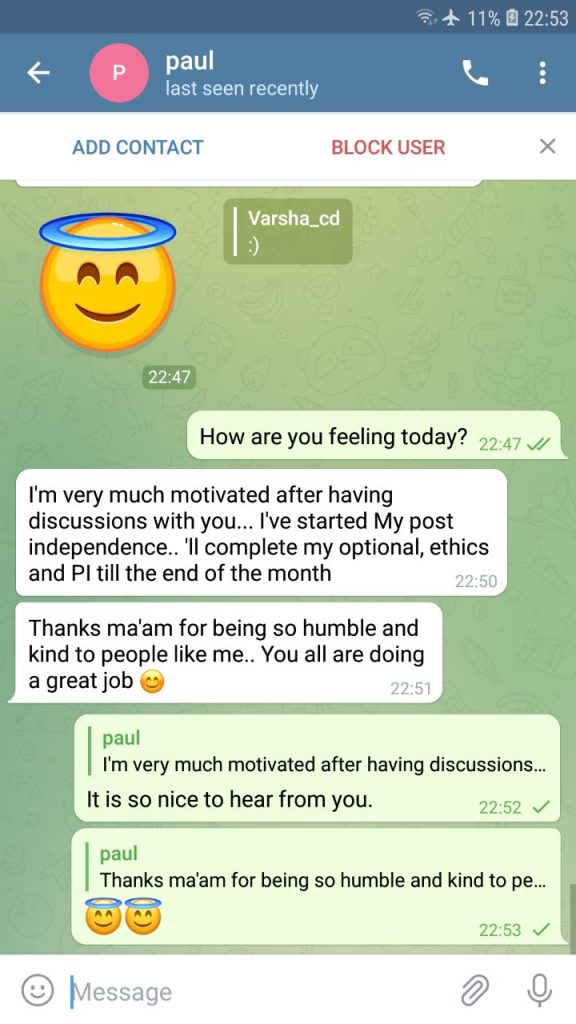
Similarly our another Civilsdaily student, Ashishsums up his Samanvaya experience with Civilsdaily mentor,Pravin Sir, “Because of Pravin sir’s support, I am able to understand a topic in lesser time.”
This is how Pravin sir evaluates Ashish’s Mains Test Series every week. After every test series evaluation, Pravin sir schedules a 1 hour call to discuss how Ashish can improve his marks and the sources he can refer for key topics.
It’s Your Turn Get the Free 40 Min Counselling Session By a CD Mentor
Civilsdaily mentors are so dedicated, consistent and focused for your UPSC goal, that you will eventually become focused into turning your dreams to reality.
At the core of Civilsdaily UPSC mentorship, lies the fact that each one of you will have a unique journey while preparing for the exam. Some will get through on the first attempt without much effort while others will take both more time and more effort.
We want to understand you better to help you optimize your journey so you can focus on the right things and not waste time on the wrong ones. We are asking you to tap into the valuable experiences of mentors who underwent the same grind and realize the pitfalls and understand the shortcuts to make it.