The Supreme Court has asked the Union and the State governments to respond to a petition to enforce the fundamental duties of citizens, including patriotism and unity of the nation, through comprehensive, well-defined laws.
What did the plea say?
The plea emphasized- the need to enforce FD arises from a new illegal trend of protest by protesters in the garb of freedom of speech and expression.
This has been increasingly done by way of blocking of road and rail routes in order to compel the government to meet their demands.
What are Fundamental Duties?
The fundamental duties of citizens were added to the constitution by the 42nd Amendment in 1976, upon the recommendations of the Swaran Singh Committee.
It basically imply the moral obligations of all citizens of a country and today, there are 11 fundamental duties in India, which are written in Part IV-A of the Constitution, to promote patriotism and strengthen the unity of India.
The FDs obligate all citizens to respect the national symbols of India, including the constitution, to cherish its heritage, preserve its composite culture and assist in its defence.
They also obligate all Indians to promote the spirit of common brotherhood, protect the environment and public property, develop scientific temper, abjure violence, and strive towards excellence in all spheres of life.
Judicial interpretation of FDs
The Supreme Court has held that FDs are not enforceable in any Court of Law.
It ruled that these fundamental duties can also help the court to decide the constitutionality of a law passed by the legislature.
There is a reference to such duties in international instruments such as the Universal Declaration of Human Rights and International Covenant on Civil and Political Rights, and Article 51A brings the Indian constitution into conformity with these treaties.
Total FDs
Originally ten in number, the fundamental duties were increased to eleven by the 86th Amendment in 2002.
The 10 fundamental duties are as follows:
To oblige with the Indian Constitution and respect the National Anthem and Flag
To cherish and follow the noble ideas that inspired the national struggle for freedom
To protect the integrity, sovereignty, and unity of India
To defend the country and perform national services if and when the country requires
To promote the spirit of harmony and brotherhood amongst all the people of India and renounce any practices that are derogatory to women
To cherish and preserve the rich national heritage of our composite culture
To protect and improve the natural environment including lakes, wildlife, rivers, forests, etc.
To develop scientific temper, humanism, and spirit of inquiry
To safeguard all public property
To strive towards excellence in all genres of individual and collective activities
The 11th fundamental duty which was added to this list is:
To provide opportunities for education to children between 6-14 years of age, and duty as parents to ensure that such opportunities are being awarded to their child. (86th Amendment, 2002)
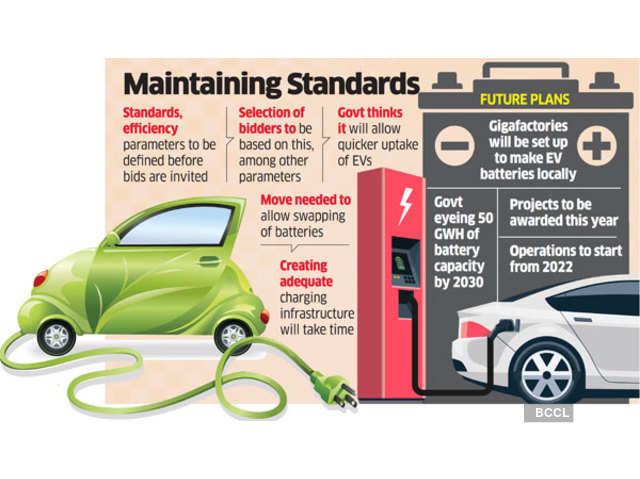
NITI Aayog is holding a consultation on the upcoming electric vehicle (EV) battery swapping policy.
What is BaaS?
Battery-as-a-service (BaaS) is seen as a viable charging alternative.
Manufacturers can sell EVs in two forms: Vehicles with fixed or removable batteries and vehicles with batteries on lease.
If you buy an electric scooter with battery leasing, you do not pay for the cost of the battery—that makes the initial acquisition almost 40% cheaper.
Users can swap drained batteries for a fully charged one at a swap station. The depleted batteries are then charged on or off-site.
The advantages of swapping include low downtimes for commercial fleets, reduced space requirements, and lower upfront costs.
It is also a viable solution for those who don’t have parking spots at home.
What is battery interoperability?
That’s when a battery is compatible across vehicles and chargers, so you can seamlessly swap a battery at any swap station. This can help achieve scale.
However, manufacturer and service providers say there are safety concerns around the ‘one-size-fits-all’ model and caution too much standardization can kill innovation.
Why hasn’t BaaS taken off yet?
There are economic and operational constraints.
Energy service providers offering swapping solutions have to charge 18% goods and services tax (GST) for swapping, compared to 5% GST on the purchase of an EV.
Additionally, the government’s FAME-II incentives are not offered to vehicles sold with BaaS or swap station operators.
While these are economic disadvantages compared to direct charging solutions, the lack of a dense and interoperable battery swap infrastructure has also hindered the roll-out.
Manufacturers, on the other hand, are keen to create proprietary battery and charging systems.
Issues with BaaS
There is a need for standardization of safety specifications as well as the battery.
Swapping in the various permutations and combinations of batteries at a station where they have not been tested for compatibility could lead to safety hazards.
Also, mandating only one type of battery to be eligible for concessions would be disadvantageous to many players.
Who offers BaaS in India?
Bengaluru-based startup Bounce is the first e-two-wheeler maker to sell its scooters with BaaS, and claims to have achieved a million battery swaps.
Others like Ola Electric and Ather have stuck to direct charging solutions, while Hero Electric offers both fixed and removable batteries.
Many makers are working with energy service providers to offer battery swapping.
The global precedent is a mixed bag: Ample, which offers swaps in the US, has found success with commercial fleets, while most personal users charge at home.
Why is Battery Swapping needed?
High Cost of EVs: An EV, by industry standards, is 1.5-2x costlier than IC Engine counterpart and at least half the cost is from the battery pack.
Cost reduction: Many manufacturers are offering batteries separately from a vehicle, reducing the cost. In that case, a fleet owner can buy vehicles without battery and utilize battery swapping.
Range Anxiety: Another major reason stopping people from buying EVs is range anxiety, or in simple terms, the fear of battery getting empty without finding a charging station.
Inadequate charging infrastructure: Unlike petrol pumps, EV charging stations are rare to spot and that further increases the range anxiety exponentially, especially while going on a road trip.
Hazard management: In case of a Swapping Station, one can simply locate a station, go and replace the empty battery with a new one.
The President of India recently took part in the Indian Navy’s 12th Presidential Fleet Review.
What is the President’s Fleet Review?
In simplest terms, it is the country’s President taking stock of the Navy’s capability.
It showcases all types of ships and capabilities the Navy has.
It takes place once under every President, who is the supreme commander of the armed forces.
The President is taken on one of the Naval ships, which is called the President’s Yacht, to look at all the ships docked on one of the Naval ports.
The yacht will be distinguished by the Ashoka Emblem on her side and will fly the President’s Standard on the Mast”.
Importance of Presidential Fleet Review
A fleet review is usually conducted once during the tenure of the President.
So far, 11 Presidential Fleet Reviews have been conducted since Independence, of which two have been International Fleet Reviews, in 2001 and 2016.
In terms of significance, the Navy’s Presidential review is second only to the Republic Day Parade.
The President will be given a 21-gun salute before embarking on the yacht.
Do all naval ships participate?
The idea is to showcase not all the Navy’s ships, but every type of ship — and the kind of capabilities it has at that time.
The review also includes merchant ships as well.
What else happens in the fleet review?
In this most formal of naval ceremonials, each ship dressed in full regalia will salute the President as he passes.
The President will also be reviewing the Indian Naval Air Arm in a display of spectacular fly-past by several helicopters and fixed-wing aircraft.
In the final stage of the review, a mobile column of warships and submarines will steam past the Presidential Yacht.
How many of these reviews have been held?
There have been 11 President’s Fleet Reviews since Independence.
The first was conducted in 1953, under Dr Rajendra Prasad.
The next one was done not by the President but by the then Defence Minister, Y B Chavan, in 1964.
Since then, it has been the President reviewing the fleet.
The longest gap between reviews was of 12 years — between 1989 (President R Venkatraman) and when 2001 (President K R Narayanan).
The last one was done in 2016, under President Pranab Mukherjee.
Significance of the event
It is one of the most important events for the Navy, which is essentially showing its allegiance and commitment to defending the country.
It is a long-standing tradition followed by navies across the world, and according to Navy officials it is a strong bond that links seafarers of the world.
Historically, a Fleet Review is an assembly of ships at a pre-designated place for the purpose of displaying loyalty and allegiance to the Sovereign and the state.
In turn, the Sovereign, by reviewing the ships, reaffirms his faith in the fleet and its ability to defend the nation’s maritime interest.
It is perhaps conceived as a show of naval might. Though it still has the same connotation, assembling of warships without any belligerent intentions is now the norm in modern times.
Given the fact that political input in economic policymaking is becoming dominant as regional and state-level issues assume overriding significance, it’s perhaps time to consider sheltering economics from politics and vice versa.
Continuity in policy
The sudden withdrawal of farm laws last year and the repeal of the land acquisition ordinance in 2015 are two examples of policy backsliding in an otherwise decent record of policy continuity since 1991.
The overall trajectory of tariffs has been downward and average tariffs are now below 10 percent compared to over 400 percent before 1991.
As a favored rule, domestic policy priorities should not be held hostage to external pressures, but they can and ought to be used to push through difficult and desirable domestic reform.
Challenges in achieving high growth
Challenges in reforms: Relying on chance events to drive reform might work in rare circumstances, but not when the aspiration is to become a $10 trillion economy by 2030.
Realizing this target or even coming close to it will require sustained growth of over 15 percent per annum in nominal GDP — that’s no mean task.
The golden period of India’s growth fetched an 8.1 percent increase in real GDP between 2004 and 2009.
Even during this period, the growth story was cut short by the global financial crisis and devilled intermittently by institutional weaknesses.
Failure of institutions: The coal scam and the 2G scam are examples of the inability of institutions to keep pace with rapid growth.
As growth occurs, institutions also require sophistication, knowledge, and some (not complete) protection from political interference.
Need for the fiscal council for budget-making process
The Monetary Policy Committee (MPC) in 2016, replaced RBI’s internal decision-making driven by the central bank governor to include three external experts to strengthen and bring transparency into monetary policy decisions.
This can be extended to other important government functions, such as the budgetary process
Successive finance commissions and the Fiscal Responsibility and Budget Management (FRBM) Review Committee have recommended the creation of a fiscal council that, like the MPC, will bring transparency in the budget-making process.
The idea is simple, moderate the influence of the political agenda and powerful interest groups that could, and often do, capture the process.
Suggestions on policymaking
It is art and science: Policymaking is nothing if not art that invokes science when expedient.
Domain experts should be an integral part of the formulation process.
Implementation, of course, can be left to the executive.
When the TRAI was first set up, it had a healthy combination of domain experts and public policy professionals, resembling a specialized regulatory agency that reflected a serious intent to strengthen capacity.
Importance of domain experts: Instead of going down the chosen path, TRAI has reversed gear and today resembles a government department.
In fact, this is the same affliction with almost all regulatory and policy institutions that are now a feature of India’s increasingly market-based economy.
As more sectors (for example, the Gati Shakti initiative) engage the private sector, lessons from the last quarter-century should not be wasted — domain expertise is conspicuous by its absence in regulatory and policy institutions.
Way forward
Create a cadre of professionals: Commissions tend to be made up of retired civil servants or retired judges.
This is worrying and, therefore, it is vital to create a cadre of professionals with technical expertise for the complex tasks of managing the policy processes.
Distancing politics from the policy: The net needs to be cast wider so that politics and policy are distanced, not completely but certainly more than it is today.
Consider the question “Politicians and economists have a love-hate relationship; they can’t do without each other. In context of this examine the issues with policymaking in India and why role of the domain expert is important in policymaking today?”
Conclusion
India should not be in a situation in which it is in perpetual hostage to vested interests of politics and business.
UPSC Civil Services Exam is conducted every year to induct officers into All India Services like IAS, IPS, IFS and IRS. Known for being one of the most rigorous exams in India, over ten lakh candidates vie for 700-900 vacancies every year. These challenges, however, shouldn’t deter you from cracking UPSC-CSE in 2023.
The Holy Trinity of UPSC-CSE Preparation
Before you begin your preparation for the UPSC Exam, you need to ace the Holy Trinity of clearing UPSC-CSE – hard work, strategy and guidance. Most toppers believe in putting 70% of their efforts into self-studies. They then invest 20% of their time in honing their strategy. Finally, about 10% of their preparation goes into seeking guidance from experienced UPSC mentors.
There are three qualifying stages in UPSC-CSE – Prelims, Mains and Interview. The preliminary examination is based on objective questions, the mains examination requires one to write explanatory answers, and the interview is a personality test. With the advent of digital media, you can prepare for all three stages online in an integrated manner.
Develop a deep Knowledge of the syllabus
Realize the extent of your preparation even before you start. It would help if you memorized the entire UPSC syllabus and understood the nature and scope of every sub-topic. You must also know the right books in the market for every subject and the unnecessary ones. Going through the previous year papers will give you a glimpse of the pattern of questions asked under each topic. Sometimes, aspirants are unaware of their strong and weak points. Getting timely assistance from a UPSC mentor is crucial at this point.
Creating a plan with measurable outcomes is critical for this exam. An ideal schedule will have syllabus coverage, revision, and tests for both prelims and mains on a daily basis. It’s important to set weekly and monthly targets to stay on track for an entire year. However, following a topper’s strategy blindly without understanding your pace of learning makes you disoriented in the long run. Every aspirant should have a personalized study plan by a mentor that is tailored to their learning curve. A smart strategy is experimental only at the initial stages while you try to understand your comfort zones. However, after three months or so, it needs to provide stability to your preparation.
Current Affairs is the lifeblood of UPSC preparation. However, there is so much news every day that an average aspirant struggles to keep up. To streamline current affairs preparation, you must connect news events to the topics in your books. Doing so can make it easier for aspirants to recall essential facts and score better in the exam. A mentor can give you an idea and work along with you to track the right news topics for UPSC in the initial peroiod.
Out of 9 papers in GS Mains, two of them will be based on a subject of your choice from the 48 options provided by UPSC-CSE. Before selecting an optional, narrow down the 3-4 based on your educational background. After going through the previous year question papers and the study material, consult with a mentor which could be the most scoring subject amongst the three subjects. The objective is to score above 100 marks out of 250 in your optional papers.
While studying a topic, it’s essential to know what kind of questions would appear in this section from Mains point of view. Any aspirant must practice answering questions on Mains G subjects and Essays. Not just answer-writing, but evaluation and feedback of those answers by a trusted mentor will considerably improve your marks. Getting constructive criticism at the outset will help you implement the best technique to write answers. Having your essays examined will ensure you make a habit of avoiding blunders in the exam hall.
Getting the appropriate advice may save you a lot of time and effort. Why waste time learning by trial-and-error when you can simplify the process with proper guidance through one-on-one UPSC mentorship?
Why Should You Opt for a Free 1-on-1 Mentorship from Civilsdaily Mentor to Understand UPSC than Follow Generic Advice on Youtube?
You have heard the same advice over and over again in many youtube videos by toppers and UPSC coaches — Revise every topic three times, study so-and so books for the exam and practice test series. However is it helping you much?
Jasmine Kaur also felt the same way, before she got in touch with Santosh sir. Despite revising three times and reading the same books like other toppers, she was not able to clear prelims. After Santosh sir’s mentorship, she easily cleared the exam in 2021.
It’s always better to opt for personalised mentorship than generic advice on youtube which can clash with your capacity. And here at Civilsdaily, we provide it absolutely for free!
How does Samanvaya, Free 1-on-1 Mentorship help you clear UPSC 2023 in one shot?
Our philosophy behind MENTORSHIP is to get you out of this Snooze cycle. This ensures that you are the BEST VERSION of yourself in this journey. If you are under the impression that mentorship is weekly calls you attend, then you are mistaken, my friend. Trust us, your mentor will be your ‘FRIEND, PHILOSOPHER AND GUIDE’.
TO EACH THEIR OWN – Every aspirant is different. Their strengths and weaknesses are different. Their time availability is also different. Identifying this is important so you don’t end up making unrealistic targets and lose momentum. Your mentor will make sure you start slow but remain consistent to build your confidence. Making your schedule structured based on our experience of working with 2500+ students is our first priority.
TRACK YOUR PROGRESS – When you see yourself grow, it becomes easier to motivate yourself to push boundaries. Tracking your progress can happen in many ways like mentorship calls or chat sessions or by regular tests. The idea is to ensure that you don’t go off track in your preparation, and even if you do, we have your back.
EVOLUTION – A constant guidance is important to bring consistency to your UPSC preparation. Guidance is not about clearing your doubts or asking you to study when you don’t. It is also about the evolution of your preparation. This is where you and your mentor work as a team. A constant effort to PLAN AND BUILD UP YOUR ABILITY to learn in a faster and more efficient way.RECEIVE PERSONAL GUIDANCE FOR UPSC (REGISTER HERE)
TALK IT OUT – The biggest hurdle in achieving your highest level of consistency is the emotional part. Every now and then, you. surround yourself with negative thoughts, you feel scared and depressed. Instead of resolving these emotional issues, you avoid them as it seems like a waste of your precious time. You have to understand that ignoring emotional troubles does not solve them. What your doing is building an emotional time bomb that may burst a week before your mains or prelims! This is where your MENTOR AS A FRIEND comes in. All our mentors have been through this journey. We understand your fears and anxieties. So, TALK IT OUT.
Don’t let inconsistency keep you away from your dreams.
How has Civilsdaily Mentorship, helped Aspirants become Toppers?
The most difficult challenge faced by EVERY candidate is inconsistency. Be it inconsistency in studies, answer-writing practice, covering the syllabus, or revision, every candidate finds it difficult to cope with. Buthow do successful candidates manage to FIGHT Inconsistency so consistently?
In UPSC 2020, Civilsdaily helped 80+ students secure ranks in their exams. In the top 100, every 3rd ranker was a Civilsdaily student.
A very recent success story would be Vishwa Shah, student of Civilsdaily Mentor, Sukanya Ma’am. Vishwa has cleared the GPSC exam to become the Deputy Superintendent of Police in Gujarat. He has penned a thank-you note yesterday. Heartiest Congratulations to Vishwa!
One of our other Civilsdaily Student, Shubham Nagargojecleared the exams in 2020 to become an IPS Officer. Shubham was gracious enough to let us know how he felt about Civilsdaily Samanvaya Guidance under Parth sir.
To know how all of them cleared the exam with our mentorship, visit the UnherdPodcast.https://www.youtube.com/embed/SJ88ihHyqRg?feature=oembed&enablejsapi=1&origin=https://www.civilsdaily.com
Now that results are announced for UPSC 2021 Prelims, out of 15 out of 25 students of Santhosh Gupta sir have been recommended to Mains. One such student, Rahul expresses his gratitude and extends his appreciation.https://www.youtube.com/embed/JisjYSfTzaM?feature=oembed&enablejsapi=1&origin=https://www.civilsdaily.com
Most of our Mentors like Sudhanshu sir, Sajal sir, Santhosh sir, Pravin sir, Parth Verma sir and Sukanya Ma’am were UPSC aspirants themselves and have attended UPSC Mains more than five times and UPSC Interview more than twice. Hence their mentorship is always a blend of the best test series, comprehensive notes and current affairs knowledge.
All of them dedicate their time weekly to give 1-on-1 mentorship to every student where they discuss last week’s performance and next week’s approach.
Be it Telegram, Whatsapp or Habitiat channels, they are always available and clear student’s doubts in a turnaround time of 24 Hours.
Why Civilsdaily Mentors are the GPS for Your UPSC-CSE Preparation
Remember there is always light at the end of the tunnel and if you want to get out of the tunnel you have to follow the direction of the light! Our mentors’ give you direction which is divided into daily modules. All you have to do is study and complete them on time.
How are Current Civilsdaily Students Gearing up for UPSC-CSE 2022?
Initially, our Civilsdaily student Smriti wasn’t confident about Prelims when she began her preparation. Though she had joined Civilsdaily in 2020, she started studying for UPSC-CSE back in 2019. At that time, Smriti had enrolled in multiple institutes. Though, most of these institutes had promised a personal mentor, she was unable to get in touch with them on a daily basis. Also those mentors never scheduled test-series on a weekly basis. Hence, despite preparing for a year, Smriti had scored only 35 marks out of 200 in her first test series by Civilsdaily.
She then started writing 20-25 test series over the course of UAP 2021 and in her last test, her scores have drastically improved. She now scores in the range of 130-135 marks in prelims’ and 110+ in mains’ papers.
In Smriti’s own words she describes her Samanvaya Mentorship Experience to be —
“Our parents provide us financial and emotional support, friends provide us moral support and the right mentor gives you logistic and logical support for UPSC. There are days when I felt I won’t be able to compete against lakhs of aspirants. That’s when my mentor, Ravi sir reminded me of my improvement and encouraged me that I can crack it with the same consistency. We need someone, who tells us we are performing well especially when we cannot see that ourselves. The mentorship at Civilsdaily helped me become mentally stronger as a person. In other institutes, mentors are allotted only for doubt resolution. But at Civilsdaily, I am getting end-to-end mentorship via value added notes, classes, test series and detailed evaluation.”
Similarly our another Civilsdaily student, Ashishsums up his Samanvaya experience with Civilsdaily mentor,Pravin Sir, “Because of Pravin sir’s support, I am able to understand a topic in lesser time.”
This is how Pravin sir evaluates Ashish’s Mains Test Series every week. After every test series evaluation, Pravin sir schedules a 1 hour call to discuss how Ashish can improve his marks and the sources he can refer for key topics.
It’s Your Turn Get the Free 40 Min Counselling Session By a CD Mentor
Civilsdaily mentors are so dedicated, consistent and focused for your UPSC goal, that you will eventually become focused into turning your dreams to reality.
At the core of Civilsdaily UPSC mentorship, lies the fact that each one of you will have a unique journey while preparing for the exam. Some will get through on the first attempt without much effort while others will take both more time and more effort.
We want to understand you better to help you optimize your journey so you can focus on the right things and not waste time on the wrong ones. We are asking you to tap into the valuable experiences of mentors who underwent the same grind and realize the pitfalls and understand the shortcuts to make it.
India’s approach towards FTAs is now focusing more on gaining meaningful market access and facilitating the Indian industry’s integration into global value chains. As Union Minister of Commerce and Industry Piyush Goyal has repeatedly emphasized, India would no longer be signing trade agreements just to join a group, but the new approach of FTA negotiations would respond to the need of new emerging dynamics in international trade and the Indian economy.
What is a Free Trade Agreement (FTA)?
It is an arrangement between two or more countries under which they agree to end tariffs and non-tariff barriers on a large value of imports from partner countries.
Coverage: The agreement may also cover, among others, services, investment, and economic cooperation.
FTA normally covers trade in goods (such as agricultural or industrial products) or trade in services (such as banking, construction, trading etc.).
FTA can also cover other areas such as intellectual property rights (IPRs), investment, government procurement and competition policy, etc.
Main focus: The focus of an FTA is primarily on economic benefits and encouraging trade between the countries by making it more efficient and profitable. But FTAs may also have political, or strategic benefits.
India’s revamped FTA strategy
Gaining meaningful market access: India’s approach towards FTAs is now focusing more on gaining meaningful market access and facilitating Indian industry’s integration into global value chains.
Under the revamped FTA strategy, the Government of India has prioritised at least six countriesor regions to deal with, in which the United Arab Emirates (UAE) figures at the top of the list for an early harvest deal.
The others are the United Kingdom, the European Union, Australia, Canada, Israel and a group of countries in the Gulf Cooperation Council (GCC).
The early harvest deal is to be enlarged into a comprehensive FTA in due course of time.
Why does the FTA with UAE matter?
Important economic hub: The UAE has emerged as an important economic hub not just within the context of the Middle East/West Asia, but also globally.
Strategic location: The UAE, due to its strategic location, has emerged as an important economic centre in the world.
Although the UAE has diversified its economy, ‘the hydrocarbon sector remains very important followed by services and manufacturing.
Within services, financial services, wholesale and retail trade, and real estate and business services are the main contributors.
As part of the GCC, the UAE has strong economic ties with Saudi Arabia, Kuwait, Bahrain, and Oman, meaning the UAE shares a common market and a customs union with these nations.
Under the Greater Arab Free Trade Area (GAFTA) Agreement, the UAE has free trade access to Saudi Arabia, Kuwait, Bahrain, Qatar, Oman, Jordan, Egypt, Iraq, Lebanon, Morocco, Tunisia, Palestine, Syria, Libya, and Yemen.
India-UAE Bilateral Relations
The relation has greatly flourished especially after the accession of H. H. Sheikh Zayed Bin Sultan Al Nahyan, as the ruler of Abu Dhabi in 1966, and subsequently with the creation of UAE federation in 1971.
The greater push has been achieved in bilateral relations when the visit of India’s Prime Minister to the UAE in August 2015 marked the beginning of a new strategic partnership between the two countries.
Further, during the visit of the Crown Prince of Abu Dhabi to India in January 2017 as the chief guest at India’s Republic Day celebrations, it was agreed that bilateral relations were to be upgraded to a comprehensive strategic partnership.
This gave momentum to launching negotiations for an India-UAE comprehensive economic partnership agreement.
Indian Diaspora in UAE: Around 3 million Indians are living harmoniously in the UAE.
UAE – A willing partner: As India seeks to enhance economic engagement and deepen security cooperation with the Gulf, it finds a willing partner in the UAE.
India being a natural partner: As UAE ‘Look[s] East’ to find partners for its economic growth and with security concerns emanating from turmoil in West Asia and growing threat from terrorism, it finds a natural partner in India.
UAE has a special place due to its business-friendly atmosphere, willingness to investin the Indian economy and its important role in maintaining peace and stability in the region.
India’s West Asia policy: The UAE occupies a key place in India’s West Asia policy. The high-level visit from both sides has given a new impetus to this partnership.
In 2017 the two sides signed the agreement on Comprehensive Strategic Partnership (CSP).
Why UAE is tilting towards India?
Geopolitical conditions as Iran is threatening continuously to close the Strait of Hormuz in case there is a conflict with Saudi Arabia or US. This will adversely affect UAE as well.
Failure of Pakistan to meet expectations: UAE saw Pakistan as a partner and incorporated a deep economic and security relationship with it. But in the present day, Pakistan does not seem to be of much help to UAE.
Already facing internal issues, Pakistan failed to come to the aid of Saudi Arabia in its war against Iran-backed rebels in Yemen and has been unable to curb jihadists operating from its land across West Asia.
India is an important destination for oil and energy purchase as the US is on the way of becoming hydrocarbon independent.
UAE’s massive sovereign wealth funds can act as a great resource in the development of infrastructure in India.
Issue of Terrorism: There has been a rising convergence between India and UAE on the terror issue and both the countries talked of the need to combat terror groups without any discrimination.
Recently,five UAE diplomats were killed in an attack in Kandahar in Afghanistan.
Violent conflicts around without any resolutions: Countries like Syria, Iraq, Libya and Yemen are suffering from violent conflicts. The Gulf Cooperation Council (GCC) has not produced expected results.
What is the Economic Significance of the UAE?
The UAE has emerged as an important economic hub not just within the context of the Middle East/West Asia, but alsoglobally.
The UAE, due to its strategic location, has emerged as an important economic centre in the world.
In recent years, the UAE, through its ‘Vision 2021’, has sought to diversify its economy and reduce its dependency on oil.
Since 2012, growth has been led, according to a World Trade Organisation document, by the non-hydrocarbon sectors reflecting the successful diversification of the economy.
Although the UAE has diversified its economy, the hydrocarbon sector remains very important followed by services and manufacturing.
Within services, financial services, wholesale and retail trade, and real estate and business services are the main contributors.
India-UAE trade and investment ties
Trade and commerce forms the backbone of the bilateral relations. UAE has been one of India’s leading sources of FDIs. India and the UAE established diplomatic relations in 1972.
The India-UAE total trade merchandise has been valued at U.S.$52.76 billion for the first nine months of the fiscal year 2021-22, making UAE India’s third largest trade partner after China and the United States.
The UAE accounts for 8 percent of India’s oil imports and was fifth largest supplier of crude oil to India.
As India and the UAE strive to further deepen trade and investment ties, the soon-to-be-announced early harvest agreement comes at the most opportune time.
The aim is to boost bilateral merchandise trade to above U.S.$100 billion and services trade to U.S.$15 billion in five years.
Attractive export market: As we are witnessing a big turnaround in manufacturing, the UAE would be an attractive export market for Indian electronics, automobiles, and other engineering products.
Ninth biggest investor: The UAE’s investment in India is estimated to be around U.S.$11.67 billion, which makes it the ninth biggest investor in India.
On the other hand, many Indian companies have set up manufacturing units either as joint ventures or in Special Economic Zones for cement, building materials, textiles, engineering products, consumer electronics, etc.
Advanced Technology and the Knowledge Economy
In 2018, in an effort to keep pace with the changing technological imperative to attain their national aspirations, India and UAE signed a MoU to generate an estimated $20 billion in the span of a decade.
The Emirates have stepped up efforts to invest in the development of the knowledge economy by expanding “golden visa” residency permits in order to attract the best minds to the country so as to fuel the knowledge economy.
These ten-year visas are granted to doctors, engineers, PhD scholars and specialists in high-end technology fields such as artificial intelligence (AI), Big Data, virology and epidemiology.
Space Cooperation
Space is a new arena in which India and the UAE have collaborated through the work of the UAE Space Agency (UAESA) and the Indian Space Research Organization (ISRO).
Space cooperation between India and the UAE gained quick momentum during Prime Minister Modi’s visit to the Emirates in 2015.
Together, the two space agencies have developed the nano-satellite, Nayif-1, which was launched from the Satish Dhavan Space Centre, Sriharikota in India.
The two countries are likely to work together on Emirates’ ‘Red planet Mission’.
Security and Defence Cooperation
Another significant pillar of India-UAE ties is reflected in their growing cooperation in security and defense sector.
With the spread of radicalism in Gulf and South Asia, India looks to enhance security cooperation with UAE to counter terrorist threats and combat radicalization.
‘Desert Eagle II’, a ten day air combat exercise, was held between the air forces of India and UAE.
What is an Interim Trade Agreement (ITA)?
An interim or early harvest trade agreement is used to liberalise tariffs on the trade of certain goods between two countries or trading blocs before a comprehensive FTA is concluded.
Government’s emphasis on interim agreements may be tactical so that a deal may be achieved with minimum commitments and would allow for contentious issues to be resolved later.
Recently, India and Australia have announced plans to conclude an ITA in March 2022.
India is also looking to complete an early harvest agreement with the UAE and the UK in the first half of 2022.
Challenges
The UAE tariff structure is bound with the GCC, and the applied average tariff rate is 5%. Therefore, the scope of addressing Non-Tariff Barriers (NTBs) becomes very important.
The reflection of NTBs can be seen through Non-Tariff Measures (NTMs) which have mostly been covered by Sanitary and Phytosanitary (SPS) and Technical Barriers to Trade (TBT).
The UAE has 451 SPS notifications.
Most of the notifications are related to consumer information, labelling, licensing or permit requirements and import monitoring and surveillance requirements.
These compliances pose a challenge for Indian exporters.
Way Forward
(1) Needs to ensure the execution of the investment projects with the required expertise
Potential areas to enhance bilateral trade include defence trade, food and agricultural products as well as automobiles. Medical tourism can be an important area where India can attract Emiratis.
Indian companies with expertise in renewable energy sector can invest in UAE.
In defence sector, there is a need to further enhance cooperation through joint training programmes.
(2) Manifold Benefits of India-UAE Trade Agreements
With India’s newfound strength in exports, a trade agreement with an important country such as the UAE would help sustain the growth momentum.
As we are witnessing a big turnaround in manufacturing, the UAE would be an attractive export market for Indian electronics, automobiles, and other engineering products.
As both the UAE and India are aggressively pursuing FTAs with several important countries, not only companies from these two countries but also MNCs from other geographies too would find the UAE and India an attractive market to invest in.
(3) Improving the relations with the GCC
As part of the GCC, the UAE has strong economic ties with Saudi Arabia, Kuwait, Bahrain, and Oman and shares a common market and customs union with these nations.
Under the Greater Arab Free Trade Area (GAFTA) Agreement, the UAE has free trade access to Saudi Arabia, Kuwait, Bahrain, Qatar, Oman, Jordan, Egypt, Iraq, Lebanon, Morocco, Tunisia, Palestine, Syria, Libya, and Yemen.
This FTA with the UAE will pave the way for India to enter the UAE’s strategic location, and have relatively easy access to the Africa market and its various trade partners.
This can help India to become a part of that supply chain especially in handlooms, handicrafts, textiles and pharma.
(4) Solving the issue of UAE’s Non-Tariff Barriers (NTBs)
The UAE tariff structure is bound with the GCC (applied average tariff rate is 5%), therefore, the scope of addressing Non-Tariff Barriers (NTBs) becomes very important.
The reflection of NTBs can be seen through Non-Tariff Measures (NTMs) mostly covered by Sanitary and Phytosanitary (SPS) and Technical Barriers to Trade (TBT).
The SPS notifications are mainly related to live poultry, meat, and processed food and the TBT notifications are related to fish, food additives, meat, rubber, electrical machinery, etc.
The FTA agreement must try to bring more transparency and predictability in the use of NTBs so that their compliance becomes less cumbersome.
Conclusion
India-UAE Relations have become a pivot of India’s Extended Neighborhood and Look West Policy in the region. Shared economic visions and geopolitical outlooks have spurred the two sides to seek to expand cooperation across multiple domains, notably in investment, technology, the knowledge economy, and defense and security. The recently signed India-UAE free trade agreement will enable two-way investment flows and help achieve ambitious export targets.
UPSC Civil Services Exam is conducted every year to induct officers into All India Services like IAS, IPS, IFS and IRS. Known for being one of the most rigorous exams in India, over ten lakh candidates vie for 700-900 vacancies every year. These challenges, however, shouldn’t deter you from cracking UPSC-CSE in 2023.
The Holy Trinity of UPSC-CSE Preparation
Before you begin your preparation for the UPSC Exam, you need to ace the Holy Trinity of clearing UPSC-CSE – hard work, strategy and guidance. Most toppers believe in putting 70% of their efforts into self-studies. They then invest 20% of their time in honing their strategy. Finally, about 10% of their preparation goes into seeking guidance from experienced UPSC mentors.
There are three qualifying stages in UPSC-CSE – Prelims, Mains and Interview. The preliminary examination is based on objective questions, the mains examination requires one to write explanatory answers, and the interview is a personality test. With the advent of digital media, you can prepare for all three stages online in an integrated manner.
Develop a deep Knowledge of the syllabus
Realize the extent of your preparation even before you start. It would help if you memorized the entire UPSC syllabus and understood the nature and scope of every sub-topic. You must also know the right books in the market for every subject and the unnecessary ones. Going through the previous year papers will give you a glimpse of the pattern of questions asked under each topic. Sometimes, aspirants are unaware of their strong and weak points. Getting timely assistance from a UPSC mentor is crucial at this point.
Creating a plan with measurable outcomes is critical for this exam. An ideal schedule will have syllabus coverage, revision, and tests for both prelims and mains on a daily basis. It’s important to set weekly and monthly targets to stay on track for an entire year. However, following a topper’s strategy blindly without understanding your pace of learning makes you disoriented in the long run. Every aspirant should have a personalized study plan by a mentor that is tailored to their learning curve. A smart strategy is experimental only at the initial stages while you try to understand your comfort zones. However, after three months or so, it needs to provide stability to your preparation.
Current Affairs is the lifeblood of UPSC preparation. However, there is so much news every day that an average aspirant struggles to keep up. To streamline current affairs preparation, you must connect news events to the topics in your books. Doing so can make it easier for aspirants to recall essential facts and score better in the exam. A mentor can give you an idea and work along with you to track the right news topics for UPSC in the initial peroiod.
Out of 9 papers in GS Mains, two of them will be based on a subject of your choice from the 48 options provided by UPSC-CSE. Before selecting an optional, narrow down the 3-4 based on your educational background. After going through the previous year question papers and the study material, consult with a mentor which could be the most scoring subject amongst the three subjects. The objective is to score above 100 marks out of 250 in your optional papers.
While studying a topic, it’s essential to know what kind of questions would appear in this section from Mains point of view. Any aspirant must practice answering questions on Mains G subjects and Essays. Not just answer-writing, but evaluation and feedback of those answers by a trusted mentor will considerably improve your marks. Getting constructive criticism at the outset will help you implement the best technique to write answers. Having your essays examined will ensure you make a habit of avoiding blunders in the exam hall.
Getting the appropriate advice may save you a lot of time and effort. Why waste time learning by trial-and-error when you can simplify the process with proper guidance through one-on-one UPSC mentorship?
Why Should You Opt for a Free 1-on-1 Mentorship from Civilsdaily Mentor to Understand UPSC than Follow Generic Advice on Youtube?
You have heard the same advice over and over again in many youtube videos by toppers and UPSC coaches — Revise every topic three times, study so-and so books for the exam and practice test series. However is it helping you much?
Jasmine Kaur also felt the same way, before she got in touch with Santosh sir. Despite revising three times and reading the same books like other toppers, she was not able to clear prelims. After Santosh sir’s mentorship, she easily cleared the exam in 2021.
It’s always better to opt for personalised mentorship than generic advice on youtube which can clash with your capacity. And here at Civilsdaily, we provide it absolutely for free!
How does Samanvaya, Free 1-on-1 Mentorship help you clear UPSC 2023 in one shot?
Our philosophy behind MENTORSHIP is to get you out of this Snooze cycle. This ensures that you are the BEST VERSION of yourself in this journey. If you are under the impression that mentorship is weekly calls you attend, then you are mistaken, my friend. Trust us, your mentor will be your ‘FRIEND, PHILOSOPHER AND GUIDE’.
TO EACH THEIR OWN – Every aspirant is different. Their strengths and weaknesses are different. Their time availability is also different. Identifying this is important so you don’t end up making unrealistic targets and lose momentum. Your mentor will make sure you start slow but remain consistent to build your confidence. Making your schedule structured based on our experience of working with 2500+ students is our first priority.
TRACK YOUR PROGRESS – When you see yourself grow, it becomes easier to motivate yourself to push boundaries. Tracking your progress can happen in many ways like mentorship calls or chat sessions or by regular tests. The idea is to ensure that you don’t go off track in your preparation, and even if you do, we have your back.
EVOLUTION – A constant guidance is important to bring consistency to your UPSC preparation. Guidance is not about clearing your doubts or asking you to study when you don’t. It is also about the evolution of your preparation. This is where you and your mentor work as a team. A constant effort to PLAN AND BUILD UP YOUR ABILITY to learn in a faster and more efficient way.RECEIVE PERSONAL GUIDANCE FOR UPSC (REGISTER HERE)
TALK IT OUT – The biggest hurdle in achieving your highest level of consistency is the emotional part. Every now and then, you. surround yourself with negative thoughts, you feel scared and depressed. Instead of resolving these emotional issues, you avoid them as it seems like a waste of your precious time. You have to understand that ignoring emotional troubles does not solve them. What your doing is building an emotional time bomb that may burst a week before your mains or prelims! This is where your MENTOR AS A FRIEND comes in. All our mentors have been through this journey. We understand your fears and anxieties. So, TALK IT OUT.
Don’t let inconsistency keep you away from your dreams.
How has Civilsdaily Mentorship, helped Aspirants become Toppers?
The most difficult challenge faced by EVERY candidate is inconsistency. Be it inconsistency in studies, answer-writing practice, covering the syllabus, or revision, every candidate finds it difficult to cope with. Buthow do successful candidates manage to FIGHT Inconsistency so consistently?
In UPSC 2020, Civilsdaily helped 80+ students secure ranks in their exams. In the top 100, every 3rd ranker was a Civilsdaily student.
A very recent success story would be Vishwa Shah, student of Civilsdaily Mentor, Sukanya Ma’am. Vishwa has cleared the GPSC exam to become the Deputy Superintendent of Police in Gujarat. He has penned a thank-you note yesterday. Heartiest Congratulations to Vishwa!
One of our other Civilsdaily Student, Shubham Nagargojecleared the exams in 2020 to become an IPS Officer. Shubham was gracious enough to let us know how he felt about Civilsdaily Samanvaya Guidance under Parth sir.
To know how all of them cleared the exam with our mentorship, visit the UnherdPodcast.https://www.youtube.com/embed/SJ88ihHyqRg?feature=oembed&enablejsapi=1&origin=https://www.civilsdaily.com
Now that results are announced for UPSC 2021 Prelims, out of 15 out of 25 students of Santhosh Gupta sir have been recommended to Mains. One such student, Rahul expresses his gratitude and extends his appreciation.https://www.youtube.com/embed/JisjYSfTzaM?feature=oembed&enablejsapi=1&origin=https://www.civilsdaily.com
Most of our Mentors like Sudhanshu sir, Sajal sir, Santhosh sir, Pravin sir, Parth Verma sir and Sukanya Ma’am were UPSC aspirants themselves and have attended UPSC Mains more than five times and UPSC Interview more than twice. Hence their mentorship is always a blend of the best test series, comprehensive notes and current affairs knowledge.
All of them dedicate their time weekly to give 1-on-1 mentorship to every student where they discuss last week’s performance and next week’s approach.
Be it Telegram, Whatsapp or Habitiat channels, they are always available and clear student’s doubts in a turnaround time of 24 Hours.
Why Civilsdaily Mentors are the GPS for Your UPSC-CSE Preparation
Remember there is always light at the end of the tunnel and if you want to get out of the tunnel you have to follow the direction of the light! Our mentors’ give you direction which is divided into daily modules. All you have to do is study and complete them on time.
How are Current Civilsdaily Students Gearing up for UPSC-CSE 2022?
Initially, our Civilsdaily student Smriti wasn’t confident about Prelims when she began her preparation. Though she had joined Civilsdaily in 2020, she started studying for UPSC-CSE back in 2019. At that time, Smriti had enrolled in multiple institutes. Though, most of these institutes had promised a personal mentor, she was unable to get in touch with them on a daily basis. Also those mentors never scheduled test-series on a weekly basis. Hence, despite preparing for a year, Smriti had scored only 35 marks out of 200 in her first test series by Civilsdaily.
She then started writing 20-25 test series over the course of UAP 2021 and in her last test, her scores have drastically improved. She now scores in the range of 130-135 marks in prelims’ and 110+ in mains’ papers.
In Smriti’s own words she describes her Samanvaya Mentorship Experience to be —
“Our parents provide us financial and emotional support, friends provide us moral support and the right mentor gives you logistic and logical support for UPSC. There are days when I felt I won’t be able to compete against lakhs of aspirants. That’s when my mentor, Ravi sir reminded me of my improvement and encouraged me that I can crack it with the same consistency. We need someone, who tells us we are performing well especially when we cannot see that ourselves. The mentorship at Civilsdaily helped me become mentally stronger as a person. In other institutes, mentors are allotted only for doubt resolution. But at Civilsdaily, I am getting end-to-end mentorship via value added notes, classes, test series and detailed evaluation.”
Similarly our another Civilsdaily student, Ashishsums up his Samanvaya experience with Civilsdaily mentor,Pravin Sir, “Because of Pravin sir’s support, I am able to understand a topic in lesser time.”
This is how Pravin sir evaluates Ashish’s Mains Test Series every week. After every test series evaluation, Pravin sir schedules a 1 hour call to discuss how Ashish can improve his marks and the sources he can refer for key topics.
It’s Your Turn Get the Free 40 Min Counselling Session By a CD Mentor
Civilsdaily mentors are so dedicated, consistent and focused for your UPSC goal, that you will eventually become focused into turning your dreams to reality.
At the core of Civilsdaily UPSC mentorship, lies the fact that each one of you will have a unique journey while preparing for the exam. Some will get through on the first attempt without much effort while others will take both more time and more effort.
We want to understand you better to help you optimize your journey so you can focus on the right things and not waste time on the wrong ones. We are asking you to tap into the valuable experiences of mentors who underwent the same grind and realize the pitfalls and understand the shortcuts to make it.
As the theme of International Mother Language Day 2022, it has much relevance in reshaping Indian higher education.
India’s unique cultural and linguistic diversity
According to the Language Census in 2018, India is home to 19,500 languages or dialects, of which 121 languages are spoken by 10,000 or more people in our country.
For centuries, India has been home to hundreds of languages and thousands of dialects, making its linguistic and cultural diversity the most unique in the world.
Our linguistic diversity is one of the cornerstones of our ancient civilisation.
Impact of globalisation: While languages are among the key bridges that ensure cultural and civilisational continuity, globalisation and Westernisation have impacted not just the growth but also the survival of many of our dialects in this rich cultural and linguistic tapestry.
Therefore, International Mother Language Day has special significance to the Indian context.
Endangered languages
In November 1999, the UNESCO General Conference approved the declaration of February 21 as International Mother Language Day, in response to the declining state of many languages.
According to the UN agency, at least 43% of the estimated 6,000 languages spoken in the world are endangered.
UNESCO has been striving to protect the cultural and linguistic diversity of member-states through pro-active international measures.
It is our collective responsibility to revive and revitalise the 196 Indian languages which fall under the “endangered” category.
Role of technology: This year’s theme
Globally, the role of technology came to the fore during the COVID-19 pandemic when school shutdowns forced educators and learners to adapt themselves to online education.
The theme of International Mother Language Day in 2022 — “Using Technology for Multilingual Learning: Challenges and Opportunities” — is one of special relevance to us.
The central idea is to leverage technology to support and enrich the teaching-learning experience on a multi-lingual level.
It also aims at achieving a qualitative, equitable and inclusive educational experience.
Inevitably, the widespread use of technology would fast-track development.
Multilingual education predicated on the increasing use of one’s mother tongue is a key component of inclusion in education.
Seen in its entirety, this is in line with Prime Minister Narendra Modi’s vision of “sabka saath, sabka vikas, sabka vishwas”.
Direction of NEP
The National Education Policy (NEP) 2020 encourages the use of mother tongue as the medium of instruction till at least Class five but preferably till Class eight and beyond.
The use of mother tongue in teaching is bound to create a positive impact on learning outcomes, as also the development of the cognitive faculties of students.
There is a pressing need to create and improve scientific and technical terminology in Indian languages.
We have been able to create a large English-based education system which includes colleges that offer courses in medicine and multiple disciplines of engineering.
This impressive system paradoxically excludes a vast majority of learners in our country from accessing higher education.
Way forward
The need to build an effective multilingual education system across diverse streams and disciplines becomes all the more imperative.
In this context, the collaboration between the AICTE and IIT Madras to translate some courses on the central government’s e-learning platform, Study Webs of Active Learning for Young Aspiring Minds (SWAYAM) into eight regional languages such as Tamil, Hindi, Telugu, Kannada, Bengali, Marathi, Malayalam and Gujarati, is commendable. Such tech-led initiatives will serve to democratise higher education.
At the same time, the decision of the AICTE to permit B. Tech programmes in 11 native languages, in tune with the NEP, is a historic move.
Our policy-planners, educators, parents and opinion leaders must bear in mind that when it comes to education in mother tongue and local languages, we can take the cue from European countries as well as Asian powers such as Japan, China and Korea, among others.
Conclusion
Co-existing over centuries, borrowing from and nurturing each other, our languages are interwoven with our individual, local and national identity.
Electricity prices vary not just among end users, but also between states, where a complex patchwork of different taxes and subsidy regimes can leave consumers in some states paying five times more for their electricity than their counterparts in neighbouring states.
Deprivations faced by Low Income States in India
The low-income States (LIS) are deprived on many fronts.
They have low accessibility to credit, low investments, low power availability and accessibility, and high energy costs.
The high-income States (HIS), on the other hand, have a big share in industry and commerce because they are not deprived on the same fronts.
The six HIS (Maharashtra, Tamil Nadu, Gujarat, Karnataka, Andhra Pradesh and Telangana) together account for 56.4% of factories and 54.3% of the net value added to the country, while their share in population is only 32.3%.
Among other reasons, this is because they have higher credit and financial accessibility (55% of total institutional credit and 56% of total industrial credit went to these five HIS) at the credit-deposit ratio.
On the other hand, the six LIS (Bihar, Jharkhand, U.P., M.P., Odisha, and Rajasthan) access only 15% of total institutional credit and barely 5% of total industrial credit, while their share in population is 43%.
The maximum benefit of the Atmanirbhar package (₹20 lakh crore) also went to the HIS as they have a higher share in industry.
Role of power supply in disparity among states
Among other reasons, the availability of adequate quality power at the cheapest rate attracts investments, either private or public, in a particular location.
Due to a complex patchwork of different taxes and subsidy regimes, electricity prices vary not just among end users, but also between states.
This can leave consumers in some states paying five times more for their electricity than their counterparts in neighbouring states.
Solutions
Energy India Outlook 2021 provides two solutions.
1] Eliminate price discrimination by synchronising all regional grids
The power-producing States have the advantage of power, being available at lower prices.
This problem can be addressed by synchronising all the regional grids.
This will help the transfer of energy (without compromising quality).
The idea is of ‘One Nation, One Grid, One Frequency’.
Further, this will pave the way for establishing a vibrant electricity market and facilitate the trading of power across regions through the adoption of the ‘one tariff’ policy.
The Central Electricity Regulatory Commission is in the process of implementing a framework of the Market-Based Economic Dispatch and moving towards ‘One Nation, One Grid, One Frequency, One Price’.
2] Include electricity duty in GST
Apart from uniform cost, the power sector also needs uniformity in electricity duty charged by different States.
In general, the association between income and electricity consumption is direct.
Thus, only 32% of the population used 50% of power.
Contrary to this, six backward States got only 25% of the power though their share of the population is 43%.
Therefore, it is clear that the substantial proportion of the power cost incurred in HIS is also borne by the LIS which buy those industrial products, as the input cost of power has already been included in the product’s price.
Further, this situation justifies the fact that the final costs of power consumption are also borne by other States.
Thus, the electricity duty should be redistributed among the States under the ambit of GST equally shared by the CGST and SGST.
Conclusion
In order to attain higher economic growth, the States should raise the issue of uniform energy tariff and inclusion of electricity duty under the ambit of GST.