Civilsdaily Team is inviting you to a scheduled Zoom meeting.
Tikdam technique to score 125 plus in Prelims || by Ravi sir, Civilsdaily IAS Mentor Date & Time: Feb 24, 2022 @08:00 PM (Login Starts by 07:45 PM) India
Knowledge alone is not enough to clear UPSC Prelims. Elimination techniques alone are not enough to crack this exam. One needs both to clear UPSC Prelims from 2014 onwards. Since UPSC Prelims is the toughest exam out of Interview and Mains with over 9.5 lakh aspirants getting disqualified, it’s always better to think about increasing 20-30 marks with your existing knowledge using elimination techniques.
Why is that with the same syllabus, the same study materials and similar syllabus and similar study materials, most candidates score differently? For some, just a reading of the Spectrum book is enough to answer all the Modern History questions, but for others despite reading the same book they are still confused on the D Day.
If it’s about prelims exam performance, then aspirants fall into either of these four categories. Which category are you in currently?
1) Prelims score 0-40: They need to work on improving their knowledge and learn answering tricks 2) Prelims score 50-70: They have decent knowledge and decent answering tricks. 3) Prelims score 80-100: They have good knowledge but they need to develop answering tricks. 4) Prelims score 120+: They have excellent knowledge and know all the answering tricks.
UPSC 2020 AIR 30 Topper & Civilsdaily Student Divyanshu Chaudhary says how elimination techniques are useful for UPSC Prelims
So, what to do? Clearing Prelims is all about Knowledge + Answering Tricks (Tikdams). And while you are studying hard to improve your knowledge, Ravi sir will help you improve your answering techniques, for absolutely FREE!
Let’s look at a few examples. Ravi sir will explain how you can answer these questions with smart techniques, even if you DON’T know the answer.
A) With reference to ‘fuel cells’ in which hydrogen-rich fuel and oxygen are used to generate electricity, consider the following statements :(UPSC 2016)
If pure hydrogen is used as a fuel, the fuel cell emits heat and water as by-products.
Fuel cells can be used for powering buildings and not for small devices like laptop computers.
Fuel cells produce electricity in the form of Alternating Current (AC).
Which of the statements given above is/are correct?
(a) 1 only
(b) 2 and 3 only
(c) 1 and 3 only
(d) 1, 2 and 3
B) In India, under cyber insurances for individuals, which of the following benefits are generally covered, in addition to payment for the loss of funds and other benefits? (UPSC 2020)
1. Cost of restoration of the computer system in case of malware disrupting access to one’s computer.
2. Cost of a new computer if some miscreant willfully damages it, if proved so.
3. Cost of hiring a specialized consultant to minimize the loss in case of cyber extortion.
4. Cost of defense in the court of law if any third party files a suit.
Select the correct answer using the code given below:
(a) 1, 2, and 4 only
(b) 1,3 and 4 only
(c) 2 and 3 only
C) Regarding the taxation system of Krishna Deva, the ruler of Vijayanagar, consider the following statements: (UPSC 2015)
The tax rate on land was fixed depending on the quality of the land.
Private owners of workshops paid an industries tax.
Which of the statements given above is/are correct?
(a) 1 only
(b) 2 only
(c) Both 1 and 2
(d) Neither 1 nor 2
You can solve these questions with the help of techniques that Ravi sir will teach you in the webinar.
This is your opportunity to learn the tricks that can help you score 120+ in your Prelims. Join Ravi sir for a free webinar and this is what you can learn:
1. 10 Different types of elimination/intelligent guess techniques for hard to verify facts through solving previous year UPSC questions.
2. How to master the Elimination techniques, used by toppers.
3. Ideal strategy for the Last 120 days for UPSC prelims 2022.
4. Which are the tricky topics in the syllabus where one can use elimination techniques? Like for example information technology is a perfect topic where tricky questions can come from.
6.Open Q&A session with Ravi sir
There are limited slots available so we request you to enroll now!
Knowledge alone is not enough to clear UPSC Prelims. Elimination techniques alone are not enough to crack this exam. One needs both to clear UPSC Prelims from 2014 onwards. Since UPSC Prelims is the toughest exam out of Interview and Mains with over 9.5 lakh aspirants getting disqualified, it’s always better to think about increasing 20-30 marks with your existing knowledge using elimination techniques.
Why is that with the same syllabus, the same study materials and similar syllabus and similar study materials, most candidates score differently? For some, just a reading of the Spectrum book is enough to answer all the Modern History questions, but for others despite reading the same book they are still confused on the D Day.
If it’s about prelims exam performance, then aspirants fall into either of these four categories. Which category are you in currently?
1) Prelims score 0-40: They need to work on improving their knowledge and learn answering tricks 2) Prelims score 50-70: They have decent knowledge and decent answering tricks. 3) Prelims score 80-100: They have good knowledge but they need to develop answering tricks. 4) Prelims score 120+: They have excellent knowledge and know all the answering tricks.
UPSC 2020 AIR 30 Topper & Civilsdaily Student Divyanshu Chaudhary says how elimination techniques are useful for UPSC Prelims
So, what to do? Clearing Prelims is all about Knowledge + Answering Tricks (Tikdams). And while you are studying hard to improve your knowledge, Ravi sir will help you improve your answering techniques, for absolutely FREE!
Let’s look at a few examples. Ravi sir will explain how you can answer these questions with smart techniques, even if you DON’T know the answer.
A) With reference to ‘fuel cells’ in which hydrogen-rich fuel and oxygen are used to generate electricity, consider the following statements :(UPSC 2016)
If pure hydrogen is used as a fuel, the fuel cell emits heat and water as by-products.
Fuel cells can be used for powering buildings and not for small devices like laptop computers.
Fuel cells produce electricity in the form of Alternating Current (AC).
Which of the statements given above is/are correct?
(a) 1 only
(b) 2 and 3 only
(c) 1 and 3 only
(d) 1, 2 and 3
B) In India, under cyber insurances for individuals, which of the following benefits are generally covered, in addition to payment for the loss of funds and other benefits? (UPSC 2020)
1. Cost of restoration of the computer system in case of malware disrupting access to one’s computer.
2. Cost of a new computer if some miscreant willfully damages it, if proved so.
3. Cost of hiring a specialized consultant to minimize the loss in case of cyber extortion.
4. Cost of defense in the court of law if any third party files a suit.
Select the correct answer using the code given below:
(a) 1, 2, and 4 only
(b) 1,3 and 4 only
(c) 2 and 3 only
C) Regarding the taxation system of Krishna Deva, the ruler of Vijayanagar, consider the following statements: (UPSC 2015)
The tax rate on land was fixed depending on the quality of the land.
Private owners of workshops paid an industries tax.
Which of the statements given above is/are correct?
(a) 1 only
(b) 2 only
(c) Both 1 and 2
(d) Neither 1 nor 2
You can solve these questions with the help of techniques that Ravi sir will teach you in the webinar.
This is your opportunity to learn the tricks that can help you score 120+ in your Prelims. Join Ravi sir for a free webinar and this is what you can learn:
1. 10 Different types of elimination/intelligent guess techniques for hard to verify facts through solving previous year UPSC questions.
2. How to master the Elimination techniques, used by toppers.
3. Ideal strategy for the Last 120 days for UPSC prelims 2022.
4. Which are the tricky topics in the syllabus where one can use elimination techniques? Like for example information technology is a perfect topic where tricky questions can come from.
6.Open Q&A session with Ravi sir
There are limited slots available so we request you to enroll now!
Knowledge alone is not enough to clear UPSC Prelims. Elimination techniques alone are not enough to crack this exam. One needs both to clear UPSC Prelims from 2014 onwards. Since UPSC Prelims is the toughest exam out of Interview and Mains with over 9.5 lakh aspirants getting disqualified, it’s always better to think about increasing 20-30 marks with your existing knowledge using elimination techniques.
Why is that with the same syllabus, the same study materials and similar syllabus and similar study materials, most candidates score differently? For some, just a reading of the Spectrum book is enough to answer all the Modern History questions, but for others despite reading the same book they are still confused on the D Day.
If it’s about prelims exam performance, then aspirants fall into either of these four categories. Which category are you in currently?
1) Prelims score 0-40: They need to work on improving their knowledge and learn answering tricks 2) Prelims score 50-70: They have decent knowledge and decent answering tricks. 3) Prelims score 80-100: They have good knowledge but they need to develop answering tricks. 4) Prelims score 120+: They have excellent knowledge and know all the answering tricks.
UPSC 2020 AIR 30 Topper & Civilsdaily Student Divyanshu Chaudhary says how elimination techniques are useful for UPSC Prelims
So, what to do? Clearing Prelims is all about Knowledge + Answering Tricks (Tikdams). And while you are studying hard to improve your knowledge, Ravi sir will help you improve your answering techniques, for absolutely FREE!
Let’s look at a few examples. Ravi sir will explain how you can answer these questions with smart techniques, even if you DON’T know the answer.
A) With reference to ‘fuel cells’ in which hydrogen-rich fuel and oxygen are used to generate electricity, consider the following statements :(UPSC 2016)
If pure hydrogen is used as a fuel, the fuel cell emits heat and water as by-products.
Fuel cells can be used for powering buildings and not for small devices like laptop computers.
Fuel cells produce electricity in the form of Alternating Current (AC).
Which of the statements given above is/are correct?
(a) 1 only
(b) 2 and 3 only
(c) 1 and 3 only
(d) 1, 2 and 3
B) In India, under cyber insurances for individuals, which of the following benefits are generally covered, in addition to payment for the loss of funds and other benefits? (UPSC 2020)
1. Cost of restoration of the computer system in case of malware disrupting access to one’s computer.
2. Cost of a new computer if some miscreant willfully damages it, if proved so.
3. Cost of hiring a specialized consultant to minimize the loss in case of cyber extortion.
4. Cost of defense in the court of law if any third party files a suit.
Select the correct answer using the code given below:
(a) 1, 2, and 4 only
(b) 1,3 and 4 only
(c) 2 and 3 only
C) Regarding the taxation system of Krishna Deva, the ruler of Vijayanagar, consider the following statements: (UPSC 2015)
The tax rate on land was fixed depending on the quality of the land.
Private owners of workshops paid an industries tax.
Which of the statements given above is/are correct?
(a) 1 only
(b) 2 only
(c) Both 1 and 2
(d) Neither 1 nor 2
You can solve these questions with the help of techniques that Ravi sir will teach you in the webinar.
This is your opportunity to learn the tricks that can help you score 120+ in your Prelims. Join Ravi sir for a free webinar and this is what you can learn:
1. 10 Different types of elimination/intelligent guess techniques for hard to verify facts through solving previous year UPSC questions.
2. How to master the Elimination techniques, used by toppers.
3. Ideal strategy for the Last 120 days for UPSC prelims 2022.
4. Which are the tricky topics in the syllabus where one can use elimination techniques? Like for example information technology is a perfect topic where tricky questions can come from.
6.Open Q&A session with Ravi sir
There are limited slots available so we request you to enroll now!
GS-1 Indian culture will cover the salient aspects of Art Forms, literature and Architecture from ancient to modern times.
GS-2 Issues relating to development and management of Social Sector/Services relating to Health, Education, Human Resources.
GS-3 Infrastructure: Energy, Ports, Roads, Airports, Railways etc.
GS-4 Probity in Governance: Concept of public service; Philosophical basis of governance and probity; Right to Information, Codes of Ethics, Codes of Conduct, Citizen’s Charters, Work culture, Quality of service delivery, Utilization of public funds, challenges of corruption.
HOW TO ATTEMPT ANSWERS IN DAILY ANSWER WRITING ENHANCEMENT(AWE)?
Daily 4 questions from General studies 1, 2, 3, and 4 will be provided to you.
A Mentor’s Comment will be available for all answers. This can be used as a guidance tool but we encourage you to write original answers.
You can write your answer on an A4 sheet and scan/click pictures of the same.
Upload the scanned answer in the comment section of the same question.
Along with the scanned answer, please share your Razor payment ID, so that paid members are given priority.
If you upload the answer on the same day like the answer of 11th February is uploaded on 11th February then your answer will be checked within 72 hours. Also, reviews will be in the order of submission- First come first serve basis
If you are writing answers late, for example, 11th February is uploaded on 13th February , then these answers will be evaluated as per the mentor’s schedule.
We encourage you to write answers on the same day. However, if you are uploading an answer late then tag the mentor like @Staff so that the mentor is notified about your answer.
*In case your answer is not reviewed, reply to your answer saying *NOT CHECKED*.
UPSC Civil Services Exam is conducted every year to induct officers into All India Services like IAS, IPS, IFS and IRS. Known for being one of the most rigorous exams in India, over ten lakh candidates vie for 700-900 vacancies every year. These challenges, however, shouldn’t deter you from cracking UPSC-CSE in 2023.
The Holy Trinity of UPSC-CSE Preparation
Before you begin your preparation for the UPSC Exam, you need to ace the Holy Trinity of clearing UPSC-CSE – hard work, strategy and guidance. Most toppers believe in putting 70% of their efforts into self-studies. They then invest 20% of their time in honing their strategy. Finally, about 10% of their preparation goes into seeking guidance from experienced UPSC mentors.
There are three qualifying stages in UPSC-CSE – Prelims, Mains and Interview. The preliminary examination is based on objective questions, the mains examination requires one to write explanatory answers, and the interview is a personality test. With the advent of digital media, you can prepare for all three stages online in an integrated manner.
Develop a deep Knowledge of the syllabus
Realize the extent of your preparation even before you start. It would help if you memorized the entire UPSC syllabus and understood the nature and scope of every sub-topic. You must also know the right books in the market for every subject and the unnecessary ones. Going through the previous year papers will give you a glimpse of the pattern of questions asked under each topic. Sometimes, aspirants are unaware of their strong and weak points. Getting timely assistance from a UPSC mentor is crucial at this point.
Creating a plan with measurable outcomes is critical for this exam. An ideal schedule will have syllabus coverage, revision, and tests for both prelims and mains on a daily basis. It’s important to set weekly and monthly targets to stay on track for an entire year. However, following a topper’s strategy blindly without understanding your pace of learning makes you disoriented in the long run. Every aspirant should have a personalized study plan by a mentor that is tailored to their learning curve. A smart strategy is experimental only at the initial stages while you try to understand your comfort zones. However, after three months or so, it needs to provide stability to your preparation.
Current Affairs is the lifeblood of UPSC preparation. However, there is so much news every day that an average aspirant struggles to keep up. To streamline current affairs preparation, you must connect news events to the topics in your books. Doing so can make it easier for aspirants to recall essential facts and score better in the exam. A mentor can give you an idea and work along with you to track the right news topics for UPSC in the initial peroiod.
Out of 9 papers in GS Mains, two of them will be based on a subject of your choice from the 48 options provided by UPSC-CSE. Before selecting an optional, narrow down the 3-4 based on your educational background. After going through the previous year question papers and the study material, consult with a mentor which could be the most scoring subject amongst the three subjects. The objective is to score above 100 marks out of 250 in your optional papers.
While studying a topic, it’s essential to know what kind of questions would appear in this section from Mains point of view. Any aspirant must practice answering questions on Mains G subjects and Essays. Not just answer-writing, but evaluation and feedback of those answers by a trusted mentor will considerably improve your marks. Getting constructive criticism at the outset will help you implement the best technique to write answers. Having your essays examined will ensure you make a habit of avoiding blunders in the exam hall.
Getting the appropriate advice may save you a lot of time and effort. Why waste time learning by trial-and-error when you can simplify the process with proper guidance through one-on-one UPSC mentorship?
Why Should You Opt for a Free 1-on-1 Mentorship from Civilsdaily Mentor to Understand UPSC than Follow Generic Advice on Youtube?
You have heard the same advice over and over again in many youtube videos by toppers and UPSC coaches — Revise every topic three times, study so-and so books for the exam and practice test series. However is it helping you much?
Jasmine Kaur also felt the same way, before she got in touch with Santosh sir. Despite revising three times and reading the same books like other toppers, she was not able to clear prelims. After Santosh sir’s mentorship, she easily cleared the exam in 2021.
It’s always better to opt for personalised mentorship than generic advice on youtube which can clash with your capacity. And here at Civilsdaily, we provide it absolutely for free!
How does Samanvaya, Free 1-on-1 Mentorship help you clear UPSC 2023 in one shot?
Our philosophy behind MENTORSHIP is to get you out of this Snooze cycle. This ensures that you are the BEST VERSION of yourself in this journey. If you are under the impression that mentorship is weekly calls you attend, then you are mistaken, my friend. Trust us, your mentor will be your ‘FRIEND, PHILOSOPHER AND GUIDE’.
TO EACH THEIR OWN – Every aspirant is different. Their strengths and weaknesses are different. Their time availability is also different. Identifying this is important so you don’t end up making unrealistic targets and lose momentum. Your mentor will make sure you start slow but remain consistent to build your confidence. Making your schedule structured based on our experience of working with 2500+ students is our first priority.
TRACK YOUR PROGRESS – When you see yourself grow, it becomes easier to motivate yourself to push boundaries. Tracking your progress can happen in many ways like mentorship calls or chat sessions or by regular tests. The idea is to ensure that you don’t go off track in your preparation, and even if you do, we have your back.
EVOLUTION – A constant guidance is important to bring consistency to your UPSC preparation. Guidance is not about clearing your doubts or asking you to study when you don’t. It is also about the evolution of your preparation. This is where you and your mentor work as a team. A constant effort to PLAN AND BUILD UP YOUR ABILITY to learn in a faster and more efficient way.RECEIVE PERSONAL GUIDANCE FOR UPSC (REGISTER HERE)
TALK IT OUT – The biggest hurdle in achieving your highest level of consistency is the emotional part. Every now and then, you. surround yourself with negative thoughts, you feel scared and depressed. Instead of resolving these emotional issues, you avoid them as it seems like a waste of your precious time. You have to understand that ignoring emotional troubles does not solve them. What your doing is building an emotional time bomb that may burst a week before your mains or prelims! This is where your MENTOR AS A FRIEND comes in. All our mentors have been through this journey. We understand your fears and anxieties. So, TALK IT OUT.
Don’t let inconsistency keep you away from your dreams.
How has Civilsdaily Mentorship, helped Aspirants become Toppers?
The most difficult challenge faced by EVERY candidate is inconsistency. Be it inconsistency in studies, answer-writing practice, covering the syllabus, or revision, every candidate finds it difficult to cope with. Buthow do successful candidates manage to FIGHT Inconsistency so consistently?
In UPSC 2020, Civilsdaily helped 80+ students secure ranks in their exams. In the top 100, every 3rd ranker was a Civilsdaily student.
A very recent success story would be Vishwa Shah, student of Civilsdaily Mentor, Sukanya Ma’am. Vishwa has cleared the GPSC exam to become the Deputy Superintendent of Police in Gujarat. He has penned a thank-you note yesterday. Heartiest Congratulations to Vishwa!
One of our other Civilsdaily Student, Shubham Nagargojecleared the exams in 2020 to become an IPS Officer. Shubham was gracious enough to let us know how he felt about Civilsdaily Samanvaya Guidance under Parth sir.
To know how all of them cleared the exam with our mentorship, visit the UnherdPodcast.https://www.youtube.com/embed/SJ88ihHyqRg?feature=oembed&enablejsapi=1&origin=https://www.civilsdaily.com
Now that results are announced for UPSC 2021 Prelims, out of 15 out of 25 students of Santhosh Gupta sir have been recommended to Mains. One such student, Rahul expresses his gratitude and extends his appreciation.https://www.youtube.com/embed/JisjYSfTzaM?feature=oembed&enablejsapi=1&origin=https://www.civilsdaily.com
Most of our Mentors like Sudhanshu sir, Sajal sir, Santhosh sir, Pravin sir, Parth Verma sir and Sukanya Ma’am were UPSC aspirants themselves and have attended UPSC Mains more than five times and UPSC Interview more than twice. Hence their mentorship is always a blend of the best test series, comprehensive notes and current affairs knowledge.
All of them dedicate their time weekly to give 1-on-1 mentorship to every student where they discuss last week’s performance and next week’s approach.
Be it Telegram, Whatsapp or Habitiat channels, they are always available and clear student’s doubts in a turnaround time of 24 Hours.
Why Civilsdaily Mentors are the GPS for Your UPSC-CSE Preparation
Remember there is always light at the end of the tunnel and if you want to get out of the tunnel you have to follow the direction of the light! Our mentors’ give you direction which is divided into daily modules. All you have to do is study and complete them on time.
How are Current Civilsdaily Students Gearing up for UPSC-CSE 2022?
Initially, our Civilsdaily student Smriti wasn’t confident about Prelims when she began her preparation. Though she had joined Civilsdaily in 2020, she started studying for UPSC-CSE back in 2019. At that time, Smriti had enrolled in multiple institutes. Though, most of these institutes had promised a personal mentor, she was unable to get in touch with them on a daily basis. Also those mentors never scheduled test-series on a weekly basis. Hence, despite preparing for a year, Smriti had scored only 35 marks out of 200 in her first test series by Civilsdaily.
She then started writing 20-25 test series over the course of UAP 2021 and in her last test, her scores have drastically improved. She now scores in the range of 130-135 marks in prelims’ and 110+ in mains’ papers.
In Smriti’s own words she describes her Samanvaya Mentorship Experience to be —
“Our parents provide us financial and emotional support, friends provide us moral support and the right mentor gives you logistic and logical support for UPSC. There are days when I felt I won’t be able to compete against lakhs of aspirants. That’s when my mentor, Ravi sir reminded me of my improvement and encouraged me that I can crack it with the same consistency. We need someone, who tells us we are performing well especially when we cannot see that ourselves. The mentorship at Civilsdaily helped me become mentally stronger as a person. In other institutes, mentors are allotted only for doubt resolution. But at Civilsdaily, I am getting end-to-end mentorship via value added notes, classes, test series and detailed evaluation.”
Similarly our another Civilsdaily student, Ashishsums up his Samanvaya experience with Civilsdaily mentor,Pravin Sir, “Because of Pravin sir’s support, I am able to understand a topic in lesser time.”
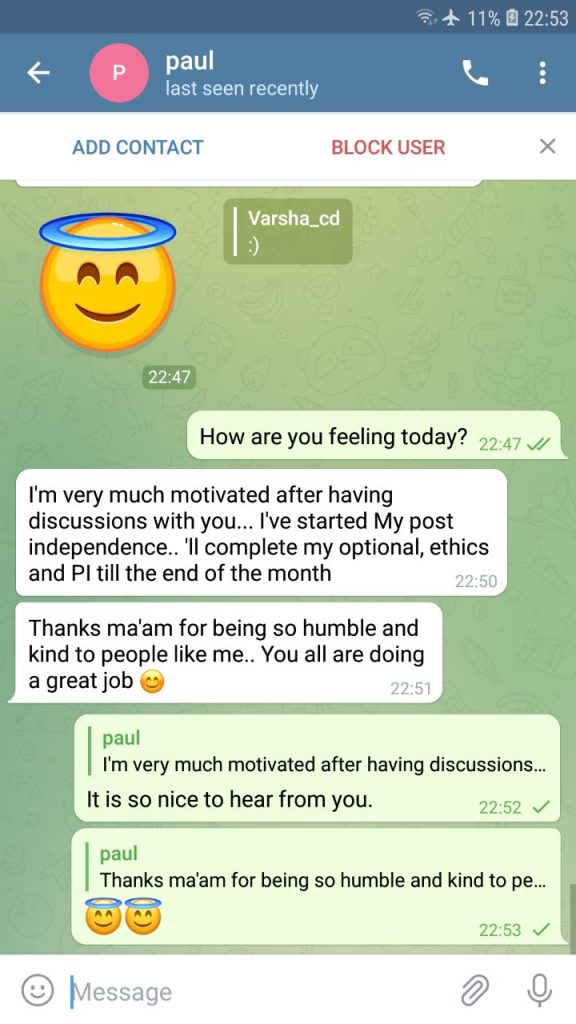
This is how Pravin sir evaluates Ashish’s Mains Test Series every week. After every test series evaluation, Pravin sir schedules a 1 hour call to discuss how Ashish can improve his marks and the sources he can refer for key topics.
It’s Your Turn Get the Free 40 Min Counselling Session By a CD Mentor
Civilsdaily mentors are so dedicated, consistent and focused for your UPSC goal, that you will eventually become focused into turning your dreams to reality.
At the core of Civilsdaily UPSC mentorship, lies the fact that each one of you will have a unique journey while preparing for the exam. Some will get through on the first attempt without much effort while others will take both more time and more effort.
We want to understand you better to help you optimize your journey so you can focus on the right things and not waste time on the wrong ones. We are asking you to tap into the valuable experiences of mentors who underwent the same grind and realize the pitfalls and understand the shortcuts to make it.
The two-day visit to Moscow by Pakistan’s PM Imran Khan comes at a time when President Vladimir Putin is the bad boy of the world for his actions against Ukraine.
Pakistan–Russia Relations: A backgrounder
The Soviet Union and Pakistan first established diplomatic and bilateral relations on 1 May 1948.
For most of the Cold War, the Soviet Union’s relations with Pakistan have seen ups and downs during the different periods in the history of Pakistan.
Pakistan is credited for playing a key role for allying and supporting the West during this time period of the Cold War.
In recent years their ties have warmed as a countermeasure to warming ties between India and the United States.
Instances of Russia defying India
The two countries carried out their first-ever joint military drills in 2016 despite Indian requests to postpone due to the Uri attack.
Pakistan and Russia signed an agreement for the Pakistan Stream Gas pipeline from Karachi to Kasur, and reached a price accord by December 2016.
Pakistan has also granted Russia access to a warm water port in the Arabian Sea (Gwadar Port).
Their mutual partnership with China that has grown in recent years signals the undeniable development of a new axis in South Asia and Central Asia.
The two countries take the lead in projecting the Taliban as the rightful claimants to power in Kabul.
A timeline of relations
Cold war era: Pakistan’s relations with Russia have come a long way since the time it was a willing ally and treaty partner of the US bloc against the Soviet Union. It had helped the US repair its relations with China, which sent Beijing and Moscow further apart.
Paving way for India: In response, India and USSR solidified their ties with a defense pact and increased economic and people-to-people exchanges.
Afghan War: Pakistan saw itself as a frontline state against the spread of communism, and actively aided and assisted in the defeat of the Red Army in the first Afghan war, with the US and Saudi Arabia using the Pak Army.
Fall of USSR: The collapse of the Soviet Union led to major shifts in international relations. From their vantage points, Pakistan and Russia watched the US and post-economic-reforms India draw closer.
Pakistan parted with the US
Putin’s Russia began looking for new markets for its military hardware, as well as new international partners, began building ties with Pakistan.
By then, serious rifts had emerged between the Obama Administration and Pakistan.
The killing of Osama bin Laden in a stealth raid by US marines in Pakistan’s Abbottabad became the turning point.
Russia-Pakistan-China
(1) Helping the lonely Pakistan
In 2011, to New Delhi’s shock, Russia lifted its four-decade-old arms embargo on Pakistan — and within four years, would sell Pakistan its first MiG attack helicopters.
As a US defeat in Afghanistan began to look certain, both countries made common cause on Afghanistan, again to India’s dismay.
In September 2016, after the Jaish-e-Mohammed attack in Uri, Russia went ahead with a joint military exercise with Pakistan, ignoring New Delhi’s appeal.
In 2017, with Indo-Pak relations at their lowest, Russia sold more helicopters to Pakistan.
(2) Enters the old dragon
After its 2014 annexation of Crimea, Russia found a friend in China, the long-time friend of Pakistan, triangulating the relationship.
Both Pakistan and Russia are participants in China’s Belt and Road Initiative.
After the Taliban takeover in Afghanistan, the world has seen the three take common positions and in tacit acknowledgment of each other’s interests in that country.
Impact on ties with India
The Russia-India relationship is not what it used to be in the Soviet days, both sides recognise its continued mutual benefits. However-
Russia is hardly starry-eyed about its relations with Pakistan.
It has clear views against Pakistan’s patronage of terrorists.
While it is supportive of the Taliban regime, Russia is concerned about radical terrorism expansion from Afghanistan.
Russia remains India’s biggest arms supplier, and India took the risk of being sanctioned by the US when it bought the Russian S 400 missile defence system.
New Delhi has not yet allowed its close ties with the US to tilt its delicate balance on the Ukraine issue.
Significance of Pak Visit
IK is visiting Russia on the Kremlin’s invitation sides to convey their own messages to the West about building partnerships in a changing world.
He will become the first foreign leader to visit Russia after Putin recognized two breakaway regions of Ukraine as independent republics.
He is also the first Pakistani PM to travel to that country since the landmark visit by Nawaz Sharif in 1999.
What does Pakistan seeks to have?
Pakistan wants Russia to invest in, and construct a $2.5 billion gas pipeline from the seaport in Karachi to Kasur in the Punjab hinterland, even though this pipeline is unlikely to transport Russian gas.
Moscow, however, appears to be more interested in the possibility of building the 1,800-km Turkmenistan-Afghanistan-Pakistan-India (TAPI) pipeline.
The National Aeronautics and Space Administration (NASA) has announced plans to retire and decommission the International Space Station (ISS) by 2031.
What is the ISS?
The ISS was launched in 1998 as part of joint efforts by the U.S., Russia, Japan, Canada and Europe.
The idea of a space station originated in the 1984 State of the Union address by former U.S. President Ronald Reagan.
The space station was assembled over many years, and it operates in low-earth orbit.
Since its inception, it has served as a laboratory suspended in space and has aided multiple scientific and technological developments.
The ISS was originally built to operate for 15 years.
Why was ISS launched?
A space station permits quantum leaps in research in science, communications, and in metals and lifesaving medicines which could be manufactured only in space.
ISS has consistently maintained human presence for the past 21 years, providing astronauts with sophisticated technologies for scientific research.
Why is NASA planning to decommission the ISS?
The space station has already surpassed that checkpoint by being active for 21 years, with plans to continue operations till 2030.
The ISS goes through 16 rotations of the earth per day, causing extreme temperature changes on the exterior.
The side facing the sun can get heated up to 121°C while the temperature on the opposite, darker side can fall to –157°C, causing intense expansion and contraction of the building material.
This orbital thermal cycling, coupled with dynamic loading, affects the longevity of the primary structure of the space station.
The technical lifetime is also limited by parts like radiators, modules and truss structures that tend to degrade over time.
What is the procedure to de-orbit the ISS?
NASA plans to remove the ISS from its orbit around the earth and eventually plunge it into the ocean at a point farthest from human civilisation.
The space agency will use the dual method of natural orbit decay and a re-entry manoeuvre to bring an end to the ISS as we know it.
According to the plan, the earth’s natural atmospheric drag will be used in lowering the altitude of the ISS while setting up the de-orbit.
The space station operators will then provide the final push to it to lower the structure to the maximum possible height and ensure safe re-entry into the earth’s atmosphere.
It would then lead to Point Nemo over the South Pacific Oceanic Uninhabited Area (SPOUA).
Dissembling process would have posed huge logistical and financial challenges.
How big is it?
The ISS is a huge structure — almost the size of a football field — and it was not designed to be disassembled easily in space.
The station currently operates in low-earth orbit above 400 km in altitude, at a point where it still experiences atmospheric drag and requires re-boosts to continue in its orbit.
The station also has a mass of over 4,30,000 kg.
Existing propulsion systems do not have the capacity to raise the station’s altitude to a high target and escape low-earth orbit.
The random re-entry method was discarded since it carries a huge risk for the human population on the ground.
What is the future of space stations?
As the ISS plans to end operations in space, new players are already lining up to replace it.
In January 2022, China announced that its space station will be ready for operations this year.
Blue Origin, the aerospace company founded by Jeff Bezos, has also announced its plans to build Orbital Reef, a commercially developed, owned, and operated space station in low-earth orbit.
Blue Origin is working alongside Sierra Space on the project.
India’s teenage chess grandmaster Rameshbabu Praggnanandhaa has won praise for a stunning victory over world number one Magnus Carlsen in an online championship.
Why are we reading this?
UPSC had asked three questions on sports in CSP 2021. They were based on Laureus World Sports Award, Summer Olympics, and ICC World Test Championship.
Try to ace uncertainties. No one can memorize such facts.
Grandmaster: Behind the Title
Grandmaster is the highest title or ranking that a chess player can achieve.
The Grandmaster title — and other chess titles — is awarded by the International Chess Federation, FIDE (acronym for its French name Fédération Internationale des Échecs).
It is the Lausanne-Switzerland-based governing body of the international game.
The title is the badge of the game’s super elite, a recognition of the greatest chess talent on the planet, which has been tested and proven against a peer group of other similarly talented players.
Other (lesser) titles
Besides Grandmaster, the Qualification Commission of FIDE recognises and awards seven other titles:
International Master (IM)
FIDE Master (FM)
Candidate Master (CM)
Woman Grandmaster (WGM), Woman International Master (WIM), Woman FIDE Master (WFM), and Woman Candidate Master (WCM) and so on .
Titles are for life
All the titles, including that of Grandmaster, are valid for life, unless a player is stripped of the title for a proven offence such as cheating.
Qualifications for Grandmaster
The qualifications for Grandmaster were changed several times, including in 1957, 1965, and 1970.
Currently, FIDE awards chess’s highest honour to a player who is able to achieve a FIDE Classical or Standard rating of 2,500, plus three Grandmaster norms.
Grandmaster norms are defined by a set of complex and rigorous rules regarding tournaments, games, and players, that are set out in the FIDE Title Regulations.
The current regulations were approved by the FIDE Council on October 27, 2021, and came into effect on January 1, 2022.
Each norm is very difficult to attain.
Broadly, a player must have a performance rating of 2,600 or higher in a FIDE tournament that has nine rounds.
Who holds maximum titles?
FIDE has so far recognized fewer than 2,000 Grandmasters out of the millions who play the game around the world.
A vast majority of Grandmasters have been male. Russia (and the erstwhile USSR) has produced the most Grandmasters in the world, followed by the United States and Germany.
Grandmasters in India
India became a chess powerhouse in the 2000s, and now has more than 70 Grandmasters.
In 2016, Praggnanandhaa had become the world’s youngest IM at age 10 years, 10 months, and 19 days.
Try this question from CSP 2021:
Q. Consider the following statements in respect of the Laureus World Sports Award which was instituted in the year 2000:
American golfer Tiger Woods was the first winner of this award.
The award was received mostly by ‘Formula One’ players so far.
Roger Federer received this award maximum number of times compared to others.
Which of the above statements are correct?
(a) 1 and 2 only
(b) 2 and 3 only
(c) 1 and 3 only
(d) 1, 2 and 3
[wpdiscuz-feedback id=”77m1w3if0o” question=”Please leave a feedback on this” opened=”1″]Post your answers here.[/wpdiscuz-feedback]
Knowledge alone is not enough to clear UPSC Prelims. Elimination techniques alone are not enough to crack this exam. One needs both to clear UPSC Prelims from 2014 onwards. Since UPSC Prelims is the toughest exam out of Interview and Mains with over 9.5 lakh aspirants getting disqualified, it’s always better to think about increasing 20-30 marks with your existing knowledge using elimination techniques.
Why is that with the same syllabus, the same study materials and similar syllabus and similar study materials, most candidates score differently? For some, just a reading of the Spectrum book is enough to answer all the Modern History questions, but for others despite reading the same book they are still confused on the D Day.
If it’s about prelims exam performance, then aspirants fall into either of these four categories. Which category are you in currently?
1) Prelims score 0-40: They need to work on improving their knowledge and learn answering tricks 2) Prelims score 50-70: They have decent knowledge and decent answering tricks. 3) Prelims score 80-100: They have good knowledge but they need to develop answering tricks. 4) Prelims score 120+: They have excellent knowledge and know all the answering tricks.
UPSC 2020 AIR 30 Topper & Civilsdaily Student Divyanshu Chaudhary says how elimination techniques are useful for UPSC Prelims
So, what to do? Clearing Prelims is all about Knowledge + Answering Tricks (Tikdams). And while you are studying hard to improve your knowledge, Ravi sir will help you improve your answering techniques, for absolutely FREE!
Let’s look at a few examples. Ravi sir will explain how you can answer these questions with smart techniques, even if you DON’T know the answer.
A) With reference to ‘fuel cells’ in which hydrogen-rich fuel and oxygen are used to generate electricity, consider the following statements :(UPSC 2016)
If pure hydrogen is used as a fuel, the fuel cell emits heat and water as by-products.
Fuel cells can be used for powering buildings and not for small devices like laptop computers.
Fuel cells produce electricity in the form of Alternating Current (AC).
Which of the statements given above is/are correct?
(a) 1 only
(b) 2 and 3 only
(c) 1 and 3 only
(d) 1, 2 and 3
B) In India, under cyber insurances for individuals, which of the following benefits are generally covered, in addition to payment for the loss of funds and other benefits? (UPSC 2020)
1. Cost of restoration of the computer system in case of malware disrupting access to one’s computer.
2. Cost of a new computer if some miscreant willfully damages it, if proved so.
3. Cost of hiring a specialized consultant to minimize the loss in case of cyber extortion.
4. Cost of defense in the court of law if any third party files a suit.
Select the correct answer using the code given below:
(a) 1, 2, and 4 only
(b) 1,3 and 4 only
(c) 2 and 3 only
C) Regarding the taxation system of Krishna Deva, the ruler of Vijayanagar, consider the following statements: (UPSC 2015)
The tax rate on land was fixed depending on the quality of the land.
Private owners of workshops paid an industries tax.
Which of the statements given above is/are correct?
(a) 1 only
(b) 2 only
(c) Both 1 and 2
(d) Neither 1 nor 2
You can solve these questions with the help of techniques that Ravi sir will teach you in the webinar.
This is your opportunity to learn the tricks that can help you score 120+ in your Prelims. Join Ravi sir for a free webinar and this is what you can learn:
1. 10 Different types of elimination/intelligent guess techniques for hard to verify facts through solving previous year UPSC questions.
2. How to master the Elimination techniques, used by toppers.
3. Ideal strategy for the Last 120 days for UPSC prelims 2022.
4. Which are the tricky topics in the syllabus where one can use elimination techniques? Like for example information technology is a perfect topic where tricky questions can come from.
6.Open Q&A session with Ravi sir
There are limited slots available so we request you to enroll now!