💥UPSC 2026, 2027, 2028 UAP Mentorship (March Batch) + Access XFactor Notes & Microthemes PDF

Search results for: “”

  • WOMEN PROTECTION IN INDIA

    WOMEN PROTECTION IN INDIA
    India is a country known for its rich beautiful culture and tradition. Women are given the place of goddess Lakshmi in the Indian culture. But by seeing the last few year crimes against women, there seems the safety and security of women are at stake. As we can literally observe that crimes against women occur every minute in India. There has been a decline in the women status from ancient to medieval period which is continued in such an advanced era. Each day a single woman, a girl child, a young girl, a mother and women from all walks of life are being assaulted, molested, and violated. The streets, public transport, public spaces, in particular, have become the territory of the hunters. There are certain common crimes against women are rape, dowry deaths, sexual harassment at home or workplace, kidnapping and abduction, cruelty by husband, relatives, assault on a woman, child and sex, trafficking, attack, child marriages and many more. Though the Constitution of India has given the equal rights of dignity, equality, and freedom from gender discrimination but in practical filed no one bothers to follow such law until and unless the people’s mindset towards a woman does not change.
    All you need to know the Rights of Women in India-
    When we talk about the rights for women in India then we can take into consideration both the Constitutional Rights and Legal Rights. The constitutional rights are those which are incorporated in the various provisions of the constitution. The legal right refers to those which are incorporated in the various laws (Acts) of the Parliament and the State Legislatures. To be more specific, let’s discuss the rights through the following points-
    Rights of Woman enshrined in the Constitution of India-
    1. Article 15(1) provides that the state shall not discriminate against any citizen of India on the ground of sex.

    2. Article 15(3) provides that the state is empowered to make any special provision for women i.e. the state can make affirmative discrimination in favour of women.

    3. Article 16(2) provides that no citizen shall be discriminated against or be ineligible for any employment or office under the state on the ground of sex.

    4. Article 23(1) provides that traffic in human beings and forced labour is prohibited.

    5. Article 39(a) provides the state to secure for men and women equally the right to an adequate means of livelihood
    6. Article 39(d) provides the state to secure equal pay for equal work for both Indian men and women.
    7. Article 39(e) provides that the state is required to ensure that the health and strength of women workers are not abused and that they are not forced by economic necessity to enter avocations unsuited to their strength.
    8. Article 42 provides that the state shall make provision for securing just and humane conditions of work and maternity relief.
    9. Article 51-A (e) provides that it shall be the duty of every citizen of India to renounce practices derogatory to the dignity of women.
    10. Article 243-D(3) provides that one-third of the total number of seats to be filled by direct election in every Panchayat shall be reserved for women.
    11. Article 243-D(4) provides that one-third of the total number of offices of Chairpersons in the Panchayats at each level shall be reserved for women.
    12. Article 243-T(3) provides that one-third of the total number of seats to be filled by direct election in every Municipality shall be reserved for women.
    13. Article 243-T(4) provides that the offices of Chairpersons in the Municipalities shall be reserved for women in such manner as the State Legislature may provide.

    Legal Rights of Women enshrined under various Indian Legislations:
    1. Protection of Women from Domestic Violence Act (2005) is a comprehensive legislation to protect women in India from all forms of domestic violence by the husband or any of his relatives. Domestic violence is subjected to any kind of physical, sexual, mental, verbal or emotional.

    2. The Immoral Traffic (Prevention) Act, 1986 (PITA) has amended The Immoral Traffic (Suppression) Act, 1956 (SITA). This Act is the premier legislation only for prevention of trafficking for commercial sexual exploitation i.e. for the purpose of preventing and ultimately prohibiting prostitution for women and girls to criminalize sex work. In 2006, the Ministry of Women and Child Development proposed an amendment bill i.e. the Immoral Traffic (Prevention) Amendment Bill, 2006 that has yet to be passed.

    3. Indecent Representation of Women (Prohibition) Act (1986) prohibits indecent representation of women through advertisements or in publications, writings, paintings, figures or in any other manner.
    4. Commission of Sati (Prevention) Act (1987) provides for the more effective prevention of the commission of practice of Sati or the voluntary or forced burning or burying alive of widows, and to prohibit glorification of this action through the observance of any ceremony.

    5. Dowry Prohibition Act (1961) prohibits the giving or receiving of dowry at or before or any time after the marriage from women.

    6. Maternity Benefit Act (1961) protects the employment of women during the time of her maternity and entitles her to a ‘maternity benefit’ and certain other benefits. The Maternity Benefit (Amendment) Act, 2017 an amendment to the Maternity Benefit Act (1961) has been passed. The Act is applicable to contractual or consultant women employees, as well as to the women who are already on maternity leave at the time of enforcement of the Amendment Act.

    7. Medical Termination of Pregnancy Act (1971) provides for the termination of certain pregnancies by registered medical practitioners on humanitarian and medical grounds.

    8. Pre-conception and Pre-Natal Diagnostic Techniques (Prohibition of Sex Selection) Act (1994) prohibits sex selection before or after conception and prevents the misuse of pre-natal diagnostic techniques for sex determination leading to female foeticide.
    9. Equal Remuneration Act (1976) provides for payment of equal remuneration to both men and women workers for same work or work of a similar nature. It also prevents discrimination on the ground of sex, against women in recruitment and service conditions.
    10. Muslim Women (Protection of Rights on Divorce) Act (1986) protects the rights of Muslim women who have been divorced by or have obtained divorce from their husbands.
    11. Hindu Succession Act (1956) recognizes the right of women to inherit parental property equally with men. Then there came the Hindu Succession (Amendment) Act 2005 granting daughters the right to inherit ancestral property along with their male relatives.
    12. Minimum Wages Act (1948) does not allow discrimination between male and female workers or different minimum wages for them.
    13. Mines Act (1952) and Factories Act (1948) prohibits the employment of women between 7 P.M. to 6 A.M. in mines and factories and provides for their safety and welfare.
    14. The Sexual Harassment of Women at Work Place (Prevention and Protection) Act (2013) provides protection to women from sexual harassment at all workplaces both in public and private sector, whether organised or unorganized.
    15. Child Labour (Prohibition and Regulation) Amendment Act, 2016 prohibits the engagement of children in all occupations and of adolescents in hazardous occupations and processes, where adolescents refer to those under 18 years and children to those under 14 years.
    16. The Protection of Children from Sexual Offences (POCSO Act) 2012 was formulated in order to effectively address sexual abuse and sexual exploitation of children. It defines a child as any person below the age of 18 years and provides protection to all children under the age of 18 years from the offences of sexual assault, sexual harassment, and pornography.
    Apart from the above-mentioned rights, there are following general laws that every woman should know-
    • Right to free aid
    When a woman goes to the police station without being accompanied by a lawyer she should be aware of the fact that she has a right to get the legal aid and that she should demand it.
    • Right to privacy
    A woman who has been raped has a right to record her statement in private in front of the magistrate without being overheard by anyone else or with a lady constable or a police officer in person. Under section 164 of the Criminal Procedure Code, the cops will have to give the privacy to the victim without stressing her in front of masses.
    • Right to Zero FIR
    As according to the Supreme Court ruling a rape victim can register her police complaint from any police station under the Zero FIR.
    • Right to no arrest
    According to a Supreme Court ruling, a woman cannot be arrested after sunset and before sunrise. Except, in case the woman has committed a serious crime, the police require to get it in writing from the magistrate explaining why the arrest is necessary during the night.
    • Right to not being called to the police station
    According to section 160 of the Criminal Procedure Code, women cannot be called to the police station for interrogation. The police can interrogate a woman at her residence in the presence of a woman constable and family members or friends.
    • Right to confidentiality
    Under no conditions a rape victim’s identity of can be revealed. Neither the police nor media can make known the name of the victim in public. Section 228-A of the Indian Penal Code makes the disclosure of a victim’s identity a punishable offence.
    Recent amendments to certain laws-
    • The gang rape that took place on the night of 16th December 2012 took the entire nation in such a outrage stage that it forced to give a new shape to the criminal law by the enactment of the most awaited Act i.e. the Criminal Law (Amendment) Act, 2013 Thus the Act has included the following sections-
    o Section 354A provides for Sexual harassment and punishment for sexual harassment.
    o Section 354B provides for Assault or use of criminal force to woman with intent to disrobe.
    o Section 354C provides for Voyeurism.
    o Section 354D provides for Stalking.
    o The definition of “Rape” under section 376 has been amended.
    • The Muslim Women (Protection of Rights on Marriage) Bill 2017 makes instant “Triple Talaq” in any form “illegal and void”. The proposed law would also give the woman the right to approach a magistrate seeking “subsistence allowance” for herself and her minor children.
    • The Union Cabinet in April 2018 has approved an ordinance amending the Protection of Children from Sexual Offences (POCSO), 2012 Act to introduce a new provision of the death penalty to those convicted of raping children up to 12 years of age.
    The Indian legislature has forwarded to you certain specific laws that are applicable to women only. As a parent, wife, daughter, employee and a woman, these are rights set in place to protect you and it is important that you are aware of these.

  • UPSC

    Suggest that one how should start his UPSC preparation as a beginner.

  • UPSC 2017 Results Out

    DURISHETTY ANUDEEP has topped the exam.

    We congratulate all our students who made it. We are in the process of compiling the list and would reach out to you shortly.

    Please post your results in the comments section. For students who didn’t make it, please don’t be disheartened. UPSC is a marathon.


  • [open SIP] Test 23- February’18 CA Link + Discussion

    Link for the test: Click2Attempt  (Let us know your score in comments)

    We have started our Open SIP program in conjunction with our PAID program (Click2Know all details of the program)

    We will be running this special FREE initiative on daily basis providing students with revision questions for static subjects as well as current affairs starting from June 2017

    Test 23 as per schedule (Click2View) is February’18 CA


    Liked the test? You can join our FLT program containing more such high-level questions. The module contains 11 FLTs (8 paper 1 TS + 3 CSAT)

    Know all details about the program and join here: Click2Join

    Want to do quick revision for Prelims? Join our SIP Comprehensive or SIP Mini modules giving you Static & Dynamic subjects coverage through video lectures

    SIP Comprehensive- Samanvaya + Lectures + Notes + FLTs + CA Tests: Click2Join

    SIP Mini- Samanvaya + Lectures + Notes: Click2Join

  • [Prelims Spotlight] Social impact bond, Indian National Centre for Ocean Information Services (INCOIS), Vidhata

    Here are 2 Back2Basics collections from today’s news items

    B2B #1: From news- [op-ed snap] Outcome-based financing for development in India

    Social impact bond

    1. A Social impact bond, also known as Pay for Success Financing, a Pay for Success Bond or a Social Benefit Bond  or simply a Social Bond, is a contract with the public sector in which a commitment is made to pay for improved social outcomes that result in public sector savings
    2. The term was originally coined by Geoff Mulgan, Chief Executive of the Young Foundation
    3. The first Social Impact Bond was launched by UK-based Social Finance Ltd. in September 2010
    4. Social Impact Bonds are a type of bond, but not the most common type. While they operate over a fixed period of time, they do not offer a fixed rate of return
    5. Repayment to investors is contingent upon specified social outcomes being achieved
    6. Therefore, in terms of investment risk, Social impact bonds are more similar to that of a structured product or an equity investment.


    B2B #2: From news- Strong winds in Atlantic create high waves off Indian coasts over 10,000 km away

    Indian National Centre for Ocean Information Services (INCOIS)

    1. INCOIS is an autonomous organization of the Government of India, under the Ministry of Earth Sciences
    2. ESSO-INCOIS is a unit of the Earth System Science Organization (ESSO)
    3. ESSO- INCOIS is mandated to provide the best possible ocean information and advisory services to society, industry, government agencies and the scientific community through sustained ocean observations and constant improvements through systematic and focused research


    As a part of revision for Prelims 2018, Here’s a Factoid to brush up your concepts

    Key words related to History : Vidhata

    Dynasty/era : Vedic period

    Meaning : 1.Vidatha appears for 122 times in the Rig-Veda and seems to be the most important assembly in the Rig Vedic period. Vidatha was an assembly meant for secular, religious and military purpose. 2.The Rig-Veda only once indicated the connection of woman with the Sabha whereas Vidatha is frequently associated with woman women actively participated in the deliberations with men. 3. Vidatha was the earliest folk assembly of the Aryans, performing all kinds of functions- economic, military religious and social. The Vidatha also provided common ground to clans and tribes for the worship of their gods.

  • [open SIP] Test 22- Environment ( Full Syllabus) Link + Discussion

    Link for the test: Click2Attempt  (Let us know your score in comments)

    We have started our Open SIP program in conjunction with our PAID program (Click2Know all details of the program)

    We will be running this special FREE initiative on daily basis providing students with revision questions for static subjects as well as current affairs starting from June 2017

    Test 22 as per schedule (Click2View) is Environment ( Full Syllabus)


    Liked the test? You can join our FLT program containing more such high-level questions. The module contains 11 FLTs (8 paper 1 TS + 3 CSAT)

    Know all details about the program and join here: Click2Join

    Want to do quick revision for Prelims? Join our SIP Comprehensive or SIP Mini modules giving you Static & Dynamic subjects coverage through video lectures

    SIP Comprehensive- Samanvaya + Lectures + Notes + FLTs + CA Tests: Click2Join

    SIP Mini- Samanvaya + Lectures + Notes: Click2Join

  • [Static Revision] The Peninsular Plateau | Part 1

    Article Outline:

    • Location and Extent
    • Geological History and Features
    • Chief Characteristics
      • General elevation and flow of rivers
      • Important physiographic features
      • The Deccan Trap
    • Physiographic Divisions
      • The Central Highlands
      • The Deccan Plateau
      • The Northeastern Plateau.
    • Hill ranges of the peninsula
      • The Aravallis
      • Vindhyan Ranges
      • Satpura ranges
      • Western and Eastern Ghats
    • Significance of this region


    Peninsular Plateau is the oldest and largest Physiographic unit of India.

    A. Location and Extent

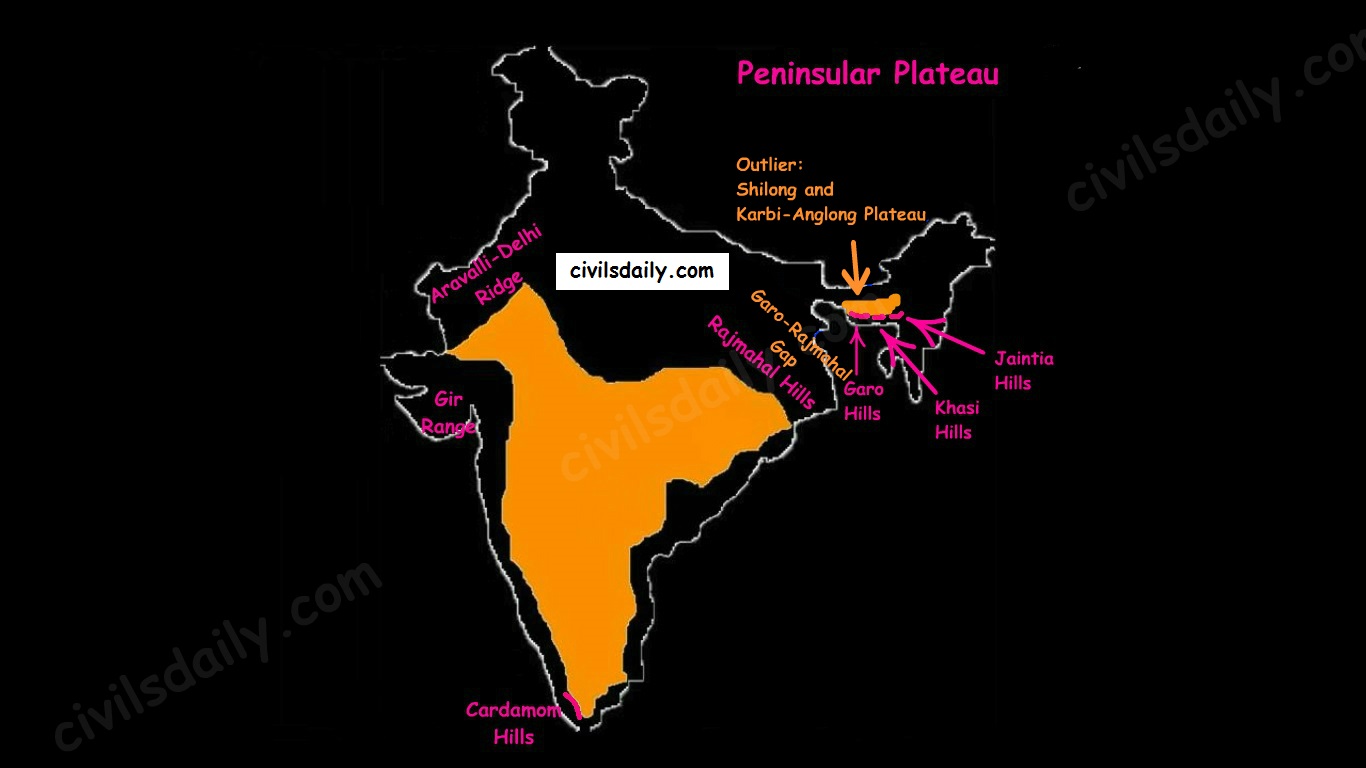
    • The Peninsular Plateau lies to the south of the Northern Plains of the India.
    • It is bordered on all sides by the hill ranges:
    • Delhi ridge in the north-west (extension of Aravalis),
    • the Rajmahal hills in the east,
    • Gir range in the west, and
    • the Cardamom hills in the south constitute the outer extent of the peninsular plateau.
    The Physiographic Divisions of India | The Peninsular Plateau
    • Outlier:
      • Shillong and Karbi-Anglong plateau.

    Note: Kutchch Kathiawar region – The region, though an extension of Peninsular plateau (because Kathiawar is made of the Deccan Lava and there are tertiary rocks in the Kutch area), they are now treated as integral part of the Western Coastal Plains as they are now levelled down.

    • The Garo-Rajmahal Gap:
      • The two disconnected outlying segments of the plateau region are seen in the Rajmahal and Garo-Khasi Jaintia hills.
      • It is believed that due to the force exerted by the northeastward movement of the Indian plate at the time of the Himalayan origin, a huge fault was created between the Rajmahal hills and the Meghalaya plateau
      • Later, this depression got filled up by the deposition activity of the numerous rivers.
      • As a result, today the Meghalaya and Karbi Anglong plateau stand detached from the main Peninsular Block.

    Geological History and Features:

    The peninsular plateau is a tableland which contains igneous and metamorphic rocks. It is one of the oldest and the most stable landmass of India.

    In its otherwise stable history, the peninsula has seen a few changes like:

    1. Gondwana Coal Formation.
    2. Narmada-Tapi rift valley formation.
    3. Basalt Lava eruption on Deccan plateau:

    During its journey northward after breaking off from the rest of Gondwana, the Indian Plate passed over a geologic hotspot, the Réunion hotspot, which caused extensive melting underneath the Indian Craton. The melting broke through the surface of the craton in a massive flood basalt event, creating what is known as the Deccan Traps (Its various features have been discussed in the later portion of the article).

    Chief Characteristics:

    The entire peninsular plateau region is an aggregation of several smaller plateaus and hill ranges interspersed with river basins and valleys. The Chhattisgarh plain occupied by the dense Dandakaranya forests is the only plain in the peninsula.

    1. General elevation and flow of rivers:

    • The average elevation is 600-900 metres.
    • The general elevation of the plateau is from the west to the east, which is also proved by the pattern of the flow of rivers.
    • Barring Narmada and Tapti all the major rivers lying to the south of the Vindhyas flow eastwards to fall into the Bay of Bengal.
    • The westward flow of Narmada and Tapi is assigned to the fact that they have been flowing through faults or rifts which were probably caused when the Himalayas began to emerge from the Tethys Sea of the olden times.

    2. Some of the important physiographic features of this region are:

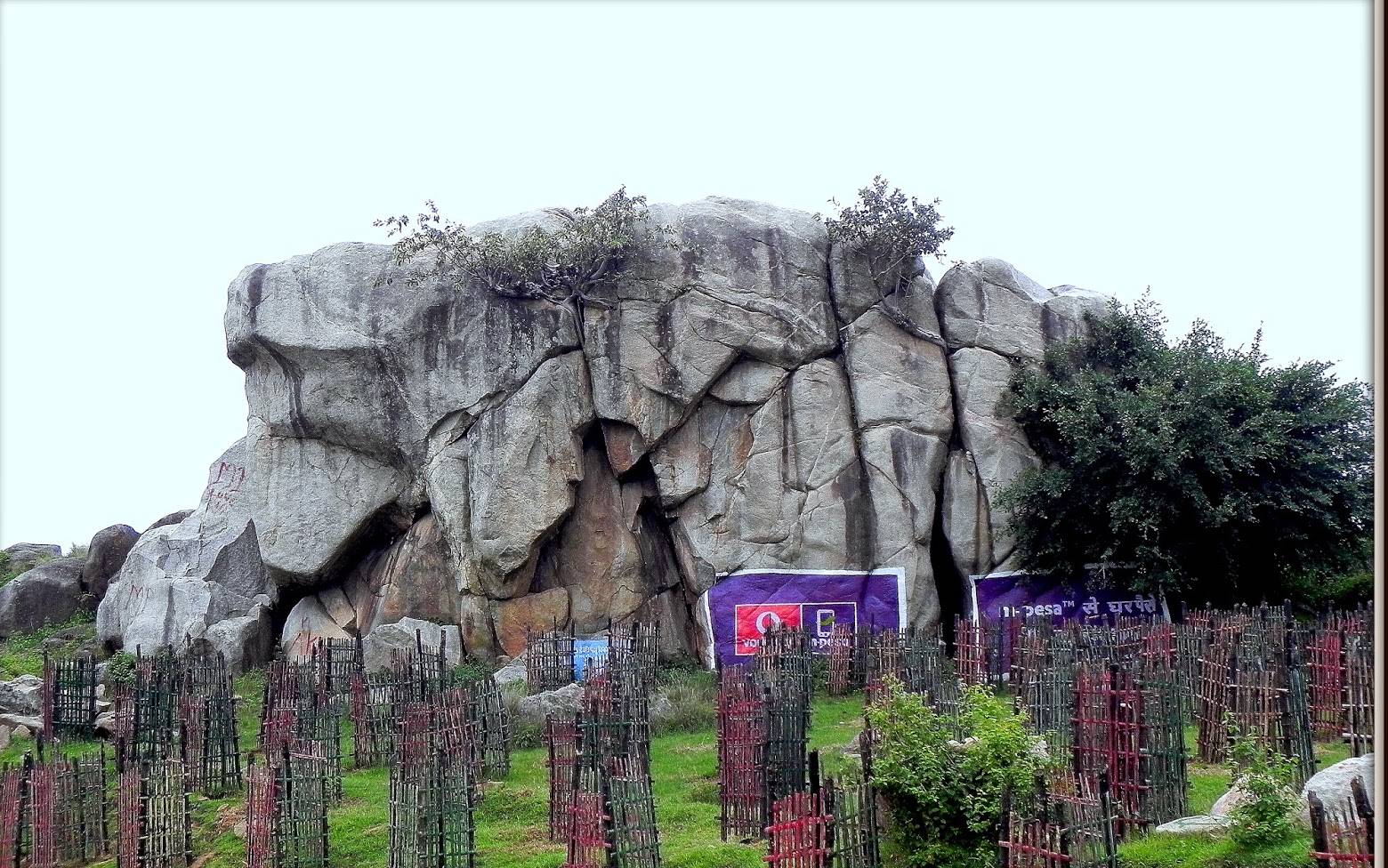
    • Tors – Prominent, isolated mass of jointed, weathered rock, usually granite.
    A granite tor near Ranchi
    A granite tor near Ranchi
    • Block Mountains and Rift Valleys:
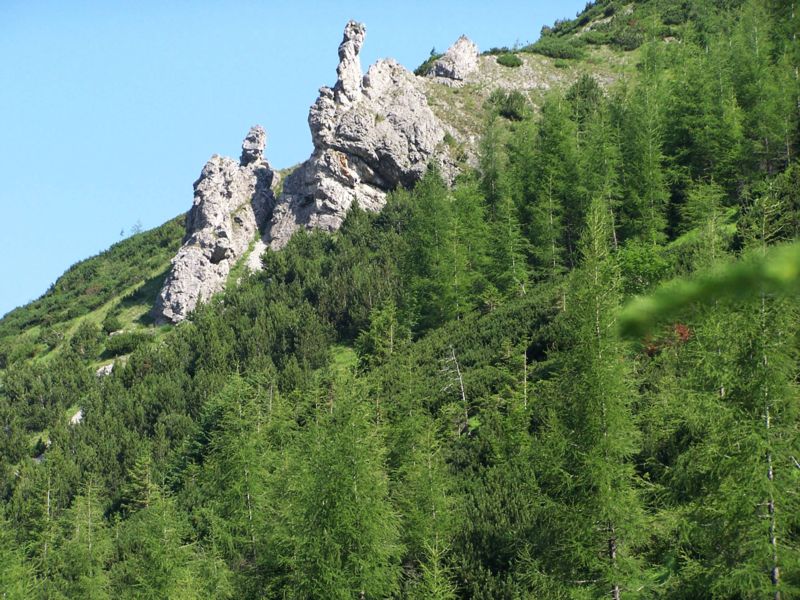
    • Spurs: A marked projection of land from a mountain or a ridge
    spur
    Image Source
    • Bare rocky structures,
    • Series of hummocky hills and wall-like quartzite dykes offering natural sites for water storage.
    • Broad and shallow valleys and rounded hills
    • Ravines and gorges: The northwestern part of the plateau has a complex relief of ravines and gorges. The ravines of Chambal, Bhind and Morena are some of the well-known examples.

    3. The Deccan Traps:

    • One of the most important features of the peninsular plateau is the black soil area in the western and northwestern part of the plateau, which is known as the Deccan Trap.
    • From the end of the Cretacious until the beginning of the Eocene, numerous fissure-type eruptions took place in the north-western part of the Deccan plateau. It is believed that the lava outpourings were more than the mass comprising the present-day Himalayas.
    • It covers a major portion of the Maharashtra plateau and parts of Gujarat, northern Karnataka and Malwa plateau. Some parts of Tamil Nadu, Andhra Pradesh, UP, and Jharkhand have some outliers of Deccan trap.
    • Basalt is the main rock of the region.
    • The region has black cotton soil as a result of weathering of this lava material and this soil is one of the finest examples of the parent material controlled soils.

    That’s it for this part! In the next article, we will focus on the physiographic divisions of the Peninsular Plateau.

  • [Prelims Spotlight] Unnat Bharat Abhiyan, National framework for Malaria Elimination , NFME), Press Freedom Index, HySIS (Hyperspectral Imaging Satellite)

    Here are 3 Back2Basics collections from today’s news items

    B2B #1: From news- More institutions to work for rural development

    Unnat Bharat Abhiyan

    1. This is an HRD Ministry initiative launched in 2014 with the two-fold aim to provide rural India with professional resource support from institutes of higher education in the field of STEM
    2. And Building institutional capacity in Institutes of higher education in research & training relevant to the needs of rural India
    3. This programme will be launched in collaboration with the Indian Institutes of Technology (IIT), Indian Institutes of Science Education & Research (IISERs) and the National Institutes of Technology (NITs) throughout the country
    4. Each IIT/NIT/IISER will identify 10 villages in its neighborhood and work out technologies to solve the most pressing issues of the region
    5. Various teams from these institutes will visit the villages, identify problems and then aim to find financially-viable schemes.


    B2B #2: From news- Expand national programmes to eliminate malaria by 2030: WHO

    National framework for Malaria Elimination (NFME)

    1. NFME outlines the strategies for eradication of the disease by 2030
    2. It classifies districts or states/UTs depending upon their Annual Parasite Incidence (API) or malaria
      endemicity into categories 0,1,2,3
    3. API number gives the number of cases affected by malaria per 1000 population per annum
    4. The milestones and targets are set for 2016, 2020, 2022, 2024, 2027 and 2030 by when the entire country has sustained zero indigenous cases and deaths due to malaria for 3 years and initiated the processes for certification of malaria elimination status to the country
    5. The objectives of the NFME are to:
    • Eliminate malaria from all low (Category 1) and moderate (Category 2) endemic states/UTs (26) by 2022
    • Reduce the incidence of malaria to less than 1 case per 1000 population in all States/UTs and the districts and malaria elimination in 31 states/UTs by 2024
    • Interrupt indigenous transmission of malaria in all States/ UTs (Category 3) by 2027;
    • Prevent re-establishment of local transmission of malaria in areas where it has been eliminated and to maintain the malaria-free status of the country by 2030


    B2B #3: From news- Press freedom: India falls to 138, North Korea remains most repressive country in RSF rankings

    Press Freedom Index

    1. The Press Freedom Index is an annual ranking of countries compiled and published by Reporters Without Borders based upon the organization’s own assessment of the countries’ press freedom records in the previous year
    2. It intends to reflect the degree of freedom that journalists, news organizations, and netizens have in each country, and the efforts made by authorities to respect this freedom
    3. A smaller score on the report corresponds to greater freedom of the press as reported by the organization
    4. The index only deals with press freedom and does not measure the quality of journalism nor does it look at human rights violations in general
    5. The report is partly based on a questionnaire which asks questions about pluralism, media independence, environment and self-censorship, legislative framework, transparency, and infrastructure
    6. Violence against journalists, netizens, and media assistants, including abuses attributable to the state, armed militias, clandestine organizations or pressure groups, are monitored by RSF staff during the year and are also part of the final score


    As a part of revision for Prelims 2018, Here’s a Factoid to brush up your concepts

    Name : HySIS (Hyperspectral Imaging Satellite)

    Details : Earth observation satellite, using a critical chip it has developed called “optical imaging detector array”


  • [open SIP] Test 21-Economics ( Full Syllabus) Link + Discussion

    Link for the test: Click2Attempt  (Let us know your score in comments)

    We have started our Open SIP program in conjunction with our PAID program (Click2Know all details of the program)

    We will be running this special FREE initiative on daily basis providing students with revision questions for static subjects as well as current affairs starting from June 2017

    Test 21 as per schedule (Click2View) is Economics ( Full Syllabus)


    Liked the test? You can join our FLT program containing more such high-level questions. The module contains 11 FLTs (8 paper 1 TS + 3 CSAT)

    Know all details about the program and join here: Click2Join

    Want to do quick revision for Prelims? Join our SIP Comprehensive or SIP Mini modules giving you Static & Dynamic subjects coverage through video lectures

    SIP Comprehensive- Samanvaya + Lectures + Notes + FLTs + CA Tests: Click2Join

    SIP Mini- Samanvaya + Lectures + Notes: Click2Join

  • [Static Revision] Issues related to Planning in India

    Economic planning has been a central belief of India’s development strategy since independence. Since the time of independence, India has successfully followed the path of planned development.

    Understanding How Planning Worked: The Model

    The Indian Situation at the time of Independence.

    The Choices

    The basic question’s that planners had to decide are:

    The First question:

    The Second Question:

    The Third Question:

    The Chosen Path by the Indian Planners: Mahalanobis Model

    Centralised (Imperative) versus Capitalist Economic Planning

    Indicative versus Imperative Economic Planning

    The Rationale for Planning in India

    The Feature of Indian Planning

    The Key Objectives of Planning in India

    The Achievements of Planning in India

    India’s development strategy, commitments, and approaches towards growth and development, as reflected in the Plans, have undergone various shifts over the years in response to the objective conditions of the economy and challenges of the moment. Some of these changes have been strikingly bold and original, others more modest.

    Criticism of Indian Planning: The Debate

    Despite the achievement, however, in recent years Indian planning has come under attack from a number of quarters, both within and outside the country. Countries which for long had centrally-planned economies have abandoned planning, at least overtly. It sometimes comes as a surprise to people abroad that India continues to preserve planning as a central pillar of its development strategy despite having had a vibrant market economy for many years now.

    The dissatisfaction with planning originates from two main directions.

    The Counter Arguments

    The Relevance of Planning in the 21st Century India

    The Way Forward

    1. All this is not to say, however, that the planning methodology should not change so as to reflect the new economic realities and the emerging requirements. It has, it must, and it will.
    2. First of all, the – inter-sectoral balancing and indicative planning, at least in the sense of working out the optimal investment programme, which has been the centre-piece of Indian planning since the Second Plan, will continue to remain important in the foreseeable future.
    3. Despite the much greater openness of the Indian economy, our very size and diversity will ensure that imports will continue to play a relatively small role in the economy, except in a very few products.  Thus, the requirement of planning in estimating the sectoral investment needs will remain.
    4. A more important conceptual issue relates to the nature of the planning problem itself. In a controlled or directed economy, it is only necessary to work out a feasible path from the initial condition to the target. However, in a largely market economy this is not sufficient. Although working out the traditional feasible path continues to be necessary, it needs to be complemented by an assessment of the path the economy is likely to take on a business-as-usual basis.
    5. The planning problem then is how to move from the projected path to the desired. Thus, in addition to the standard planning model, there is need to have two other models: (a) a projection model; and (b) a model which adequately captures the effect of policy measures on key parameters.

    By,

    Himanshu Arora

    Doctoral Scholar in Economics & Senior Research Fellow, CDS, Jawaharlal Nehru University

More posts