💥UPSC 2026, 2027, 2028 UAP Mentorship (March Batch) + Access XFactor Notes & Microthemes PDF

Search results for: “”

  • Natural Vegetation and Wildlife: Part 4 | Vegetation Zones of the Himalayas, The Problems of Indian Forestry

    The Himalayan ranges show a succession of vegetation from the tropical to the tundra, which changes with altitude. When we look at the vegetational zones, the eastern Himalayas are similar to the western Himalayas.

    But on the whole, the eastern Himalayas have more tropical elements, a greater variety of Oaks and Rhododendrons and less of conifers than the western Himalayas.

    Some other differences are:

    • The higher rainfall and warmer conditions in this part of the Himalayas.
    • Also, the tree line and the snow line are higher in the eastern Himalayas than the corresponding lines in the western Himalayas (Recall the discussion on snowline? Click here to quickly revise!).
    • Species diversity and vegetation density are also higher in the East.

    Also, the southern slopes of the Himalayas carry a thicker vegetation cover because of relatively higher precipitation than the drier north-facing slopes.

    Some other ways of classifying forests:

    1. Classification according to composition:

    • Coniferous Forests: These are temperate forests occupying about 6.50% of the total forest area of the country. These are confined to the Himalayan ranges and provide soft wood timber.
    • Broad-Leaved Forests: These are tropical and subtropical monsoon forests. These are widely spread and cover 94% of the total forest area of the country. These are found in the plains, plateaus and mountainous areas of the country. Sal, Teak and Bamboo are important varieties.

    2. Legal or Administrative Classification:

    Broadly speaking, reserved, protected and unclassed are the three major legal classes of forest in India. A legal notification in a government gazette under Indian Forest Act creates or defines the boundaries of “reserved and “protected” forests in India. These forests by definition are owned by government. The rest of forests areas or waste land or any other land “recorded” in land records as “forest” but not notified in government gazette as “reserved” or “protected” forests under Indian Forest Act, are called unclassed forests. The status of their ownership and control varies among various States in India.

    • Reserved Forests:
      • These forests are under the direct supervision of the government and no public entry is allowed for the collection of timber or grazing of cattle.
      • About 53 % of total forest area falls in this category.
      • Reserved forests are regarded as the most valuable as far as the conservation of forests and wildlife is concerned.
      • In such forests, most of the activities are prohibited unless allowed.
    • Protected Forests:
      • These forests are looked after by the government but the local people are allowed to collect fuelwood/timber and graze their cattle without causing serious damage to the forests.
      • These occupy 29% of the total forest area of the country.
      • In such forests, most of the activities are allowed unless prohibited.
    • Unclassed/Unclassified Forests:
      • There is no restriction on cutting of trees and cattle grazing.
      • These occupy 18% of the total forest area of the country.
      • These are the other forests and wastelands belonging to both government and private individuals and communities.
      • All north-eastern states and parts of Gujarat have a very high percentage of their forests as unclassed forests managed by local communities.

    Reserved and protected forests are referred to as permanent forest estates because they are maintained for the purpose of producing timber and other forest produce, and for protective reasons

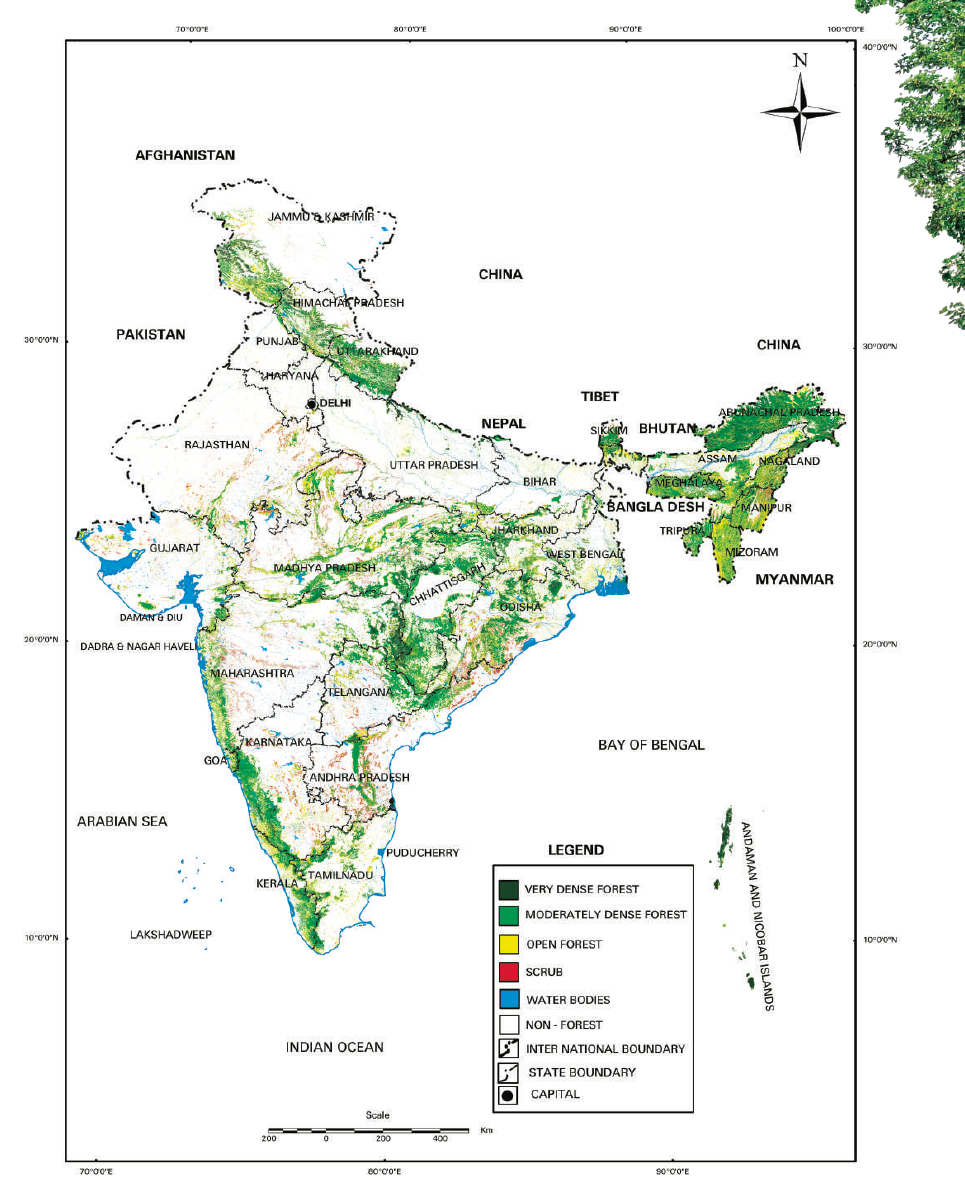
    3. The Forest Survey of India classifies forest cover in 4 classes:

    • Very Dense forest: All lands with tree cover (including mangrove cover) of canopy density of 70% and above.
    • Moderately dense forest: All lands with tree cover (including mangrove cover) of canopy density between 40% and 70%.
    • Open forests: All lands with tree cover (including mangrove cover) of canopy density between 10% and 40%.
    • Scrubs: All forest lands with poor tree growth mainly of small or stunted trees having canopy density less than 10%

    The moderately dense and very dense forests are called Prime forests. Non-Forests are the lands not included in any of the above classes.
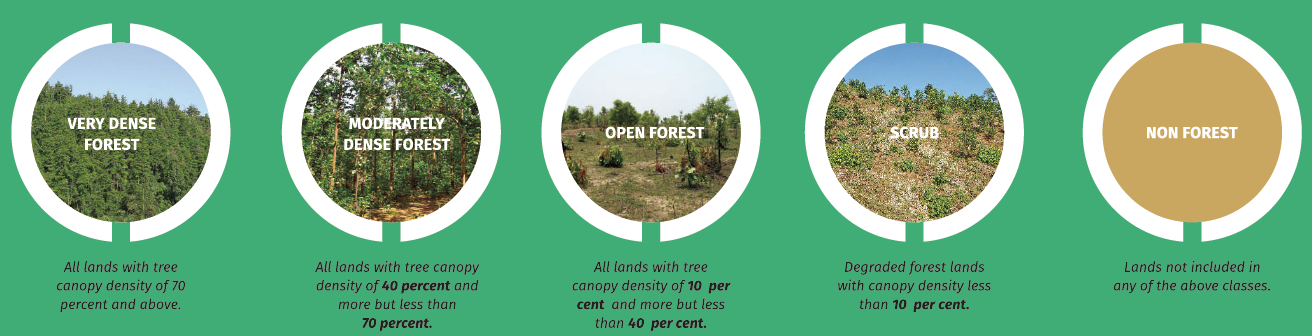
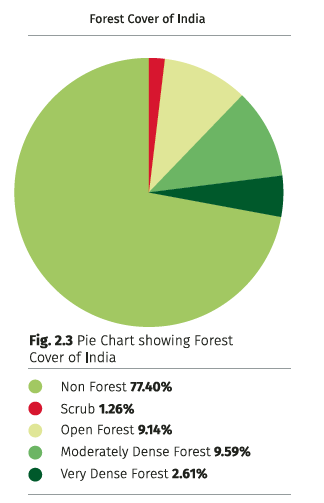
    Source – India State of Forest Report (ISFR) 2015

    Forest Cover in India:

    According to the India State of Forest Report 2015, forests cover 21.34% of the total geographical area of the country (Road more about the report here!).

    Some other facts:

    • Out of the total forest cover, the maximum share is of Moderate Dense Forests, followed by Open Forests.
    • Also, Madhya Pradesh has the largest total forest cover, followed by Arunachal Pradesh and Chhattisgarh.
    • Mizoram, with 88.93 % of forest cover has the highest forest cover in percentage terms, followed by Lakshadweep.
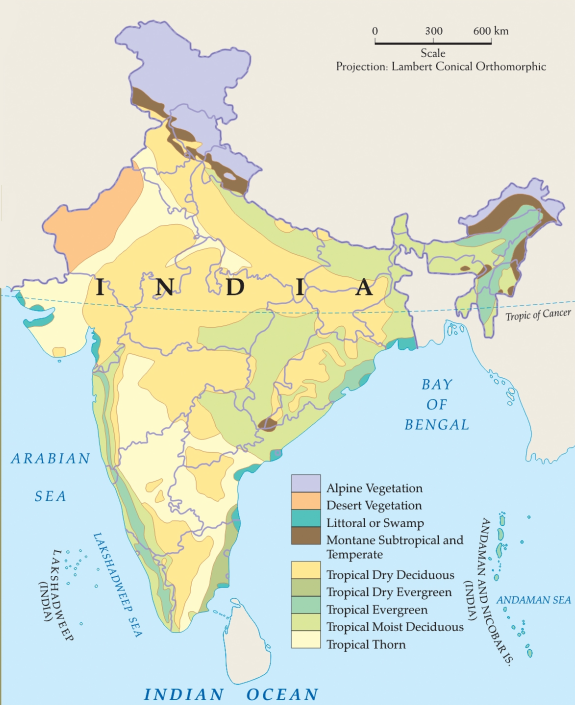
    Source – India State of Forest Report (ISFR) 2015
    The Forest Cover map of India. Source: India State of Forest Report (ISFR) 2015

    The Problems of Indian Forestry:

    The specific problems of the Indian Forestry are the following:

    1. Low Forest Cover

    The forest cover in India is only 21.34% against the world average of about 35% and the stipulated 33% under the National Forest Policy 1952. The states of Punjab, Haryana and Rajasthan have less than 5% of their areas under forests. Forest area is decreasing due to deforestation on account of:

    • Growing demand for agricultural land.
    • Urbanisation and industrialisation
    • Construction of multipurpose projects
    • Commercial activities like mining, quarrying, oil extraction, orchard development etc.
    • Shifting cultivation – Increasing pressure of population has reduced the jhum cycle to only 5 years in many parts of Nagaland, Meghalaya, Mizoram, Tripura and Manipur. Consequently, the forests do not have sufficient time to regenerate.
    • Overgrazing by cattle
    • Transhumance i.e. seasonal migration by nomadic tribes up and down the mountains.

    2. Uneconomic utilisation of forests:

    • Most of the forests are not gregarious i.e. usable plants not growing close enough. This creates a problem in their exploitation.
    • 40% of the total forest area is inaccessible.
    • Lumbering, transport and sawing of timber is still done by primitive techniques.
    • Lack of scientific techniques of growing forests as in Canada, Russia. Only natural growth of forests takes place in India

    3. Forest Fires – Natural and manmade.

    4. Plant diseases, pests, insects
  • Natural Vegetation and Wildlife: Part 3 | The Sub-tropical, Temperate, Sub-Alpine and Alpine, Littoral and Swamp Vegetation

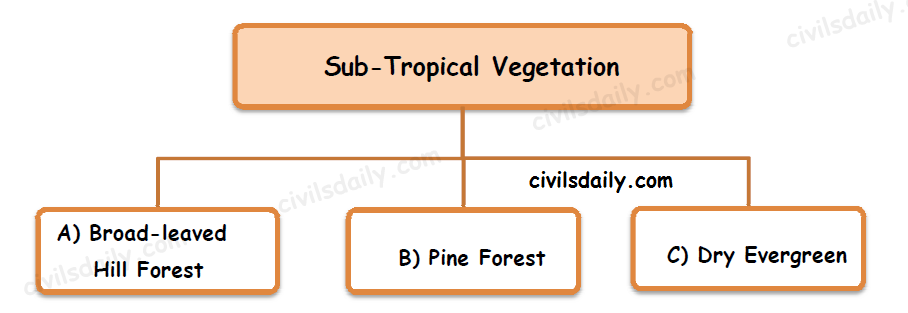
    4. Subtropical Vegetation

    A. Sub-tropical Broad-leaved Hill Forests:

    • Distribution: These forests occur on the lower slopes of the Himalaya in Bengal and Assam and on other hill ranges such as Khasi, Nilgiri, Mahabaleshwar, Pachmarhi, Amarkantak and Parasnath.
    • Important Species: In the eastern Himalayas, Oak, Chestnut, Ash, Birch, Pine are common species.

    B. Sub-tropical Pine Forest

    • Distribution: Subtropical chir pine forest occurs throughout the central and western Himalaya, and Khasi pine forest occurs in Khasi hills.
    • Important Species: In the western Himalayas Chir Pine is the most important tree while Oak occurs in the wetter areas. In drier areas of Kashmir (rainfall 50-100cm) wild Olives are common with varieties of scrub.
    • Chief Characteristics:
      1. These forests are almost pure throughout their zone of distribution.
      2. The understorey is also not pronounced.

    C. Sub-tropical Dry Evergreen Forest

    • Distribution: These forests occur in areas with low rainfall and consist of xerophytic, thorny and small-leaved evergreen species. Such forests are localised in the north-west corner of the country.

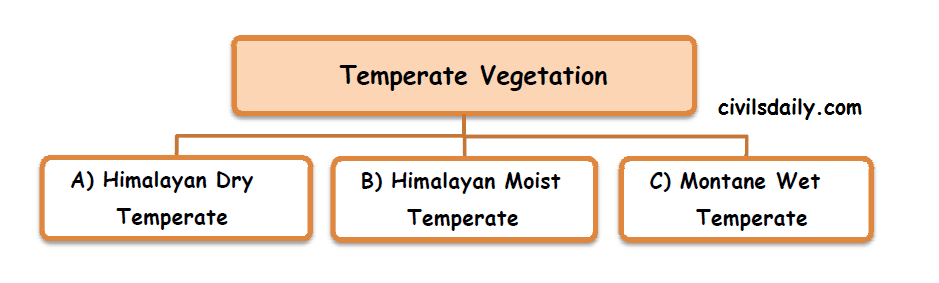
    5. Temperate Vegetation

    A. Himalayan Dry Temperate Vegetation

    • Distribution: It is found in the inner dry ranges of the western Himalayas.
    • Characteristic Features: It is predominantly a coniferous forest with xerophytic scrubs. Epiphytes and climbers are rare. [Coniferous trees are tall, straight with narrow needle like leaves. Most of the coniferous trees are evergreen but some like Larch are deciduous in nature]
    • Important Species are Chilgoza, Deodar, Oak, Maple, Ash, Olive etc.

    B. Himalayan Moist Temperate Vegetation

    • Distribution: In the western Himalayas between 1500m and 3000m.
    • Characteristic Features: The trees are 30 to 50m tall and undergrowth is mostly evergreen. Mosses and ferns grow freely on trees.
    • Important Species: Deodar, Spruce, Maple, Walnut, Poplar, Cedar, Chestnut, Birch, Oak etc.

    C. Montane Wet Temperate Vegetation

    • Distribution: In the eastern Himalayas, evergreen wet temperate forests occur between 1800m and 2700m of altitude. Nilgiris, the Annamalai and the Palni hills of south India also have this kind of forests above 1500m of altitude. The trees there are shorter, and the undergrowth is denser with abundance of epiphytes, mosses and ferns.
    • Characteristic Features: Rainfall is high, temperature is moderate in summer, and winter is cold. Rate of evaporation is not high. So trees do not shed their leaves annually, at least not at the same time.
    • Important Species: Oak, Poplar, Elm, Laurel, Maple, Birch, Alder, Magnolia

    6. Sub-Alpine and Alpine Vegetation

    • Distribution: It occurs above 2700m of altitude in the eastern Himalayas and above 3000m in the western Himalayas.
    • Important Species: It is a dense scrubby forest of Silver Fur, Juniper, Pine, Birch and Rhododendron.
    • Characteristic Features:
      1. The alpine forests give way to alpine grasslands through shrubs and scrub. These extend upwards up to the snowline.
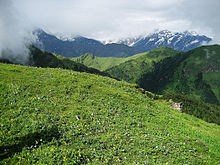
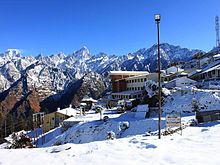
      2. Bugyals: Bugyals are high altitude alpine grasslands or meadows in Uttaranchal (at an elevation between 3400m and 4000m). These are referred to as ‘nature’s own gardens’. The topography of the terrain is either flat or sloped. The surface of these bugyals is covered with natural green grass and seasonal flowers. They are used by tribal herdsmen to graze their cattle. During the winter season the alpine meadows remain snow-covered. During summer months, the Bugyals present a riot of beautiful flowers and grass. Bugyals have a very fragile ecosystem. Some examples of Bugyals:
        • Auli (near Joshimath) – A premier skii range is located here.
        • Gorso
        • Kwanri Bugyal
        • Bedni
        • Panwali and Kush Kalyan
        • Dayara
        • Munsiyari Bugyal

    Auli Bugyal during summers

    Auli Bugyal during winters

    7. Littoral and Swamp Vegetation ( Mangrove Vegetation/ Tidal Forests)

    • Distribution: In the tidal deltas of Ganga, Mahanadi, Godavari and Krishna rivers, evergreen mangrove vegetation thrives. These areas have rainfall of more than 200cm.
    • Important Tree Species: Sundari, Agar, Bhendi, Keora, Nipa
    • Important Animal Species: Turtles, crocodiles, gharials and snakes are the common animals found in these forests. Royal Bengal Tiger is found in the tidal forests of Ganga delta.
    • Characteristic Features:
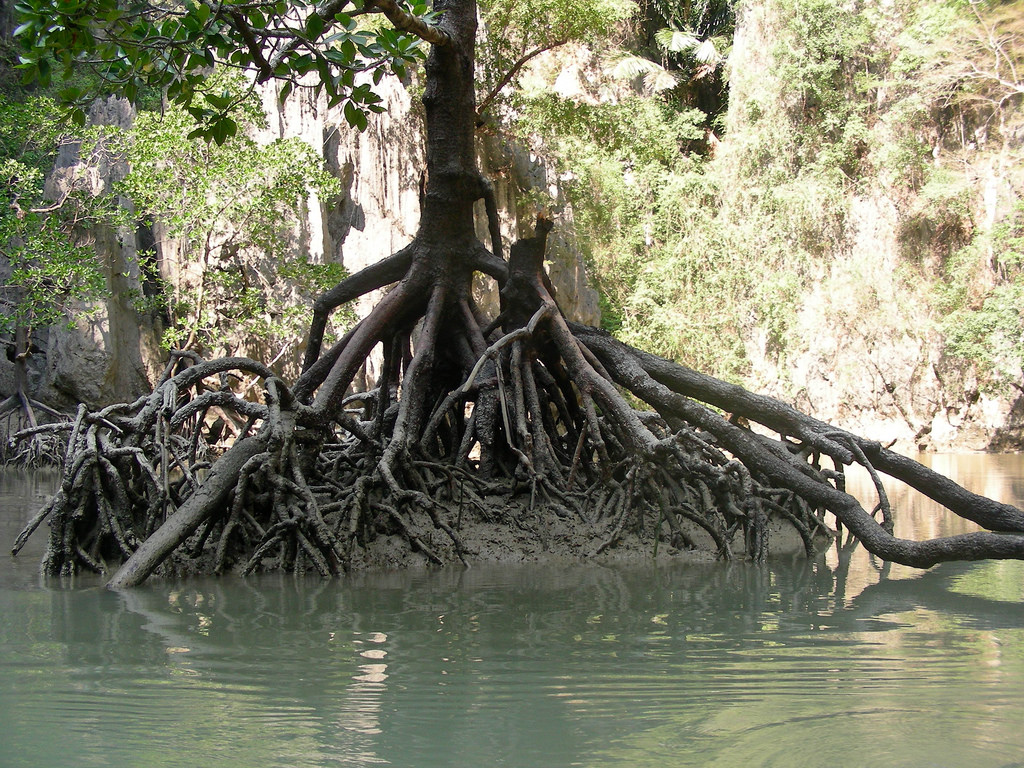
      • The trees are mainly evergreen. Typically they produce tangled webs of arching roots that are exposed during low tides.
      • This vegetation is an adaptation to two conditions:
        • High water salinity
        • Flooded at regular intervals
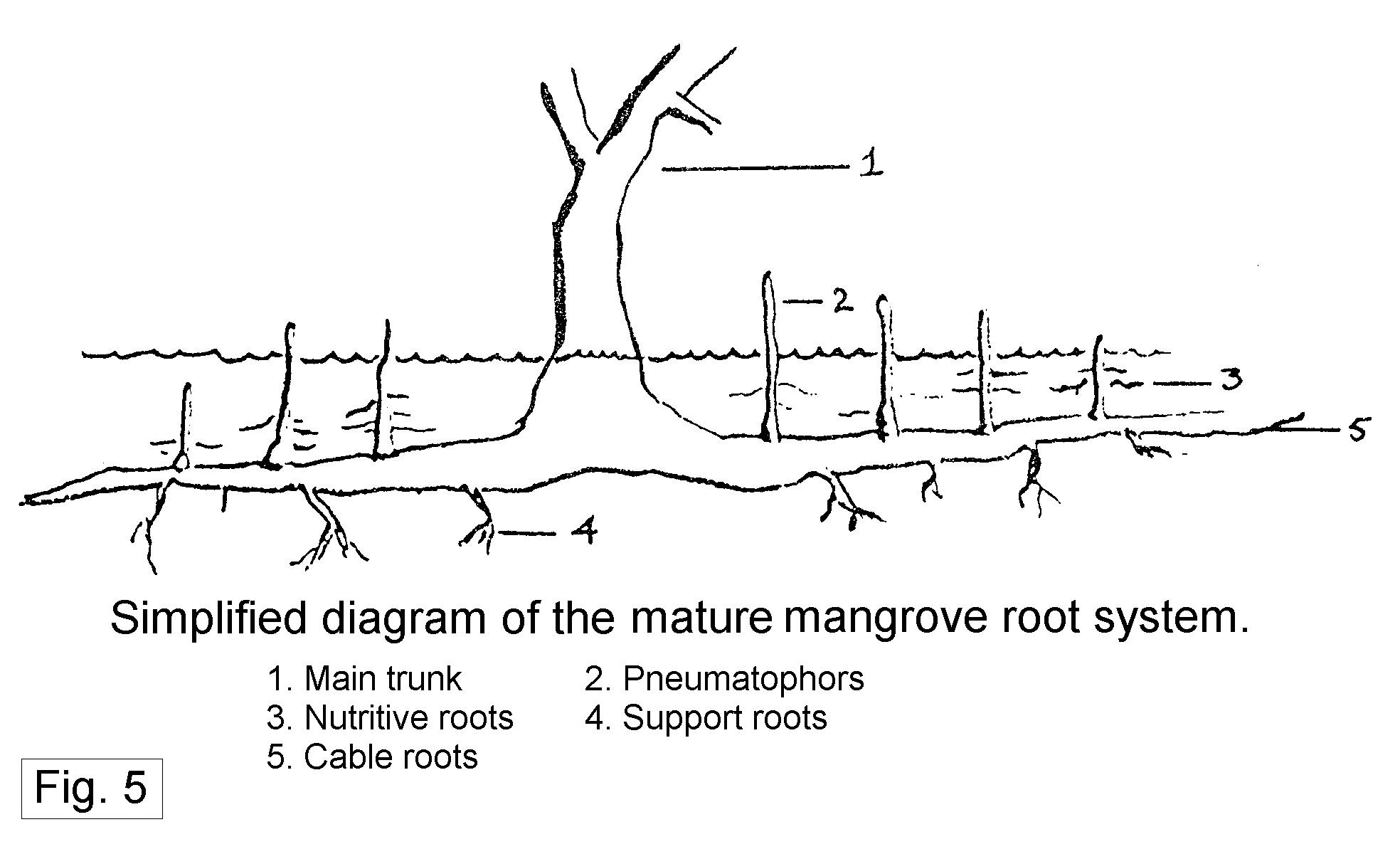
      • Prominent among these adaptations are the presence of stilt roots, buttress, pneumatophores etc.
        • Stilt roots (also called prop roots)- Stilt roots outgrow the trunk of the mangrove, branches or already existing stilt roots. As soon as stilt roots reach the ground the tip of the stilt root develops an underground root system with which it connects the stilt root into the ground and then develops one or more further stilt roots which grow arcuately into the air to again run into the ground to develop an underground root system, this process repeats several times.
          Source

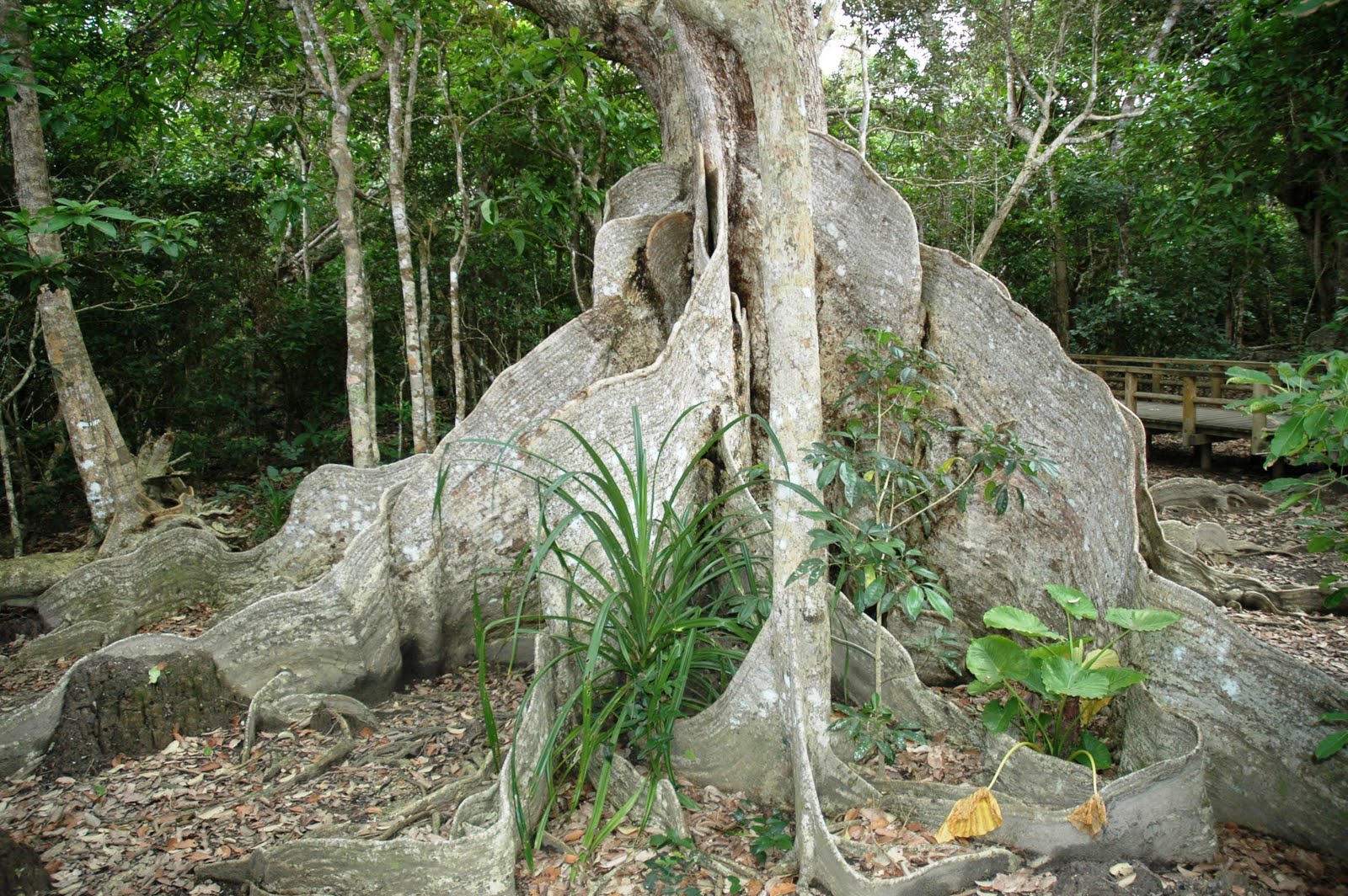
        • Buttress Roots – Buttress roots, developed by many trees concerning mangroves, provide stability to huge trees. The buttress roots can grow up to 10 meters in height. Buttress roots, also called buttresses do not continue their growth underground as they do above, underground buttresses develop a huge amount of small roots that grow in the soil under the buttress root.

          Source

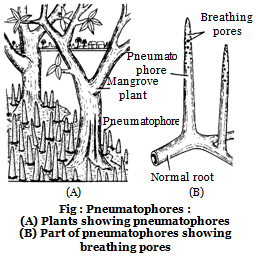
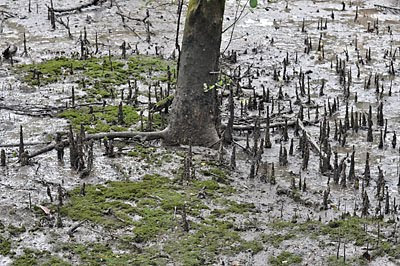
        • Pneumatophores – Because of waterlogged conditions, the roots are deprived of oxygen during high tides. Some mangrove roots extend vertically above the ground. These specialised roots are known as pneumatophores. These have pores which enable the trees to breathe when other roots are submerged under water during high tide.

          Source

          Sunderbans breathing roots

          Source

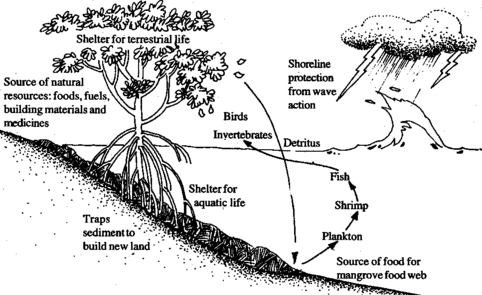
      • Mangrove shrubs, known best for a thriving aquatic life nurtured within their mesh of stilt-roots also serve a vital socio-economic function. They act as “green shields” buffering the coastline against sea erosion, and the potentially devastating impacts of cyclones and tsunami.
      • Mangroves support livelihood, essentially aquaculture, they supply medicinal plants, and fuel wood and construction materials. And in terms of ecological services, they stabilise shorelines, are nurseries for fishbreeding and filter heavy metals.

    Note:

    A study in November 2014 found mangrove patches in Karnataka. The Forest Survey of India missed recording these mangrove patches earlier as they were not large. According to the study, Karnataka has 300 hectares of mangrove forests spread over 3 coastal districts and a vibrant saline water ecosystem generally associated with India’s east coast. At the confluence of 4 rivers – Aghanashini, Gangavali, Sharavati and Venkatpura; and the Arabian Sea, is a long stretch of dense and tall mangrove vegetation locally known as Kandla or Sundar (Sundar is a well-known species of trees in mangrove forests after which the Sunderbans have been named). The study notes that while mangroves have been declining in several parts of the world from timber harvesting and pollution, these forests in Karnataka have in fact grown spatially over the last two decades.
    Grasslands in India:

    Owing to a short monsoon season followed by a long hot dry season, grasslands equivalent to Steppe/Pampas/Savanna are absent in India. The closed deciduous forest grades into thorny forest without an intermediate park like stage, and there is no steppe type of Grassland between the woodland and the desert.

    But locally available types of grassland are:

    1. Hilly/Upland Grassland:
      • Himalayas (generally above 1000m height)
      • Deccan Plateau Hills (Western Ghats in Karnataka where forests have been cleared)
      • Nilgiris have extensive grassy slopes (grass is often found interspersed with small isolated ‘shola’ forests*).
    2. Low Lands: in the plains of Punjab, Haryana, UP, Assam and Bihar.
    3. Riverine Grasses: These are found along the banks of the rivers which provide grazing facilities to cattle especially the bhabar pastures in northern India.

    *‘Sholas’ are the mixed dense forests of tropical evergreen and temperate evergreen rainforest species in the Nilgiri Hills. The patches of shola forests are found mainly in valleys and are usually separated from one another by undulating montane grassland. The shola and grassland together form the shola-grassland complex or mosaic.

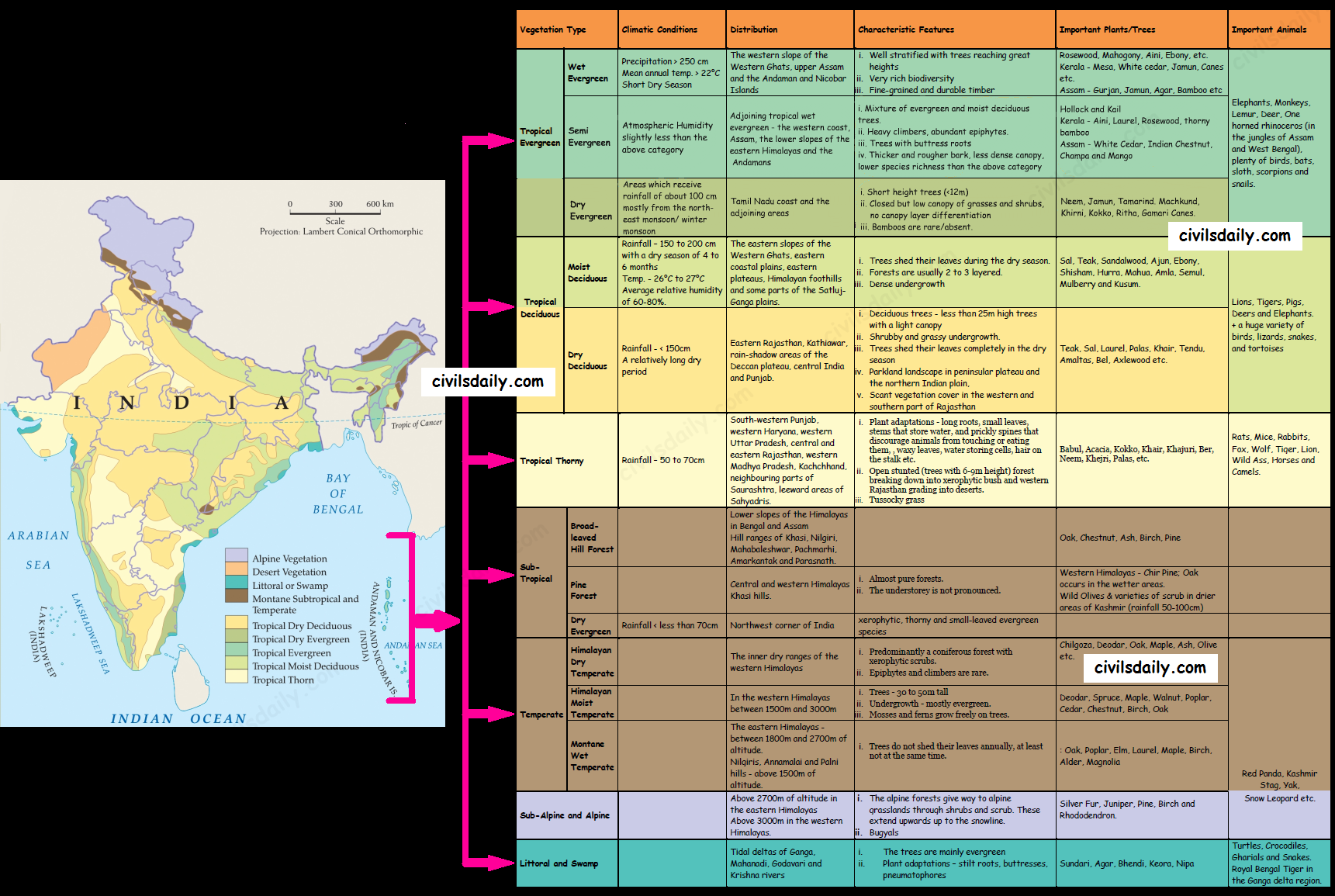
    Now that we are done with the vegetation types of India, expand the following image for a quick revision!

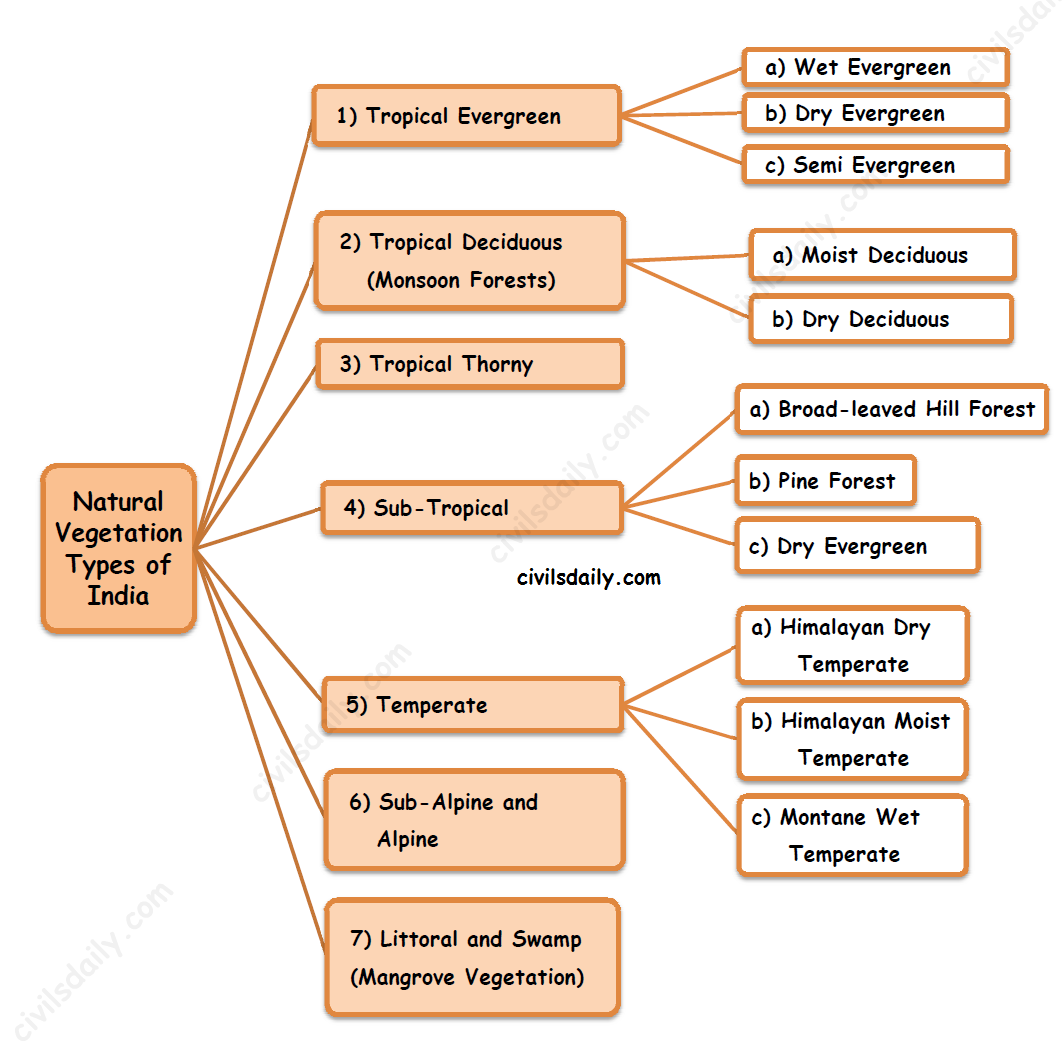
    The Vegetation Types of India
  • Natural Vegetation and Wildlife: Part 2 | Tropical Evergreen, Tropical Deciduous and Tropical Thorny Vegetation

    Moving on, let’s discuss the various natural vegetation types of India in detail:

    Natural Vegetation Types of India

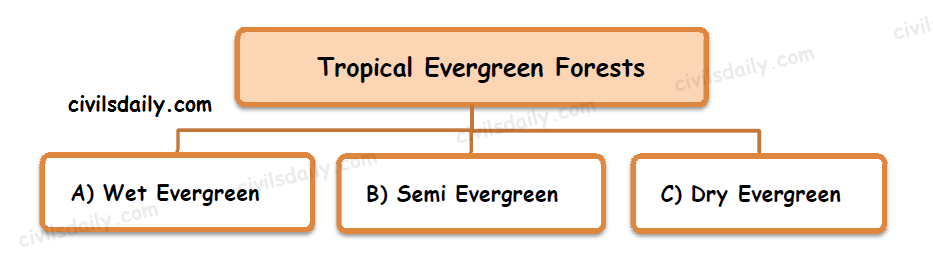
    1. Tropical Evergreen Forests

    ‘Evergreen’ because there is no definite time for trees to shed their leaves, flowering and fruition. As such these forests appear green all the year round.

    The common animals found in these forests are elephants, monkey, lemur and deer. The one-horned rhinoceros are found in the jungles of Assam and West Bengal. Besides these animals, plenty of birds, bats, sloth, scorpions and snails are also found in these jungles.

    A. Tropical Wet Evergreen Vegetation:

    • Distribution: These forests are found on the western slope of the Western Ghats, upper Assam through Cachar and the Andaman and Nicobar Islands.
    • Climatic Conditions: They are found in warm and humid areas with an annual precipitation of over 250 cm and a short dry season. The mean annual temperature here is above 22°C.
    • Characteristic Features:
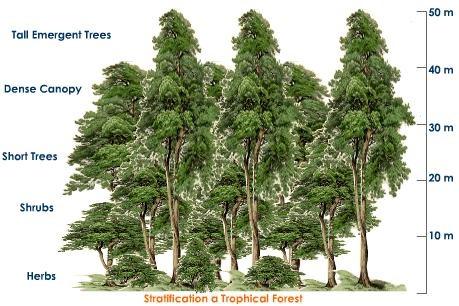
      • Tropical evergreen forests are well stratified, with layers closer to the ground covered with shrubs and creepers, followed by short structured trees, further followed by tall variety of trees.
      • In these forests, trees reach great heights up to 60 m or above.
      • Bounded by semi-evergreen forests on drier margins.
      • Very rich biodiversity.
      • Timber produced in these forests is fine-grained and durable.
    • Important Species found in these forests: Rosewood, Mahogony, Aini, Ebony, etc. Important species in Kerala are Mesa, White cedar, Jamun, Canes etc. Common species found in Assam forests are Gurjan, Jamun, Agar, Bamboo etc.

    B. Tropical Semi-Evergreen Vegetation:

    • Distribution: These forests occur in areas adjoining tropical wet evergreen, and form a transition between evergreen and moist deciduous forests. These forests occur on the western coast, in Assam, on the lower slopes of the eastern Himalayas and in the Andamans in the areas where precipitation and atmospheric humidity is slightly less than that in tropical evergreen vegetation area.
    • Characteristic Features:
      • Such forests have a mixture of evergreen and moist deciduous trees. The undergrowing climbers provide an evergreen character to these forests.
      • The climbers are heavy, bamboos are less prevalent and epiphytes are abundant. [Epiphytes – The plants which depend on other plants for mechanical support (and not for nutrients). e.g. lichens, mosses, orchids etc.]
      • The forest is dominated by a variety of large trees with a tendency to gregariousness (i.e. growing in groups that are close together)
      • Plant Adaptations in these areas:
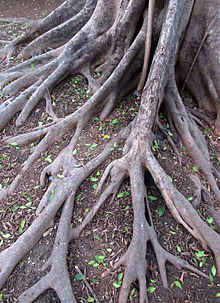
        • Buttresses – Many large trees have huge ridges called buttresses near the base that can rise 30 feet high before blending into the trunk. Buttress roots provide extra stability and increase the surface area of a tree so that it can ‘breathe in’ more carbon dioxide and ‘breathe out’ more oxygen. Typically, they are found in nutrient-poor rainforest soils and do not penetrate to deeper layers.

          Source. A buttress root system provides structural support.

          Big trees with buttress roots in tropical evergreen forest, India, Andaman Islands, Havelock Island. Source.

        • The bark is thicker and rougher, and the canopy is less dense than that in the previous type. Also, the canopies are not continuous and species richness is lower
    • Main species are white cedar, hollock and kail. Important Species in Kerala are Aini, Laurel, Rosewood, thorny bamboo, etc. Important species of northeastern India are White Cedar, Indian Chestnut, Champa and Mango.

    C. Tropical Dry Evergreen Vegetation:

    • Distribution: This type is confined to the Tamil Nadu coast and the areas which receive rainfall of about 100cm mostly from the north-east monsoon/winter monsoon (October-December).
    • The growth of evergreen forests in areas of such low rainfall arouses great botanical interest. This vegetation may be due to the seasonal distribution of rainfall (winter rainfall).
    • Characteristic Features of this vegetation:
      • Short height trees (<12m)
      • A closed but low canopy of grasses and shrubs.
      • No canopy layer differentiation.
      • Bamboos are rare /absent.
    • Important Species found in these forests: Neem, Jamun, Tamarind, Machkund, Khirni, Kokko, Ritha, Gamari Canes.
    • Most of the land under these forests has been cleared for agriculture or casuarinas plantations (Eucalyptus tree plantations)

    2. Tropical Deciduous Vegetation

    Also called the monsoon forests, these are the most widespread forests in India. The term ‘Deciduous’ refers to the ability of some plants to lose their leaves annually. They are spread over regions which receive rainfall between 70 and 200 cm.

    In these forests, the common animals found are lion, tiger, pig, deer and elephant. A huge variety of birds, lizards, snakes, and tortoises are also found here. [Currently, India is the only country on Earth confirmed to have both lions and tigers in its wilderness.]

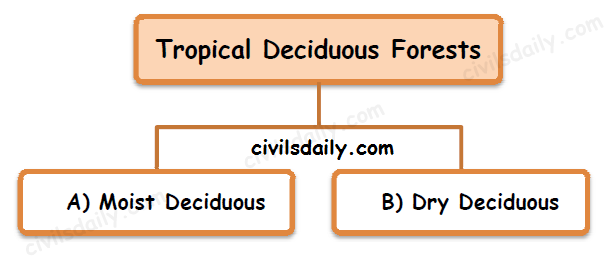
    On the basis of the availability of water, these forests are further divided into:

    A. Tropical Moist Deciduous Vegetation

      • Climatic Conditions: It thrives in areas having of moderate rainfall of 150-200 cm with a dry season of 4 to 6 months, a mean annual temperature of 26°C to 27°C and an average relative humidity of 60-80%. On the wetter margins, it has a transition to the tropical Semi-Evergreen Vegetation, while on the drier margins to the Tropical Dry Deciduous.
      • Distribution: It is found on the eastern slopes of the Western Ghats, eastern coastal plains, eastern plateaus, Himalayan foothills and in some parts of the Satluj-Ganga plains.
      • Characteristic Features:
        1. The trees shed their leaves during the dry season.
        2. These forests are usually 2 to 3 layered.
        3. Dense undergrowth
    • Important Species: The common trees are Sal, Teak, Sandalwood, Ajun, Ebony, Shisham, Hurra, Mahua, Amla, Semul, Mulberry and Kusum.

    B. Tropical Dry Deciduous Vegetation

    • Climatic Conditions: The dry deciduous trees grow in areas where rainfall is less than 150cm and the dry period is relatively long. On the wetter margins, it has a transition to the moist deciduous, while on the drier margins to thorn forests.
    • Distribution: It is found in Eastern Rajasthan, Kathiawar, rain-shadow areas of the Deccan plateau, central India and Punjab.
    • Characteristic Features:
      • These forests consist of trees less than 25m high, with a light canopy consisting of deciduous trees. The undergrowth is shrubby and grassy.
      • As the hot dry season begins (March-May), the trees shed their leaves completely and the forest appears like a vast grassland with naked trees all around.
      • In the higher rainfall regions of the Peninsular plateau and the northern Indian plain, these forests have a parkland landscape i.e. trees are more stunted and widely spaced and are interspersed with patches of grass.
      • In the western and southern part of Rajasthan, vegetation cover is very scanty due to low rainfall and overgrazing.
    • Important Species: Common plants are Teak, Sal, Laurel, Palas, Khair, Tendu, Amaltas, Bel, Axlewood etc.

    3. Tropical Thorny Vegetation

    • Climatic Conditions: In areas with 50-70cm of rainfall
    • Distribution: It is found in south-western Punjab, western Haryana, western Uttar Pradesh, central and eastern Rajasthan, western Madhya Pradesh, Kachchhand, neighbouring parts of Saurashtra, leeward areas of Sahyadris.
    • Characteristic Features:
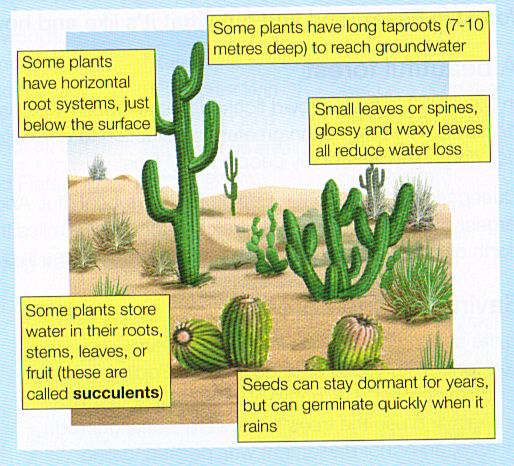
      • Plant life is highly specialized to adapt to the coarse and dry conditions in this area, with long roots, small leaves, stems that store water, and prickly spines that discourage animals from touching or eating them.
      • The natural vegetation consists of open stunted (trees with 6-9m height) forest breaking down into xerophytic bush and western Rajasthan grading into deserts.
      • In these forests, plants remain leafless for the most part of the year and give an expression of scrub vegetation.
      • Plant adaptations:
        • These xerophytic plants combat drought with certain devices of water preservation like partial or complete replacement of leaves by thorns, waxy leaves, water storing cells, hair on the stalk etc.
        • Tussocky grass grows up to a height of 2 m as the undergrowth.
        • Trees are scattered and have long roots penetrating deep into the soil in order to get moisture.
        • The stems are succulent to conserve water.
        • Leaves are mostly thick and small to minimize evaporation.

          Source

    • Important Species: Common species are Babul, Acacia, Kokko, Khair, Khajuri, Ber, Neem, Khejri, Palas, etc.
    • In these forests, the common animals are rats, mice, rabbits, fox, wolf, tiger, lion, wild ass, horses and camels.
  • Natural Vegetation and Wildlife- Part 1 | An Overview of Natural Vegetation Types Found in India

    Before we discuss the natural vegetation types found in India, let’s get acquainted with some basic terms:

    Flora, Vegetation and Forests:

    Flora refers to plants of a particular region or period, listed as a species and considered as a group. Likewise, fauna refers to the animal life, considered collectively, of any given period, environment or region.

    Vegetation, on the other hand, refers to the assemblage of plant species in a given environmental frame or ecological frame. It is broader than the term flora which refers to species composition. Further:

    • Natural vegetation includes that part of the plant life which grows in wild without human aid and adapts to constraints of the natural environment in size, structure and requirements. Thus cultivated crops and fruit orchards form a part of the vegetation but not natural vegetation.
    • That part of natural vegetation which has remained undisturbed by humans is referred to as virgin vegetation. It can be found in India in the inaccessible parts of the Himalayas, the Thar Desert and the Sunderbans. Elsewhere, human occupation has either transformed natural vegetation into cultivated vegetation or degraded the natural vegetation.
      • The virgin vegetation, which is purely Indian is known as endemic or indigenous species but that which has come from outside India is termed as exotic.

    Forest: The term forest implies ‘natural vegetation’ of the area, existing from thousands of years and supporting a variety of biodiversity, forming a complex ecosystem.

    Depending on the physical, geographical, climatic and ecological factors, there are different types of forests like evergreen forest (mainly composed of evergreen tree species i.e. species having leaves all throughout the year) and deciduous forest (mainly composed of deciduous tree species i.e. species which lose their leaves during particular months of the year). Each forest type forms a habitat for a specific community of animals that are adapted to live in it.

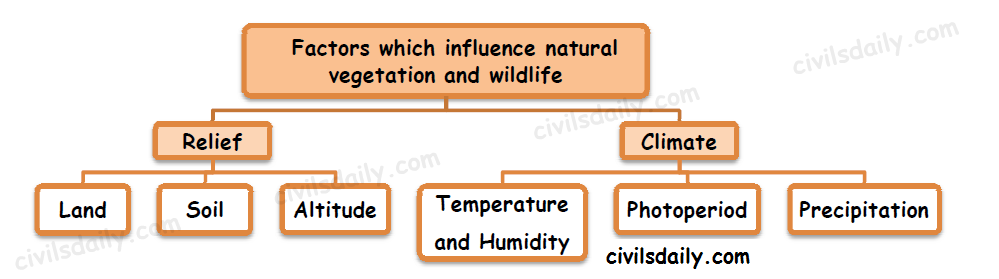
    Various factors which influence the type and distribution of natural vegetation and wildlife:

    • Land

    The nature of land affects the natural vegetation directly and indirectly. E.g. the type of vegetation in the mountainous regions is different than that in the plateau and plain areas. The fertile land is generally devoted to agriculture, while the undulating and rough terrains are areas where grassland and woodlands develop and give shelter to a variety of wildlife.

    • Soil

    Different types of soils provide basis for different types of vegetation. The sandy soils of the desert support cactus and thorny bushes while wet, marshy, deltaic soils support mangroves and deltaic vegetation. The hill slopes with some depth of soil have conical trees.

    • Temperature and Humidity

    Temperature and humidity are the main factors which determine the character and extent of vegetation. E.g. an area with high temperature and high humidity supports evergreen forest, while an area with high temperature and low humidity supports thorny bushes (desert).

    • Precipitation

    Areas of heavy rainfall have more dense vegetation as compared to other areas of less rainfall.

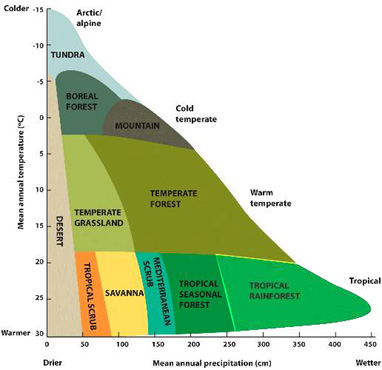
    See the following diagram to understand the combined effect of temperature and annual precipitation on the vegetation type of an area:

    Source
    • Photoperiod (Sunlight)

    Photoperiod, also called the light duration or day length, refers to the length of the light period as compared to the darkness within a day. The variation in photoperiod at different places is due to the differences in latitude, altitude, season and duration of the day. Due to longer duration of sunlight, trees grow faster in summer.

    • Altitude

    Increasing elevation causes a distribution of vegetation similar to that of increasing latitude. In general, ‘altitude mimics latitude’ and there occurs a close parallel between latitudinal and altitudinal zonation of climate and thus natural vegetation too. E.g. Mount Kenya in east Africa and Mount Chimborozo in Equador have their feet on the equator but their peaks are snow covered.

    It was Alexander Von Humboldt who first recognised the relationship between vegetation and altitude.

    Source

    The Forest Types of India:

    Since India is a land of various climatic regions, varied kinds of natural vegetation have developed here. Having said that, rainfall is more important than temperature (except in the Himalayas) in determining the vegetation distribution in India. The seasonal rainfall distribution/the length of the dry season also affect the vegetation distribution in an important way.

    In general, the following inter-relationship is observed in India:

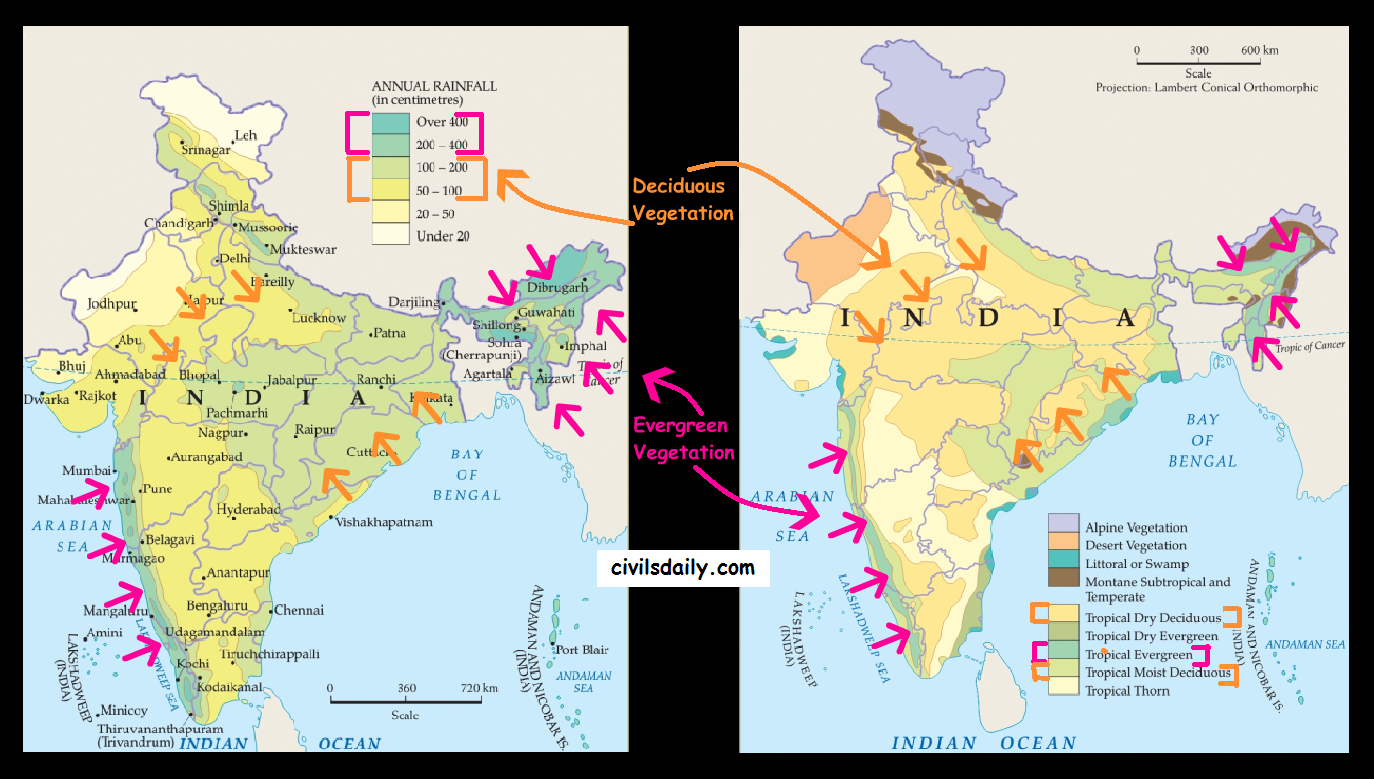
    Observe this broad relationship as highlighted in the following map:

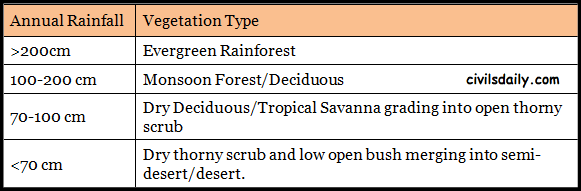
    High rainfall areas (>200cm) —> Evergreen forests grow in the high rainfall areas of the Western Ghats, North –eastern India and the Andaman and Nicobar Islands. These forests grow in areas where the monsoon period lasts for several months. There is no definite time for trees to shed their leaves, flowering and fruition. As such these forests appear green all the year round, hence the name evergreen.

    Moderate Rainfall Areas (70-200cm) —>Deciduous forests are found in regions with a moderate amount of seasonal rainfall that lasts for only a few months. Most of the forests in which Teak trees grow are of this type. The deciduous trees shed their leaves during the winter and hot summer months.

    Low Rainfall areas/ Semi-arid areas (<70cm) —> Thorn forests are found in the semi-arid regions of India. The trees, which are sparsely distributed, are surrounded by open grassy areas.

    Apart from these, mangroves forests grow along the coast, especially in the river deltas. These plants are uniquely adapted to be able to grow in a mix of saline and freshwater (will be taken up in detail in the following sections.)

  • The Southwest Monsoon Season (Jun – Sep) | Part 2

    India’s Climatic Calendar: The Southwest Monsoon Season

    Chief Characteristics of Monsoonal Rainfall:

    • Monsoonal rainfall is largely governed by relief or topography. For example:
      • The windward side of the Western Ghats registers a rainfall of over 250 cm.
      • The heavy rainfall in the north-eastern states can be attributed to their hill ranges and the Eastern Himalayas.
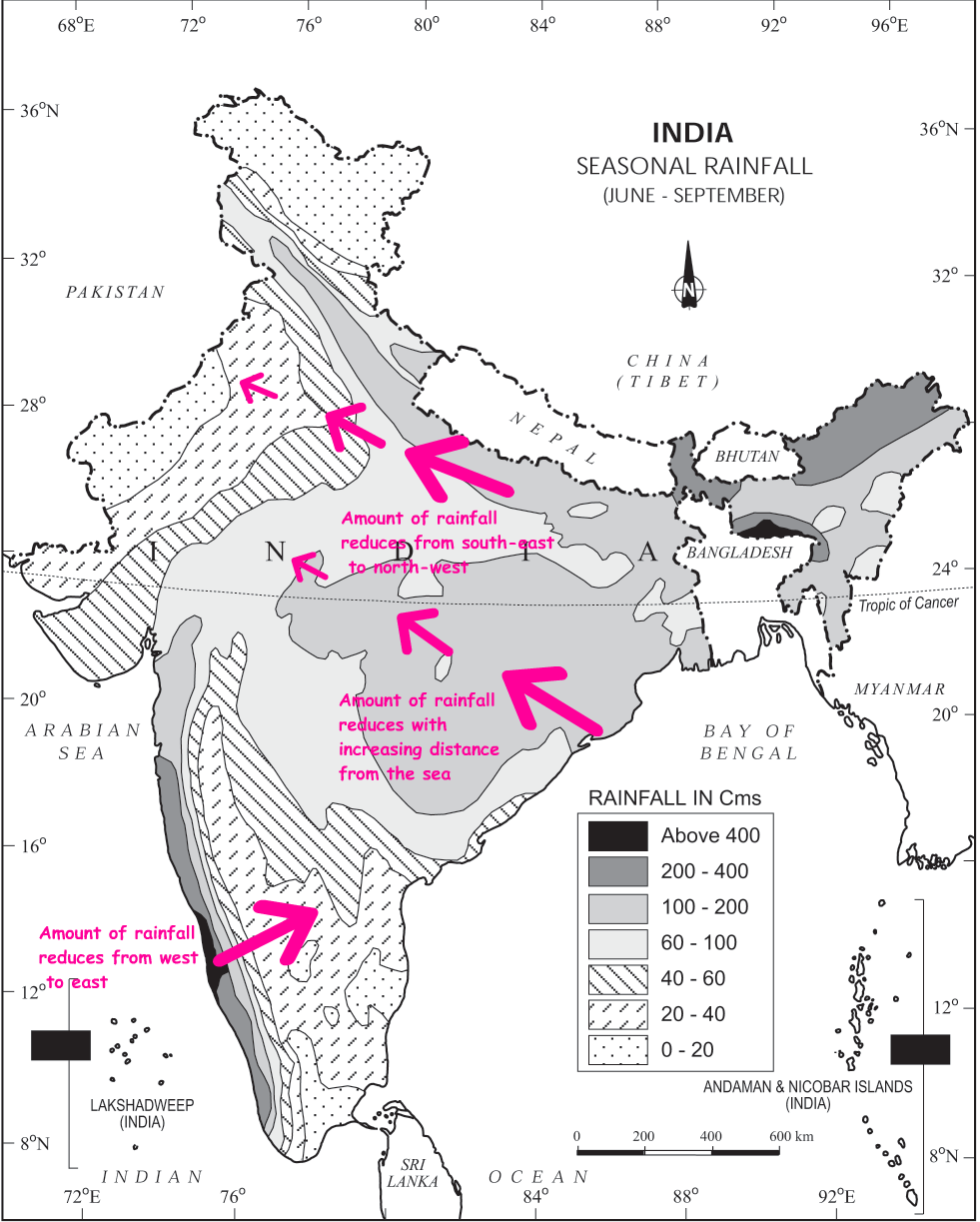
    • The monsoon rainfall has a declining trend with increasing distance from the sea. E.g. consider the amount of rainfall received during the south-west monsoon period at the following places:

    Kolkata (119 cm) –> Patna (105 cm) –> Allahabad (76 cm) –> Delhi (56 cm)

    • The rain comes in spells and displays a declining trend from west to east over the west coast, and from the south-east towards the north-west over the North Indian Plain and the northern part of the Peninsula.
    • Its spatial distribution is also uneven which ranges from 12 cm to more than 250 cm.
    Image Source: NCERT

    What causes monsoons?

    Monsoon is a familiar though a little known climatic phenomenon. Despite the observations spread over centuries, the monsoon continues to puzzle the scientists. Many attempts have been made to discover the exact nature and causation of monsoon, but so far, no single theory has been able to explain the monsoon fully.

    Let’s look at some of the important concepts about the origin of monsoons. We will study these along the following lines:

    1. The Classical Hypothesis
      • Halley(1690’s)
      • Hadley (1730’s)
    2. The role of moisture.
    3. The shifting of ITCZ – Flohn

    Recent theories:

    1. The role of Tibetan plateau
      • As a mechanical barrier
      • As a high-level heat source
    2. The role of jetstreams
      • The Sub-tropical/ tropical westerly jetstream
      • The tropical/ equatorial easterly jetstream

    1. The Classical Hypothesis

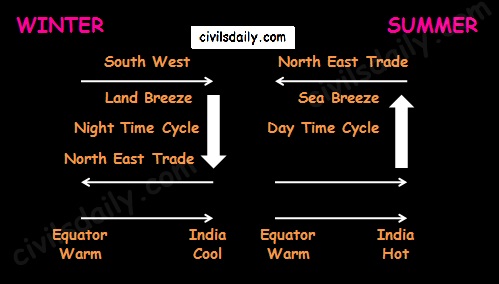
    Halley hypothesized that the primary cause of the annual cycle of Indian monsoon circulation was a differential heating effect between the ocean and land in South Asia.

    • During April and May when the sun shines vertically over the Tropic of Cancer, the large landmass in the north of Indian ocean gets intensely heated. This causes the formation of an intense low pressure in the northwestern part of the subcontinent.
    • The pressure in the Indian Ocean in the south of the landmass is high as water gets heated slowly.
    • This pressure differences causes the flow of winds from the high pressure to low pressure areas

    Thus the first model ever proposed about the mechanism of the Indian monsoon was Haley’s planetary scale sea-breeze – land breeze system in 1690’s.

    Image Source
    Indian Monsoon: Haley’s Planetary Scale Sea Breeze–Land Breeze Model

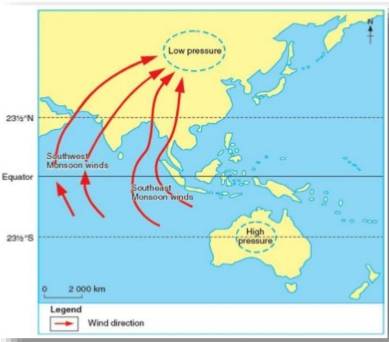
    Hadley later argued that Haley’s model was lacking in the physical ingredient of the effect of rotation of earth about its axis. Hadley reasoned that the monsoon originates in the SE trades of the southern hemisphere and as it flows across the equator towards the heated landmass, the coriolis force causes it to turn to right, thereby forming the summer monsoon or the SW monsoon.

    Image Source

    2. The role of moisture:

    Moisture plays an important role in the atmospheric circulation which was not appreciated by either Halley or Hadley.

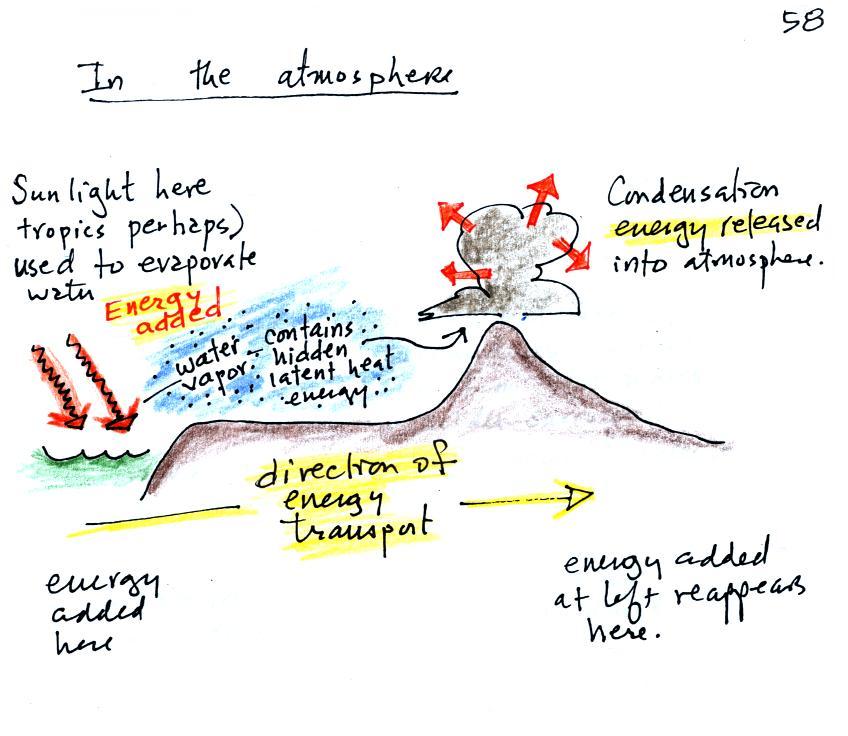
    In this respect, the release of latent heat augments the differential heating produced by the land-sea contrast by providing a mechanism for the solar energy received over the vast stretches of the Indian Ocean to be collected, stored, concentrated and later released over the parched landscape of India by a massive atmospheric motion (See the following image to understand this transfer of solar energy) . As the moisture laden air comes over India, with its upliftment there takes place condensation releasing latent heat – augmenting the low pressure conditions i.e. the cause getting augmented by its effect.

    Image Source

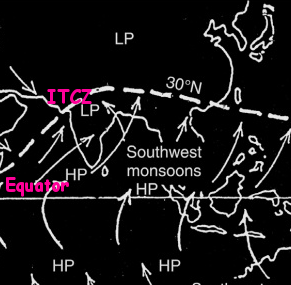
    The shifting of ITCZ – Dr. Flohn

    The existence of Asian monsoon according to Dr. Flohn is not due to the temperature contrast between land and sea but primarily due to the annual migration of thermally induced planetary winds and pressure belts. For Flohn, the winter monsoon is nothing but the tropical easterlies or the northern trade winds. According to Flohn, the SW monsoon is constituted by the equatorial westerlies which have been displaced northward (because of shift of ITCZ by 20° or more).

    Shifting of the ITCZ and the Indian Monsoon – Dr. Flohn

    Recent Theories:

    1. The role of Tibetan Plateau:

    A remarkable aspect of the large scale circulation during the summer monsoon season over south-Asia is the upper tropospheric anti-cyclone situated over the Tibetan Plateau.

    • The Tibetan Plateau located more than 4500m above mean sea-level with a length of 2000km and width of 600km in the west and 1000km in the east, is considered to be one of the key factors in the development of monsoon circulation in the region.
    • The Tibetan plateau exerts its influence both as a mechanical barrier in the atmospheric flow as well as a high level heat source.
    • An anti-cyclone appears in the upper troposphere over Tibet during the Indian monsoon season primarily due to latent and sensible heating over the plateau.
    • This anti cyclone appears over south-east Asia in the month of May and then moves north-westwards, reaching Tibetan plateau around the height of the summer monsoon season.
    • From about September, the anticyclone migrates south-eastward towards Indonesia and loses definition after October.
    • Variations in the intensity and position of this High and its orientation have been found to be closely related to the monsoon circulation over South Asia.

    The role of Jet streams:

    Jet streams which affect India’s monsoon:

    1. Sub tropical/ Tropical Westerly Jet stream (TWJS) ~27°N

    • (Covered in detail in the discussion on winter season. Need to revise? Click here!)
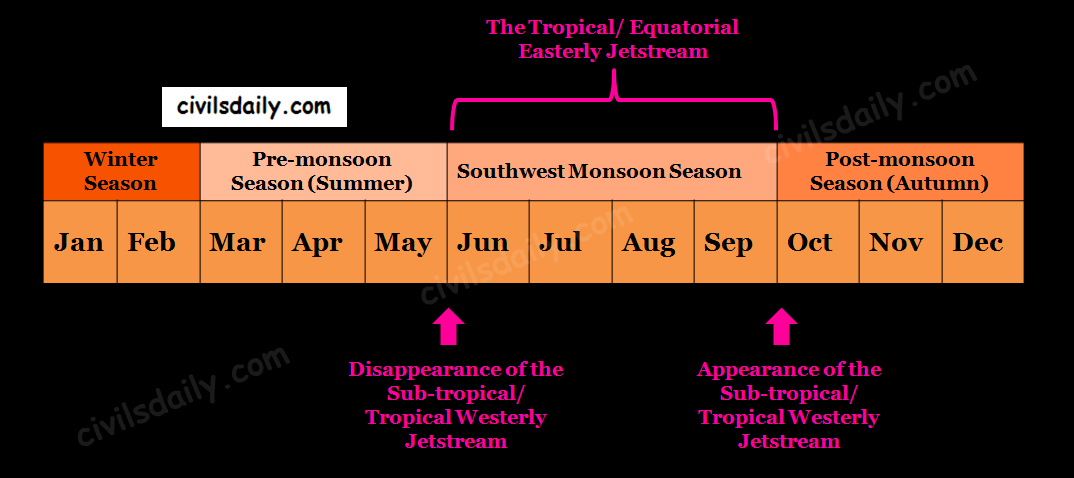
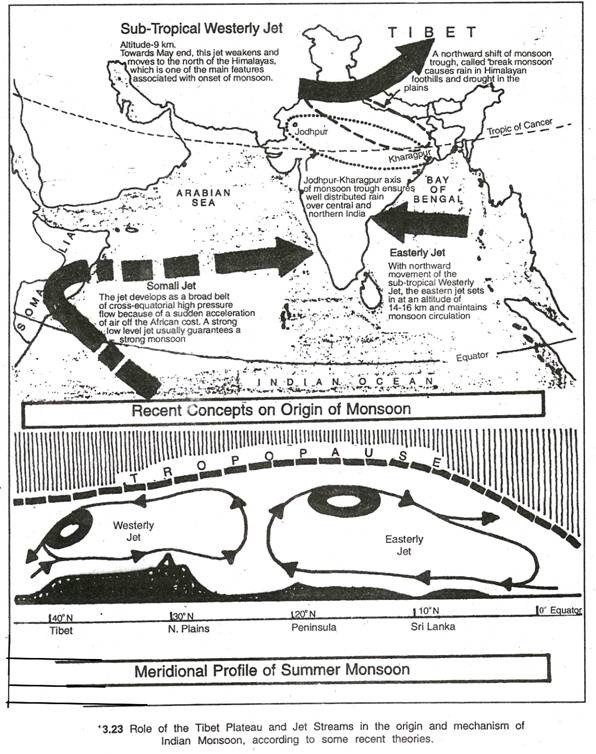
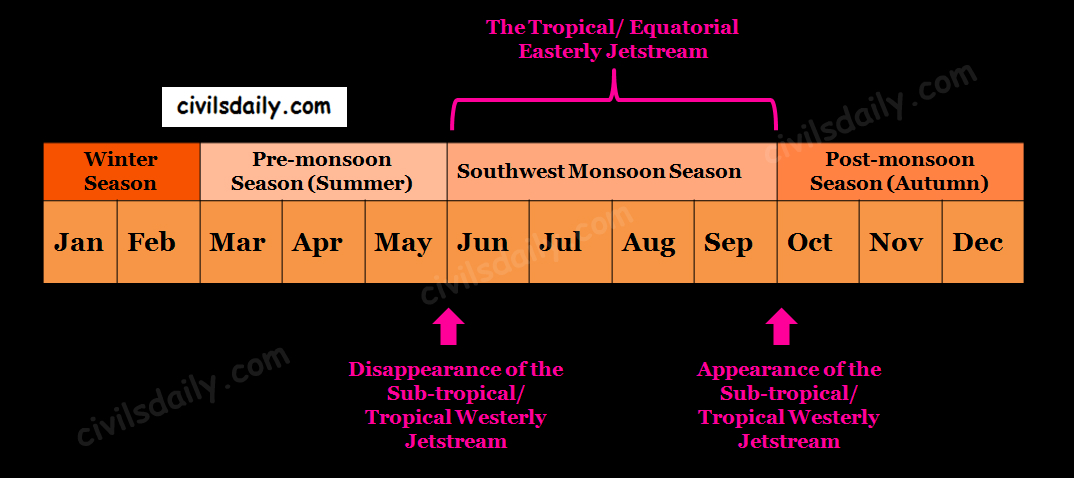
    • According to Dr. Koteshwaram, the disappearance of this jet from the south of the Himalayas paves the way for the burst of South-West Monsoon along the coast of Kerala.

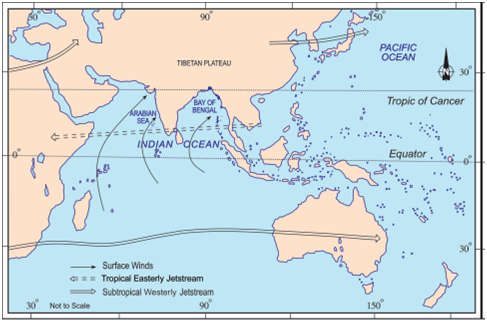
    2. Tropical/ Equatorial Easterly Jet stream (TEJS) ~14°N

    • This jet is a prominent feature of the upper air circulation during the Indian summer monsoon season (June – September). It appears as a band of strong easterlies extending from SE Asia across the Indian Ocean and Africa to the Atlantic, generally at a height of about 14 kms. It is present over south Indian peninsula between 12° and 15°N with a mean position of 14°N. This easterly jet stream is held responsible for the burst of the monsoon in India.
    • The position and speed of this jet have been found to have significant spatial and temporal fluctuations, which in turn correlate with monsoon rainfall distribution over peninsular India.

    The Subtropical Westerly Jetstream and the Tropical Easterly Jetstream

    Factors which influence the South-West monsoon intensity and rainfall distribution:

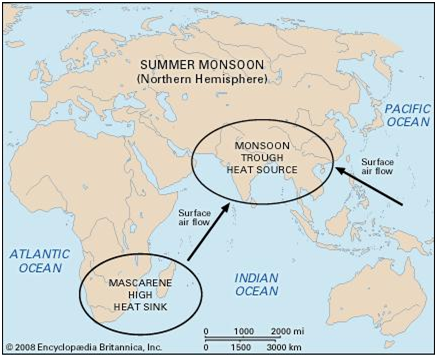
    • Mascarene High and the Somali Jetstream: It is the high pressure area at sea level south of the equator in the Indian Ocean near Mascarene Islands. The position and intensity of this high are considered to be closely linked to the south summer monsoon activity.

    According to scientists, the broad belt of high pressure around the Mascarene Islands generates a cross-equatorial flow known as the Somali Jet which brings heavy rain to India’s west coast. A strong, low level jet usually means a strong monsoon over peninsular India.

    Image Source

    • Variation in the axis of the monsoon trough: The monsoon trough axis experiences considerable day to day variation in its position, which has a vital bearing on the monsoon rainfall distribution in the region. During the break monsoon periods, when there is a temporary lull in monsoon activity, the trough line shifts to the foothills of the Himalayas. Rainfall over the central parts of India decreases considerably and there is an increase in rainfall over northern India along the Himalayan foothills.
    • Teleconnections (ENSO – ElNino and Southern Oscillation Index):

    A. Southern Oscillation Index (SOI)

      • A curious see-saw pattern of meteorological changes has been observed b/w Indian Ocean & Pacific ocean. Whenever pressure is higher over Indian Ocean, low pressure prevails over Pacific Ocean & vice versa. This see-saw relationship is referred to as the Southern Oscillations.
      • To measure this pressure difference, a SOI has been developed based on the pressure data at certain representative stations (e.g. the SOI between Tahiti island and Darwin is the most widely used)

    SOI (Southern Oscillation Index) = (Atm. Pressure @Tahiti) – (Atm. Pressure @Darwin)

    Tahiti = Pacific Ocean, Darwin = Indian Ocean

    B. El-Nino (Spanish for male child)

      • It is an anomalous warming of the Eastern Tropical Pacific Ocean that occurs at 2 – 10 years intervals and is frequently associated with far reaching climatic and oceanic impacts around the world.

    These two are believed to be inter-connected – the southern oscillation has been identified as the atmospheric counterpart to El-Nino. Both are together referred to as ENSO.

    During the high southern oscillation phase (Normal situation), precipitation tends to be abundant in the Indonesian – Australian region, most of the south Asian region, SE Africa and northern coast of South America. Relatively dry conditions prevail over the equatorial pacific, east central Africa and northern Mexico.

    During the low phase of the southern oscillation (El-Nino), the rainfall anomalies are approximately opposite. The El-Nino is found to be adversely correlated with the SW monsoon rain.

    La-Nina (Spanish for girl child) refers to the reinforced normal situation and is found to be positively correlated with the SW monsoon rain.

    Image Source

  • The Southwest Monsoon Season (Jun – Sep) | Part 1

    India’s Climatic Calendar: the South-West Monsoon Season

    Temperature Conditions during this season:

    As the sun shifts northwards, the temperature rapidly increases especially in the northern India.

    The wind circulation over the subcontinent undergoes a complete reversal at both, the lower as well as the upper levels. Let’s see how:

    Distribution of air pressure and winds on the surface of the earth:

    • As a result of rapid increase in temperature in May over the north-western plains, the low-pressure conditions over there get further intensified.
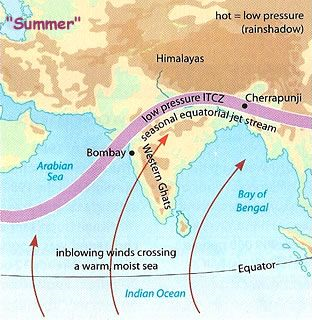
    • Because of the heating of the subcontinent, by the middle of July, the low-pressure belt near the surface [termed as Inter Tropical Convergence Zone (ITCZ)] shifts northwards, roughly parallel to the Himalayas between 20° N and 25° N. The ITCZ in this position is sometimes called the monsoon trough.

    [Revision Note: ITCZ is the low-pressure zone located at the equator where the trade winds converge. It is also referred to as the thermal equator. It is a zone of generally calm, hot, rising air and low pressure.]

    • Roughly, this elongated low-pressure monsoon trough extends over the Thar desert in the north-west to Patna and Chotanagpur plateau in the east-southeast.
    • Meanwhile, the sea surrounding India heats up slowly, creating a zone of relatively high pressure off India’s Southern Coastline.
    • Next, because winds blow from high to low pressure, warm moisture-laden air moves south-westerly direction from the sea over to India in the north and North East and is deflected by the Coriolis force as the Earth spins. It is this moist air current which is popularly known as the south-west monsoon.

    Image Source

    Jet Stream and Upper Air Circulation:

    • By this time, the westerly jet stream withdraws from the Indian region. In fact, meteorologists have found an interrelationship between the northward shift of the equatorial trough (ITCZ) and the withdrawal of the westerly jet stream from over the North Indian Plain. It is generally believed that there is a cause and effect relationship between the two.
    Indian Monsoons: Jetstreams and the Shifting of ITCZ
    • An easterly jet stream flows over the southern part of the Peninsula in June and has a maximum speed of 90 km per hour. In August, it is confined to 15°N latitude, and in September up to 22° N latitudes. The easterlies normally do not extend to the north of 30° N latitude in the upper atmosphere.
    Image Source: NCERT

    Easterly Jet Stream and Tropical Cyclones: [The tropical cyclones were discussed in detail in the discussion on summer season. Remember? Revise here before moving forward!]

    • The easterly jet stream steers the tropical depressions into India.
    • These depressions play a significant role in the distribution of monsoon rainfall over the Indian subcontinent. The tracks of these depressions are the areas of highest rainfall in India.
    • The frequency at which these depressions visit India, their direction and intensity, all go a long way in determining the rainfall pattern during the south-west monsoon period.

    The onset and progress of South-West Monsoon in India:

    1. Entry of Monsoon into India:

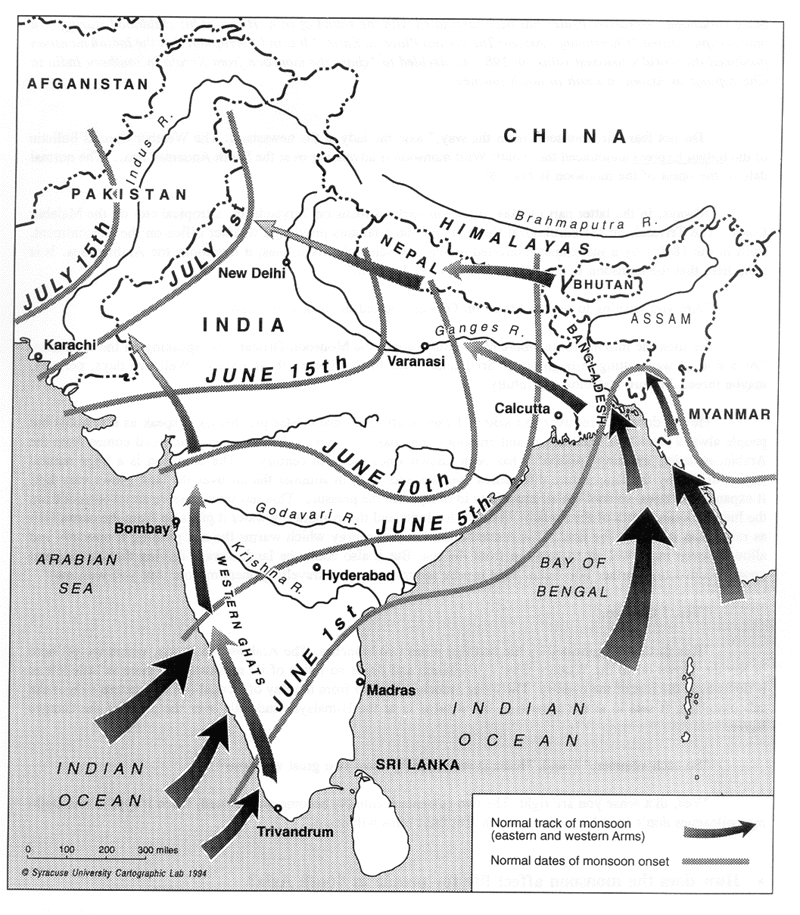
    • The rain in the south-west monsoon season begins rather abruptly. This sudden onset of the moisture-laden winds associated with violent thunder and lightning is often termed as the “break” or “burst” of the monsoons.
    • The mean date for the burst of monsoon along the coast of Kerala is 1 first June with a coefficient of variation of a week. It reaches the interior parts of the country by the first week of July. By mid-July, south-west monsoon engulfs the entire subcontinent.

    Image Source

    • Impact of this rainfall: One result of the first rain is that it brings down the temperature substantially. The day temperature registers a decline of 5°C to 8°C between mid-June and mid-July.

    2. The progress of monsoons: As these winds approach the land, their south-westerly direction is modified by:

    • The relief, and
    • The thermal low pressure over the north-west India.

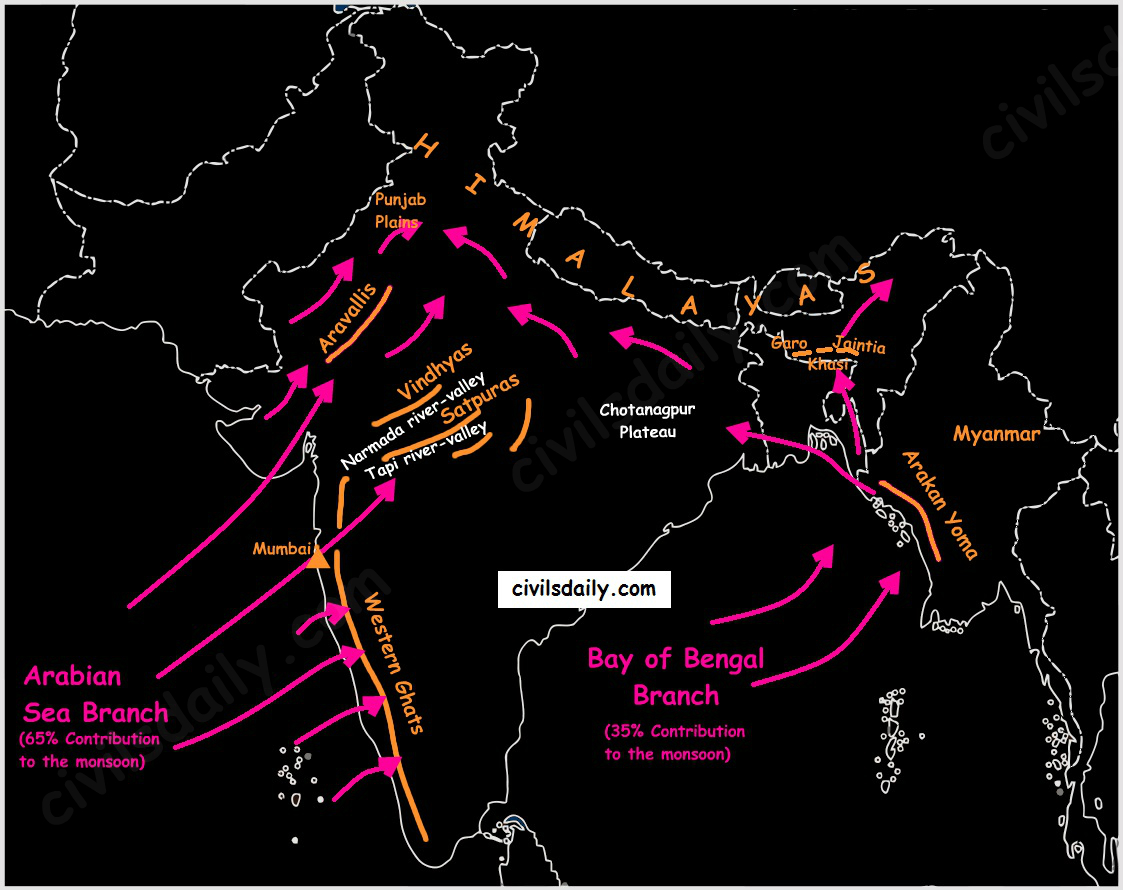
    The monsoon approaches the landmass in two branches:

    • The Arabian Sea branch
    • The Bay of Bengal branch.
    Indian Monsoons: the Arabian Sea Branch and the Bay of Bengal Branch

    The Arabian Sea branch:

    The monsoon winds originating over the Arabian Sea further split into three branches:

    1. One branch is obstructed by the Western Ghats.
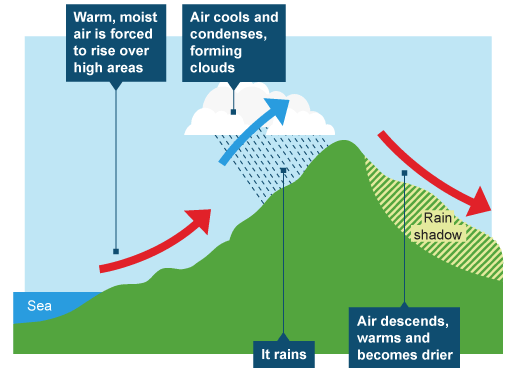
      • As these winds climb the slopes of the Western Ghats, they become cooler, their moisture retention capacity reduces and as a result, the windward side of the Sahyadris and Western Coastal Plain receive very heavy rainfall ranging between 250 cm and 400 cm.
      • Much of the rainfall along the Western Ghats is thus orographic, as the moist air is obstructed and forced to rise along the Ghats.
      • After crossing the Western Ghats, these winds descend and get heated up. This reduces humidity in the winds. As a result, these winds cause little rainfall east of the Western Ghats. This region of low rainfall is known as the rain-shadow area.

    Image Source

    1. Another branch of the Arabian Sea monsoon strikes the coast north of Mumbai. Moving along the Narmada and Tapi river valleys, these winds cause rainfall in extensive areas of central India. The Chotanagpur plateau gets 15 cm rainfall from this part of the branch. Thereafter, they enter the Ganga plains and mingle with the Bay of Bengal branch.
    2. The third branch of this monsoon wind strikes the Saurashtra Peninsula and the Kachchh. It then passes over west Rajasthan and along the Aravallis, causing only a scanty rainfall. In Punjab and Haryana, it too joins the Bay of Bengal branch. These two branches, reinforced by each other, cause rains in the western Himalayas.

    Note: Though this branch passes through Rajasthan, it does not cause rainfall there. This is because:

    • The direction of Aravallis is parallel to these monsoon winds.
    • The dry and hot winds from the Sindh region of Pakistan lessen the relative humidity of these monsoon winds and do not allow them to get saturated.

    The Bay of Bengal branch:

    • The Bay of Bengal branch strikes the coast of Myanmar and parts of south-east Bangladesh. But the Arakan Hills along the coast of Myanmar deflect a big portion of this branch towards the Indian subcontinent.
    • The monsoon, therefore, enters West Bengal and Bangladesh from the south and south-east instead of from the south-westerly direction.
    • From here, this branch splits into two under the influence of the Himalayas and the thermal low in north-west India.
      • One branch moves westward along the Ganga plains reaching as far as the Punjab plains.
      • The other branch moves up the Brahmaputra valley in the north and the northeast, causing widespread rains.
        • Its sub-branch strikes the Garo and Khasi hills of Meghalaya. The hills of Garo, Khasi and Jaintia are expanded in a funnel shape with an opening towards the sea. So the moist winds coming from the Bay of Bengal undergo a sudden rise here and cause excessive rainfall. Mawsynram, located on the crest of Khasi hills, receives the highest average annual rainfall in the world (1141cm).
        • There is relatively less rainfall on the leeward slope of the Meghalaya Plateau e.g. 143 cm in Shillong and 161 cm in Guwahati which is very less in comparison to that in Mawsynram.
        • The Brahmaputra valley to the north also experiences a rain-shadow effect; the problem is mitigated, however, by the adjacent Himalayas, which cause the winds to rise again, thereby establishing a parallel belt of heavy precipitation.

    Note:

    • The Arabian Sea branch is stronger than the Bay of Bengal branch. 65% of the humidity brought by the monsoon comes from the Arabian Sea whereas the monsoon coming from the Bay of Bengal contributes only 35% to the humidity.
    • In the Gangetic Plains, the two branches merge into one. By the time they reach the Punjab their moisture is largely spent. The gradual reduction in the amount of rainfall toward the west is evidenced by the decline from 162 cm at Kolkata to 66 cm at Delhi and to desert conditions still farther west.
    • Over the north-eastern portion of peninsular India, the two branches also intermittently collide, creating weak weather fronts with sufficient rainfall to produce patches of fairly high precipitation (more than 152 cm) in the Chotanagpur plateau.

    Here it is important to know why the Tamil Nadu coast remains dry during this season.

    It is because:

    • The Tamil Nadu coast is situated parallel to the Bay of Bengal branch of south-west monsoon.
    • It lies in the rain-shadow area of the Arabian Sea branch of the south-west monsoon.

    3. Break in the Monsoon

    During the south-west monsoon period after having rains for a few days, if rain fails to occur for one or more weeks, it is known as ‘break’ in the monsoon. These dry spells are quite common during the rainy season.

    Reasons:

    • These breaks in rainfall are related to the cyclonic depressions mainly formed at the head of the Bay of Bengal, and their crossing into the mainland. Besides the frequency and intensity of these depressions, the passage followed by them determines the spatial distribution of rainfall.
    • In northern India rains are likely to fail if the rain-bearing storms are not very frequent along the monsoon trough or the ITCZ over this region.
    • Over the west coast, the dry spells are associated with days when winds blow parallel to the coast.

    4. The Withdrawal of the SW monsoon:

    The withdrawal of the SW monsoon and the onset of the NE monsoon in the end of September are a gradual phenomenon. They take place almost at the same time and tend to merge. This explains the popularity of the phrase “Retreating Monsoon”. This will be taken up in detail in the discussion on Autumn Season.

  • The Winter Season (January – February)

    India’s Climatic Calendar – the Winter Season

    Temperature Conditions during this season:

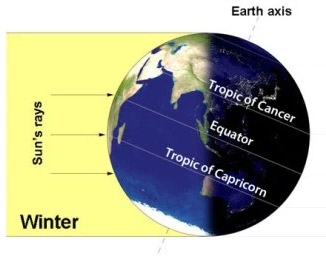
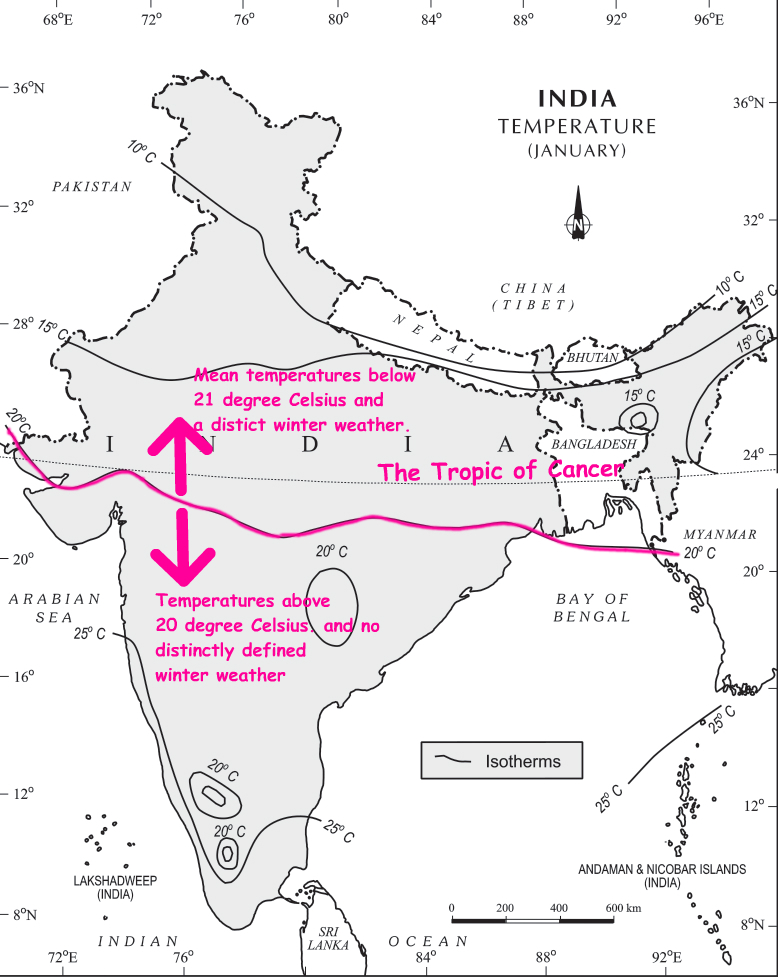
    By the end of December (22nd December), the sun shines vertically over the Tropic of Capricorn in the southern hemisphere. So, India which is located in the northern hemisphere experiences low temperatures. January and February are the coldest months over most parts of the country.

    Image Source

    The isotherm of 20°C runs roughly parallel to the Tropic of Cancer.

    The northern region:

    This season usually begins in late-November in northern India. Lowest temperatures are observed in Punjab and Rajasthan. December and January are the coldest months in the northern plain. The night temperature may be quite low, sometimes going below freezing point in Punjab and Rajasthan.

    There are three main reasons for the excessive cold in north India during this season:

    • States like Punjab, Haryana and Rajasthan being far away from the moderating influence of sea experience continental climate.
    • The snowfall in the nearby Himalayan ranges creates cold wave situation; and
    • Around February, the cold winds coming from the Caspian Sea and Turkmenistan bring cold wave along with frost and fog over the northwestern parts of India.

    The peninsular region:

    The Peninsular region of India, however, does not have any well-defined cold weather season. There is hardly any seasonal change in the distribution pattern of the temperature in coastal areas because of:

    • Moderating influence of the sea, and
    • Proximity to the equator.

    Distribution of air pressure and winds on the surface of the earth:

    In winter months, the weather conditions over India are generally influenced by the distribution of pressure in the Central and Western Asia.

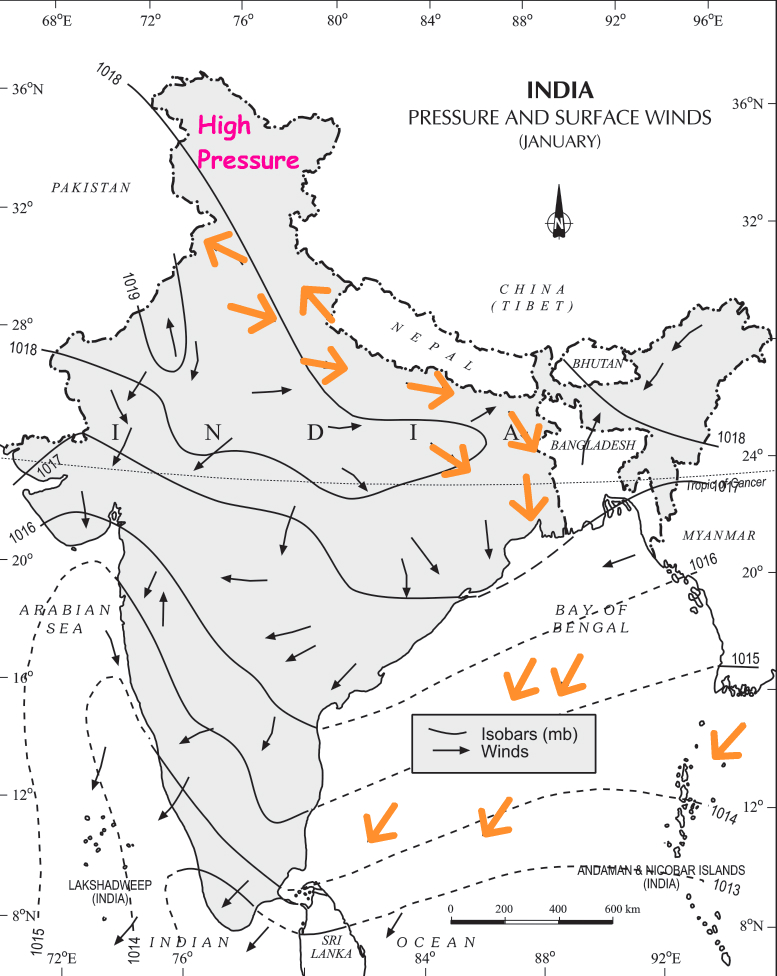
    • A high-pressure centre in the region lying to the north of the Himalayas develops during winter.
    • This centre of high pressure gives rise to the flow of air from the north towards the Indian subcontinent, south of the mountain range.
    • These surface winds blowing out of the high-pressure centre over Central Asia reach India in the form of a dry continental air mass.
    • These continental winds come in contact with trade winds over northwestern India. The position of this contact zone is not, however, stable. Occasionally, it may shift its position as far east as the middle Ganga valley with the result that the whole of the northwestern and northern India up to the middle Ganga valley comes under the influence of dry northwestern winds.
    • In south India, the air pressure is slightly lower (due to higher temperatures). As a result, winds start blowing from northwestern high-pressure zone to the low air pressure zone over the Indian Ocean in the south. Due to a low pressure gradient, the light winds blow outwards with a low velocity of about 3-5 km per hour.
    • By and large, the topography of the region influences the wind direction (See the following map):
      • They are westerly or northwesterly down the Ganga Valley.
      • They become northerly in the Ganga-Brahmaputra delta.
      • Free from the influence of topography, they are clearly north-easterly over the Bay of Bengal.
    • These land bearing winds being cold and dry don’t give rain over most parts of the country. However, these winds cause rain along the Coromandel Coast since they collect moisture on their way over the Bay of Bengal.

      Image Source – NCERT ClassXI

    Jet Stream and Upper Air Circulation:

    Higher up in the atmosphere, a different pattern of air circulation is observed during the winter months:

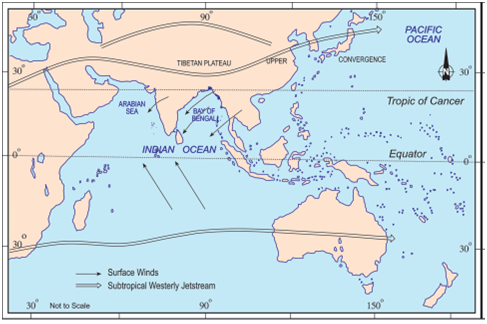
    • All of Western and Central Asia remains under the influence of westerly winds along the altitude of 9-13 km from west to east. These winds blow across the Asian continent at latitudes north of the Himalayas roughly parallel to the Tibetan highlands. These are known as the sub-tropical/tropical westerly jet stream.
    • Tibetan highlands act as a barrier in the path of these jet streams. As a result, jet streams get bifurcated. One of its branches blows to the north of the Tibetan highlands, while the southern branch blows in an eastward direction, south of the Himalayas, later recombining into a single stream over China.
    • It is believed that this southern branch of the jet stream exercises an important influence on the winter weather in India.
    • The mean position of this jetstream is about 25°N.
    Image Source: NCERT Class 9
    • This jetstream first appears over the northern parts of the Indian subcontinent in the month of October after the withdrawal of the summer monsoon and shifts progressively southwards with the advance of the winter season. Thereafter, it shifts back towards the north, weakens and disappears from the South Asian region with the establishment of the South-West monsoon in June. According to Dr.Koteshwaram, the disappearance of this jet from the south of the Himalayas paves the way for the burst of South-West Monsoon along the coast of Kerala.
    Indian Climate and the role of Jetstreams.

    Western Disturbances:

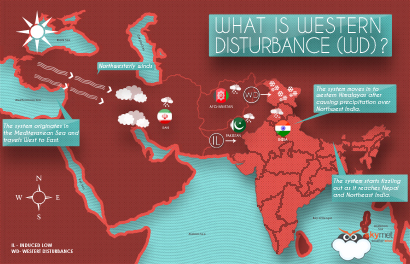
    During the winters, the weather in India is pleasant. The pleasant weather conditions, however, at intervals, get disturbed by shallow cyclonic depressions originating over the east Mediterranean Sea.

    • These temperate cyclones travel eastwards across West Asia, Iran, Afghanistan and Pakistan and enter the north-western parts of India with the help of the westerly jetstream (discussed above).
    • On their way, the moisture content gets augmented from the Caspian Sea in the north and the Persian Gulf in the south. Since these extratropical cyclones reach India from the West, they are usually referred to as the western disturbances over the Indian region.

    Image Source

    • Because of the high terrain, mountain ranges, most of these disturbances are in the mature stage and hence weak or irregular by the time they reach India.
    • Reaching Rajasthan, Haryana and Punjab, these disturbances slow down and stagnate due the nearly closed in nature of the region with high hills.
    • With moisture feed from the Arabian Sea, these disturbances may intensify and move north-east. The tracks of these disturbances come farthest south to latitudes 22/23°N in the month of February.
    • An increase in the prevailing night temperature generally indicates an advance in the arrival of these disturbances.

    The western disturbances result in:

    • A cold spell in north-western India as these depressions are followed by cold waves.
    • Winter rainfall in Punjab, Haryana, Delhi and western Uttar Pradesh, locally known as ‘mahawat’. Although the amount is meagre, it is highly beneficial for Rabi crops.
    • Snowfall in the higher altitudes of Kashmir and Himachal Pradesh and sometimes hail too. It is this snow that sustains the flow of water in the Himalayan rivers during the summer months.

    The precipitation goes on decreasing from west to east in the plains and from north to south in the mountains.

    Note: The term western disturbance is generally applied to all disturbances which come from the West, even when a “low” may not be seen on the synoptic charts.

  • Indian Climate – An Introduction

    India’s climate can be described as hot monsoonal type. The word monsoon comes from the Arabic word ‘Mausim’ which means ‘season’. Monsoon, by definition, is a wind system that changes wind direction seasonally. The four principal monsoon regions in the world are:
    • South Asia
    • East Asia
    • Northern Australia
    • West Africa

    Let’s take the case of South Asia:

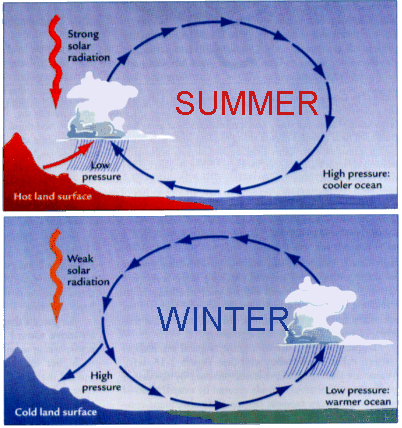
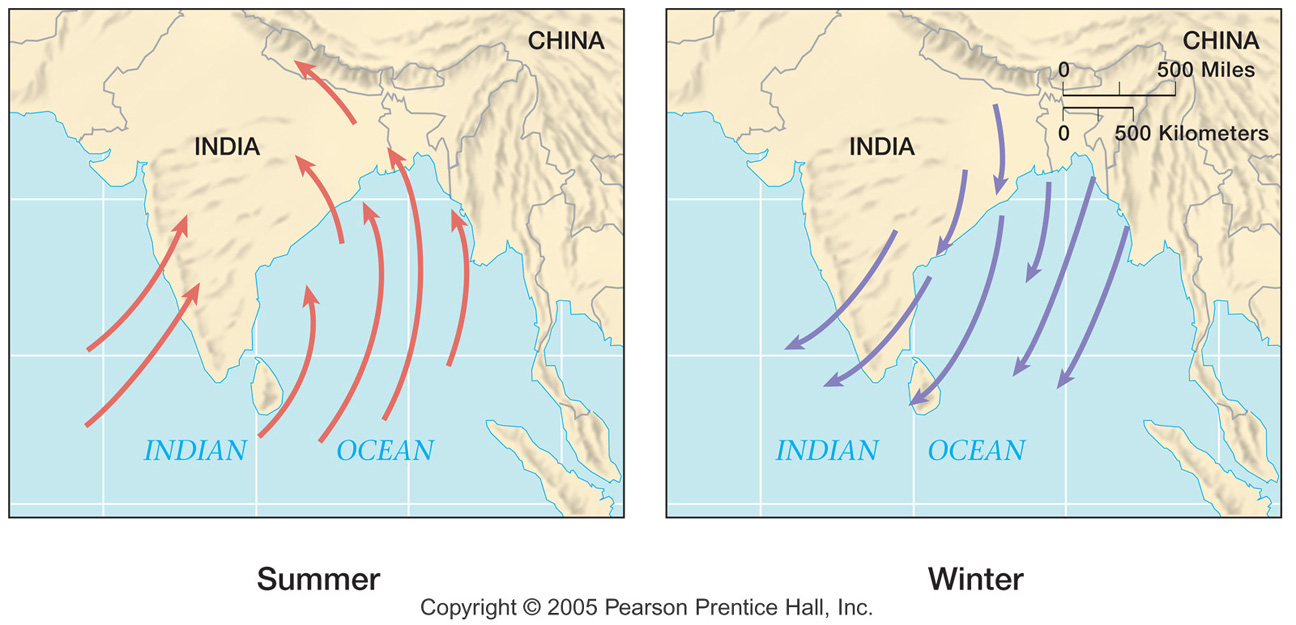
    During winter, the large continent of Asia gets extremely cold and the Siberian high pressure develops. Air flow is offshore and dry. During the summer, the continent develops low pressure in response to heating and the airflow reverses. Moisture-laden air from the ocean is brought inland where it rises over the terrain and produces extremely large amounts of rainfall. See the following diagram and observed the marked shift in the wind direction.

    Image Source

    But at the same time, we know that there are great regional differences and variations experienced in India with respect to temperature rainfall etc. Let’s look at some of these regional variations:

    • Variations in temperature: While in the summer the mercury occasionally touches 55°C in the western Rajasthan, it drops down to as low as minus 45°C in winter around Leh. On a December night, the temperature in Drass (Jammu and Kashmir) may drop down to minus 45°C while Thiruvananthapuram or Chennai on the same night record 20°C or 22°C.
    • Daily temperature range: In Kerala and in the Andaman Islands, the difference between day and night temperatures may be hardly seven or eight degree Celsius. But in the Thar desert, if the day temperature is around 50°C, at night, it may drop down considerably up to 15°-20°C.
    • Regional variations in type and amount of precipitation: While snowfall occurs in the Himalayas, it only rains over the rest of the country. Similarly, while Cherrapunji and Mawsynram in the Khasi Hills of Meghalaya receive rainfall over 1,080 cm in a year, Jaisalmer in Rajasthan rarely gets more than 9 cm of rainfall during the same period. Most parts of the country get rainfall during June-September, but in the coastal areas of Tamil Nadu, it rains in the beginning of the winter season.

    These regional variations differentiate the weather and climate of different regions of India.

    This brings us to the difference between weather and climate:

    Weather is the momentary state of the atmosphere while climate refers to the average of the weather conditions over a longer period of time. Weather changes quickly, maybe within a day or week but climate changes imperceptively and may be noted after 50 years or even more.

    Factors Determining the Climate of India:


    India’s climate is controlled by a number of factors which can be broadly divided into two groups — factors related to location and relief, and factors related to air pressure and winds.

    Factors related to Location and Relief

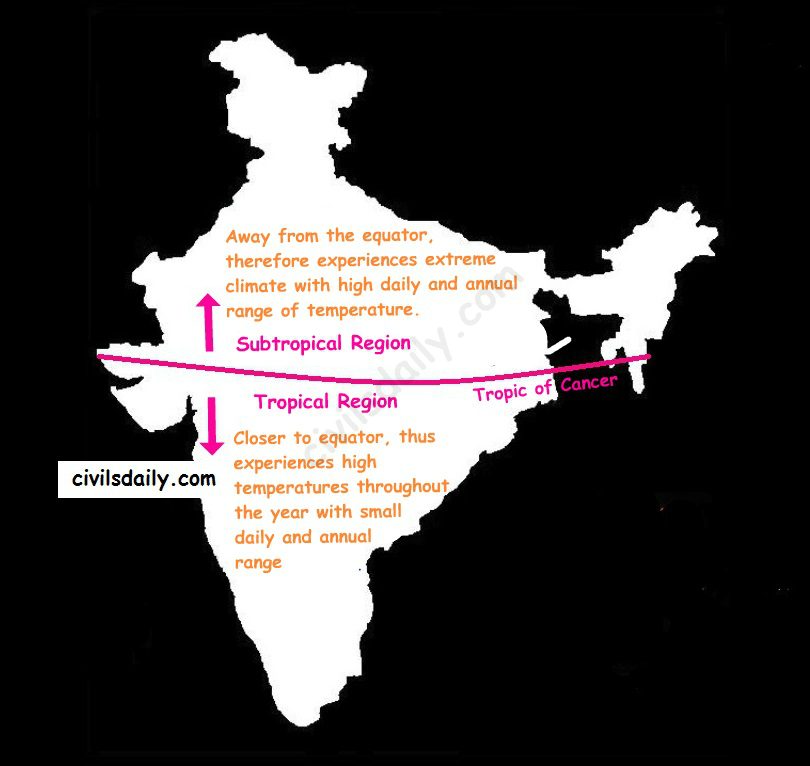
    1. Latitude: The Tropic of Cancer passes through the central part of India in the east-west direction. Thus, the northern part of the India lies in the sub-tropical and temperate zone and the part lying south of the Tropic of Cancer falls in the tropical zone. The tropical zone being nearer to the equator experiences high temperatures throughout the year with small daily and annual range. Areas north of the Tropic of Cancer being away from the equator, experience extreme climate with high daily and annual range of temperature.

    Impact of Latitude on India’s Climate

    1. The Himalayan Mountains:

    The lofty Himalayas in the north along with its extensions act as an effective climatic divide.

    • The Himalayas act as an invincible shield to protect the subcontinent from the cold northern winds. These cold and chilly winds originate near the Arctic circle and blow across central and eastern Asia.
    • The Himalayas also trap the monsoon winds, forcing them to shed their moisture within the subcontinent.

    3. Distribution of Land and Water: India is flanked by the Indian Ocean on three sides in the south and girdled by a high and continuous mountain-wall in the north. As compared to the landmass, water heats up or cools down slowly. This differential heating of land and sea creates different air pressure zones in different seasons in and around the Indian subcontinent. The difference in air pressure causes a reversal in the direction of monsoon winds.

    4. Distance from the Sea: With a long coastline, large coastal areas have an equable climate. Areas in the interior of India are far away from the moderating influence of the sea. Such areas have extremes of climate. That is why the people of Mumbai and the Konkan coast have hardly any idea of extremes of temperature and the seasonal rhythm of weather. On the other hand, the seasonal contrasts in weather at places in the interior of the country such as Delhi, Kanpur and Amritsar affect the entire sphere of life.

    5. Altitude: Temperature decreases with height. Due to thin air, places in the mountains are cooler than places on the plains. For example, Agra and Darjeeling are located on the same latitude, but the temperature of January in Agra is 16°C whereas it is only 4°C in Darjeeling.

    6. Relief: The physiography or relief of India also affects the temperature, air pressure, direction and speed of the wind and the amount and distribution of rainfall. The windward sides of Western Ghats and Assam receive high rainfall during June-September whereas the southern plateau remains dry due to its leeward situation along the Western Ghats.

    Factors Related to Air Pressure and Wind

    The following three factors are responsible for the differences in local climates of India:

      • Distribution of air pressure and winds on the surface of the earth.
      • Upper air circulation caused by factors controlling the global weather and the inflow of different air masses and jet streams.
      • The inflow of western cyclones generally known as disturbances during the winter season and tropical depressions during the south-west monsoon period into India.

    Note: The variations in the atmospheric pressure closer to the surface of the earth have no role to play in the making of upper air circulation.

    The mechanism of these three factors and their impact on the Indian climate will be understood with reference to specific seasons of the year in the following sections.

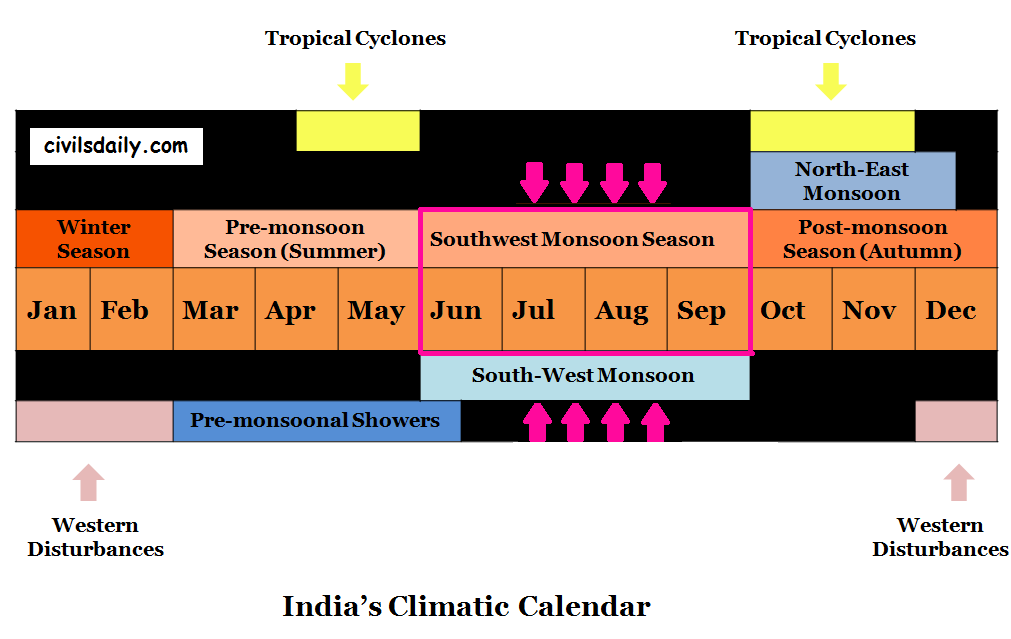
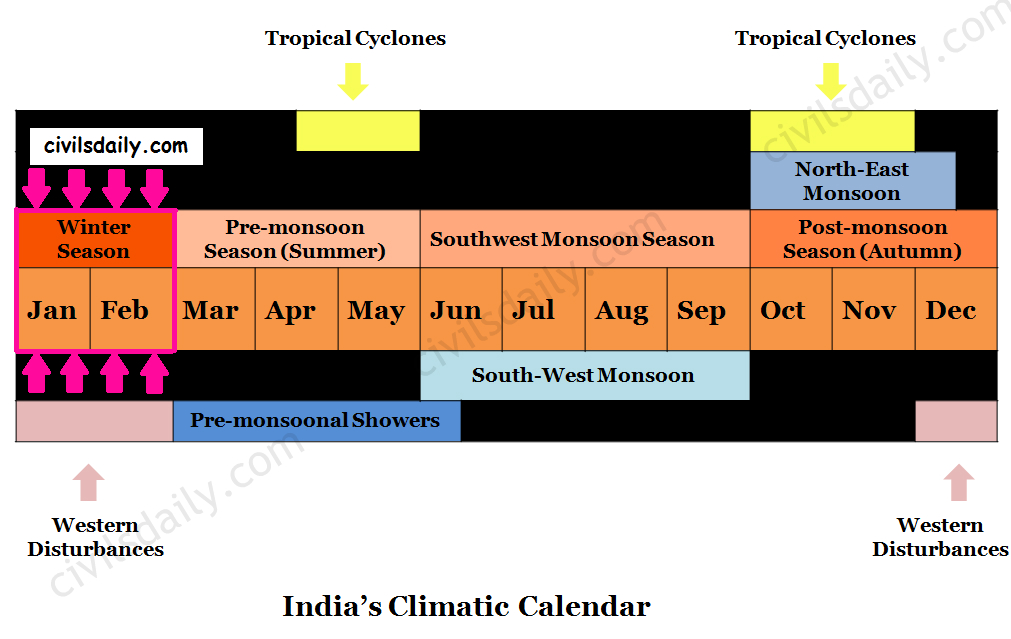
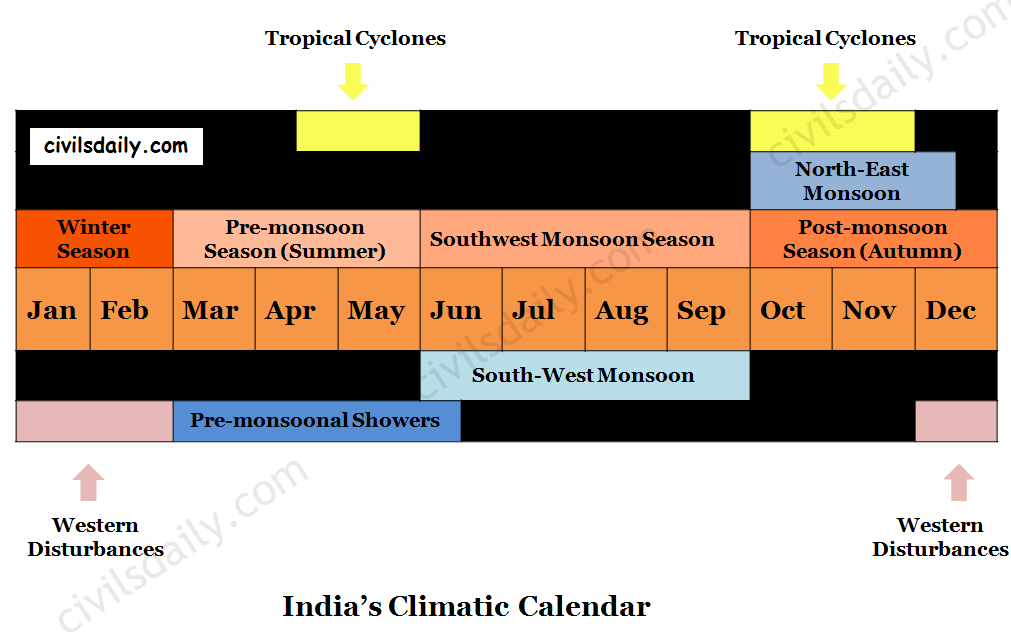
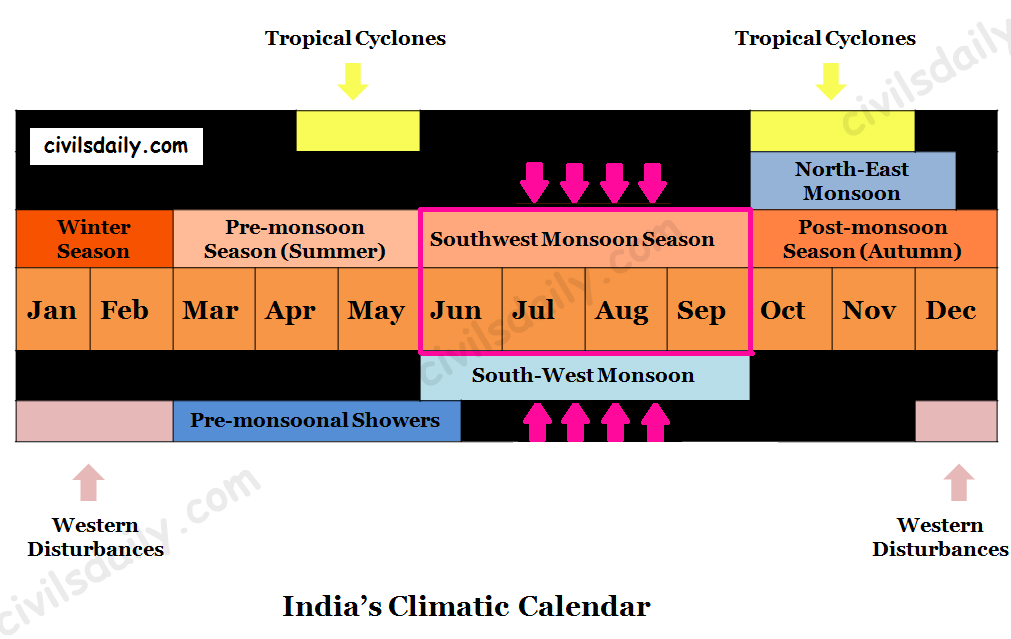
    India’s Climatic Calendar

    The climatic conditions of India can best be described in terms of an annual cycle of seasons.

    The India Meteorological Department (IMD) recognises the following four seasons:

      • The Winter Season (January – February)
      • The Pre-monsoon Season or summer season (March – May)
      • The Southwest Monsoon Season or rainy season (June – September)
      • The Post Monsoon Season or autumn season (October – December)

      India’s Climatic Calendar

  • Drainage System | Part 2

    Drainage

    The flow of water through well-defined channels is known as ‘drainage’ and the network of such channels is called a ‘drainage system’.

    Types of Drainage Patterns

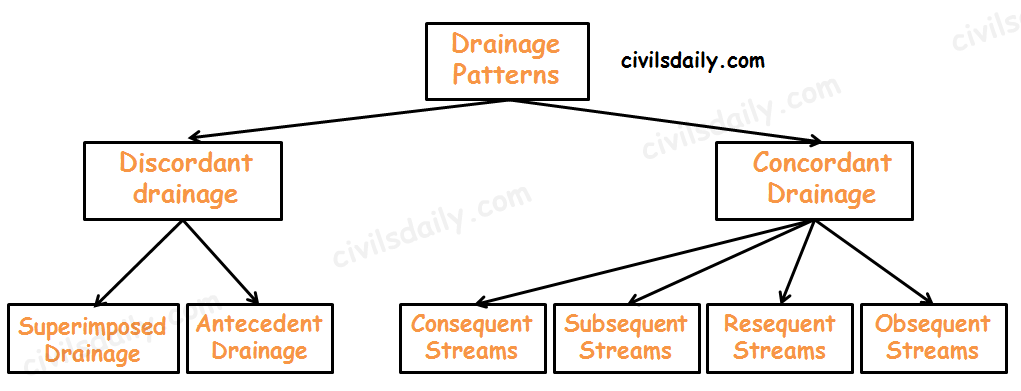
    Discordant drainage

    A pattern of drainage that bears no relation to the structure of the underlying rock. This may be because:

    • The drainage pattern developed on rock strata that have since been removed by erosion; a process known as superimposition. The drainage pattern thus developed is called superimposed drainage (or Epigenetic or Superinduced Drainage). Examples: The Damodar, the Subarnarekha, the Chambal, the Banas and the rivers flowing at the Rewa Plateau, rivers of eastern USA and southern France.
    • The drainage pattern was already present before a period of uplift and folding that formed the present structure. As the uplift took place, the rivers were able to cut down at approximately the same rate and so maintain their courses. This process is called antecedence and the drainage system thus developed is called antecedent drainage.

    Many of the Himalayan rivers have antecedent origin i.e. these rivers existed even before the Himalayan ranges were uplifted. These rivers originate in the Tibetan side beyond the mountain ranges of Himalayas. The Indus, Satluj, Alaknanda, Gandak, Kosi, Brahmaputra all have an antecedent origin. Since these rivers are antecedent, they run transverse to the mountain ranges cutting deep V-shaped, steep-sided valleys (deep gorges).

    Concordant Drainage (also called accordant drainage)

    The pattern of drainage which arises from and closely follows the trends of the underlying strata is called concordant drainage.

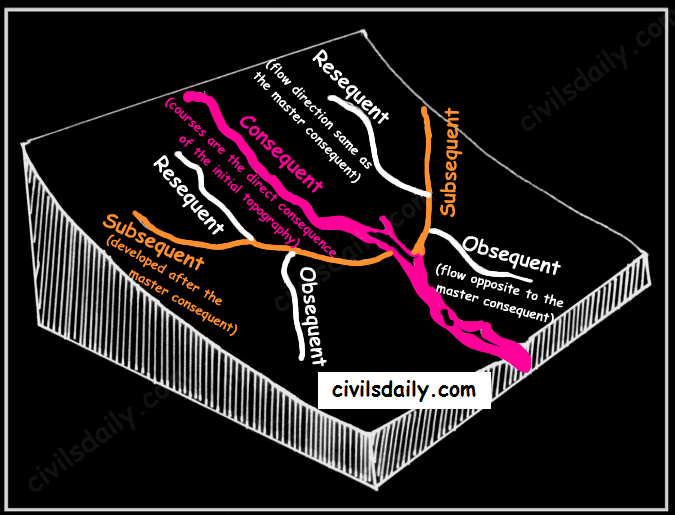
    • Consequent Streams: Those streams whose courses are the direct consequence of the initial topography are called consequent streams.
    • Subsequent Streams: These are developed after the master consequent.
    • Obsequent streams: These flow in opposite direction to the master consequent.
    • Resequent Streams: A resequent stream flows in the same direction as that of the initial consequent stream, but which develops in response to a new base level formed due to inversion of relief.
    Concordant Drainage Patterns

    Drainage pattern:

    Drainage pattern refers to a design which a river and its tributaries form together from its source to its mouth. The drainage pattern of an area is the outcome of:

    • The geological time period,
    • Nature and structure of rocks,
    • Topography,
    • Slope,
    • Amount of water flowing, and
    • The periodicity of the flow.

    Some Important Drainage Patterns:

    A combination of several patterns may be found in the same drainage basin.

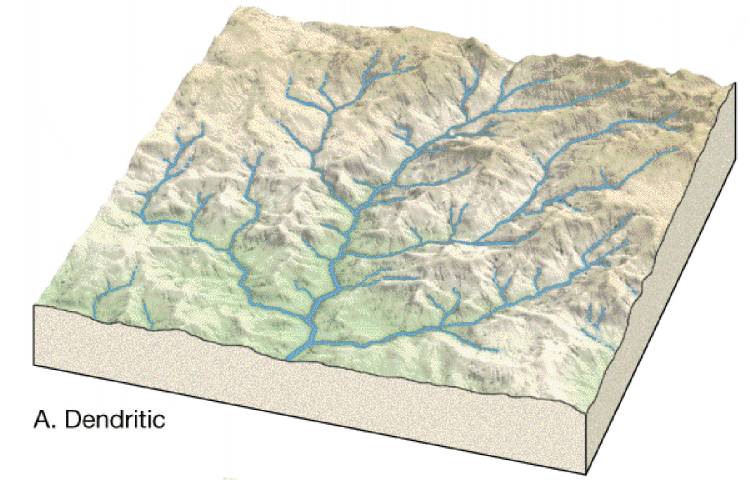
    • Dendritic: The dendritic pattern develops where the river channel follows the slope of the terrain. The drainage pattern resembling the branches of a tree is known as “dendritic” the examples of which are the rivers of northern plain. It is the most common stream pattern. A dendritic pattern develops in a terrain which has uniform lithology, and where faulting and jointing are insignificant.

    Source

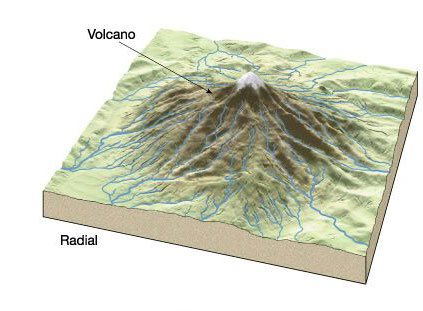
    • Radial: The radial pattern develops when streams flow in different directions from a central peak or a dome-like structure. E.g. the rivers like the Narmada, Son and Mahanadi originating from Maikal Hills flow in different directions and are good examples of a radial pattern.

    Radial drainage patterns are also found/in the Girnar Hills (Kathiwar, Gujarat), and Mikir Hills of Assam.

    Source

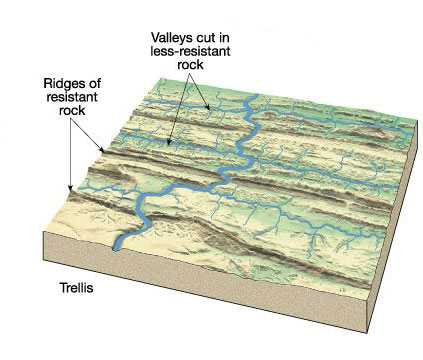
    • Trellis: When the primary tributaries of rivers flow parallel to each other and secondary tributaries join them at right angles, the pattern is known as ‘trellis’. A trellis drainage pattern develops where hard and soft rocks lie parallel to each other. For example, rivers in the upper part of the Himalayan region and in the old folded mountains of the Singhbhum (Chotanagpur Plateau) have drainage of trellis pattern. The trellis drainage pattern can also be seen in the Appalachian region of the U.S.A., where hard and soft rocks occur in parallel bands.

    Source

    • Centripetal: When the rivers discharge their waters from all directions in a lake or depression, the pattern is known as ‘centripetal’. This drainage pattern is also called endorheic drainage. For example, Loktak lake in Manipur.

    Source

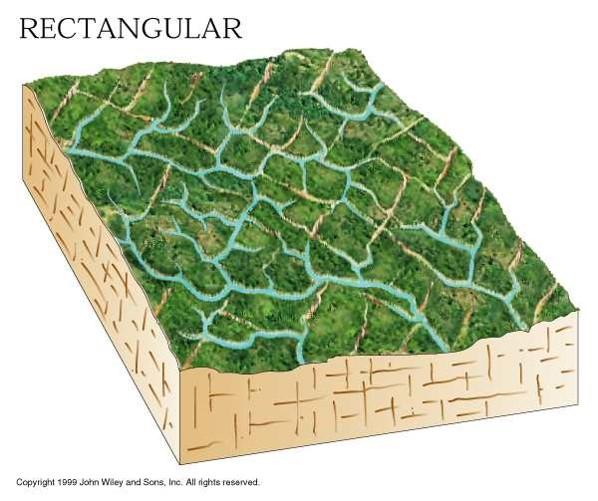
    • Rectangular: In this drainage, both the main stream and its tributaries show right-angled bends. A rectangular drainage pattern develops on a strongly jointed rocky terrain. It differs from trellis pattern drainage, since it is more irregular and its tributary streams are not as long or as parallel as in trellis drainage. Example: Colorado river (USA), streams found is the Vindhyan Mountains of India.

    Source

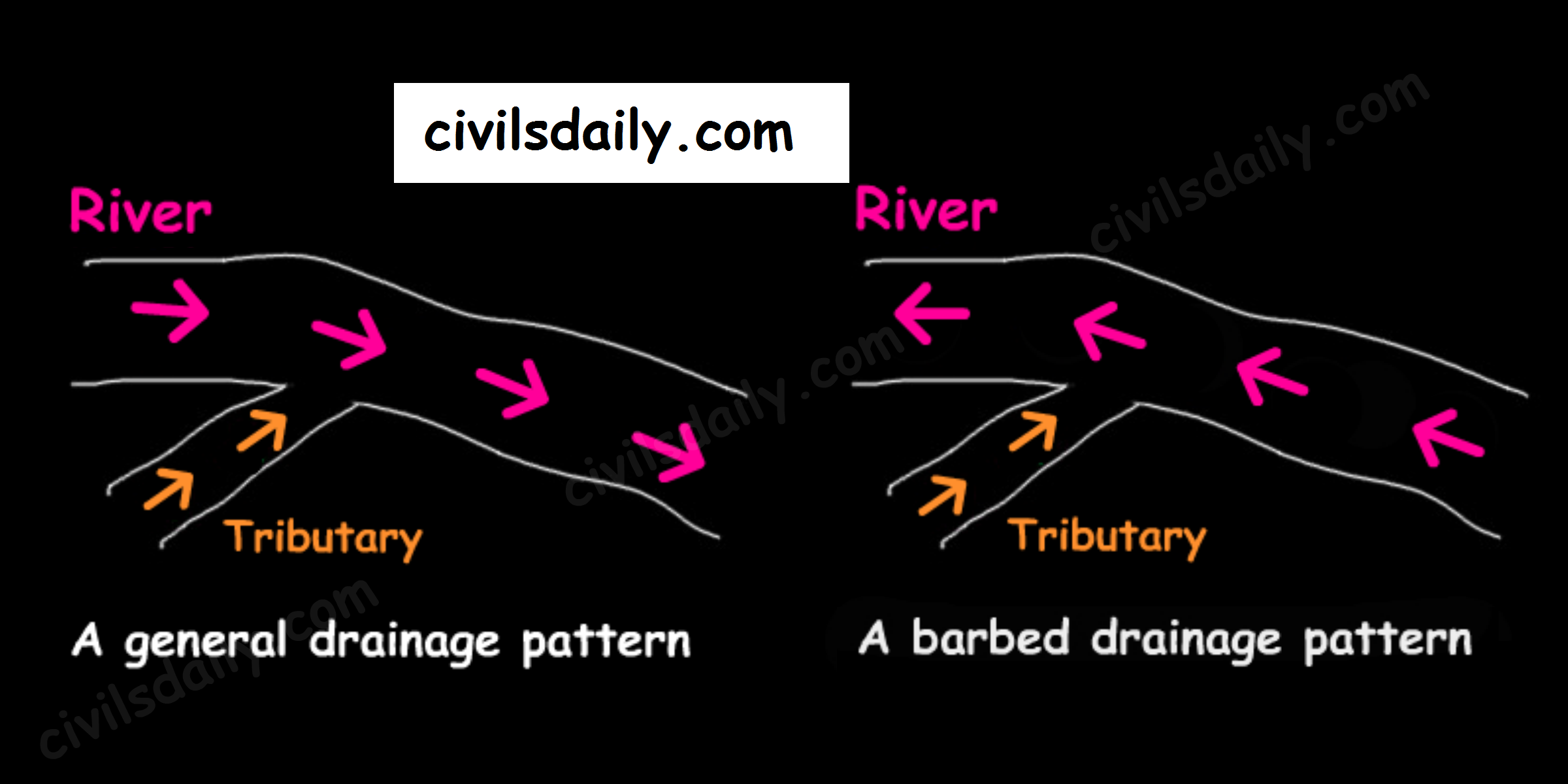
    • Barbed: If you look at the way that tributaries empty into larger rivers, you will notice that most of them flow in the same direction as the rivers they empty into. But quite a large number flow the other way. In fact, you will find stretches of some rivers where every tributary empties into the river in the “wrong” direction! Such an occurrence is known as a barbed drainage pattern.

    Most barbed drainage patterns are the result of river-capture which reverses the direction of flow. However, the tributary channels continue to flow in their original direction.

    The Arun River (Nepal), a tributary of the Kosi is an interesting example of barbed drainage pattern.

    A Barbed Drainage Pattern
    • Annular: Annular pattern represents that part of a drainage pattern in which the subsequent streams follow the curving or arcuate courses before joining the conse­quent stream. These results from a partial adaptation to an underground circular structure i.e. batholiths. This is not a very common drainage pattern in India. Some examples of this are however found in Pithoragarh (Uttarakhand), Nilgiri Hills in Tamil Nadu and Kerala.

    Source

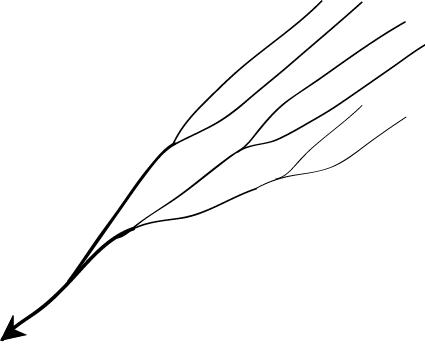
    • Parallel drainage: The drainage pattern in which the rivers flow almost parallel to each other is known as parallel drainage. The small and swift rivers originating in the Western Ghats and discharging their water into the Arabian Sea provide a good example of parallel drainage pattern in India.

    Source

    • Deranged pattern: This is an uncoordinated pattern of drainage characteristic of a region recently vacated by an ice-sheet. The picture is one of numerous water courses, lakes and marshes; some inter-connected and some in local drainage basins of their own. This type of drainage is found in the glaciated valleys of Karakoram.

    Source

  • Drainage System | Part 1

    Before we start with the drainage system of India, let’s look at the broad framework along which we will proceed.

    Article outline:

    • Basic Terminology
      • Source of a river
      • Confluence
      • Tributary
      • Distributary
      • Mouth of a river
      • River basin, catchment area and watershed
      • River Rejuvenation
      • River Regime and River Discharge
    • Drainage – Discordant and Concordant
      • Discordant drainage
        • Antecedent Drainage
        • Superimposed Drainage
      • Concordant Drainage
        • Consequent Streams
        • Subsequent Streams
        • Obsequent Streams
        • Resequent Streams
    • Drainage patterns
      • Dendritic
      • Trellis
      • Rectangular
      • Radial
      • Annular
      • Parallel
      • Centripetal
      • Deranged
      • Barbed
    • The Drainage System of India
      • Classification of Drainage Systems in India
        • On the basis of discharge of water – the Arabian Sea drainage, the Bay of Bengal drainage and inland drainage.
        • On the basis of the size of the watershed – Major, Medium and minor
        • On the basis of the mode of origin, nature and characteristics – the Himalayan drainage and the Peninsular drainage.
      • The Himalayan drainage
        • Evolution
        • Major River systems
      • The Peninsular drainage
        • Evolution
        • Major river systems
      • Differences between the Himalayan and Peninsular river systems
      • The shifting courses of rivers

    Before we study India’s Drainage system, it is imperative that we understand the basic terminology associated with a river and its drainage.

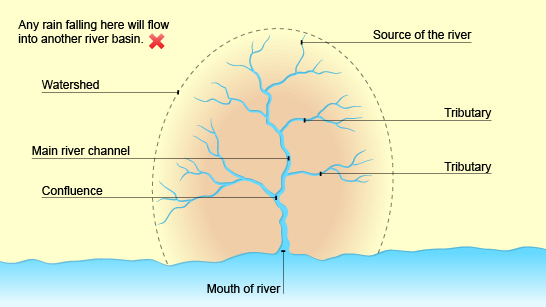
    Source

    Some basic terms:

    Source of a river: The beginning or start of a river.

    Confluence: The point at which two rivers or streams join.

    Distributary: The small river that branches out from the main river and then never meets again. It thus decreases the river’s water volume. Distributaries are commonly found on deltas but are also important in the formation of alluvial fans and cones.

    Tributary: A stream or smaller river which joins a larger stream or river and thus increases its water volume.

    Mouth: The point where the river comes to the end, usually when entering a sea.

    Determination of left/right bank of a river: Stand facing the mouth of the river in the direction of its course. Your left hand side will be the left bank and your right hand side, the right bank.

    River basin, catchment area and watershed

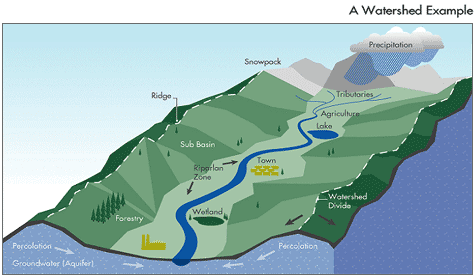
    Generally, the area drained by a river and its tributaries is called its river basin or catchment area or a watershed. But, there are subtle differences between them.

    River Basin: All the area drained by a river and its tributaries.

    Catchment area: It refers to all the area of land over which rain falls and is caught to serve a river basin.

    The catchment area of large rivers or river system is called a river basin while those of small rivers, a lake, a tank is often referred to as a watershed. Watersheds are small in area, generally less than 1000 ha.

    There are many smaller watersheds within a river basin. Example: watershed of Yamuna + water shed of Chambal + watershed of Gandak + …. = Drainage basin of Ganga.

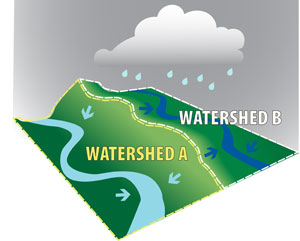
    Watershed:

    Source

    • As a catchment/drainage area: All the land with a common outlet for its surface water ie a geohydrological area from where the water drains to a common point.

    Let’s watch this video for a better understanding:

    • As a water divide: Watershed as a water divide refers to an elevated line from where the water flows in different directions into different river basins.

    Source

    The 3 major watersheds which direct and control the flow of surface water in India are:

    • The Great Himalayan watershed with its important Karakoram branch
    • In Central India, the watershed is formed by Vindhyas, Satpura and Maikala ranges.
    • The Western Ghats.

    A river basin or watershed is often taken as planning unit for macro/micro level developmental planning because:

    • River basins and watersheds are marked by synergy and unity. What happens in one part of the basin or watershed (eg flood, drought etc.) directly affects the other parts and the unit as a whole.
    • The data about land and water characteristics is measurable and comparable.

    Base level of erosion and River Profile:

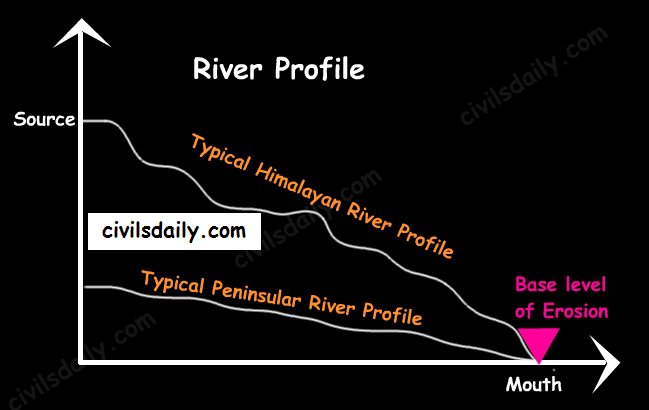
    Base level of erosion: – It is the lowest level to which down-cutting by a river is possible, often referred to as the ‘mouth of the river’. The ultimate base level for any stream is the water body into which it flows – sea, lake, reservoir, dam etc. For large rivers, sea level is usually the base level, but a large river or lake is likewise the base level for tributary streams.

    Under normal circumstances, the goal of a river is to do the work of erosion, initially up to its local and then permanent base level.

    River Profile: It refers to the cross-section of a river from its source to mouth representing the height of the river at various points. The peninsular rivers have almost reached their base levels of erosion.

    River Profile

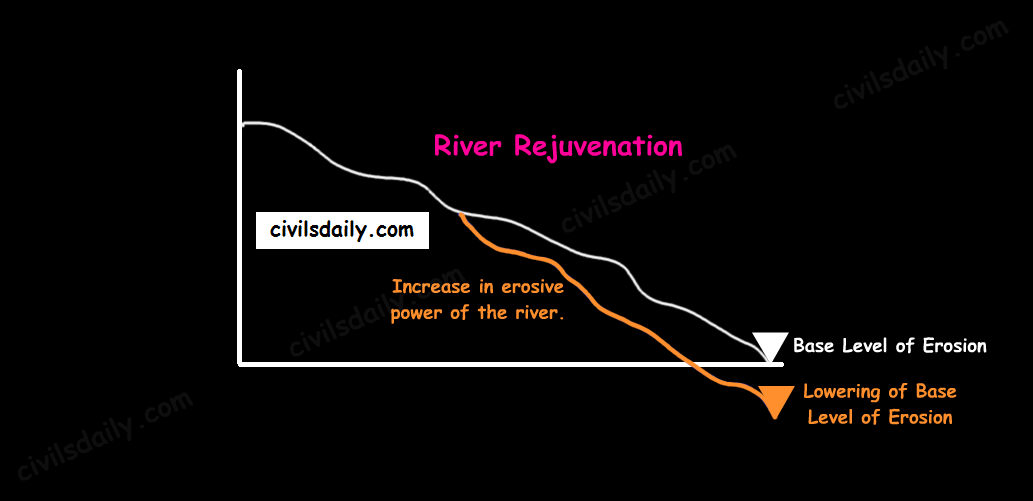
    River Rejuvenation

    River Rejuvenation refers to a significant enhancement in the erosive power of the rivers. It can happen because of the following reasons:

    • Fall in the sea level (lowering of base level of erosion)
    • Dynamic upliftment of the land
    • For a given load, if there is a considerable increase in the volume of water.
    • For a given volume of water, if there is a considerable decrease in the load.
    River Rejuvenation

    River Regime and River Discharge:

    Discharge: The volume of water flowing in a river measured over time. It is measured either in cusecs (cubic feet per second) or cumecs (cubic metres per second).

    River regime: It refers to the seasonal fluctuation in respect of volume of water in the river.

    Let’s consider the case of Himalayan and Peninsular rivers. The main differences in their flows are caused by the differences in climate. The main differences are:

    • The regimes of Himalayan Rivers are monsoonal as well as glacial. This is because the Himalayan Rivers are perennial as they are fed by glaciers through snow melt and also receive rainfall water during rainy season. E.g. The river Ganga has its minimum flow during the January-June period, maximum flow is attained either in August or in September followed by a gradual steady fall afterwards.
    • The regimes of most of the peninsular rivers, on the other hand, are monsoonal as they are fed by rainfall alone e.g. the river Narmada has a very low volume of discharge from Jan-July and a sharp rise in August (the rise corresponding with the monsoon season). The fall in October is as spectacular as the rise in August (as the monsoon season ends). It also varies from one part of the Peninsular plateau to the other.

More posts