💥UPSC 2026, 2027, 2028 UAP Mentorship (March Batch) + Access XFactor Notes & Microthemes PDF

Search results for: “”

  • Gandhi Sagar Wildlife Sanctuary: India’s New Cheetah Habitat

    Why in the News?

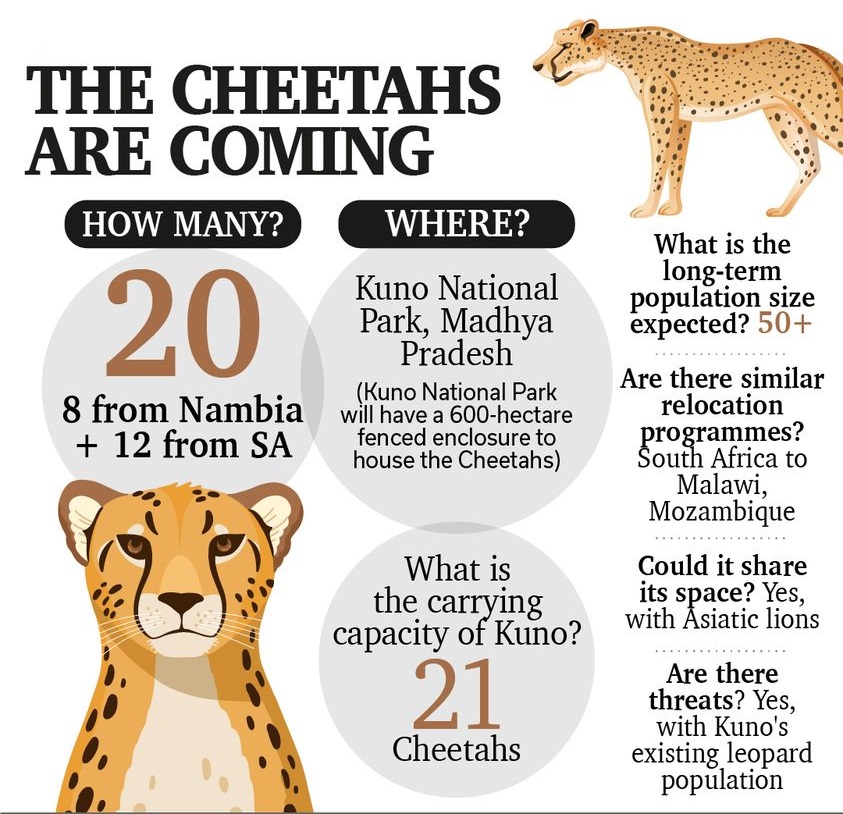
    • Gandhi Sagar Wildlife Sanctuary will become the second home for cheetahs in India, after Kuno National Park. The final decision on importing cheetahs from Namibia and South Africa will be made after the monsoon season to avoid infection risks.

    Cheetah Reintroduction in India:

    • In India, cheetahs disappeared in the early 1950s due to hunting and the loss of their habitat.
    • The ‘Action Plan for Reintroduction of Cheetah in India /Project Cheetah (2022)’ aims to bring cheetahs from African countries to various national parks.
    • It is spearheaded by the National Tiger Conservation Authority (NTCA).
    • Recently, cheetahs from Namibia were reintroduced in Kuno National Park, Madhya Pradesh.

    About Cheetah:

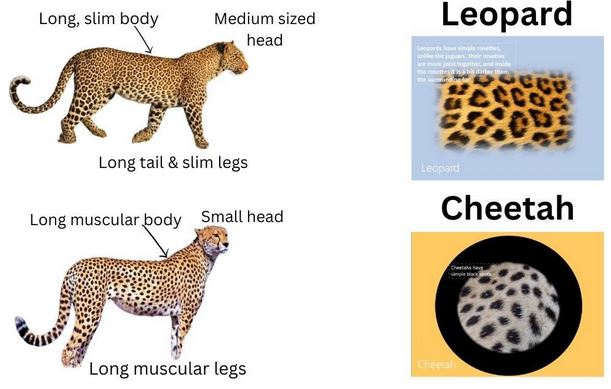
    • The cheetah is a fast-running big cat native to Africa and central Iran, capable of speeds up to 80 to 128 km/h.
    • They live in various habitats like savannahs, arid mountains, and hilly deserts.
    • Cheetahs live in three main groups: females with cubs, male coalitions, and solitary males.
    • They hunt during the day, preferring dawn and dusk.
    • The global cheetah population was 6,500 mature individuals, according to the most recent IUCN assessment in 2021.
    • They are listed as VULNERABLE by the IUCN.
    • The Asiatic Cheetah is one of the five subspecies of cheetah, critically endangered and found only in Iran.


    About Gandhi Sagar Wildlife Sanctuary

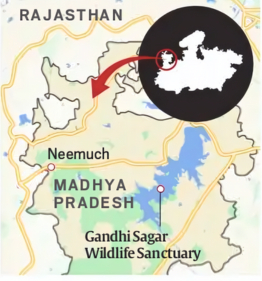
    • Located in western Madhya Pradesh, Gandhi Sagar Wildlife Sanctuary covers an area of 368.62 sq km.
    • It spans the Mandsaur (187.12 sq km) and Neemuch (181.5 sq km) districts, bordering Rajasthan.
    • Situated on a flat rocky plateau characterized by shallow topsoil and exposed sheetrock.
    • It is divided by the Chambal River, with the Gandhi Sagar dam and reservoir within its boundaries.
    • Flora and Fauna:
      • Flora: The sanctuary features a savannah ecosystem with open grasslands interspersed with dry deciduous trees. Riverine valleys within the sanctuary support evergreen vegetation.
      • Fauna: The sanctuary is home to a diverse range of wildlife, including species like leopards, sloth bears, striped hyenas, grey wolves, golden jackals, jungle cats, Indian foxes, and marsh crocodiles.

    Habitat Suitability for Cheetahs

    • Officials cite Gandhi Sagar as having an ideal habitat parallel to Maasai Mara (a National Park) in Kenya, suitable for cheetahs.
    • Plans include expanding the cheetah habitat to around 2,000 sq km, contingent upon cooperation with Rajasthan’s Bhainsrodgarh sanctuary.

    PYQ:

    [2024]  Consider the following statements:

    1. Lions do not have a particular breeding season.

    2. Unlike most other big cats, cheetahs do not roar.

    3. Unlike male lions, male leopards do not proclaim their territory by scent marking.

    Which of the statements given above are correct?

    (a) 1 and 2 only

    (b) 2 and 3 only

    (c) 1 and 3 only

    (d) 1, 2 and 3

    [2012]  Consider the following: (2012)

    1. Black-necked crane
    2. Cheetah
    3. Flying squirrel
    4. Snow leopard

    Which of the above are naturally found in India?

    (a) 1, 2 and 3 only
    (b) 1, 3 and 4 only
    (c) 2 and 4 only
    (d) 1, 2, 3 and 4

  • Formula for Flapping Frequency across Flying and Swimming Animals


    Why in the news?

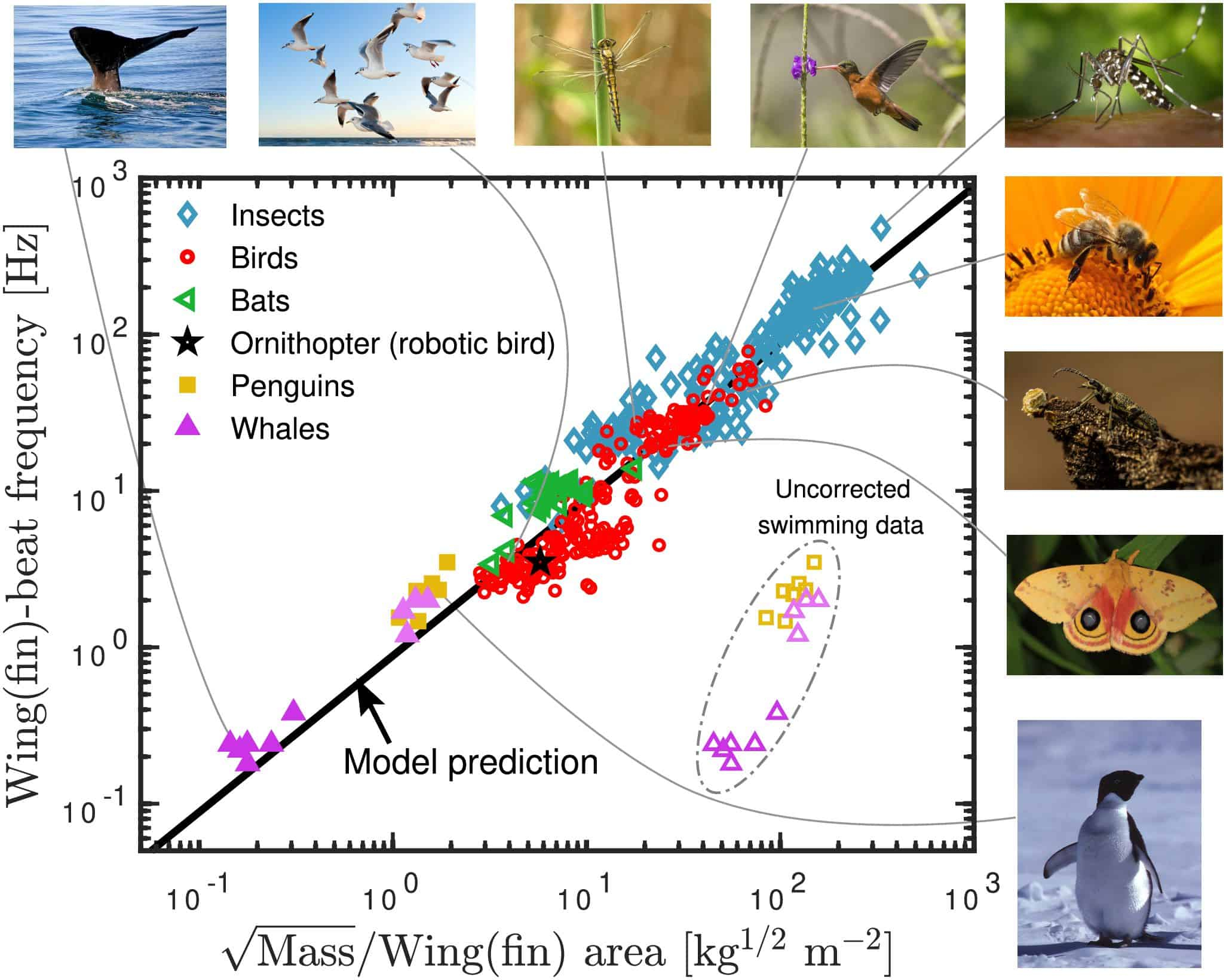
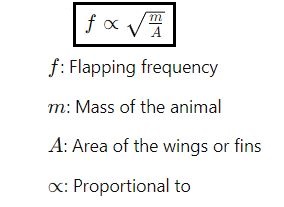
    • Researchers at Roskilde University in Denmark discovered a formula that correlates the flapping frequency of winged and swimming animals to their mass and wing/fins size.
      • The formula applies universally across a diverse range of species, from insects to birds, bats, penguins, whales, and even robotic ornithopters.

    Formula for Flapping Frequency

    • The formula was derived from Newton’s second law (F= mass x acceleration) applied to animals flapping wings to stay airborne.
    • Factors considered in the derivation included air density, wing size, and the forces generated by wing movements.

    Research Methodology

    • The researchers derived the formula theoretically from Newton’s second law, relating the force needed to stay airborne or submerged to the wing/fins’ motion, air/water dynamics, and animal mass.
    • They incorporated empirical observations into a constant C to account for specific shape and flight kinematics variations.

    Application and Validity

    • The formula’s validity was tested across various animals:
      • 176 insect data points (e.g., bees, moths, dragonflies)
      • 212 bird data points (from hummingbirds to swans)
      • 25 bat data points

    Formula Extension to Swimming Animals

    • The formula also predicts the frequency of fin/fluke movements in swimming animals.
    • Adjustments are made for water density and buoyancy effects, excluding fish with swim bladders.

    Limitations and Modifications

    • The formula applies well in conditions with high Reynolds numbers (Re), where fluid flow is streamlined.
    • At low Re values, where viscosity dominates, modifications are needed.
    • The equation holds as long as animal density variations do not exceed a factor of ten.

    Insights and Future Research

    • Insights from the formula include understanding flight efficiency and potential evolutionary pathways for winged animals.
    • Future research aims to explore further insights hidden within the C constant, potentially revealing deeper principles governing animal flight and swimming dynamics.

    PYQ:

    [2024] The organisms “Cicada, Froghopper and Pond skater are:

    (a) Birds

    (b) Fish

    (c) Insects

    (d) Reptiles

  • Foreign Travellers in Ancient and Medieval India

     
    17th June 2024

    Travellers Visited India

    Contemporary Rulers

    Contribution.

    Deimachos

    Period: (320-273 BC)

    Who: Greek Ambassador

    Came India in the reign of Bindusara.

    Megasthenes

    Period: (302-298 B.C.)

    Who: Greek ethnographer & ambassador.

    Ambassador of Seleucus Nicator, who visited in the court of Chandragupta Maurya.

    Wrote an interesting book Indica.

    Ptolemy

    Period: 130 A.D.

    Who: From Greece and Geographer.

    Wrote “Geography of India” which gives the description of Ancient India.

    Fa-Hien

    Period: (405-411 A.D.)

    Who: Chinese Buddhist Monk

    Came to India in the reign of Chandragupta II Vikramaditya.

    –          Visited the birth place of Buddha, Lumbini.

    –          His Travelogue “Records of Buddhist Kingdoms”.

    –          Wrote Fo-Kyo-Ki.

    Hiuen-Tsang

    Period: (630-645 A.D.)

    Who: Chinese Buddhist Monk

    Visited India during the reign of Harshavardhana.

    –          Came through Tashkent and Swat Valley.

    –          Book is “Si-Yu-Ki or the records of western world”.

    I-tsing

    Period: ( 671- 695 A.D.)

    Who: Chinese traveller

    Visited India in connection with Buddhism.

    –          His works are Biographies of Eminent Monks.

    –          Gives useful information about the social, religious and cultural life of the people of this country.

    Al-Masudi

    Period: (957 A.D.)

    Who: Arab Traveller

    Gives an extensive account of India in his work “Muruj-ul-Zahab”.

    Al- Beruni or Abu Rehan Mahamud

    Period: (1024-1030 A.D.)

    Who: Muslim Scholar and Polymath

    Came along with Mahmud Ghazni during one of his Indian raids.

    –          First Muslim Scholar to study India also known as founder of Indology.

    –          Wrote “ Tahqiq-i-Hind/Kitab-ul-Hind.

    Marco Polo

    Period: (1292-1294 AD)

    Who: Venetian Traveller

    Visited South India in 1294 A.D during the reign of Pandyan ruler of Madurai, Madverman, Kulshekhara (1272-1311)

    His work “The Book of Sir Marco Polo” which gives an invaluable account of the economic history of India.

    Ibn Batuta

    Period: (1333-1347 A.D.)

    Who: Morrish traveller

    Visited India during the reign of Muhammad-Bin-Tughlaq.

    His book “ Rehla” (the travelogue)

    Shihabuddin al-Umari

    Period: (1348 A.D.)

    Who: Came from Damascus

    He gives a vivid account of India in his book “ Masalik albsar fi-mamalik al-amsar

    Nicolo Conti

    Period: (1420-1421 A.D.)

    Who: Venetian traveller

    Came during the rule of Devraya I of Sangam Dynasty of Vijayanagar empire.

    Given a graphic account of Vijayanagaras capital.

    Abdur Razzaq

    Period: (1443-1444 A.D.)

    Who: Persian traveller, Ambassador of Shahrukh of Timurid dynasty.

    –          Came during the rule of Devraya II of Sangam dynasty of Vijaynagar Empire.

    –          Came in India at Zamorin’s Calicut.

    Given a brief account of this countryside, in his Matla us Saddin wa Majuma ul Baharain.

    Athanasius Nikitin

    Period: (1470- 1474 A.D.)

    Who: Russian merchant

    Visited South India in 1470.

    -He describes the condition of the Bahmani kingdom under Muhammad III (1463-82).

    – His narrative “ The journey beyond 3 seas”

    Duarte Barbosa

    Period: (1500-1516 A.D.)

    Who: Portuguese traveller

    He has given a brief description of the government and the people of Vijayanagar Empire.

    Domingo Paes

    Period: (1520-1522 A.D.)

    Who: Portuguese traveller

    Visited the court of Krishnadeva Raya of Vijayanagar Empire.

    Fernao Nuniz

    Period: (1535-1537 A.D.)

    Who: Portuguese merchant

    Came during the rule of Achyutdeva Raya of Tuluv dynasty of vijayanagar Empire.

    Wrote history of the empire from its earliest times of the closing years of Achyutdeva Raya’s reign.

    John Hughen Von Linschotten

    Period: (1583 A.D.)

    Who: Dutch traveller

    Given a valuable account of the social and economic life of South India.

    William Hawkins

    Period: (1608-1611 A.D.)

    Who: Ambassador of James I, king of England.

    Came in India at the reign of Jahangir,the great Mughal Emperor. William finch came with him.

    Sir Thomas Roe

    Period: (1615-1619 A.D.)

    Who: Ambassador of James I, king of England.

    Came in India at the reign of Jahangir,the great Mughal Emperor.

    Edward Terry

    Period: (1616 A.D.)

    Who: Ambassador of Thomas Roe.

    Describe about Indian social (Gujarat) behaviour.

    Franciso Palsaert

    Period: (1620-1627 A.D.)

    Who: Dutch traveller stayed at Agra.

    Gave a vivid account of the flourishing trade at Surat, Ahmadabad, Broach, Cambay, Lahore, Multan etc.

    Peter Mundy

    Period: (1630-34 A.D.)

    Who: Italian traveller

    Came in the reign of the Mughal Emperor, Shahjahan.

    Gives valuable information about the living standard of the common people in the Mughal Empire.

    John Albert de Mandesto

    Period: (1638 A.D.)

    Who: German traveller

    Reached Surat in 1638 A.D.

    Jeen Baptiste Tavernier

    Period: (1638-1663 A.D.)

    Who: French traveller

    Visited India 6 times in the reign of Shahjahan and Aurangzeb.

    Nicolao Manucci

    Period: (1653-1708 A.D.)

    Who: Italian traveller

    He got service at the court of Dara Shikoh.

    Francois Bernier

    Period: (1656- 1717 A.D.)

    Who: French physician and Philosopher.

    Danishamand Khan, a noble of Aurangzeb was his patron.

    Jean de Thevenot

    Period: (1666 A.D.)

    Who: French traveller

    Given an account of cities like Ahmadabad, Cambay, Aurangabad and Golconda.

    John Fryer

    Period: (1672-1681 A.D.)

    Who: English traveller


    Given a vivid account of Surat and Bombay.

    Gemelli Careri

    Period: (1695 A.D.)

    Who: Italian traveller who landed at Daman.

    His remarks on the Mughal emperor’s military organisation and administration are important.


  • [17th June 2024] The Hindu Op-ed: High Court’s take on Marriage Act, an erosion of rights

    PYQ Relevance:

    Q Discuss the possible factors that inhibit India from enacting for its citizen a uniform civil code as provided for in the Directive Principles of State Policy. (UPSC IAS/2015)

    Customs and traditions suppress reason leading to obscurantism. Do you agree? (UPSC IAS/2020)

    Mentor comment: Interfaith marriages in India face legal and societal challenges despite protections under the Special Marriage Act, 1954. Recent judicial interventions have raised concerns about misinterpretations, impacting couples’ rights to choose partners freely. Such marriages often encounter opposition from families and communities, leading to social tensions. Efforts to protect couples through legal frameworks are crucial amid ongoing debates on religious and cultural sensitivities.

    Let’s learn!

    Why in the News?

    • A recent order from the Madhya Pradesh High Court has raised concerns about the interpretation of the law regarding inter-faith marriages and the scope of the Special Marriage Act, 1954.
    About Special Marriage Act, 1954:

    •The SMA was passed by the Parliament on October 9, 1954.
    •It governs a civil marriage where the state sanctions the marriage rather than the religion.
    The minimum age to get married under the SMA is 21 years for males and 18 years for females.
    Need for SMA:
    •Issues of personal law such as marriage, divorce, and adoption are governed by religious laws that are codified.
    •These laws, such as the Muslim Marriage Act,1954, and the Hindu Marriage Act, 1955, require either spouse to convert to the religion of the other before marriage.
    •However, the SMA enables marriage between inter-faith or inter-caste couples without them giving up their religious identity or resorting to conversion.

    Erroneous Considerations

    • Typical Assessment Under Article 226: When a petition for police protection is filed under Article 226 of the Constitution, the High Court usually assesses the violation of the petitioners’ rights and the threat they face.
    • Extended Protection Examples:
    • The Madras High Court granted protection to a lesbian couple, recognizing the dangers they faced.
    • The Punjab and Haryana High Court provided protection to a live-in couple, emphasizing the protection of their fundamental rights under Article 21 of the Constitution.
    • Contrasting Focus of Madhya Pradesh HC: Instead of focusing on the threats faced by the couple, the HC focused on the validity of the couple’s impending marriage, disregarding their right to life and liberty.
    What is Article 226 of the Constitution?
    Article 226 grants the High Courts of Indian states the power to issue writs. These writs are primarily meant for the enforcement of fundamental rights guaranteed under Part III of the Constitution or for any other legal purpose. The High Courts have the authority to issue writs such as habeas corpus, mandamus, prohibition, quo warranto, and certiorari.

    Dilution of the Special Marriage Act

    • Contradictory Order: The Madhya Pradesh High Court’s order contradicts the core principles of the Special Marriage Act.
    • Irrelevant Supreme Court Precedent: The court erroneously relied on a Supreme Court precedent related to property succession under Mohammedan Laws, which is irrelevant to the validity of inter-faith marriages under the Special Marriage Act.
    • Misinterpretation of Section 4: The court misinterpreted Section 4 of the Act, which excludes marriages between close relatives, not inter-faith marriages.
    • Act’s Purpose: The Act is designed to facilitate marriage between any two Indian nationals, regardless of their faith.

    Present status of Special Marriages:

    • Significance of the Order: The Madhya Pradesh High Court order is significant given the current social and political climate, where inter-faith and inter-caste marriages face vigilantism and right-wing propaganda.
    • Ongoing Petitions: There are ongoing petitions challenging unconstitutional provisions within the Special Marriage Act, such as the prior notice requirement, pending before the Supreme Court.
    • Supreme Court’s Ruling in Shafin Jahan Case:
    • Emphasized the protection of personal liberty and the right to choose a life partner, regardless of faith or caste.
    • Justice D.Y. Chandrachud’s judgment highlighted that intimate personal decisions do not require social approval and are protected by the Constitution.

    Way forward

    • Disregard of Shafin Jahan Judgment: The Madhya Pradesh High Court’s order disregards the spirit of the Shafin Jahan judgment, which prioritizes individual autonomy, privacy, and liberty.
    • Courts’ Responsibility: Constitutional courts must remember that jurisprudence favours autonomy and personal liberty.

    https://www.thehindu.com/opinion/op-ed/high-courts-take-on-marriage-act-an-erosion-of-rights/article68297655.ece

  • [UPSC’25 Beginner’s Webinar]: On PYQs, Current Affairs & Time management | 19th June, 2:00 PM

    [UPSC’25 Beginner’s Webinar]: On PYQs, Current Affairs & Time management | 19th June, 2:00 PM

    Integrated UPSC Strategy for IAS Beginner

    Join Saloni Vats, AIR 129, UPSC’23 Mam’s FREE webinar on 19th June, 2:00 PM.


    In the last 3 years, a lot of things have changed about UPSC CSE

    This includes Exam Patterns & trends, Prelims, CSAT, Mains, and Preparation strategy

    Standard resources and mocks can’t make you feel prepared anymore

    Now, Every ranker who qualifies Mains crafts a process for it, painstakingly

    Civilsdaily Masterclasses allow you to access the real work from those who have done it before

    All rankers built their own preparation system. What’s stopping you?

    Let us help you develop your system

    Never start from scratch on your UPSC preparation

    Start like a Topper.

    Read what Saloni Vats, Rank 129, UPSC’23, has to say about UPSC preparation and approach.

    “I genuinely believe std. Resources and mock tests are not enough now to get a rank in UPSC CSE.

    With approximately 12 months to go for UPSC Prelims 2025, one has to consider the overall preparation strategy and how he/she will approach the exam.

    Now, you need to define the exact plan.

    This thinking gives you an edge over others in the exam. You become relaxed and confident throughout the journey, which is otherwise filled with lots of daily anxiety, fear, and uncertainty.

    And this Wednesday, I am coming to help you create your own preparation plan, especially if you are a beginner; you must attend this.

    My masterclass will be a reality check on modern-day UPSC prep. Not just book list and strategy but also my inputs on your current strategy shared with you over our private Zoom meeting.”

    Attend the FREE Webinar on Integrated UPSC 2025 Prelims and Mains Strategy

    In this masterclass, you will get:

    1. A 60-minute deep dive on how to plan your UPSC preparation if this is going to be your serious UPSC attempt. 
    2. Understanding UPSC 2023 & 24’s trend and strategy for the next 12 months for integrated UPSC Prelims, Mains and CSAT preparation.
    3. Insider tips that only the top IAS and IPS rankers know and apply in every attempt

    Join Saloni Vats, AIR 129, UPSC’23 Mam’s FREE webinar on 19th June, 2:00 PM.

    By the end, you’ll have razor-sharp clarity and a clear roadmap for approaching and qualifying your UPSC 2024-25 exam with confidence and near-perfect certainty. 

    Saloni Vats, AIR 129, UPSC’23

    Registration open! Join now to attend the webinar for FREE

    (Don’t wait—the next webinar won’t be until July’24)


    These masterclasses are packed with value. They are conducted in private with a closed community. We rarely open these webinars for everyone for free. This time we are keeping it for 300 seats only.

    Ready to attend the UPSC Webinar?


    Not sure yet?

    We recommend you register here. It takes less than 10 seconds to register.

    • No spam! Once in a while, we’ll only send you high-quality exam-related content. 
    • We will inform you about the upcoming Masterclasses that might benefit you.
    • You can demand one free mentorship call from verified Civilsdaily mentors. 
    • You can always choose to unsubscribe. 
  • India refuses to endorse Ukraine meet statement

    Why in the news?

    India emphasized that only proposals acceptable to both Russia and Ukraine can lead to peace as it decided to disassociate from the final document issued on June 16 at the conclusion of the Peace Summit in Switzerland.

    What is a Joint Communique on a Peace Framework?

    • The Joint Communique on a Peace Framework is a formal document issued at the conclusion of the Peace Summit in Switzerland, held on June 16, 2024. This communique outlines the collective stance and proposed guidelines for achieving peace in the ongoing Russia-Ukraine conflict.

    Key Highlights of the Ukraine Peace Summit in Switzerland

    • Attendance and Endorsement: More than 80 countries attended the summit and endorsed the “Joint Communique on a Peace Framework.” The communique emphasized the protection of Ukraine’s territorial integrity, based on Ukraine’s peace formula and the UN charter.
    • Non-Endorsing Countries: India, Saudi Arabia, South Africa, Thailand, Indonesia, Mexico, and the United Arab Emirates did not sign the communique. Brazil maintained an observer status, and China declined the invitation altogether.
    • India’s Participation and Stance: India attended the summit but chose not to endorse the final document. India’s stance is rooted in the belief that any peace proposal must be acceptable to both Russia and Ukraine for it to be sustainable. The Ministry of External Affairs (MEA) emphasized India’s commitment to understanding different perspectives to find a lasting resolution through dialogue and diplomacy.

    Why did India Refuse?

    • Neutrality and Balanced Approach: India maintains a policy of neutrality and balanced diplomacy, avoiding taking sides in the Russia-Ukraine conflict to preserve its diplomatic relations with both nations.
    • Mutually Acceptable Solutions: India believes that any peace proposal must be acceptable to both Russia and Ukraine to be sustainable, emphasizing dialogue and practical engagement between the conflicting parties.
    • Strategic and Diplomatic Considerations: By not endorsing the communique, India retains its potential role as a trusted mediator, protecting its strategic ties with Russia and considering broader geopolitical concerns such as food and energy security.

    Conclusion: India’s decision reflects its stance on neutrality, advocating for peace proposals acceptable to both Russia and Ukraine while preserving diplomatic relations and strategic interests amid global geopolitical dynamics.

    Mains PYQ:

    Q What is the significance of Indo-US defence deals over Indo-Russian defence deals? Discuss with reference to stability in the Indo-Pacific region.(UPSC IAS/2020)

  • India needs to close the gender gap in education and politics  

    Why in the news?

    While global gender parity has improved to 68.5% in 2024 from 68.4% in 2023, progress remains slow. The World Economic Forum’s report indicates it will take 134 years to achieve full parity at this rate.

    The Global Gender Gap Report 2024

    • It is released by the World Economic Forum (WEF), and highlights significant disparities in gender parity across various sectors.

    Present Scenario:

    Global Gender Gap Report 2024: 

    • The global gender gap stands at 68.5% closed, indicating slow progress towards gender parity.
    • Iceland leads with over 90% closure, while India has slipped to 129th position out of 146 countries, with 64.1% closure.
    • India’s slight regression is attributed to declines in education and political empowerment indices.

    Challenges in India:

    • Despite improvements in economic participation, India needs to bridge gaps in education and political representation.
    • The labour force participation rate for women is 45.9%, indicating significant untapped potential.
    • Gender disparity in literacy rates persists, with women lagging 17.2 percentage points behind men, impacting India’s global ranking.

    Significance of Low Gender Gap in the Education Sector:

    • Bridging the gender gap in education is crucial for enhancing women’s economic opportunities.
    • Measures such as preventing dropout rates among girls, imparting job skills, and ensuring workplace safety are essential.
    • Improving literacy rates and educational attainment levels for women can lead to higher economic productivity and empowerment.

    Significance of Low Gender Gap in Political Representation:

    • India shows low representation of women in political bodies despite some progress. Women constitute only 13.6% of the Lok Sabha members, reflecting inadequate political empowerment.
    • Implementation of the Women’s Reservation Bill, aimed at reserving one-third of seats in legislative bodies, remains crucial for enhancing women’s political participation and influence.

    Way forward: 

    • Enhancing Education Access and Quality: Implement targeted policies to reduce the gender gap in education, focusing on increasing girls’ enrollment and retention rates.
    • Promoting Women’s Political Empowerment: Implement initiatives to encourage women’s active participation in politics, such as leadership training programs, awareness campaigns, and support networks.

    Mains PYQ:

    Q Can the vicious cycle of gender inequality, poverty and malnutrition be broken through microfinancing of women SHGs? Explain with examples. (UPSC IAS/2021)

  • Under Kafala, workers are dispensable

    Why in the news?

    Shortly after a fatal fire claimed the lives of 49 migrant workers, predominantly Indians, in the Mangaf area of Al Ahmadi municipality, Kuwait

    About the Gulf Cooperation Council (GCC)

    • It is a regional intergovernmental organization that aims to promote economic, political, and cultural cooperation among its member states.
    • The GCC was established in 1981 and currently consists of six Arab countries: Bahrain, Kuwait, Oman, Qatar, Saudi Arabia, and the United Arab Emirates. The council’s main headquarters is located in Riyadh, Saudi Arabia.

    What is the Kafala system?

    • The Kafala system is a sponsorship system used in several Gulf Cooperation Council (GCC) countries, including Saudi Arabia, Qatar, Kuwait, Bahrain, Oman, and the United Arab Emirates. It governs the legal status of migrant workers, particularly those from other countries in Asia and Africa, who come to work in these countries. It binds migrant workers to a specific employer, known as the “kafeel,” who is responsible for the worker’s visa and legal status.
    • Note:  sponsorship by local sponsor or employer in West Asian countries

    Migrants’ Rights in GCC countries:

    • Vulnerabilities of Migrant Workers: Migrant workers in GCC countries face systemic vulnerabilities due to the Kafala system, tying their legal status to employers who control their accommodation, wages, and freedom of movement. Lack of independent legal status and dependency on employers make them susceptible to exploitation, poor living conditions, and arbitrary deportations.
    • Living Conditions and Safety: Many migrants live in crowded and substandard accommodations, which exacerbate risks during emergencies such as fires, as seen in the Mangaf tragedy. Safety standards in workplaces and living spaces often fall short, posing significant risks to migrants’ health and well-being.
    • Legal Protections and Access to Justice: Legal protections for migrant workers vary, with some categories like domestic workers often excluded from labor laws and protections. Limited access to justice and the ability to organize or unionize further restrict their ability to advocate for improved rights and conditions.

    India’s Relationship with GCC Countries:

    • Economic Dependence and Migrant Workforce: India has a significant economic relationship with GCC countries, with millions of Indian migrants working across sectors such as construction, healthcare, and services. Remittances from GCC countries contribute significantly to India’s economy, highlighting the mutual economic interdependence.
    • Diplomatic and Policy Engagements: India engages diplomatically with GCC countries to safeguard the interests and welfare of its migrant workers, advocating for better working conditions, legal protections, and safety measures. Bilateral agreements and negotiations focus on labour rights, remittance flows, and crisis management during emergencies affecting Indian migrants.

    What India can do? (Way forward)

    • Diplomatic Engagement and Advocacy: Strengthen diplomatic ties with GCC countries to advocate for better working conditions, legal protections, and safety measures for Indian migrants.
    • Consular Services and Support: Enhance consular services and support networks in GCC countries to provide timely assistance, legal aid, and emergency relief to Indian migrant workers.
    • Skill Development and Empowerment: Collaborate with GCC governments and employers to ensure skill development programs for Indian migrants, enhancing their employability and negotiating power.

    Mains PYQ:

    Q Indian Diaspora has an important role to play in South-East Asian countries’ economy and society. Appraise the role of the Indian Diaspora in South-East Asia in this context. (UPSC IAS/2017)

  • What is SWM Cess and Why is It Levied on Waste Generators?

    Why in the News?

    The Bruhat Bengaluru Mahangara Palike (BBMP) has proposed a Solid Waste Management (SWM) Cess of ₹100 per month for each household.

    What is Cess?

    • A cess is a form of tax or levy imposed by governments to fund specific services or purposes, such as waste management or infrastructure development.

    How has the SWM cess fared so far?

    • Purpose of SWM Cess: SWM Cess is intended to cover a portion of the costs incurred by Urban Local Bodies (ULBs) in providing SWM services, which are resource-intensive and crucial for maintaining cleanliness and health standards in urban areas.
    • Legal Provisions: According to the Solid Waste Management Rules, 2016, ULBs are mandated to collect user fees/cess for SWM services. The proposed increase reflects the rising costs and challenges faced by ULBs in managing solid waste effectively.

    Why has it hit the headlines suddenly?

    • Significant Increase in User Fee: The proposed SWM Cess represents a substantial increase from the previous user fees typically charged by ULBs (Urban Local Bodies) across India, which are generally in the range of ₹30-50 per month. Such a significant rise in fees has garnered attention and sparked debate among residents and stakeholders in Bengaluru.
    • Impact on Residents: The SWM Cess directly affects every household in Bengaluru, potentially adding financial burden on residents. This has led to widespread discussions and concerns among citizens about the affordability and justification of the proposed increase.

    Present Status in Bengaluru:

    • Bengaluru faces significant challenges in solid waste management (SWM) due to its large population and high daily waste generation of approximately 5,000 tonnes. Managing such volumes requires extensive resources and infrastructure.
    • The Bruhat Bengaluru Mahangara Palike (BBMP) primarily focuses its SWM efforts on the collection and transportation of waste. These activities are labor-intensive and consume a major portion of BBMP’s budget allocated for SWM services.
    • SWM services constitute a substantial portion of BBMP’s budget, with limited revenue generated from these services. This financial strain necessitates the proposal of initiatives like the SWM Cess to bridge the funding gap and ensure sustainable service delivery.

    What is about to change?

    • Proposed Changes: Going forward, Bengaluru plans to implement several changes in its SWM strategy.
      • These include revising user fees and potentially increasing charges on bulk waste generators to better cover operational costs and enhance service efficiency.
    • Strategies for Improvement: BBMP aims to enhance waste management practices through initiatives such as waste segregation at source, promoting decentralized composting centres, and launching public awareness campaigns. These efforts are aimed at optimizing resource utilization and improving overall SWM effectiveness in the city.

    Mains PYQ: 

    Q What are the impediments in disposing of the huge quantities of discarded solid wastes which are continuously being generated? How do we remove safely the toxic wastes that have been accumulating in our habitable environment? (UPSC IAS/2018)


  • PM-Kisan Samman Nidhi Yojana

    Why in the News?

    The Prime Minister will release the 17th installment of the Pradhan Mantri Kisan Samman Nidhi (PM-KISAN), amounting to over ₹20,000 crore, for 92.6 million beneficiary farmers across the country.

    About the PM-KISAN Scheme

    • The PM-KISAN is a Central Sector Scheme with 100% funding from the Government of India.
    • It is being implemented by the Ministry of Agriculture and Farmer’s Welfare.
    • Launched: In February 2019.
    • Aim: To help procure various inputs to ensure proper crop health and appropriate yields, commensurate with the anticipated farm income at the end of each crop cycle.
    • Objective: To provide eligible farmers with an annual financial assistance of ₹6,000.
      • This assistance is distributed in three equal instalments of ₹2,000 each every 4 months, via Direct Benefit Transfer (DBT) into beneficiaries’ bank accounts.
    • Beneficiaries:
      • Farmer families that hold cultivable land can apply for the benefits of this plan.
      • Small and Marginal Farmers (SMFs) (a farmer who owns cultivable land up to 2 hectare as per land records of the concerned State/UT.).
      • The entire responsibility of identification of beneficiary farmer families rests with the State / UT Governments.

    Do you know?

    The PM-KISAN scheme was first conceived and implemented by the government of Telangana as the Rythu Bandhu scheme.

    Rythu Bandhu Scheme

    • It is also known as the Farmer’s Investment Support Scheme (FISS).
    • It is a welfare programme for farmers started in 2018 by the Telangana government.
    • Under the scheme, the state government provided the 58 lakh farmers in Telangana with ₹5,000 per acre of their land as a farm investment for two crops.
    • There is no ceiling on the number of acres held by a farmer.
    • So, a farmer who owns two acres of land would receive Rs 20,000 a year, whereas a farmer who owns 10 acres would receive Rs 1 lakh a year from the government.
    • This investment is made twice a year, once for the kharif harvest and once for the Rabi harvest.
    • It is the country’s first direct farmer investment support scheme where cash is paid directly to the beneficiary.

    Impact of the Scheme

    • Beneficiaries outreach: Over 11 crore farmers (with more than 3 crore women farmers) across the country have availed of the PM-Kisan scheme, indicating its widespread reach and impact.
    • Financial Support: This financial aid helps farmers meet their agricultural expenses, purchase seeds, fertilizers, and other inputs, and support their families’ livelihoods.
    • Improved Agricultural Practices: This contributes to food security and boosts the agricultural sector’s growth.
    • Poverty Alleviation: The scheme plays a crucial role in alleviating poverty among small and marginal farmers by providing them with a steady source of income just like Universal Basic Income (UBI).
    • Enhanced Livelihoods: PM-Kisan supports farmers’ livelihoods, by providing a safety net during times of agricultural distress or economic uncertainties, ensuring a better quality of life for rural communities.

    PYQ:

    [2020] Under the Kisan Credit Card scheme, short-term credit support is given to farmers for which of the following purposes?

    1. Working capital for maintenance of farm assets.
    2. Purchase of combine harvesters, tractors and mini trucks.
    3. Consumption requirements of farm households.
    4. Post-harvest expenses.
    5. Construction of family house and setting up of village cold storage facility.

    Select the correct answer using the code given below:

    (a) 1, 2 and 5 only

    (b) 1, 3 and 4 only

    (c) 2, 3, 4 and 5 only

    (d) 1, 2, 4 and 5

  • Tarang Shakti-2024: Indian Air Force’s First Multinational Air Exercise

    Why in the News?

    • The Indian Air Force’s first multinational air exercise, Tarang Shakti-2024, will be held in August.
      • It is inspired by the Red Flag exercise hosted by the US.

    Tarang Shakti-2024

    • Originally planned for late 2023, the exercise was postponed.
    • The exercise will be conducted in two distinct phases:
    1. Phase One: Scheduled in southern India during the first two weeks of August.
    2. Phase Two: To be held in the western sector from late August to mid-September.
    • Some countries will partake in both phases, facilitating comprehensive training scenarios, while others will engage in specific phases based on operational objectives.
    • Confirmed Participants:
      • Australia, France, Germany, Japan, Spain, UAE, UK, USA, among others.

    Red Flag Exercise 

    • Hosted by USAF: The recently concluded Red Flag exercise at Eielson Air Force Base, Alaska, involved diverse international participation.
      • IAF Deployment: Deployed eight Rafale fighters, supported by IL-78 mid-air refuellers and C-17 Globemaster aircraft.
      • Combat Simulations: Included scenarios for air combat, with Red and Blue Forces simulating defensive and offensive roles respectively.

    Significance of the Exercise

    • The exercise provides a platform to showcase advanced military technologies and capabilities, including fighter jets, transport aircraft, and aerial refuelling systems.
    • This enables participants to demonstrate their equipment’s effectiveness and interoperability in multinational settings.
    • It would enhance regional stability and promote collective security in the Indo-Pacific region.
    • It reinforces India’s role as a key partner in global security initiatives and strengthens diplomatic relations with participating countries.

    PYQ:

    [2024] Which of the following statements about the Exercise Mitra Shakti-2023 is/ are correct?

    1. This was a joint military exercise between India and Bangladesh.
    2. It commenced in Aundh (Pune).
    3. Joint response during counter-terrorism operations was a goal of this operation.
    4. Indian Air Force was a part of this exercise.

    Select the answer using the code given below:

    (a) 1, 2 and 3

    (b) 1 and 4

    (c) 1 and 4

    (d) 2, 3 and 4

  • What is an Electromagnet?

    PC: The Hindu

    Why in the News?

    Recently Scientists have designed a magnetic resonance imaging (MRI) scanner that costs a fraction of existing machines, setting the stage for improving access to this widely used diagnostic tool. So we need to know about the Electromagnet.

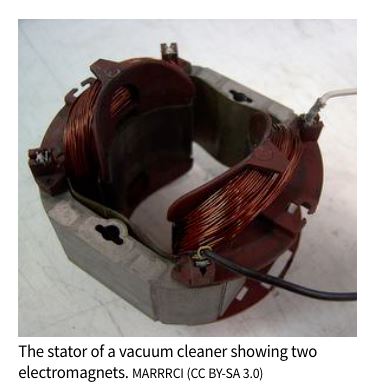
    What is an Electromagnet?

    • Invented in 1824 by William Sturgeon, electromagnets revolutionised technology.
    • Sturgeon was an English physicist and inventor who discovered that wrapping a coil of wire around a piece of iron and passing an electric current through the wire produced a magnetic field.
    • Electromagnets are used in Loudspeakers for sound reproduction, Motors for mechanical movement., and MRI machines for medical imaging, etc

    How Electromagnets Work?

    • Electric current flowing through a wire generates a magnetic field around the wire.
    • Coiling the wire enhances this magnetic field by concentrating it within the coil’s core.
    • This configuration creates an electromagnet, where the strength of the magnetic field is directly proportional to the current flowing through the coil.
    • The magnetic flux density so generated is measured in ‘Tesla’.

    Enhancing Magnetic Strength with a Core

    • Coiling the wire around a magnetic material (core), such as iron or steel:
      • Amplifies the magnetic field produced by the electric current.
      • Ferromagnetic materials like iron align their internal magnetic domains with the external magnetic field generated by the coil.
      • This alignment significantly increases the overall magnetic strength of the electromagnet compared to a non-magnetic core.

    Persistence of Magnetization

    • It refers to the property of a material to retain a certain amount of magnetization even after the removal of an external magnetic field.
    • Certain core materials exhibit retained magnetization even after the current ceases.
    • This residual magnetism is useful in applications requiring sustained magnetic fields, such as:
      • Superconducting electromagnets used in MRI machines, are capable of producing magnetic fields up to 30 Tesla.
      • Research electromagnets like those used in particle physics, which require stable and powerful magnetic fields.

    Who was Michael Faraday (1791-1867)?

    • Michael Faraday was a pioneering English scientist and physicist who made substantial contributions to the fields of electromagnetism and electrochemistry.
    • Faraday is best known for his experiments and discoveries in electromagnetism, which laid the groundwork for the principles of electromagnetic induction and the laws of electrolysis.

    Key achievements of Michael Faraday include:

    1. Electromagnetic Induction: He discovered electromagnetic induction in 1831, showing that a changing magnetic field induces an electric current in a nearby conductor.
    2. Electrochemistry: Faraday formulated the laws of electrolysis, which describe the quantitative relationship between the amount of material produced or consumed during electrolysis and the amount of electricity passed through the electrolyte.
    3. Faraday’s Laws of Electromagnetic Induction: These laws describe the fundamental principles of generating electricity using magnetic fields, forming the basis for the development of electric generators and transformers.
    4. Faraday Cage: He invented the Faraday cage, a device used to block electromagnetic fields.


    PYQ:

    [2011] Microbial fuel cells are considered a source of sustainable energy. Why?

    1. They use living organisms as catalysts to generate electricity from certain substrates.
    2. They use a variety of inorganic materials as substrates.
    3. They can be installed in wastewater treatment plants to cleanse water and produce electricity.

    Which of the statements given above is/are correct?

    (a) 1 only

    (b) 2 and 3 only

    (c) 1 and 3 only

    (d) 1, 2 and 3

  • Madras High Court’s Interpretation of POSH Act, 2013

    Why in the News?

    Madras HC upheld the ‘Right to Report’ serious incidents of sexual harassment a time, rejecting the 3-month deadline under the Sexual Harassment of Women at Workplace (Prevention, Prohibition, and Redressal) Act (POSH), 2013.

    • Long-term emotional and psychological damage on victims underscored the need for a broader application of the law.

    Right to Report under POSH Act, 2013

    • Case Background: The decision came while addressing a police officer’s petition to quash an enquiry report for alleged sexual assault against a female colleague.
    • Madras HC Reasoning: Serious allegations leading to “grave mental trauma” and “stress” constitute a “continuing offence” under POSH, allowing victims to report and investigate at any time.
    • Notable Observations: the Madras HC distinguished between isolated incidents and serious allegations like assault or molestation.
    1. Isolated Incidents: Must adhere to strict deadlines under POSH.
    2. Serious Allegations: Treated as continuous misconduct until addressed, allowing flexibility in reporting timelines due to fear of victimisation.

    What is the POSH Act?

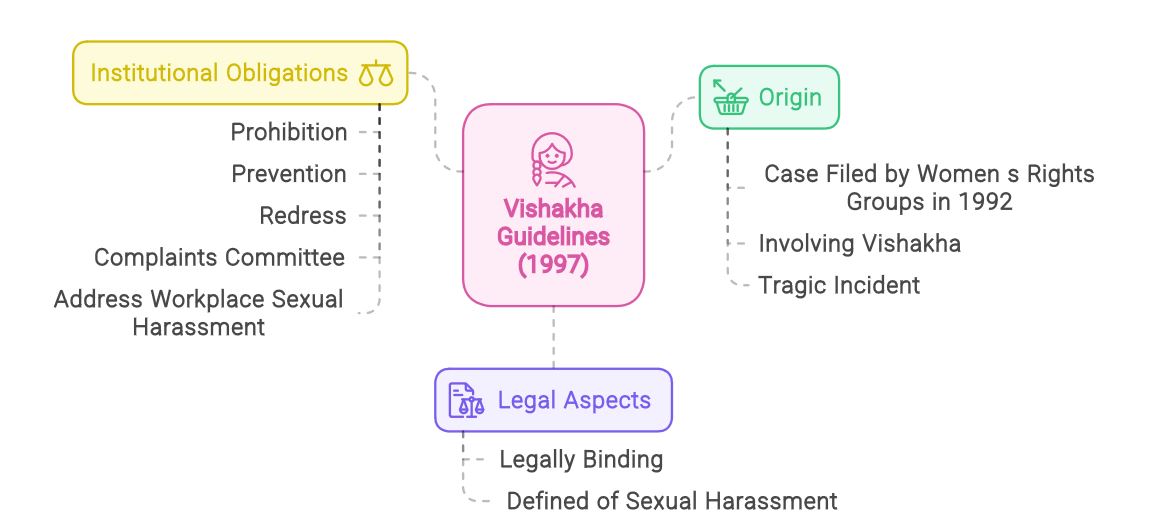
    • The Sexual Harassment of Women at Workplace (Prevention, Prohibition and Redressal) Act was passed in 2013.
    • It defined sexual harassment, laid down the procedures for a complaint and inquiry, and the action to be taken.
    • It broadened the Vishakha Guidelines, which were already in place.

    The POSH Act broadened these guidelines:

    • It mandated that every employer must constitute an Internal Complaints Committee (ICC) at each office or branch with 10 or more employees.
    • It lays down procedures and defines various aspects of sexual harassment, including the aggrieved victim, who could be a woman “of any age whether employed or not”, who “alleges to have been subjected to any act of sexual harassment”.
    • This meant that the rights of all women working or visiting any workplace, in any capacity, were protected under the Act.

    Definition of Sexual Harassment

    Under the 2013 law, sexual harassment includes “any one or moreof the followingunwelcome acts or behaviour” committed directly or by implication:

    • Physical contact and advances
    • A demand or request for sexual favours
    • Sexually coloured remarks
    • Showing pornography
    • Any other unwelcome physical, verbal or non-verbal conduct of a sexual nature.

    The Ministry of Women & Child Development has published a Handbook on Sexual Harassment of Women at the Workplace with more detailed instances of behaviour that constitutes sexual harassment at the workplace. These include, broadly:

    • Sexually suggestive remarks or innuendos; serious or repeated offensive remarks; inappropriate questions or remarks about a person’s sex life
    • Display of sexist or offensive pictures, posters, MMS, SMS, WhatsApp, or emails
    • Intimidation, threats, blackmail around sexual favours; also, threats, intimidation or retaliation against an employee who speaks up about these
    • Unwelcome social invitations with sexual overtones, commonly seen as flirting
    • Unwelcome sexual advances.

    Unwelcome behaviour

    • The Handbook says “unwelcome behaviour” is experienced when the victim feels bad or powerless; it causes anger/sadness or negative self-esteem. 
    • It adds unwelcome behaviour is one which is “illegal, demeaning, invading, one-sided and power based”.

    Circumstances amounting to SHW

    The Act mentions five circumstances that amount to sexual harassment implied or explicit:

    1. The promise of preferential treatment in her employment
    2. The threat of detrimental treatment
    3. Threat about her present or future employment status
    4. Interference with her work or creating an offensive or hostile work environment
    5. Humiliating treatment likely to affect her health or safety

    Procedure for complaint

    Description
    Filing a complaint The aggrieved victim has the option to file a complaint with the ICC, but it is not compulsory for the ICC to act.
    Assistance in filing a complaint Any member of the ICC must provide reasonable assistance to the victim in filing a written complaint.
    Filing a complaint on behalf of the victim If the victim is unable to file a complaint due to incapacity, death, or other reasons, her legal heir may file it on her behalf.
    The time limit for filing a complaint The complaint must be made within 3 months from the date of the incident
    Extension of time limit ICC has the authority
    Monetary settlement and conciliation Yes. It is possible.
    Forwarding complaint or initiating an inquiry Must be completed within 90 days.
    Confidentiality of information The act ensures the confidentiality of the woman’s identity, respondent’s identity, inquiry details, recommendations, and actions taken

    Requirements imposed on employers

    Description
    Internal Complaints Committee (ICC) Employers with more than 10 employees must establish an ICC to address sexual harassment complaints.
    Composition of ICC The ICC must include women employees, another employee, and a third-party member familiar with sexual harassment issues.
    Local Committee (LC) for smaller organizations Organizations with fewer than 10 employees must create an LC to receive complaints from the informal sector.
    Complaint filing process Women can file written complaints to either the ICC or LC within three to six months of the incident.
    Resolution methods The Act provides two resolution methods: conciliation between the parties involved or conducting an inquiry by the committee.
    Annual audit report Employers must file an annual audit report on sexual harassment complaints and take responsibility for conducting workshops, awareness programs, and orientation for ICC members.
    Non-compliance penalties Non-compliance with the Act can result in penalties, including fines.


    PYQ:

    [2019] What are the continued challenges for Women in India against time and space?

    [2014] We are witnessing increasing instances of sexual violence against women in the country. Despite existing legal provisions against it, the number of such incidences is on the rise. Suggest some innovative measures to tackle this menace.

    [2010] Two of the schemes launched by the Government of India for Women’s development are Swadhar and Swayam Siddha. As regards the difference between them, consider the following statements:

    1. Swayam Siddha is meant for those in difficult circumstances such as women survivors of natural disasters or terrorism, women prisoners released from jails, mentally challenged women etc.,whereas Swadhar is meant for holistic empowerment of women through Self Help Groups.
    2. Swayam Siddha is implemented through Local Self Government bodies or reputed Voluntary Organizations whereas Swadhar is implemented through the ICDS units set up in the states.

    Which of the statements given above is/are correct?

    (a) 1 only
    (b) 2 only
    (c) Both 1 and 2
    (d) Neither 1 nor 2

  • We are live! And our keys are the most authentic!

    We are live! And our keys are the most authentic!

    Everyone join in!

    https://www.youtube.com/watch?v=PPBROLP8Vxo

  • [PDF]Releasing Keys for Set C. Set A and Set B will follow in the next 20 mins.

    For explanations and the logic we have used to resolve controversial questions Register here

    The solutions are marked in RED.

    First reaction from Civilsdaily

    1. Factual questions on the lines of state PCS were high.
    2. Questions on armed forces, environment were tough. These were generally not from topics that aspirants study.
    3. Polity, economics and geography were on easier lines.
    4. Economics – capital markets, bonds – https://indianexpress.com/article/upsc-current-affairs/upsc-essentials/upsc-prelims-2024-economy-six-key-areas-to-focus-9354795/
    5. IR was also on expected lines – https://indianexpress.com/article/upsc-current-affairs/upsc-essentials/upsc-prelims-2024-special-six-areas-international-relations-9356189/
    https://www.youtube.com/watch?v=MwYcS2bMd-I&t=386s

    For explanations and the logic we have used to resolve controversial questions Register here

  • [Live]UPSC Prelims 2023 – Question Paper, Answer Key, Solutions with Explanations

    [Live]UPSC Prelims 2023 – Question Paper, Answer Key, Solutions with Explanations

    Prelims 2023 is here. And we are all with you. We will keep updating this section with all the necessary details.


    Message from entire Civilsdaily’s Team

    Good luck for tomorrow from the entire Civilsdaily Family. This is not a feel-good post but a hard-hitting one because life isnt feel good and upsc definitely isnt feel good. Tomorrow is an important day, and having the right mindset is crucial. Ultimately, Prelims is a mind game.

    1. **Going from strength to strength**

    Molightson’s story is significant. He comes from the Maring tribe in Manipur, leading a content life with limited exposure to the outside world. His painful experiences with city life and hotel management could’ve made him bitter. But not him. He learned to handle pressure. He appeared for Prelims amidst riots in Manipur. He could’ve said Prelims is not worth risking his life, given his slim chances. Instead of blaming the world for his problems, he looked inward and went from strength to strength. The right kind of people have this attitude.

    2. **Control the controllables**

    Anything you do in life with a 0.1% success rate will have uncontrollable elements. Your hard work and the inner force to push your limits are necessary conditions but not sufficient. To achieve success, many factors need to come together. Animesh, AIR 2 was battling his Mom’s cancer(where he eventually lost) on one front and fighting UPSC on the other(where he aced like none). We all want to win all fights. But all we can do is give our best and leave the rest to destiny. If you haven’t done your best, putting your best foot forward to control what you can; then you dont have the right to blame what you can’t control.

    3. **Choices you make**

    You always have a choice in how to respond to a situation. Consider last year’s Prelims. Many came out saying elimination techniques were ineffective. Yet, every ranker used a spectrum of elimination techniques, few requiring solid prior knowledge and deep conceptual understanding, while others requiring none.

    Many rankers have held sessions with us, solving the Prelims paper and explaining the same.

    What happened here? Your response was reactive. UPSC tricked you into believing what your institutes taught you was worthless. Those who could stop these thoughts gave their best. Tomorrow is not about content, or academics. That is something you can fix with time. It is about getting these life lessons right. It is about building this kind of resilience.

    Not sure whether UPSC intended its candidates to be this tough. But the kind of folks entering the services NOW definitely have the right mindset.

    🔗 For PDFs. Fill out the form here – https://bit.ly/cd_yt to register and get the keys.

  • [15th June 2024] The Hindu Op-ed: Reimagining Indian federalism

    [15th June 2024] The Hindu Op-ed: Reimagining Indian federalism

    PYQ Relevance:

    Q The concept of cooperative federalism has been increasingly emphasised in recent years. Highlight the drawbacks in the existing structure and the extent to which cooperative federalism would answer the shortcomings. (UPSC IAS/2015)
    Q How far do you think cooperation, competition and confrontation have shaped the nature of federation in India? Cite some recent examples to validate your answer. (UPSC IAS/2020)

    Mentors’ comment: Federalism is crucial as it balances power between national and regional governments, fostering a diverse and inclusive governance structure. It allows regions to address local needs effectively while maintaining national unity. By promoting cooperation and accommodating diversity, federalism enhances democratic participation, prevents centralization of power, and ensures more equitable resource distribution, supporting overall stability and development.

    Let’s learn_ _

    Why in the news?

    On June 4, 2024, the BJP fell short of a Lok Sabha majority, relying on regional partners. This coalition governance could curb the BJP’s dominance and revitalize India’s federal structure, damaged over the past decade.

    Undermine the Federalism in last decade before the 2024 election 

    • Centralisation of Power: Under the current administration, there has been a significant shift towards centralising power at the expense of state autonomy, moving away from the principle of cooperative federalism.
    • Use of Investigative Agencies: Regulatory and investigative agencies like the Enforcement Directorate, Central Bureau of Investigation, and Income-Tax agencies have been used to clamp down on political opponents from regional parties, thereby undermining state authority and autonomy.
    • Imposition of Hindi: Efforts to impose Hindi on non-Hindi speaking southern states have been part of a broader strategy to homogenize the nation, disregarding the linguistic and cultural diversity of states.
    • Unilateral Decision-Making: Key decisions, such as imposing a nationwide lockdown during the COVID-19 pandemic, were made unilaterally by the central government without consulting the states, exemplifying a top-down approach.
    • Fiscal Manipulation: The financial autonomy of states has been undermined by the central government through mechanisms like levying cesses on various items, which are not shared with states, disrupting the balance of fiscal federalism.

    The concerns of the Southern States

    • Financial Disparity: Southern states recognize the necessity of correcting regional imbalances but are concerned about disproportionate financial allocations favoring less-performing northern states. For example, Uttar Pradesh received ₹25,069 crore in tax devolution, more than the combined total for all five southern states.
    • Potential Political Disenfranchisement: There is anxiety over the potential political dominance of northern states like Uttar Pradesh and Bihar, particularly concerning the upcoming delimitation exercise. These states, with their larger populations, could outweigh the southern states’ influence in the Lok Sabha.

    Measures to resolve the concerns of southern States

    • Need for Equitable Redistribution: Southern leaders emphasise the importance of equitable redistribution and representation, advocating for a balanced approach that does not financially persecute the high-performing southern states.
    • Coordination Among Southern Leaders: Southern chief ministers are likely to collaborate to address the threat of political disenfranchisement, recognising that their collective interests are at stake in maintaining a fair federal structure.

    Why Need to Revive the Inter-State Council?

    • Potential for Effective Deliberation: Although the Council has the potential to be a formidable forum for decision-making and dispute resolution, it has become ineffective under the control of the Ministry of Home Affairs.
    • Independent Arena for Coordination: Reviving the Council would provide an independent space for consultation, decision-making, and dispute resolution, ensuring better coordination between states and various governmental departments on issues affecting states.
    • Accommodating Diversity: In a diverse country like India, fostering a sense of common belonging while respecting the developmental differences among states is crucial. The Council can help in creating policies that are inclusive and considerate of these differences.
    • Preventing Fragmentation: Ensuring that all states feel that their common nationhood is beneficial helps in maintaining national unity. Without proper forums for dialogue, regional, religious, and linguistic tensions could escalate.
    • Addressing Inequitable Power Dynamics: The statement “We have more people, so we will have more money and power” threatens to disrupt the delicate balance of federalism. The Council can help address these power imbalances and promote equitable development across all states.

    Conclusion: To strengthen India’s federalism, revitalizing the Inter-State Council is crucial, ensuring it operates independently for effective consultation and decision-making. Equitable fiscal practices, respect for state autonomy, and promotion of cultural diversity will foster cooperative governance and prevent centralization, thereby balancing regional needs with national unity.

    Source: https://www.thehindu.com/opinion/lead/reimagining-indian-federalism/article68290374.ece#:~:text=This%20Modi%2Dfied%20brand%20of,on%20political%20opponents%20from%20regional

  • Unsolved issue of the Buddha Relics from Bavikonda

    Why in the News?

    • Ten years after the division of Telangana from united Andhra Pradesh, the distribution of antiquities, manuscripts, and cultural objects remains contentious.
      • The custody of objects like Buddha Relics from Bavikonda are part of this dispute.

    About Bavikonda Buddhist Complex

    • Bavikonda, a significant ancient Buddhist site dating from the 3rd century BC to the 3rd century AD, is located along the Eastern Coastline of Andhra Pradesh near Visakhapatnam on the way to Bheemunipatnam.
    • It is located an ancient trade route linking Andhradesa with North India via Kalinga, along with its proximity to ancient ports.
    • The discovery of Roman silver coins further supports this historical context.
    • The site also features Buddhapada slabs intricately carved with Ashtamangala symbols, found on the platforms surrounding the Mahachaitya.

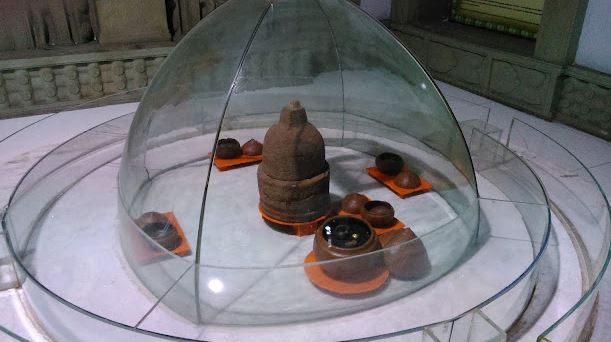
    About Buddha Relics from Bavikonda

    • The relics were discovered in 1993 during archaeological excavations conducted by the Andhra Pradesh Department of Archaeology and Museums (DAM).
    • These discoveries have significantly contributed to our understanding of the spread of Buddhism in the region during the post-Ashoka period along the Krishna River basin.
    • Nature of Relics:
    • The site at Bavikonda yielded several earthen vessels containing gold objects and precious beads.
    • These relics are believed to include corporeal remains (related to skull) of the Buddha, along with silver and gold caskets.
    • These were found alongside an earthen urn or receptacle (Samudgaka) containing ashy deposits and burnt charcoal.

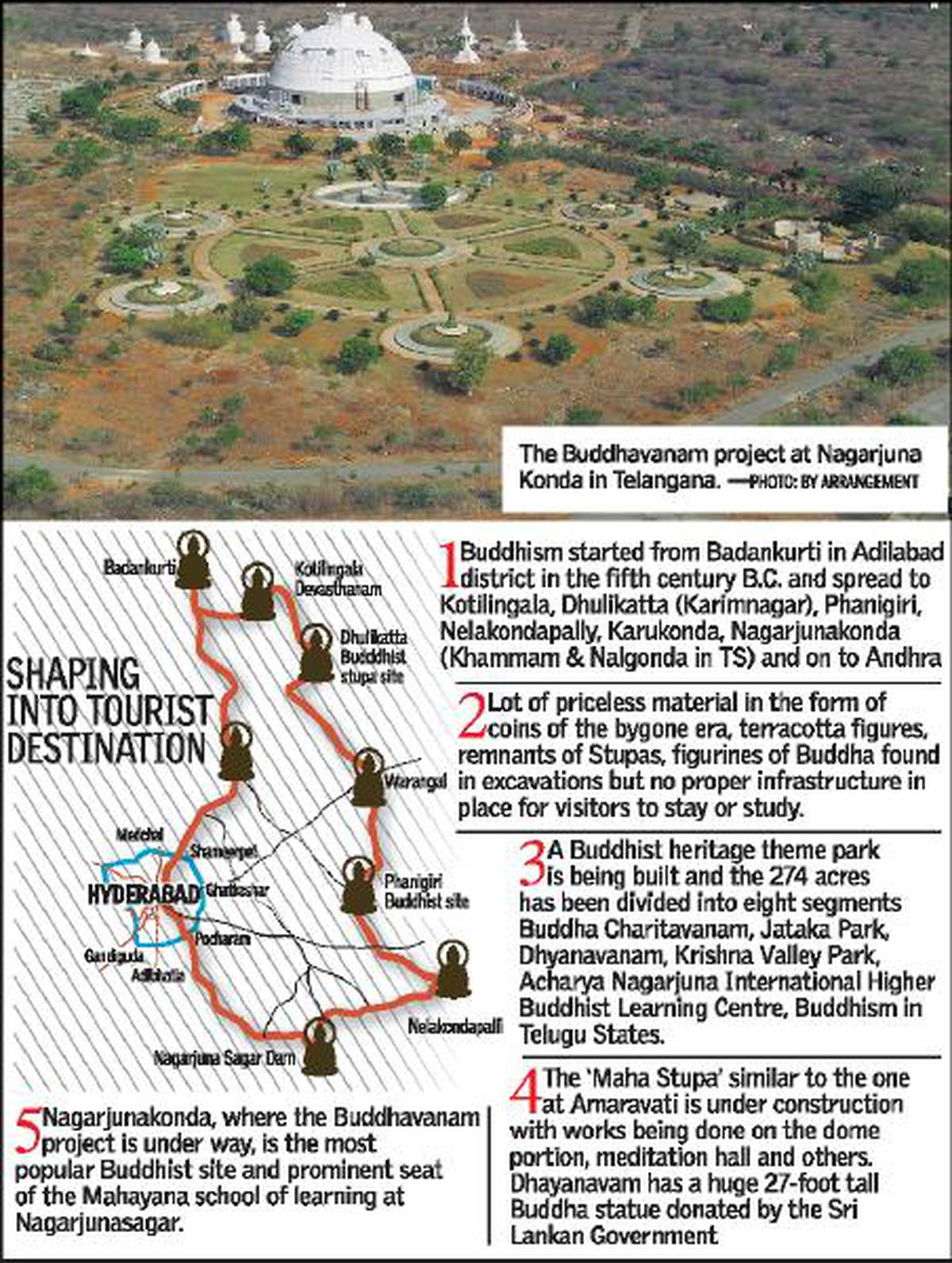
    Noted Buddhavanam Sites in Andhra Region

    • Thotlakonda: Located near Visakhapatnam, Thotlakonda is another prominent Buddhist site dating back to the 3rd century BC to the 3rd century AD. It consists of monastic complexes, stupas, chaityas, viharas, and a university. Excavations have revealed relics and artifacts indicating it was a major center for Buddhist learning and trade.
    • Salihundam: Situated near Srikakulam, Salihundam dates from the 2nd century BC to the 12th century AD. It features remnants of stupas, votive stupas, monastic complexes, and sculptures. The site is noted for its architectural and sculptural heritage, reflecting a blend of Buddhist and Hindu influences over centuries.
    • Pavurallakonda: Close to Bheemunipatnam, Pavurallakonda is a Buddhist hilltop monastery dating back to the 3rd century BC to the 2nd century AD. It includes viharas, chaityas, and relic caskets. The site offers panoramic views of the coastline, adding to its spiritual ambiance.
    • Ghantasala: Located near Krishna district, Ghantasala served as an ancient Buddhist site from the 2nd century BC to the 2nd century AD. It contains stupas, viharas, and relics that indicate its significance as a trading hub and center for Buddhist teachings.
    • Nagarjunakonda: Situated in the Guntur district, Nagarjunakonda is an island on the Krishna River that flourished from the 3rd century BC to the 3rd century AD. It boasts numerous Buddhist monasteries, stupas, chaityas, and sculptures. The site is renowned for its architectural grandeur and extensive archaeological findings.


    PYQ:

    [2015] Which of the following kingdoms were associated with the life of Buddha?

    1. Avanti
    2. Gandhara
    3. Kosala
    4. Magadha

    Select the correct answer using the codes given below:

    (a) 1, 2 and 3

    (b) 2 and 3 only

    (c) 1, 3 and 4

    (d) 3 and 4 only

  • CIC upholds decision of Rashtrapati Bhavan on RTI query

    Why in the News? 

    • The Central Information Commission (CIC) upheld Rashtrapati Bhavan’s response to an RTI query regarding the number of times former President Kovind returned decisions by the Prime Minister/Union Council of Ministers for reconsideration.
      • The President’s Secretariat stated that no information was available on record regarding such returns.

    Back2Basics: Right to Information (RTI)

    • The RTI Act of 2005 grants Indian citizens the right to access government-held information, with exceptions.
    • Its goal is to enhance transparency and accountability in public authorities.
    • This Act replaced the earlier Freedom of Information Act of 2002.
    • RTI aligns with Freedom of Speech and Expression (Article 19) in India’s Constitution.

    About Central Information Commission (CIC)

    Details
    Establishment Set up under the Section 12 of the Right to Information Act, 2005.
    Function
    • Oversees implementation of RTI Act in Central Government and Union Territories.
    • Resolves complaints and decides appeals related to the Act.
    Headquarters New Delhi
    Composition
    • Chief Information Commissioner (CIC)
    • Up to 10 Information Commissioners (IC), (appointed by President on recommendation of PM-led Committee consisting Leader of Opposition and Cabinet Ministers.)
    Qualifications CIC and IC must be persons of eminence in public life with wide knowledge and experience in: Law, Science and Technology, Social Service, Management, Journalism, Mass Media, Administration, and Governance.

    NON-ELIGIBLITY: Members of Parliament or Legislature of any State or Union Territory, hold any office of profit, be connected with any political party, or carry on any business or profession.

    Tenure
    • CIC and IC hold office for such term as prescribed by Central Government or until they attain age of 65 years, whichever is earlier.
    • NO Reappointment.
    • IC can be appointed as Chief Information Commissioner, but total tenure including term as IC should not exceed 5 years.
    Removal
    • President can remove CIC or IC on grounds like insolvency, conviction for moral turpitude, engaging in another office of profit, etc.
    • Removal for misbehaviour requires Supreme Court enquiry and recommendation.
    Salary & Conditions Salary, allowances, and service conditions determined by Central Government, cannot be varied to their disadvantage during service (After RTI Amendment Act,2019)
    How RTI amendment, 2019 has changed CIC?
    • Before the 2019 amendment to the RTI Act, ICs at the CIC held a 5-year fixed term and were considered equal in status to the Chief Election Commissioner and Supreme Court judges.
    • The 2019 amendments granted the Centre the power to alter these terms at its discretion.
    Functions
    • Receives and inquires into complaints related to RTI Act violations, including non-appointment of Public Information Officer, refusal or delay in information, unreasonable fees, incomplete or false information.
    • Submits annual report on Act’s implementation to Central Government, presented to Parliament.
    Powers
    • Can suo-moto order inquiries, summon persons, enforce oaths, access and inspect documents, receive evidence on affidavit, requisition public records, summon witnesses, and enforce compliance of decisions.
    • Can direct public authorities on information access, officer appointments, record management, training, and impose penalties or compensation for non-compliance.


    PYQ:

    [2018] The Right to Information Act is not all about citizens’ empowerment alone, it essentially redefines the concept of accountability. Discuss. (150 words)

    [2019] There is a view that the Officials Secrets Act is an obstacle to the implementation of RTI Act. Do you agree with the view? Discuss.

    [2020] “Recent amendments to the Right to Information Act will have a profound impact on the autonomy and independence of the Information Commission”. Discuss.

  • What are the standards for awarding death sentence, the President’s ‘Mercy’ power?

    Why in the News?

    • The President of India has rejected a Mercy Petition to pardon a Pakistani terrorist.
      • The accused was one among the Lashkar-e-Tayyeba terrorists who attacked the Red Fort in 2000, killing two soldiers and a civilian guard.

    What is the process of Mercy Petition?

    • Step 1: The convict facing a death sentence can file a mercy petition within 7 days of the Supreme Court dismissing their appeal.
    • Step 2: The convict or their relative submits a written petition to the President or governor, citing grounds such as sole breadwinner, physical/mental health, perceived harshness of the law, or judicial errors.
    • Step 3: The petition is forwarded to the Ministry of Home Affairs for assessment and recommendations, including consultation with the relevant State government.
    • Step 4: Based on Home Ministry recommendations and the Council of Ministers’ advice, the President can accept or reject the mercy plea without a specified time limit.
    • Step 5: While governors cannot pardon death sentences, they can commute, remit, or reprieve sentences under their state’s executive powers for offences against state laws.

    Judiciary on Mercy Petitions:

      • Bachan Singh v. State of Punjab (1980): The Supreme Court, upheld the death penalty but set the stringent criteria. It emphasized that the death penalty should be awarded only in the “rarest of rare” cases when all mitigating circumstances are considered.
      • In Maru Ram v. Union of India (1981), the Supreme Court ruled that the power to grant pardons under Article 72 of the Constitution must be exercised based on the advice of the Council of Ministers.
      • In Kehar Singh vs Union of India (1989) case, the court asserted that presidential pardon is an act of grace, not a right that can be claimed. The exercise of this power is purely administrative and not subject to judicial review.
      • In the Dhananjoy Chatterjee vs State of West Bengal (1994) case, the Supreme Court clarified that the pardoning powers under Articles 72 and 161 of the Constitution can only be exercised by the Central and State Governments, respectively, and not autonomously by the President or Governor.
      • In Epuru Sudhakar & Anr. v. Government of Andhra Pradesh (2006), the Supreme Court ruled that the clemency powers of the President and Governor under Article 72 and Article 161 are subject to judicial review.
      • In Shatrugan Chauhan v. State of U.P. (2014), the appex court has also commuted the death sentence in cases of inordinate delay in deciding mercy petitions. The court commuted the sentence of one Gurmeet Singh after he spent 27 years in custody (and 21 years on death row). 
      • In Mohd. Afzal Guru vs State of Delhi (2014) case, the court-mandated a minimum 14-day gap between the rejection of a mercy petition and the execution of a death penalty, ensuring adequate time for legal recourse.
      • Report of the 262nd Law Commission (2015): Recommended abolishing the death penalty for all crimes except terrorism-related offenses and waging war.
      • In April 2023, the Supreme Court upheld the Mumbai High Court’s decision to commute the death sentence of a woman and her sister due to significant delays in deciding their mercy petitions.

    About Presidents’ Pardoning Powers under Article 72

    • According to Article 72, the President of India has the power to grant pardons, reprieves, respites, or remissions of punishment or to suspend, remit, or commute the sentence of any person convicted of any offense: In cases where the punishment or sentence is by a Court Martial;
      • According to Article 161, the Governor of a State has the power to grant pardons, reprieves, respites, or remissions of punishment or to suspend, remit, or commute the sentence of any person convicted of any offence against any law relating to matters under the executive power of the State.
    • In the recent Supreme Court Ruling of 2021, the apex court held that the Governor of a state can pardon prisoners, including those on death row, even before they have served a minimum of 14 years of their prison sentence.

    Did you know?

    1. Pardon means completely absolving the person of the crime and letting him go free. The pardoned criminal will be like a normal citizen.
    2. Commutation means changing the type of punishment given to the guilty into a less harsh one, for example, a death penalty commuted to a life sentence.
    3. Reprieve means a delay allowed in the execution of a sentence, usually a death sentence, for a guilty person to allow him some time to apply for a Presidential Pardon or some other legal remedy to prove his innocence or successful rehabilitation.
    4. Respite means reducing the quantum or degree of the punishment to a criminal in view of some special circumstances, like pregnancy, mental condition etc.
    5. Remission means changing the time period of the punishment without changing its nature, for example reducing twenty years of rigorous imprisonment to ten years.

    Cases as specified by Art. 72

    In all cases where the punishment or sentence:

    1. is by a court-martial.
    2. is for an offence against any law relating to a matter to which the executive power of the Union extends.
    3. is a sentence of death.

    Nature of the Pardoning Power

    • The pardoning power of the president is not absolute.
    • At a procedural level, the apex court in Epuru Sudhakar & Anr. v. Government of Andhra Pradesh (2006) has held that the President’s power must be exercised based on the aid and advice of the Council of Ministers and can be challenged on multiple grounds including that relevant material was not considered, the power was exercised based on political considerations, or there was no application of mind.
    • This has not been discussed by the Constitution but is the practical truth. Further, the constitution does not provide for any mechanism to question the legality of decisions of presidents or governors exercising mercy jurisdiction.


    PYQ:

    [2014] Instances of President’s delay in commuting death sentences have come under public debate as denial of justice. Should there be a time specified for the President to accept/reject such petitions? Analyse.

More posts