
And this is the FULL Story on Railway Reforms @2015
Thank you students for appreciating the thoughts. It is imperative that in current day and age we work out to mitigate the fears of GS and lay down and approach which works best and is all inclusive.
Moving on with the two factors which I mentioned before –
I. External factors:
It is a belief that every thing in this world is meant to fullfil certain purpose. Anything which disrupts this teleology then it will be considered as unethical. e.g same sex marriages
According to critics it is “unnatural” because they say that sexual intercourse is meant for new life i.e. for child. Hence, they denounce use of contraceptives , abortion, etc.
But at the same time we know it for sure that many societies/countries have legalised same sex marriages. Why ? Just think.
In this approach it is the result which influences our choice/decisions. Formula being “ greatest good of the greatest number” (Utilitarianism).
II. Internal factors:
In nutshell this paper is all about ethical decision and courageously defending our stand without FEAR & FAVOUR.
Ever wondered why you can’t concentrate on anything. Be it your studies or movies or anything going on. You are never ever able to hold your attention. The good thing is; science is justifying your lack of attention and is suggesting that average attention span is 2.5 minutes.
Concentration is not about a book or syllabus or anything. Concentration is a quality which defines your attentiveness and sharpness to grab things. A dull mind will not be interested in anything. A lukewarm mind might be interested in something interesting like a movie or a video game or whatsapp messages. But to grab things which are useful for exams or our life in general we need to sharpen our concentration.
Concentration is a quality we were all born with. Can you recollect how easily your concentration used to flow on a bird sitting on a tree outside the class or something on a wall, etc. It was then that our elders taught us to stop looking at these things and begin to concentrate on our books. And the result was, we lost our quality of concentration. Concentration is knack which we were born with but we have forgotten, thanks to our teachers and society. If you know the knack of concentration, you can concentrate on anything. Again remember, it is not about concentrating on books or syllabus or anything. It is just that you develop your knack of concentration and let it flow wherever it is required.
Few Techniques
Begin with this one minute exercise. While taking shower start looking concentrating on the droplet of water drizzling from the tap. Do it for a minute. Similarly, whenever you are bored while studying, start look at the second hand of your clock for at least 1 minute. Just do this exercise for few months. You will be amazed that your concentration will increase manyfold.
After you do these exercises for a few times in a day for about 3-4 months, you can migrate to a more refined technique. It is defined as Tratak in Hindu texts. The technique is simple. You need a small candle or a small lamp lit with castor oil or Desi Ghee. Lit it and start gazing at the light in a dark room. Do this exercise without blinking. Start with 5 minutes and keep increasing by 1 minute each week till you achieve it for 15 minutes. Your eyes may water but let it be. This will make your brain more stable and you will be able to concentrate.
Remember that don’t force yourself to concentrate on your books. It will never work. Increase your quality of concentration and you will see that it will help you study well and do everything in life in general really really well.
Lil One has always been good at chess. But this week, his game has suddenly become quite indestructible. I was getting frustrated as he was anticipating almost every move of mine and was giving me a tough match, often winning the board. “Losing to one’s kid is a wonderful feeling!”, my elderly neighbour informed me after she saw this most embarrassing spectacle of Lil One finally rupturing my rook defence and yell in delight, Orc style. I tried to look positively delighted to find this little speck of a boy beating me; my neighbour glowed in approval and left to inform the entire building of my successful motherhood milestone.
AAAAAAARRRGH! I am SO upset! Ok, I can see Saintly Sacrificing Mommies Inc. including women like Karan-Arjun’s mommy glowering at me in disapproval. But frankly, I am so frustrated! Ok, so here’s the world’s most well kept secret. Losing to one’s own kid in chess is quite an awesome feeling, once you overcome that strong urge to go and yell real loudly in frustration.
“You are reluctant to sacrifice, Mom, that’s your problem”, piped Lil One, getting into groove on his pet subject “3001 Favorite Mommy Errors.” “You have to be able to give up a minor piece in order to capture my rook. The power of exchange sacrifices is BIG. Let go a small thing today for BIG gains tomorrow. It always works. That’s what all chess masters say.”
Hmm. A sacrifice? He’s talking about a trade-off! Perhaps we are witnessing the same kind of a trade-off in the politico-economic-parliamentary space today. PM Modi declared in the “Mann-Ki-Baat” show a couple of days ago that the Land Ordinance would not be re-promulgated. Is this a small exchange sacrifice to get the rook, the GST Bill, going? It does look like it.
Frankly, I was never comfortable with that Land Ordinance. You can see some of my arguments regarding land acquisition in India in my earlier blogs here. The archaic Land Acquisition Act 1894 was replaced by the Right to Fair Compensation and Transparency in Land Acquisition, Rehabilitation and Resettlement (RFCT- LARR) in 2013. This Act was passed after a lot of discussion in the Parliament. LARR required consent of 80% of the land owners, if the acquisition was being done by a private party and 70% , if it was done by PPP. It also mandated Social Impact Assessment (SIA) before the land acquisition is done. The BJP, which was then on the Opposition bench, had been vociferous about certain clauses pertaining to Social Impact Assessment. Those clauses were duly inserted and then the Act was passed.
Now once the NDA came to power, it made an attempt to make the Act more “industry-friendly.” How does one do that? Well, there were two main changes that the NDA wanted to make in order to hasten the process of acquiring the land. First, it sought to dilute the SIA compliance for projects such as industrial corridors, rural infrastructure, affordable housing and “infrastructure and social infrastructure” projects. This last category includes sectors ranging from urban public transport to hospitals. Second, it provided an exemption to the consent clause for the Section 10A projects, as listed above.
This, it was felt, would reduce the time required in terms of acquiring land, thereby helping the industry to reduce project costs. To quote a CII estimate, the time required for consent and rehab and resettlement could increase the project costs of a 1000 MW power plant from Rs.150 crores to Rs.450 crores.
What I was uncomfortable with was the fact that the NDA chose to take the Ordinance route in order to get this on track. We are talking about land, the most politicized of all assets, the asset mostly closely associated with land grab and conflicts and farmers’ welfare programs, and there simply CANNOT be a case for promulgating an ordinance. This is one issue on which one wants full transparency. These amendments to the Act should have been passed after full discussion in the Parliament.
The Ordinance was passed and was renewed three times. There was a hope that the issues would get duly discussed in the Parliament in the monsoon session and the amendments would be passed; but what we’ve seen is a monsoon washout. There were two key discussions to be held in the monsoon session; the GST Bill and the Land Ordinance, both of which couldn’t be tabled.
In the meanwhile, the industry lobby is getting restive about policy reforms promised by Modi Sarkar. The external environment has become unstable and volatile, monsoons in India have been 12% deficient causing the agriculture growth rate to fall to only 1.6% in FY16, the IIP is showing sluggishness in industry and interest rate continues to be high despite low inflation. Tabling and passing the GST Bill will be a shot in the arm for industries wanting to see some action on the indirect tax front.
Surprising many, the PM declared on his radio show that the Land Ordinance would be allowed to lapse on 31st August 2015. He mentioned that the Ordinance was about getting a better deal for farmers, whose land was acquired, but it had backfired and had created an environment of mistrust within the farmers. He was hence allowing it to lapse. Interestingly, the tone in which he spoke was not accusing or bitter but reconciliatory and warm. Full points on delivery!
Well, what happens to industrial growth then, one may well wonder. We are back to square one. Project time will now escalate and so will project costs. How do you take care of that, PM? What we’re witnessing is a trade-off. Let’s get the GST rolling smoothly. Now that the land issue is null and void, it’ll be easier to get the Opposition back to the Parliament. The Opposition cannot really take too much of a stance against GST; it was their idea in the first place and is undeniably required for taking growth ahead. Once the GST Bill is passed, we can get back to the more sticky issue of land acquisition (I hope this time through a discussion route.)
He’s let the land ordinance go so that he can take the more required and infinitely more flashy GST reform ahead. If the NDA can get the GST Bill passed, no industry lobby will be able to claim that they have not done enough for growth. Sacrifice the knight for the rook.
After dinner, I challenged Lil One to one more game of chess. As we were lining up our pieces, he suddenly said, “Can you feel it in your heart when you’re going to win, Mom? I can. Dil se.” I had a sudden urge to tell him it’s not Dil ki baat. It’s Mann ki Baat.
India’s relations with the West Asian countries are historical since the independence. India has interests in economic, political, security and strategic fields with the West Asian nations.
For decades, India was a passive player in West Asia-a beneficiary of good relationships with multiple actors. Historically, India’s West Asia policy has been multi-directional.
Importance of west Asia for India
India has huge stakes involved in the region such as energy, trade and safety of Indian community in the region.
Political instability
The security situation in West Asia has been continuously deteriorating ever since the onset of the Arab Spring in December 2010.
India’s close relation with Israel is another sore point with west Asia.
India’s “Look West” policy
India adopted look west policy in 2005. However, the policy did not get much attention since 2005. Recent visit of Prime Minister Narendra Modi to number of west Asia countries has the potential to transform our engagement with West Asia.
Change in West Asian strategic thinking
Several factors have contributed to this fundamental shift in West Asian strategic thinking.
Analysis
Key Highlights
Israel – Palestine Conflict
Prime Minister Narendra Modi paid first official visit to Saudi Arabia. He is the fourth Indian Prime Minister to visit Saudi Arabia after Dr. Singh in 2010, Indira Gandhi in 1982 and Jawaharlal Nehru in 1956.
Following are the areas in which Prime Minister visit will have significant impact:
Importance of Saudi Arabia:
Maintaining vibrant ties with Saudi Arabia is imperative for India’s energy security as well as for national security.
Critical Issues with Saudi Arabia
Saudi – Pakistan relation: Pakistan is a “Historic ally” of the Saudis.
Saudi-Iran rivalry: destabilizing West Asia and influencing West Asian geopolitics.
Ideological problem:
Saudi Arabia’s aggressive foreign policy in West Asia: foreign policy is doing great damage to regional stability, which is India’s most important goal in the region.
Prime Minister paid his first official visit to Iran. During the visit, the two sides signed a total of 12 of agreements on economy, trade, transportation, port development, culture, science and academic cooperation.
India and Iran signed the “historic” Chabahar port agreement, which has the potential of becoming India’s gateway to Afghanistan, Central Asia and Europe.
Economic significance of Port
Strategic significance
The trilateral trade treaty
Transformational visit
Prime Minister Narendra Modi paid his first official visit to gas-rich Qatar. During the visit following seven agreements were signed.
An overview
India formally recognised Israel on September 17, 1950. Relations between India and Israel were not always warm. The two countries found themselves at loggerheads for almost 4 decades. India was the leader of NAM, and tilted towards Soviet and Arab world, where as Israel was out and out an US ally. India’s large muslim population was also a hurdle in establishing good bilateral relations.
Since firmly establishing ties, both countries have benefitted immensely.
Since the upgradation of relations in 1992, defence and agriculture have been the main pillars of bilateral engagement. In recent years, ties have expanded to areas such as S&T, education and homeland security. The future vision of the cooperation is of a strong hi-tech partnership as befits two leading knowledge economies.
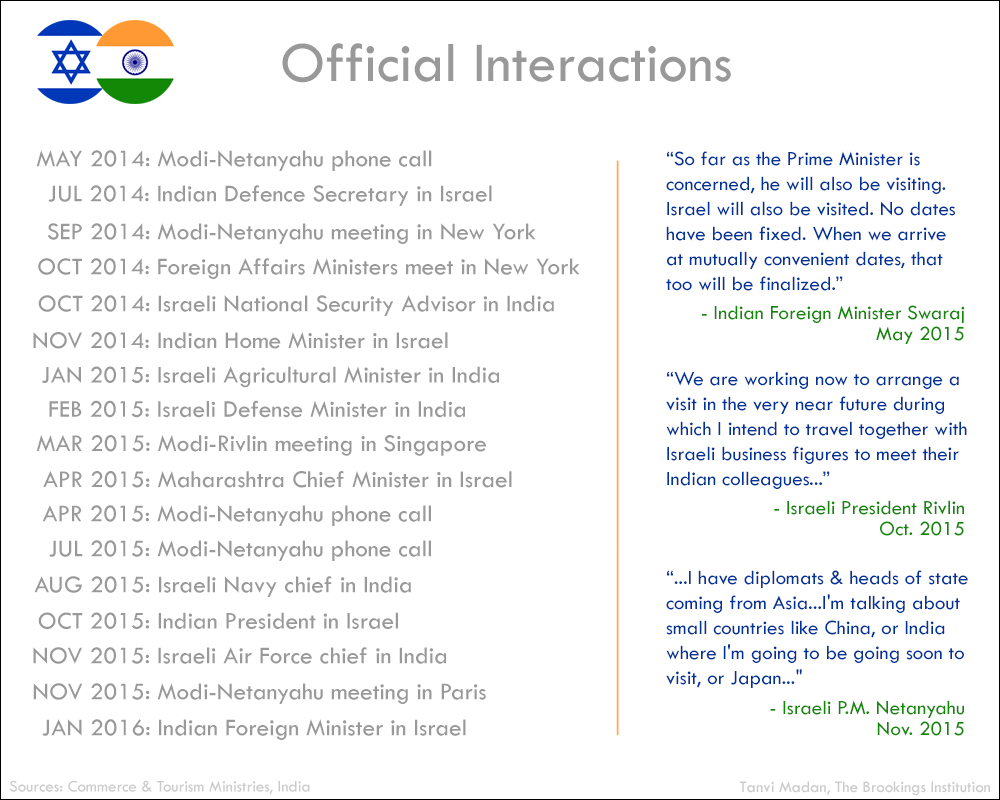
President Pranab Mukherjee visited Israel in October, 2015. From Israel, Prime Minister Ariel Sharon and President Ezer Weizmann visited India in 2003 and 1997 respectively . There have been frequent Ministerial level exchanges in the recent past.
India has benefited from Israeli expertise and technologies in horticulture mechanization, protected cultivation, orchard and canopy management, nursery management, micro-irrigation and post-harvest management particularly in Haryana and Maharashtra. Israeli drip irrigation technologies and products are now widely used in India. Some Israeli companies and experts are providing expertise to manage and improve dairy farming in India through their expertise in high milk yield.
India imports critical defence technologies from Israel. There are regular exchanges between the armed forces and defence personnel.
India is known in Israel as an ancient nation with strong cultural traditions.
Why India and Israel are bringing their relation out of the carpet?
Since 1992, the relations between the countries has developed steadily. Shared concerns regarding terrorism, have been key drivers. In fact, The President of India recently stated that Israel has come through for India, when needed the most.
The president referred to the assistance given during the Kargil crisis in 1999 in particular, but there has also been less publicly-acknowledged help in the past. India, for its part, has felt that the closer relationship with Israel has created a constituency for it in the United States.
The governments have also been trying to increase people-to-people interaction through educational exchanges and tourism, with some success.
Israel has talked about the relationship being “held under the carpet.” More bluntly, happy to engage intimately in private, but hesitant to acknowledge the relationship in public. The explanations for this have ranged from Indian domestic political sensitivities to its relations with the Arab countries.
In 2014, India had expressed concern about loss of life in Gaza strip, as well as provocations against Israel, and called both sides to deescalate. Yet, it then voted in support of the U.N. Human Rights Council resolution that condemned Israel, a move that left observers wondering why didn’t India abstain. Since then, however, the government has moved toward the expected approach.
The first sign of this was PM Modi’s decision to meet with Netanyahu on the sidelines of the opening of the U.N. General Assembly in 2014. Since then, there have been a number of high-level visits and interactions, including a few “firsts. Last year, Pranab Mukherjee, for example, became the first Indian president to travel to Israel. The Israeli ambassador to India has observed the “high visibility” the relationship now enjoys.
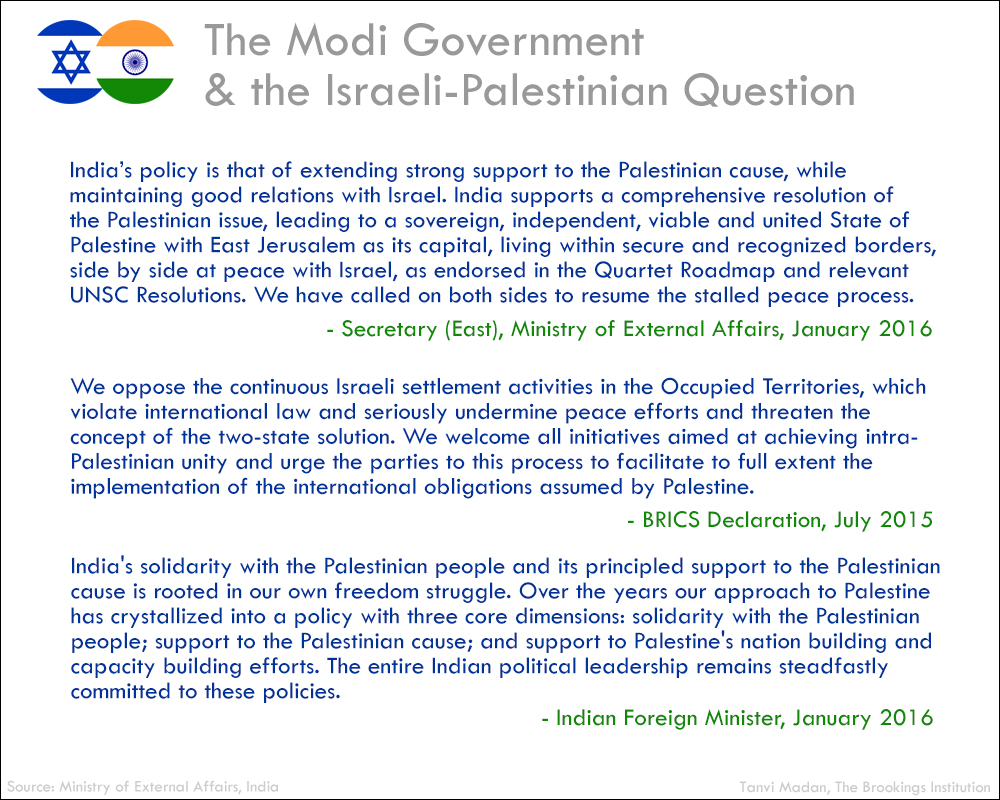
The deepening and more open relationship with Israel, however, hasn’t been accompanied by a U-turn on the Indian government’s policy toward Palestine. Government seems to be doing is trying to de-hyphenate its ties with Israel and Palestine. The de-hyphenated approach, in turn, potentially gives Indian policymakers more space to take India’s relationship with Israel further.
The government has reiterated India’s traditional position on a two-state solution, as an independent Palestinian state with East Jerusalem as its capital.
The continuity on this front is not just driven by historic and domestic political factors, but also by India’s broader balancing act in the region. Even as India’s relations with Israel have deepened, it has maintained and even enhanced its relations with Iran and the Gulf Cooperation Council (GCC) countries.
Main areas of cooperation
There is a lot of complementarity between both nations’ economic interests.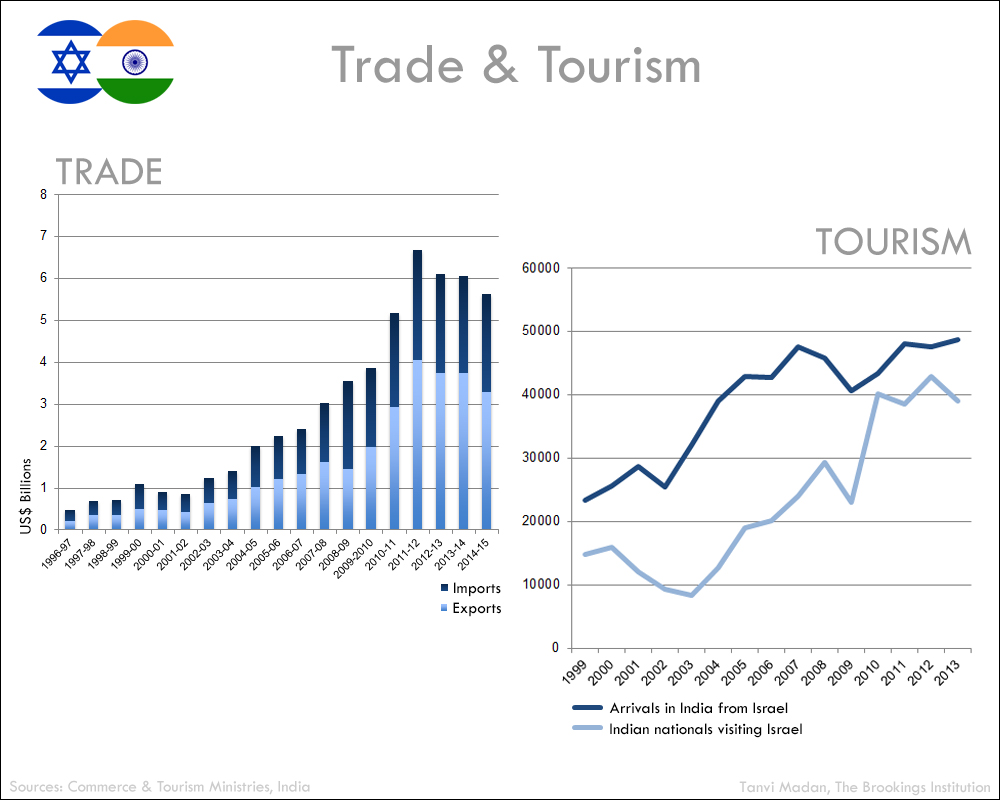
Israeli President’s visit to India
What challenges remain?
Asian alliance comprising India, Israel, South Korea, Japan and Australia could work together to deal with issues including missile defence and piracy. At the global level, the differences in outlook of both nations are evident. India seems more in favour of a multi-polar world while Israel prefers a uni-polar one. But both nations do not want to see a weakened US.
Conclusion
Over the past 60 years, India’s Israel policy has been rooted in pragmatism. Although India initially opposed the creation of Israel, strategic cooperation caused Indo-Israeli relations to warm from the 1960s onward without alienating the Arab World.
Today India maintains close relationships with both Israel and Arab nations. Due to its close ties with both parties, India has the potential to play a major role in the peace process between Palestinians and Israelis. India is in a position to serve as an honest, unbiased broker, a role that the United States has struggled to fill.
The India-Israel relationship provides a valuable lesson in international politics, especially for states whose ideological alliances prevent them from forging solely pragmatic ties. India has shown that the even-handed pursuit of diplomatic, military, and economic interests is the way to garner diplomatic credibility and popular good will without damaging other strategic relationships.
IRAQ CRISIS
A civil war is raging in Iraq. There is a deadlock between the Islamic State in Iraq and the Levant (alternatively translated as Islamic State in Iraq and Syria and abbreviated as ISIL or ISIS an unrecognized state and active Jihadist militant group in Iraq and Syria influenced by the Wahhabi movement). It is operating in Iraq and Syria.
Here we are analyzing the situation of IRAQ in FAQ form:
What was Operation Iraqi Freedom?
After the attacks on September 11, 2001, and the overthrow of the Taliban and al-Qaeda in Afghanistan, the United States Government turned its attention to Iraq and the regime of Saddam Hussein. Citing intelligence information that Iraq had stockpiled and continued to develop weapons of mass destruction (WMD) such as poison gas, biological agents, and nuclear weapons, as well as harboring and supporting members of Osama Bin Laden’s al-Qaeda terrorist network, the United States and Great Britain led a coalition to topple Hussein’s regime in March 2003.
Since the end of the Persian Gulf War of 1990-1991, the United States Air Force had maintained a continuous presence in the Middle East, enforcing no-fly zones in the northern and southern portions of Iraq, termed Operation NORTHERN WATCH, based out of Turkey, and Operation SOUTHERN WATCH, based out of Kuwait and Saudi Arabia.
Finally, Operation Iraqi Freedom (OIF), the U.S.-led coalition military operation in Iraq, was launched on March 20, 2003, with the immediate stated goal of removing Saddam Hussein’s regime and destroying its ability to use weapons of mass destruction or to make them available to terrorists. Over time, the focus of OIF shifted from regime removal to the more open-ended mission of helping the Government of Iraq (GoI) improve security, establish a system of governance, and foster economic development.
What were the outcomes of Operation Iraqi Freedom?
The outcomes were:
a) End the regime of Saddam Hussein.
b) Elimination of Iraq’s weapons of mass destruction.
c) Destruction of terrorist infrastructure in Iraq.2
d) Coalition military forces secured Iraq’s southern oil fields
e) Sanctions on Iraq were imposed by the United Nations Security Council as a result of the Hussein regime’s unwillingness to abandon its weapons of mass destruction and terrorist programs, account for individuals missing from the 1991 Persian Gulf War, and stop its repression of the Iraqi civilian population. With the military action to remove the Hussein regime a success, U.N. sanctions against Iraq come to an end.
f) Estimates on the number of casualties during the invasion in Iraq vary widely. Estimates on civilian casualties are more variable than those for military personnel. According to Iraq Body Count, a group that relies on press reports, NGO-based reports and official figures to measure civilian casualties, approximately 7,500 civilians were killed during the invasion phase. The Project on Defense Alternatives study estimated that 3,200–4,300 civilians died during the invasion.
What was Operation New Dawn?
The transition to Operation New Dawn, Sept. 1, marks the official end to Operation Iraqi Freedom and combat operations by United States forces in Iraq.
During Operation New Dawn, the remaining 50,000 U.S. service members serving in Iraq will conduct stability operations, focusing on advising, assisting and training Iraqi Security Forces (ISF). Operation New Dawn also represents a shift from a predominantly military U.S. presence to one that is predominantly civilian, as the Departments of Defense and State work together with governmental and non-governmental agencies to help build Iraq’s civil capacity.
The transition to Operation New Dawn represents the U.S. commitment to the government and people of Iraq as a sovereign, stable country that will be an enduring strategic partner with the United States. This has been made possible by the improved capability of the ISF to take the lead in securing their country.
New Dawn also signifies the success of the responsible drawdown of forces and the redeployment of thousands of U.S. Soldiers, as well as the return or transfer of war fighting equipment to the U.S. or to combat troops fighting in Afghanistan.
What happened after withdrawal of US forces in 2011?
The withdrawal of American military forces from Iraq began in June 2009 and was completed by December 2011, bringing an end to the Iraq War.
Despite the elimination of a repressive single-party cult of personality state, the invasion and occupation led to sectarian violence which caused widespread displacement among Iraqi civilians. The Iraqi Red Crescent organization estimated the total internal displacement was around 2.3 million in 2008, and as many as 2 million Iraqis leaving the country. Poverty led many Iraqi women to turn to prostitution to support themselves and their families, attracting sex tourists from regional lands. The invasion led to a constitution which supported democracy as long as laws did not violate traditional Islamic principles, and a parliamentary election was held in 2005.
In addition the invasion preserved the autonomy of the Kurdish region, and stability brought new economic prosperity. Because the Kurdish region is historically the most democratic area of Iraq, many Iraqi refugees from other territories fled into the Kurdish land.
What was the Economic and Political Situation of Iraq after withdrawal?
Iraq’s political and economic challenges dominated both its internal politics and relations with the US, Iran, and Iraq’s other neighbors. To improve economic situation Iraq needs trade and cross-border support from Iran, just as it needs aid, diplomatic, and military support from the US. Iraq’s much-reduced military capabilities make it dependent on aid, military sales, and training from the United States, and Iraq still lacks the resources and cohesion to resist against Iranian coercion and to defend against Iranian aggression.
A budget crisis that lasted from 2008 to 2010, and a political crisis that began long before the March 2010 election that produced a de facto stalemate in many aspects of governance, have added to these economic problems as well as sharply delayed critical qualitative improvements in every branch of Iraq’s national security forces.
Iraq has not been able to absorb and support many of the aid projects funded during the US occupation, and its problems in national governance have been compounded by corruption, political infighting, and sectarian and ethnic struggles at the provincial and local levels.
While the existence of vast oil reserves in Iraq are not in question, the country’s petroleum sector faces many challenges that have limited its ability to produce, export, and deliver this valuable natural resource.
Battle over Iraq’s natural resources has a significant impact on its domestic politics and divisions. Iraq faces political fallout between the central government and the Kurdish regional government (KRG) over energy contracts and the right to invite and award lucrative contracts to international companies.
In April 2012, the KRG halted its supply of oil for export through Iraq’s national pipeline, claiming that the central government owed over $1.5 billion in operating costs to companies in the Kurdish region.
For its part, the government in Baghdad has threatened to simply deduct that lost oil revenue from what the KRG’s portion of the Iraqi budget. At the same time, Iraq’s oil-rich Shi’ite provinces want a larger share of the country’s export earnings while other Arab Shi’ite and Sunni provinces want the distribution of these shares based on need of their portion of Iraq’s total population.
Internal disputes between the central government and Iraq’s oil rich regions, as well as poor infrastructure, political uncertainty, sabotage, and internal demand will further limit Iraq’s ability to produce and export oil.
What were the Criticisms for the USA Invasion on Iraq?
The Bush Administration’s rationale for the Iraq War has faced heavy criticism from an array of popular and official sources both inside and outside the United States, with many U.S. citizens finding many parallels with the Vietnam War. For example a former CIA officer who described the Office of Special Plans as a group of ideologues who were dangerous to U.S. national security and a threat to world peace, and that the group lied and manipulated intelligence to further its agenda of removing Saddam. The Center for Public Integrity alleges that the Bush administration made a total of 935 false statements between 2001 and 2003 about Iraq’s alleged threat to the United States.
Criticisms include:
The financial cost of the war has been more than £4.55 billion ($9 billion) to the UK, and over $845 billion to the US government. According to Nobel Prize-winning economist Joseph E. Stiglitz and Harvard public finance lecturer Linda J. Bilmes it costs the United States $720 million a day to wage the Iraq war. This number takes into account the long-term health care for veterans, interest on debt and replacement of military hardware.
In March 2013, the total cost of the Iraq War was estimated to have been $1.7 trillion by the Watson Institute of International Studies at Brown University. Critics have argued that the total cost of the war to the US economy is estimated to be from $3 trillion to $6 trillion, including interest rates, by 2053.
What are the Reasons for Current Crisis?
Iraqi Prime Minister Nouri al-Maliki, a Shiite, took power in 2006 and largely left out many Sunnis from ascending in the political ranks, leaving religious strife as the centerpiece of this disagreement. In the past, al- Maliki has also been criticized for his alleged “spoils system” approach in promoting his political allies to posts in the military.
Earlier Shiite militants had encouraged by the government to conduct sectarian cleansing in mixed areas around Baghdad, particularly in Diyala province between Baghdad and the Iranian border. These events contributed to the motivation of Sunnis who have taken up arms or acquiesced in the Islamic State of Iraq and Syria’s offensive.
Even as the ISIS tide rolls southward down the Tigris, there is probably little danger of Baghdad and other Shiite areas falling into Sunni insurgent hands.
Who are the major Players in the Iraq crisis?
The major players and groups in the crisis:
Insurgents
The Islamic State of Iraq and the Levant (ISIL) is a Sunni jihadist group that has its roots in the al-Qaeda linked insurgents that formed the backbone of the resistance against U.S. forces in Iraq after the 2003 invasion.
It has since expanded operations into Syria, where it is fighting the regime of Bashar Assad, and has broken formal ties with al-Qaeda. It embraces a radical form of Islam and consists of battle-hardened fighters.
Earlier this year, the group ransacked Fallujah and Ramadi, two influential Sunni cities in western Iraq. It has managed to hold much of Fallujah and portions of Ramadi. More recently it seized parts of Mosul and was positioned to edge toward Baghdad.
ISIL is also referred to as the Islamic State of Iraq and Syria (ISIS).
Nouri al-Maliki
The prime minister of Iraq leads a Shiite dominated government that has alienated many of the Sunnis in Iraq over the past several years. Maliki has been criticized for not taking more steps to include rival Sunni leaders in his government.
Shiites are the majority sect in Iraq, but for most of Iraq’s history they were oppressed by the Sunnis, who dominated the government. Saddam Hussein and his key leaders were all Sunnis. Shiite leaders during that time were driven into exile.
Iraq’s Armed Forces
Organized, trained and, to some extent, equipped by the United States, the Iraqi military was a competent force when the United States pulled all its forces out in 2011.
But over the past several years Maliki has been accused of appointing political cronies to key leadership positions and the military has ceased to conduct regular training. Sunnis have said the army is little more than another Shiite militia and have little confidence in its ability to protect them. Many units simply collapsed when insurgents attacked Mosul and other cities in Iraq.
Shiite militias
During the U.S. occupation of Iraq, Shiite militias, some of which were backed by Iran, grew to become powerful forces. Among the strongest such militias is the Mahdi Army, a group loyal to anti-American cleric Muqtada al-Sadr.
Shiite militias at various times attacked U.S. forces and also participated in sectarian warfare in Iraq between Sunnis and Shiites, which peaked in 2006. Most of the insurgent gains were in Sunni or mixed areas. Shiite militias will likely try to protect Shiite neighborhoods if insurgents attempt to move into Baghdad.
Who are ISIS?
The Islamic State in Iraq and the Levant (alternatively translated as Islamic State in Iraq and Syria or Islamic State in Iraq and al-Sham abbreviated ISIL and ISIS, is an unrecognized state and active Jihadist militant group in Iraq and Syria. In its unrecognized self-proclaimed status as an independent state, it claims the territory of Iraq and Syria, with implied future claims intended over more of the Levant including Lebanon, Israel, Jordan,Cyprus and Southern Turkey.
It was established in the early years of the Iraq War and has pledged allegiance to al-Qaeda in 2004. The group was composed of and supported by a variety of insurgent groups, including its predecessor organisation, the Mujahideen Shura Council, Al-Qaeda in Iraq (AQI), Jaysh al-Fatiheen, Jund al-Sahaba, Katbiyan Ansar Al- Tawhid wal Sunnah, Jeish al-Taiifa al-Mansoura etc., and other clans whose population profess Sunni Islam. Its aim was to establish acaliphate in the Sunni majority regions of Iraq, later expanding this to include Syria. In February 2014, after an eight-month power struggle, al-Qaeda cut all ties with ISIS.
In addition to attacks on government and military targets, the group has claimed responsibility for attacks that have killed thousands of Iraqi civilians. Despite significant setbacks for the group during the latter stages of the Coalition’s presence in Iraq, by late 2012 the group was thought to have renewed its strength and more than doubled the number of its members to about 2,500.
In early June 2014, following its large-scale offensives in Iraq, ISIS have seized control of most of Mosul, the second most populous city in Iraq, its surrounding Nineveh province, and the city of Fallujah. ISIS has also taken control of Tikrit, the administrative center of the Salah ad Din Governorate, with the ultimate goal of capturing Baghdad, the Iraqi capital. ISIS was believed to have only 2,000–3,000 fighters up until the Mosul campaign, but during that campaign it became evident that this number was a gross underestimate
What steps can be taken to control the problem?
The problem will only get worse in the coming months. Now that the Iraqi government’s weakness in Sunni territories has been exposed, other Sunni extremist groups are joining forces with the Islamic State of Iraq and Syria to exploit the opening. The Baathist-affiliated Naqshbandi Army and the Salafist Ansar al-Sunna Army are reportedly taking part in the offensive as well, and they are drawing support from a Sunni population that believes itself persecuted and disenfranchised by al-Maliki’s government and threatened by Shiite militias that are his political allies.
The problem at its core is not just a matter of security, but politics. The Islamic State of Iraq and Syria and its allies would not have had the opportunity to seize ground in the Sunni Arab-dominated provinces of Salaheddin, Nineveh and Anbar if there had been more inclusive and sincere political outreach to the mainstream Sunni Arab community.
In the end, the solution to the ISIS threat is a fundamental change in Iraq’s political discourse, which has become dominated by one sect and one man, and the inclusion of mainstream Sunni Arabs and Kurds as full partners in the state.
If al-Maliki truly wishes to restore government control to the Sunni provinces, he must reach out to Sunni and Kurdish leaders and ask for their help, and he must re-enlist former Sons of Iraq leaders, purged military commanders and Kurdish Peshmerga to help regain the territory they once helped the Iraqi government defend. But these are steps a-Maliki has shown himself unwilling and unlikely to take.
Recommendations for a path forward
In this complicated and quickly evolving situation, the steps that can be taken are:
ARAB SPRING:
The Arab Spring, a term given to the Arab Revolution. In almost all of the Arabian and African countries they are either ruled by the autocratic Kings or by the Military Rulers who had overthrown the earlier government and established an autocratic regime.
As you know in autocratic regimes it become very difficult for the citizens of the country to be heard as per Rule of Law. In most of the Arabian countries still all the Laws are as per the orthodox Sunni Rules. But now it is very true to say that : “the longer an autocrat stays in power the shorter time it takes for his regime’s ouster” upheavals in Tunisia, Egypt and Yemen, as well as the violent uprising and foreign military intervention in Libya and now the ongoing tension in Syria is the best example of that.
The main reasons for the civil uprising was:
1.Double digit Inflation Rates
2.UNEMPLOYMENT/UNDEREMPLOYMENT:

eg. The very first instance which sparked the whole Arab Spring in Tunisia is only due to Mohammed Bouazizi from Tunisia is a prime example of how unemployment can prove deadly for a regime and how the government’s indifference proves fatal for the whole country. Instead of helping out the 26-year-old who tried his best to seek a job including his attempt to get drafted into the military and applying for jobs in both public and private sectors, the government officials confiscated his vegetables kiosk and effectively barred him from feeding his family and paying for his sister’s university fees.
With no way out, he set himself on fire in front of the government building where his confiscated kiosk rested and registered his extreme condemnation of Ben Ali’s 23-year-old regime and its economic policies. He immolated himself but also burnt the outlandish castles of the ruling elite, spinning the wheel of a massive revolution that changed everything in the country.
POLITICAL/RELIGIOUS OPPRESSION
According to the Universal Declaration of Human Rights: “Everyone is entitled to all the rights and freedoms set forth in this Declaration, without distinction of any kind, such as race, colour, sex, language, religion, political or other opinion, national or social origin, property, birth or other status.
Furthermore, no distinction shall be made on the basis of the political, jurisdictional or international status of the country or territory to which a person belongs, whether it is independent, trust, non-self-governing or under any other limitation of sovereignty
The most apt example of this is :
The civil war in Algeria is a prime example of how political or religious or both forms of oppression can lead a country to civil war. The Front for Islamic Salvation (FIS) won the first round of elections with a heavy mandate in December 1991. Then president Chadli Bendjedid invited the Algerian military to take control of the situation. The army removed the president from power and installed a military-backed government.
The FIS was banned and the army put a squeeze on religious activities across the country. A military operation was started against the armed supporters of the FIS, which then splintered into smaller militant groups that attacked the security forces, police and civilians. The army also staged bloody attacks against suspected Islamists, which ensued a full-fledged civil war, leaving at least 200,000 Algerians dead and approximately 15,000 forcibly disappeared.
The conflict continued till 2002 when the armed militants laid down the arms and accepted the new civilian government’s amnesty. By then the damage was done and the socio-economic fabric of the country was ripped apart.
Following a wave of protests in the wake of popular uprisings in Tunisia, Egypt, Libiya and Yemen, Algeria officially lifted its 19-year-old state of emergency on 24 February 2011. The country’s Council of Ministers approved the repeal two days prior.
ABSENCE OF POLITICAL DISSENT/LACK OF PARTICIPATION
Political dissent refers to any expression which conveys public dissatisfaction over the policies of the government. It may come in both violent and nonviolent forms – including protests, civil disobedience, strike, lobbying. The violent expressions may include self-immolation, rioting, arson, bombings, assassinations and armed revolution.
The lack of political dissent is the hallmark of any repressive government. Dictatorships and authoritarian regimes tend to punish any form of political dissent and are quick to quell it effectively. The suppression of freedom of speech is the first target of such government that denies an individual or group of individuals to speak freely without censorship, limitation or punishment.
Similarly, the freedom of assembly and association is the individual’s right to come together with the others to express, promote, pursue and defend common interests collectively. Any given authoritarian regime would deny this basic right to its citizens and violators would be punished sternly by employing the services of the notorious secret services and police forces. Jails and prisons in authoritarian states are full of political prisoners at any given time. Also, there is no existence of a viable political opposition group or movement.
Suppression of political dissent is very common in the Middle East and Central Asia. The Libyan example is a classic case study.
The arrest of Fathi Terbil, a human rights activist arrested in Benghazi by the security services, triggered massive anti-government protests in cities across Libya on 16 February.Instead of addressing the concerns of the general public and allowing them to peacefully air their views, the Libyan authorities commanded by Moammar Gaddafi, the 68-year-old dictator who has been in the power since the 1969 coup, opened fire on the protestors and used disproportionate force to disperse them. Initially, the masses withdrew from the streets but came back with vengeance after arming themselves with crude weapons and ammunitions.
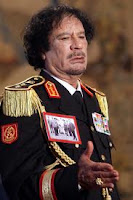
The result was a large scale revolt that engulfed whole of Libya with large urban centres expelling the pro-Gaddafi regime elements and declaring the cities ‘free’. Though, the Gaddafi regime has mounted unprecedented attacks on the rebels controlled the cities in both east and west of Libya, the rage and determination to break away from the clutches of the authoritarianism and tyranny of the Libyan despot rages stronger than ever.
The Gaddafi regime denied the masses their right to govern themselves and address their problems. The Libyan system of the ‘People’s Committees’ was never reformed and crumbled under the weight of cronyism and nepotism. This injustice and repression turned into an insurmountable rebellion for Gaddafi’s loyal forces and mercenaries to crush.
Acts of foreign interference can be described as activities carried by or on behalf of, are directed or subsidised by or are undertaken in active collaboration with, a foreign power. Such activities are usually clandestine or deceptive and are carried on for intelligence purposes. They are also carried on for the purpose of affecting political or governmental processes. Such activities are detrimental to the interests of a nation and involve threat to a person, group of people or the nation as a whole.
Middle East stands to be one of the most active regions of foreign interference. From meddling into the affairs of the state by regional players to direct/indirect interference by US and other western powers, this region has seen more than its share of foreign interference.
Lebanon is a hapless victim of foreign intervention in the Middle East region that faced brutal invasions and braved civil wars incited by regional powers. The country’s fragmented socio-political scenario provided ideal conditions to the outsiders who furthered their interests at the expense of Lebanese national interests.
Iran and Syria armed and aided Shia militants and named them Hezbollah whereas Israel propped up the Christian Phalange militias that went on to massacre thousands of people from rival sectarian groups.
On the top sat powers like US, France and Russia that benefitted from the arms trade while the country was being reduced to ashes. The situation is so grim in Lebanon today that governments in Beirut are formed or toppled on the directives coming from either Tehran, Damascus, Riyadh, Tel Aviv or Washington DC.
KLEPTOCRACY:
A group of people that engages itself in thievery to govern is known as kleptocracy. It consolidates the tyrannical powers by practicing transfer of money and power from the many to the few. The kleptocratic ruling class consists of moneyed elite that usurps justice, liberty, equality, sovereignty, and other democratic rights from the people.
Just as the Middle East and North African nations are flush with oil wealth, the region is also a haven of kleptocratic rulers from the shores of the Atlantic to the warm waters of Persian Gulf. Kingdoms upon kingdoms are ruled by dynasties that are at least a few centuries old and owe their existence to the 19th century imperial powers. In fact it was the very imperial system that not only gave birth to them but also propped and saved them from the adverse winds of political change and democracy
The 7,000-strong House of Saud is the most powerful kleptocracy in the Middle East with most power resides in the hands of 200 or so descendants of Ibne Saud, the founder of modern Saudi Arabia. Thanks to the tapping of the world’s largest proven oil reserves, the Sheikhs of the Al Saud family have enriched themselves to astronomical proportions.
With all the accumulated wealth, the richest ruling family on the planet aids and abets other dictatorships in the region and provides a safe haven after their removal. In stark contrast to their mega-rich lifestyle, thousands of Saudi families live in dire conditions and are mired in poverty and unemployment.
The Saudi government is also actively accused of supporting neo-Wahhabi Islamic extremists in Pakistan, Yemen, Iraq, Central Asia and elsewhere by funding religious seminaries (madarsas) and providing arms and weapons.
On the other hand, the very same rulers have massive stakes in US and European businesses, spread from California to French Riviera. This bizarre mix of religion and hedonism has contributed to numerous conflicts, human rights abuses and environmental disasters across the region and have resulted into the deaths of hundreds of thousands of people.
POLICE STATE
Police state can be described as a state in which the government exercises rigid and repressive controls with the help of secret police forces and agencies over the social, economic and political life of the nation.
Syria is one such state in the Middle East where the dynastic Al-Assad regime represses people with the help of the secret services and other state apparatus. The country is void of any form of political freedoms and the decades long arbitrary laws forbid any form of demonstration, activism or dissent.
Despite poverty, unemployment and harsh economic conditions, the masses are afraid of any kind of opposition to the Bashar Al-Assad regime fearing massive reprisals by the state. Many opposition political activists say the Syrian military and intelligence services were behind the 1982 Hama massacre that claimed the lives of more than 20,000 people believed to be supporters of the Muslim Brotherhood, an arch rival of the ruling secular nationalist Baath party.
The Human Rights Watch, along with Syrian Human Rights Committee, maintains that thousands of political prisoners, including bloggers and journalists critical of the Baathist regime, remain imprisoned in Syrian jails without any trials.
The country remains under a state of emergency when the Baath Party seized power in 1963. The four major organs of security forces are the air force intelligence, general intelligence directorate, military intelligence and the political security directorate. These agencies, known as Mukhabarat (intelligence), enjoy wide ranging powers including the right to detain any person on suspicion for longer periods without any arrest warrant.
Syria is one of the most repressive countries in the world in terms of freedom of expression and information. Criticism of the president, ruling Baath party or discussions on the ethno-religious issues in Syria remain particularly sensitive and are often punished.
The repression comes despite the fact that Syrian constitution enshrines the right of every citizen “to freely and openly express his/her views in words, in writing, and through all other means of expression,” while also guaranteeing “the freedom of the press, of printing, and publication in accordance with the law.”
AUTOCRACY
Autocracy comes from the Greek words: “autos” meaning “self” and “kratos” meaning “power.” In an autocratic system, one person or group holds all the power, without the participation, or sometimes even the consent, of the people. It is considered as the opposite of democracy.
An autocracy lacks political competition, transparency, freedom of expression, right to have a different opinion, human rights framework, and accountability of state institutions. The autocrat of a country will definitely claim, in theory, the existence of such rights and will ask the state institutions to observe them. However, in practice, there won’t be any checks and balances or the precedent of such rights existing and laws observed by the state.
Egypt under the reign of Hosni Mubarak could be termed as a classical autocratic state where any form of dissent was not tolerated. The state was put under the firm control of the security apparatus that kept a lid on political activities, muzzled the press, and tortured opponents of the regime. Everything revolved around the policies of his cronies, known as the National Democratic Party.

Mubarak, who came in power in October 1981, stayed clung onto it by “winning” four presidential elections – three of which were not contested by any candidate and the other by a landslide. The existence of the parliament was nothing more than a sham, which acted as a rubberstamp and approved Mubarak’s authoritarian policies without any debate. The formation of political parties was technically impossible if not constitutionally restricted.
The presence of the Egyptian autocrat was overwhelming. His portraits were hung in the government offices, the parliament, courts and public places. The intention of such imposing existence was to make sure that Mubarak is present on the public psyche all around the clock with absolute control. A whole generation grew up watching him in power, who always asked the people to cooperate with the government and help him defeat the imaginary ‘enemies of the state’.
A landmark Iran nuclear agreement was reached between Iran and six world powers is a historic step forward that solves an over-a-decade-long stand-off between Iran and the West. The agreement looks like a “win-win deal” for all sides.
Cooperation between US-Iran: Tehran and Washington are engaged in Syria and Iraq. They share common interests in Afghanistan.
Opposition to deal
India’s benefit

A United Nations-backed ceasefire between the Saudi-allied forces and Shia Houthi rebels took effect in Yemen.
Yemen Conflict time line
Saudi Arabia led air strikes
Impact of conflict on Yemen
The conflict has ruined large parts of the country and raised tensions in West Asia, with Saudi Arabia and its Sunni allies backing the government and Shia powerhouse Iran supporting the rebels.
Rise of extremist
Humanitarian catastrophe
Way forward
Three previous attempts to reach a ceasefire had collapsed mainly due to difference between Iran and Saudi Arabia.

Current military situation: Red: Syrian Government, Green: Syrian Opposition, Yellow: Federation of Northern Syria (SDF), Grey: Islamic State of Iraq and the Levant, White: Al-Nusra Front
2011 March – Security forces shoot dead protestors in southern city of Deraa demanding release of political prisoners, triggering violent unrest that steadily spread nationwide over the following months.

2011 protests
Pro-democracy protests erupted in 2011; the government responded with violence
President Assad announces conciliatory measures, releasing dozens of political prisoners, dismissing government, lifting 48-year-old state of emergency.
2011 May – Army tanks enter Deraa, Banyas, Homs and suburbs of Damascus in an effort to crush anti-regime protests. US and European Union tighten sanctions. President Assad announces amnesty for political prisoners.
2011 June – The government says that 120 members of the security forces have been killed by “armed gangs” in the northwestern town of Jisr al-Shughour. Troops besiege the town and more than 10,000 people flee to Turkey. President Assad pledges to start a “national dialogue” on reform.
2011 June – The IAEA nuclear watchdog decides to report Syria to the UN Security Council over its alleged covert nuclear programme reactor programme. The structure housing the alleged reactor was destroyed in an Israeli air raid in 2007.
2011 July – President Assad sacks the governor of the northern province of Hama after mass demonstration there, eventually sending in troops to restore order at the cost of scores of lives.
2011 October – New Syrian National Council says it has forged a common front of internal and exiled opposition activists.
2011 November – Arab League votes to suspend Syria, accusing it of failing to implement an Arab peace plan, and imposes sanctions.
The uprising against President Assad gradually turned into a full-scale civil war
2011 December – Twin suicide bombs outside security buildings in Damascus kill 44, the first in a series of large blasts in the the capital that continue into the following summer.
2012 February – Government steps up the bombardment of Homs and other cities.
International pressure:
2012 March – UN Security Council endorses non-binding peace plan drafted by UN envoy Kofi Annan. China and Russia agree to support the plan after an earlier, tougher draft is modified.
2012 May – France, UK, Germany, Italy, Spain, Canada and Australia expel senior Syrian diplomats in protest at killing of more than a hundred civilians in Houla, near Homs.
Opposition rifts
Divisions and concern about the role of Islamists have bedevilled the opposition
Guide to the Syrian opposition
2012 June – Turkey changes rules of engagement after Syria shoots down a Turkish plane, declaring that if Syrian troops approach Turkey’s borders they will be seen as a military threat.
2012 July – Free Syria Army blows up three security chiefs in Damascus and seizes Aleppo in the north.
2012 August – Prime Minister Riad Hijab defects, US President Obama warns that use of chemical weapons would tilt the US towards intervention.
2012 October – Syria-Turkish tension rises when Syrian mortar fire on a Turkish border town kills five civilians. Turkey returns fire and intercepts a Syrian plane allegedly carrying arms from Russia.
Fire in Aleppo destroys much of the historic market as fighting and bomb attacks continue in various cities.
2012 November – National Coalition for Syrian Revolutionary and Opposition Forces formed in Qatar, excludes Islamist militias. Arab League stops short of full recognition.
Israeli military fire on Syrian artillery units after several months of occasional shelling from Syrian positions across the Golan Heights, the first such return of fire since the Yom Kippur War of 1973.
2012 December – US, Britain, France, Turkey and Gulf states formally recognise opposition National Coalition as “legitimate representative” of Syrian people.
2013 January – Syria accuses Israeli jets of attacking a military research centre near Damascus, but denies reports that lorries carrying weapons bound for Lebanon were hit. Unverified reports say Israel had targeted an Iranian commander charged with moving weapons of mass destruction to Lebanon.
International donors pledge more than $1.5bn (£950m) to help civilians affected by the conflict in Syria.
2013 March – Syrian warplanes bomb the northern city of Raqqa after rebels seize control. US and Britain pledge non-military aid to rebels.
Chemical arms claims
Government forces have faced – and denied – repeated allegations of chemical weapons use
Rise of Islamists
2013 June – Government and allied Lebanese Hezbollah forces recapture strategically-important town of Qusair between Homs and Lebanese border.
2013 July – Saudi-backed Ahmed Jarba becomes leader of opposition National Coalition, defeating Qatar-backed rival.
2013 September – UN weapons inspectors conclude that chemical weapons were used in an attack on the Ghouta area of Damascus in August that killed about 300 people, but do not explicitly allocate responsibility.
2013 October – President Assad allows international inspectors to begin destroying Syria’s chemical weapons on the basis of a US-Russian agreement.
2013 December – US and Britain suspend “non-lethal” support for rebels in northern Syria after reports that Islamist rebels seized bases of Western-backed Free Syrian Army.
2014 January-February – UN-brokered peace talks in Geneva fail, largely because Syrian authorities refuse to discuss a transitional government.
2014 March – Syrian Army and Hezbollah forces recapture Yabroud, the last rebel stronghold near the Lebanese border.
2014 May – Hundreds of rebels are evacuated from their last stronghold in the central city of Homs. The withdrawal marks the end of three years of resistance in the city.
‘Caliphate’ in east
2014 June – UN announces removal of Syria’s chemical weapons material complete.
Islamic State of Iraq and Syria militants declare “caliphate” in territory from Aleppo to eastern Iraqi province of Diyala.
2014 August – Tabqa airbase, near the northern city of Raqqa, falls to Islamic State militants, who now control all of Raqqa province.
2014 September – US and five Arab countries launch air strikes against Islamic State around Aleppo and Raqqa.
2015 January – Kurdish forces push Islamic State out of Kobane on Turkish border after four months of fighting.
2015 March -Opposition offensives push back government forces. New Jaish al-Fatah (Army of Conquest) Islamist rebel alliance, backed by Turkey, Saudi Arabia and Qatar, captures provincial capital of Idlib.
2015 May – Islamic State fighters seize the ancient city of Palmyra in central Syria and proceed to destroy many monuments at pre-Islamic World Heritage site.
Jaish al-Fatah takes control of Idlib Province, putting pressure on government’s coastal stronghold of Latakia.
2015 June – Kurds take Ain Issa and border town of Tal Abyad, Islamic State attacks Kobane and seizes part of Hassakeh, the main city in north-eastern Syria.
2015 September – Russia carries out its first air strikes in Syria, saying they target the Islamic State group, but the West and Syrian opposition say it overwhelmingly targets anti-Assad rebels.
2015 December – Britain joins US-led bombing raids against Islamic State in wake of Paris suicide bombing attacks.
Syrian Army allows rebels to evacuate remaining area of Homs, returning Syria’s third-largest city to government control after four years.
2016 February – A US-Russian-brokered partial ceasefire is agreed but fails to stick, as do repeated subsequent attempts.
2016 March – Syrian government forces retake Palmyra from Islamic State, with Russian air assistance.
2016 August – Turkish troops cross into Syria to help rebel groups push back so-called Islamic State militants and Kurdish-led rebels from a section of the two countries’ border.
2016 December – Government troops, backed by Russian air power and Iranian-sponsored militas, recaptures Aleppo, the country’s largest city, depriving the rebels of their last major urban stronghold.

Few international disputes have generated as much emotion, passion, anguish, and diplomatic gridlock as∙ the Israeli‐Palestinian conflict. Rooted in decades of clashes over religion, borders, and territory, the dispute between Israelis and∙ Palestinians has engulfed scores of politicians, diplomats, and others in a peace process in which the ultimate goal has been tantalizingly close on numerous occasions only to be dismantled at the 11th hour. While the tortured history of the conflict dates back more than a century.
Finally, in 1947 the United Nations decided to intervene. However, rather than adhering to the principle of “self‐determination of peoples,” in which the people themselves create their own state and system of government, the UN chose to revert to the medieval strategy whereby an outside power divides up other people’s land.
Under considerable Zionist pressure, the UN recommended giving away 55% of Palestine to a Jewish state‐ despite the fact that this group represented only about 30% of the total population, and owned fewer than 7% of the land
In 1967, Israel conquered still more land. Following the “Six Day War,” in which Israeli forces launched a highly successful surprise attack on Egypt, Israel occupied the final 22% of Palestine that had eluded it in 1948 – the West Bank and Gaza Strip.
Since, according to international law it is inadmissible to acquire territory by war, these are occupied territories and do not belong to Israel. It also occupied parts of Egypt (since returned) and Syria (which remain under occupation).
Also during the Six Day War, Israel attacked a US Navy ship, the USS Liberty, killing and injuring over 200 American servicemen. President Lyndon Johnson recalled rescue flights, saying that he did not want to “embarrass an ally.” (In 2004 a high‐level commission chaired by Admiral Thomas Moorer, former Chairman of the Joint Chiefs of Staff, found this attack to be “an act of war against the United States,” a fact few news.
The UN Security Council passed Resolution 242, which called for peace between Israel and its neighbors in exchange for Israel giving back the land it had acquired during the Six Day War. Negotiations about how to implement it went nowhere. The Sinai was returned to Egypt under a separate peace deal in 1979, but the Golan Heights and the Palestinian territories remain under occupation.
The Palestinians in the occupied West Bank and Gaza were not given citizenship in Israel or equal protection or benefits under the law. The Israeli government also violated the Geneva Conventions by confiscating Palestinian land and water resources and building settlements on the West Bank and Gaza. For twenty years, the Palestinians of the West Bank and Gaza were a traumatized, defeated, docile population, routinely humiliated by soldiers and used as cheap labor in the Israeli economy.
The explosive atmosphere reached a flashpoint in September of 2000, when the second Intifada erupted.Soon afterwards, Israelis voted in a new Prime Minister ‐‐ Ariel Sharon of the right‐wing Likud party. The unrest spiraled from Palestinian protests and deadly Israeli repression into riots, assassinations, suicide bombings, and massive Israeli military incursions. The conflict became known as the second Intifada.
India’s solidarity with the Palestinian people and its attitude to the Palestinian question was given voice through our freedom struggle by Mahatma Gandhi. India’s empathy with the Palestinian cause and its friendship with the people of Palestine have become an integral part of its time‐tested foreign policy.
In 1947, India voted against the partition of Palestine at the United Nations General Assembly. India was the first Non‐Arab State to recognize PLO as sole and legitimate representative of the Palestinian people in 1974. India was one of the first countries to recognize the State of Palestine in 1988. In 1996, India opened its Representative Office to the Palestine Authority in Gaza, which later was shifted to Ramallah in 2003.
Apart from the strong political support to the Palestinian cause at international and bilateral levels, India has been contributing, since long time, material and technical assistance to the Palestinian people. With the Government of India’s aid, two projects were completed in the field of higher education i.e. Jawaharlal Nehru Library at the Al Azhar University in Gaza city and the Mahatma Gandhi Library‐cum‐Student Activity Centre at the Palestine Technical College at Deir Al Balah in the Gaza Strip.
Under India‐Brazil‐South Africa (IBSA) Forum’s assistance, an Indoor Multi‐purpose Sports Complex has been constructed in Ramallah Al Quds hospital in Gaza is in the process of reconstruction and the process of building a rehabilitation centre in Nablus has started. Trade between India and Palestine has shown steady improvement.
Products imported from India include fabrics, yarns, readymade garments, household appliances, stationery products, leather products, industrial tools and accessories, basmati rice, spices, vaccines and pharmaceutical products, sanitary wares, marble and granites.
India’s recent steps towards Israel and Palestine
Belief that is growing as India’s tilt towards the Israel is shown by following incidence:
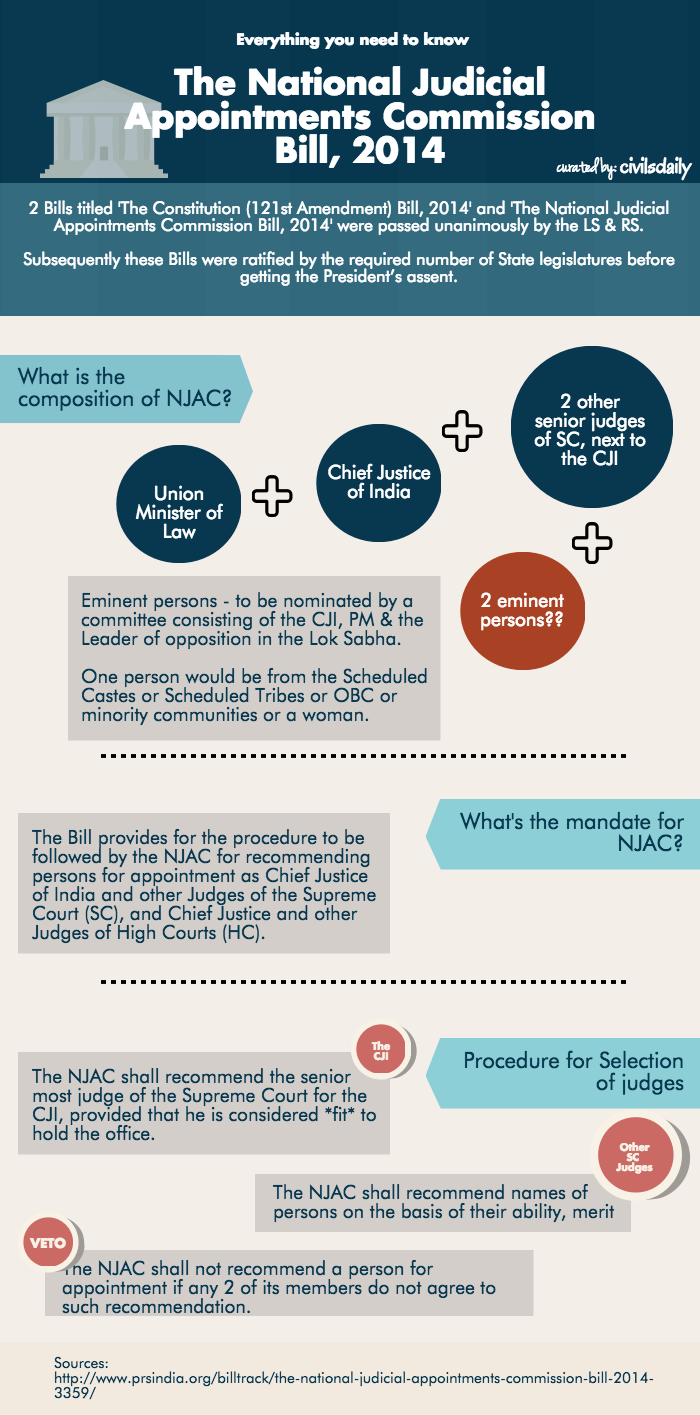
NJAC-National Judicial Appointments Commission
COMPOSITION
FUNCTIONS
Framing of regulations
Reference to NJAC for filling up the vacancies
Procedure for selecting of SC Judges
Veto power:
Procedure for the selection of the HC judges:
Chief Justice of HC:
Appointment of the judges of HC’s:
Veto power:
Transfer of judges of the HC’s will be as per the regulations to be framed.
President’s position:
CONVENER OF THE NJAC – LAW SECRETARY OF INDIA.
Note: If a bill is pending before the parliament it cannot be subjected to judicial review.
This paper is unique. It is not just about “question-answer” as it happens in other GS papers and optional paper i.e. questions are asked for which there are well defined and well structured answers. Usually a candidate pours whatever he/she has mugged up.
But in this paper this is not the scenario. Here you have to take a “stand”. In simple terms you need to take a decision , a decision which you can justify. Best decision ( of course ethical decision)is that which you can justify in front of:
Another misconception about this paper is that this paper is all about case studies i.e. just do case studies, theory part can be dealt in examination hall itself !!! But this is completely a wrong strategy. Actually as said earlier, in this paper one has to take a stand , a stand which can be justified.
And this justification will come basically from theoretical portion i.e. values , philosophers ,psychology concepts ,moral thinkers/personalities , personal experience , etc. So until & unless your theoretical portion is very strong , you can’t justify your decision/stand in case studies.
In fact you can’t differentiate between case studies and theory. In fact theory makes a strong foundation over which case studies approach has to be built upon. Hence, to deal this paper competitively we need to understand strong inter-linkages between philosophy , psychology and governance.
Apart from all these , for complete appreciation of this paper we need to grasp some fundamental/basic issues of ethics (I am not talking of theories!!). In fact there are two basic issues ( one being “what ought to”) over which entire ethics is built on.

Actually, our life is governed by two set of factors –
Circumstances is one area where we can do nothing , there is no freedom , we cannot do anything e.g. situation , gender, society , etc in which we find ourselves in this world. Consequently, it has nothing to do with ethics. Just remember role of ethics begins only when there is freedom.
Second thing is “Choice” where one enjoys freedom. Hence, it is the domain of ethics. The kind of choice which we make defines our life & it governs our life – we enjoy , we suffer ,we repent , we feel proud , we face repercussions ,etc. Our life is all about our choices . In any situation , whatever, we have no options but to make choice. One of the existentialist thinker says ‘ Man is condemned to be free i.e. he has no choice but to make choice’.
Even if somebody says that he only follows his brother or parents or teacher , actually he is exercising his choice to follow. He could have very well denied. In one of the religious text “ Abraham decided to sacrifice his only son Isaac on the orders of God.” But don’t you think that it was his choice to obey God’s order.
Therefore – “ No choice but to make choice.”
Moment you make choice, here begins the domain of ethical examination and then question arises “whether such choice is right or wrong , good or bad , just or unjust, or simply ethical or unethical”.
To make a choice or to exercise freedom one does not need any specialisation in any discipline. YOU DON’T HAVE TO STUDY ETHICS , INTEGRITY & APTITUDE !!
An illiterate person in very remote village does make choice. Twenty two years back one person named Manjhi made a choice to cut a way through mountain !! You all are seeing a movie based on his life and simply appreciating his choice !! But he didn’t study GS IV. He acted what his conscience said to him, rest is the history ( great , awesome , unbelievable).

Now if ethics is all about choice then one question becomes obvious that what are the factors which governs our ability to decide ?
Let’s come back to those two factors in the other post. I would like to hear from your side on your views on Ethics. I will follow up with another post.
Take good care.
Firstly sincerest apologies for posting detailed strategy for Civil Engineering so late. I am no authority on Civil Engineering but due to requests from aspirants, I decided to go ahead. I freezed my optional subject almost year after my graduation. So it wasn’t easy as I didn’t have my notes (Well who makes notes in engineering 😛 ) but I knew I could do well since I had decent pointer during my graduation.
Let’s come to the point. 2014 was my first shot at CSE. And I had quite decent marks in CE (Paper I: 138, Paper II: 136)
Positives of Civil Engineering as optional:
Negatives of Civil Engineering as optional
Civil Engineering Part II
Books: Building Construction by Arora & Bindra, CPM by UK Srivastava
Analysis: Questions are diverse & mostly predictable. Refer previous years’ IFoS & CSE papers & study accordingly. Prepare your own notes & it’ll help you revise faster. Questions from Engineering Economics are popping out of nowhere. UK Srivastava has covered it beautifully. Also I feel in this humongous theoretical section, one should study with photographic memory. Memorize diagrams & not data. Let the answers flow from your perfect diagrams.
Books: BC Punmia (Laxmi Publications)
Analysis: Please do Photogrammetry without fail. If you want to skip this topic you can, but do photogrammetry without fail. Remember basic things here like levelling & PT survey
Books: Saxena & Arora (Dhanpat Rai publications)
Analysis: I did most of this part from NPTEL videos however I’d recommend NPTEL videos only for ‘Points & Crossings’ part of Rail Engineering. Questions are mostly simple & attemptable. However be ready for bouncers like 2014 CE questions.
Books: Justo Khanna & NPTEL softcopies of same course.
Analysis: Since syllabus is huge, don’t spend much time on any particular section. Solve numericals from Justo Khanna. Do signal designs well.
Books: SK Garg (Primary source), Ven-Te-Chow (optional)
Analysis: Over the years, direct questions on UH, no. of rainfall gauges have reduced. Focus is more on complicated topics as far as numerical are concerned.
However theory questions are much on the lines & predictable
Books: SK Garg
Analysis: Syllabus is crisp & previous years’ questions can help immensely. Do theory well
Books: SK Garg
Analysis: This topic I feel needs most number of revision. There are less formulae so do them well. UPSC has knack of asking unconventional formulae from this topic (Eg. 2013 CE question on plume).
Common denominator of all topics of Paper-II
(Give me 1-2 days to write strategy for P-I of Civil Engineering)
