💥Join UPSC 2027,2028 Mentorship (July Batch) + XFactor Notes & Microthemes PDF

Search results for: “”

  • 7th January 2020| Daily Answer Writing Enhancement

    The topics covered in the upcoming AWE on 8th January are:

    Q.1) Effects of globalization on Indian society.

    Q.4) Case Studies


    Question 1)

    Urbanization is not a side effect of economic growth; it is an integral part of the process. Do you think Indian Urbanization has helped in India’s socio-economic growth? Discuss. (15 Marks)

    Question 2)

    With the rapidly changing circumstances in the Middle East India might have to walk the tight rope of maintaining the relations with the U.S. and Iran’. Discuss. (15 Marks)

    Question 3)

    India’s dependence on oil could well be described as the chink in its armour. In light of the statement above, discuss how India could leverage science and technology to end its dependence on oil? (15 Marks)

    Question 4)

    You are the leader of a 5 member team that has been assigned to carry out social impact assessment of a project proposed in a Naxal area. Members have been allotted a remote village each to conduct surveys and ascertain views of local people. You are under strict instructions not to disclose the identity of respondents outside the project. While compiling data, you are puzzled by the responses from one of the villages. You accompany the point-person for that village the next day for verification. You randomly pick a person from the list of respondents and ask her for clarification of the response she had given earlier. She seems confused and denies any knowledge of the survey being conducted, let alone she is questioned. You try to verify this from other respondents and get similar replies. This raises serious doubts about the integrity and credibility of the survey process. (a) What are the ethical issues involved in the situation? (b) As a team leader accountable for the credibility of the survey and working on a hard timeline, what are the possible options before you? List their merits and demerits. (c) Giving reasons, state the course of action you would follow. (15 Marks)

    Reviews will be provided in a week. (In the order of submission- First come first serve basis). In case the answer is submitted late the review period may get extended to two weeks.

    *In case your answer is not reviewed in a week, reply to your answer saying *NOT CHECKED*. If Parth Sir’s tag is available then tag him.

    For the philosophy of AWE and payment, check  here: Click2Join

  • SAMANVAYA: Students Preparing for UPSC 2020 > 5 months to go – get fired up

    SAMANVAYA: Students Preparing for UPSC 2020 > 5 months to go – get fired up

    Click here to fill the form, tell us about your preparation and we will email you a revision plan specifically designed for you.

    Dear Students, 

    Our lectures on paper discussions and posts on solutions and sample structures have received over 20,000 hits collectively.  

    It is time to get serious with your preparation and we have got your back.


    After numerous conversations with so many aspirants, we have started understanding your problems better and standardizing solutions for the same.

    These are being incorporated into our Samanvaya program. It is these practices that will make the program more effective.

    At the core of Samanvaya lies the fact that each one of you will have a unique journey while preparing for the exam. Some will get through on the first attempt without much effort while others will take both more time and more effort. We want to understand you better to help you optimize your journey so you can focus on the right things and not waste time on the wrong ones. We are asking you to tap into the valuable experiences of mentors who underwent the same grind and realize the pitfalls and understand the shortcuts to make it.

    Samanvaya program involves the following –

    1. Identifying your weaknesses

    Over 80% of students who claimed to have revised NCERTs were unable to answer basic questions. Many were not comfortable with at least 1 GS subject and Optional. Many struggled with ‘What went wrong’ after 2-3 years of hard work.

    Our mentors will help you assess your preparedness and suggest accurate strategies.

    2. Strategy and study plan discussions

    Over 90% of students couldn’t stick to a plan. Study plans and strategies are iterative in nature and we want to help you with that. Many are unable to perform in tests despite preparing hard. This could be due to a variety of factors – lack of adequate prep, jitters in the exam hall, inadequate revision, lack of practice of test series or just a bad day at work. Tell us what you think went wrong and we’ll figure out a way to get you over the line next time.

    3. Helping you understand the exam better

    Which books to read, different approaches, etc. Over 60% of students we talked to did not find NCERTs relevant and saw no point in being thorough with them.

    4. Lack of motivation

    We have all had those days when it’s been hard to motivate ourselves to hit the books and just study. It happens to the best of us sometimes and for some of us, it happens more frequently. And it is understandable, Civil Service preparation is a long and often lonely process. Every aspirant, from toppers to those who have quit have been overwhelmed by this process at some point.

    Samanvaya Code of Conduct

    • Be honest with your mentors about your preparation levels and stage.
    • Follow their advice and participate in tests and assignments that they set for you
    • Stay active in the telegram groups, ask doubts, don’t hold yourself back.
    • Don’t expect spoonfeeding. You have to drive the initiative.

    Click here to fill the form, tell us about your preparation and we will email you a revision plan specifically designed for you.

    Here’s the feedback that we got from some of our students:


    Click here to fill the form, tell us about your preparation and we will email you a revision plan specifically designed for you.

  • [op-ed of the day]Spotting an opportunity in changing fundamentals

    “Phase one” of the trade deal between the U.S. and China notwithstanding, the ongoing dispute between the U.S. and China and other changing scenarios could turn out opportunities in various forms for India.

    Oil prices windfall

    • Slack demand and increased production by the U.S., had lowered oil prices which was good news for India.
    • It could also help India address its current account deficit.
    • But oil prices have surged more than 4% following the killing of Iranian general by the U.S.
    • An outbreak of hostilities could send the oil prices soaring.
    • India’s energy import from the U.S. is likely to touch $10 bn by 2019-20.
    • While China is increasing its stake in Saudi Aramco- one of the largest oil production company in the world.
    • China is also increasing its ties with the other oil producers which gives China the opportunity to increase its naval presence in the Indian Ocean increasing the Strait of Hormuz.

    On trade front

    • According to the State Bank of India report-Ecowrap, India has scarcely benefited from the trade war.
    • Of the $35bn decline in China’s export to the U.S. $21bn was diverted to the other countries and the rest $14bn was made good by the U.S. producers.
    • India contributed only $755-million of this diversion.
    • The U.S. tariff made some other players-Mexico, Taiwan, Vietnam even more competitive.
    • China is facing pork shortage but India exports pork indirectly through Vietnam, increasing its cost and reducing market share.
    • China’s thrust on the AI, robotics, autonomous vehicles, and space technology has raised the U.S. suspicion, raising the prospects of high-tech war.
    • The big three Chines high-tech companies, Baidu, Alibaba, and Tencent together invested $5bn in India.
    • India could use this opportunity to insist China open its market for the IT sector and other tech exports.
    • India has allowed all the players including Huawei to participate in the 5G trials but the outcomes are far from over.
    • With all that said, the U.S.-China tensions drive supply chains out of China, with the right policies as Vietnam has done, India could emerge as an alternative destination.
    • Restriction by the U.S. on  China could lead to difficulties in reducing emissions and mitigate climate change in China.
    • Restrictions on technology export often lead to an increase in domestic research.
    • So, China could succeed in developing all the technologies that are denied to it by the U.S. under the restrictions.
    • With the protests in Hong Kong showing no signs of abating, India may have to cater to refugees of Indian origin if things turn uglier.

    Key regional issues

    • The situation in the South China Sea is in favour of China as it already has occupied several of them.
    • Though India is a member of “Quad” dialogue on border issues, it has no role in negotiating the “Code of Conduct” with the ASEAN.
    • On the connectivity issues, the U.S. position is helpful for India. Recently the U.S. criticised China-Pakistan Economic Corridor.
    • India is not a member of the Indo-Pacific Business Forum created by the U.S., Japan, and Australia.
    • India is also not a member of Blue Dot network created by the U.S., Japan, and Australia.
    • In future India might have to reconcile its regional connectivity issues with BRI projects that have mushroomed in the region.
    • On the ideological fronts, China is so emboldened by its economic success that it seeks to challenge the liberal democratic model and offers an alternative based on its own system.
    • India might have to contend with the greater Chinese presence in the Asia-Pacific theatre.

    Conclusion

    India’s relations with the U.S. and Chinas growing influence in economic as well as all the other sphere represents multiple challenges for India and are likely to grow in the future.

  • [op-ed snap]Secularism’s Brexit moment


    Context

    In India, the debate on the issue of secularism needs to be based on a more principled and practical basis.

    Change in public discourse

    • Popular skepticism of secularism has been growing these days.
    • Secularism is being increasingly discounted not only by the hardliners but also by the moderate middle.
    • It is no longer taboo to raise questions that were formerly the preserve of the fringe.
    • Today, democracy is taken for granted by all the Indians. No one raises questions over its utility.
    • Secularism need to be elevated to the same level as is the democracy today, where no one raises the question on its utility.

    What are the issues with the defenders of secularism?

    • Rather than make case for secularism, its champions indulge in name-calling and citing the example from the past to tarnish and shut down critics.
    • They also cite the Constitution in their support-without realising that it is this very document’s secular thrust that has became suspect.
    • They also assume the obvious correctness of their cosmopolitan worldview.

    What changes need to be made?

    • They must make a case for secularism anew-principled and practical.
    • On principled basis-individual equality, freedom of conscience and personal habits.
    • On a practical basis-no country can flourish by degrading their minority.
    • They must stress the India’s plurality and “live and let live” culture, syncretic traditions and long history of respect and accommodation of differences.
    • They also need to show some humility.
    • They also have to show openness to fair-minded criticism.

    Conclusion

    These suggestions are urgently needed to be followed by those arguing in the defence of secularism otherwise there is a very real possibility of a large section of a society losing faith in secularism. In this anxious hours India needs to engage in open and self-critical debate-rather than polarising polemic.


  • [op-ed snap]Lifting growth, containing inflation

    Context

    There is a large scope for  the improvement in the efficiency of grain management system under the National Food Security Act (NFSA).

    Declining Agri-sector growth rate

    • India’s growth rate plummeted to 4.5 per cent in the second quarter of this fiscal.
    • The quarterly growth in GDPA (agri-GDP) is hovering at around 2 percent, it is a cause for great concern.
    • Agriculture still engages about 44 per cent of India’s workforce, which has serious consequences for the overall economy of the country.

    The bleak picture of the economy

    • Recently inflation has started to surge after a long time.
    • Inflation is led by the different components of the food segment- cereals, pulses, and vegetables.
    • There is a challenge of containing inflation and increasing the demand at the same time.
    • At the same time, there is also the challenge of maintaining the fiscal deficit by 3.3 %.
    • Recently Finance minister has launched an investment package of 102 lakh crores.
    • So, there is a need to take a look at the inefficiencies in food grain management.

    Inefficiencies in NFSA

    • It supplies a certain quantity of wheat and rice to 67 percent population.
    • It gives wheat at Rs. 2/kg and rice at Rs. 3/kg.
    • While the cost of these grains to FCI is at Rs. 25/kg and Rs. 35/kg respectively.
    • This led to the provision of Rs 1.84 lakh crores for food subsidy.
    • The buffer stocks with the FCI is far more than double the buffer stock norms as on January 1 every year.
    • This excess stock is the result of an inefficient strategy for food management.
    • The strategy where the procurement of these grains is open-ended while the disbursement is restricted.
    • The money locked in these excess stock is about 1 lakh crores.
    • If the rabi season procurement is good FCI may run out of storage space to accommodate.

    Suggestions for improvement

    • The open market operation should be increased.
    • Even if the government liquidate half of the excess stock it would fetch Rs.50,000 crores.
    • The Shanta Kumar panel had submitted the blueprint for the improvement in the grain management system.
    • Only three reiterations are needed.
    • First-while the Antyodaya category should keep getting the maximum food subsidy, the issue price should be fixed at 50% of the procurement for the rest.
    • Second- restrict the percentage of population covered under the scheme to 40 % from the present 67%
    • Third-stop the procurement of rice in the north-western states of Punjab and Haryana where the water table is depleting.

    Conclusion

    • If the government implements these three points it can save the country another Rs. 50,000 crores annually. On top of this, it will help the government to reduce its fiscal deficit.
  • Miyawaki Method

    Kerala Forest Dept. has adopted Miyawaki afforestation concept to be used in govt. offices, schools and puramboke land.

    Miyawaki Method

    • Miyawaki method is a method of urban afforestation by turning backyards into mini-forests.
    • It includes planting trees as close as possible in the same area which not only saves space, but the planted saplings also support each other in growth and block sunlight reaching the ground, thereby preventing the growth of weed.
    • Thus the saplings become maintenance-free (self sustainable) after the first three years.
    • It helps to create a forest in just 20 to 30 years while through conventional methods it takes anywhere between 200 to 300 years.

    The technique

    • The native trees of the region are identified and divided into four layers — shrub, sub-tree, tree, and canopy.
    • The quality of soil is analysed and biomass which would help enhance the perforation capacity, water retention capacity, and nutrients in it, is mixed with it.
    • A mound is built with the soil and the seeds are planted at a very high density — three to five sapling per square meter.
    • The ground is covered with a thick layer of mulch.
  • Smog Tower

    Recently New Delhi got its first smog tower (a prototype air purifier). In November, the Supreme Court had directed the Centre and the Delhi government to prepare a plan to install ‘smog towers’ across the capital to deal with air pollution.

    What is a ‘Smog Tower’?

    • Smog towers are structures designed to work as large-scale air purifiers.
    • They are usually fitted with multiple layers of air filters, which clean the air of pollutants as it passes through them.
    • The smog tower installed at Lajpat Nagar is capable of treating 6,00,000 cubic metres of air per day and can collect more than 75 per cent of particulate matters (PM) 2.5 and 10.
    • After the cleaning, the tower releases clean air.
    • The project is collaboration between the IIT Bombay, IIT-Delhi and the University of Minnesota, the latter having helped design a similar tower of over 100 metres in China’s Xi’an city.
    • The Central Pollution Control Board (CPCB) will also be involved with the project.

    How it works?

    • The 20-metre (65 feet) high tower will trap particulate matter of all sizes suspended in the air.
    • Large-scale air filters shall draw in the air through fans installed at the top before passing it through the filters and releasing it near the ground.
    • The filters installed in the tower will use carbon nanofibres as a major component and will be fitted along its peripheries. The tower will focus on reducing particulate matter load.

    Other examples in the world

    • China, which has been battling air pollution for years, has two smog towers — in its capital Beijing and in the northern city of Xi’an.
    • The Xi’an tower is dubbed the world’s largest, and has reportedly brought down PM 2.5 by 19% in an area of around 6 sq km in its vicinity.
    • The 100-metre (328 feet) high tower has produced 10 million cubic metres of clean air every day since its launch.
    • On severely polluted days the tower is able to bring down smog close to moderate levels.
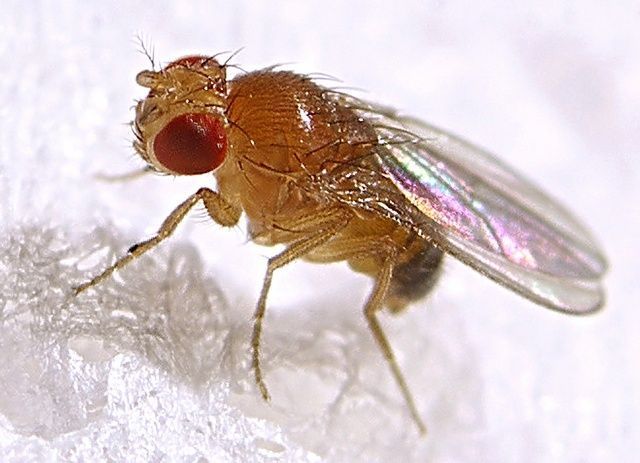
  • Drosophila

    Pune is set to host the fifth edition of the Asia Pacific Drosophila Research Conference (APDRC5) is being organised in the country for the first time by the Indian Institute of Science Education and Research (IISER).

    Drosophila

    • Drosophila is a genus of two-winged flies commonly known as fruit flies that are used in evolutionary and developmental studies.
    • It is a genus of flies, belonging to the family Drosophilidae, whose members are often called “small fruit flies” or pomace flies, vinegar flies, or wine flies, a reference to the characteristic of many species to linger around overripe or rotting fruit.
    • It is one of the most widely-used and preferred model organisms in biological research across the world for the last 100 years.
    • Several discoveries in biology have been made using this. Its genome is entirely sequenced and there is enormous information available about its biochemistry, physiology and behaviour.
  • Carbon Stock in Indian forests

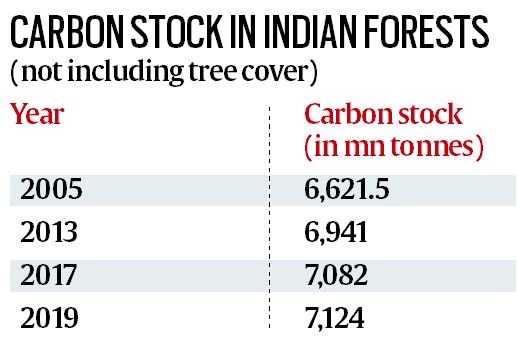
    • The State of Forest Report (SFR) 2019 has shown an increase in the carbon stock trapped in Indian forests in the last two years.
    • However it shows why it is going to be an uphill task for India in meeting one of its international obligations on climate change.

    India’s carbon commitment

    • India, as part of its contribution to the global fight against climate change, has committed itself to creating an “additional carbon sink of 2.5 to 3 billion tonnes of carbon dioxide equivalent” by 2030.
    • That is one of the three targets India has set for itself in its climate action plan, called Nationally Determined Contributions, or NDCs, that every country has to submit under the 2015 Paris Agreement.
    • The other two relate to an improvement in emissions intensity and an increase in renewable energy deployment.
    • India has said it would reduce its emissions intensity (emissions per unit of GDP) by 33% to 35% by 2030 compared to 2005.
    • It has also promised to ensure that at least 40% of its cumulative electricity generation in 2030 would be done through renewable energy.

    What is the relationship between forests and carbon?

    • Forests, by absorbing carbon dioxide from the atmosphere for the process of photosynthesis, act as a natural sink of carbon.
    • Together with oceans, forests absorb nearly half of global annual carbon dioxide emissions.
    • In fact, the carbon currently stored in the forests exceeds all the carbon emitted in the atmosphere since the start of the industrial age.
    • An increase in the forest area is thus one of the most effective ways of reducing the emissions that accumulate in the atmosphere every year.

    How do the latest forest data translate into carbon equivalent?

    • The latest forest survey shows that the carbon stock in India’s forests (not including tree cover outside of forest areas) have increased from 7.08 billion tonnes in 2017.
    • This translates into 26.14 billion tonnes of carbon dioxide equivalent as of now.
    • It is estimated that India’s tree cover outside of forests would contribute another couple of billion of tonnes of carbon dioxide equivalent.

    How challenging does this make it for India in meeting its target?

    • An assessment by the Forest Survey of India (FSI) last year had projected that, by 2030, the carbon stock in forests as well as tree cover was likely to reach 31.87 billion tonnes of CO2 equivalent.
    • An additional 2.5 to 3 billion tonnes of sink, as India has promised to do, would mean taking the size of the sink close to 35 billion tonnes of CO2 equivalent.
    • Considering the rate of growth of the carbon sink in the last few years, that is quite a stiff target India has set for itself.
    • In the last two years, the carbon sink has grown by just about 0.6%%. Even compared to 2005, the size of carbon sink has increased by barely 7.5%.
    • To meet its NDC target, even with most optimistic estimates of carbon stock trapped in trees outside of forest areas, the sink has to grow by at least 15% to 20% over the next ten-year period.

    Way Forward

    • There are two key decisions to be made in this regard — selection of the baseline year, and addition of the contribution of the agriculture sector to carbon sink.
    • When India announced its NDC in 2015, it did not mention the baseline year.
    • India’s emissions intensity target uses a 2005 baseline, so there is an argument that the forest target should also have the same baseline.
    • But there is a strong demand for a 2015 baseline as well, so that it results in some concrete progress in adding new forest cover.
    • The NDC specifically mentions that and “additional” 2.5 to 3 billion tonnes of carbon sink would be created through additional forest and tree cover by 2030 MoEFCC insist that tree cover outside forest areas must include agriculture as well.
    • India would also have to specify whether it wants to count the carbon sink in the agriculture sector in its target.