💥Join UPSC 2027,2028 Mentorship (July Batch) + XFactor Notes & Microthemes PDF

Search results for: “”

  • WHO prequalifies Serum’s low-cost Pneumococcal Vaccine

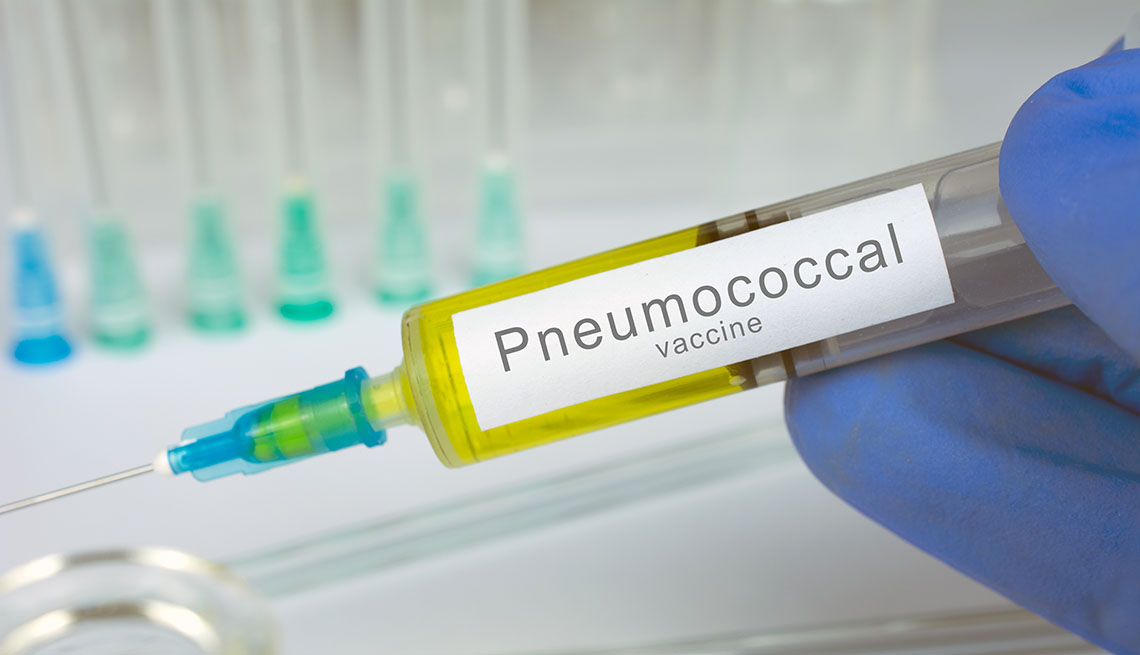
    Pneumococcal vaccine developed by the Pune-based Serum Institute of India has been pre-qualified by the World Health Organisation (WHO).

    Pneumococcal Vaccine

    • Pneumococcal vaccination is a method of preventing a specific type of lung infection (pneumonia) that is caused by the pneumococcus (Streptococcus pneumonia) bacterium.
    • There are more than 80 different types of pneumococcus bacteria – 23 of them covered by the vaccine.
    • The vaccine is injected into the body to stimulate the normal immune system to produce antibodies that are directed against pneumococcus bacteria.
    • This method of stimulating the normal immune system to be directed against a specific microbe is called immunization.
    • It does not protect against pneumonia caused by microbes other than pneumococcus bacteria, nor does it protect against pneumococcal bacterial strains not included in the vaccine.

    About the Vaccine

    • The pneumococcal vaccine PNEUMOSIL is a conjugate vaccine to help produce stronger immune response to a weak antigen.
    • Serum Institute had optimized an efficient conjugate vaccine manufacturing processes for its meningitis A vaccine (MenAfriVac).
    • It was used for manufacturing the pneumococcal vaccine. This helped the company reduce the manufacturing cost of pneumococcal vaccine.

    Why?

    • It pneumonia caused 1,27,000 deaths in India in 2018, the second highest number of child mortality under the age of five in the world.
    • In India, pneumonia and diarrhoea cause the most deaths in children under five years.
    • In 2017, pneumococcal conjugate vaccine was included in the under India’s Universal Immunisation Programme (UIP).
    • It has been introduced in a phased manner starting with Himachal Pradesh, parts of Bihar, Uttar Pradesh, Madhya Pradesh and Rajasthan.
    • The efficacy of the Serum vaccine was tested against an already approved pneumococcal vaccine (Synflorix).
  • [pib] UJALA & Street Lighting National Programme

    The Unnat Jyoti by Affordable LEDs for All (UJALA) and LED Street Lighting National Programme (SLNP) has completed five years of successful implementation.

    UJALA and SLNP

    • SLNP is the world’s largest streetlight replacement programme and UJALA is the world’s largest domestic lighting project.
    • Both have been spearheaded and implemented by Energy Efficiency Services Limited (EESL), a joint venture of PSUs under the Ministry of Power.

    Major accomplishments

    UJALA

    • UJALA project brought the market transformation in energy efficiency sector.
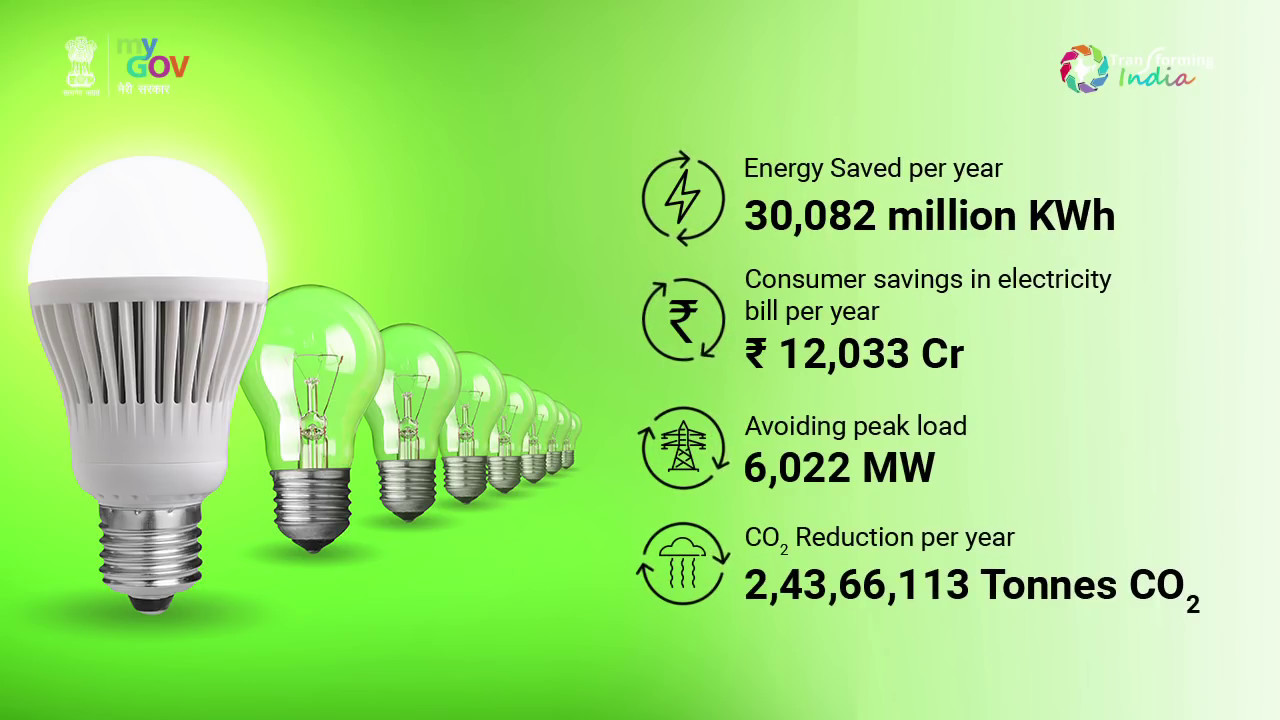
    • Prices of LED bulbs being distributed under UJALA programme have fallen to one-tenth of their rates in 2015 from INR. 310 to INR 38 in 2018.
    • The switch from inefficient incandescent bulbs to LEDs is helping families reduce their electricity bills while also enabling them to access better brightness in homes.
    • Through the UJALA over 36.13 crore LED bulbs have been distributed across India.
    • This has resulted in estimated energy savings of 46.92 billion kWh per year, avoided peak demand of 9,394 MW, and an estimated GHG emission reduction of 38 million t CO2 annually.

    SLNP

    • Under the SLNP programme, over 1.03 crore smart LED streetlights have been installed till date, enabling an estimated energy savings of 6.97 billion kWh per year with an avoided peak demand of 1,161 MW and an estimated GHG emission reduction of 4.80 million tonnes CO2 annually.
    • LED streetlights have been installed in various states across the country, helping generate approximately 13,000 jobs to support Make in India initiative.
    • This has enabled citizens to increase productivity at night and made roads safer for pedestrians and motorists due to enhanced brightness and reduced dark spots.
    • As these lights are automated, they switch on and off at sunrise and sunset thereby reducing wastage.
    • In the last five years, the LED streetlights installed have illuminated 3,00,000 km of roads in India, enabling public safety and energy efficient lighting.
  • 6th January 2020| Daily Answer Writing Enhancement

    The topics covered in the upcoming AWE on 7th January are:

    Q.1) Urbanization, their problems, and their remedies.

    Q.4) Case Studies


    Question 1)

    Reduced fertility and mortality rate leading to a rapid increase in working-age population poses several challenges. Discuss while suggesting a way forward. (15 Marks)

    Question 2)

    In India, debate on secularism often degenerates into a polarising polemic from both the sides- its defenders and opponents. In the light of the statement above, discuss the arguments made by the supporters of secularism and problems associated with it. (15 Marks)

    Question 3)

    Despite the reformative steps taken by the Government, there is still a large scope for improving the efficiencies in the grain management system under the National Food Security Act(NFSA). Elaborate. (15 Marks)

    Question 4)

    Developing countries are often very vulnerable to exploitation by multinational corporations. They support industrialization but lack of infrastructure is a major limiting factor. Further, without suitable laws and regulations, developing nations are ill-prepared for such endeavours. In their efforts to attract business, these nations often overlook the health and safety violations by the corporations doing business within their borders. Drawn by low-cost labour, new markets, and lower operation costs, corporations have little incentive to address environmental and human risks once they are entrenched. In this situation, there is an imminent threat of disaster. Discuss some feasible strategies to balance economic development and safety and security of people at large in developing countries with special emphasis on India. (15 Marks)

    Reviews will be provided in a week. (In the order of submission- First come first serve basis). In case the answer is submitted late the review period may get extended to two weeks.

    *In case your answer is not reviewed in a week, reply to your answer saying *NOT CHECKED*. If Parth Sir’s tag is available then tag him.

    For the philosophy of AWE and payment, check  here: Click2Join

  • Failed Prelims 2019!  Don’t Worry CD Prelims Test Series 2020 can help you to rectify your Fundamental weakness

    Failed Prelims 2019! Don’t Worry CD Prelims Test Series 2020 can help you to rectify your Fundamental weakness

    Here’s the link to the Prime Prelims TS brochure. Click2download | To understand the points in depth, we recommend you download and read before joining us.


    Dear Students,

    Prime TS, being our legacy product always gets the best from us. Our oldest & most loved offering takes a giant leap this year with 6 key differentiators and 3 ‘exclusive’ features.

    We started way back in 2015 with Dr. Vipin Garg (then an AIIMS graduate, member of the founding team @Civilsdaily and now an IAS officer in Gujarat) working hand in hand with us on defining the key features of our Prelims Test Series. Over the years, Prime TS has evolved into a comprehensive learning & assessment companion for aspirants of all stages and preparation style.

    Mastering Prelims by Guided yet Flexible Goal Setting

    Here’s the question we have always challenged ourselves with: 

    What good is a test series if all it does is give you a set of 100 questions and backs them up with explanations? As good as the xerox version of the same, right?

    Why do most of us find it hard to make a cut at UPSC Prelims (in spite of the abundance of pirated versions of high-quality test series)?

    Short Answer: Lack of a goal based mentoring to ensure that you tie up your loose ends in a time-bound manner before going to the next mock

    Long Answer: The misconception that reverse engineering (learning theory from solutions) & recursive learning (solving the wrong questions again & again till you get them right) alone is enough for a rewarding mock practice is LETHAL. What you need is a way to correct your fundamental learning errors. You need to analyse what went wrong in the learning process (which can potentially wreck 5 similar questions in the future). You need someone to motivate you and take you back to the basics to correct the identified gaps. Right about that very moment. Not after the whole subject is done. Not after the prelims is lost!

    This answer defines the very foundation of our Prime Prelims Test series and here’s how we solve this problem for YOU:

    1. Evidence-based question making: The 3600 questions you face in our mocks have their relevance established in UPSC’s trend analysis. We focus on themes that are important as per UPSC so that we maximise your chances of questions overlap with the actual UPSC Prelims.

    2. Standardising & Tagging those evidence backed questions: Even for the most serious student, judging the quality of any TS is a difficult proposition. To ensure that we hold the end of our bargain, we have introduced 3 layers of tagging:

      1. Difficulty Level Tags: Level 1, 2, 3

      2. Subject/ sub-subject Tags: To ensure that your revision is focussed, we tag questions at deeper layers so that you discover your subject specific blindspots and rectify them

      3. Question Type Tags: Helps you understand the mix of questions and equip yourself in multifaceted question forming. Eg: Consolidation Questions, Comparative Questions, Interactive Questions*

    3. Tikdams for mastering the art of intelligent guesstimates: Think of तिकड़म as a more refined version of the oft-quoted word Jugaad. UPSC is an intelligent test taker. It not only wants to test your comprehension (of syllabus) but also your ability to perform under pressure (& lack of information). How would you solve a “factual” question which gives an illusion of the necessity of “rote-learning”? By ensuring that your core fundamentals are strong and then using the Art of Tikdams to go for the best approximation among the answer choices! We are the only test series which trains you on that!*

    4. SAMANVAYA – 1<>1 Mentoring for Goal Setting: SAMANVAYA adds the much-needed layer of mentor intervention to help you with personalised mini-goals to fortify the defenses in a time-bound manner. It takes help from point #1 & #2 to understand your preparation timeline and then works with you.

    5. CD’s Monthly Magazines: We walk the extra mile with Monthly Magazine Combo (12 months of all good content at CD). These magazines are a brand in themselves and have been a preference of Toppers for years. The monthly package contains curated information from these 6 areas :
      1. News + PIB (without oped),
      2. Op-eds
      3. SC Judgements
      4. Govt. Schemes in News
      5. Intl Org + Domestic Org
      6. Prelims Daily Compilations
    6. Advanced Lecture Series: PRIME TS, being our legacy product gets the best of us. While we leave no stones unturned to build your assessment profile, we also provide you with this crucial & independent module as a part of the package.

      ALS is yet another nifty way of revisiting the tricky, factual and sometimes technical aspects of the static syllabus. 60+ hours of videos – most helpful when you advance to the L2 & L3 tests and very rewarding for senior UPSC students.


    We have kept our pricing similar to previous year’s. The idea is to make it affordable for every single aspirant without compromising the quality & promise which comes with our name.

    It doesn’t matter if you plan to join an offline coaching institute or go on the self-study route, Prime Prelims is an investment worth making to ensure that your learning curve gets shortened and your test-taking skills delight you with a positive result 🙂

    Here’s the link to the Prime Prelims TS brochure. Click2download

    Click here to enroll for the Prime Prelims TS

    PS: We are in the process of preparing an updated dossier on the Art of Tikdams and will make it available for a free download soon. If you wish to download an older version of the document, pls click here.

    PS2: Once you join the programme, you will get a detailed time table on how to go about the reading material and how to space your assessment routine. Everything is planned out for you!


    If you wish to do a direct bank transfer, here are the details.

    A/C NAME: APEIROGON TECHNOLOGIES PVT. LTD
    A/C NO: 50200016012695
    IFSC CODE: HDFC0000922
    GSTIN: 07AAOCA0521B1ZA

    NOTE #1: BEFORE MAKING A DIRECT BANK TRANSFER, PLS CHECK THE FULL AMOUNT (INCLUSIVE OF TAXES). ONCE THE PAYMENT IS DONE, DROP A MAIL TO HELLO@CIVILSDAILY WITH YOUR TRANSACTION ID AND COURSE JOINED
    NOTE #2: CIVILSDAILY’S PARENT COMPANY NAME IS APEIROGON TECHNOLOGIES. DON’T PANIC!
  • [op-ed snap] Horror in Kota

    Context

    Death of 100 children in the month of December at a Government Hospital in Kota highlights the state of the public health system in India.

    Public health as a political agenda

    • After the incident of a large number of children in such a short span, Rajasthan CM appealed not to politicise the issue.
    • But it is high time the issue is in fact politicised.
    • The issue of public health needs to be pushed at the top of the political agenda.
    • Citizens must hold political parties accountable for the state of healthcare in the country.

    Poor infrastructure

    • Until the number of deaths crosses a certain threshold the poor state of infrastructure fails to attract the attention of the authorities.
    • This hospital came to light like Gorakhpur Medical college where scores of children had died only after media reports of 963 child deaths.

    Conclusion

    Every single death in a hospital ought to be seen as a failure that needs to be addressed urgently. For that, the government needs to make public health a priority.

  • [op-ed of the day]Bracing for global impact after Soleimani’s assassination

    Context

    The recent targeted killing of Commander of Quds Forces of the Iranian Revolutionary Guard Corps (IRGC) by the US raised the tension in the region to a new high level. The imminent blowback from Iran could have several consequences for the rest of the world including India.

    Different from past killings

    • Though the U.S. has carried out many such targeted killings in the past but this case bears two important differences to the past killings.
    • Unlike Osama bin Laden or Abu Bakr, Gen. Soleimani was a state actor.
    • Unlike the above mentioned two, he was not past his prime.

    Roles played by Gen. Soleimani

    • He was the founder-commander of Iran’s Quds Force-formed for extra-territorial operations.
    • He enhanced Iran’s influence in the Arab countries by leveraging the disarray in the region.
    • Arab countries with a significant Shia population such as Lebanon, Syria, Iraq, and Yemen came under Iranian influence.

    What could be the fallouts

    • Tit-for-tat between Iran and the U.S. could easily go out of hand and precipitate into a major confrontation.
    • Both countries have domestic compulsions- there are elections due in both countries.
    • These compulsions limit options for both countries to low-intensity skirmishes.
    • The fact that the killing was carried on the Iraqi soil also assumes significance.
    • The incident could increase the problems in Iraq which is rocked by three months of youth protests against undue foreign interference by both Iran and the U.S.
    • The event is also likely to re-polarise the Iraqi society along sectarian lines.
    • In the worst-case scenario Iraq could turn into the new Syria.

    Potential fallout for India

    • Global oil prices have already seen a 4% rise in within hours of the incident.
    • India has already faced difficulty in maintaining relations with both countries because of the U.S.-Iran cold war.
    • While we want to be on the right side of the U.S., our ties with Iran apart from being civilisational have their own geostrategic logic.
    • With conflict turning hot, its adverse impact on India could magnify.
    • High oil prices will definitely increase our import bill and increase difficulties in supplies.
    • Safety of an estimated 8 million expatriates in the Gulf may be affected.
    • Iran could influence the U.S.-Taliban peace process in Afghanistan which in turn increases India’s woes.
    • After Iran, India has a large number of Shia population and some of them could be radicalised due to the event.

    Conclusion

    The event, if turn into a wider conflict between the two countries, could have many consequences for India from soaring oil prices and maintaining the balance between the two countries to the safety of expatriates in the Gulf.

  • [Burning Issue] India State of Forest Report 2019 : Part-II

    Continued ….


    Comparison with 2017 report

    • The 2019 survey has found an increase of 5,188 sq km in total forest and tree cover in the country.
    • Tree and forest cover together made up 24.56% (8,07,276 sq km) of India’s area. In the last assessment it was 24.39%.
    • The nation’s tree and forest cover has largely hovered from 21-25% and is short of the National Forest Policy, 1988, which envisages 33% to be under such cover.
    • Mangrove cover in the country has increased by 54 sq km (1.10%) as compared to the previous assessment.

    Various factors attributed to the increasing trend

    The increasing trend of forest cover is largely due to the various national policies aimed at Conservation and sustainable management of our forests. Few of them are:

    Green India Mission: It has the broad objective of both increasing the forest and tree cover by  5 million ha,  as well as increasing the quality of the existing forest and tree cover in another 5 million ha of forest/ non forest lands in 10 years.

    PM Ujjwala Yojana: In India 67 per cent of the rural households depend on firewood for cooking.In order to address this problem, the Ujjwala scheme provides free LPG connections to BPL families in remote rural areas.

    National Agroforestry Policy (NAP): A dynamic ecologically based concept which integrates woody perennials in the agricultural landscape diversifies and sustains production.

     REDD+ policy:  Its objective is to mitigate climate change through reducing net emissions of greenhouse gases through enhanced forest management in developing countries.

    Joint forest management (JFM): It is the concept of developing relationships between fringe forest groups and forest department on the basis of mutual trust and jointly defined roles and responsibilities for forest protection and development.

    National Afforestation Programme: It provides support, both in physical and capacity building terms, to the Forest Development Agencies (FDAs) which in turn are the main organs to move forward institutionalization of Joint Forest Management.

    CAMPA: Funds under Compensatory Afforestation Fund Management and Planning Authority (CAMPA) has proved instrumental in compensating forest land diverted for non-forest purpose which would mitigate impact of diversion of such forest land.

    Critical evaluation of the report

    • The latest report should seem heartening given, today this stands at 7.12 lakh sq km, up from 6.7 lakh sq km in 2005—that too, in the face of development needs compelling the diversion of forest land.
    • The depletion in the northeastern states forest cover is worrying given these are very old forests, and have greater carbon sequestration capacity.
    • The rapid increase in forest cover, especially with a fair share of the gain being concentrated in the dense forests category (canopy density higher than 40%), is likely rooted in two factors.

    Flaws with the satellite imaging

    • The Forest Survey of India has been using better satellite imagery with a 1:50,000 scale, compared to the 1:250,000 scale earlier.
    • This means any area, even as small as 0.01 sq km, with a canopy density of more than 10% is captured as a forest; the earlier resolution meant land units under 0.25 sq km didn’t get captured as forest.
    • Thus, land that has been denuded of forest cover but did not get recorded as forest earlier because it fell below the 0.25 sq km threshold now figures in the ISFR as a “gain” in forest cover.

    Canopy as a basis of identification

    • The tree canopy basis of identification doesn’t differentiate between natural forests, plantations, orchards, or even palm groves.
    • This means the loss in diversity doesn’t get captured by the data.
    • Thus, the growth in forest-cover could be attributed to fast-growing plantation trees like eucalyptus that are favoured in compensatory afforestation programmes.

    Accounting plantation

    • ISFR 2019, for the first time ever, gives data for forest diversity.
    • The ‘plantations/trees outside forests’ already account for nearly 9% of the total area under forests—making plantations the fourth largest group.
    • Some of these are fast-growing species such as bamboo in the north-eastern region and also rubber and coconut plantations in the southern states.
    • Monoculture practices cannot substitute natural forests in biodiversity or ecological services.

    Less realistic data

    • The last two decades have been almost drought for Andhra Pradesh, and 60% of Karnataka reeled under drought in 9-11 years between 2001 and 2015.
    • It is hard to see how the two states have performed so well in increasing forest cover.

    Conclusion

    • Where forest cover is concerned, India has set itself a target that needs a much higher rate of afforestation in the coming years than the current one of 35 million tonnes per year carbon dioxide equivalent.
    • Even though a progress has been made in increasing the green cover over the past few years, India is still quite far from achieving its target of 33 per cent of the total geographical area by 2030.
    • India has committed to the UNFCCC as part of its Nationally Determined Contribution (NDC) that, besides reducing emission intensity of its GDP by 33-35 per cent by 2030.
    • The forest data needs to reflect more of the ground reality instead of becoming a tool to lull the country into inaction on forests.


    References

    https://www.civilsdaily.com/news/india-state-of-forest-report-isfr/

    https://www.thehindu.com/sci-tech/energy-and-environment/total-tree-forest-cover-in-country-increases-by-5188-sq-km-forest-report/article30431835.ece

    https://www.financialexpress.com/opinion/indias-forest-cover-growing-isfr-data-masking-harsher-on-ground-realities/1809920/

    https://swachhindia.ndtv.com/tree-plantation-while-green-cover-in-india-has-increased-existing-forests-are-thining-india-state-of-forest-report-2019-40722/

    https://www.thehindubusinessline.com/specials/clean-tech/time-to-step-up-forest-cover-pace/article30445513.ece

    https://www.thehindu.com/sci-tech/energy-and-environment/one-fifth-of-countrys-forests-prone-to-fires-study/article30446295.ece

    https://www.researchgate.net/publication/330222412_Potential_of_Short_Rotation_Forestry_and_Agroforestry_for_Climate_Change_Mitigation_and_Sustainability 

  • [Burning Issue] India State of Forest Report 2019 : Part-I

    Context

    • Forests play an extremely important role in ensuring ecological balance and existence of life on the earth.
    • However, rampant cutting of trees and thinning of forests has been taking place in the country due to activities related to development and infrastructure building, emphasise the environmental experts.
    • Thus, in a bid to keep up the pace of conservation of forests amidst developmental activities, the Forest Survey of India (FSI), an organisation under MoEFCC started monitoring forest cover in 1987.
    • Under the same initiative, FSI released its biennial assessment report, India State of Forest Report 2019.

     India State of Forest Report (ISFR)

    • The ISFR is a biennial report published by the Forest Survey of India (FSI).
    • FSI has been mandated to assess the forest and tree resources of the country including wall-to-wall forest cover mapping in a biennial cycle.
    • Starting 1987, 16 assessments have been completed so far. ISFR 2019 is the 16th report in the series.

    Highlights of the report

    • In the present assessment, the total forest and tree cover of the country is 80.73 million hectare which is 24.56 per cent of the geographical area of the country.
    • As compared to the assessment of 2017, there is an increase of 5,188 sq. km in the total forest and tree cover of the country.
    • Out of this, the increase in the forest cover has been observed as 3,976 sq km and that in tree cover is 1,212 sq. km.
    • Range increase in forest cover has been observed in open forest followed by very dense forest and moderately dense forest.
    • The top three states showing increase in forest cover are Karnataka (1,025 sq. km) followed by Andhra Pradesh (990 sq km) and Kerala (823 sq km).

    Some Major Findings

    • Area-wise Madhya Pradesh has the largest forest cover in the country followed by Arunachal Pradesh, Chhattisgarh, Odisha and Maharashtra.
    • In terms of forest cover as percentage of total geographical area, the top five States are Mizoram (85.41%), Arunachal Pradesh (79.63%), Meghalaya (76.33%), Manipur (75.46%) and Nagaland (75.31%).

    Increase in the tree cover

    • Tree cover comprises of tree patches of size less than 1 hectare occurring outside the recorded forest area.
    • The tree cover of the country is estimated as 95,027 sq km which is 2.89% of the geographical area.
    • Maharashtra has had the highest increase in tree cover and a large part of that is due to horticulture.

    Forest Cover in Tribal Districts

    • The total forest cover in the tribal districts is 4,22,351 sq km, which is 37.54% of the geographical area of these districts.
    • There has been a decrease of 741 sq km of forest cover within the Recorded Forest Area/ Green Wash (RFA/GW) in the tribal districts and an increase of 1,922 sq km outside.
    • There has been a decline in tree cover inside forests due to tribal populations getting “land titles” (patta) and there has been a rise in trees outside the forest area due to an increase in tree plantation and afforestation.

    Mangroves

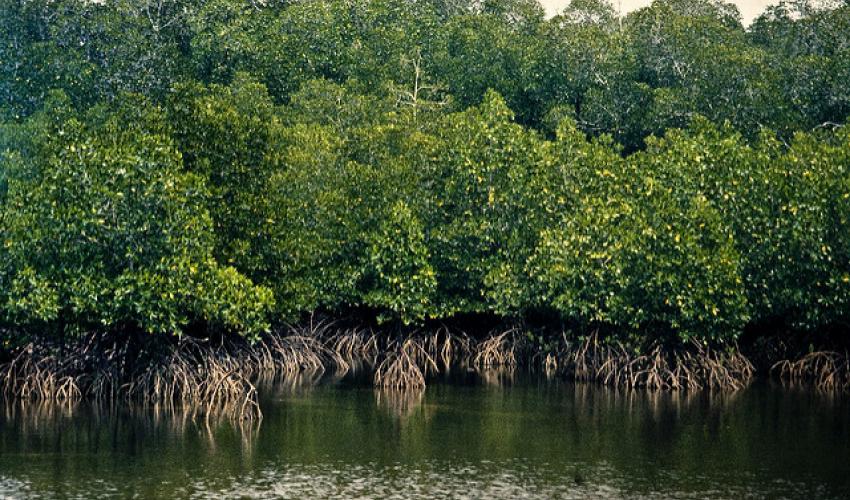
    • Mangrove cover has been separately reported in the ISFR 2019 and the total mangrove cover in the country is 4,975 sq km.
    • An increase of 54 sq Km in mangrove cover has been observed as compared to the previous assessment of 2017.
    • Top three states showing mangrove cover increase are Gujarat (37 sq km) followed by Maharashtra (16 sq km) and Odisha (8 sq km).

    Bamboo

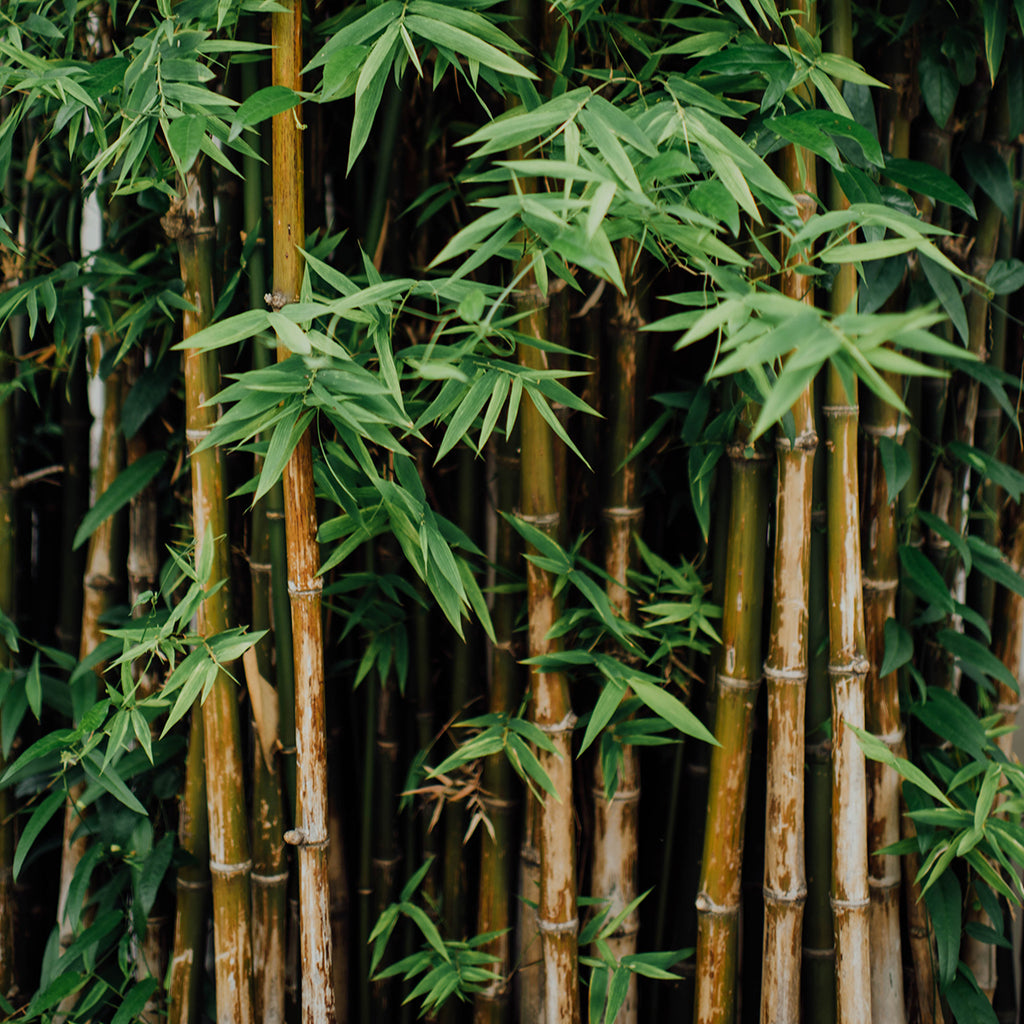
    • The extent of bamboo bearing area of the country has been estimated 16.00 million hectare.
    • There is an increase of 0.32 million hectare in bamboo bearing area as compared to the last assessment of ISFR 2017.

    Wetlands

    • Wetlands within forest areas form important ecosystems and add richness to the biodiversity in forest areas, both of faunal and floral species.
    • Due to importance of wetlands, FSI has carried out an exercise at the national level to identify wetlands of more than 1 ha within RFA.
    • There are 62,466 wetlands covering 3.8% of the area within the RFA/GW of the country.

    Carbon Stock

    • Under the current assessment the total carbon stock in country’s forest is estimated 7,124.6 million tonnes.
    • There an increase of 42.6 million tonnes in the carbon stock of country as compared to the last assessment of 2017.
    • The annual increase in the carbon stock is 21.3 million tonnes, which is 78.2 million tonnes CO2 eq.

    Decline of Forest Cover in North Eastern

    • Total forest cover in the North Eastern region is 1,70,541 sq km, which is 65.05% of its geographical area.
    • There has been a decrease of forest cover to the extent of 765 sq km (0.45%) in the region.
    • Except Assam and Tripura, all the States in the region show decrease in forest cover.

    Forest Fires

    • About 21.40% of forest cover in India is prone to fires, with forests in the north-eastern region and central India being the most vulnerable a/c to the report.
    • The forest fire points (FFP) identified during the 13 years add up to 2,77,758.
    • They were analysed using a moderate resolution imaging spectro-radiometer (MODIS) by overlaying the points coverage over the grid coverage of 5 km x 5 km.
    • The analysis showed that extremely fire-prone areas account for 3.89% of total forest cover, very highly fire-prone areas account for 6.01% and highly fire-prone areas for 11.50%.
    • Together, the three categories come to 21.40 % of forest cover.


    to be continued …….

    Note: Part-II of the same Burning Issue will be published by 20:00 hrs.

  • [op-ed snap]Eradication of TB by 2025

    At the End TB summit, 2018 the prime minister of India made a bold commitment to end tuberculosis by 2025-five years ahead of the global target. Which is possible to achieve if the efforts are put at the level it was done in case of polio.

    The toll taken by TB

    • Despite the disease being fully curable, people still die from it.
    • TB usually affects people in their most productive years and drives families into debt.
    • It has a direct link to human suffering, discrimination and also poverty.
    • Due to its infectious spread, it directly affects our economic growth as well.
    • With resilience, sufficient investment, innovative approaches and strategies and the participation of all stakeholders, TB can be defeated.

    First Step- Awareness

    • The first step is the creation of awareness and empowering of communities.
    • TB affects millions, yet very few know enough about it.
    • Multilingual, multi-stakeholder awareness effort to ensure that all Indians knows about the challenges of TB and where to seek treatment is required.
    • With the expansion of the media and evolving technology, it is possible to reach everyone with the right information.

    Second Step- Access to diagnosis and treatment

    • Ensuring that every Indian get access to correct diagnosis and treatment for TB, regardless of their ability to pay for it is the second step.
    • To do so, working with the private sector is necessary as was done in the case of polio.
    • There are numerous innovative private-sector programmes and partnership schemes for TB.

    Role of  Private sector

    • Recently launched programmes for doctors and labs offer the private sector various incentives.
    • Even today, about half a million TB cases go unnotified, especially those seeking care in the private sector.
    • Those cases need to be tracked and ensured that everyone in the need of treatment and care gets it.
    • Organisations like Indian Medical Association and Indian Academy of Paediatrics are working with the private sector to ensure patient-centric care as per “Standards of TB Care in India” (STCI).

    Drug-resistant TB

    • A key challenge is building a forward-looking plan to address and control drug resistance.
    • Drug-resistant TB is a man-made menace that is a major roadblock in a fight against TB.
    • Every TB patient must be tested for drug resistance at the first point of care, whether in the public or private sector, to rule out any drug resistance.

    Efforts by the government

    • Nikshay Poshan Yojana -in which TB patients receive Rs 500 every month while on treatment was launched.
    • Nikshay Poshan Yojana ensure that the patients have economic support and nutrition during the required period.
    • ‘TB Harega Desh Jeetega Campaign’ was launched to accelerate the efforts to end TB by 2025.
    • The campaign aims to initiate preventive and promotive health approaches.
    • By applying “multi-sectoral and community-led” approach, the government is building a national movement to end TB by 2025.
    • Resource allocation towards the TB Elimination Programme has been increased by four-fold.
    • Sincere efforts need to be made to make our health systems more accessible and reliable.
    • It also required to ensure that those seeking care trust the healthcare system and get the appropriate care for completing treatment.
    • There is a need to create more labs, point of care tests, an assured drug pipeline, access to new drugs.
    • The government should also ensure counselling and support for those affected.
    • Every patient who is diagnosed late and does not receive timely treatment continues to infect others.
    • To break this cycle, government machinery at the field level should work with communities and provide free diagnosis and treatment to every affected individual.

    Conclusion

    With all the efforts, planning and resource put in place to eradicate the menace of TB from India, it is possible to achieve the goal by 2025.