civils daily! good work
Search results for: “”
-
5 Oct 2016 | DEBATE: Lodha Committee freezes BCCI accounts
Yesterday came reports that the Lodha committee, angry at the defiance of its recommendations, asked banks to “freeze” BCCI accounts. BCCI countered by saying that this would result in cancellation of the ongoing India-New Zealand series due to lack of funds.
Do you think that Lodha committee over-reacted and is a pattern of SC exceeding its mandate? Did the BCCI over-react, and should have just acceded to the demands? Or is the media just blowing up the issue as usual?
This is a debate so you need to take a side and rebut each others points.
Useful Links –
-
5 Oct 2016 | Target Mains: GS Questions & DNA Framework
GS1 (Consolidation within the country)
Demand – Explain elements which unite India and build a common identity.
Approach –
– Brief mention of differences (2 marks)
– Historical, cultural etc factors (geography, freedom struggle etc) responsible for creating an Indian identity which makes us united (8 marks)
GS2 (Statutory, regulatory and various quasi-judicial bodies)
Demand – What is the purpose of regulatory bodies? Discuss with examples. Is independence an issue for them?
Approach –
– Purpose of regulatory bodies such as checking anti-competitive practices (2.5 marks)
– Give examples of such bodies and purpose (2.5 marks)
– Why is their independence necessary? (2.5 marks)
– What are the dangers to their independence? (2.5 marks)
GS3 (Indian economy)
Demand – Discuss whether SEZ’s have failed or succeeded in India and the reasons.
Approach –
– What are SEZ’s? (2 marks)
– State of SEZ’s in India? (4 marks)
– Way forward. (4 marks)
GS4 (Case study)
Demand and Approach – No hints in case studies!
-
5 Oct 2016 | GS4 | A member of your team has to take frequent leaves due to the health problems of her child. This results in more work load on her team members leading to anger. The team member is otherwise an ideal employee. How would you deal with this situation if you were the manager of this team?
GS4 (Case study)
A member of your team has to take frequent leaves due to the health problems of her child. This results in more work load on her team members leading to anger. The team member is otherwise an ideal employee. How would you deal with this situation if you were the manager of this team?
Best answer
Simran Bains wrote the best answer for this question and got a score of 4.5/10 (if the best answer is an image, it cannot be uploaded here, hence scroll down to see those). The answer is being reproduced below for everyone’s convenience. Of course these answers can always be improved. (Best answer of a particular only involves those given on that day, later answers may not have been checked)
-
5 Oct 2016 | GS3 | Countries such as China have used SEZ’s to develop manufacturing zones and promote exports. What has India’s experience been with SEZ’s? What are the reasons for their success or failure?
GS3 (Indian economy)
Countries such as China have used SEZ’s to develop manufacturing zones and promote exports. What has India’s experience been with SEZ’s? What are the reasons for their success or failure?
Best answer
Aman Chauhan wrote the best answer for this question and got a score of 5/10 (if the best answer is an image, it cannot be uploaded here, hence scroll down to see those). The answer is being reproduced below for everyone’s convenience. Of course these answers can always be improved. (Best answer of a particular only involves those given on that day, later answers may not have been checked)
-
5 Oct 2016 | GS2 | There are many regulatory bodies in India, such as SEBI, TRAI etc. Why are they necessary? Discuss issues relating to their independence given that the government appoints their heads and there may be a conflict of interest.
GS2 (Statutory, regulatory and various quasi-judicial bodies)
There are many regulatory bodies in India, such as SEBI, TRAI etc. Why are they necessary? Discuss issues relating to their independence given that the government appoints their heads and there may be a conflict of interest.
Best answer
Ashutosh Namdeo wrote the best answer for this question and got a score of 4.5/10 (if the best answer is an image, it cannot be uploaded here, hence scroll down to see those). The answer is being reproduced below for everyone’s convenience. Of course these answers can always be improved. (Best answer of a particular only involves those given on that day, later answers may not have been checked)
-
5 Oct 2016 | GS1 | India is a land of diversity. People speak different languages, have different beliefs etc, but are still united as Indians. What are the factors responsible for this unity?
GS1 (Consolidation within the country)
India is a land of diversity. People speak different languages, have different beliefs etc, but are still united as Indians. What are the factors responsible for this unity?
Best answer
Shashank Pander wrote the best answer for this question and got a score of 4/10 (if the best answer is an image, it cannot be uploaded here, hence scroll down to see those). The answer is being reproduced below for everyone’s convenience. Of course these answers can always be improved. (Best answer of a particular only involves those given on that day, later answers may not have been checked)
-
5 Oct 2016 | Prelims Daily: CA Questions with Tikdams & Tidbits
Dear students,
When you submit your answer, if possible, give some reasoning & more info. along with the ABACAA format. Elaborate on what you know. This helps the whole community to know more and learn more!
Q.1) Consider following statements with reference to Monetary policy committee.
1. Government amended the RBI Act to hand over the job of monetary policy-making in India to a newly constituted Monetary Policy Committee (MPC).
2. MPC is entrusted with the task of fixing the benchmark policy interest rate (repo rate) to contain inflation within the specified target level.
3. RBI set up an Expert Committee under N.S.Vishwanathan to revise the monetary policy framework.
Which of the statements given above is/are correct?
a) 1 and 2 only
b) 3 only
c) 2 and 3 only
d) 1, 2 and 3 only
Q.2) Recently, Japanese researcher won the Nobel Medicine Prize. Consider the following statements with regard to this.
1. Yoshinori Ohsumi won Nobel prize for his pioneering work on autophagy.
2. Autophagy is a process whereby cells eat themselves which when disrupted can cause Parkinson’s and diabetes.
3. A Nobel laureate Christian de Duve coined the term ‘autophagy’.
Which of the statements given above is/are correct?
a) 1 and 2 only
b) 3 only
c) 2 and 3 only
d) 1, 2 and 3 only
Q.3) Consider following statements with regard to Global Initiative of Academic Networks (GIAN).
1. GIAN aims at tapping the talent pool of scientists and entrepreneurs to engage with the institutes of higher education in India.
2. GIAN initiative launched by Ministry of Science and Technology.
Which of the statements given above is/are correct?
a) 1 only
b) 2 only
c) Both 1 and 2
d) Neither 1 nor 2
Q.4) Colombia is frequently in the news. It shares borders with
1. Venezuela
2. Panama
3. Ecuador
4. Bolivia
5. Peru
Select the correct answer using the codes given below.
a) 1,2 and 4
b) 2, 4 and 5
c) 1, 2, 3 and 5
d) 1,2,3 and 4 only
Q.5) Recently, The International Buddhist Conclave-2016, opened its sessions in
a) Bodh Gaya
b) Nalanda
c) Sarnath
d) Lumbini
IMPORTANT STUFF:
1. These questions are mostly derived from our daily newscards. Reading daily news from Civilsdaily’s App (click here) or website + solving these questions will help you reinforce the basics.
2. For a comprehensive preparation of IAS Prelims 2017 – consider joining one of the three Prelims Modules by CD – prelims.civilsdaily.com
3. Solutions of today’s Prelims Daily – Click here
4. For attempting previous Prelims Daily Questions – Click here
-
First timers to IAS Prep? Prepare Indian Agriculture for GS Mains with me!
I will maintain a link list of all post written under this theme, here –
#1. Indian Agriculture 101 – What’s NPF, PMKSY, CCEA and CACP?
#2. Indian Agriculture 102 – India’s Green Revolution and National Food Security Mission
#3. Indian Agriculture 103 – What is Rashtriya Krishi Vikas Yojna (RKVY) and is it any good?
#4. Indian Agriculture 104 – Everything that you need to know about Drought Management in India
#6. 8 Types of Farming in India
Hello,
Indian Agriculture, as we all would agree is a topic that haunts us all (second only to Environment & Biodiversity). Here is an attempt to understand the economics, policy making etc. of this very, very important sub-segment of Indian Economics for GS Mains.
I find that most of the newbies have no idea about how to cover this portion which involves – schemes by ministries, economics around it, op-eds and cross examinations of success and failures.
I will be using a standard source – The Annual Report of Ministry of Agriculture [Pdf here].
There is absolutely no need to go for Indian Economy reference books or wait for that big fat India Year Book to come out to understand Indian Agriculture. In fact, Dr. V strongly advices against using the IYB!
The Ministry’s report is an amazing piece of art! I won’t be covering it linearly but would be touching upon the IAS Pre and Mains aspects of the syllabus to extract maximum juice for all of us. We will discuss things like difference between CECA and CACP, reason behind new crop insurance schemes and will cover things in tidbits format for an easy recall.
PS: All Blogs are accessible from Web and App
PPS: Please do leave your comments on the blog. Participate in the questions which are posed between the lines and let me know if you liked what you read.
-
Indian Agriculture 101 – What’s NPF, PMKSY, CCEA and CACP?
We know that 54.6% of India’s population is engaged in agriculture and allied activities (census 2011) and it contributes 17.4% to the country’s Gross Value Added.
That’s the very first line we read in any policy document/ economic survey chapter related to Agriculture and to an uninitiated, this strikes as an ironical play of numbers.
More than half of our population is engaged in something which adds less than 20% value to our country’s economy? Why don’t we just outsource our food supplies to other nations and educate the next gen farmers to write code and sell IT software so that we make more money!
If I tell you that, the %age share kept on decreasing year over year – you would be amused still.

Don’t worry. A fall in the share of the agriculture and allied sector in GVA is an expected outcome in a fast growing and structurally changing economy. This means that we as a country have more avenues of value creation. Which is good, right?
Before we go on further, you may wonder what these allied activities are?
The allied industries are all the small and medium enterprises that depend directly or indirectly on the activity of Agriculture.
When you think of paddy crop – you don’t just think of paddy but also of the labour it employs, the fertilizer industry which it calls for, the sales agencies, the pesticides folks etc. All these come into allied industry.
Got it? Now chew on this and prepare yourself for a Prelims MCQ on allied industry!

At this point, we have a vague idea that monsoons being a notorious variable in the agriculture space, most of the times we aren’t able to meet our targets, farmers go in distress, reality bites when we see videos of farmer suicides and we salute people like Nana Patekar & co. who go out of their way to allay the concerns of their families. We wonder about govt. schemes, insurance policies, family welfare programs and why they are not in play etc. etc.
But being an aspiring bureaucrat, you need to know your basics first.
National Policy for Farmers (NPF), 2007
Major aims: To improve economic viability of farming and increase net income of farmers. This is like the umbrella policy. It’s a national level scheme and many of the existing schemes which you hear about in papers etc. are being run under this.
I never knew that Pradhan Mantri Krishi Sinchayee Yojana (PMKSY), Kisan Credit Card, Pradhan Mantri Fasal Bima Yojana (PMFBY) etc etc. are all part of this. You tend to miss on such information but now you know.
Can you imagine the expanse of this National Policy?
No one is going to ask you to list down its policy objectives, but this is a great way of stepping into a senior bureaucrat’s shoes and understand the gamut of activities he/ she needs to keep in his/her mind while drafting a policy document.
As we start this series and write more chapters, we will be covering the Prelims and Mains worthy aspects of these 14 policy objectives. When you are done, you can come back, read each line and recall what we covered.
Policy provisions in NPF-2007 include:
- Asset reforms in respect of land, water, livestock, fisheries and bio-resources;
- Supply of good quality seeds and disease-free planting material, Issue of soil health passbooks to the farmers and integrated pest management system;
- Region and crop specific implements and machinery;
- Support services for women;
- Timely, adequate and easy reach of institutional credit at reasonable interest rates and farmer-friendly insurance instruments;
- Support services and inputs like application of frontier technologies; agricultural bio-security system;
- Use of Information and Communication Technology (ICT) and setting up of farm schools to revitalize agricultural extension;
- Coverage of farmers under a comprehensive national social security scheme;
- Effective implementation of Minimum Support Price (MSP) across the country and establishing community foodgrain banks;
- Development of agricultural market infrastructure and terminal markets for agriculture;
- Curriculum reforms in agricultural universities;
- Special categories of farming like organic farming and contract farming;
- Rural non-farm employment initiative for farm households; and
- Integrated approach for rural energy
100 bucks say that you overlooked these 14 points! But think for a moment – in any mains or essay question based on agriculture – these themes are going to recur. This is a national level policy instituted in 2007 and it is still in play, which means that these idealistic goals have still not been achieved. That’s 14 points for you to rattle off to anyone who asks you about the “agricultural issues that need our attention!”
Moving on, the first chapter of the annual report mentions some important schemes, committees, jargons etc which need our attention. Let’s understand them in tidbits before we move on.
[Tidbits] Pradhan Mantri Krishi Sinchayee Yojana (PMKSY)
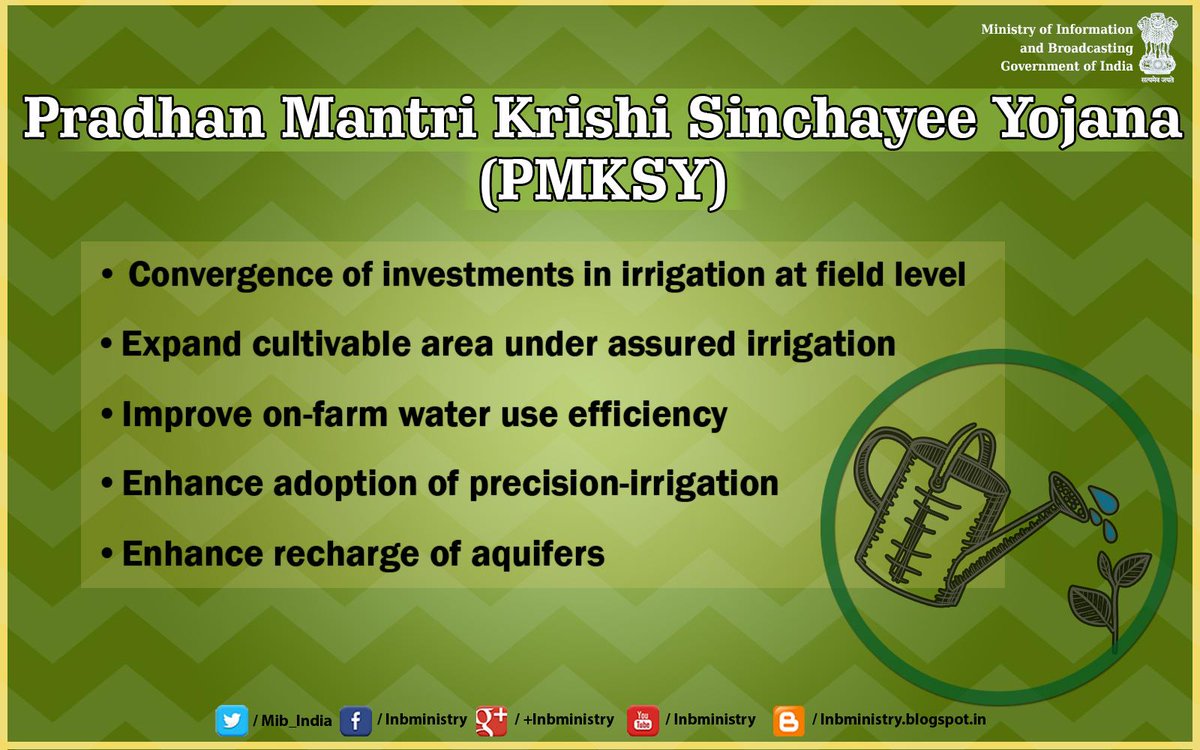
source
- The scheme has been approved with an outlay of Rs. 50,000 crore for a period of 5 years
- What’s an outlay?
- Cabinet Committee on Economic Affairs (CCEA) gave approval to that outlay. CCEA is chaired by PM
- Ministries involved?
- Ministry of Rural Development
- MoWR RD & GR
- Ministry of Agriculture
Usually when multiple ministries are involved – it’s a case of amalgamation of a lot of schemes into one. For instance, here – PMKSY has been formulated amalgamating ongoing schemes:
- Accelerated Irrigation Benefit Programme (AIBP) of the Ministry of Water Resources
- River Development & Ganga Rejuvenation (MoWR,RD&GR)
- Integrated Watershed Management Programme (IWMP) of Department of Land Resources (DoLR)
- On Farm Water Management (OFWM) of Department of Agriculture and Cooperation (DAC)
You want to read more on this – Achieving the goals of- Per drop more crop & Har khet ko paani
[Tidbits] Kisan Credit Card
source
Answer this question –
In India, which of the following have the highest share in the disbursement of credit to agriculture and allied activities?
- Commercial Banks
- Cooperative Banks
- Regional Rural Banks
- Microfinance Institutions
KCC is implemented by Commercial Banks, Cooperative Banks and Regional Rural Banks. I hope you know that Commercial Bank includes the Public Sector Banks in its definition.
[Tidbits] Crop Insurance in India
We will study this in great detail later but very, very quickly:
- The existing crop insurance schemes have recently been reviewed – This is important to note otherwise we keep reading outdated stuff and confuse among the many names and schemes!
- Earlier we had National Crop Insurance Programme (NCIP) and it had many schemes under it:
- Modified National Agricultural Scheme (MNAIS)
- Weather Based Crop Insurance Scheme (WBCIS)
- Coconut Palm Insurance Scheme (CPIS)
- Now forget all the above because the flavour of the day is – Pradhan Mantri Fasal Bima Yojana (PMFBY)

source
“This is a historic day. I am confident that this scheme, which is inspired by the consideration of farmers’ benefit, will bring about a major transformation to the lives of farmers,” – PM’s Tweet
There are a few significant features about the new scheme and this will make it both – farmers’ friendly and a game-changer in the long run. How does this scheme overcomes the shortcomings of previous scheme? What makes it a game changer? Read this blog to understand in detail – Pradhan Mantri Fasal Bima Yojana – Min Premium, Max Insurance
[Tidbits] What should I know about Commission for Agricultural Costs and Prices?
- CACP is mandated to advise on the price policy (MSP) of 23 crops under 5 groups of commodities namely
- Kharif crops,
- Rabi crops,
- Sugarcane,
- Raw Jute and
- Copra (dried coconut)
- Please note that for the determination of MSP – cost of production is not the only variable for consideration
- Other factors: Demand and supply, price trends in the market, both domestic and international, inter-crop price parity etc.
[Prelims 2009] Consider the following statements:
- The Commission for Agricultural Costs and Prices recommends the Minimum Support Prices for 32 crops.
- The Union Ministry of Consumer Affairs. Food and Public: Distribution has launched the National Food Security Mission.
Which of the statements given above is/ are correct?
- 1 only
- 2 only
- Both 1 and 2
- Neither 1 nor 2
What’s the difference between CCEA and CACP?
- CACP assess the various factors and recommends a MSP (Minimum Support Price) to the Ministry
- Ministry may either agree or disagree with it and come up with a new price
- That price then goes to CCEA (Chaired by the PM) and CCEA has the power to approve an MSP
Clear? Awesome!
That’s all for this first lesson. We move onto next in a few days but it would be great if you can comment to let me know how you find this! For newbies or oldies, does it feel like it helped understand the Agriculture and various Economic/ Polity angles?
References: Apart from extensive research around news articles, the mainstay of this series is the annual report of the Ministry of Agriculture to the GOI – Click to download a copy
All articles in this series are listed here – First timers to IAS Prep? Prepare Indian Agriculture for GS Mains with me!

