💥UPSC 2026, 2027, 2028 UAP Mentorship (March Batch) + Access XFactor Notes & Microthemes PDF

Search results for: “”

  • One Stop Centre Scheme and the Nirbhaya Fund. What’s the connect?

    Ministry of Women and Child Development (MWCD), has formulated a Centrally Sponsored Scheme for setting up One Stop Centres (OSC), to be funded from the Nirbhaya Fund.

    source

    Aim?

    • Centres will be established across the country to provide integrated support and assistance under one roof to women affected by violence, both in private and public spaces
    • An integrated range of services including medical, legal, and psychological support
    • In the first phase, one OSC will initially be established in each State/UT
    • The OSC will be integrated with 181 and other existing helplines

    What’s 181? It is the women in distress helpline number. It was recently in news when this helpline for women in Delhi was transferred under the Delhi Commission for Women with the AAP government handing over its charge to the panel.

    Implementation guidelines and appraisal process?

    • The implementation guidelines have a prescribed proforma, for the submission of proposal for the establishment OSCs by States/UTs.

    The term pro forma (Latin for “as a matter of form” or “for the sake of form”) is most often used to describe a practice or document that is provided as a courtesy and/or satisfies minimum requirements, conforms to a norm or doctrine, tends to be performed perfunctorily and/or is considered a formality.

    • Feedback received from states/ UTs will be examined by a Programme Approval Board (PAB) to be constituted in the Ministry of Women and Child Development.


    Concerns? Areas of improvements?

    • While providing counselling, can these centres be equipped with a direct line to state police stations to file FIRs? Online FIR system for sex related violence may be a possible solution
    • How would these centres fare against the AFSPA provisions which guarantee safeguards for the security personnel?
    • The Nirbhaya fund, though allocated, has still not been utilised to the full capacity

    Read here and here about how OSC comprise only a small %utilisation of the otherwise 3,000cr heavy Nirbhaya fund.

    Questions

    1. What has the GoI done with Nirbhaya fund since its inception in 2013? Mark out the small or big schemes (along with ministries) where the funds’ utilisation was pegged to bring about a social change?

    Hint: In the fiscal year 2013-2014, one proposal was made by the Ministry of Home Affairs, the Ministry of Road Transport and Highways, and the Ministry of Railways each.


  • Mother and Child Health – Immunization Program, BPBB, PMJSY, PMMSY, etc.


    • Aim: To generate awareness and improve efficiency of delivery of welfare services meant for women
    • Launched on 22 January 2015 with an initial corpus of Rs. 100 crore
    • Joint initiative of Ministries of Women & Child Development, Health & Human Resource Development

    Districts Identified

    The three criteria for selection of districts:

    1. Districts below the national average (87 districts/23 states);
    2. Districts above national average but shown declining trend (8 districts/8 states)
    3. Districts above national average and shown increasing trend (5 districts/5 states- selected so that these CSR levels can be maintained and other districts can emulate and learn from their experiences)
    • First Phase:

    100 districts have been identified on the basis of low Child Sex Ratio as per Census 2011 covering all States/UTs as a pilot With at least one district in each state

    • Second Phase

    The scheme has further been expanded to 61 additional districts selected from 11 States/UT having CSR below 918


    Strategies:

    • Implement a sustained Social Mobilization and Communication Campaign to create equal value for the girl child & promote her education
    • Focus on Gender Critical Districts and Cities low on CSR for intensive & integrated action
    • Mobilize & Train Panchayati Raj Institutions/ Urban local bodies/ Grassroot workers as catalysts for social change
    • Ensure service delivery structures/ schemes & programmes are sufficiently responsive to issues Of gender and children’s rights
    • Enable Inter-sectoral and inter-institutional convergence at District/ Block/ Grassroot levels

    Implementation:

    1. Centre: A National Task Force (NTF) headed by Secretary WCD
      State: A State Task Force (STF)
    2. District: District Task Force (DTF) headed by the District Collector/ Deputy Commissioner with representation of concerned departments
    3. Block: A Block Level Committee headed by SDM/ SDO/ BDO
    4. Gram Panchayat/ Municipality: Respective Panchayat Samiti/ Ward Samiti
    5. Village: Village Health Sanitation and Nutrition Committees
    Published with inputs from Swapnil
  • Tit-bits for prelims (what do you think)

    Hello everyone

    As prelims is not more than 80 days away, we thought of different ways of helping you in your preparation. In this context UW announced a test series on the forum. Now to help you with the factual stuff, we came up with the idea of presenting confusing and important factoids in card format which would be linked to a subject in the story. You can revise them and discuss them on website.

    For instance

    Polity Tit-bits

    High Court

    • High court judges are appointed and removed by president not the governor
    • salary is charged on consolidated fund of states while pension on CFI
    • Writ jurisdiction under article 226 is wider than that of supreme court’s under article 32
    • There are 24 high courts in India

    Discuss– logic behind these provisions and name the high courts which have jurisdiction over more than 1 state or UT

    Supreme court

    • A distinguished jurist can be appointed to supreme court but not high court
    • Only parliament not president can increase the number of judges
    • A person can directly approach supreme court under art 32
    • President can seek advice under article 143, supreme court not bound to advise, president not bound to accept the advise

    Discuss– Under what conditions, supreme court is duty bound to tender the advise to president?

    Do let us know, what you think about the initiative in comment section. If good enough number of aspirants want it, we would start pushing 4-5 such cards every day in the app or on the forum.

    It takes lots of time to design such stuff, so feel free to write your opinion. Do let us know if you want any changes etc. We would start it only if you recommend it.

  • Economic Survey For IAS | Chapter 11 | Powering One India


    Power or electricity is very essential constituent of infrastructure affecting economic growth and welfare of the country. India is the 5th largest producer of electricity in the world. At an electricity-GDP elasticity ratio of 0.8 <for 1% increase in GDP, 0.8% increase in electricity generation required>, electricity will continue to remain a key input for India’s economic growth.

    Uninterrupted, reliable power at reasonable cost is essential for the success of make in India which in turn is critical for the transformation of industrial sector which would provide jobs to burgeoning young population entering the labour force every month <1m new entrants to labour force every month>.

    High tariffs and erratic supply for industry have led to a slow but steady decline in the growth of industrial electricity purchases from utilities and a gradual transition towards captive generation often using diesel gen sets which is more expensive as also more damaging to the environment.

    Status of diesel gensets in India-

    • 47% of firms report using a diesel generator
    • Total capacity of the diesel generators (DG) in the country may be as high as 72 GW and growing at the rate of 5 GW per year
    • DG capacity for industrial loads greater than 1 MW is 14 GW
    • A substantial portion of the rest (58 GW) may be contributed by micro and small industries, with load capacities of less than 1 MW

    Effect of captive power generation using diesel gen sets

    • This particularly affects SMEs as they are unable to shift to captive power generation and when they do, they are unable to absorb the higher costs as their margins are generally very low.
    •  Agro based and other industries are not able to develop in peri urban or rural areas and rural population either remain stuck in unremunerative agriculture or migrates to urban areas in search of jobs (distress migration)
    • It affects competitiveness of our industry and our exports suffer
    • Pollution, environmental degradation, climate change, global warming

    What are the other issues in India’s power sector?

    A- Complexity of tariff schedules

    • There are separate tariffs for poultry farms, pisciculture, wetland farms (above and below a certain size), mushroom and rabbit farms, etc <complexity of tariff structure>
    • It prevents economic actors from responding sufficiently to price signals due to the high cost of processing the price information <if it’s so complex, our mind can not take economically rational decisions>

    Suggestion – Simplification of tariffs with, perhaps no more than 2-3 tariff categories <say low tariff below certain level of power consumption, high after that level and separate category for industrial tariff>

    It will improve transparency and may well yield consumption and collection efficiency, along with governance benefits <consumers will be able to take rational decisions, no scope for rent seeking>

    B- Tariffs And Cost-

    Cmmon sense suggests avg tariff (AT) should not be less than avg cost of supply (ACS) but in India-

    • Average tariffs in some cases are set below the average cost of supplying electricity
    • Even after adjusting ACS for Aggregate Technical and Commercial (AT&C) losses AT continues to stay below the adjusted level of ACS in most states i.e tariff are set way below the required level <what are AT&C losses? Answer in comments>

    Suggestion- -Tariffs reflecting costs are a necessary condition for discoms to sustain themselves over the long-run. So avg tariffs need to be raised while giving relief to poorer section of society. How?

    Exploiting Progressivity to Lower Tariffs for the poor

    • There is, at present, no specific policy guidelines on the intra-category cross subsidisation or subsidy provisioning
    • The tariff schedule is progressive as the consumption increases, although, Avg billing rates (ABR) for all the consumption categories lies below the average cost of supply (ACS) implying that costs are not fully recovered even from high end consumers i.e state or industry subsidizing consumption of rich
    • Other countries such as Bangladesh, Sri Lanka, South Korea, Vietnam and Brazil better exploit the progressivity of electricity tariffs in the domestic category <higher ratio of tariffs charged to the rich relative to poor>

    Suggestion- make tariff schedule after welfare analysis and charge consumers progressively much more for higher consumption while simplifying tariff schedule

    Advantage- cross-subsidisation occurs within the residential consumers itself< rich and consumers with high consumption intensity within the residential sectors subsidise prices for consumers with lower consumption>

    Given their relatively inelastic price elasticity, rich consumers will continue to maintain their consumption even after price increase. The net effect is that the residential revenue collection becomes cost neutral for the discoms (loss making at present)

    What has govt done so far?


    Open access policy and it’s present status

    What is open access– simple- open to access electricity from any seller i.e. consumers being able to purchase directly from power producers rather than distribution companies.

    Advantage- As it allows generators to sell power to the highest bidders while consumers can source their needs from the most economic seller, it promotes competition and efficiency

    Open Access (OA) policy introduced under Electricity Act 2003, allows consumers with electricity load above 1 MW to procure electricity directly from electricity markets

    OA provides an aggregation of the country-wide supply and demand on the same platform. Therefore, this constitutes a first step towards discovering a single market price for power around the country <if anyone can buy and sell from anybody freely it would ultimately create a single price for electricity and thus one market for power>

    Barriers to open access-

    Price barriers- cross subsidy surcharge– Industrial consumers procuring power from discoms subsidize residential consumers but they don’t have to do so if they procure power through open access, electricity regulator levies a surcharge to cover the cost of residential subsidy known as cross subsidy surcharge.

    Idea was that cross-subsidy surcharge to be levied on OA consumers would come down over time. Nonetheless, cross-subsidy surcharges over the years have gone up as discoms lobby hard to increase surcharge.

    Non price barriers- delay in granting open access, transmission constraints and congestion and transmission losses

    In short price and non-price barriers come in the way of single-nationwide electricity prices through open access

    Some achievements –

    • highest ever increase in generation capacity <in 2014-15 the addition to plant capacity in utilities was 26.5 GW, much higher than the average annual addition of around 19 GW over last five years>
    • bringing down the peak electricity deficit in the country to the lowest ever level of 2.4%
    • Indian Railways (IR) attempting to shift to open access (OA) for power purchase
    • From power deficit to power surplus <it’s possible because discoms are so much under debt that they just don’t want to purchase any more power, all the more important to expedite the shift to open access>
    • Grid parity for solar generation is on its way to becoming a reality <tariffs reached an all-time low of R4.34/kWh in latest auction> <What’s grid parity? Why is it important? Answer in comments>/

    Some policy decisions of govt of India-

    A- Ujwal DISCOM Assurance Yojana (UDAY)  

    • States shall take over 75 per cent of discom debt outstanding as of September 2015.
    •  Reduction of Aggregate Technical & Commercial (AT&C) losses to 15 per cent by 2018-19.
    •  Reduction in difference between average cost of supply and average revenue realized (ARR) by 2018-19.
    •  Increased supply of domestic coal to substitute for imported coal.
    • States shall take over future losses of discoms in a phased manner.
    • Banks/FIs not to advance short term debt to discoms for financing losses.

    B. Deen Dayal Upadhyaya Gram Jyoti Yojana (DDUGJY)

    • Electrification of all villages <how many villages are unelectrified? what is criteris for calling a village electrified? Answer in comments. >
    • Metering of unmetered connections for reducing losses.
    • Separation of feeders to ensure sufficient electricity to agriculture and continuous supply to other categories.
    • Improvement of sub-transmission and distribution network to improve the quality and reliability of supply.

    C. Integrated Power Development Scheme (IPDS)

    • Strengthening of sub-transmission and distribution network in urban areas.
    • Metering of distribution transformers /feeders / consumers in urban areas.
    • IT enablement of distribution sector and strengthening of distribution network.

    D. Domestic Efficient Lighting Program (DELP)

    77 crore LED bulbs to replace household and street light incandescent bulbs

    E. National Tariff Policy, 2016

    • Cross subsidy surcharge formula revised.
    • Regulator will devise power supply trajectory to ensure 24X7 power supply for all consumers latest by 2021-22 or earlier


    Installed capacity in India as of 31st march 2016 (ratta laga lo)

    • Thermal – 210 GW (185 Coal)
    • Renewable – 85 GW ( 43 Hydro plus 42 others)
    • Nuclear – 5780 MW
    • Total – 301 GW

    Break up of renewable energy

    • Wind- 27 GW
    • Solar- 6.7GW
    • Biomass and bagasse cogeneration -4.8GW <what is cogeneration?>
    • Small hydel- 4.3 GW
    • Total- 43GW

    Renewable energy target by 2022

    • 100 GW solar power,
    • 60 GW wind energy
    • 10 GW small hydro power,
    • 5 GW biomass-based power

    The target for solar is split into 40 GW Rooftop and 60 GW through Large and Medium Scale Grid Connected Solar Power Project

    Nuclear energy target


    Earlier the target was 63,000 Mwe by 2032 but now govt seems to have slashed it to just about 14,500 Mwe by 2024 as India-USA nuclear deal seems to be floundering (for more refer this link)

    Electricity amendment bill 2014

    • The Bill amends the Electricity Act, 2003.
    • It seeks to segregate the distribution network business and the electricity supply business, and introduce multiple supply licensees in the market i.e separation of content and carriage<distribution network will now become like wires which anybody would be able to access just as we can obtain telecom services from any service provider, we would be able to get electricity from any provider>
    • The Bill introduces a supply licensee who will supply electricity to consumers.
    • The distribution licensee will maintain the distribution network <like present discoms> and enable the supply of electricity for the supply licensee.

    For more info refer to PRS bill analysis here 

    P.S.- This completes economic survey volume one in full retail with all the relevant concepts.

  • Tina Dabi on her strategy for Political Science

    source: facebook

    Read all the blogs and strategies given by IAS Rankers here, Click on the Toppers Speak collection.

  • Artika Shukla: Tale of a Varanasi girl who got 4th rank in IAS 2015 exam

    26 year old Varanasi girl, Artika Shukla has secured 4th rank Civil Services Examination 2015. She believed that If one has a dream, they should just follow it”. She gives all credit to his elder brother.

    source

    Why IAS?

    From her college days she always wanted to do something for the youth of the country. She wanted to inspire the youth of country to contribute for the nation by setting her own example. Besides all that she gets an inspiration from her brother. So that she chooses civil services.

    Following the Footsteps of Brother:

    Her elder brother Utsav Shukla is an IAS officer from 2012 batch. He is posted in Guwahati. She said that when she had decided to opt out of her PG graduation course to prepare for IAS, many people told that it was a wrong decision. But her brother supported her in the journey and always stood behind her. She happily credited her success to her brother for being her “pillar and support” throughout.

    Education Background:

    She did her MBBS from Maulana Azad Medical College, New Delhi in 2013. After that she started preparations for the postgraduate course in medical science. She got success and took admission in MD pediatrics course at the SGPGI, Chandigarh. She quit her MD paediatrics course in November 2014. to prepare for the civil services.

    Family:

    Arkita’s father is a doctor and her mother is a house wife. Her father Dr. BK Shukla who is a pediatrician said that it was happy and proud moment for them. She had worked hard and he appreciated her work. She makes them to feel proud.

    Preparation and Coaching:

    She started her preparation from 2014. She said that she had not joined any coaching classes for preparation and sought all help and material from her brother. She managed to prepare for it while shuttling between Varanasi and Delhi and Chandigarh. She had joined a test series and mock interviews after month of August.

    About Optional:

    She had taken Medical Science as her subject because she has in depth knowledge of that subject. She gets an IAS post in her first attempt.

    Inspiration:

    She always said that her brother is big inspiration for her. Also she draws inspiration from Former President Late A.P.J Abdul Kalam. She also gives credit to her father and mother to take faith on her. She added that “If one has a dream, they should just follow it”.

    Her vision:

    She said that she wanted to see India on the top of the world. As an IAS officer she would   work for it. She would be honest IAS officer with a difference as god had given a chance to serve for it.

    Tips to aspirants:

    • Work hard and dedicatedly
    • Follow the proper direction
    • Be patient and do your work sincerely, you will definitely get success
  • Intellectual Property Rights in India

    What are IPRs?

    Intellectual Property Rights (IPRs) are legal rights, which result from intellectual invention, innovation and discovery in the industrial, scientific, literary and artistic fields. These rights entitle an individual or group to the moral and economic rights of creators in their creation.


    Types:

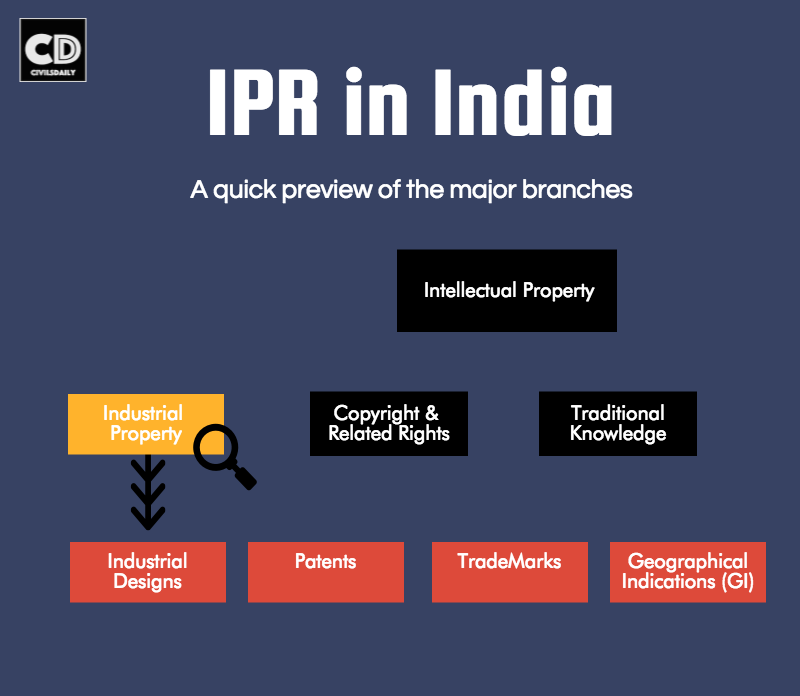
    Patent- It is a set of exclusive rights granted by a sovereign state to an inventor for a limited period of time in exchange for detailed public disclosure of an invention.

    Copyright- It is a legal right created by the law of a country that grants the creator of an original work exclusive rights for its use and distribution. It includes literary & artistic works such as novels, poems, plays, films, musical works, drawing, painting, photography, sculpture, architectural designs

    Trademark- It is a recognizable sign, design, or expression which identifies products or services of a particular source from those of others. Trademarks used to identify services are usually called service marks.

    Industrial design right- It is an intellectual property right that protects the visual design of objects that are not purely utilitarian. An industrial design consists of the creation of a shape, configuration or composition of pattern or color, or combination of pattern and color in three-dimensional form containing aesthetic value. An industrial design can be a two- or three-dimensional pattern used to produce a product, industrial commodity or handicraft.

    Trade secret- It is a formula, practice, process, design, instrument, pattern, commercial method, or compilation of information which is not generally known or reasonably ascertainable by others, and by which a business can obtain an economic advantage over competitors or customers

    Geographical Indication (GI)- It is a name or sign used on certain products which corresponds to a specific geographical location or origin (e.g. a town, region, or country). The use of a geographical indication may act as a certification that the product possesses certain qualities, is made according to traditional methods, or enjoys a certain reputation, due to its geographical origin. A recent example is of Indian variety of Basmati rice getting GI tag.

    From above points, it is clear that IPR is a very sensitive issue in terms of businesses different kinds and international relations as well.

    IPRs in pharmaceutical sector:

    Some sectors are very sensitive in terms of IPRs like pharmaceuticals. Let’s explore briefly into IPR issues in pharmaceutical sector.

    We hear of two kinds of drugs- generic and brand name drugs:

    Generic drugs are those whose patent has expired or does not exist and which can be produced by any registered manufacturer without need of taking permission from any authority and also without any payment of royalty.

    Brand name drugs are those which are patented and cannot be produced without the consent of the patent holder. A royalty is to be paid for production of these drugs.

    But what happens if a company holds patent of an essential drug and there is an emergency in which the drug needs to be provided at low cost for vast populace? In this case, Compulsory Licensing comes to the rescue.

    What is Compulsory Licensing?

    • A compulsory license provides that the owner of a patent or copyright licenses the use of their rights against a payment. This payment is either set by law or determined through some form of arbitration
    • In essence, under a compulsory license, an individual or company seeking to use another’s intellectual property can do so without seeking the rights holder’s consent, and pays the rights holder a set fee for the license
    • This is an exception to the general rule under intellectual property laws that the intellectual property owner enjoys exclusive rights that it may license – or decline to license – to others

    Does there have to be an emergency?

    Not necessarily. This is a common misunderstanding. The TRIPS Agreement does not specifically list the reasons that might be used to justify compulsory licensing. However, the Doha Declaration on TRIPS and Public Health confirms that countries are free to determine the grounds for granting compulsory licences.

    In March 2012, India granted its first compulsory license ever. The license was granted to Indian generic drug manufacturer Natco Pharma Ltd for Sorafenib tosylate, a cancer drug patented by Bayer.

    Here, first thing first, What is TRIPS?

    • TRIPS is an international agreement administered by the World Trade Organization (WTO), which sets down minimum standards for many forms of intellectual property (IP) regulations as applied to the nationals of other WTO Members
    • It was negotiated at the end of the Uruguay Round of the General Agreement on Tariffs and Trade (GATT) in 1994
    • TRIPS requires WTO members to provide copyright rights, covering content producers including performers, producers of sound recordings and broadcasting organizations, geographical indications, including appellations of origin, industrial designs, integrated circuit layout-designs, patents, new plant varieties, trademarks, trade dress, and undisclosed or confidential information
    • The agreement also specifies enforcement procedures, remedies, and dispute resolution procedures

    Now, back to the topic…

    India is a huge market for generic drugs and hence it is very obvious that there must emerge issues out of patents for pharmaceuticals.

    One such case came up in 1998- Novartis v. Union of India & Others

    It was a landmark decision by a two-judge bench of the Supreme Court, on the issue of whether Novartis could patent Glivec in India. It was the culmination of a seven-year-long litigation fought by Novartis. The Supreme Court upheld the Indian patent office’s rejection of the patent application.

    Ground of rejection?

    Novartis claimed patent for he changed form of Glivec on the basis of the increased bio-availability in the body of the patient by making changes in chemical composition of its original anti-cancer drug Imatinib Mesylate. This changed form of the drug could not withstand the ‘enhanced therapeutic efficacy’ test enshrined under Section 3(d) of Indian Patents Act and therefore it was rejected.

    Recently, Gilead got patent for its Hepatitis C drug Solvadi. An application for the same patent was first rejected in January 2015 as lacking inventiveness and novelty. The decision, however, is seen as a major blow to the access to drug movement

    Now let’s turn towards the latest developments in the IPRs in India.

    New IPR Policy

    Govt of India recently released a new National Intellectual Property Rights (IPR) Policy which is in compliance with WTO’s agreement on TRIPS

    Why a new policy?

    • Global drug brands led by US companies have been pushing for changes to India’s intellectual property rules for quite some time now. They have often complained about India’s price controls and marketing restrictions
    • Also, an IPR policy is important for the government to formulate incentives in the form of tax concessions to encourage research and development (R&D)
    • It is also critical to strengthen the Make In India, Startup and Digital India schemes
    • The IPR policy comes at a time when India and other emerging countries faces fresh challenges from the developed world and mega regional trade agreements such as the Trans-Pacific Partnership (TPP)

    Seven objectives:

    1. IPR Awareness: To create public awareness about the economic, social and cultural benefits of IPRs among all sections of society
    2. Generation of IPRs: To stimulate the generation of IPRs
    3. Legal and Legislative Framework: To have strong and effective IPR laws, which balance the interests of rights owners with larger public interest
    4. Administration and Management: To modernize and strengthen service-oriented IPR administration
    5. Commercialization of IPRs: Get value for IPRs through commercialization
    6. Enforcement and Adjudication: To strengthen the enforcement and adjudicatory mechanisms for combating IPR infringements
    7. Human Capital Development: To strengthen and expand human resources, institutions and capacities for teaching, training, research and skill building in IPRs

    Highlights:

    • The new policy calls for providing financial support to the less empowered groups of IP owners or creators such as farmers, weavers and artisans through financial institutions like rural banks or co-operative banks offering IP-friendly loans
    • The work done by various ministries and departments will be monitored by the Department of Industrial Policy & Promotion (DIPP), which will be the nodal department to coordinate, guide and oversee implementation and future development of IPRs in India
    • The policy, with a tagline of Creative India: Innovative India, also calls for updating various intellectual property laws, including the Indian Cinematography Act, to remove anomalies and inconsistencies in consultation with stakeholders
    • For supporting financial aspects of IPR commercialisation, it asks for financial support to develop IP assets through links with financial institutions, including banks, VC funds, angel funds and crowd-funding mechanisms
    • To achieve the objective of strengthening enforcement and adjudicatory mechanisms to combat IPR infringements, it called for taking actions against attempts to treat generic drugs as spurious or counterfeit and undertake stringent measures to curb manufacture and sale of misbranded, adulterated and spurious drugs
    • The policy will be reviewed after every five years to keep pace with further developments in the sector

    International angle:

    Last month, the US Trade Representative kept India, China and Russia on its “Priority Watch List” for inadequate improvement in IPR protection. However, brushing aside concerns of the US on India’s IPR regime, the government said its intellectual property rights laws are legal-equitable and WTO-compliant. Thus, the government has not yielded to pressure from the United States to amend India’s patent laws.

    Benefits:

    • The new policy will try to safeguard the interests of rights owners with the wider public interest, while combating infringements of intellectual property rights
    • By 2017, the window for trademark registration will be brought down to one month. This will help in clearing over 237,000 pending applications in India’s four patent offices
    • It also seeks to promote R&D through tax benefits available under various laws and simplification of procedures for availing of direct and indirect tax benefits
    • Unlike earlier where copyright was accorded to only books and publications, the recast regime will cover films, music and industrial drawings
    • A host of laws will also be streamlined — on semi-conductors, designs, geographical indications, trademarks and patents
    • The policy also puts a premium on enhancing access to healthcare, food security and environmental protection
    • Policy will provide both domestic and foreign investors a stable IPR framework in the country
    • This will promote a holistic and conducive ecosystem to catalyse the full potential of intellectual property for India’s growth and socio-cultural development while protecting public interest
    • It is expected to lay the future roadmap for intellectual property in India, besides putting in place an institutional mechanism for implementation, monitoring and review
    • The idea is to incorporate global best practices in the Indian context and adapt to the same

    Challenges:

    • According to the policy, India will retain the right to issue so-called compulsory licenses to its drug firms, under “emergency” conditions
    • Also, the government has indicated that there is no urgent need to change patent laws that are already fully World Trade Organization-compliant. So India has resisted pressure from the US and other Western countries to amend its patent laws
    • The policy also specifically does not open up Section 3(d) of the Patents Act, which sets the standard for what is considered an invention in India, for reinterpretation


    Published with inputs from Swapnil


  • Don’t miss your IAS Prelims by that 1 question!

    Hello Everyone,

    Though I am really occupied with some stuff till this month end but then something happened which set me off to write this blog. Just few minutes back one of my pupils sent his Prelims mark-sheet to me and called me up to say that he just missed the Prelims by one question, for if he had one more correct answer his score would have been 108.66 which would have seen him cross the cut-off pegged at 107.34.


    Probably he was expecting some comforting words but for the knowledge that, though controlled to a large extent, I still have the remnants left in me which don’t allow me to mince words when I must not. Sometimes bitter pill becomes indispensable.

    By the way his score in Paper I is 106.66 and that in Paper II is 146.

    To cut the long story short, the point is not that he missed it by one question for which he need some comforting words (they shall anyway follow tomorrow) but that this one questions cost him one year!

    I still remember vividly when he came last year to show the paper we identified 2-3 questions where he knew the answer but marked them wrong in haste. So called silly mistakes. But then can it really be called a “silly” mistake if it can cost you a year? I guess not. Whether your score is 107 or 007, it does not matter, both won’t get the chance to write the Mains.

    The lesson is simple if you can lean it. Study. Given that these “silly” mistakes will creep in come what may, study hard enough to get enough MCQs correct that you don’t need to bother about this 1 question.

    And yes, we were planning to put in place a Prelims series and here is the schedule:

  • Request for 3 new explains with infographs.

    Please make explains on
    1. DTAA- Mauritius, the new agreement, its implications and all that.
    2. Patents n its related stuff. This we need definitely with infographs. Please?
    3.NSG-NPT link. Why is it important for India and stuffs like that.
    Please consider this, CD. These three are a bit difficult for me to understand.

  • Civil Services Prelims 2015 Official Answer Keys

    Here is the official answer key.

    http://www.upsc.gov.in/exams/answerkeys/2015/CSP_2015/CSP_15_GS_I_AKy.pdf

    http://www.upsc.gov.in/exams/answerkeys/2015/CSP_2015/CSP_15_GS_II_AKey.pdf

    No need for further mahabharat on controversial questions. Just accept the answer and move on.

    What explains the eastward flow of the equatorial counter-current?*
    a) The Earth’s rotation on its axis
    *b) Convergence of the two equatorial currents*
    c) Difference in salinity of water
    d) Occurrence of the belt of calm near equator

    Official Answer : B

    In the South Atlantic and South Eastern Pacific regions in tropical latitudes, cyclone does not originate. What is the reason?
    a) Sea Surface temperature are low
    *b) Inter Tropical Convergence Zone seldom occurs*
    c) Coriolis force is too weak
    d) Absence of land in those regions

    Official Ans: B

    A decrease in tax to GDP ratio of a country indicates which of the following?
    1. Slowing economic growth rates
    2. Less equitable distribution of national income

    Select the correct answer using the code given below.
    a) 1 only
    b) 2 only
    c) Both 1 and 2
    d) Neither 1 nor 2
    Official Ans: A

    Custodian of constitution answer is Supreme Court.

    You can put answers of other controversial questions in the comments below.

    Cut off for general category is 107.34

    Find the category wise cut off pdf attached below

    http://upsc.gov.in/exams/cut-off%20marks/2015/CS_2015/CutOff_CSM_2015.pdf

More posts