💥UPSC 2026, 2027, 2028 UAP Mentorship (March Batch) + Access XFactor Notes & Microthemes PDF

Search results for: “”

  • Gravitational Wave Observations

    Eureka moment: Gravitational waves found


    Recently, Gravitational waves, the cosmic ripples that distort space-time itself, have been directly detected for the first time. Let’s know about this unprecedented discovery!

    What is so special about this eureka moment?

    • For the first time, scientists have observed ripples in the fabric of space-time called gravitational waves, arriving at the earth from a cataclysmic event in the distant universe
    • This confirms a major prediction of Albert Einstein’s 1915 general theory of relativity and opens an unprecedented new window onto the cosmos
    • Physicists have concluded that the detected gravitational waves were produced during the final fraction of a second of the merger of two black holes to produce a single, more massive spinning black hole
    • This collision of two black holes had been predicted but never observed

    Let’s first know about Albert Einstein’s general theory of relativity?

    • In 1905, Albert Einstein determined that the laws of physics are the same for all non-accelerating observers, and that the speed of light in a vacuum was independent of the motion of all observers. This was the theory of special relativity
    • It introduced a new framework for all of physics and proposed new concepts of space and time
    • Einstein then spent 10 years trying to include acceleration in the theory and published his theory of general relativity in 1915
    • In it, he determined that massive objects cause a distortion in space-time, which is felt as gravity

    [ Einstein’s mathematics showed that massive accelerating objects (such as neutron stars or black holes orbiting each other) would disrupt space-time in such a way that ‘waves’ of distorted space would radiate from the source ]

    What are Gravitational waves?

    Cataclysmic events, such as this artist's rendition of a binary-star merger, are believed to create gravitational waves that cause ripples in space-time
    Cataclysmic events, such as this artist’s rendition of a binary-star merger, are believed to create gravitational waves that cause ripples in space-time. Credits: NASA

    • Gravitational waves are distortions or ‘ripples’ in the fabric of space-time caused by some of the most violent and energetic processes in the Universe
    • These ripples would travel at the speed of light through the Universe, carrying with them information about their cataclysmic origins, as well as invaluable clues to the nature of gravity itself

    What are the Sources of Gravitational Waves?

    • Any object with mass that accelerates (which in science means changes position at a variable rate, and includes spinning and orbiting objects) produces gravitational waves, including humans and cars and airplanes etc.
    • But the gravitational waves made by us here on Earth are much too small to detect
    • The strongest gravitational waves are produced by catastrophic events such as colliding black holes, the collapse of stellar cores (supernovae), coalescing neutron stars or white dwarf stars, the slightly wobbly rotation of neutron stars that are not perfect spheres, and the remnants of gravitational radiation created by the birth of the Universe itself

    InfographLigo-gravitational-waves


    Not one but four types of Gravitational Waves!

    • In order to understand the types of gravitational waves, Laser Interferometer Gravitational Wave Observatory (LIGO) scientists have defined 4 categories of gravitational waves
    • These categories are: Continuous Gravitational Waves, Compact Binary Inspiral Gravitational Waves, Stochastic Gravitational Waves, and Burst Gravitational Waves

    But, Why Detect Them?

    • This will open up a new window of study on the Universe, giving us a deeper understanding of these cataclysmic events, and usher in brand new cutting-edge studies in physics, astronomy, and astrophysics
    • More importantly, since gravitational waves don’t interact with matter (unlike electromagnetic radiation), they travel through the Universe completely unimpeded giving us a crystal clear view of the gravitational wave
    • This will provide astronomers and other scientists, first glimpses of previously unseen and unseeable wonders, and greatly adding to our understanding of the nature of space and time itself

    So, How does LIGO come into the Picture?

    • LIGO( Laser Interferometer Gravitational Wave Observatory) is the world’s largest gravitational wave observatory and a cutting edge physics experiment
    • LIGO exploits the physical properties of light and of space itself to detect and understand the origins of gravitational waves
    • LIGO has 2 widely separated identical detector sites working in unison as a single “observatory”: one in Hanford, southeastern Washington State and the other in rural Livingston, Louisiana
    • LIGO has a very close collaboration with the VIRGO collaboration that analyzes data from VIRGO, a 3 km gravitational wave interferometer located near Pisa, Italy
    • Data from LIGO and Virgo are combined and analyzed together by the LIGO and Virgo collaborations
    • Thus significantly increasing the capability of combined data for detecting and using gravitational waves to learn about nature

    Is there any Way ahead for India?
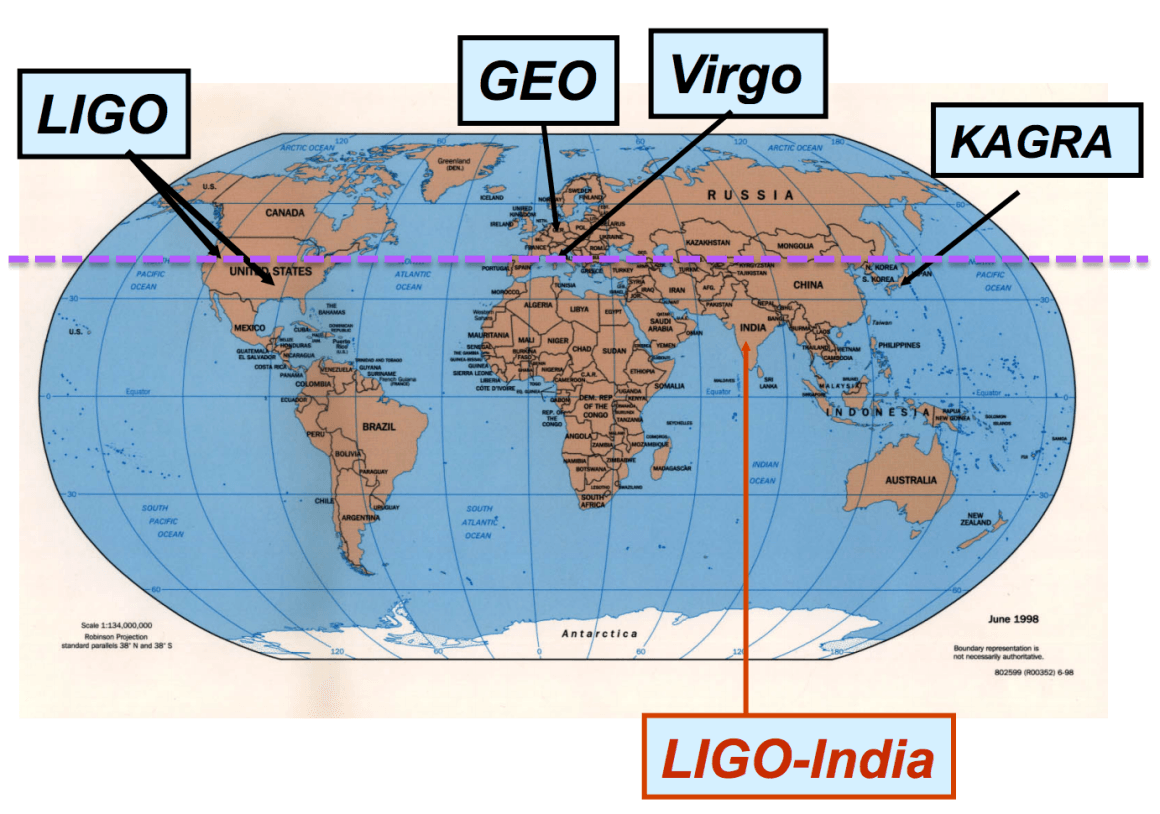
    Image - Locations of existing gravitational-wave detectors, and how far out a LIGO in India would be Source: LIGO
    Image – Locations of existing gravitational-wave detectors, and how far out a LIGO in India would be. Source: LIGO

    • Yes, because Union cabinet has approved a proposal to establish a state-of-the-art gravitational wave observatory in India in collaboration with LIGO in the US
    • The project will bring unprecedented opportunities for scientists and engineers to dig deeper into the realm of gravitational wave and take global leadership in this new astronomical frontier
    • This will also bring considerable opportunities in cutting-edge technology for the Indian industry which will be engaged in the construction of the 8-km long beam tube at ultra-high vacuum on a leveled terrain
    • With its establishment, India will join the global network of gravitational wave detectors
    • The establishment of an observatory in India assumes importance because the further the distance between the observatories, the greater will be the accuracy in locating gravity waves
    • Maharashtra and Madhya Pradesh are among the states shortlisted for the experiment

    Can we expect some answers from you guys?

    #Q. Recently, Union cabinet has approved a proposal to establish a gravitational wave observatory, one of the mega science projects in India. Discuss, how will this project help India if it becomes a reality.


    Published with inputs from Arun | Image: space.com
  • Real Estate Industry

    Challenges, opportunities & criticism of the Real Estate Regulatory Bill 2016

    The Real Estate Regulatory Bill, 2016 is being hailed as a much-needed step to reform the real estate sector. It will help regulate the sector and bring in clarity for both buyers and developers.

    What was the need for regulation in the real estate?

    • The real estate sector has some issues such as a lengthy process for project approvals, lack of clear land titles, and prevalence of black money
    • There wasn’t complete transparency as far as govt approvals were concerned
    • There were also instances when projects were sold without adequate clearances
    • The delayed projects, sometimes by up to years and arbitrary changes in layout plans are rampant in the sector

    How does the Bill seeks to regulate the sector?

    The basic thrust of this Bill is to regulate the delivery of projects to home buyers. It provides them a legal safeguard for their investment, and seeks to address timely delivery of houses. It seeks to enforce the contract between the developer and buyer and act as a fast track mechanism to settle disputes

    • It establishes state level regulatory authorities called Real Estate Regulatory Authorities (RERA)
    • The Bill establishes state level tribunals called Real Estate Appellate Tribunals.  Decisions of RERAs can be appealed in these tribunals
    • It makes mandatory the disclosure of all information for registered projects like details of promoters, layout plan, land status, schedule of execution and status of various approvals
    • The Bill prohibits a developer from changing the plan in a project unless two-thirds of the allottees have agreed for such a change
    • It says that builders must specify the time-frame for completion of projects and stick to it, or be ready to pay penalties
    • The Bill mandates that 70% of the amount collected from buyers of a project be used only for construction of that project This provision will effectively allow developers to continue their practice of diverting funds collected for a project towards land acquisition or other projects, and will work in their favour by also allowing them to grow their land and/or project portfolio>

    How will the Real Estate Regulatory Authorities help improve the sector?

    • Residential real estate projects need to be registered with RERAs, except few
    • Promoters cannot book or offer these projects for sale without registering them
    • Real estate agents dealing in these projects also need to register with RERAs
    • On registration, the promoter need to provide details of the project to the RERA

    Challenges ahead

    • The Bill will make life difficult for builders, as they would face more red-tapeism now, especially in procuring relevant approvals.
    • This Bill does not address the developers demand of a single-window clearance from the govt
    • The implementation of the Bill is up to the states, it leaves builders with greater chances of being harassed

    Impact

    • Timely completion of projects would lead to a steady increase in supply of homes
    • It is expected that these measures will eventually bring down home prices and increase demand
    • It will be good for the overall economy too, as the housing sector has strong backward (cement, steel and other building material industries) and forward (furniture and furnishings, interior decoration, electrical and electronics) linkages with other industries
    • More number of job creation in the economy

    Criticism

    • The builder lobbies argued that the bill should have a time-frame for municipal and other authorities to give timely approvals, because the delay in approvals lead to delays in handing over possession of apartments
    • In terms of pricing, which is governed by circle rates, it will be difficult to monitor

    Future

    • The states’ support for faster clearances to projects will be required to make this Bill successful
    • Govt is also trying to bring in a National Urban Rental Housing Policy, which would take into account the requirements of tenancy hassles in modern days
    Published with inputs from Pushpendra
    

    Sagarmala Project: Smart ports for Blue Revolution in India

    The Union Cabinet chaired by the Prime Minister Modi, on March,2015 gave its ‘in-principle’ approval for the concept and institutional framework of Sagarmala Project. Let’s take a glance on it.


    What’s the prime objective of Sagarmala?

    The prime objective of the Sagarmala project is to promote port-led direct and indirect development and to provide infrastructure to transport goods to and from ports quickly, efficiently and cost-effectively.

    What’s the current issue and background of ports in India?

    • At present there are around 200 ports (small and big) in the country, of these, only 12 are major ports which are government owned ports, which handle about 58% of sea-borne traffic.
    • These major ports operate as Trusts under the Major Ports Trust Act, 1963, except for the Port of Ennore, which is a company under the Companies Act.
    • There are legacy issues with these govt owned major ports, they do not keep pace with emerging technology, requirements of international trade, emerging trends in containerisation, flexible rules, size of ships etc.

    Which are the 12 Major Ports ?

    These are Kolkata (including Dock Complex at Haldia), Visakhapatnam, Chennai, V.O. Chidambaranar (Tuticorin), Cochin, New Mangalore, Mormugao, Jawaharlal Nehru Port Trust (JNPT), Mumbai, Kandla and Ennore.


    Just, Look back into the history?

    In 2003, then PM Vajpayee proposed Project Sagarmala with following features:

    • Setup Sagarmala Development Authority (Similar to National highway authority of India).
    • It will get money via Maritime development cess. (5 paise per kg on cargo).
    • It will improve ports, shipping industry, inland water transport, coastal shipping.
    • PPP and FDI to gather more investment.

    Then, which are the Key pillars to achieve Smart-development ?

    • Supporting and enabling Port-led Development through appropriate policy and institutional interventions.
    • Providing for an institutional framework for ensuring inter-agency and states’ collaboration for integrated development.
    • Port Infrastructure Enhancement, including modernization and setting up of new ports.
    • Efficient Evacuation to and from hinterland.

    What are some of the measures to make Smart Ports?

    • Ports should be registered as Companies under Companies Act.
    • The port administration should only look after the provisions of infrastructure and safety and not day-to-day running of the port
    • There is still no regulation to control the trade practices.
    • Hence, there is a dire need to introduce a regulatory architecture that takes care of ex-ante declaration of rates of services.

    Then, what’s the plan to implement such a vast initiative?

    • For a comprehensive and integrated planning for “Sagarmala”, a National Perspective Plan (NPP) for the entire coastline shall be prepared within six months.
    • It will identify potential geographical regions to be called Coastal Economic Zones (CEZ).
    • While preparing the NPP, synergy and integration with planned Industrial Corridors, Dedicated Freight Corridors, National Highway Development Programme, Industrial Clusters and SEZs would be ensured.

    What are the suggestions for effective mechanism at state level?

    • Set up State Sagarmala Committee to be headed by CM / Minister in Charge of Ports.
    • Sagarmala Coordination and Steering Committee (SCSC) shall be constituted under the chairmanship of the Cabinet Secretary and others.
    • This Committee will provide coordination between ministries, state governments and agencies connected with implementation and review the progress of implementation of the National Perspective Plan.

    How does it ensure the sustainable development in CEZ?

    • This would be done by synergising and coordinating with State Governments and line Ministries of Central Government through their existing programmes.
    • Such as those related to community and rural development, tribal development and employment generation, fisheries, skill development, tourism promotion etc.
    • In order to provide funding for such projects and activities that may be covered by departmental schemes a separate fund by the name ‘Community Development Fund’ would be created.

    What’s the role of Institutional Framework ?

    • It has to provide for a coordinating role for the Central Government.
    • It should provide a platform for central, state governments and local authorities to work in tandem and coordination under the established principles of cooperative federalism.

    What’s the role of NSAC?

    A National Sagarmala Apex Committee (NSAC) is envisaged for overall policy guidance and high level coordination, and to review various aspects of planning and implementation of the plan and projects.

    So, Is it Good to have smart ports on the line of Smart Cities?

    Can you answer some questions?

    #1. Can you examine the bottlenecks in Indian port infrastructure and list the initiative taken in recent times to address this issue?

    #Q.2 Indian port infrastructure can be revamped by Sagarmala project by effective management? critically comment.


    Published with inputs from Arun
  • iOS app

    Your website has been really helpful… But please develop an iOS application for this great site.. Thank u

  • Judicial Pendency

    Overcoming the backlog of cases: Judicial reform

    A British citizen, Will Pike was paralysed during the 2008 Taj Hotel blasts in 2008. Suing the hotel group for compensation, he wanted the trial to take place in London rather than in India. Accepting his contention, the London court allowed the matter, specifically stating that the trial in India could take some ‘twenty years’. This is a befitting example of the pendency in Indian judicial system and how it needs to be urgently addressed.

    THE MAGNITUDE OF THE PROBLEM

    The graphic below states the number of cases pending before the Courts in India. Currently, about 3.25 crore cases are pending in the Indian courts and Judges fear that this number might escalate to about 4 crore cases by the end of 2016. This problem gets escalated due to the crunch of Judges at all levels of Judiciary as seen in the graphic below.


    Timely justice is an integral part of access of justice and this huge backlog of cases amounts to denial and derailment of justice. This article will look into the proposed reforms for addressing this systemic problem.

    10 REFORMS FOR ADDRESSING JUDICIAL PENDENCY

    The 245th Law Commission Report on “Arrears and Backlogs: Creating Additional Judicial (W)omanpower has recommended the following measures

    1. Calculating Adequate Judge Strength through a more scientific analysis of data – In this context, the Commission has negated a simplistic method like Judge-Population ratio (Number of judges required per million people) in favour of a Rate of Disposal Method.

    In the Rate of Disposal Method, one looks at the current rate at which judges dispose of cases. Then, given that the institutions and disposal rate remain the same, the Courts would need how many more additional judges to keep pace with the new filings in Court so that the newly instituted cases do not add to the existing backlog.

    2. Judges to be appointed on a Priority basis: India currently has 1/5th of the number of judges it needs and thus, the Judges need to be appointed on a priority basis.

    3. Increasing the age of retirement for Subordinate Court Judges to 62 years.

    4. Creation of Special Courts for traffic/police challan cases: They constitute about 37.4% of the existing pendency before the subordinate courts.

    5. Provision for staff and infrastructure

    6. Periodic Needs Assessment by High Courts: Monitoring the rate of institution and disposal of cases and revising the adequate strength of Judges since a High Court is equipped with all the information relating to the subordinate courts in the State. The Malimath Committee had recommended setting up of Vigilance Cells in each district by the High Court to monitor the performance of subordinate judicial officers.

    7. Uniform data collection and data management methods : to bring in greater transparency.

    8. Need for a system-wide reform: The Commission has recommended the following:
    ● Greater encouragement to Alternative Dispute Resolution (ADR) and Lok Adalats <Can you tell us the difference among various types of ADRs, mediation, arbitration and conciliation? Answer in comments>
    ● Setting up non-mandatory time frames and performance benchmarks for resolution of different types of cases based on rational criteria.

    OTHER RECOMMENDATIONS

    9. Use of Technology : Has been recommended by the 230th Law Commission Report and the Malimath Committee Report to
    (a) Club cases filed on similar points of law, which can be decided on the basis of a single judgment.
    (b) Track old cases, which have become infructuous and dispose them off quickly
    (c) Setting up E-Courts and ushering in E-filing. Has received a major boost under the e-Courts Integrated Mission Mode Project.

    10. Creation of All-India Judicial Service: Provided for under Article 312 of the Indian Constitution. The idea has been mooted by various bodies including the First Judicial Pay Commission and accepted by the Supreme Court. Art 2012 proposal regarding creation of this service has not received responses from all States and this proposal continues to be hanging in the air <can you tell us the procedure of creation of new all India service? Answer in comments>.

    CONCLUSION:

    Many steps are currently being taken by the Government and the Courts to address this problem.

    • Monthly National Lok Adalats are carried out for expeditious disposal of claims.
    • In March 2016, the Monthly Lok Adalat disposed of about 1.5 lakh cases and settled claims worth Rs. 100 crores <Where can one appeal against the decision of Lok Adalats. Also tell us about the jurisdiction of Lok Adalats. Answer in comments>
    • In criminal cases, the setting-up of fast-track Courts and “plea bargaining” have further expedited matters <Can you tell us what’s plea bargaining? Answer in comments>
    • The e-courts project, aimed at providing better Court management and a database of all pending cases with easier filing of important documents is underway.
    • Moreover, the National Litigation Policy 2015 is awaiting ministerial approval and seeks to reverse the trend of Government being the biggest litigant <did you know one of the argument for rejecting NJAC was that govt was the biggest litigant, therefore can have no role in appointment of judges>.

    However, in view of the burgeoning backlog and urgency of reducing backlog, the efforts need to be severely expedited.


    P.S. This article is published with inputs from a CD user  Joyousjojo (name changed on request).

    P.P.S. If you want to write explainers for CD, mail us your explainer at hello@civilsadily.com

  • Alternative Dispute Resolution Mechanism – NCA, Lok Adalats, etc.

    The Supreme Court recently admitted an SLP (Special Leave Petition) under Article 136 of the Constitution on the setting up of a National Court of Appeal (NCA) with regional benches which will act as final courts of appeal in civil, criminal, revenue and labour matters <Can you tell us, what is SLP in comments>.

    In 1987, in the case of Bihar Legal Support Society v. the Chief Justice of India, the proposal to set up the National Court of Appeal was mooted and welcome by the then Chief Justice P N Bhagwati. The current petition by Chennai based lawyer has once, again brought the issue to the fore.

    The Supreme Court will set up a Constitution Bench to decide on the proposed NCA as primarily, it raises the following question related to the interpretation of the Constitution Answer in comments>.

    As of now, the Supreme Court is the final court of appeal in all cases. With the NCA, the role of the Apex Court would be restricted to hearing only constitutional and public law cases. Would this amount to tinkering with the ‘basic structure’ of the Constitution?

    REASONS WHY NCA COULD BE A WELCOME PROPOSITION?

    Given the never-ending and ever –increasing case-load on the Apex Court, the NCA could be a welcome change on the following grounds:
    (a) Clearing the massive backlog: With the huge pendency of cases in all three levels of Judiciary, the National Court of Appeal with its regional benches may prove to be crucial in clearing the massive backlog of cases. About 98% of the Apex Court’s time is wasted on routine matters like bail pleas, dishonor of cheques, traffic violations, correcting errors in HC judgments.

    With the NCA hearing matters pertaining to civil, criminal, labour and revenue laws, Supreme Court would be able to concentrate on the more important public law concerns.

    (b) Restoring the Apex position of the Apex Court: With the Supreme Court getting an opportunity to hear exclusively on constitutional and public law matters, its position as the final arbiter on constitutional cases and on developing the law will be further strengthened.

    This is in tune with the scenario in England, UK and Wales where the Supreme Court only rules on matters of constitutional importance or sets a new legal precedent.

    (c) Greater access to justice: Access to justice is a fundamental right for all under the Indian Constitution. In the Indian scenario, this is proportionate to the distance from Supreme Court. As per a recent survey, majority of cases come from northern states like 14% from Delhi High Court in comparison to southern states like only 2.5% of cases from Kerala High Court and even fewer from North-eastern States. Setting up NCA with regional benches will help in reducing travelling expenses, with a better cost-benefit ratio.

    WHY SHOULD THE STATUS QUO BE MAINTAINED?

    The Centre has been challenging the move to set up the NCA on the following grounds:

    (a) Dilution of the powers of Apex Court: Currently, many citizens resort to Article 136 of the Constitution in any sort of matter. With the subject matter of disputes being divided amongst NCA and the Supreme Court, Supreme Court’s exclusive power to entertain appeals under Article 136 will be significantly diluted.

    (b) Compromise the unified structure of the Judiciary: Currently, there is one Apex Court with the High Court in states followed by subordinate courts. This integrated structure will suffer a backseat with NCA somewhere in the middle between High Courts and Supreme Court Answer in comments>.

    Moreover, earlier proposals to set up Regional Benches of the Supreme Court with one bench in each region have been rejected by the Supreme Court on the ground that it will affect the unitary character of the Judiciary and that there can be only one Supreme Court.

    For providing greater access to citizens from far-flung areas, it has been proposed that there could be dedicated courtrooms with video conferencing facilities for litigants and lawyers from far-flung areas. This will avoid the need of setting up regional benches and even NCA to a great extent.

    (c) Large-scale Constitutional amendments required: For bringing the NCA into existence, several provisions of the Constitution related to independence of Judiciary, hierarchy of Courts, powers of Supreme Court etc. will have to be amended. Moreover, Article 136 of the Constitution is a part of the basic structure and in view of the decision in Keshvananda Bharati case, limiting the powers of Supreme Court through NCA will be extremely difficult.

    The solution does not lie with creating courts of appeal because it would not bring down litigation. The Supreme Court has to exercise restraint on the manner of interference under its constitutional power. Today people take chances and come to Supreme Court on every issue, including challenging an adjournment order – Attorney General

    Law Commission Recommendation 

    • Law Commission in its 229th report submitted to the government in 2009 recommended setting up of four regional benches at Delhi, Chennai/Hyderabad, Kolkata and Mumbai to deal with appeals arising out of high courts. Earlier 125th report had recommended setting up of NCA Answer in comments>.
    • It said, if necessary Article 130 may be amended to implement its suggestion that Cassation Benches may be set up in four regions, while the Constitution Bench sits in Delhi . < Is Law commission a constitutional or statutory or executive body? Answer in comments>

    But the Supreme Court rejected it in 2010, saying dividing the Supreme Court would affect the country’s unitary character. A Full Court comprising all SC judges reiterated its earlier resolutions passed in 1999, 2001, 2004 and 2006 in this regard.

    CONCLUSION: The burgeoning backlog of cases plaguing all the three levels of judiciary demand more resources and institutional reforms to deal with the problem. However, any proposals to set up institutions like the NCA will require Constitutional amendments and major Legislative will to go through. This at present is not forthcoming. The idea of a National Court of Appeal requires consideration, but in a manner that would not undermine the undoubted authority of the Supreme Court of India. The next hearing for the matter is slated up for April 4.


    P.S. This article is published with inputs from a CD user  Joyousjojo (name changed on request).

    P.P.S. If you want to write explainers for CD, mail us your explainer at hello@civilsadily.com

  • syria vs ISIS

    the Syria army just took back the historic city of pylmira from the ISIS.Should it be considered important topic of global interest because the city have UNESCO’s heritage site i.e. the temple of BEL

  • Amended Technology Upgradation Fund Scheme

    • The Cabinet Committee on Economic Affairs (CCEA) has approved introduction of Amended Technology Upgradation Fund Scheme (ATUFS) for technology upgradation of the textiles industry <Who chairs CCEA? Who are its members? What are its functions? Answer in comments>
    • The ATUFS replaces existing Revised Restructured Technology Upgradation Fund Scheme (RR-TUFS) to give a boost to textile sector under Make in India campaign


    ATUFS targets:

    • Employment generation (including women) and global export by encouraging garment and apparel industry <very labour intensive sector>
    • Promote Technical Textiles which is a sunrise sector for export and employment creation <can you tell us about technical textiles in comments>
    • Improvement in quality and productivity by promoting conversion of existing looms to better technology looms
    • Encourage better quality in textile processing industry and keep check on import of fabrics by the garment sector

    Two broad categories of ATUFS:

    1. Apparel, Garment and Technical Textiles sectors would be provided on capital investment with fifteen per cent subsidy. However, it will be subject to a ceiling of Rs. 30 crore for entrepreneurs over a period of five years
    2. Remaining sub-sectors of textile sectors would be provided subsidy at a rate of 10 percent. However, it would be subject to a ceiling of Rs.20 crore

    Advantages:

    • 12,671 crore is for committed liabilities under the ongoing RR-TUFS scheme and Rs. 5,151 crore is for new cases under ATUFS
    • The amended scheme would give a boost to ‘Make in India’ in the textiles sector
    • It is expected to attract investment to the tune of one lakh crore rupees, and create over 30 lakh jobs
    • All cases pending with the Office of Textile Commissioner which are complete in all respects, shall be provided assistance under the ongoing scheme and the new scheme will be given prospective effect
    • Office of Textile Commissioner (TXC) is being reorganised & its offices shall be set up in each state
    • Officers of the TXC shall be closely associated with entrepreneurs for setting up the industry, including processing proposals under the new scheme, verifying assets created jointly with the bankers and maintaining close liaison with the State Government agencies

    About TUFS:

    • TUFS was introduced by the Union Government in 1999
    • Aim was to facilitate new technology for making the Indian textile industry globally competitive and to reduce the capital cost for the textile industry
    • The scheme was earlier amended for continuation during the 12th Five Year Plan into Revised Restructured Technology Upgradation Fund Scheme
    Published with inputs from Swapnil
  • Civils Digest in HINDI – First edition released | Pay what you want

    प्रिय साथियों,

    ‘सिविल्स डाइजेस्ट’ का प्रथम हिंदी अंक आपके हाथों में है। इसके प्रकाशन के पीछे कोई व्यावसायिक कारण न होकर एक ऐसी ज़रूरत है जिसके लिए हमने हिंदी माध्यम के साथियों को परेशान होते हुए देखा है। आप जानते हैं कि ‘द हिंदू’ समाचार पत्र पढ़ना सिविल सेवा की तैयारी का एक अनिवार्य अंग है, लेकिन हमारे बहुत से ऐसे साथी हैं जिन्हें अंग्रेजी पढ़ने या समझने में कई तरह की समस्याओं से दो चार होना पड़ता है। ऐसा नहीं है कि उन्हें अंग्रेजी नहीं आती बल्कि इसे ऐसे समझिये कि अंग्रेजी कभी उनकी पहली भाषा नहीं रही। यही कारण है कि हमारे अधिकांश साथी ‘द हिंदू’ या ‘इंडियन एक्सप्रेस’ जैसे समाचार पत्र चाहकर भी नहीं पढ़ पाते, या पढ़ते भी हैं तो हिंदी की अपेक्षा उन्हें उसमें दोगुना समय लगता है। हमने जब इस बारे में सोचा तो पहले पहल मूल हिंदी में एक पत्रिका निकालने का निर्णय लिया किंतु फिर पाया कि करंट अफेयर्स संबंधी पत्रिकाओं के बाज़ार में यह महज़ उनकी संख्या बढ़ाने से अधिक कुछ नहीं होगा। क्यों न कुछ ऐसा किया जाए कि हिंदी में ही अंग्रेजी की वे ख़बरें मिलें जो हिंदी अख़बारों में ढूँढे नहीं मिलती। हमने इस विषय में बहुत से अभ्यर्थियों से बात की और अंतिम में इस निर्णय पर पहुंचे कि हम ‘द हिंदू’ और अन्य प्रमुख अंग्रेजी अख़बारों की महत्वपूर्ण ख़बरों(जो सक्षिप्त कर ‘सिविल्स डेली’ एप्लीकेशन पर आपको उपलब्ध कराई जाती हैं) का हिंदी अनुवाद आप तक पहुंचाएंगे। यह पत्रिका उसी निर्णय का परिणाम है।

    इस अंक में आप फरवरी माह में ‘सिविल्स डेली’ पर अपलोड हुई सभी ख़बरों का हिंदी अनुवाद पढ़ सकेंगे, साथ ही इसमें आपको तिथिवार क्रम से उन पारिभाषिक शब्दों का भी विस्तृत अनुवाद मिलेगा जिन्हें जानने की जिज्ञासा ख़बर पढ़ते समय आपके भीतर बनी रहती है। यहाँ यह बताना आवश्यक है कि अनुवाद करते समय इस बात का पूरा ख्याल रखा गया है कि कहीं कोई तथ्यात्मक ग़लती न हो और न ही अंग्रेजी में प्रकाशित किसी सामग्री की मूल भावना में कोई अंतर आए। फिर भी हम पूरी ईमानदारी से इस बात को स्वीकार करते हैं कि ऐसी बहुत सी जगहें होंगी जहाँ आपको कमियाँ नज़र आएँगी। उन कमियों को दूर करने और अगला अंक इससे बेहतर बनाने के लिए हम आपसे सुझावों की अपेक्षा करते हैं।

    इस अंक के हिंदी अनुवाद में प्रमोद कोंसवाल, संचिता, देवेश और तनय का हमें सहयोग मिला। हिंदी माध्यम के साथियों की ज़रूरतों को समझते हुए हम जल्द ही ‘सिविल्स डेली’ एप्लीकेशन का हिंदी संस्करण भी लॉन्च करेंगे जिसकी सूचना आपको यथाशीघ्र दे दी जाएगी। तब तक आप इस पत्रिका को पढ़िए, अपने मित्रों को पढ़वाईये और आपके मन में जो भी हो नीचे लिखे मेल आईडी पर भेज दीजिये।
    शुभकामनाएं

    सिविल्स डेली

    (email: hello@civilsdaily.com)

    Download link – https://www.instamojo.com/civilsdaily/civils-digest-march-hindi-edition/

  • Economic Survey For IAS | Chapter 09 | Reforming The Fertiliser Sector

    Before reading this chapter, it’s important that you read Chapter three – spreading JAM, chapter two – exit problem/ chakravyuha challenge and fundamentals of subsidy.

    • Fertilizer accounts for large fiscal subsidies (0.73 lakh crore or 0.5 %of GDP), the second-highest after food.
    • Only 17,500 crores or 35 per cent of total fertilizer subsides reaches small farmers

    Where does the rest (65%) of subsidy amount go?

    Obviously it leaks out to black market, large framers (bounty for the well off) and inefficient producers (exit problem).

    We will come to the question of leakages later but before that let us know a few basics about fertilizer sector and it’s regulation in India.

    1. There are 3 basic types of fertilizer used—Urea, Diammonium Phosphate (DAP), and Muriate of Potash (MOP) i.e N,P,K fertilizers.
    2. Urea dominates the sector. It is the most produced (86%), the most consumed (74%) and the most imported (52%).
    3. Urea also faces the most government intervention <50% under movement control compared to 20% for other two fertilizers,>
    4. Urea also receives maximum subsidy (70% of total fertilizer subsidy) as well as in per unit terms (75% of cost of urea is subsidized compared to 35% for other two)
    5. Urea is also not included in nutrient based subsidy regime

    Nutrient based subsidy

    Under this method, subsidy is given on the basis of nutrient content in the fertilizer. Suppose govt decided it would give 100 rs subsidy per kg of potash. Now, if cost of a fertilizer which contains 1 kg of potash is 1000 rs, govt will give 100 rs and he would be able to sell it at 900 rs. <govt does not fix retail price, govt gives same amount of per kg subsidy to all manufacturers, if production cost is less, you can sell it lower prices and capture market. It incentivises inefficiency this way.

    Contrast this with urea subsidy which is cost plus based . In this regime govt fixes price of urea. Suppose govt fixed urea price at 500 rs per kg. Firm A produced 1 kg urea at 700, govt will give it 200 rs (700-500) so that it could sell it at 500. If more efficient firm B produced 1 kg of Urea at 600 rs, it will get 100 rs subsidy (600-500). Clearly, there’s no incentive to be efficient. More inefficient you are, more subsidy you get.

    Other benefits of nutrient based subsidy

    • Note that in cost plus method, govt can only subsidize a few fertilizers. But in NBS, govt has to simply state, it will give 100 rs per kg for N, K, P, Boron, Sulfur, Zinc etc. It will thus encourage production of complex fertilizers <many nutrient including micro nutrients in the one fertilizer>
    • Complex and micro nutrients will increase the productivity of soil.
    • It will encourage greater competition , leading to productivity gains.

    Now let’s discuss 5 kind of govt intervention in urea sector

    1. Controlled maximum retail price <encourages diversion and black marketing>
    2. Firm specific cost plus subsidy <inefficient firms get larger subsidies>
    3. Consignment specific subsidy to importers
    4. Canalization of imports Only 3 agencies allowed to import <shortages when domestic production falls>
    5. Movement control <govt tells how much to import and where to sell>

    All these controls result in leakages. As we saw earlier only 35% of subsidy reaches small and marginal farmers.

    1. Black marketing– Simply because the principle of one product one price (we discussed it w.r.t. LPG earlier) is violated.

    Urea is only subsidized for agricultural uses but it is used for industrial purpose also < one of the ingredients in chemical industry, explosives, automobile systems, laboratories, medical uses, flavour enhancing additive in cigarettes and others>. As we know cost of subsidised urea is 75% lower than cost of non subsidised urea which gives strong incentive to divert it to the black market. Why?

    • Simple- Suppose urea for agri use is 250 rs and for industrial use is 1000 rs, there’s strong incentive to sell it to industrial consumers at 750 rs and show it as urea for agri use.
    • Similarly, urea is diverted to B’desh, Nepal where urea prices are high.

    Result- Shortage of urea in domestic market.

    Who suffers – small and marginal farmers. Rich farmers are well connected and get subsidies urea while small farmers have to buy urea from black market at much higher price <51% of farmers buy urea at above M.R.P.>

    In the three eastern states bordering Bangladesh, 100 per cent of farmers had to buy urea at above MRP in the black market <diversion to B’desh>

    Black market effects are aggravated by a further regulation—canalisation. As we saw , only three firms are allowed to import urea into India, and they are also instructed when to import, what quantities to import, and in which districts to sell their goods. And we all know how good govt is in forecasting needs.

    Result- Shortages and shooting up of urea prices when demand is at it’s peak and invariably small farmers suffer disproportionately.

    Reform by govt.-neem-coating urea

    • Neem-coating makes it more difficult for black marketers to divert urea to industrial consumers.
    • Neem-coating also benefits farmers by reducing nitrogen losses from the soil by providing greater nutrient to the crop <less urea required>
    • Work as pesticide
    • Less water pollution

    2. Benefits large farmers– A regressive subsidy. As we saw small farmers suffer due to black marketing while large well connected farmers take advantage of subsidies.

    3. Subsidy to inefficient firms– result of cost plus regime which does not encourage efficiency gains.

    Result – even though urea consumption has increased steadily over the last 15 years, no new domestic production capacity has been added, leading to a large dependence on imports. Efficient firms are forced to shut their shops.

    Externalities of urea prices

    What is externality?

    an externality is the cost or benefit that affects a party who did not choose to incur that cost or benefit <for instance, vehicle owners pollute the environment, we all suffer the consequences an example of negative externality. Can you give us an example of positive externality in comments plz>

    • It’s clear urea is under priced compared to other fertilizers resulting in excessive usages.
    • Ideal N:P:K ratio for Indian soil is 4:2:1 but actual ratio is 8.2:3.2:1 i.e excessive usage of urea

    Result-

    • Deterioration of soil quality
    • Fertilizer leaching to water bodies resulting in pollution of water
    • Algal bloom


    Reforms- aim of reform is to eliminate leakages while benefiting small farmers

    1. decanalising urea imports—which would increase the number of importers and allow greater freedom in import decision–would allow fertiliser supply to respond flexibly and quickly to changes in demand
    2. bringing urea under the Nutrient Based Subsidy program

    Turning fertiliser into JAM

    Fertilizer subsidy is an ideal case for JAMming (Chapter three) as leakages are high and central govt controls fund flows.

    Also, urea manufacturing is not labour intensive so no harm to workers.

    Ideally fertiliser subsidies would be targeted only at small and marginal farmers. But there are problems with targeting

    1. Assessing poverty—based on landholdings or some other measure—will be difficult
    2. How to target tenant farmers and sharecroppers <10% of all farmers are such farmers and they should not be excluded in any case>
    3. Relatively low levels of last-mile financial inclusion in much of rural India <last mile challenge, chapter three>

    What can be done if not JAM?

    Set a cap on the number of subsidised bags each household can purchase <just like 12 subsidized LPG cylinders> and require biometric authentication at the point of sale (POS) <BAPU (chapter three)>

    • Requiring biometric authentication would make it harder to conduct large-scale diversion
    • Imposing a cap on the total number of subsidised bags each farmer can purchase would improve targeting <Small farmers would still be able to get all their urea at subsidised prices but large farmers may have to pay market prices for some of the urea they buy>

    As urea is more sensitive, it could be initiated first for other fetilizers

    Other reforms-

    • Rationalise subsidies to domestic firms <shifting to NBS regime> which would release fiscal funds to spend more effectively on schemes that help poor farmers, such as drip irrigation and connectivity through the Pradhan Mantri Gram Sadak Yojana
    • Secure long term fertiliser supplies from locations where energy prices are cheap
    • Encourage Indian firms to locate plants in countries such as Iran following the example of the Fertiliser Ministry’s joint venture in Oman, which allowed India to import fertiliser at prices almost 50 per cent cheaper.


    Suggested reading- Fertilizers and challenges of reform

    Self study- New Urea Policy 2015

More posts
