💥UPSC 2026, 2027, 2028 UAP Mentorship (March Batch) + Access XFactor Notes & Microthemes PDF

Search results for: “”

  • Rashtriya Gokul Mission

    Potential to enhance the productivity of the indigenous breeds of India through professional farm management and superior nutrition is immense. For this it is essential to promote conservation and development of indigenous breeds.

    The “Rashtriya Gokul Mission” aims to conserve and develop indigenous breeds in a focused and scientific manner
    It is a focussed project under National Programme for Bovine Breeding and Dairy Development, with an outlay of Rs 500 crore during the 12th Five Year Plan


    Importance & need for conservation of indigenous breeds:

    • During 2012-2013, about 45 million cattle were ‘in milk’ and contributed around 59 million tonnes of milk
    • Cattle not only contribute substantially to milk production but are also used as draught animals, for agricultural operations and transport in rural areas
    • Most of the agricultural operations by small farmers are performed by bullocks
    • They also provide cow dung (organic manure), cow urine (medicinal value)
      Indigenous cattle are categorized as Zebu and are suited for draught power because of the presence of a hump
    • Indigenous cattle are well known for their quality of heat tolerance and ability to withstand extreme climatic conditions
    • Studies indicate that temperature rise due to global warming will negatively impact milk production
    • The annual loss in milk production of cattle and buffaloes due to thermal stress in 2020 will be about 3.2 million tonnes of milk costing more than Rs 5000 Crore at current price rate
    • The decline in milk production and reproductive efficiency will be highest in crossbred cattle followed by buffaloes. Indigenous Breeds will be least affected by climate change as they are more hardy and robust
    • Some of the indigenous breeds have enormous potential to become high yielding commercial milch animals under optimal farm management
    • The pre-requisites for the development of a breed are- a) the presence of a minimum base population and b) a wide selection differential for economic traits
    • The indigenous dairy breeds with potential for development as commercially viable milch cattle in a shorter time frame are- Sahiwal in Punjab; Rathi and Tharparkar in Rajasthan; and Gir and Kankrej in Gujarat
    • If these breeds are selectively crossed with bulls selected through sibling and progeny testing, the offsprings would be commercially viable. In this manner the entire population of the breed can be upgraded in a few generations

    Objectives:

    • To undertake breed improvement program for indigenous cattle breeds so as to improve genetic makeup and increase the stock
    • To enhance milk production and productivity of indigenous bovines
    • To upgrade nondescript cattle using elite indigenous breeds like Gir, Sahiwal, Rathi, Tharparkar, Red Sindhi <What is a non-descript cattle? Answer in comments>
    • To distribute disease free high genetic merit bulls of indigenous breeds for natural service

    Implementation:

    • State Implementing Agency (SIA)- Livestock Development Boards (LDB)
      State Gauseva Ayogs- Mandated to sponsor proposals to the SIAs and monitor implementation of the sponsored proposal
    • Participating Agencies- All Agencies having a role in indigenous cattle development. Ex- ICAR, universities, Colleges, NGOs and Gaushalas with best germplasm

    Components:

    • Establishment of village level Integrated Indigenous Cattle Centres viz Gokul Gram
    • Strengthening of bull mother farms to conserve high genetic merit Indigenous Breeds
    • Establishment of Field Performance Recording (FPR) in the breeding tract.
      Assistance to Institutions/lnstitutes which are repositories of best germplasm
    • Implementation of Pedigree Selection Programme for the Indigenous Breeds with large population
    • Establishing Gopalan Sangh- Breeder’s Societies
    • Distribution of disease free high genetic merit bulls for natural service.
      Incentive to farmers maintaining elite animals of indigenous breeds
    • Heifer rearing programme
    • Award to Farmers (Gopal Ratna) and Breeders” Societies (Kamadhenu)
      Organization of Milk Yield Competitions for indigenous breeds
    • Organization of Training Programme for technical and non technical

    Gokul Gram:

    • These are Indigenous Cattle Centres and will act as Centres for development of Indigenous Breeds
    • They’ll be established- a) in native breeding tracts and b) near metropolitan cities for housing the urban cattle
    • A dependable source for supply of high genetic breeding stock to the farmers in the breeding tract
    • Self sustaining and will generate economic resources from sale of milk, organic manure, vermi-composting, urine distillates, and production of electricity from bio gas for in house consumption and sale of animal products
    • Also function as state of the art in situ training centre for Farmers, Breeders

    Published with inputs from Swapnil
  • Mahi

    Which one is correct statement:
    1) gravitational wave are capable of transmitting their energy through a vacuum.

    2) gravitational wave are not capable of transmitting their energy through a vaccum.

  • Akhilesh Ranjan Committee on Taxation of E-Commerce


    • A Committee on Taxation of e-commerce constituted by the Central Board of Direct Taxes (CBDT) to examine the business models for e-commerce submitted its report on 21 March 2016
    • The Report of the Committee was received by the Government of India and taken into consideration in the preparation of Finance Bill, 2016
    • The Report provides the view of the Committee on issues related to taxation of e-commerce and recent international developments in this area
    • The Committee included officers of the CBDT, representatives from the industry, the Institute of Chartered Accountants of India and tax experts
    • The 8 member committee was headed by Akhilesh Ranjan, Joint Secretary (FT&TR-I), C8DT, Department of Revenue, Ministry of Finance


    Recommendations:

    • Equalization Levy may be imposed on payments to non-residents for specified services by a separate chapter in the Finance Act, 2016
    • The Equalization Levy should be chargeable on any sum that is received by a non resident from a resident in India or a permanent establishment in India as a consideration for the specified digital services
    • The rate of Equalization Levy may be between 6 to 8 % of the gross sum received
    • Equalization Levy should not be charged unless the consideration received for specified services in a year from a person in India is more than one lakh rupees
    • Equalization Levy should also not be charged on payments received by a permanent establishment of a non-resident in India, which are attributable to that permanent establishment and taxable under Income-tax Act, 1961
    • Every person that has received any sum chargeable to Equalization levy, would be required to pay the Equalization Levy chargeable on that sum to the union government
    • Every person that has received any sum chargeable to Equalization levy, would be required to file a return of Sum chargeable to Equalization Levy as prescribed, if such total sum received by that person in a year exceeds ten crore rupees
    • Any income arising from a transaction on which Equalization Levy has been paid should be exempted from income-tax, by necessary amendment in Section 10 of the Income-tax Act, 1961
    • The definition of business connection in section 9 of the Income-tax Act, 1961 may be expanded to include the concept of significant economic presence
    • Work on exploring the possibility of deduction of Equalization Levy by the payment gateways should be initiated immediately
    • The implementation and impact of Equalization Levy may be monitored on a regular basis

    What is Equalisation Levy?

    • To avoid some of the difficulties arising from creating new profit attribution rules for purposes of a nexus based on significant economic presence, an equalisation levy could be considered as an alternative way to address the broader direct tax challenges of the digital economy
    • This approach has been used by some countries in order to ensure equal treatment of foreign and domestic suppliers
    • An equalisation levy could be structured in a variety of ways depending on its ultimate policy objective
    • In general, an equalisation levy would be intended to serve as a way to tax a non-resident enterprise’s significant economic presence in a country
    • In order to provide clarity, certainty and equity to all stakeholders, and to avoid undue burden on small and medium-sized businesses, the equalisation levy would be applied only in cases where it is determined that a non-resident enterprise has a significant economic presence

    Follow the story for updates- e-Commerce: The New Boom


  • Deen Dayal Upadhyaya Antyodaya Yojana

    It is a scheme for upliftment of urban and rural poor through enhancement of livelihood opportunities through skill development and other means

    Why the scheme?

    • To provide Skill training to the poor in cities and villages. This would make them eligible for employment and will help in poverty alleviation
    • By 2020, developed nations will have shortage of ~57 million workers & foreign companies will have to outsource work elsewhere
    • Companies require cheap but skilled labour force (India will have ~47 million new workers by 2020)
    • Every year, 12 million Indians join workforce but out of them only 10% are skilled compared to 70% in and 50% in China
    • Therefore, success of Make in India, will depend on success of this scheme
    • Also, under the current urban poverty alleviation programmes, only 790 cities and towns are covered
    • The government has decided to extend these measures to all the 4,041 statutory cities and towns, there by covering almost the entire urban population

    Rural component

    Official name: Deen Dayal Upadhyaya Grameen Kaushalya Yojana

    Under: Ministry of Rural Development

    Earlier schemes:

    • Swarnajayanti Gram Swarojgar Yojana (SGSY) was renamed as National Rural Livelihood Mission (NRLM) which was in turn converted to Aajivika
    • Aajivika has a sub-component of skill development which is now named as Deen Dayal Upadhyaya Grameen Kaushalya Yojana

    Eligibility: 15 years and above (in Aajivika, it was 18)

    Target: Train 10 Lakh rural youth by 2017

    Others:

    • Government will setup training centres in rural areas
    • Training syllabus will be designed on international standards, so that rural youth can work in the foreign companies coming to India under Make in India
    • Special attention to physically disabled persons

    Urban component

    Official name: Deen Dayal Upadhyay Antyodaya Yojana (DAY)

    Under: Ministry of Housing & Urban Poverty Alleviation (HUPA)

    Eligibility: Urban poor

    Target: Train 5 Lakh people every year

    6 Components:

    1. Setup City Livelihood Centres with Rs. 10 lakh grant
    2. Give training to each urban poor via these centres. Government will spent Rs.15k-18k on training each of them
    3. Form Urban Self Help Groups (SHG) and give Bank linkage and Rs.10,000 to each group
    4. Setup Vendor markets and give skill training to vendors as well
    5. Construction of permanent shelters for urban homeless & other essential services
    6. Help the poor to setup enterprises & give them loan at 7% interest rate

    Tie up with NSDC

    • MoHUPA signed an MoU with National Skill Development Corporation (NSDC)
    • NSDC will give training to poor, according to market needs, via its training centres
    • It will also help in identification of beneficiaries besides certification of training programmes through Sector Skill Councils (SSCs)

    SSCs– These are industry led bodies and they define standards and syllabus for different training program in given industrial sector

    • NSDC will identify beneficiaries and design their training program with help of above SSCs
    • Thus, NSDC-MoHUPA tie up will help in speedy and result oriented implementation of Deen Dayal Antyodaya Yojana


    For updates, follow- The Mammoth Task Of Skilling India


    Published with inputs from Swapnil
  • Deen Dayal Upadhyaya Gram Jyoti Yojana (DDUGJY)


    • Aim: To ensure electrification of all the un-electrified villages by 2017 in mission mode Answer in comments.>
    • The Scheme draws its inspiration from the similar pioneering scheme implemented by the Government of Gujarat
    • It will enable to initiate much awaited reforms in the rural areas
    • It focuses on feeder separation (rural households & agricultural) and strengthening of sub-transmission & distribution infrastructure including metering at all levels in rural areas Answer in comments.>
    • The scheme will replace the existing Rajiv Gandhi Grameen Vidyutikaran Yojana (RGGVY)
    • Scheme has an outlay of Rs 76000 Cr for implementation

    Why DDUGJY?

    • The rural agricultural and non-agricultural consumers of the country are generally serviced through the local distribution network which is unreliable
    • Many rural areas of the country face insufficient electricity supply, consequently the distribution utilities are forced to resort to load shedding
    • This affects the power supply to both agricultural and non-agricultural consumers
    • The demand of power in rural areas is increasing day by day due to changing consumer base, improving living standards for which augmentation of rural infrastructure needs to be regularly undertaken
    • To improve the commercial viability of power distribution, there is need for metering of all categories of the consumers

    Objectives:

    • To provide electrification to all villages
    • Feeder separation to ensure sufficient power to farmers and regular supply to other consumers
    • Improvement of Sub-transmission and distribution network to improve the quality and reliability of the supply
    • Metering to reduce the losses

    Benefits:

    • All villages and households shall be electrified
    • Increase in agriculture yield
    • Business of Small and household enterprises shall grow resulting into new avenues for employment
    • Improvement in Health, Education, Banking (ATM) services
    • Improvement in accessibility to radio, telephone, television, internet and mobile etc
    • Betterment in social security due to availability of electricity
    • Accessibility of electricity to schools, panchayats, hospitals and police stations etc
    • Rural areas shall get increased opportunities for comprehensive development
    • Key enabler in Digital India programme

    Progress:

    • Govt has achieved its annual target of electrifying 7000 villages during this (2015-16) fiscal year under DDUGJY (according to recently published data) Answer in comments>
    • However, these figures have been contested and critcised for being unrealistic
    • An analysis by The Hindu- The govt has electrified 20% of the villages that were without power at the start of this financial year (2015-16)

    Follow the story for updates- Policy Wise: India’s Power Sector


    Published with inputs from Swapnil
  • Simple acts like brushing your teeth may be polluting the environment

    The National Green Tribunal recently issued notices to the Union health, environment and water resources ministries seeking their comments on what has been done to identify and curb the growing threat of ‘microbeads’.

    Apart from being used in several personal care products, research studies showed presence of plastic microbeads in table salt also, which is one of the most basic ingredients used in cooking. It was also observed that the microbeads found in toothpaste can get stuck in our gums and lead to cancer. So let us have a closer look at ‘microbeads’ which are otherwise invisible to the naked eye.

    # What are ‘Microbeads’ / ‘ Microplastics’ ?

    Microbeads are plastic microspheres that are widely used in cosmetics as exfoliating agents and in personal care products such as toothpaste, as well as in biomedical and health science research.  According to the UNEP, microplastics are the most harmful pollutants currently choking the oceans.


    # What is all the fuss about these ‘beads’ ?

    These microbeads flow straight from the bathroom drain into the sewer system. Wastewater treatment plants are not designed to filter out microbeads and that is the main reason why, ultimately, they contribute to the Plastic Soup swirling around the world’s oceans. Sea creatures absorb or eat microbeads. These microbeads are passed along the marine food chain. Since humans are ultimately at the top of this food chain, it is likely that we are also absorbing microbeads from the food we eat. Microbeads are not biodegradable and once they enter the marine environment, they are impossible to remove.

    # What is the environmental fallout?

    Microplastics have been found on almost every beach worldwide, on polar icecaps and just about everywhere in the oceans. Apart from creating ‘plastic islands’ in the oceans, when plastics break down, more toxic substances which are harmful to humans and which cause hormonal imbalances or neurological diseases are released.

    Substantial quantities of microplastics in the ocean sink to the bottom. The amount of plastic on the ocean floor is 1000 times greater than the amount floating on the surface

    (Source: betthemicrobead.org)

    #Test Yourself

    # There is some concern regarding the use of microplastics in certain personal care products. Why?

    1. They may accumulate in the marine environment and release toxic substances.
    2. They may enter the food chain.
    3. They may cause diseases like cancer.

    Select the correct answer using the codes given below.

    (a) 1 and 2 only

    (b) 1 only

    (c) 2 and 3 only

    (d) 1, 2 and 3


  • Foreign Policy Watch: India-Pacific Island Nations

    What are Pacific Island Nations (PINs)?

    • These are 14 island countries in Pacific Ocean – Cook Islands, Fiji, Kiribati, Marshall Islands, Micronesia, Nauru, Niue, Palau, Papua New Guinea, Samoa, Solomon Islands, Tonga, Tuvalu, and Vanuatu


    • These countries range in land area from the largest Papua New Guinea (461,700 sq km) to the smallest Nauru (21 sq km)
    • The size of their population ranges from Papua New Guinea (7.7 million) to Niue (1,500)
    • Development indicators also vary widely with per capita income ranging from USD 27,340 (Cook Islands) to USD 1020 (Papua New Guinea)

    Why study about PINs?

    • On August 21, 2015 India hosted the second edition of Forum for India-Pacific Islands Cooperation (FIPIC) summit in Jaipur
    • All the 14 nations of the group participated in the summit
    • So obviously, this becomes an important topic for exam and you cannot ignore this as an unimportant grouping

    Importance of the Pacific area:

    • Though these countries are relatively small in land area and distant from India, many have large exclusive economic zones (EEZs), and offer promising possibilities for fruitful cooperation
    • The Pacific Ocean is the earth’s largest ocean covering 46% of water surface and 33% of the earth’s total surface, making it larger than the entire earth’s land area
    • It is bounded by 41 sovereign states plus Taiwan, and 22 non-independent territories
    • It is rich in marine resources and accounts for 71% of the world’s ocean fishery catch
    • The Pacific has for long been an area of geostrategic interest for countries such as the US, Japan, China, Russia, Australia, and Indonesia – large economies which lie on its boundary
    • Two developed Pacific Island countries – Australia and New Zealand – have tended to dominate regional cooperation forums such as the Pacific Islands Forum (PIF)

    Issues with PINs:

    • They are dispersed and low populated countries
    • They have logistics problems to develop their economies
    • Less manufacturing activity
    • With climate change and global warming, these countries fear of being drowned or disappeared
    • Their natural resources are being depleted day-by-day – sugar, timber etc.
    • India used to import phosphates from the Nauru Island, which is now being depleted
    • Problems in sugar market due to global vagaries

    External influences:

    #1. Australia: These countries are highly influenced by Australia due to its close proximity – for example, Australia helping the development of natural gas of Papua New Guinea etc.

    #2. China

    • China has significantly expanded its foothold in the region, from increasing business and trade ties to setting up diplomatic missions in each of these countries
    • More than 3,000 Chinese companies are already operating in these Island groups in various businesses.
    • China is now the largest bilateral donor in Fiji and the second largest in the Cook Islands, Papua New Guinea, Samoa, and Tonga
    • Last year, China provided around $2 billion credit to these nations collectively
      6 out of 14 Pacific Islands recognize Taiwan as a legitimate govt of China
    • Taiwan is already holding annual meet with these countries to engage them

    #3. These island groups are forming partnerships with EU and other economic groupings

    Where can India engage?

    #1. UNSC: These 14 nations are supporting India’s attempts to become permanent member of UNSC

    #2. Agriculture:

    • These are agriculture oriented economies
    • Major products- palm oil, sugar, and timber
    • We can do value addition to their products- copra, sugar, timber
    • They are diversifying in oil production and we are short on edible oil so this is a major area to work on
    • India can make use of the mahogany (timber) that is extensively grown in these islands, for getting raw materials for paper industry

    #3. Minerals:

    • These islands have plenty of oil, gas, and minerals in their sea beds
    • For example, the Kiribati islands, they are spread over an area that is bigger than the Indian subcontinent and have rich sources of minerals
    • India can form joint ventures and explore these minerals

    #4. Disaster Management: These islands are frequently affected by natural disasters like typhoons, earthquakes etc. India can help them in disaster management

    #5. Services sector:

    • The other biggest potential area which India can leverage from these islands is the development of services sector – IT, tourism, healthcare and fisheries
    • We can explore tourism options to these isolated beautiful spots
    • Tourism also has an advantage from the fact that there are large number of ethnic Indians in these islands
    • Many of these countries send their nationals to India for education though programmes sponsored by the Indian Council of Cultural Relations

    #6. Energy:

    • India is developing renewable energy and has set a target of 175 GW by 2022. It can help the Pacific Islands in this area and provide energy security
    • We can transplant our experience of A&N islands in establishing isolated energy grids in these countries
    • There has been lot of tree cutting for industrialisation and they are using more diesel for power. We can help them by providing assistance in renewable energy

    #7. Democracy:

    • In the past, these pacific islands have faced a threat to democracy
    • For example- there was a coup in Fiji which overthrew the democratically elected government, there was a civil war in Papua New Guinea
    • In this context, India can serve as a stable and solid partner, as it is one of the largest democracies in the world, so that these islands can have an assured trade and investment relations.

    #8. Ethnicity:

    • Unlike other proximate countries like Australia, India has intimate relations, going beyond exploration of natural resources, with these nations
    • Culturally they are linked to India. For example, Fiji has huge number of Indian ethnic population
    • We should leverage this advantage to engage & establish more intimate relations

    #9. Climate Change: India should fight for their cause in the coming UN Climate Change meetings & should see to it that these islands get enough finances for disaster mitigation

    #10. The Pacific Island groups have enthusiastically welcomed India’s offer in telemedicine, tele-education, space cooperation, fostering democracy and community activities

    #11. These countries are in need of MSME and we have good experience in developing them

    FIPIC:

    • The Forum for India–Pacific Islands Cooperation (FIPIC) was launched during PM’s visit to Fiji in November 2014


    • FIPIC includes 14 of the island countries – Cook Islands, Fiji, Kiribati, Marshall Islands, Micronesia, Nauru, Niue, Palau, Papua New Guinea, Samoa, Solomon Islands, Tonga, Tuvalu, and Vanuatu

    Why FIPIC?

    • Though these countries are relatively small in land area and distant from India, many have large exclusive economic zones (EEZs), and offer promising possibilities for fruitful cooperation.
    • India’s focus has largely been on the Indian Ocean where it has sought to play a major role and protect its strategic and commercial interests
    • The FIPIC initiative marks a serious effort to expand India’s engagement in the Pacific region
    • At this moment, total annual trade of about $300 million between the Indian and Pacific Island countries, where exports are around $200 million and imports are around $100 million
    • This is a part of India’s extended Act East Policy

    Summits:

    #1. Suva, Fiji:

    • One of the key outcome of the first summit in Suva, Fiji was that top leadership of both India and Pacific Islands decided to meet at a regular interval and an annual summit was instituted in this regard
    • Other areas- visa on arrival for their nationals, funds for small business, line of credit for a co-generation power plant for Fiji, and a special adaptation fund for technical assistance and capacity building for countering global warming

    #2. Jaipur, India:

    • India announced to convene international conference on blue economy in New Delhi in 2016 and invited all the experts form the island nations
    • Set up Space Application Center, in partnership with ISRO, in any of the 14 countries and friendly port calls by the Indian Navy
    • Pacific leaders have expressed their concerns over climate change and its effect on their respective counties. India also assured them to voice their concerns and appropriate measures at the 2015 United Nations Climate Change Conference (COP 21) in Paris
    • In return all the 14 visiting head of state/government reiterated their support to India’s bid for a permanent memberships at the reformed United Nations Security Council
    • India offered to help the Pacific Islands with their hydrography and coastal surveillance, by engaging the Indian Navy. It would help them have a better understanding of their maritime zone and strengthen security of their EEZs
    • India also announced FIPIC Trade Office at Federation of Indian Chambers of Commerce & Industry (FICCI) to promote Trade & Investment opportunities between India & Pacific Island Countries

    Way ahead:

    • China is already on there and giving large credit, so does it mean India can not build good relations with these nations? No
    • We need to build on our advantages- health tourism, building democratic institutions which they need a lot
    • India’s strong relations with Fiji, which has considerable influence in the region, is a strong point which could help counter the growing Chinese influence
    • Relations with Fiji had improved in India’s favour in the past decade and not only those of Indian origin but also Fijians were friendly towards Indians, which worked to Indian advantage
    • Most of the economies in the region are based on agriculture, fisheries and small-scale industries and India’s capacity in these sectors is even better than Europe and China

    Published with inputs from Swapnil
  • Roundup of the week (March 20 – March 26)

    1. Terrorist attack in Brussels

    Attacks by ISIS on airport and metro station came close on the heels of massacre in Paris (nov 2016). Also, they came 4 days after lone surviving mastermind of Paris attacks was apprehended by Police. It clearly shows that ISIS is demonstrating that it is capable of striking at will.

    But why Brussels?

    1. Symbolism- Brussels is headquarters of NATO as well as European Union.
    2. Divided nation– Belgium is divided b/w French (Walloon actually) and Dutch (Flemish actually) speaking population. In almost all walks of public life there’s compromise. Flemish don’t/ can’t vote for Walloon candidates, so accountability is not to the whole populace but to the linguistic community
    3. Weak institutions – Divided accountability results in weak institutions, intelligence sharing is particularly poor.
    4. Marginalized Muslim population– about 7% of Belgian population is Muslim, most of which lives in ghettos, breading discontent. <You can say that, this is the most imp cause and should have been the first point but many commentators have begun to argue that poverty is not the main cause of terrorism> 

    You can read more about why Belgium in this The Hindu Oped  <not recommended for exams, can safely avoid thia>

    In per capita terms, Belgium has supplied most foreign fighters to ISIS.

    So why is ISIS striking western capitals?

    1. Russian and American airstrikes have shrunk ISIS territory in Iraq and Syria. By striking they are taking battle to European heartland.
    2. They get media coverage, shows them winning, helps attract more recruits
    3. Terrorism is to spread terror and this helps spread terror and panic.
    4. It also leads to further polarization of society, backlash against ordinary Muslims, helps their propaganda that Muslims all over the world are being persecuted, helps in recruitment.

    Read this The Hindu editorial- Message is Brussels attack

    But why are so many foreign fighters joining ISIS?

    Around 5000 foreign fighters (500 of them from Belgium) have left comfort of their homes and traveled 1000s of mile to join marauding army of ISIS in the hope of achieving salvation.

    1. Std response of jhola chaap JNU wallahs– high poverty, unemployment rate among Muslims. Lack of integration, Ghettoisation, marginalization of whole community which breeds discontent leading to them joining terrorist organizations. <read this Praveen Swami oped to know why Jholachaaps are wrong>
    2. Sleek propaganda / psych war by ISIS– by selectively quoting verses from Quran and Hadith, they make faithfuls belief that it was the right course of action which would take them to Jannat. That is what God ordered.
    3. Seduction of violence for a higher cause– violence leading to spiritual redemption

    But didn’t president Obama vow to defeat and ultimately degrade ISIS? What needs to be done now?

    You all know what happened to Obama’s red lines on chemical weapons use in Syria. Don’t take him seriously (just kidding).

    USA and Russia did launch airstrikes and it has resulted in containment and shrinkage of ISIS territory in middle east but problem is made worse by the raging civil war in Syria and sectarian strife in wider middle east in which Russia and USA are on the opposite sides of the spectrum. While USA along with sunni Arab monarchs and Turkey wants regime change in Syria, Russia is on the side of regime in Syria. No coordinated strategy against ISIS is possible in this context resulting in ISIS being still able to recruit more and more foreign fighters.

    What needs to be done-

    1. Recognize ISIS as the major and primary threat and converge on the strategy to defeat ISIS. Gradual transition of power in Syria <unlikely to be done, Saudis and Turkey won’t agree though Syrian peace process presents an opportunity>.
    2. Problem has to be tackled at the source i.e Syria and here support of Syrian army and govt would be necessary <again Syrian peace process assumes importance>
    3. For launching Jihad by Khalifa <which Abu Baghdadi claims himself to be>, territory is required,. If ISIS is defeated from Syria, in strict theocratic sense, there can’t be any Khilafat, attraction of ISIS which increase after the declaration of Khaliphate will come down.
    4. Counter radicalisation/ deradicalisation strategy- This war is war of ideas. It can’t be won with bombs and bullets. We will have to present a counter narrative which is equally exciting, equally sleek and is drawn from same religious scriptures.
    5. In this counter narrative, role of Muslim clergy becomes important. They will have to drive home the moderate interpretation of Quran everyday, not just when a terrorist attack occurs. <Listen to Tahir Ul Qadri’s speech at Sufi conference>
    6. And yes it goes without saying-better jobs, better education, better integration and no backlash when such attacks happen <terrorists want to polarise the society>

    India has just taken the right step by organizing the World Sufi Conference which highlighted moderate and liberal aspect of Muslim tradition.  PM showered praise on Sufism and spoke about how it has contributed to a spirit of peace and harmony.


    2. Russian troop withdrawal from Syria

    Putin announced this on 14th march <not exactly this week but RSTV discussion occurred on Sunday>. So what’s going on in Putin’s mind?What does it mean for regime in Syria and Syrian peace talks?

    1. Russian intervention has changed the balance of power in Syria. Regime which was losing territory when Russia moved in has now regained control.
    2. By withdrawing it’s troops Russia is also sending Assad signals to engage in peace talks.
    3. Putin has also once again brought Russia as a major player in international politics which western countries did not accept after fall of Soviet Union.

    Make no mistake, Russia has kept all it’s naval presence in Mediterranean, air force is still operating from Latakia airbase to preclude any chances of West declaring unilateral no fly zone over Syria.

    You all know, this conflict has a sectarian shia-sunni dimension. So question for you- Name Shia majority countries of this world. Answer in comments.

    Read this Hindu Editorial – An opportunity for peace in Syria and Watch this RSTV discussion


    3. Solar panel Dispute – India and WTO

    Dispute has been going on for quite some time. Basically to promote clean energy and manufacturing in India, GOI decided to buy powers from solar power generators (of course at better terms) but with the condition that they have to source (buy) solar cell and solar modules from Indian vendors i.e there was domestic content requirement (DCR). Uncle Sam (USA) did not like this , not one bit and complained in WTO.

    USA’s arguments – which were ultimately accepted by WTO dispute settlement body-

    1. DCR violates Trade related Investment measures (TRIMs) provisions
    2. DCR violates national treatment clause <once a product has entered a country, it will be treated the same as domestic product regardless of where it comes from>, non discrimination clause
    3. That it has resulted in injury to US manufactures <exports to India went down by 90%)

    India’s response – rejected by WTO

    1. It’s for govt procurement which is outside the scope of WTO agreements – rebuttal– govt was procuring electricity not solar modules, solar cells on which there was DCR
    2. General exception clause-necessary to secure compliance with its domestic and international law obligations relating to ecologically sustainable development and climate change. rebuttal- 1st there is no such obligation, 2nd, you can secure such compliance with imported solar modules
    3. Only 5% of total power requirement was under this rule

    Now India has decided to appeal against the verdict of dispute settlement body.

    Let’s understand in brief how WTO dispute settlement works

    1. You don’t like what other country is doing, raise a complaint with WTO
    2. 1st step is mediation, talk with the other country, see if problem can be resolved
    3. No resolution, a dispute settlement panel is formed, hears both parties, gives it’s verdicts
    4. Not satisfied with it’s orders, appeal with the appellate body, decision is final
    5. What if country doesn’t comply with the orders? well there’s very little that WTO can do. Other country is free to take retaliatory measures.

    Talks of promoting clean energy <100k MW solar>, sustainable development in this question is pure BS. You agree to play by rules, so play by rules. If you don’t like them in the light of changed circumstances, negotiate and change the rules. <btw, can you tell us the break up of india’s clean energy target, how much grid connected solar, off grid, roof top, wind, bio-fuel etc? Answer in comments.>


    4. Real Estate Regulation Bill

    This bill which has now become an act basically tries to do a few things-

    1. Establish a real estate authority and tribunal
    2. Developers, brokers and projects all three have to register with the authority
    3. Transparency – disclosing all the details of the project like carpet ares etc and no change w/o buyer’s permission (2/3rd)
    4. Escrow account- 70% funds locked in to prevent diversion
    5. Penalty for delays

    So far so good but what this act doesn’t do is that it does not impose time limits for clearances, no single window clearance. It would only result in more babugiri, more corruption and ultimately project cost will increase.

    Root of the problem is over-regulation. Although land and real estate are bought and sold all the time, India doesn’t have a functioning market for land and real estate. The high prices in real estate are a reflection of an artificial scarcity caused by over-regulation, as well as bad regulations, by multiple agencies. The builder-babu-politician nexus is a corollary of this distorted environment.

    Another issue is that it’s a concurrent list subject and many states which already have their acts will drag their feet.


    5. Nepal PM’s special mission to China and signing of Transit agreement

    That Nepal-India ties are going through a very difficult phase after the promulgation of constitution and Madheshi blockade (which Nepal termed as blockade by India) is no secret. Anti-India sentiments have reached feverish pitch in Nepal <Nepali nationalism is built on Anti-Indianism>.

    To put the relations on an even keel Nepal PM visited India ahead of China but significant differences remain, especially on the question of Madhesi rights in Nepal and was reflected in the inability of the two sides to issue a joint statement at the end of Oli’s visit last month.

    Now Nepal has signed following deals with China

    1. landmark transit agreement that will allow Nepal to use Chinese ports to import goods from third countries
    2. assist Nepal in the exploration of hydrocarbon resources and expand the use of solar energy
    3. agreements on building of multiple train routes connecting Nepal with China’s key production centres is also in the pipeline (not signed yet)

    Should India be worried?

    • India would not worry good neighborly relations b/w Nepal and China. After all, even India is courting Chinese investments. But if it impinge on our security interests India will be worried.#
    • As far as trade and transit is concerned, 98 per cent of Nepal’s third country trade goes through India and to the port of Kolkata,
    • India at present has two rail lines under construction and three more are being planned to increase Nepal’s trade ties.
    • India agreed on giving dedicated access to Nepal to the port of Vizag.

    Delhi’s problem then is less about coping with China’s grand strategy (one belt one roda, ending India’s influence in south Asia) than overcoming the entrenched distrust of India in Kathmandu and bringing greater purpose to economic engagement with Nepal.


    6. Update on Adahar bill discussed in last round up

    Let me summarise him for those of you who don’t like his ranting

    1. Not a money bill– to arbitrarily declare something a money bill is to subvert the spirit of the Constitution. This bill will set a horrendous precedent for ways of bypassing the Rajya Sabha. The solution to legislative logjam cannot be subversion of the representative scheme bequeathed to us.
    2. On privacy- The national security exceptions in the bill are too broad. It negates all protections the bill seemingly provides
    3. Even if you want to keep national security exception, this can not be left entirely to the bureaucracy and executive when they themselves will not be under any system of accountability
    4. Aadhaar will give the ability to link different databases biometrically. To protect privacy, each such database will need additional locks. Linking databases should need consent from multiple key-holders subject to legislative oversight and judicial redress. It would require overarching privacy legislation.
  • Pradhan Mantri Krishi Sinchayee Yojana (PMKSY)

    PMKSY envisages amalgamation of ongoing schemes:

    1. Accelerated Irrigation Benefit Programme (AIBP) of the Ministry of Water Resources, River Development & Ganga Rejuvenation (MoWR RD & GR)
    2. Integrated Watershed Management Programme (IWMP) of Department of Land Resources (DoLR)
    3. On Farm Water Management (OFWM) of Department of Agriculture and Cooperation (DAC)

    Ministries involved:

    1. Ministry of Rural Development- Mainly undertake rain water conservation, construction of farm pond, water harvesting structures, small check dams and contour bunding etc.
    2. MoWR RD & GR- Undertake various measures for creation of assured irrigation source, construction of diversion canals, field channels, water diversion/lift irrigation, including development of water distribution systems
    3. Ministry of Agriculture- Promote efficient water conveyance and precision water application devices like drips, sprinklers, pivots, rain-guns in the farm “(Jal Sinchan)”, construction of micro-irrigation structures to supplement source creation activities, extension activities for promotion of scientific moisture conservation and agronomic measures

    Objectives:

    • Achieve convergence of investments in irrigation at the field level
    • Har Khet ko pani- Expand cultivable area under assured irrigation
    • More crop per drop- Improve on-farm water use efficiency to reduce wastage of water & enhance the adoption of precision-irrigation and other water saving technologies
    • Enhance recharge of aquifers and introduce sustainable water conservation practices by exploring the feasibility of reusing treated municipal based water for peri-urban agriculture
    • Attract greater private investment in precision irrigation system.

    Features:

    #1. Financial outlay- Rs. 50,000 crore over a period of five years (2015-16 to 2019-20)

    #2. Bringing under a common platform- all the concerned Agencies engaged in creation/ use/ recycling/ potential recycling of water

    This will ensure that a comprehensive and holistic view of the entire “water cycle” is taken into account and proper water budgeting is done for all sectors namely, household, agriculture and industries

    #3. Decentralized State level planning and execution structure

    • This will allow states to draw up a District Irrigation Plan (DIP) and a State Irrigation Plan (SIP)
    • DIP will have holistic developmental perspective of the district, outlining medium to long term developmental plans
    • DIP will integrate three components namely, water sources, distribution network and water use application
    • These will be prepared at two levels- the block and the district

    #4. Geotagging- All structures created under the schemes will be geotagged

    Implementing Committees:

    #1. National Steering Committee (NSC):

    • It will supervise and monitor the programme at the national level
    • This is an Inter-Ministerial committee under the Chairmanship of the Prime
    • Minister with Union Ministers of all concerned Ministries

    #2. National Executive Committee (NEC):

    • It will oversee programme implementation, allocation of resources, inter-ministerial coordination, monitoring and performance assessment, addressing administrative issues etc.
    • To be constituted under the Chairmanship of the Vice Chairman, NITI Aayog

    #3. State Level Sanctioning Committee (SLSC):

    • It will administer the scheme at the state level
    • It will be Chaired by the Chief Secretary of the respective States
    • It will have all authority to sanction the project and also monitor the progress of the scheme

    #4. District Level Implementation Committee: At the district level; for ensuring last mile coordination at the field level

    Now it’s time to solve some IAS prelims questions

    1. Consider the following statements: (IAS 2015)1. The Accelerated Irrigation Benefits Programme was launched during 1996-97 to provide loan assistance to poor farmers.
      2. The Command Area Development Programme was launched in 1974-75 for the development of water-use efficiency.
      Which of the statements given above is/are correct?(a) 1 only
      (b) 2 only
      (c) Both 1 and 2
      (d) Neither 1 nor 2
    2. consider following pairs:
      Programme/ Project Ministry
      1. Drought-Prone Area Programme of Agriculture
      2. Desert Development Programme of Environment and Forests
      3. National Watershed Development Project for Rainfed Areas of Rural Development


      Which of the above pairs are correctly matched? (IAS 2014)

      1. 1 and 2 only
      2. 3 only
      3. 1, 2 and 3
      4. None
    3. What are the benefits of implementing the ‘Integrated Watershed Development Programme’? (IAS 2014)
      1. Prevention of soil runoff
      2. Linking the country’s perennial rivers with seasonal rivers
      3. Rainwater harvesting and recharge of ground water table
      4. Regeneration of natural vegetation

      Select the correct answer using the code given below.

      1. 1 and 2 only
      2. 2, 3 and 4 only
      3. 1, 3 and 4 only
      4. 1, 2, 3 and 4
    4. With reference to micro-irrigation, which of the following statements is/are correct? (IAS 2011)
      1. Fertilizer/nutrient loss can be reduced
      2. It is the only means of irrigation in dry land farming.
      3. In some areas of farming, receding of ground water table can be checked.

      Select the correct answer using the codes given below:

      (a.) 1 only (b.) 2 and 3 only (c.) 1 and 3 only (d.) 1, 2 and 3


    Suggested Readings-


    Published with inputs from Swapnil
  • From Jan Dhan to Jan Suraksha: A Journey towards Financial Inclusion and Security


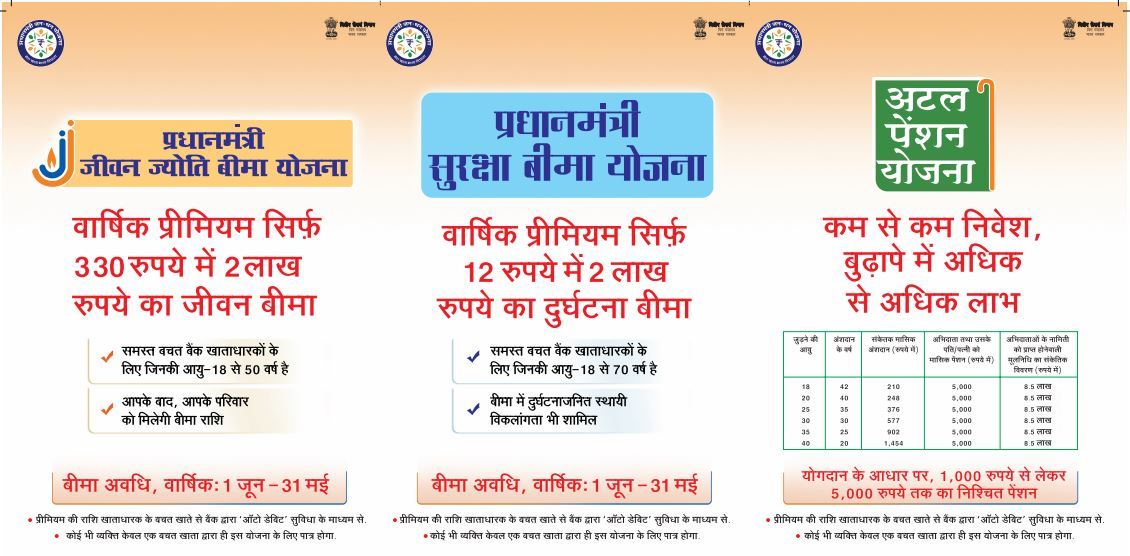
    The budget 2015-16 had announced 3 Social Security Schemes:
    #1. Pradhan Mantri Suraksha BimaYojna (PMSBY)
    #2. Pradhan MantriJeevan Jyoti Bima Yojana (PMJJBY)
    #3. Atal Pension Yojana (APY)

    Why the schemes?

    • India faces the biggest challenge of providing banking facilities and insurance coverage to all
    • Having access to institutional finance has so far remained a far cry to a vast chunk of rural population
    • As of May 2015, only 20% of India’s population has any kind of insurance and only 11% has any kind of pension scheme
    • Insurance is a way of managing risks & give necessary protections in case of financial loss
    • When one has an insurance policy, certain rights and protections are derived out of it to the person and his family
    • There is a dire need for providing social security at a very nominal cost to the millions and economic empowerment of the poor <what is social security? Why is it lacking in our country? Answer in comments.>
    • PMJDY is a major step to bring people across the country closer to institutionalized finance, and save them from the clutches of informal financiers
    • However, most of the PMJDY accounts had zero balance initially. The government aims to reduce the number of such zero balance accounts by using these schemes <what is the proportion of zero balance account now? Answer in comments.>

    PMSBY & PMJJBY:


    • Implementation: The scheme will be offered by all Public Sector General Insurance Companies and all other insurers who are willing to join the scheme and tie-up with banks for this purpose
    • Govt Contribution: Various Ministries can co-contribute premium for various categories of their beneficiaries from their budget or from Public Welfare Fund created in this budget from unclaimed money
    • Auto-debit: The premium amount will be auto debited from subscriber’s bank account
    • The schemes will be linked to the bank accounts opened under the Pradhan Mantri Jan Dhan Yojana scheme

    Criticisms of PMSBY:

    • Private banks have complained that the Govt should focus on upper middle class instead of the poorer section
    • Western scholars have argued that financial inclusion is a myth and serving such large number of people would only increase the burden and work-load of public sector

    Criticisms of PMJJBY:

    • The banks have complained that revenue received will be very low
    • Some bankers have claimed that amount they are receiving is not sufficient to cover the service costs
    • Insurers have also pointed out that no health certificate or information of pre-existing disease is required for joining

    Atal Pension Yojana

    • It focuses on the unorganized sector where nearly 400 million employees representing more than 80% of all employees are engaged <what is unorganized sector? differentiate b/w informal and unorganized? Answer in comments.>
    • The aim is to make sure that needy people could get fixed amount when they get old
    • It is the improved version of Swavalamban scheme, launched in 2010-11, which has been found lacking in clarity with regard to pension benefits at the age after 60

    Features:

    • All citizen of India aged between 18-40 years are eligible
    • A guaranteed minimum monthly pension will be provided to the subscribers varying from Rs. 1000 to Rs. 5000 per month
    • The pension amount depends on contribution by subscriber
    • Government of India will guarantee the minimum benefit of pension
    • Most interesting part of the scheme is that the government will contribute 50% of the contribution made by the subscriber or Rs. 1000 whichever is lower
    • However, contribution by the govt is available for only those who are not income tax payers and are not covered by any Statutory Social Security Schemes
    • Bank account holder of Any Bank account is eligible

    Suraksha Bandhan drive- Spreading the social security message

    • Aim: To take forward the Govt’s objective of creating a universal social security system in the country, targeted especially at the poor and the under-privileged
    • Participating Banks supported by the participating Insurance Companies are carrying out local outreach, awareness building and enrolment facilitation under the drive
    • Public service organizations supported by peoples representatives are participating in these efforts through various outreach activities such as enrolment drives, camps etc. in large numbers during this period

    Published with inputs from Swapnil

More posts