💥UPSC 2026, 2027, 2028 UAP Mentorship (March Batch) + Access XFactor Notes & Microthemes PDF

Search results for: “”

  • Know Your Services | The Indian Audit and Accounts Service

    This blog is a part of the series – Know Your Services @Intro to Civil Services


    • Indian Audit and Accounts Service (IAAS) is a Central Service, free of control from any executive authority, under the Comptroller and Auditor General of India
    • The officers of the Indian Audit and Accounts Department serve in an audit managerial capacity
    • IAAS is responsible for auditing the accounts of the Union and State governments and public sector organizations, and for maintaining the accounts of State governments
    • It role is somewhat similar to the National Audit Office (United Kingdom)

    Recruitment & Training:

    • Recruitment to the IAAS is through the joint competitive examinations (the Civil Services Examination) and through promotion from the subordinate cadre
    • Once recruited to IAAS, the directly recruited officers are trained mainly at the National Academy of Audit and Accounts, Shimla for one and half year training


    The training is split into two phases:

    • Phase- I involves giving a theoretical background to the students on concepts of Government and commercial auditing and accounting
    • Phase- II gives emphasis on practical training

    The training involves modules where Officer Trainees are attached to the Reserve Bank of India, the National Institute of Public Finance and Policy, the Bureau of Parliamentary Studies and the Indian Institute of Management, Lucknow.

    The Officer Trainees are also given an international exposure through attachment with London School of Economics and Political Science.

    Career Progression:

    • After training, the Officer Trainees are posted as Deputy Accountants General (DAsG) or Deputy Directors (DDs). Subsequent to their promotion, they become Senior Deputy Accountants General (Sr. DAsG) or Directors
    • All officers below the rank of AG/PD are also called Group Officers as they are generally in charge of a group in the office

    The service can be divided into officers looking after State accounts and the officers at Headquarters: 

    • The state accounts and audit offices are headed by Accountants General or Principal Accountants General. They are functionally equivalent, only the designations vary
    • Major states have three Principal Accountants General (PAsG) or Accountants General (AsG), each heading Accounts and Entitlement (i.e., compiling state accounts, maintaining pension accounts, loan accounts, etc.), General and Social Sector Audit (GSSA) or Economic and Revenue Sector Audit (ERSA)
    • The equivalent officers at the Central level are Principal Directors (PDs) or Directors General (DsG)
    • The PDs, DsG, AsG and PAsG report to Additional Deputy CAG (also called ADAI, for historical reasons) or Deputy CAG (called DAI, again for historical reasons)
    • The Deputy CAGs are the highest-ranked officers in the service

    IA&AS officers mainly go abroad to conduct embassy audit i.e. audit of Embassies and High Commissions of India situated all over the world. They are also deputed regularly to conduct audit of international institutions like UN. Some of the officers are doing long term foreign assignments in United Nations, UNOPS, Organisation for the Prohibition of Chemical Weapons, UNRWA, etc.

    Why IAAS?

    IAAS, over its long history, has evolved as a premier central service, owing to several positives that the service offers. IAAS works under CAG of India, a constitutional body, which makes it aloof from any undue political interference.

    The service is good for people with professional bend of mind, as it’s a knowledge oriented department. Auditing some entity requires a thorough understanding of that entity. So one needs to constantly update oneself. Hence, the IAAS Officers are valued in the bureaucracy for their multi-faceted experience and expertise in the area of Audit, Accounts and finance.

    Not surprisingly, several of them have stints in key positions in the union ministries of Government of India.

    The service is known for most timely promotions amongst all the civil services. It is said that the entire government setup is similar to huge elephant. Owing to its mammoth size, people working under it, get to feel only a part of it. IAAS is one such service which offers to understand this elephant in entirety, as it works in close contact with all the departments of government, be it for accounting function or auditing.

    As years pass by, bureaucrats often complaint about monotone of their job. IAAS offers varied opportunities for its officers, to work in several domains such as Accounts, Entitlements and Audit. Within audit itself, the number of sectors covered, makes work refreshing and challenging.

    In a recently conducted survey by the Government of India, amongst 3 All India Services and 7 Central Services, IAAS emerged as the service with highest percentage of job satisfaction amongst its officers. It is known to be an employee friendly service. IAAS also allows an optimal work life balance, as also evident from the mentioned survey.

    • With increasing international exposure due to collaborative working framework of Supreme Audit Institutions of the world, auditing international bodies like the UN, WHO, and bilateral/ multilateral assignments with other countries, the IAAS officers get continuous exposure of international assignments.
    • IAAS Officers have been borrowed out to international organizations like the United Nations, IDI and various other countries for their expertise and skills.

    Indian Audit & Accounts Service, thus, offers very challenging and satisfying career avenues to the bureaucrats of this country.


    Published with inputs from Swapnil
  • Know Your Services | The Indian Information Service

    This blog is a part of the series – Know Your Services @Intro to Civil Services

    Overview:

    • The Indian Information Services (IIS), a Central Service, earlier known as Central Information Service (CIS), was established as an organized service w.e.f. 1st March, 1960 and consisted of both Group ‘B’ and Group ‘A’
    • Prior to 1960, these posts were manned by officers recruited separately for each media Unit through the UPSC from open market
    • In 1987, CIS was bifurcated into IIS Group ‘A’ and IIS Group ‘B’
    • The Indian Information Service consists of posts all over India including a few abroad in various media organization
    • As on 01.01.2014, the total sanctioned strength of IIS Group ‘A’ is 571
    • The IIS Officers’ cadre controlling authority is the Ministry of Information and Broadcasting
    • Service conditions of IIS Group ‘A’ officers are regulated by IIS (Group A’) Rules, 2013

    Recruitment:

    At present there are two modes of recruitment to IIS Group ‘A’ service-

    1. Through Civil Services Examination conducted by UPSC every year (50%)
    2. Through promotion from Senior Grade of IIS Group ‘B’ (50%)

    Training:

    • After allocation by DoP&T, the officers undergo three months Foundation training in any of the institute recognized by DoP&T
    • This is followed by nine months Professional Training in Indian Institute of Mass Communication (IIMC)
    • Thereafter one year Media Attachment in different Media Units i.e. PIB, AIR, DDN of Ministry of Information & Broadcasting

    Designations held by. IIS Group ‘A’ officers:

    • Principal Director General
    • Director General
    • Additional Director General
    • Director/ Joint Director
    • Deputy Director
    • Assistant Director

    Appointments to other Ministries/ Departments:

    • IIS officers can be appointed to other Ministry/ Departments on deputation basis, including deputation under Central Staffing Scheme
    • They also serve as Personal Secretaries to Ministers in Central Government on co-terminus basis

    Functions of IIS Group ‘A’ officers:

    • To look after the administration and coordination work of the Press Information Bureau Headquarters and day to day publicity work of the Government
    • To guide, supervise and control Field Publicity Units of the Central Government spread across the country
    • To issue directions from time to time effective monitoring and evaluation the work of field units
    • Control, Supervision and Guidance to the News Services Units of the All India Radio and Doordarshan including the Regional News Units
    • Organization of press advertising and visual publicity campaigns for disseminating information to the people on the activities and policies of the Central Government through various media of mass communication such as Press Advertisements, folders, posters, booklets, calendars, diaries, exhibitions, cinema slides
    • To monitor the complex legal issues involved in the verification of titles, registration and circulation for Newspapers in India
    • To plan and execute the media strategy’ to provide publicity to various programmes/ schemes of Government for the welfare of the people across the country

    This was all about very formal aspects. Let’s see what it actually is on ground.

    The insider’s view:

    It’s a good job full of challenges and growth. The income might not be the best when compared to what similar skillsets will make in corporate world. But you get to serve the nation with your skills at hand and if you fair really well at it, then your chances of making it big is fair enough as you will be indulging in dialogue and action with other top level bureaucrats and diplomats of India. The best part- you will make your thoughts count in the programmes and policies of Government of India as you will be doing lots of advising for the government on its information policy right from the start.

    You get to work with Doordarshan and All India Radio, State’s wide community radios and many other Government owned and run print and media channels. IIS is more like a Corporation in whole via which its officers serve in myriad of organizations during the course of their career, wherein they  try to spotlight the issues affecting the weaker and marginalized sections of the society, particularly in rural areas.

    IIS officers will also be harnessing the technological innovations in communication and media and always keep themselves updated. Since discovery of internet, use of mobile phones for various activities, social and digital media has completely transformed the old tools of communication, Your day to day work with the government will be very fast paced and will have a very good learning curve as an Grade-A Officer and also a top notch citizen who gives a damn about people of India.

    The work is interesting as it uses the flare for journalism, public relations and administration all together. So it all a well mixed career path with various inlets and sources to govern, organize and activities to do and finish within the single large framework of Information and Broadcasting in India. The promotional channel is more or less the same as that of other Services in Civils. Attached with it will come many government perks and allowances which will pay off in longer run to support your financial status and growth as an employee. You get a reasonably good pension too after you retire, Wink Wink!


    Published with inputs from Swapnil
  • Roundup of the week (March13 – March 19) – II

    #3. Compulsory licensing to make patented drugs cheaper <Patients over patents>

    Issue arose as US industry groups recently claimed the Indian government offered them a “private” assurance that compulsory licences will not be issued, save in emergencies and for non-commercial purposes.

    Issues -1. Should govt be assuring them privately <policies should be made transparently>

    2. When should govt use the flexibility of compulsory licensing (CL) under TRIPS-

    Some basics – Compulsory licencing is a safeguard under TRIPS provision of WTO based on national circumstances <not just under public health emergencies or urgency>

    Under Indian patents act, to grant CL three conditions need to be satisfied

    1. three years from the date of the grant of a patent
    2. the invention is not available to the public at an affordable price
    3. drug/ invention is not being manufactured in India

    Under CL, govt allows domestic generic producers to manufacture drug without the consent of Patent holder who agrees to market the drug at substantially lower rate. pay some royalty to patent holder.

    So far, India has issueed only one compulsory license for a kidney cancer drug where in sharp contrast to Bayer’s (innovator) Rs 2.8 lakh per month price tag, Natco offered to sell its version of the drug at Rs 8,800 per month.


    Under CL, govt allows domestic generic producers to manufacture drug without the consent of Patent holder who agrees to market the drug at substantially lower rate. pay some royalty to patent holder.

    So far, India has issueed only one compulsory license for a kidney cancer drug where in sharp contrast to Bayer’s (innovator) Rs 2.8 lakh per month price tag, Natco offered to sell its version of the drug at Rs 8,800 per month.

    Consider these per month treatment costs


    Needless to say, India should fully utilize flexibility available under TRIPS to make drugs affordable while also respecting interests of innovators. Full article here. <What are the other public health safeguards under TRIPS? Answer in the comments>


    #4. Issue of drug pricing : a bitter pill to swallow

    In India National Pharmaceutical Pricing authority (NPPA) brought 348 drugs into India’s National List of Essential Medicines (NLEM) under the Drug Price Control Order (DPCO), 2013. But there were significant loopholes based on which Supreme court termed whole policy irrational and unreasonable.

    1. Only drugs covered, not all the formulations and combinations of the drugs
    2. only 18% of the domestic market share of drugs under price control
    3. in some cases, maximum price of a medicine is fixed well above the price of the market leader

    Price controls remain an effective answer to ensuring affordability. Even free markets in the West utilise price, volume and cost-effective controls to mitigate health-care inflation. Canada has its Patented Medicine Prices Review Board, while Egypt has brought all medicines under price control. Lebanon has utilised regressive margin pricing and improved transparency by publishing patient prices on its online Lebanon National Drug Index.

    1. Read full article here
    2. Follow this story to read imp updates of ministry of health

    #5. Swearing in of democratically elected president in Myanmar

    As Suu Kyi can not be president <barred constitutionally as her son and husband hold british passport>, her aide U Htin Kyaw became the president. To know ,What potential it holds to transform India- Myanmar relations, read this explianer. The hindu editorial here


    #6. Revisiting the sedition Law

    Govt admitted in parliament that definition of sedition is too wide and requires reconsideration. Govt should now be bold in revisiting the sedition law.

    Vague and ‘over-broad’ definitions of offences often result in mindless prosecutions based merely on the wording of the act that seems to allow both provocative and innocuous speeches to be treated as equally criminal. One way to limit its mischief is to narrow the definition; but a more rational and constitutional option would be to scrap the provision altogether.

    Read everything you need to know including supreme court judgement, law commision recommendatins about sedition in this awesome explainer.

    The Hindu editorial here

    Keep a note of SAARC and India Pakistan relations as SAARC summit will be in nov in Islamabad just before mains and will be a hot topic <just when aspirants stop reading newspaper but UPSC knows that event is before mains and can set the question>

    1. Read this primer on SAARC
    2. Follow ‘Foreign Policy Watch: India-SAARC Nations’ story to keep yourself updated

    Self Study and Questions to answer

    1. Learn the differences b/w money bill and financial bill ( both types of financial bill).
    2. Powers of speaker? How is speaker appointed and removed?
    3. Compare and contrast Rajya Sabha with Legislative councils. Also compare Rajya Sabha with US Senate and House of Lords.
  • Roundup of the week (March13 – March 19) – Part 2

    #3. Compulsory licensing to make patented drugs cheaper <Patients over patents>

    Issue arose as US industry groups recently claimed the Indian government offered them a “private” assurance that compulsory licences will not be issued, save in emergencies and for non-commercial purposes.

    Issues -1. Should govt be assuring them privately <policies should be made transparently>

    2. When should govt use the flexibility of compulsory licensing (CL) under TRIPS-

    Some basics – Compulsory licencing is a safeguard under TRIPS provision of WTO based on national circumstances <not just under public health emergencies or urgency>

    Under Indian patents act, to grant CL three conditions need to be satisfied

    1. three years from the date of the grant of a patent
    2. the invention is not available to the public at an affordable price
    3. drug/ invention is not being manufactured in India

    Under CL, govt allows domestic generic producers to manufacture drug without the consent of Patent holder who agrees to market the drug at substantially lower rate. pay some royalty to patent holder.

    So far, India has issueed only one compulsory license for a kidney cancer drug where in sharp contrast to Bayer’s (innovator) Rs 2.8 lakh per month price tag, Natco offered to sell its version of the drug at Rs 8,800 per month.


    Under CL, govt allows domestic generic producers to manufacture drug without the consent of Patent holder who agrees to market the drug at substantially lower rate. pay some royalty to patent holder.

    So far, India has issueed only one compulsory license for a kidney cancer drug where in sharp contrast to Bayer’s (innovator) Rs 2.8 lakh per month price tag, Natco offered to sell its version of the drug at Rs 8,800 per month.

    Consider these per month treatment costs


    Needless to say, India should fully utilize flexibility available under TRIPS to make drugs affordable while also respecting interests of innovators. Full article here. <What are the other public health safeguards under TRIPS? Answer in the comments>


    #4. Issue of drug pricing : a bitter pill to swallow

    In India National Pharmaceutical Pricing authority (NPPA) brought 348 drugs into India’s National List of Essential Medicines (NLEM) under the Drug Price Control Order (DPCO), 2013. But there were significant loopholes based on which Supreme court termed whole policy irrational and unreasonable.

    1. Only drugs covered, not all the formulations and combinations of the drugs
    2. only 18% of the domestic market share of drugs under price control
    3. in some cases, maximum price of a medicine is fixed well above the price of the market leader

    Price controls remain an effective answer to ensuring affordability. Even free markets in the West utilise price, volume and cost-effective controls to mitigate health-care inflation. Canada has its Patented Medicine Prices Review Board, while Egypt has brought all medicines under price control. Lebanon has utilised regressive margin pricing and improved transparency by publishing patient prices on its online Lebanon National Drug Index.

    1. Read full article here
    2. Follow this story to read imp updates of ministry of health

    #5. Swearing in of democratically elected president in Myanmar

    As Suu Kyi can not be president <barred constitutionally as her son and husband hold british passport>, her aide U Htin Kyaw became the president. To know ,What potential it holds to transform India- Myanmar relations, read this explianer. The hindu editorial here


    #6. Revisiting the sedition Law

    Govt admitted in parliament that definition of sedition is too wide and requires reconsideration. Govt should now be bold in revisiting the sedition law.

    Vague and ‘over-broad’ definitions of offences often result in mindless prosecutions based merely on the wording of the act that seems to allow both provocative and innocuous speeches to be treated as equally criminal. One way to limit its mischief is to narrow the definition; but a more rational and constitutional option would be to scrap the provision altogether.

    Read everything you need to know including supreme court judgement, law commision recommendatins about sedition in this awesome explainer.

    The Hindu editorial here

    Keep a note of SAARC and India Pakistan relations as SAARC summit will be in nov in Islamabad just before mains and will be a hot topic <just when aspirants stop reading newspaper but UPSC knows that event is before mains and can set the question>

    1. Read this primer on SAARC
    2. Follow ‘Foreign Policy Watch: India-SAARC Nations’ story to keep yourself updated

    Self Study and Questions to answer

    1. Learn the differences b/w money bill and financial bill ( both types of financial bill).
    2. Powers of speaker? How is speaker appointed and removed?
    3. Compare and contrast Rajya Sabha with Legislative councils. Also compare Rajya Sabha with US Senate and House of Lords.
  • Roundup of the week (March13 – March 19) – Part 1

    Having successfully run the daily show (daily newscards) for over a year, we now begin last week tonight (roundup of the week gone by). In this initiative every Saturday or Sunday night, we shall discuss, major events of the last week.

    We already cover daily news in crisp bullet points without any opinion- left, right or centre- to let you have your own opinion on various issues. In this initiative, we shall discuss most imp. op-eds of the week. Only outlines and issues within major events will be discussed here. Links of CD news stories, external oped links, RSTV videos will be attached to give you holistic picture.

    So let’s discuss major events of week gone by.

    #1. Aadhar bill–  Major issues


    Manner of passing of the bill – Money bill or not

    Some basics- Article 110 deals with money bill. Essentially any bill that contains provisions related to only 6 provisions: taxes, money going into or out of Consolidated Fund of India or Contingency fund of India, Receipt into Public account of India (I haven’t listed all 6 in detail for brevity, you can get the sense from the summary) and finally 7th provision is any matter incidental to the above issues.

    If bill deals with these issues plus any other issues, it will not be termed as money bill (read the word only in the definition of money bill) but financial bill under article 117.

    Govt’s argument- Bill mainly deals with transfer of money (subsidies) out of CFI and other matters are incidental to it (7th provision), hence money bill. While opposition claims main purpose is giving statutory baking to Aadhar, withdrawal of money is incidental to it, hence not a money bill.

    Read this Indian express oped to know why this is not a money bill .

    Why govt introduced it as money bill– NDA does not have majority in RS and in money bills RS can only suggest recommendations within 14 days. Loksabha can reject them as they did in this bill. Also money bill can be introduced only in LS on recommendation of president. Speaker certifies it as money bill and speaker’s certification can not be challenged.

    Read this link to understand why govt rejected all 5 amendments suggested by LS.

    But wait, is the decision of speaker final? Well, constitution says so but in India supreme court can do anything. Even under 10th schedule, anti defection law, speaker’s decision was final but supreme court held it justiciable (What was the logic given by supreme court? Answer in comments>

    Similarly supreme court changed the term procedure established by law to due process of law for all practical purposes, word consultation in judicial appointment to concurrence. How did supreme court do that? Read the whole story here

    2nd issue is that of privacy – risk of mass surveillance plus govt’s stand in the court that Privacy is not a fundamental right. Basically as Aadhar will b linked to almost every service we avail, govt will have the vast data to profile the citizens, snoop on them. Also national security clause gives sweeping powers to govt.  Read these opeds to know how it has potential to violate privacy.

    1. Jean Dreaze on Aadhar’s potential for mass surveillance 
    2. don’t compromise on privacy
    3. Aadhar and right to privacy being a fundamental right

    Attorney general in Supreme Court on right to privacy

    8 judge bench of supreme court in  M P Sharma And Others vs Satish Chandra, District Magistrate Delhi (1954),  and 6  judge bench in Kharag Singh vs State of Uttar Pradesh (1962), held that the right to privacy was not a fundamental right. It has not been overruled in any subsequent judgment by a larger Bench, hence not a fundamental right.

    3rd issue is whether Biometric will be effective in India <fingerprinting might not work in manual labour> and issue of making Aadhar mandatory while earlier it was sold as a voluntary number.

    Read these 9 issues related to Aadhar bill

    Whether or not, you read those external links, please follow these CD stories

    1. Aadhaar Cards: The Identity Revolution
    2. Right To Privacy In India – Is It a Fundamental Right?

    #2. Pictorial warning on tobacco containing products


    Summary– In late 2014, ministry of health proposed that 85% of a cigarette packet’s surface area on both the sides should carry health warnings, up from 40% on one side of the packet.

    But now parliamentary committee recommended that

    • pictorial warnings be restricted to only 50% on both the sides of the cigarette packets
    • In the case of bidis, chewing tobacco and other tobacco products, warning be restricted 50% of the display area on only one side of the packet

    Logic– Cylindrical packing of Bidi, no concept of 2 sides but what abut horizontal packing of tobacco containing paan Masala. But wait why ain’t tobaco containing paan masala banned in every state? They are food product and thus banned under safety guidelines, Read more here

    Anyway the argument for not increasing pictorial warning is

    1. encourage illicit trade
    2. revenue earned through tobacco excise
    3. employment

    Health costs of tobacco-

    1. revenue earned is just 17% of the health burden of tobacco.
    2. 1m tobacco-related deaths

    I don’t need to say, what should be done with the recommendations. Full oped here


  • Guys , my lonely preparation is giving me troubles 🙁

    is there anyone out there who feel the same way as me, n feel the need to compare preparation strategies, coz i am all for truly dedicated aspirants as my preparation buddies right now….

    my style of preparation is :
    1. in my home (Hyderabad)
    2. current affairs : Civils daily n Insights on india
    3. other topics : mostly Ncerts, n other books (usually what toppers suggest)
    4. currently just started on my test series of insights
    5. making notes in “Evernote” (if u also have evernote we could share our notes, knowledge, answers ..what not)

    am usually a fast reader, n catch up quickly on others opinions, n i study for 6-7 hrs, 3hrs for current affairs, other 3-4 hrs for remaining, no such thing as weekly breaks but from time to time(when i feel like it) .
    That’s it about me , so if anyone feels they could work along with me in going through this exam , then let me know…

    let me be clear on this,am here only for those who need some study companion like me , those who work good alone or who has their own study group i wish them all the best

    regards
    charan

  • Roundup of the week (March13 – March 19) – I

    Having successfully run the daily show (daily newscards) for over a year, we now begin last week tonight (roundup of the week gone by). In this initiative every Saturday or Sunday night, we shall discuss, major events of the last week.

    We already cover daily news in crisp bullet points without any opinion- left, right or centre- to let you have your own opinion on various issues. In this initiative, we shall discuss most imp. op-eds of the week. Only outlines and issues within major events will be discussed here. Links of CD news stories, external oped links, RSTV videos will be attached to give you holistic picture.

    So let’s discuss major events of week gone by.

    #1. Aadhar bill–  Major issues


    Manner of passing of the bill – Money bill or not

    Some basics- Article 110 deals with money bill. Essentially any bill that contains provisions related to only 6 provisions: taxes, money going into or out of Consolidated Fund of India or Contingency fund of India, Receipt into Public account of India (I haven’t listed all 6 in detail for brevity, you can get the sense from the summary) and finally 7th provision is any matter incidental to the above issues.

    If bill deals with these issues plus any other issues, it will not be termed as money bill (read the word only in the definition of money bill) but financial bill under article 117.

    Govt’s argument- Bill mainly deals with transfer of money (subsidies) out of CFI and other matters are incidental to it (7th provision), hence money bill. While opposition claims main purpose is giving statutory baking to Aadhar, withdrawal of money is incidental to it, hence not a money bill.

    Read this Indian express oped to know why this is not a money bill .

    Why govt introduced it as money bill– NDA does not have majority in RS and in money bills RS can only suggest recommendations within 14 days. Loksabha can reject them as they did in this bill. Also money bill can be introduced only in LS on recommendation of president. Speaker certifies it as money bill and speaker’s certification can not be challenged.

    Read this link to understand why govt rejected all 5 amendments suggested by LS.

    But wait, is the decision of speaker final? Well, constitution says so but in India supreme court can do anything. Even under 10th schedule, anti defection law, speaker’s decision was final but supreme court held it justiciable (What was the logic given by supreme court? Answer in comments>

    Similarly supreme court changed the term procedure established by law to due process of law for all practical purposes, word consultation in judicial appointment to concurrence. How did supreme court do that? Read the whole story here

    2nd issue is that of privacy – risk of mass surveillance plus govt’s stand in the court that Privacy is not a fundamental right. Basically as Aadhar will b linked to almost every service we avail, govt will have the vast data to profile the citizens, snoop on them. Also national security clause gives sweeping powers to govt.  Read these opeds to know how it has potential to violate privacy.

    1. Jean Dreaze on Aadhar’s potential for mass surveillance 
    2. don’t compromise on privacy
    3. Aadhar and right to privacy being a fundamental right

    Attorney general in Supreme Court on right to privacy

    8 judge bench of supreme court in  M P Sharma And Others vs Satish Chandra, District Magistrate Delhi (1954),  and 6  judge bench in Kharag Singh vs State of Uttar Pradesh (1962), held that the right to privacy was not a fundamental right. It has not been overruled in any subsequent judgment by a larger Bench, hence not a fundamental right.

    3rd issue is whether Biometric will be effective in India <fingerprinting might not work in manual labour> and issue of making Aadhar mandatory while earlier it was sold as a voluntary number.

    Read these 9 issues related to Aadhar bill

    Whether or not, you read those external links, please follow these CD stories

    1. Aadhaar Cards: The Identity Revolution
    2. Right To Privacy In India – Is It a Fundamental Right?

    #2. Pictorial warning on tobacco containing products


    Summary– In late 2014, ministry of health proposed that 85% of a cigarette packet’s surface area on both the sides should carry health warnings, up from 40% on one side of the packet.

    But now parliamentary committee recommended that

    • pictorial warnings be restricted to only 50% on both the sides of the cigarette packets
    • In the case of bidis, chewing tobacco and other tobacco products, warning be restricted 50% of the display area on only one side of the packet

    Logic– Cylindrical packing of Bidi, no concept of 2 sides but what abut horizontal packing of tobacco containing paan Masala. But wait why ain’t tobaco containing paan masala banned in every state? They are food product and thus banned under safety guidelines, Read more here

    Anyway the argument for not increasing pictorial warning is

    1. encourage illicit trade
    2. revenue earned through tobacco excise
    3. employment

    Health costs of tobacco-

    1. revenue earned is just 17% of the health burden of tobacco.
    2. 1m tobacco-related deaths

    I don’t need to say, what should be done with the recommendations. Full oped here


  • Economic Survey For IAS | Chapter 06 | Bounties for the Well-Off


    In the article on fiscal policy (click here to read) we discussed conceptual framework behind subsidies. A good subsidy will be on merit goods (for everyone) and should be well targeted (to poor). If the subsidy is not well targeted, it can result in inclusion error (well offs getting benefits) and exclusion error (poor not getting benefits). We also discussed govt should be most sensitive about exclusion errors as they affect poor directly <poor woman not getting kerosene won’t be able to light up her home>. In the JAM chapter of the economic survey, we read JAM trinity has the potential to weed out ghost beneficiaries and thus minimize inclusion error. In this chapter we shall discuss, subsidies which leak to relatively well off sections of society <above bottom 30% in income distribution>.

    Performance of a subsidy programme can be judged on two criteria

    1. Equity- i.e subsidizing those goods and services that account for a large share of expenditures of poorer households <for instance food account for >50% share of household budget of poor but very little share of rich, subsidisng food or not taxing it at all will be proportionately more beneficial for poor than rich>.> On the other hand subsidizing a good/ service such as airfares/ ATF (aviation turbine fuel) which is mostly consumed by rich will not benefit the poor and thus will not be equitable>
    2. Effectiveness– depends on how well targeted the subsidy is .Suppose a good is consumed by poor such as kerosene but also used in other industries <adulterating diesel for instance>, not targeting well will result in leakage. Higher the amount used by non targeted goods, lesser the effectiveness of subsidy.

    Based on these aspects, let’s discuss the bounties for the well off by the govt.

    The government spends nearly 4.2% of GDP subsidising various commodities and services. this data is from last year’s economic survey. This considers all implicit as well as explicit subsidies at both central and state level such as subsidised passenger fares, subsidised electricity etc. This is not how subsidies are shown in the budget. As we discussed in the fiscal policy article, govt budgets about 10% of expenditure as subsidies i.e about 1.6% of GDP (only major explicit subsidies are considered there).

    Case of small savings – These schemes were created to mobilise saving by encouraging “small earners” to save, and offered above market deposit rates in accessible locations like post offices.


    We discussed that one distortion of small savings rate where rate is decided by govt is incomplete transmission of monetary policy (click here to read more about monetary policy and transmission) by banks but the issue here is are these schemes even benefiting small savers i.e. poor.

    First things first, these are not just small. There are three types of schemes-

    1.  “actually small” schemes- Eg. postal deposits, schemes for the elderly and women <poor people deposit small amount>
    2. “notso-small” schemes- Eg. Public Provident Fund (PPF) <generally tax payers deposit upto 1.5 lakh rs limit i.e not so small amount and tax payers are at the top 5% of income distribution in India i.e not at all poor, not even middle but rich>
    3. not-small-atall” schemes– Eg. tax-free bonds issued by Public sector Companies <generally rich people deposit on avg 6 lakh per person i.e not small and poor don’t have 6 lakh rs to deposit>

    Moral of the story so far is that we should not grudge first type of small schemes (post office savings schemes) for they are for the really needed i.e equity principle holds true.

    But the benefit these schemes confer are much beyond the difference b/w rates of interest. Actual benefit is because of tax concessions and here they become even more iniquitous <poor even middle income groups are so poor, they don’t pay income tax. Only top 5% of population pay income tax>

    How are savings taxed

    Savings can be taxed at three stages

    1. Contribution stage <when you deposit the amount>
    2. Interest accrual <interesting earnings>
    3. Withdrawal stage<when you take out principal and interest>

    Income tax is inherently biased against savings; it leads to double taxation in so far both the savings and the earnings are taxed <taxation of deposits as well as interest earnings>. So to eliminate this bias and promote savings, tax incentives are given. So savings may not be taxed at all in what is known as EEE (exempt exempt exempt) i.e exempt from taxes at all three stages of taxation. Or they can be taxed at deposit and earning stage (TTT). Or tax at the time of withdrawal only (EET) or making earnings tax free (TET)

    Note that, TTT or TET does not mean you are tax both at the time of deposit and withdrawal. Same income won’t be taxed twice. Hence taxation at the time of contribution is deemed to be taxed at the time of withdrawal.

    Let’s understand this with example

    Scheme Deposit Initial Tax savings (30%) Interest (10%) Tax on interest (30%) Tax at withdrawal Real interest
    TTT 100k 0 10k 30k 0 10k-3k =7k
    TET 100k 0 10k 0 0 10k
    EEE 100k 30k 10k 0 0 10k + 30k in tax savings
    EET 100k 30K 10k 0 30k + 3k 7k

    Clearly EEE scheme (provident fund) and TET (tax free bonds) give higher returns. Survey calculates that implicit subsidy is about 6% (R 12,000 crore) on Provident fund (not so small savings) and 3.7% on tax-free bonds (not at all small saving and investment by largely rich).

    This is based on data that only 5.8% of population earns more than 2 lakh rupees to come under income tax net. Even more starkly, major benefit is reaped by those in 30% tax bracket (income more than 10 lakh) who are among top .5% of population. IN developed countries, greater proportion of population pay taxes and thus these schemes benefit middle class as well.

    So how should savings be taxed?

    Case for concessional tax treatment of savings -tax concession for savings # higher post-tax return for the investor # positive substitution effect in favour of savings rather than current consumption. <higher savings # higher investment # good for economy esp for a capital starved economy like India>

    But problems with the way scheme is designed in India

    • It also creates a disincentive for savings (income effect), since the higher returns now require lower savings to meet the lifetime savings target. <If a person needed to save 1lakh rupee for his old age, he now will have to invest less to save equivalent amount>
    • Tax incentives for savings, as designed in India, do not encourage net savings (contribution plus accumulation minus withdrawals) since withdrawals are also exempt from tax <no incentive not to withdraw full amount at the maturity>
    • Tax incentives for savings distort the interest structure and choice of saving instruments. They just divert funds to specified savings instruments.
    • They also increase the interest rate at which households are willing to lend funds to banks (i.e., make deposits) , thereby adversely affecting investment.<depositors won’t lend to banks at lower rates hence banks unable to pass rate cuts to consumers>
    • regressive as they provide relatively higher tax benefits to investors in the higher tax bracket; in fact, the real “small savers”, who are largely outside the tax net, do not enjoy any form of tax subsidy on their savings.

    Overall, tax incentives for savings, more so as designed in India, are economically inefficient, inequitable and do not serve the intended purpose. Hence, there is a strong case for review of the design of the tax incentives for savings schemes.

    Economic survey suggests EET method of taxation for following reasons-

    1. savings (contribution) reduce cash flow # the ‘ability’ to pay # taxation would create hardship # disincentive to save.<if I save 100k, consumption decreases by equivalent amount and over that govt taxes me, why would I save>. Taxation at the point of withdrawal (principal or earnings) occurs when the ability to pay is greater and therefore, justified on principles of taxation <after all, now my income is actually increasing>
    2. TEE # taxation at the point of contribution # no immediate incentive to save # exemption of withdrawals # encourages withdrawal. Under EET # full deduction at the point of contribution and accumulation # incentive for savings # taxation at the point of withdrawal # disincentive for withdrawal.
    3. TEE # withdrawals are exempt irrespective of the amount # no incentive for consumption smoothening <will withdraw the whole amount in one go>, Under EET # More you withdraw # come under higher income tax bracket # withdraw in staggered manner # consumption smoothening
    4. no uncertainty about the potential tax liability
    5. extremely simple in terms of compliance and administration
    6. most developed countries and many developing countries are implementing the EET method of taxation of savings

    Other bounties

    Case of Gold-Top 20% consumes 80% of gold yet gold is taxed at rate of <2% compared to standard tax rate of 26% (centre + states)

    Railways– Reserved class is hardly used by poor (bottom 30%), yet upto 34% of reserved class fare is subsidized.

    LPG-91 % of subsidies are accounted for by the better-off as their share of consumption of LPG is 91% compared to 9% for poor (bottom 30%)

    Electricity– Better off are subisdized about 32% of electricity bill while poor about 49%. But since 84% of electricity consumption is by better off, acutual subsidy amount will be pretty high.

    ATF- There’s no point subsidizing ATF or taxing it less than diesel for no poor travels by air. Yey ATF tax is 20% compared to 55% for diesel and industry still keep clamoring for lower taxes on ATF.

    Kerosene– 50% of PDS kerosene is consumed by better off.plus adulteration etc

    If we add it all total subsidy to well off comes out to be more than 1lakh crore i.e 16b$ (.8% of GDP).rupees and we haven’t yet added corporate tax exemptions. Contrast this with expenditure on health, a merit good, social responsibility of govt, just 1.3% of GDP.

    Addressing these interventions and rectifying some egregious anomalies may be good not only from a fiscal and welfare perspective <more govt budget for actual needy i.e poor>, but also from a political economy welfare perspective, lending credibility to other market-oriented reforms. <govt is pro rich barbs whenever any market oriented reforms are undertaken> It is also an opportunity foregone to help the truly deserving.

    Criticism of this analysis (personal views)

    • Higher taxes on gold hurts the jewelers. But most importantly promote black marketing, black money generation and corruption <people will buy gold at cheaper rate in Thailand and smuggle to India>
    • People earning 2 lakh rupees or 5 lakh rupees can not be termed super rich by any stretch of imagination.5 lakh per annum for a family of 5 turns out to be kust 1lakh per capita i.e 8k rupees per person per month. Problem is with super rich(top .1%, not even 1%) and high amount og agri income not being taxed(issue addressed in next chapter)
    • Political economy argument-Just as govt reduced interest rate on provident funds, barbs of pro rich, pro-corporate started being labelled on govt. Fact is that voice of vociferous minority(salaried middle class, super rich according to survey) is much more than silent minority(poor) as we discussed in chapter on exit problem.
  • Discussing Budget 2016-17 | Tax Reforms

    In this section, we will deal with the issue which can guide the future investments for an economy – Tax Reforms.

    budget_tax reforms

    Focus Areas

    Small Enterprises

    • The corporate income tax rate is lowered for relatively small enterprises i.e companies with turnover not exceeding Rs 5 crore to 29% plus surcharge and cess, from the next financial year.
    • Govt. has increased the turnover limit under Presumptive taxation scheme to Rs 2 crores to bring big relief to a large number of assesses in the MSME category.

    Start Ups

    • 100% deduction of profits for 3 out of 5 years for startups set up during April 2016 to March 2019. MAT will apply in such cases
    • Startups will look at India as a favourable destination instead of relocating to more tax friendly regimes such as Singapore
    • New manufacturing companies to be given an option to be taxed at 25% + surcharge and cess, provided they do not claim deductions and other incentives
    • Read about the whole start up stand up policy in our two part explainer, click here and here

    Cess and Surcharge

    • Surcharge is increased on persons having income above Rs 1 crore from 12% to 15% <progessive taxation, taxing superrich>
    • The Krishi Kalyan Cess @ 0.5% will be imposed on all taxable services. The proceeds would be exclusively used for financing initiatives relating to improvement of agriculture and welfare of farmers
    • An Infrastructure cess @ 1% on small petrol, LPG, CNG cars, 2.5% on diesel cars of certain capacity and 4% on other higher engine capacity vehicles and SUVs
    • The ‘Clean Energy Cess’ levied on coal, lignite and peat is renamed as ‘Clean Environment Cess’ and simultaneously increased its rate from Rs 200 per tonne to Rs 400 per tonne <click here to know difference b/w tax, cess and surcharge with an awesome infographic>

    Miscellaneous Provisions

    • To implement General Anti Avoidance Rules (GAAR) from 1.4.2017
    • Exemption of service tax on services provided for skill development &
      entrepreneurship
    • Changes in customs and excise duty rates on certain inputs to reduce
      costs and improve competitiveness of domestic industry
    • 13 cesses which are levied by various ministries in which revenue collection is
      less than Rs 50 crore in a year will be abolished

    Opportunities Missed

    • The finance minister could have reduced corporate tax rate by half a percent overall, rather than distorting the structure. Most countries have reduced corporate tax rates to attract inward investments <Lowering the corporate tax rate leads to money being reinvested back into businesses, increasing hiring and creating more output, and therefore spending in the economy>
    • There is no clarity about when the govt will lower the corporate tax rate to the proposed 25% from 30%. The reduction in corporate tax rate and phase out of exemptions must be in tandem to ensure a smooth transition from a high tax regime to a more competitive tax regime
    • The reduction in corporate tax rate should eventually lead to a phasing out of the MAT, as the difference between the basic tax rate and the effective MAT rate is likely to narrow
    • There is no clarity about the future of SEZs, in case tax incentives are phased out. <Already, SEZs have lost popularity since FY12, when a MAT and a Dividend Distribution Tax were implemented to prevent erosion of the tax base. Phasing out tax holidays could reduce investments in SEZs further amid sharply slowing exports>–

    Criticism

    There are several incremental measures, but no intention to undertake deep, structural reforms in tax policy or administration

    • It takes some steps forward on administrative simplification, but then doesn’t go far enough by amending the provision on retrospective taxation
    • There seems some discord between govt. and Income tax department, as Income tax department continues to send notices
    • It does provide some tax relief to SMEs under direct taxes, but doesn’t extend it to cover indirect taxes
    • The tax amnesty scheme clearly gives a signal to tax evaders that there will be ample opportunities to convert their unaccounted, untaxed incomes and assets into “white” incomes and assets, with zero risk of prosecution

    PS: Please click on the green hyperlinked text to read more about the concepts. Revise and revise & feel free to ask pertinent questions.

    Read more about GST Bill: All you need to know about and follow our story on       GST: Most Important Tax Reform since 1947 and Minimum Alternate Tax.


    Published with inputs from Pushpendra | Image: Finmin
  • Economics | Fiscal Policy Explained

    This marathon article follows article on inflation and monetary policy. If you haven’t read them, read them first by clicking here. Inflation explained, monetary policy explained. This article is very important for exam and essential to understand subsequent economic survey cahpters.

    In the last article we saw role of RBI in controlling money supply and interest rates and thus influencing growth- inflation dynamics. Government similarly affects this dynamics through its policy known as fiscal policy.


    What is fiscal policy?

    fiscal policy is the use of government revenue collection (mainly taxes but also non tax revenues such as divestment, loans) and expenditure (spending) to influence the economy.

    Fiscal policy thus contains essentially two components-

    Revenue Collection- (primarily taxation)- Govt collect taxes which are of two types

    Source- Quora


    1. Direct tax -A direct tax is generally a tax paid directly to the government by the person on whom it is imposed. Eg-. Income tax<your income, you pay tax>, corporation tax<Corporate profits, they directly pay tax>, wealth tax<your wealth, you directly pay tax>, capital gains tax<value of your asset increases, you pay tax>, securities transaction tax<you trade, you pay>

    2. Indirect tax-An indirect tax is indirectly paid by consumers. Govt taxes goods and services # manufacturer/ seller/ service provider pay the taxes # he increases the prices to recover taxes # indirectly consumers end up paying taxes. In effect, tax is shifted from one taxpayer to another, by way of an increase in the price of the goods and services. Eg. Excise duty<union tax on manufacturing>, custom duty<union tax on imports and exports>, service tax<union tax on services>, sales tax or VAT<state level tax on sale of goods, that’s why price of petrol is different in all the states>, central sales tax<tax levied by union but given to states on interstate movement of goods>

    Q. What Is Minimum Alternative Tax (MAT)? Is it a direct or indirect tax? What is the rationale for imposing it?

    Indirect tax is generally considered regressive in nature as tax remains the same no matter how much you earn. So, for instance, if tax on diesel is 20%, a poor farmer would have to pay the same tax to run his tube-well as Ambani has to pay to drive his Audi. On the other hand, in direct taxes, less you earn, less you have ti pay<Brackets in income tax>.

    Of course, governments try to make indirect tax structure a bit less regressive by taxing luxury products more. For instance, taxes on SUVs are higher than taxes of small cars. Also, govt by way of higher taxes try to shift consumption away from some product such as cigarette, tobacco etc.<sin tax>.


    What would happen if govt increased taxes?

    When government increases taxes, it basically leaves less money in the hands of people # less money # less consumer demand # apply demand supply principle # less demand for goods # prices fall # corporate will delay investment # job loss # slowdown in the economy

    As we saw when RBI raises rates or sucks out liquidity through open market sales of government securities, it tightens money supply and reduces demand resulting in prices fall. It is said to be following dear or contractionary monetary policy.

    Similarly when government raises taxes, it reduces consumption demand and it is known as contractionary fiscal policy. On the other hand when government slashes rates to stimulate consumption to kick start the economy, it is known as expansionary fiscal policy.

    Expenditure (spending)- Government spend money which also provides demand to the economy. If government decides to spend more by borrowing, it increases aggregate demand and it is known as expansionary fiscal policy.

    Basically contractionary policy- increase taxes, slash spending is followed when inflation is high to bring down demand and thus cool down prices and expansionary policies to pump prime the economy by creating the demand through decreased taxes and higher spending.

    Estimates of spending and taxation are presented in budget which also mentions various deficits like fiscal deficit, revenue deficit, effective revenue deficit. Want to know more about them, click here

    Plan v/s non plan expenditure

    Plan expenditure– expenditure on schemes and projects covered by the five-year Plans (road construction, railway line construction etc.)

    Non-plan expenditure: Ongoing expenditure by the government not covered by the Plans <routine expenditure to run the govt>. Eg. Interest payment, Subsidies, salaries, pension, defense expenditure etc.

    Please note that bot plan and non plan expenditure includes revenue and capital expenditure. It’s not that the plan expenditure is equivalent to capital expenditure while non plan is revenue expenditure. To know the difference b/w revenue and capital expenditure, click here

    Q. Plan v/s non plan classification of expenditure should be scrapped. Comment.

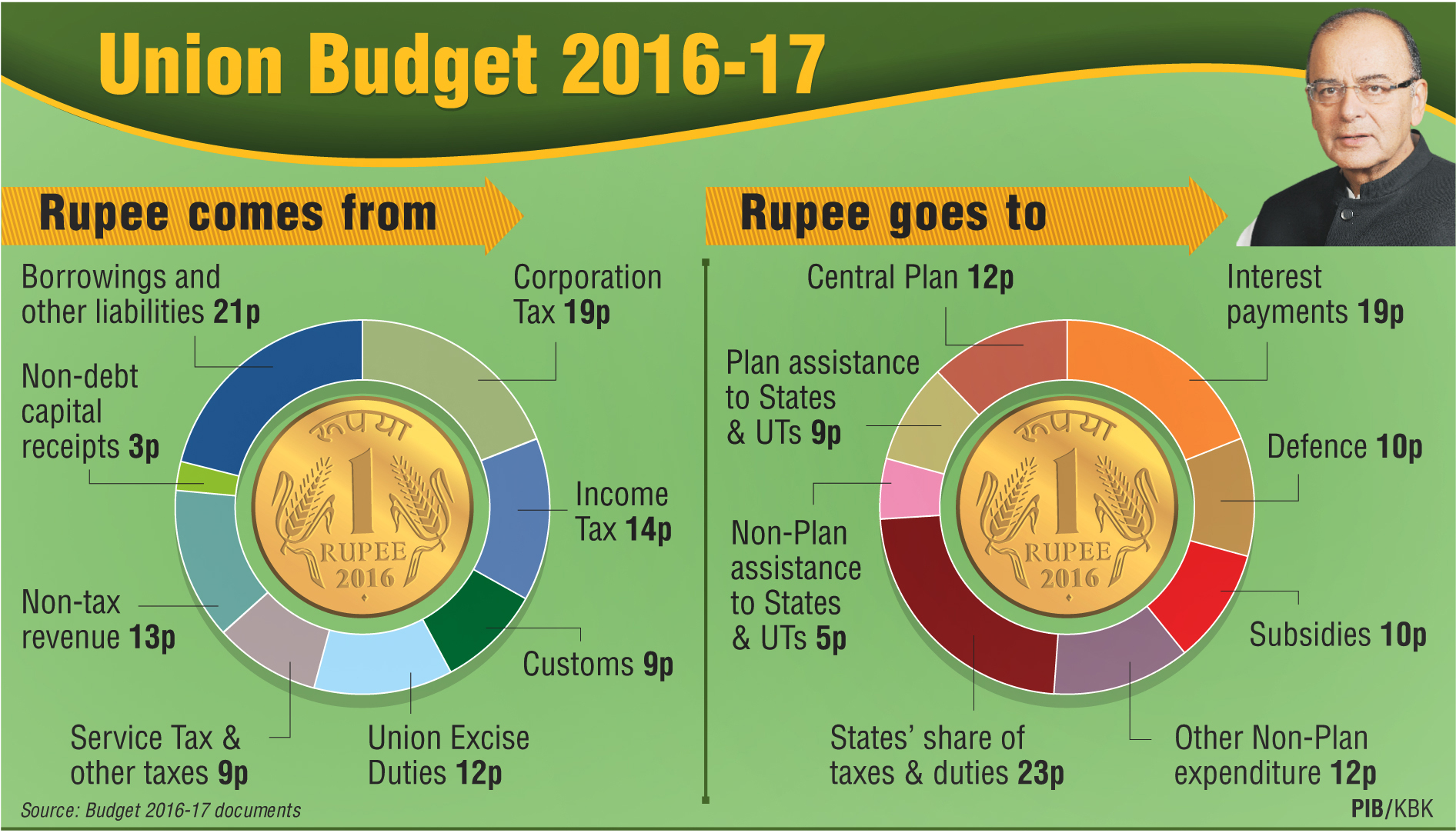
    Budget is an important part of fiscal policy as revenue and expenditure statements are presented during the budget. Let’s understand in brief, where all the revenue comes from and where all the money goes.


    We can clearly see, among non debt creating receipts (not borrowings), maximum earning is from corporate tax followed by income tax.

    Always remember these facts on revenue and expenditure side by heart

    • direct taxes> Indirect taxes
    • Corporate tax>Income tax>Excise>Service tax>custom
    • Non plan expenditure> Plan expenditure (more than double)
    • Interest payment>>subsidies and defense  <subsidies and defense are almost equal. Every year including this year defense is budget higher amount but eventually, subsidies turn out to be higher during revised estimates>
    • Food subsidies>> Fertilizer subsidies >> Fuel subsidies

    When government reduces its fiscal deficit, it is known as fiscal consolidation. Learn everything about fiscal consolidation here

    Clearly it can be achieved in two ways, reduce spending or increase taxes or combination of two. Here we discuss one component of spending known as subsidy in some detail. Everyday we read about subsidy rationalization, cutting or increasing subsidies and passionate arguments on both sides.

    So, What is subsidy?

    In a layman’s term, it can be understood as converse of a tax in that using taxation government takes money from consumers while subsidy in effect transfer money from government to consumers.

    For instance, taxes on grain would increase their market price from say 10 rs a kg to 12 rs a kg, in effect taking 2 rs from you for every kg of grain you buy. On the other hand subsidy under PDS would reduce price of grain from 10 rs to say 2rs in effect transferring 8 rs to your pocket. In this way, they are converse of indirect taxes.

    When government directly transfers money in your bank account without any condition i.e. unconditional direct benefit transfer, subsidy becomes converse of direct taxes.

    In India government (central and state) subsidize a lot of things from food to fertilizer to kerosene and LPG etc. Tax concessions can also be considered as implicit subsidy. Subsidies increase government spending and thus puts pressure on government finances.

    So what’s the rationale for subsidy?

    Like indirect taxes, subsidies can alter relative prices and budget constraints and thereby affect decisions concerning production, consumption and allocation of resources.

    So purpose of subsidies is two fold-

    1. Increasing consumption of items government considers important such as health, education, nutritious food etc or renewable energy in modern times.
    2. Redistributive effect i.e. to provide minimum level of protection to the poor <welfare function, tax the rich, distribute in poor>

    For objective one to be fulfilled government should subsidize merit goods.

    What are merit goods?

    A good which would be under-consumed (and under-produced) in the free market economy

    But why are they under-consumed?

    They are associated with positive externality i.e. they also benefit public but since consumers and producers will take account of only private benefits, they are likely to consume less than desired. For instance, consider education, not only a person is educated and earns more <private benefit> but more productive individual would also benefit society in the form of higher taxes <societal benefit> 

    For objective two (redistribution) to be achieved, subsidies should be well targeted i.e. reach the poor with minimal leakages. This requires proper targeting without which there would be inclusion errors (rich getting subsidy and exclusion errors (poor not getting subsidy). Exclusion errors are the worst since they direct affect the poor <kerosene meant for poor not reaching him, how will she light her house>

    Subsidy rationalisation is this process of better targeting to weed out unintended beneficiaries as well as phasing out subsidies on non merit goods.

    So, what are the adverse consequences of bad subsidies (non merit, not well targeted)?

    1. Fiscal effects– directly increase fiscal deficit and thus total government debt <10% of total govt spending is for subsidies> <While golden rule of borrowing is, borrow to invest >
    2. Allocative effects– result in inefficient resource allocation <producers will produce more of subsidized good even when not required>
    3. perverse distributional effects endowing greater benefits on the better off people <subsidized diesel being used to run SUVs>
    4. Shortages and black marketing <subsidized urea being diverted to non agricultural uses, scarcity leading to black marketing harms the poorest farmers the most>
    5. Tendency to self-perpetuate. They create vested interests and acquire political hues <Exit problem discussed in economic survey chapter two, click here to read>

    For instance, High MSP for wheat and rice and subsidized water and electricity illustrates all such effects, an example of bad bad subsidy.

    • Perverse distributional effects– better off farmers of Punjab and Haryana getting benefited<no procurement from eastern belt, poor farmers of Bihar, Jharkhand not getting benefits>
    • Fiscal effects– finances of central as well as state govt getting stretched, discoms in debt <high deficit # high debt # high interest cost # high deficit = vicious circle>
    • Allocative effects– pulses and oilseeds are not grown resulting in shortages <procurment only of grains, no incentive to produce pulses>
    • environmental effect– water table going down, soil getting salty and arid
    • Health effect– Groundwater pollution due to high fertilizer use, burning of husks resulting in air pollution

    How subsidies distort the market (in a comical way) is best understood by Railway subsidies <Example from last year’s economic survey> 

    • Govt subsidizes passenger fares resulting  in losses. Railways cannot generate sufficient internal resources to finance capacity expansion investments;Result-Trains always run late, very slow services, whole economy becomes unproductive
    • Of course the passenger fare is cross subsidized by high freight tariffs . It results in diversion of freight traffic to road transport which is costlier. Result- not only financial and efficiency costs but also acute costs associated with emissions, traffic congestion, and road traffic accident (RTA) <And we all know passengers on two wheeler or those walking die the most in the RTA i.e. poorer segments of society>
    • High freight cost raises the cost of manufactured goods that all households, including the poor, consume. <subsidized passenger fare but costly goods, no one knows who gains who losses but these distortions decreases the overall efficiency and thus whole economy suffers.>

    What’s the solution?

    End perverse subsidies while investing in state capacity to deliver basic goods and merit goods such as health, education, skills etc. Incentivize research and development, environment friendly technologies etc. Borrow only to invest. Adhere to FRBM targets of zero revenue deficit.

    • Direct Benefit Transfer (DBT) using  JAM number trinity, read the economic survey chapter here
    • JanDhan i.e. Bank accounts, Adhar i.e biometric identification and mobile i.e. mobile banking
    • It will result in direct transfer of money to bank account of beneficiaries and cut down leakages as intermediaries are removed.
    • Biometric authentication will remove ghost accounts i.e same person getting subsidy twice from two different names.
    • Mobile banking will give access to bank accounts for easy deposit and withdrawal

    But problem of identification of beneficiaries still remains and it requires better and more robust data collection, publishing names of beneficiaries at gram panchayat level for people to raise objections, jan sunwai (public hearing), social audits and such transparency mechanisms

    Pitfalls of DBT

    1. Where transfers are unconditional, people may just spend money on desi liquor <objective of changing consumption pattern defeated>. For instance, if govt transferred 6000 rs to every pregnant women it’s possible that money will go in the bank account of husband and instead of better nutrition for pregnant lady, he will buy desi liquor.

    solution- transfer money in the hand of oldest woman and provide her information so that she can take informed decision in the best interest of family

    1. Conditional transfers might give rise to its own kind of corruption. For instance if money is transferred for check up by a nurse, she might demand bribe for certifying you indeed showed up for check up.
    2. Private market may not exists for people to buy goods and services from the market. For instance, if PDS shops are closed, where would people buy ration from?
    3. Banking infrastructure poor <as we saw in the JAM article, last mile banking access is jamming the JAM>
    4. Real value of subsidy amount will be eroded with inflation. solution- link subsidy with CPI inflation. But generally food inflation higher than CPI, then what?
    5. There is concern that biometric fingerprinting may not work for rural manual labourers.
    • what happens to corporate tax breaks and subsidies going to not so poor?Government decision to phase out corporate tax exemption while simultaneously bringing down tax rates down to 25% level is welcome in this regard.
    • It will remove major distortions and end favours to select few corporate groups

    Government should rationalize subsidies so they are targeted better and use money thus made available to invest in physical and social infrastructure.In this way by rationalizing subsidies government can bring down fiscal deficit and overall debt level. Bringing fiscal deficit under control, reduces aggregate demand, this cooling down prices.

    Now it’s time to solve some previous year IAS prelims questions 

    #1. The sales tax you pay while purchasing a toothpaste is a

    1. tax imposed by the Central Government.
    2. tax imposed by the Central Government but collected by the State Government
    3. tax imposed by the State Government but collected by the Central Government
    4. tax imposed and collected by the State Government

    #2.To obtain full benefits of demographic dividend, what should India do?

    1. Promoting skill development
    2. Introducing more social security schemes
    3. Reducing infant mortality rate
    4. Privatization of higher education

    #3. In India, deficit financing is used for raising resources for

    1. economic development
    2. redemption of public debt
    3. adjusting the balance of payments
    4. reducing the foreign debt

    #4. There has been a persistent deficit budget year after year. Which of the following actions can be taken by the government to reduce the deficit?

    1. Reducing revenue expenditure
    2. Introducing new welfare schemes
    3. Rationalizing subsidies
    4. Expanding industries

    Select the correct answer using the code given below:

    (a) 1 and 3 only
    (b) 2 and 3 only
    (c) 1 only
    (d) 1, 2, 3 and 4

    #5. With reference to Union Budget, which of the following, is/are covered under Non-Plan Expenditure?

    1. Defense -expenditure
    2. Interest payments
    3. Salaries and pensions
    4. Subsidies

    Select the correct answer using the code given below.

    1. 1 only
    2. 2 and 3 only
    3. 1, 2, 3 and 4
    4. None

    #6. Which one of the following is not a feature of “Value Added Tax”? (2011)

    • (a.) It is a multi-point destination-based system of taxation
    • (b.) It is a tax levied on value addition at each stage of transaction in the production-distribution chain
    • (c.) It is a tax on the final consumption of goods or services and must ultimately be borne by the consumer
    • (d.) It is basically a subject of the Central Government and the State Governments are only a facilitator for its successful implementation

    #7. Under which of the following circumstances may ‘capital gains’ arise? (2012)

    1. When there is an increase in the sales of a product
    2. When there is a. natural increase in the value of the property owned
    3. When you purchase a painting and there is a growth in its value due to increase in its popularity

    Select the correct answer using the codes given below :

    • (a) 1 only
    • (b) 2 and 3 only
    • (c) 2 only
    • (d) 1, 2 and 3

    #8. Consider the following actions by the Government:

    • 1. Cutting the tax rates
    • 2. Increasing the government spending
    • 3. Abolishing the subsidies

    In the context of economic recession, which of the above actions can be considered a part of the “fiscal stimulus” package?

    A. 1 and 2 only
    B. 2 only
    C. 1 and 3 only
    D. 1, 2 and 3

    #9..Consider the following statements:

    In India, taxes on transactions in Stock Exchanges and Futures Markets are

    • 1. Levied by the Union
    • 2. Collected by the State .

    Which of the statements given above is/are correct?

    A. 1 only
    B. 2 only
    C. Both 1 and 2
    D. Neither 1 nor 2

    Answers 1-d,2-a,3-a,4-a,5-c,6-d,7-b,8-a,9-a.


    To read more conceptual articles related to economy click

    Economics Concepts Simpified


More posts