💥UPSC 2026, 2027, 2028 UAP Mentorship (March Batch) + Access XFactor Notes & Microthemes PDF

Search results for: “”

  • Part 3 | Where Procedure is Due | Landmark Judgements that Transformed India

    Every good post must have compelling questions which set its user thinking. Right? Here are a few before we deep dive into our third installment of “Landmark judgements that transformed India”.


    What’s the scope of right to life? Could parliament curtail personal liberties by any procedure, even one that violates all principles of natural justice? Do all fundamentals rights form an integrated scheme and need to be read together and in tandem or are all the fundamental rights distinct and should be considered in isolation ?

    These were the broad questions which supreme court sought to answer in Maneka Gandhi vs Union of India case.

    This is going to be a long read, yet again. Hope you enjoy these looonger narratives as they help bring out the flavour in full.

    Immediate issue was impounding of Maneka Gandhi’s passport without giving her any hearing and disclosing any reasons which she challenged in supreme court under art 32 (right to remedy) on the grounds that right to travel abroad came under broad sweep of personal liberty granted under art 21 and order also violated art 14 (equality).

    Before going into the supreme court observations and counter arguments, let’s have a look at the relevant constitutional provisions and supreme court interpretation of the same.

    Art 21 – No person shall be deprived of life or personal liberty except in accordance with the procedure established by law .

    Art 14 – Right to equality i.e. equality before law and equal protection of law

    Art 19 – 6 freedoms (7th one right to property was deleted by 44th CAA)

    Art 14 and 19 subject to reasonable restrictions (reasonableness being subject to judicial review)

    Art 22 – Safeguards against preventive detention


    For the 1st time Supreme Court was asked to interpret FR in 1950 in AK Gopalan vs state of Madras.

    He was arrested under preventive detention act. (A person can be put in jail / custody for two reasons. One is that he has committed a crime. Another is that he is potential to commit a crime in future.)

    Petitioner claim –

    All FRs were to be read collectively, in tandem and it violated art 14(equality ) and art 21 (liberty).

    Court disagreed  and applied procedure established by law textually.

    1. All FRs deal with distinct matters. Law is meant to satisfy article 22, petitioner not entitled to challenge it under other FRs ie equality and liberty.
    2. Court did not find any similarity b/w american due process of law and Indian procedure established by law in effect saying courts had no power of substantial review of laws and had only to check if correct procedure had been followed.

    Due process on the other hand would check reasonableness, fairness of law whether laws follow principles of natural justice or not .

    Put simply the difference between the doctrines of substantive and procedural due process is a function of the interplay between the questions of “why” and “how” an authority decides the way it does.

    Inquiries that seek answers as to “why” an authority decided the way it did, and examine the justice or injustice of the decision, are substantive.

    Inquiries that examine “how” an authority procedurally arrived at a decision constitute an exercise of procedural due process.

    For instance – if police arrests homo sexual couples, it’s valid as per procedure established by law as police followed correct procedure prescribed by a law enacted by a competent legislature but it may not be valid as per due process of law as it seems arbitrary, unjust to minorities (sexual minority) and this violates principle of natural justice . You get the difference bw the two, right !


    Right to travel abroad question was settled in Satwant singh case, where court held that liberty under art 21 has wide import and exclude only those liberties expressly granted under art 19.

    Right to travel within india – art 19

    Right to travel abroad – art 21

    But as art 21 was subject to procedure established by law, parliament could by enact of a valid law curtail right to travel abroad .

    Meanwhile during emergency civil liberties came under heavy assault and Judiciary also buckled under pressure.

    In  ADM Jabalpur case also known as the habeas corpus case, supreme court held that people did not even have the right to file habeas corpus writ petition challenging illegal detention. Supreme court had applied doctrine of procedure established by law in letter but not in spirit.

    After emergency in Maneka Gandhi case, supreme court sensed an opportunity for redemption and grabbed it with both hands.

    Supreme court not only emphatically asserted right to travel abroad as fundamental right under art 21 but reversed its judgement in AK Gopalan case and held that rights form an integrated scheme .

    Articles dealing with different fundamental rights contained in Part III of the Constitution do not represent entirely separate streams of rights which do not mingle at many points. They are all parts of an integrated scheme in the Constitution. Their waters must mix to constitute that grand flow of unimpeded and impartial justice… Isolation of various aspects of human freedom, for purposes of their protection, is neither realistic nor beneficial.”

    1. Art 21 has to be read alongside art 14 and 19 which demand reasonableness and non arbitrariness .
    2. Procedure established by law has to be  FAIR JUST REASONABLE AND NOT FANCIFUL ARBITRARY AND OPPRESSIVE.

    In one stroke of pen, court changed procedure established by law to de facto due process of law.

    In essence present position of article 21 is fair, just and reasonable procedure established by a valid law.

    Courts held that personal liberty in Article 21 is of the widest amplitude and it covers a variety of rights which go to constitute the personal liberty of man and some of them have been made distinct fundamental rights in Article 21.

    Impact

    1. It marked the beginning of an era of judicial activism. It gave Judiciary the power to expand the canvass of rights and create new rights to give right to life its true meaning not just satisfied with right to life remaining an empty promise. Some of these rights include-

    Right to live with dignity, right to education, right to legal aid , environmental laws such as right to clean air, right to noise free surroundings etc.

    2. Judiciary got the power to review virtually every law. Using its power of substantial review of law by this judgement and basic structure doctrine courts have now started striking down even non constitutional amendment acts.

    For instance in July 2014 it struck down national tax tribunal for taking away the powers of high courts of judicial review and not maintaining separation of judiciary and executive.

    Similarly narcoanalysis against the wishes of the person was declared illegal by holding right to mental privacy as fundamental right.

    In fact on 1997 itself supreme court in Chandra Kumar case had declared those provisions of art 323A and B (dealing with tribunals) unconstitutional which provided for direct appeal to supreme court holding judicial review by high courts as part of basic structure.

    Note – tribunal were added by 42nd CAA by adding a new part 14A.

    Relevance

    In this age of civil society activism, this judgement has given Judiciary a lot of leverage to expand scope of rights for the common citizen of this country.

    But question remain should Judiciary become a super parliament, a paramount policy making body? As we would see in a later article judiciary virtually created a law in VISAKHA JUDGEMENT. Should not this task remain with parliament?

    Should not power of substantial review of laws remain with the Parliament as was envisaged in the constitution?

    Note that founding fathers deliberately dropped due process from the draft and replaced it with procedure established by law.

    Another problem arise as different judges would surely apply different principles of morality. We examine this issue with respect to rights of sexual minority, right to privacy and euthanasia debate.

    The Naz foundation case

    Challenged section 377 of IPC

    Delhi high court decriminalised homosexuality holding that said section –

    1. Violates right to dignity and privacy

    2. Creates an unreasonable classification and targets homosexuals as a class.

    3. Public animus and disgust towards a particular social group or vulnerable minority, it held, is not a valid ground for classification under Article 14.

    4. Article 15 of the Constitution forbids discrimination based on certain characteristics, including sex. The Court held that the word “sex” includes not only biological sex but also sexual orientation, and therefore discrimination on the ground of sexual orientation is not permissible under Article 15.

    5. The right to life under Article 21 includes the right to health, and concluded that Section 377 is an impediment to public health because it hinders hiv prevention effort .

    But as you would know anti climax came when supreme court quashed the judgement holding it constitutionally unsustainable as only parliament can change laws not courts.

    Right to privacy

    Right to privacy was an inferred right. As we saw above even in Narcoanalysis case supreme court held right to mental privacy as fundamental right .

    But 8 judge bench of supreme court in  M P Sharma And Others vs Satish Chandra, District Magistrate Delhi (1954),  and 6  judge bench in Kharag Singh vs State of Uttar Pradesh (1962), held that the right to privacy was not a fundamental right.

    It has not been overruled by any subsequent judgment by a larger Bench.

    But note that right to life was given an expanded meaning only after Maneka Gandhi case 1978.

    And then there is a small matter of India being a signatory to international covenant on civil and political rights and UN declaration on human rights both of which consider right to privacy as human right.

    Are we good? Hope you enjoyed reading till now! A few paras more!

    Euthanasia debate/ Aruna Shannbaug case

    Does right to life includes within right not to live or right to die as right to speech includes right not to speak or right to remain silent?

    Maruti Shripati Dubal vs State Of Maharashtra,

    Bombay high court held

    1. Nothing unnatural about the desire to die
    2. Every man is the master of his own body and has the right to deal with it as he pleases
    3. Right to live includes right not to live or right to end one’s life
    4. Section 309 IPC prescribing punishment for attempt to commit suicide unconstitutional

    P.Rathinam vs Union of India

    Supreme court observations

    1. Attempt to commit suicide indicated a psychological problem rather than criminal conduct
    2. Section 309 violated art 21

    But this judgement would not last long as in…


    Gian Kaur v/s state of Punjab

    It was argued by petitioners  that abetting suicide was merely facilitating enjoyment of fundamental right of not to live# abetment can not be penalised

    Court reversed the judgement in Rathinam case

    What was the logic?

    1. Right to life is a natural right but suicide is unnatural termination of life # incompatible with the concept of right to life.
    2. While other negative rights such as right not to speak suspend positive right for a temporary period, person can exercise his right to speak as he wishes; right to die would permanently end the right# incompatible with right to life

    But the court held that right to life includes right to die with dignity. Court highlighted the difference bw desirability of law and constitutionality of law


    Aruna shanbaug case

    Court rejected mercy death petition but legalised passive euthanasia with elaborate safeguards

    Judgement would obviously be challenged as it impinged not only on legal but important moral and ethical principles .

    PIL filed by NGO Common Cause

    3-judge bench of the Supreme Court of India said that the prior opinion in the Aruna Shanbaug case was based on a wrong interpretation of the Constitution Bench’s opinion in Gian Kaur v. State of Punjab. The court also determined that the opinion was internally inconsistent because although it held that euthanasia can be allowed only by an act of the legislature, it then proceeded to judicially establish euthanasia guidelines. The court referred the issue to a larger Constitution Bench for resolution.

    You can clearly see how different judges apply their own individual morality to decide what is constitutional or not.

    We can add Sallekhana judgement  (natural vs unnatural death, importance of motive in suicide ) of rajasthan high court and subsequent staying by supreme court in the same pattern .

    Question remains should not parliament which has a finger or the pulse of masses take such imp calls instead of courts with different judges coming from different backgrounds applying their own moral and ethical principles in the cloak of expanding the scope of human rights .

    Now it’s time for some thought questions –

    #1. What should be the limits of due process review ? If taken too far supreme court can virtually become a law asking body and if not applied it can create situations such as emergency. Where  should be the right balance lie?

    #2. As the doctrine has been widely accepted, isn’t it time parliament amended the constitution,provided for explicit due process clause and also specified its limits ?


    If you enjoyed reading this, you might want to check earlier blogs here –

  • Indian Polity | Timeline : States and UT Reorganization

    After India became independent, its constituent units were classified into 4 distinct categories – Part A, Part B, Part C, Part D. Their composition is as follows

    Part A statesFormer British provincesAn elected governor and state legislature9 states: Assam, Bihar, Bombay, East Punjab, Madhya Pradesh, Madras, Orissa, Uttar Pradesh, and West Bengal
    Part B statesFormer princely states or groups of Covenanting statesRajpramukh (former princes)9 states: Hyderabad, Jammu and Kashmir, Madhya Bharat, Mysore, Patiala and East Punjab States Union (PEPSU), Rajasthan, Saurashtra, Travancore-Cochin, and Vindhya Pradesh
    Part CFormer princely states and provincesChief commissioner10 states: Ajmer, Coorg, Cooch-Behar, Bhopal, Bilaspur, Delhi, Himachal Pradesh, Kutch, Manipur, and Tripura
    Part DUnion TerritoryGovernor appointed by the Indian presidentAndaman and Nicobar Islands
    Part C states were administered by the President through a Chief Commissioner or Lieutenant-Governor.

    1956: States Reorganization Act. Abolished the above 4-fold classification. Part A and Part B were merged. Part C territories – HP(including Bilaspur), Delhi, Manipur, and Tripura were made UTs and the rest merged with their adjoining states. Part D(Andaman & Nicobar Islands) was made a UT.

    Total States: 14
    UT Count: 6

    1960: Bilingual state of Bombay was divided into Maharashtra and Gujrat.

    Gujrat becomes the 15th State.

    Total States: 15
    UT Count: 6

    1961: Dadra and Nagar Haveli, Portuguese colony till 1954 was converted into a UT by the 10th Constitutional Amendment Act. Dadra and Nagar Haveli becomes the 7th UT.

    Total States: 15
    UT Count: 7

    1962: Goa, Daman and Diu were acquired from Portuguese by means of police action in 1961. Constituted as UT by the 12th Constitutional Amendment Act in 1962. They come 8th and 9th UT respectively.

    Total States: 15
    UT Count: 9

    1962: State of Nagaland carved out from the state of Assam by 13th Constitutional Amendment Act in 1962. Nagaland becomes the 16th State.

    Total States: 16
    UT Count: 9

    1962: 4 French establishments – Puducherry, Karaikal, Mahe and Yanam where handed over to India in 1954. Made a UT by the 14th Constitutional Amendment Act in 1962. Puducherry becomes the 10th UT.

    Total States: 16
    UT Count: 10

    1966: Punjab was bifurcated to create Haryana. UT of Chandigargh was formed. Hilly Areas of Punjab were merged with Himachal Pradesh. Haryana becomes the 17th State. Chandigargh becomes the 11th UT.

    Total States: 17
    UT Count: 11

    1970: HP elevated from the status of UT to the status of state. HP becomes the 18th State. The total UT count comes down to 10.

    Total States: 18
    UT Count: 10

    1971: Political Map of NE underwent a Major Change. Manipur, Tripura and Meghayala elevated to the status of state. The total State-count becomes 21.

    Total States: 21
    UT Count: 10

    1975: Referendum held in Sikkim and Sikkim became an integral part of India. 36th Constitutional Amendment made it the 22nd full-fledged state.

    Total States: 22
    UT Count: 10

    1986: Mizoram and Arunachal Pradesh elevated from status of UT to the status of state. The total State-count becomes 24. The total UT-count comes down to 8.

    Total States: 24
    UT Count: 8

    1987: Goa elevated from status of UT to the status of state. Becomes the 25th State. The total UT count comes down to 7.

    Total States: 25
    UT Count: 7

    1991: Delhi becomes the National Capital Territory of Delhi.

    2000: Chhattisgargh(from MP), Uttarakhand(from UP) and Jharkhand(from Bihar) carved out to form independent states. The total State-count is 28.

    Total States: 28
    UT Count: 7

    2014: Andhra Pradesh bifurcated to form Telangana. Becomes the 29th State.

    Total States: 29
    UT Count: 7

  • Part 2 | Evolution of Indian constitution | Landmark Judgements that Transformed India

    In the last part, we saw the tussle between the Parliament and the Judiciary over amendments to fundamental rights with Supreme Court finally putting its foot down and virtually making it impossible for the parliament to abridge fundamental rights in Golaknath case.


    This is going to be a long post, so sit back and relax. You will come out appreciating the evolution better. Later, I urge you to read these developments in some detail and come back to answer the questions below.

    Smarting from this setback, Madam Indira ( the parliament, herself) passed 24th CAA to neutralise GOLAKNATH judgement. But there was also a small matter of reversing Copper judgment in bank nationalisation case so parliament passed 25th CAA.

    1. Art 19f delinked from 31, in effect parliament deciding compensation amount payable instead of courts.
    2. Art 31c  -inserted under whoch – art 39b and c, most socialist of dpsp ( equitable distribution and prevention of concentration of wealth respectively )precede over 7 freedoms (art 19 ), equality (14),property (31)
    3. Parliament’s power to determine if policy is to give effect to 39b and c not subject to judicial review.

    29th CAA had put kerala land reform act under 9th schedule and his holiness challenged the provisions and all hell broke loose.


    Now the 4th salvo

    A 13 judge bench is constituted and what does it do?

    1. Overturned Golaknath ie amendment not law , fundamental rights amendable, no implies limit under art 368 ie CAA 24 constitutional
    2. Art 25 invalid to the extent it takes away judicial review ie 39b and c above 14, 19 and 31 but subject to judicial review

    Most imp decision of all by slimmest of all 7-6 majority stated Parliament can amend any provision of the Constitution but the basic structure should not be destroyed, damaged or abrogated.

    What’s the logic?

    1. Expression amendment did not encompass defacing the constitution such that it lost its identity.
    2. In the garb of amendment parliament can not rewrite the constitution.

    Court gave relief to govt but reserved for itself power to review all amendment not just those that violate fundamental rights.

    Aftermath

    Indira Gandhi didn’t like the judgement 1 bit. She (via the president) superceded 3 judges to appoint justice A.N. Ray as CJI.

    Knives had been drawn and the battle was gonna be very bloody .

    Navnirman movement of JP (Jayprakash) had gathered steam. Indira on the back foot and then came the judgements of Allahabad High Court convicting Indira of corrupt electoral practices. Election null and void 6yrs ban.

    Supreme Court stayed it and allowed her to remain PM but not to draw salary or speak or vote in parliament.

    Darkest chapter in democracy’ 21 month emergency was declared on 25th June 1975 without even consulting cabinet.

    Indira Gandhi wasn’t to sit quiet.

    CAA 39th election of president, VP, PM and speaker beyond judicial review

    Clownish Rajnarayan challenged the CAA 39.

    For the 1st time supreme court applied basic structure doctrine and considered free and fair election and rule of law to be part of basic structure . #amending act invalidated.

    Note here that 4 of the 5 judges on the bench had given dissenting judgment in Bharati case but still applied the same doctrine for supreme court judgment becomes law until overruled by bigger bench ( art 141 ).

    Then how did Indira continue to be prime  minister and contest election again and not get banned for 6 years?

    Supreme court accepted retrospective amendment to electoral law ie electoral malpractice of Indira was no longer a corrupt practice .

    Find out for fun the charges against Mrs. Gandhi for which she was convicted and what a popular British magazine had to say about the judgement.

    Along came mini constitution 42nd amendment act TO ELIMINATE IMPEDIMENTS TO THE GROWTH OF THE CONSTITUTION – 

    1. PART 4a fundamental duties
    2. Socialist and secular to preamble

    And for the purpose of this article  amendment to article 368 nullifying basic structure doctrine by adding amendments can’t be challenged in courts and parliament possessing unlimited power of amendment

    1. All DPSPs to take precedence over all fundamental rights not just 39b and 39c.

    And Minerva Textile mills of Karnataka fired the 5th and the last salvo

    Minerva Mills v Union of India

    Unanimously struck down amendment to article 368 holding limited amending power and judicial review to be part of basic structure.

    Court held that constitution is founded on the bedrock of balance bw FRs and DPSPs. Goals set out by DPSPs have to be achieved without abrogation of means provided by FRs.

    What’s the logic?

    If a donee was vested with limited power, it could not be exercised to control that very power power and convert into unlimited one.

    Or

    If a genie grants u 3 wishes, it is understood u can not, as one of the wish, ask for unlimited number of wishes !


    Janta govt comes to power and CAA 44 deletes art 31 (b)  right to property and 19 (f) freedom to acquire, hold and dispose of property as they were not considered part of basic structure

    Right to property now a constitutional right under art 300A.

    9th schedule and judicial review

    I.R.Coelho vs state of TN,  Supreme court held that acts placed under 9th schedule after basic structure subject would be subject to judicial review to the extent of those acts violating basic structure of constitution.

    Impact of basic structure doctrine.

    It certainly saved Indian democracy from degenerating into authoritarian regime during those testing times but it has also given immense untold unbridled power to supreme court and made it the most powerful court in the world .

    As we would later see in the NJAC Verdict (let’s call it 4th judges case), Supreme court applied this doctrine, many would say for wrong reasons to strike down the act and kept for itself the power to appoint brother judges. In the original constitution only fetters on the power of parliament was art 13.

    Relevance –  It was delivered at the time of single party rule both at the centre and most of the states. In the era of coalition politics no govt is going to wield so much power to destroy the constitution and then there is ever present danger of tyranny of unelected .

    But only legitimate way to overturn the verdict would be a 15 judge bench so don’t hold your breath for that .

    Now is the time for some thought  questions 

    #1. Consider these 2 statements –

    1. Any LAW ie ordinary law violating  provisions  of constitution  would be declared null and void to to the extent of contravention.
    2. Any LAW violating art 13 would be declared null and void

    Both statements are  true ..if amendments were not law, what was the purpose of art 13 (2) other laws would anyway be declared unconstitutional !

    #2. Is basic structure doctrine relevant in the present political scenario where no single party is unlikely to enjoy majority in both the houses ?

    #3. What should be the limits to amending power of parliament? Do u think for very substantial amendments instead of courts, people by way of referendum should determine whether amendment should go.through or not ?

    #4. Whatever happens to original intent theory that constitutional courts have to interpret constitution in accordance with the implied intentions of founding fathers and there is enough evidence to suggest founding fathers thoughtfully kept FRs sacrosanct to prevent their abrogation or as we would see in a later article how supreme court by creative interpretation virtually changed procedure established by law in art 21 to due process of law while founding fathers deliberately kept expression as procedure established by law.

    Should constitutional courts be vested with such power and risk becoming super parliament ?
    Epilogue-  while basic structure doctrine saved Indian democracy and gave supreme court the final say in the matters of constitutional amendment, in the next article we shall see how the courts expanded meaning of rights under right to life and how procedure established by law has now become de facto due process of law and its implications on indian polity and democracy and by extension on all of us.

  • Part 1 | Landmark Judgements that Transformed India

    The Judiciary, at one time, was considered and projected to be the weakest branch of the state because it possessed neither power of the purse nor power of the sword. This myth has been demolished. – Soli Sorabjee

    Over the years by innovative interpretation of constitution, Judiciary has become very powerful in many democracies and nowhere is it more true than in the case of India .

    Using its power to interpret the constitution and review laws, supreme court has expanded the scope of rights and limited parliament’s power to amend the constitution. It’s landmark judgments from Kesavananda Bharati to Shreya Singhal case running into 1000s of pages and lakhs of words quoting English poets to a google reference have changed the course of Indian polity and democracy like nothing else.

    Understanding the judgements would help in understanding the working of our democracy and create an enlightened citizenry which would deepen our democracy.

    In this series we try to understand such landmark judgments which have transformed Indian polity for all time to come. We will present the context, impact, present day relevance and ask some thought provoking questions for you to answer.  Judgements have been presented in layman’s terms to help u understand better.

    We hope u enjoy this series and hey, there’s also a small matter of u being able to write better answers in mains and solving questions in prelims but that’s only incidental!

    So without wasting any further time, let’s discuss most transformational judgement of all –

    #1. Kesavananda bharati vs State of Kerala  (1973)/ limits to amending power of parliament / amendabiliy of fundamental rights/ basic structure doctrine


    His holiness kesavananda bharati challenged before the supreme court validity of 29th CAA which inserted some laws in 9th schedule and affected property of his Hindu Mutt.

    What else was at stake?

    1. Supreme court (R. C. Cooper case ) had struck down bank nationalisation act of 1969 which had nationalised 14 major banks for illusory compensation though it conceded parliament’s right to nationalise banks in national interest.
    2. Supreme court had struck down abolition of privy purses which was a betrayal of solemn promise to erstwhile kings by Sardar Patel.

    Supreme court could do all this as it had held in 1967 in Golaknath case that fundamental rights could not be abridged.

    Before returning back to Kesavananda, Let’s take a look at the relevant provisions of the constitution and supreme court interpretation of the same.

    Art 13(2) Any LAW abridging fundamental rights mentioned in part 3 shall be null and void to the extent of contravention

    Art 368 Procedure to amend the constitution.

    Art 19(f) freedom to acquire hold on and dispose off property.

    Art 31 right to property

    Both the rights were subject to reasonable restriction in public interest and restriction were subject to judicial review

    Soon after the coming into force of the constitution, states enacted land reform acts #Zamindars challenged them. #Patna high court declared bihar act unconstitutional for violating right to property #interim parliament passed 1st CAA.

    1. ART 31B created 9th schedule. Laws inserted under it by constitutional amendment were immune to judicial review.

    Other provisions not imp for this article but imp for exams

    1. Reasonable restrictions against  freedom of expression under art 19.
    2. To nullify judgment in State of Madras v. Champakam Dorairajan and giving effect to art 46 (promoting educational and economic interests of weaker sections) amplified article 15 (3)

    Zamindars didn’t like it, not one bit. And here comes the 1st salvo

    Shankari Prasad v Union of India

    Challenged 1st CAA. What was the court’s judgment?

    1. Difference bw constituent power and ordinary legislative power ie amendment not law for the purpose of article 13
    2. art13 and 368 in conflict # apply DOCTRINE OF HARMONIOUS CONSTRUCTION # ART 13 not applicable to art 368

    Govt 1-0 Zamindars

    Govt passed 17th amendment and inserted more laws under 9th schedule ‘

    Zamindars fired yet another salvo

    Sajjan Singh vs state of rajasthan

    Supreme court sang Shankari prasad song again 

    Govt 2-0 jamindars

    But Justice Mudholkar was of the view that the every Constitution has certain features which are basic in nature and those features cannot be changed.

    2 minority judgements ..utter confusion. And you can see seeds of basic structure were sown here.

    Zamindars fired 3rd salvo

    Golaknath v. State of Punjab

    11 judge bench overturned earlier 2 verdicts by a slender majority of 6-5

    Really? What was the logic given here?

    1. Nothing to suggest constituent power to be separate from legislative power and even if distinct amending power not same as constituent power which is given only to constituent assembly ie amendment is law and subject to article 13
    2. Fundamental rights so sacrosanct and transcendental that they can not be abridged even if whole parliament unanimously decided to abridge them.

    But it validated all previous land reform acts as nullifying them would create utter confusion

    Govt angry – Zamindars angry

    New landlords happy.

    Loss – loss to defendants as well as petitioner.

    Madam Indira was in power and she did not like  this . Not one bit.

    Along came 24th amendment to neutralise GOLAKNATH JUDGEMENT

    1. Art 13 inapplicable to art 368
    2. Art 368 provided powers as well as procedure to amend the constitution
    3. Parliament by way of addition, variation or repeal can amend any provision of constitution
    4. President shall give assent to CA bills ( VERY VERY IMP FOR PRELIMS )

    But madam Indira wouldn’t just stop here as Cooper judgment (Bank nationalisation ) also had to be neutralised.

    What did she do next? And how did all of this tie back to the Kesavananda bharati vs State of Kerala case. All for the next post inline.


  • Officers IAS Academy | Prelims Test Series | IAS 2016

    Officier’s IAS Academy under the aegis of R.A.Israel Jebasingh, IAS has launched a Prelims Test Series targeted at IAS 2016.

    To know more about the test series, check the link – Prelims 2016 Online Test Batch Schedule. Use Promo Code CD500 to get 500 off on the test package.

    Wonder what the questions are going to be like? Here are 6 under Indian Polity

    #1. Assertion (A) : The Rajya Sabha does not have Committee on Private Members Bills and Resolutions.
    Reason (R) : The business advisory committee of the house recommends allocation of time for discussion on stage of private members bills and resolutions.
    a) both A and R are true and R is the correct explanation of A
    b)both A and R are true but R is not the correct explanation of A
    c)A is true and R is false
    d)A is false and R is true

    Reason: Transgender bill was passed through private member , this bill was passed in rajya sabha . Such a bill was passed only once in 35 years.


    #2. Essence of federalism, (Select the most appropriate)
    a. A state cannot be divided or merged with another state without its prior consent.
    b. Assigning the residuary power of legislation exclusively to the state.
    c. No importance to any regional language at the centre.
    d. having flexibility in the amenability of the constitution unilaterally by the centre.

    Reason : Separation of Andhra without the consent of the state Government and this is against the concept of cooperative federalism proposed by the present government .


    #3. Which of the following statements regarding nature of Indian polity is/are NOT correct?
    i. Coalition government first came at centre and then at state level.
    ii. India follows first-past-the post system in election of the President.
    iii. President cannot revoke emergency without permission of Parliament.

    Select the correct answer using the codes given below:
    a. i only

    b. ii,iii

    c. i,iii

    d.i,ii,iii

    Explanation: First past the post- election is one that is won by the candidate receiving more votes than any others. First formal coalition in centre is interim government of India formed in 1946. In state the coalition was present since Provincial elections 1937.Revocation of emergency does not require parliament’s approval.


    #4. While appointing members to which of the following bodies the President of India need not consult any Panel?
    (i) National Human Rights Commission
    (ii) Election Commission of India
    (iii) Finance Commission
    (iv) Central Information Commission

    Select the correct answer using the codes given below:
    (a) i and iii only (b) ii and iii only
    (c) ii and iv only (d) i and ii only

    Reason: CIC post was not appointed for a long time and this came under huge scrutiny.


    #5. Which among the following is / are correct statements with respect to the Fourteenth Finance Commission recommendations:
    (i) It recommended to enhanced the share of the states in the central divisible pool of taxes from 32 percent to 42 per cent
    (ii) It has used forest cover and fiscal discipline in the formula for distribution of funds among states

    Select the correct option from the codes given below:
    (a) i only (b) ii only
    (c) Both i and ii (d) Neither i nor ii

    Reason: In this in regards to the Finance Commission report and their recommendation.


    #6. (i). Swachh Bharat Mission (Gramin) was launched in 2015 to improve the quality of life of rural people in India .
    (ii). Rural sanitation is a subject in the concurrent list of Seventh schedule in the constitution of India.

    Which of the above statement(s) is/are correct?
    (a) I is true
    (b) II is true
    (c)Both I & II is true
    (d) Both are false

    Reason: Government launched Swachh Bharat Mission in order to increase awareness among the citizens for a clean environment , Moreover Sanitation is under State Subject , so when central government comes up with a scheme on state list then it comes under Centrally Sponsored Schemes.


    Apply promo code = CD500 to get a rebate of 500 INR on the course fee. Application form, here.

  • Jallikattu Debate

    • Jallikattu is a bull taming sport played in Tamil Nadu as a part of Pongal celebrations on Mattu Pongal day.

    • Jallikattu is derived from the words ‘calli’ (coins) and ‘kattu’ (tie), which means a bundle of coins is tied to the bull’s horns. In older times, the tamer sought to remove this bundle from the animal’s head to win gold or silver.

    • The southern parts of Tamil Nadu witness bull-taming the most, with Alanganallur near Madurai hosting the largest and most famous of these events.

    source

    • Background
    • Factors against the ban
    • Arguments favouring the ban
    • View of SC
    • What can government do?
    • International experience
    • Way ahead

    Factors against the ban

    • Jallikattu is an ancient sport which has continued since colonial times. So it is an ancient tradition which should be preserved and not banned.
    • In Jallikattu, the objective is to obtain the ‘Jallikattu’ a pouch which contains the reward coins called ‘Jalli’ tied to the horns of the bulls. While the players are not allowed to carry weapons of any kind or wear protective gears, the bulls on the other hand will not have nose rings or ropes.
    • Plus, they’re equipped with a pair of sharp horns which can gore a human within seconds. So it’s actually the bull which has the upper hand in this match.
    • Jallikattu is what’s keeping the native breed of cows from going extinct, according to some local people which is a huge problem for western cattle industry.

    Arguments favouring the ban

    • During Jallikattu, bulls are purposefully scared and petrified and then made to run across the crowd, destroying anything that would come in their way. Various cruel means are adopted to scare and anger the bull like pinching, nailing, stabbing with sticks that have nails at the edges, twisting their tails and even forcefully making them drink alcohol and other drugs. The ropes around their nose are painfully yanked and then they are dragged into the crowd of people who further anger the bull.
    • According to the documents by PETA, these bulls also break their bones in order to escape from the crowd continuously trying to toture them. Casualty and death of humans are also alarmingly high during this game.
    • What started as a simple act of bravado has become an act of cruelty towards animals.
    • The bulls are kept in the waiting area for hours, subjecting it to the scorching sun. The bulls used in the sport are also denied food and water.
    • Due to this sport, innumerable human lives, both of the participants and the audience, have also been lost, as the bulls try to flee from the pain.

    View of SC

    • Supreme court in 2014 banned the sport jallikattu as it violates provisions of Prevention of Cruelty to Animals Act (PCA) and militates the constitutional duty of treating animals with compassion, Article 51A (g).
    • It also reiterated the expansive reading it had given in the past, to Article 21 (Right to Life), which prohibits any disturbance to the environment, including animals, considered essential for human life.

    What can government do?

    The Government must find alternate methods to continue it without hurting the animal or people. Following are some of the alternatives:

    1. Follow the famous Spanish bullfighting example where measures taken to avoid lethal damage
    2. Put effective protection (barricades, speaker announcements, clear demarcation) so that people are not hurt
    3. Create awareness regarding apathy faced by animals. Sports personalities, film stars, eminent jurists can come forward

    International experience

    • The tradition of bullfighting in Spain is cited to legitimise the conduct of Jallikattu and present it as a viable tourist attraction.
    • It is significant that the Spanish state of Catalonia banned the sport in 2012 after a prolonged ‘culture versus rights’ debate.
    • In 2002, Germany took animal rights to a new level by giving animals constitutional protection.

    Way ahead

    • Those who want the sport to be legalised have called for an amendment to the PCA Act and measures to revoke the 2011 notification of the Ministry of Environment and Forests (MoEF) which barred the use of bulls as performing animals.
    • Trying to allow an event that legitimises cruelty to animals would be a direct insult to the carefully reasoned writ of the Supreme Court, a complete negation of the PCA Act and its objectives, and would take the country back by a few steps in the crucial area of Right to Life.
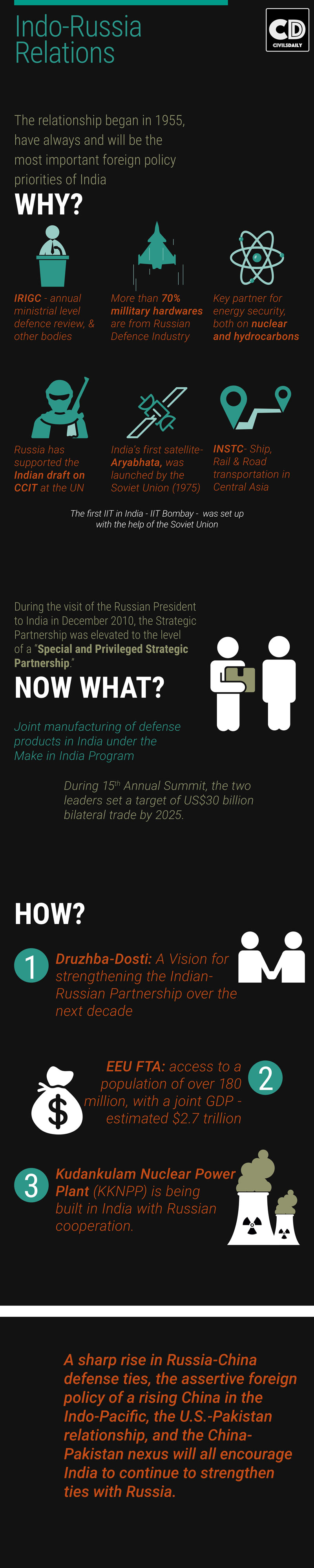
  • India-Russia relations : Momentum in transforming Strategic Partnership

    In late December, Indian Prime Minister made his first state visit to Russia to take part in the 16th annual bilateral summit. PM Modi and Russian President Vladimir Putin used the summit to review bilateral ties across a number of areas. Let’s glance over revamped relations of India-Russia!


    Can we have some background of bonding legacy?

    • Relations with Russia are a key pillar of India’s foreign policy, and Russia has been a longstanding time-tested partner of India.
    • India & Russia signed “Declaration on the India-Russia Strategic Partnership” in October 2000.
    • Under the Strategic Partnership, several institutionalized dialogue mechanisms operate at both political and official levels to ensure regular interaction and follow up on cooperation activities.
    • During the visit of the Russian President to India in December 2010, the Strategic Partnership was elevated to the level of a “Special and Privileged Strategic Partnership.

    Let’s dive into the PM’s visit for bilateral summit in Russia?

    • With the signing of sixteen agreements, this is being seen as very significant in sustaining and expanding India-Russia ties.
    • One major step taken is a deepening of India’s defense partnership with Russia for Make in India.
    • On the eve of Modi’s visit to Russia, the Indian government announced the purchase of five S-400 supersonic air defense systems from Russia, costing around $6 billion.
    • For instance, the two sides agreed that the Kamov 226 helicopter would be manufactured in India.

    How will bilateral partnership boost Make in India programme?

    • India and Russia agreed to strengthen the defense partnership in line with the “Make in India” program. So while only the public sector has been involved in defense cooperation between the two countries to date.
    • The new initiatives will encourage joint manufacturing of defense products in India and motivate the private sector to play a role in developing a strong defense manufacturing base in India.
    • It should be emphasized that “Make in India” also aims at having India emerge as an essential player in the global defense market.
    • India is forecast to spend $250 billion over the next decade upgrading its military and Russia wants to seize the opportunity to become a major part of this mission, expressing its readiness to work jointly with India on defense manufacturing.

    So, How does economic and trade cooperation matters in economic growth?

    • Enhancing trade and economic cooperation between India and Russia is a key priority for the two governments.
    • On the economic front, India and Russia decided to institutionalize the CEO’s Forum, which will meet twice a year – once in India and the other in Russia.
    • During 15th Annual Summit, the two leaders set a target of US$30 billion bilateral trade by 2025.
    • Hydrocarbons is an active area for exploring cooperation between the two countries.
    • In May 2014, ONGC and Rosneft signed an MoU for bilateral cooperation in subsurface surveys, exploration, appraisal and hydrocarbons production in the offshore Arctic region of Russia.
    • In September 2015, OVL signed an agreement with Rosneft to acquire 15% stakes in Vankorneft project.


    Did you know about India-Eurasian Economic Union FTA?

    • Moscow is a gateway for India to Central Asia.
    • In this regard a significant move by PM Modi was the effort to move forward on the India-Eurasian Economic Union (EEU) Free Trade Agreement (FTA).
    • The EEU FTA will introduce the free movement of goods, capital, services and people-people contacts and provides for common transport, agriculture and energy policies, with provisions for a single currency and greater integration in the future.
    • The FTA between India and the EEU comprises of Russia, Belarus, Armenia, Kyrgyzstan, and Kazakhstan.
    • It offers India access to a huge market with a population of over 180 million, with a joint GDP of an estimated $2.7 trillion.
    • As Russia tries to re-calibrate its economic orientation towards the Asian region, India, as one of the fastest growing G20 economies can be a significant partner for Russia.

    Shall we move into Political Relations?

    • Annual Summit meeting is the highest institutionalized dialogue mechanism under the Strategic Partnership between India and the Russian Federation.
    • So far, 15 Annual Summit meetings have taken place alternatively in India and Russia with the 15th Annual Summit held in New Delhi during the visit of President Putin to India on 11 December 2014.
    • During the Summit, 20 documents were signed covering cooperation in nuclear energy, defence, hydrocarbons, science & technology, trade and investment etc.
    • Prime Minister Modi and President Putin also adopted a Joint Statement “Druzhba-Dosti: A Vision for strengthening the Indian-Russian Partnership over the next decade.”

    Let’s see our Defence Cooperation with Mighty Russia?

    • India-Russia military technical cooperation has evolved from a simple buyer – seller framework to one involving joint research, development and production of advanced defence technologies and systems.
    • BrahMos Missile System, Joint design and development of the Fifth Generation Fighter Aircraft, as well as the licensed production in India of SU-30 aircraft and T-90 tanks, are examples of such flagship cooperation.
    • An Indian contingent participated in the military parade in Moscow on 9 May 2015, during the 70th anniversary of the victory in the World War II.
    • The Inter Governmental Commission on Military Technical Cooperation (IRIGC-MTC) is in place to review defence cooperation between the two countries.

    Let’s know about importance of International North-South Trade Corridor (INSTC) ?

    • The INSTC was initiated by Russia, India and Iran in September 2000.
    • To establish transportation networks among the member states and to enhance connectivity with the land locked region of Central Asia.
    • The North-South Transport Corridor is an ancient route that connected South Asia with North Europe for centuries.
    • This route was used by the European, Indian, Russian and many other foreign traders.
    • During the late 17th and early 19th centuries, Indian traders used this route to reach out to the Central Asian markets.
    • The modern day INSTC is a multi-modal transportation route linking Indian Ocean and Persian Gulf to the Caspian Sea via Iran, and onward to northern Europe via St. Petersburg in Russia.

    How is it important to India to protect its strategic and economic interest?

    • The INSTC envisages movement of goods from Mumbai (India) to Bandar Abbas (Iran) by sea, from Bandar Abbas to Bandar-e-Anzali (an Iranian port on the Caspian Sea) by road.
    • Then from Bandar-e-Anzali to Astrakhan (a Caspian port in the Russian Federation) by ship across the Caspian Sea, and thereafter from Astrakhan to other regions of the Russian Federation and further into Europe by Russian railways.
    • Given India’s strategic interests in the West and the Central Asian region, and need for greater economic and energy cooperation between South, Central and the West Asian region.
    • New Delhi has stepped up its engagement to reconnect with its extended neighbourhood.

    Was there any momentum on Nuclear power deal?

    • Russia is an important partner in peaceful uses of nuclear energy and it recognizes India as a country with advanced nuclear technology with an impeccable nonproliferation record.
    • In December 2014, Department of Atomic Energy (DAE) and Russia’s Rosatom signed the Strategic Vision for strengthening cooperation in peaceful uses of atomic energy between India and Russia.
    • Kudankulam Nuclear Power Plant (KKNPP) is being built in India with Russian cooperation.
    • KKNPP Unit 1 became operational in July 2013, and attained full generation capacity on 7 June 2014.
    • While its Unit 2 is in the process of commissioning in the later part of 2015.
    • India and Russia have signed a General Framework Agreement on KKNPP Units 3 & 4 and subsequent contracts are under preparation.

    What’s Next to the geopolitical space?

    • Needless to say, defence remains at the centre-stage of the bilateral relationship, although with a diversified supplier base India is at a better position today to negotiate deals with Russia especially concerning technology transfer and co-production.
    • A sharp rise in Russia-China defense ties, the assertive foreign policy of a rising China in the Indo-Pacific, the U.S.-Pakistan relationship, and the China-Pakistan nexus will all encourage India to continue to strengthen ties with Russia.
    • It is clear that India-Russia relations remain vital for both countries amid a changing regional and global security environment.

    Published with inputs from Arun
  • Air Pollution

    On the morning of 29 November, Beijing woke up to air pollution levels not seen in over a year. The city’s government immediately issued an alert and ordered factories to stop or reduce production.


    The same morning, Delhi woke up to pollution levels much higher than Beijing’s.

    And it hosted the Delhi half marathon.

    In the name of health awareness, the runners breathed air laced with pollutants exponentially beyond safe levels. And they inhaled 10-20 times as much air as a sedentary person does.

    In sharp contrast, the embassies of Norway and the United States have taken urgent steps to safeguard their personnel. While Norwegian officials are set to get “hardship pay” for working in New Delhi, the US embassy’s school has cancelled outdoor activities for its students.

    The stark difference in attitudes, perhaps, is because most Delhiites know little about how exactly the city’s air is killing them. Slowly. Daily.

    The government has largely failed to make people aware of how the pollution affects them, what the main pollutants are, what precautions they should take, the types of masks they should wear, and suchlike.

    It only dumps air pollution data on a rather glib website, on a page full of numbers and technical terms befitting a chemistry textbook.

    There is no air warning system in Delhi that could alert citizens, shut down schools and prohibit outdoor activity when pollution reaches hazardous levels.

    Most of all, though, the residents should know what exactly makes Delhi’s air so toxic. Even if you know what it is – the toxin is called PM 2.5 – there is no easy way to know how harmful it is.

    So, here’s a primer.

    Why are we talking about PM2.5?

    Delhi’s air is not polluted as much with poisonous gases as it’s with really tiny particles known as PM2.5. And its levels are consistently 16-20 times higher than the prescribed standard. At the time of the half marathon, it was 48 times the limit.

    Greenpeace recently found that even inside Delhi’s classrooms, PM2.5 levels were 11 times the limit.

    What is PM2.5?

    PM stands for particulate matter, while the number refers to the size of the particles. So, PM2.5 is like extremely fine dust whose particles are just 2.5 microns wide — that’s thirty times smaller than the width of a human hair.
    The tiny size makes it harder to prevent PM2.5 from getting into the body, making it deadlier.

    What exactly is PM2.5 made up of?

    There is no easy answer to this since the toxin is identified more by its size than what it contains. It could be a variety of solid or liquid chemicals.

    According to the United States’ Environment Protection Agency, a PM2.5 particle, depending on where it’s emitted from, could contain compounds of any of these four materials:

    Carbon – from cars, trucks, waste burning
    Nitrate – from cars, trucks, thermal power generation
    Sulphate – from thermal power generation
    Crustal – suspended soil and metals
    While individual particles obviously can’t be seen without special equipment, large amounts are visible as haze or smog.

    Why is PM2.5 bad?

    1. Being tiny, these particles easily reach the lungs. From there, they can travel through the bloodstream and reach the heart.
    2. Long exposure to PM2.5 can worsen asthma and heart conditions. They also cause runny nose, sneezing and coughing.
    3. 5 coming from diesel vehicles contains carbon and is a carcinogenic.
    4. It can also cause other heart and lung diseases, or make them worse.
    5. It slow down development of lungs in children and can leave them with reduced lung function for the rest of their lives, according to the WHO.
    6. Illnesses caused by PM2.5 kill at least 3.1 million people a year across the world.
    7. The WHO estimates that exposure to PM2.5 reduces a person’s life expectancy by an average of 8.6 months.

    How much of PM2.5 is safe?

    The WHO says there is no safe level, PM2.5 is harmful in any amount. Still, there are standards on how much PM2.5 is too much.
    As per the WHO’s own standards, the average PM2.5 levels should not exceed 10 mg per cubic metre in one year.
    In one day, it should be under 25. Indian safety limits, however, are more relaxed – at 60.
    WHO says PM2.5 level mustn’t exceed 25 mg/cubic metre. Yet, India has relaxed the limit to 60

    What’s the best protection from PM2.5?

    1. Protecting yourself from PM2.5 doesn’t require gas masks, but cotton masks that can block very fine particles.
    2. It is recommended to use an N-95 mask, the same one used to protect against the H1N1 virus.
    3. Unfortunately, planting more trees does nothing to solve the problem.
    4. Since PM2.5 are particles and not gases, they can’t be processed by the leaves.
    5. In fact, a high tree density can make the exposure worse because the extra moisture in the air would trap the particles instead of letting them fly away with the wind.
    6. The only way to cut down PM2.5 levels is to stop it at the source – cars, factories, waste burning, thermal power plants. Until then, strap on the N-95s.

    Only way to reduce PM2.5 is to stop it at source – cars, factories, waste burning, thermal plants


    Source - CatchNews | Pic - Vox-cdn

    Everything that you want to know on Delhi’s Odd-Even Policy

    Delhi Government releases blueprint for Odd-Even formula December 25, 2015. In an attempt to curb alarming levels of pollution in the Indian capital, Delhi, authorities have announced that private cars with even and odd number plates will be allowed only on alternate days. Let’s see it in brief!


    How will odd-even policy work out?

    • The Odd-Even formula plan seeks to curb the number of vehicles plying in the national capital by limiting 4-wheelers on alternate days.
    • Under it cars with licence plates ending in an odd number will ply on odd dates and those ending with an even number can run on even dates.
    • This will be on a trial basis from 1 to 15 January, 2015.
    • During this implementation, public transport including buses and the Metro will be run at high frequency.
    • The government plans to run 6,000 more buses to accommodate those who can’t drive their cars.

    Then, Who is exempted?

    • The list of 20-plus exemptions from the restrictions include emergency vehicles, fire engines, ambulances, hospitals, hearses, prisons, VIPs, enforcement vehicles and defence ministry vehicles.
    • Among VIPs, leaders of the opposition in the Lok Sabha and Rajya Sabha, Chief Ministers of states, Judges of the Supreme Court and high court and Lokayukta are exempt. <CM of Delhi is not exempted>
    • CNG and electric vehicles are also exempt.
    • Two-wheelers and vehicles driven by or occupied by handicapped persons and female drivers are also exempt.

    So, Will it really help clean the Delhi air?

    • The Centre for Science and Environment (CSE), has welcomed the “emergency action to reduce vehicle numbers on the road” but questioned the absurdity of exempting 2-wheelers, which account for more than 30% of air pollutants generated by the transport sector in Delhi, and women drivers.
    • According to the scientists of the Delhi Pollution Control Committee (DPCC), 80 per cent of PM 2.5 air pollution is caused by vehicular traffic and reduction in its levels, even in outer areas of Delhi shows that reduction of four wheeled vehicles on roads.
    • The latest set of ambient air data collected at 18 locations across Delhi through mobile dust samplers shows a consistent trend of declining levels of PM 2.5 air pollution levels.
    • If we take 250-300 as an average, then there is a drop of 100 points in PM 2.5 levels. This means there is a drop in pollution by about 25 percent. [ Isn’t it great! ]


    But, Where did the odd-even idea come from?

    Car rationing has been tried in many countries around the world.

    • Rationalisation of the movement of private vehicles has been adopted in many countries, starting with Sweden (Stockholm) and extending to other European countries.
    • China (Beijing), Mexico and Colombia (Bogota) have also implemented such measures.

    Let’s glance over some international experiments?

    Beijing

    • The city initiated the alternate day car driving restrictions just ahead of the 2008 Olympic Games and saw pollution levels drop by almost 20%.
    • Currently, Beijing imposes this rule periodically, on days with high air pollution.
    • The city has also restricted its car sales since 2011 to 20,000 car plates every month.
    • However, they have made tremendous efforts to increase public transport such as bus connectivity and metro services. [ Lesson for Delhi ]

    Paris, France

    • The city has been imposing the odd-even number plate rule during periods of high air pollution. On such days, public transport is free.
    • The rule was last implemented in March 2015 when a smog alert was issued.

    Mexico

    • The “Hoy No Circula” was introduced in Mexico around 1989 to combat air pollution.
    • It called for citywide bans, one day per week, based on last digit of the number plates.
    • For example, plates ending in 5 and 6 were not allowed to drive on Mondays while 7 and 8 were not allowed to drive on Tuesdays and so on.
    • This measure was highly successful in bringing carbon monoxide (CO) levels down by almost 11%.
    • However, in the long run, people eventually started buying more cars, rendering the ban inefficient. Therefore, it actually ended in a rise in CO levels in the long run by almost 13%.

    Oh! Are these measures short-term?

    • Yes, these examples show that the system has better potential as a short-term measure.
    • It show that temporary restrictions on vehicles may not reduce air pollution in the long term.
    • Drivers inevitably buy more cheap and inefficient cars with different number plates to get around the rules.
    • Hence, such an initiative must be complemented by other measures to ensure that we have a stable system in the long run.

    So, Are there any long-term measures available?

    Centre for Science and Environment (CSE) has suggested some long-term measures –

    • There is a need to impose restrictions on diesel vehicles to promote electric and alternative fuel vehicles.
    • The electric vehicles should be exempted from any such alternate number plate restriction.
    • The number plate measure needs to be combined with high parking charges and intensified public transport strategy. <This should be the strategy for the entire period of poor air quality as well as a long-term measure>

    International Example

    • Paris has set an example by deciding to phase out diesel cars completely by 2020.
    • London is also planning to ban diesel cars despite having a fuel quality as high as Euro 6.
    • China has already banned diesel cars on roads.India, on the other hand, is still juggling between BS-III and BS-IV norms<With accepted ground reality, we can not directly implement BS-V/BS-VI in one go>

    What Delhi can do more?

    Immediately link and scale up metro, bus, autos, taxis-walk and cycle –

    • This is needed immediately to connect doorsteps of people with their destinations for effortless movement without the car.
    • Connect each and every neighbourhood with efficient and reliable public transport service.

    Provide safe and barrier free walking and cycling infrastructure –

    • Redesign roads and road network to give safe and priority infrastructure to walkers, cyclists and public transport users.

    Adopt parking policy and taxation measures to restrain car usage –

    • Currently, parking charges in Delhi are one of the lowest in the world.
    • Limit legal parking areas across the city and demarcate them on the ground. Impose high penalty for illegal parking on public space.
    • Impose higher taxes on cars for their congestion and pollution impacts. Use the revenue to build public transport.<Congestion tax can be a good case in this regard>

    How will it affect automobile industry sector?

    • Delhi’s odd-even decision will upset powerful automobile lobbies.
    • The stakes for the car industry are too high in the capital, which is India’s biggest car market.
    • The city has the largest population of registered motorised vehicles in the country, about 89 lakh as on March 31, 2015.
    • Of them, 26 lakh are cars, 28 lakh motorcycles and 27 lakh scooters.
    • In comparison, the number of commercial vehicles like taxis, buses and three-wheelers is about 3.5 lakh.
    • The national capital region (NCR) accounts for 12% of car sales in India and is the biggest car market in the country.
    • The temporary ban, according to reported estimates, will prevent 12,000 new diesel cars from coming on the Delhi roads.

    So, the Odd-Even vehicle formula restriction is a good initiative, it is only a start. To control congestion, reduce pollution and improve liveability, there must be a comprehensive strategy in Delhi.

    At national level, how odd-even policy will affect Make in India programme? Critically analyse.


More posts