💥UPSC 2026, 2027, 2028 UAP Mentorship (March Batch) + Access XFactor Notes & Microthemes PDF

Search results for: “”

  • Divine Humor: When Deity goes wrong!

    Silicon Valley is thrilled to bits and bytes. The Draft Encryption Policy by the Department of Electronics and Information Technology (DEITY) has been nothing less than a godsend for GOD, the Gathering of Developers. Even as the Indian PM goes into the valley to charm the IT honchos, the Deity has already got their attention fully.

    Store all electronic communication, unencrypted, no matter how private, for 90 days? How exciting! Mark Zuckerberg was moved to tears on spying this huge opportunity. What! Save the FB status updates for 90 days! The Indian government is really making me feel special. Given that there are some 5 million status updates done in a day on FB in India, 90 days storage means a database of 450 million status updates! That is not a cloud computing opportunity, folks, its a crowd computing one. This itself would create billions of dollars in wealth and add another 2000 people to the FB employee base.

    He is now thinking of launching the FB Utsav, along Star Utsav lines. FB will only show the new updates while the older data will automatically go into the FB Utsav memory. FB Utsav will also have an automatic tie-up to the regular FB; when you open your regular FB account, the Utsav account will tell you “You had received 326 likes 3 months ago” making you feel instantly wanted and desired and maybe also a bit wistful.

    This’ll enhance the emotional connect between FB and the user. There’ll be more scope for emoticon development as well, as newer shades of wistfulness and jealousy get identified by the user. Pixar is looking animatedly happy about this and Disney stocks have been rising ever since the Deity announced their grand storage plans last weekend.

    FB Utsav will also host a real- time webcam option to capture the emotions on the user’s face when she sees her slim image from 3 months ago. This, together with the speed with which the user surfs away from the page, will give rise to a new fitness-panic index, say psychologists. Higher the speed, more is the speed with which dieticians and gyms will advertise on your FB account. This should give a total business boost of $5 billion, say Ad Gurus and fitness professionals.

    FB Utsav will further carry an add-on option of telling you “This guy has not liked you in 3 months now, the bugger” and will immediately flash “Remove inactive friends” button at you. Optionally, the Utsav platform will automatically “unfriend” people who are not that fond of you, helping you to manage your life better.

    Once the FB Utsav steadies as a product in India, its global counterpart FB Nostalgia would be launched. Howard Schultz, the CEO of Starbucks, has already started bidding to get FB Nostalgia launched exclusively at Starbucks Cafes, since nothing helps nostalgia along like the aroma of coffee. CCD has urged the PM to make nostalgia in India and to secure exclusive rights for Utsav and Nostalgia only for the Indian chain.

    Tim Cook has decided to come out with a special iPhone for India. Only, it’ll be called “we-phone 90”; 256 GB local storage, at ₹90,000.

    IMF has heralded the move by the Deity to be a supreme move by India to make sure that the global recessionary winds do not persist. Even though the draft Encryption Policy has been withdrawn, there is now pressure that it be re-instated with immediate effect in global interests. New ideas, apps and platforms are in line. All that is needed is the policy. Make it in India.

  • Why G4 nations need a hardball diplomacy?


    What is the G4 nations group?

    1. The G4 nations comprising Brazil, Germany, India, and Japan are 4 countries which support each other’s bids for permanent seats on the United Nations Security Council.
    2. The G4’s primary aim is the permanent member seats on the Security Council. Each of these four countries have figured among the elected non-permanent members of the council since the UN’s establishment.

    What do Brazil, Germany, India, and Japan have in common?

    Though geographically disparate, each of these states seek permanent membership on the United Nations Security Council and have the economic and political heft to make its bid not entirely unrealistic.

    Why does G4 demand Permanent membership in SC?

    According to the IMF, all countries in the current “P5” members of the Security Council and the G4 currently rank among the 10 economies with the highest nominal GDP in the world, both regarding the calculation of GDP by Purchasing Power Parity, and nominal GDP, with Italy being the only non P5 or G4 member among them.

    They also account for 9 of the world’s ten largest defense budgets, with Saudi Arabia being the only non P5 or G4 member among them. In both scenarios, the P5 and G4 countries combined account for over 60% of the world’s GDP, and around half of the world’s total population.

    Then, what’s next on the table of G4 and India, now?

    1. It is time for India and the G4 to adopt a strategy of non-cooperation towards the UNSC and the United Nations as a whole.
    2. India’s ambition for permanent membership has never been a secret. Whatever the serious powers, the only ones who count when it comes to reforming the Security Council, may say in public by way of vague endorsements of India’s push which does not commit them to any practical action, in practice they are all indifferent.
    3. More than a decade ago, India joined Brazil, Germany and Japan in the so-called Group of Four (G4) in a major push for Security Council restructuring.
    4. This faltered in the 2005 UN reform effort against determined opposition from some existing five permanent members (P5) and many regional rivals of the aspirant states.
    5. Now India has said it convene “a very substantive and significant” summit of the G4 in New York on September 26, 2015.

    Do we need a hardball diplomacy by G4 now?

    1. One essential criterion of permanent membership is the capacity and will to play hardball diplomacy. China and the US demonstrated this in their firm rejection of the G4 campaign a decade ago.
    2. The US is the strongest refusenik on the Security Council in shielding Israel from any punitive consequences for decades of defying UN resolutions.
    3. But China and Russia too have proven their hardball credentials in vetoing draft resolutions on Syria since 2011.

    Finally, can the Gandhian strategy work in this scenario? Let’s see how

    1. First, by recalling the great success of Gandhi’s non- cooperation strategy that did, after all, defeat the mighty British Empire.
    2. Second, by recognising that the Security Council is not the forum of choice for the idealists of the world.
    3. Rather, it is the epicentre of geopolitical realism where hardball tactics rule the roost as the different powers jostle furiously and use sharp elbows liberally in pursuit of hard interests.
    4. Combining the two, the conclusion is obvious. The G4 countries should engage in a deliberate and combined campaign of non-cooperation.
    5. This need not take offensive form. As Gandhi showed brilliantly, passive but polite non-cooperation is a very cost-effective strategy to force the issue against closed minds.
    6. Non-participation in Security Council elections and refuse to vote for referring or citing any country for bad behaviour, such as non-compliance with nuclear non-proliferation obligations, to the Council.
    7. They can politely remind everyone each time that as they do not believe that the council is fully legitimate, they would feel hypocritical in subjecting others to its compulsory coercive authority. Therefore they will abstain.
    8. Third and finally, since all UN peacekeeping missions are authorised by the UN Security Council, they should refuse to contribute troops, civilian personnel or funds to UN operations until such time as the council is reformed.
  • Write with Civilsdaily. Here’s how


    This post derives its meaning from this *Call to Action* post – 3 Ways to Help Civilsdaily Grow.

    If you wish to write with us, take this as a litmus test for us to know you better.

    CD Explains aspires to be the “Current Affairs for Dummies” and while we are at it, we are expected to remove facts from fluff and present crisp, approachable bites.


    But let’s put some method to this madness.

    1. We will float ~10 topics which will appear in the CD Hub under the CD Discuss mugshot.
    2. The topics will be selected from news-themes and not necessarily static newsbytes. This helps in framing a better explainer and giving a holistic view.
    3. You are expected to come up with various sub-themes and write a paragraph/ ~300 words on possible questions/ facets which can be explored by UPSC.

    Let’s take an example, shall we?

    We want to talk about Oil Politics in West Asia and India’s Foreign Policy. 

    Possible angles to explore this –

    1. Rise of ISIS militants + economics of the oil resources of Persian Gulf
    2. Politics of American interests in Middle East
    3. Unprecedented popular upsurge against the establishments of the Arab countries (~Arab Spring)
    4. India is heavily dependent on energy supplies from the Gulf region. By how much? What are we doing to hedge our risks.

    … and so on.

    There is bound to be some chaos. We are moving away from the traditional model of question-answers which you have been habituated to. But trust us, this will help you explore the topic like never before.

    You will digress and bring in much more angles to the central theme, but everything will tie up in the end and you will embrace a larger picture to tackle any question in this theme. 


    1. We will study the discussions and summarise them into easy explainers.
    2. Close to your exams, these explainers would be compiled and shipped free of cost to all those who participate in the discussions.

    So, let’s start with the first discussion right here, right now – Oil Politics in West Asia and India’s Foreign Policy. 


  • UPSC IAS pre 2015 results expected on 13th October

    The Union Public Service Commission (UPSC) IAS Preliminary Examination 2015 Results are expected to be out soon.


    Candidates who have applied for the UPSC IAS Preliminary Examination, can check their exam Results on 13th October 2015 on the official website www.upsc.org.

    The Commission conducted IAS Prelims Exam 2015 on August 23, 2015. Once the preliminary results of IAS are declared, aspirants will be required to appear for Mains Exam and Interview.


    Ref: DNA Article

  • 5 Amazingly Badass Bureaucrats You Would Be Proud To Know

    If it’s not money and perks then what attracts an aspirant to spend hours and days and weeks and months preparing for arguably the most demanding competition exam of India? Power, Prestige and the Possibility of serving the country.

    Let’s meet few of these gents and ladies whose footsteps you seek to follow. We are releasing the first list of what we would call – Badass Bureaucrats!


    #1. U. Sagayam (IAS/Tamil Nadu/2001)

    On a hot summer afternoon, on Madurai’s busy main road, the district collector saw a young man talking on a cellphone while riding a motorbike. Wonder what he did next? He handed the reckless youth a swift punishment: Plant 10 saplings within 24 hours.

    Weird right? But that’s how Sagayam works.

    ‘Lanjam thavirthu nenjam nimirthu’ (Reject bribes, hold your head high), says a board hanging above Sagayam’s chair in his modest office.

    U. Sagayam went to Madurai to probe in a multi-crore granite scam. The evidence lied in the graveyard and required exhumation. District Police expressed its inability to carry on the work in the night. What did Sagayam do? Spent the night chatting with localities and journalists at the very same graveyard! Now, that’s badass!

    Allegedly, the reason Sagayam chose to stay a full night in burial ground was for the suspicion of the local police supporting the accused as they took the rules to benefit him instead. According to the law, the police cannot perform the post-mortem after sunset.


    #2. Armstrong Pame (IAS/Manipur/2009)

    The first from the Zeme tribe of Nagaland to become an IAS officer, Armstrong Pame earned the sobriquet ‘Miracle Man’ for building a 100 km long road in a remote part of the hilly state of Manipur without government’s help.

    How did he fund the road? Here’s where the badassery comes to fore

    “My wife and I donated our one month’s salary, Armstrong paid five months’ of his, and our mother paid our dad’s one month’s pension of Rs 5,000. Our youngest brother, Lungtuabui, recently started working. He donated his entire first month’s pay for the project,” his elder brother mentioned.


    #3. Dr. Nazrul Islam (IPS/West Bengal/1981)

    Nazrul Islam retired from service on February 28, 2014, after a running battle with Mamata Banerjee for what he claimed was a deprivation of legitimate dues in terms of respect and dignity in service.

    He took up on Didi and that by no means is a small feat. He is also claimed to have dragged an MLA to the court of law in one case.


    #4. Ajit Doval (IPS/Kerala/1968)

    Anything we state here will fall short of his achievements, so let’s direct you to his wiki page for all the glory that he deserves.

    But one major achievement, which we have got to share is this:

    In 1988, Doval was awarded one of the highest gallantry awards, the Kirti Chakra, becoming the first police officer to receive a medal previously given only as a military honour.


    #5. Syed Akbaruddin (IFS/1985)

    It must go to the credit of the visionary and workaholic Akbaruddin that he made the job of MEA spokesperson the most important public job in the Government of India. In fact, Modi wanted him to become the PMO’s spokesperson as he does not have a media advisor, but he respectfully declined.


    Feeling pumped up already?

    Start on with your preparation if you haven’t already. The best way to start is by reading this post first – A Beginner’s Guide on How to Clear IAS.

  • 3 Ways to Help Civilsdaily Grow!

    Hey there,

    We know that you are quite a busy lot and you have so much to read already, so we will make it quick!


    Looks good? Just to recap in quick bullet point then:

    1. Your 5 stars mean a lot to us! Civilsdaily.com being a free initiative, our writers literally eke out a living by selling xerox notes in the black markets of Karol Bagh and Mukherjee Nagar and a “5 star + kind words” combo at the Playstore goe s along way in making them happy
    2. We want to grow at a lightning speed. We want to explain more and more news and we want to make them as approachable as a scoopwhoop listicle! If you are a college student and are interested in interning with us – do drop a line at civilsdaily[at]gmail.com
    3. For the current day aspirants – both old and new! – We will be rolling out discussion topics in bits and pieces. These topics will be first discussed and later compiled into explainers. More on this is explained on this post – Write with Civilsdaily. Here’s how. 

    Cool then? Any issues, concerns or suggestions – please list down here and we will personally comment back on most of them.


  • Who should have the last word on governance in Delhi?

    What exactly is the bone of contention?

    The recent disputes over governance in Delhi takes us back to question the fundamental philosophy of its formation and evolution over time.

    Even though Delhi has an elected Legislature having powers over all, save a few State List subjects, the ultimate authority still remains with the GOI, which could override the Delhi Government on any subject.


    Does this issue have any historical precedence? Or it’s just a Kejri-Modi battle to the glory?

    This is not a new question — the Constituent Assembly witnessed a contested discussion, with Deshbandhu Gupta supporting responsible government, and BR Ambedkar favouring greater control by the GOI owing to Delhi’s status as the national capital.


    A quick recap to the present day


    What are the possible options to resolve this dispute?

    There are three principles that must form the bedrock of formulating a new compact between the Delhi Government and GOI:

    1. Recommendations of Sitaramayya Committee set up by the Constituent Assembly to study this subject, Delhi must have a responsible government.
    2. The principle of subsidiarity must be observed for Delhi as it is observed for all other states. Meaning? 
      • This implies that the municipal corporations and other local bodies in Delhi, must be answerable first and foremost to the Delhi Government and not the GOI.
    3. The overriding power of the GOI which is currently all-pervasive must be re-looked into.

    With inputs from the Vidhi Centre For Legal Policy
  • UPSC Syllabus | GS Paper 1 | IAS Prep


    UPSC Syllabus for GS Paper 1 with Infographics [250 marks]


    The Civil Services Main examination is designed to test the academic talent of the aspirant, also his/her ability to present his/ her knowledge in a clear and coherent manner.

    The Main Examination is intended to assess the overall intellectual traits and depth of understanding of candidates rather than merely the range of their information and memory.

    It is recommended that the aspirant is aware of the broad topics of the syllabus for easy recall while reading up a book or a newspaper.


    #1. Indian & World History

    1. Indian culture will cover the salient aspects of Art Forms, Literature and Architecture from ancient to modern times.
    2. Modern Indian history from about the middle of the eighteenth century until the present- significant events, personalities, issues.
    3. The Freedom Struggle – its various stages and important contributors and contributions from different parts of the country.
    4. Post-independence consolidation and reorganization within the country.
    5. History of the world will include events from 18th century such as industrial revolution, world wars, redrawal of national boundaries, colonization, decolonization, political philosophies like communism, capitalism, socialism etc.- their forms and effect on the society.
    Civilsdaily.com focuses on Heritage and Culture - Stories @History


    #2. Topics related to Indian Society, Issues and Resolutions

    1. Salient features of Indian Society, Diversity of India.
    2. Role of women and women’s organization, population and associated issues, poverty and developmental issues, urbanization, their problems and their remedies.
    3. Effects of globalization on Indian society.
    4. Social empowerment, communalism, regionalism & secularism.

    #3. Indian & World Geography

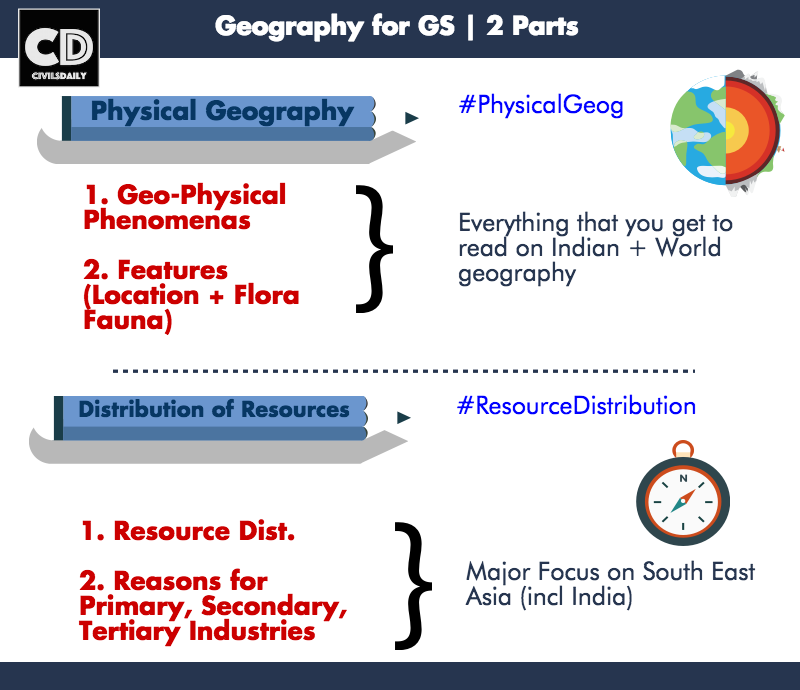
    1. Important Geophysical phenomena such as earthquakes, Tsunami, Volcanic activity, cyclone etc.
    2. Geographical features and their location-changes in critical geographical features (including water-bodies and ice-caps) and in flora and fauna and the effects of such changes.
    3. Distribution of key natural resources across the world (including South Asia and the Indian sub-continent)
    4. Factors responsible for the location of primary, secondary, and tertiary sector industries in various parts of the world (including India)
    Civilsdaily.com focuses on Current Geography News - Stories @Geography


    NOTE: The part of Paper 1 which deals with Indian Society, Issues etc. is the most neglected one. By and large, this part is dynamic in nature and can be easily dealt with if you are a regular at News Reading.

    We would recommend 2 things: 

    1. Try to be regular with The Hindu or Indian Express. Choose any and develop your own understanding of events and their inter-connections. If you are just starting out, you should read this post first.
    2. The Civilsdaily’s Android App is designed in a way that you get the most relevant Newsbytes in ~5 minutes in key point summaries. Use it judiciously along with your daily study schedule.

    Anything else that we can help with? Let us know!


  • An Infograph on the Daily Life of an IAS Aspirant

    These 5 pics best depict the “IAS ki Padai ke side effects”


    #1. From being a teetotaler at News to becoming a connoisseur of Opinions and Editorials


    #2. From watching HBO blockbusters in a 52″ LED TV to downloading RSTV debates from Youtube


    #3. Replacing the Dan Browns and JK Rowlings of the world with Sir Bipan Chandra and Sir Laxmikanth


    #4. Chilling at your home to moving on with friends and 10 other aspirants in a PG @Karol Bagh


    #5. 200 Rupey ki CCD wali Coffee to 10 Rupey ki Cutting Chai


    Had your share of laugh? Good. Now get down to some real work and read the essential strategies for clearing IAS Pre and Mains, here:


More posts