💥Mains Ready By December. Smash Mains & Smash PYQ Admissions Open

Search results for: “”

  • 20 September 2018 | High Relevance vs Low Relevance News

    Reading News for UPSC is utmost important and rising number of questions year on year in UPSC Prelims is a testimony of this

    We are starting a daily series where we will analyze news covered in The Hindu, Indian Express and other newspapers which are important from exam perspective and which are not

    Important news would have been covered in our daily news coverage in form of newscards.

    Unimportant ones will be mentioned here and a short description regarding why it is not relevant for the exam

    Click on news headlines to read the full news

    High relevance news

    Triple talaq is criminal offence

    https://www.civilsdaily.com/news/triple-talaq-is-criminal-offence/

    Read about provisions of the ordinance and the process of promulgating ordinances by the president. Important for Prelims.

    [pib] DAC Approves Procurement of Equipment Worth Rs 9,100 Crores

    https://www.civilsdaily.com/news/pib-dac-approves-procurement-of-equipment-worth-rs-9100-crores/

    Read about Akash missile systems and IUWBA. Important for Prelims.

    ITU South Asia area office and tech innovation centre to be set up in Delhi

    https://www.civilsdaily.com/news/itu-south-asia-area-office-and-tech-innovation-centre-to-be-set-up-in-delhi/

    Read about ITU. International organizations related questions are frequently asked in Prelims.

    Low Relevance News

    Nilakanth Vyas is Atomic Energy Commission chief

    Prominent scientist and Director, Bhabha Atomic Research Centre (BARC), Kamlesh Nilakanth Vyas, has been appointed Secretary, Atomic Energy, and Chairman, Atomic Energy Commission. The Appointments Committee of the Cabinet headed by PM cleared his name for the post.

    No important points in the news from exam perspective.

  • Batch 4: CD Prime Test Series for Prelims 2019

    We are now accepting admissions for Batch 4

    Join Batch 4 of Test series here: Click2Join

    Click2View the detailed schedule of test series with complete booklist to be followed.


    Get a 10% discount for early joiners. We will be extending the discount on this batch till 7th October (the date for the first test of this batch) to ensure that students join before tests start and they stay regular with the schedule

    UPDATE #2

    We are upgrading the program further to provide you more Comprehensive Preparation

    Apart from the static subject videos, now we will also provide Economic Survey & Budget Analysis Videos covering key concepts and important terms for Prelims 2019.  Economic Survey analysis will be available from 2016 to 2018 covering trends in Indian Economy as well as key issues related to it.

    That makes the total video lectures to be 75 hours

    UPDATE  #1

    Demolish UPSC series
    We are releasing 60+ Hours of Advanced Video Lectures on Static subjects – Polity, History, Geography, Economy

    These cover the most important topics from prelims perspective

    Basic knowledge will be helpful in understanding these though it’s not mandatory
    CD remains committed to its students’ success. We are ready to go the extra mile to turn your dreams into reality.

    Join Batch 4 of Test series here: Click2Join


    Here is the detailed schedule of lectures:

    Importance of Economic Survey and Budget

    Economic Survey and Budget are the 2 most important documents that you will go through in your exam preparation.

    • Economic Survey discusses all the major government initiatives with the explanation.
    • If we go by the trend, every year around 20 questions in prelims and 7-8 questions in mains are directly related to the Economic Survey and Budget.
    • Questions in prelims paper stress on important phrases, key analysis, and technical terms. Hence they have to be thoroughly studied.
    • Almost mandatory to imbibe actual phrases used in Economic Survey to frame answers for Main Examination. for example, if a Question is asked on Banking sector problems in the mains exam, you can always quote the 4R recommendations of the 2016th economic survey.
    • Adding the important and relevant facts and figures significantly enhance your marks in General Studies Paper-III.
    • Deep knowledge of the current policies and programs of the government also help an aspirant to write meaningful Essays in UPSC Civil Services Main Examination. For example, Wiping every tear from every eye “Twin balance sheet problem”, “translating potential into actuality” “ Chakravuyh challenge” etc.
    • According to the new trend economy and the environment is going hand in hand. So questions can come from that perspective also.
    • Many statistics and schemes are now being asked in Prelims

    Watch the video to know how we ensure you get 120+ score in Prelims

    The only TS that is supervised by top rankers and provides personalized attention to students. Check out the 7 points that make it the best in the market.

    Follow the video below to understand what makes the TS unique. Our planning and execution remains perfect.

    https://www.youtube.com/watch?v=QWUJ-nQWqkE


    It goes without saying that Civilsdaily’s Flagship Test Series Program has created a name for itself. It is preferred among students in their advanced stages of preparation.
    Here is what ABHILASH BARANWAL, AIR 44, CSE-2017 had to say about CD

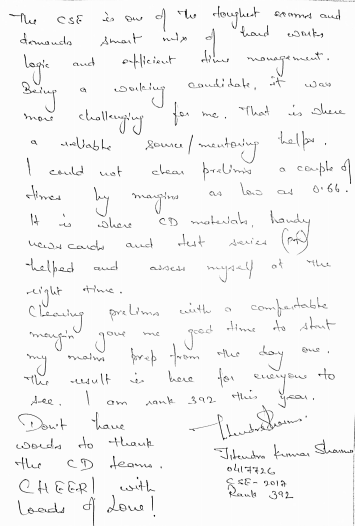
    Here is what  JITENDRA KUMAR SHARMA, AIR 392, CSE-2017 had to say –
    This year, we have upgraded the program to make it the best offering in the market.

    Introducing CD Prime TS 2019

    1. One comprehensive program – Our TS is a full-fledged course in itself! With a mix and match of various kinds of questions and detailed explanation wherever need. It is a very effective way of both, starting a subject and revising one.

    2. Telegram Groups moderated by to Toppers.  Mentorship taken to a whole new level. You will be helped at every step of the way.

    3. Introducing questions-types – Judging the quality of any TS is very subjective. While some will say its great, others will say its quality has decreased over time. That is why we have introduced the concept of question-types. They ensure consistency in quality. How? We have explained that in the end.

    4. Dedicated monthly CA Tests – Exclusive focus on Current Affairs(CA) by having dedicated monthly CA tests. Besides, exhaustively preparing for CA questions, it has helped students precisely figure out what their weaknesses are.  

    5. Tikdams and mastering the art of intelligent guesses – Tikdam Technique is an innovation by Dr. V(AIR 20) and has helped students gain additional marks. Our TS is the only TS that puts a conscious effort to build student’s risk-taking appetite.

    6. Subject and sub-subject Level Tagging – These tags will help you understand the importance of themes and revise other questions from them.

    7. Two-tier quality check  – Our questions pass through a rigorous true stage assessment criteria. The first being done by CD’s core content team with the final approval from a coterie of rankers.


    What are questions types 

    Wherever applicable, we will try to stick to the format decided below. It standardizes questions to a decent extent.

    A. Consolidation Questions
    These questions consolidate information from different topics to help you see concepts holistically and also aid retention.
    Eg. Consider this question. You would not have studied all the ‘Majorities’ together but under separate topics. This question will help you understand the concept in entirety.

    Consider the following questions on the types of Majority
    1. Special Majority of not less than 2/3 of the Members present and voting is required in the passage of a resolution under Art. 249 and Art. 312ONLY.
    2. Impeachment of the President requires Not less than 2/3 of the Members present and voting along with Majority of the Total Strength of the House.

    Which of the statements given above is/are correct?
    a)1
    b)2
    c)Both
    d)None

    Explanation – A very detailed account of the types of Majority is given here https://www.civilsdaily.com/types-of-majorities/
    Statement 1 is correct despite having ‘ONLY’ in it.

    B. Comparative Questions
    Comparative questions help you understand the relative differences between related topics. Consider the question below. Instead of asking a question on HC or SC separately, we have clubbed it together.

    Consider the following statements with respect to the appointment of judges of High Court & Supreme Court
    1. The minimum qualifications prescribed in the Constitution is same for judges of HC & SC.
    2. While SC judges are appointed by the President, HC judges are appointed by the SC.
    Which of the following is/are incorrect?
    a) 1 only
    b) 2 only
    c) Both 1 and 2
    d) None

    Explanation – 3 qualifications are common to both judges of HC and SC
    1. Citizen of India
    2. Judge of HC for 5 years
    3. Advocate in HC for 10 years
    In case of judges of SC, there is an additional qualification – If he/she is a distinguished Jurist in the opinion of the President. Judges of HC are also appointed by the President. The controversy around appointments has been in news very frequently. Please read – https://www.civilsdaily.com/story/judicial-appointments-conundrum-post-njac-verdict/

    C. Interactive Questions
    These questions will ask you to go through a concept/related concepts and reply back with comments. This will help you re-visit the entire concept rather than simply answer one specific aspect of the topic.

    Eg., consider the following question –
    The conversion of Ammonia (NH3) to nitrite (NO2-) and then to nitrates (NO3-) is called

    a) Nitrification
    b) Ammonification
    c) Assimilation
    d) Denitrification
    Answer A

    Explanation
    Nitrification
    In this process, the ammonia is converted into nitrate by the presence of bacteria in the soil. Ammonia is oxidized to form nitrites by bacteria such as Nitrosomonas species. Nitrates are converted into nitrates by Nitrobacter. This conversion is very important as ammonia gas is toxic for plants.
    Make a note of all the processes involved in the Nitrogen Cycle – nitrogen fixation, assimilation, ammonification, nitrification, and denitrification process.
    Leave their definitions/organisms involved in the comments.

    D. Star-marked/special questions
    These are advanced questions that are not from standard sources but relevant for the exam. These questions will help you build additional knowledge without going through specialized books.
    Eg. Questions on books by freedom-fighters, News not covered by the Hindu, IE, PIB but of very high importance in world affairs.

    Besides these, questions indirectly related to CA will also be asked. 

    Do I need to join a TS for prelims at all?

    Despite UPSC being unpredictable, prelims TS is the only program that can help you assess how your preparation is. Besides few questions that are directly asked from TS, it helps in developing a good understanding of how to prepare/what to prepare/what to prioritize and so on.

    In today’s hyper-competitive exam scenario, it’s almost impossible to clear the exam without a good TS in hand.

    Join Batch 4 of Test series here: Click2Join

  • [Burning Issue] Flat Income Tax Rate in India

    Why in News?

    1. Recently, the central government had formed a task force to draft a new Direct Tax law which seeks to replace the existing Income Tax Act, 1961.
    2. The Task Force will submit its report to the government on how to fix the more-than-50-year-old Income Tax Act, 1961.

    What is the flat tax rate?

    It is an income tax system in which everyone pays the same tax rate irrespective of income level. Therefore it is also named as proportional taxation system.

    What is the Need?

    1. India’s current tax system is progressive in nature, with tax rates going up when the income level goes up. To meet the changing economic needs of the country, and to fix the more than 50-year-old Income Tax Act, 1961 which is not consistent with present times, a flat tax rate system is necessary.
    2. To reinstate the Direct Tax Code (DTC) in a new structure.

    Arguments in favour

    1. A flat tax rate of 12% would be appealing even for low-income people.
    2. The compliance rate will increase by eight percentage points to 33%.
    3. While simplification and better administration of the law are major reforms that India needs, according to economists, some even suggest going for a flat tax system or lower tax system.
    4. The classic case of the flat tax system is of Hong Kong, Russia and New Zealand.
    • One of the poorest country during the World War II, Hong Kong adopted a flat tax in 1947 which led to higher compliance and dramatic economic growth.
    • Russia adopted a 13% flat tax, which went into effect in 2001 and Russia’s economy has expanded by about 10 percent since then. Russia’s income tax revenue has grown to more than 50% as people found it fair and easier to pay.
    • New Zealand is called BBLR — broader bases and lower rates — country. In New Zealand, the tax law experts focus on taking a lot of actions at a low rate, or flat rate and most importantly at the simpler tax code. New Zealand in 1980 did away with deductions and write-offs and instead applied the lowest rates on average workers. With higher compliance, New Zealand is one of the countries with the best income tax practices. Instead of imposing a progressive tax scheme, it gives it as an option for people.

    Arguments against

    1. India’s current tax system is progressive in nature, with tax rates going up when the income level goes up. India is a democratic country and is expected to invest in social welfare and infrastructure. Hence progressive tax rate is necessary.
    2. For a developing country like India, which is in the lower middle-income bracket, a flat tax structure may not be an equitable one. Income inequality in India is one of the highest, with 22 per cent of the national income going to top 1 per cent.
    3. Only with a progressive tax system, such wide income inequalities can be addressed. Hence a flat tax system will be regressive, considering India’s current situation.
    4. A system prescribing the higher rate of income tax for a higher income group helps garner revenue without becoming burdensome on lower income taxpayers
    5. The great success of Russia not just through the imposition of flat tax rate but through several changes in both the structure and the administration of taxes. The reforms widened the tax base by eliminating many exemptions and deductions as well as increasing taxes on capital income.

    India’s attempts to impose a flat rate

    1. An attempt to redraft the Income Tax Act made by the ex-finance minister P. Chidambaram in 2009 through the Direct Taxes Code (DTC). It proposed a simpler tax code and did away with unnecessary exemptions and created space for lower tax rates. However, the bill lapsed with the dissolution of the 15th Lok Sabha in 2014.
    2. The NDA government, since coming to power in 2014, has already implemented general anti-avoidance rules GAAR.
    3. In 2016 Finance Minister promised to lower corporate tax rate to 25% in 5 years.
    4. Currently, income up to Rs 2.5 lakh per annum is exempt from tax for individuals.

    Way forward

    Flat income tax rate has many success stories from many countries. Hence it is high time that India also adopts it. However, it should be implemented as a pilot project to monitor various impacts and come up with effective solution to prevent various challenges in the actual implementation. And the government should also ensure that the poor are not affected from this reform.

    Practice question

    1. What do you understand by the flat income tax rate? Discuss whether implementing a flat income tax rate in a democratic country like India is feasible or not.
  • 19 September 2018 | High Relevance vs Low Relevance News

    Reading News for UPSC is utmost important and rising number of questions year on year in UPSC Prelims is a testimony of this

    We are starting a daily series where we will analyze news covered in The Hindu, Indian Express and other newspapers which are important from exam perspective and which are not

    Important news would have been covered in our daily news coverage in form of newscards.

    Unimportant ones will be mentioned here and a short description regarding why it is not relevant for the exam

    Click on news headlines to read the full news

    High relevance news

    [pib] ‘e-Sahaj’ portal for grant of Security Clearance

    https://www.civilsdaily.com/news/pib-e-sahaj-portal-for-grant-of-security-clearance/

    Read about e Sahaj portal and national security clearance. Important for Prelims.

    [pib] New operational guidelines for Pradhan Mantri Fasal Bima Yojana (PMFBY)

    https://www.civilsdaily.com/news/pib-new-operational-guidelines-for-pradhan-mantri-fasal-bima-yojana-pmfby/

    Read about PMFBY. Becomes important in the context of the agricultural crisis in India and the need to protect farmers.

    [pib] C-DAC Information Media Server (CIMS)

    https://www.civilsdaily.com/news/pib-c-dac-information-media-server-cims/

    Read about CIMS and its applications. Can be asked in Prelims.

    [pib] Medical Cyclotron Facility Cyclone-30, Kolkata

    https://www.civilsdaily.com/news/pib-medical-cyclotron-facility-cyclone-30-kolkata/

    Know the details of the project and technical specifications. This type of questions are a common sight in Prelims.

    Low Relevance News

    Assam draft NRC: Supreme Court orders resumption of filing of claims, objections by 40 lakh left-out people

    The Supreme Court has ordered the resumption of filing of claims and objections by around 40 lakh people who were left out in the draft National Register of Citizens (NRC) of Assam

    Assam, which had faced an influx of people from Bangladesh since the early 20th century, is the only State having an NRC, which was first prepared in 1951

    No important points in the news except the above fact.

  • 18 September 2018 | Prelims Daily with Previous Year Questions

    Q.1) Which of the following international Protocol/Treaty deals with phasing out of Ozone depleting substances?

    a) Kyoto Protocol

    b) Montreal Protocol

    c) Geneva Protocol

    d) Kigali Agreement

    Inspired by: [pib] India first country in the world to develop Cooling Action Plan

    https://www.civilsdaily.com/news/pib-india-first-country-in-the-world-to-develop-cooling-action-plan/


    Q.2) Recently the India Cooling Action Plan (ICAP) was released by-

    a) NITI Aayog

    b) Ministry of Environment, Forest and Climate Change

    c) Bureau of Energy Efficiency

    d) Ministry of Commerce and Industry

    Inspired by: [pib] India first country in the world to develop Cooling Action Plan

    https://www.civilsdaily.com/news/pib-india-first-country-in-the-world-to-develop-cooling-action-plan/

    Q.3) With reference to the MPs Local Area Development Scheme (MPLADS), which of the given statements is/are not correct?

    1. It is a programme is funded and administered by Ministry of Home Affairs.
    2. It allots ₹5 crore per year to each Member of Parliament (MP) to be spent on projects of their choice in their constituency.
    3. This scheme doesn’t apply to the nominated members of both houses and Members of Rajya Sabha.

    Select the correct codes:

    a) All of the above

    b) 1 and 3

    c) 2 and 3

    d) Only 3

    Inspired by: CIC wants break-up of how MPLADS funds are utilized

    https://www.civilsdaily.com/news/cic-wants-break-up-of-how-mplads-funds-are-utilized/

    Q.4) Recently Kerala Tourism’s won the prestigious gold awards of the Pacific Asia Travel Association (PATA). In context to the PATA which of the following statements is/are correct?

    1. It is an autonomous arm of the UNESCO.
    2. The PATA Awards are presented to outstanding entries in the principal categories of Marketing; Education and Training; Environment, and Heritage and Culture.

    Select the correct codes:

    a) Both 1and 2

    b) Only 1

    c) Only 2

    d) None of the above

    Inspired by: Kerala Tourism bags coveted awards

    https://www.civilsdaily.com/news/kerala-tourism-bags-coveted-awards/

    Q.5) With reference to the shifting cultivation in India, which of the following pairs are correctly matched?

    1. Jhum – Assam
    2. Ponam – Kerala
    3. Podu – Odisha
    4. Bewar masha penda – Jharkhand

    Select the correct code:

    a) All of the above

    b) 1, 2 and 3

    c) 1 and 4

    d) 2 and 3

    Inspired by: NITI Aayog for clear policy on ‘jhum’ cultivation

    https://www.civilsdaily.com/news/niti-aayog-for-clear-policy-on-jhum-cultivation/


    For Solutions – Click Here

    Prelims Daily Archive – Click here

  • Learn Marker Technique for Better Memory

    This video is made by Piyush Sadangi under the CD Launchpad initiative

    Use Headphones for better voice quality

    It discusses a unique methodology named Marker Technique to remember things in a better way.

    Let us know the review in the comments

  • [Burning Issue] Environmental Performance Index 2018

    Why in News?

    India ranks 177 among 180 countries in the Environmental Performance Index 2018.

    A drop in the rank from the last index demands a relook at the country’s environmental policy.

    About Environmental Performance Index?

    1. It is a biennial report published by Yale and Columbia Universities in collaboration with the World Economic Forum.
    2. It ranks 180 countries based on 24 performance indicators.
    3. It is divided into 10 categories covering environmental health and ecosystem validity.
    4. Top rank in sustainability taken by Switzerland, followed by France, Denmark, Malta and Sweden in the recent EPI.

    India’s status

    1. India at the 177th place is one of the bottom 5 countries on the index.
    2. The 177th place is a drop of 36 points from 141 in 2016.
    3. Emerging economies like Brazil and China ranks at 69 and 120.
    4. India is at the bottom of the environmental health category.
    5. In terms of air quality, India is at third last.
    6. Poor performance in the environmental health policy and high pollution-related deaths are the major factors in the overall drop.
    7. Other major causes include pollution from solid fuels, coal and crop residue burning and emissions from motor vehicles.
    8. Increasingly degrading air quality in India is attributed to the growth in population, industrial production, and automotive transportation.

    Concerns

    Health

    1. Air quality is the leading environmental threat to public health
    2. Over the past decade, the deaths due to a large rise in ultra-fine PM 2.5 particles in the country.
    3. An estimated 1.4 million premature deaths in India is due to Air pollution.

    Economy

    1. Health impacts cause a serious loss in welfare equivalent to about 8% of GDP in 2013.
    2. The cost of labor productivity became 1.8% of GDP.
    3. Environmental degradation particularly affects the poor and further degrades their standard of living.

    Measures taken

    Over the past few years, the government has set some ambitious targets for environmental protection as follows

    1. Strict environmental standards for coal-fired power plants.
    2. Bharat Stage VI emission norms to be implemented from April 1, 2020.
    3. Initiatives to manufacture and sell electric vehicles in the country by 2030.
    4. Revision of National Solar Mission.
    5. Encouraging transition to renewable energy.
    6. The target for solar capacity revised from 20GW to 100 GW by 2022.
    7. Target to clean highly polluted Ganga by 2018.

    Challenges

    1. There is a huge gap between policy goals and enforcement.
    2. On solar targets, India seems to be moving in the right path. However, balancing it with other goals is seriously lacking.
    3. For example,
    • The government has relaxed its promise of implementing strict power plant emission norms by December 2017.
    • The 30% annual E-waste collection target by manufacturers has been relaxed to 10%.
    1. The automobile industry has stated that full conversion to electric vehicles is possible only by 2047 which is in contrast to the government’s targets.
    2. In the clean Ganga initiative, there have been delays in creating an action plan and lack of proper fund utilization.

    Way forward

    1. In order to address the environmental problems, there is a need to recognize the environmental costs of development.
    2. Subsidies shall be given in order to accelerate the transition to renewable, particularly solar energy.
    3. More polluting fuels should be priced higher.
    4. The environmental standards for coal power plants should be strict.
    5. Petrol and Diesel should be priced higher in order to aid the transition to electric vehicles.
    6. More political will is required to effectively implement the existing environmental laws and regulations.
    7. Considering India’s poor performance in the index, the government should take forward the environmental targets seriously.

    Practice question

    1. “India’s performance in the recent Environmental Performance Index was poor”. Discuss various reasons for the same and suggest suitable measures to improve India’s ranking.
  • 18 September 2018 | High Relevance vs Low Relevance News

    Reading News for UPSC is utmost important and rising number of questions year on year in UPSC Prelims is a testimony of this

    We are starting a daily series where we will analyze news covered in The Hindu, Indian Express and other newspapers which are important from exam perspective and which are not

    Important news would have been covered in our daily news coverage in form of newscards.

    Unimportant ones will be mentioned here and a short description regarding why it is not relevant for the exam

    Click on news headlines to read the full news

    High relevance news

    [pib] India first country in the world to develop Cooling Action Plan

    https://www.civilsdaily.com/news/pib-india-first-country-in-the-world-to-develop-cooling-action-plan/

    Read about ICAP and India’s effort in controlling global warming. Important for Prelims.

    CIC wants break-up of how MPLADS funds are utilized

    https://www.civilsdaily.com/news/cic-wants-break-up-of-how-mplads-funds-are-utilized/

    Read about the MPLADS scheme for Prelims. How it has not been a success can be a topic for Mains.

    NITI Aayog for clear policy on ‘jhum’ 

    https://www.civilsdaily.com/news/niti-aayog-for-clear-policy-on-jhum-cultivation/

    Jhum cultivation and other types of shifting cultivation can be asked in Prelims along with the areas in which they are practised.

    Low Relevance News

    India urges Pakistan to create conducive environment for talks

    India has urged Pakistan to create a ‘conducive’ environment for restarting dialogue

    No important points in the news from the exam perspective


  • 17 September 2018 | Prelims Daily with Previous Year Questions

    Q.1) In context to the HIV estimation in India, consider the following statements:

    1. The first round of HIV estimation in India was done in 1998.
    2. NACO undertakes HIV estimations biennially in collaboration with the Indian Council of Medical Research (ICMR).

    Which of the given statements is/are correct?

    a) Only 1

    b) Only 2

    c) Both 1 and 2

    d) None of the above.

    Inspired by: NACO releases HIV Estimations 2017 report

    https://www.civilsdaily.com/news/naco-releases-hiv-estimations-2017-report/

    Q.2) Which of the following statements about India’s first underwater robotic drone EyeROV Tuna, is NOT correct?

    a) It is developed by Naval Physical and Oceanographic Laboratory (NPOL) of DRDO.

    b) It can be easily accessed and controlled with the supporting attached and connected hardware such as laptops and joysticks.

    c) It can be navigated up to a depth of 50 metres to take real-time HD video images to examine ship hulls or undersea cables or bridge moorings.

    d) It weighs less than 10 kilogram and can be used for inspection of ship hulls, ports, dams and nuclear power plants.

    Inspired by: EyeROV TUNA: India’s first Underwater Robotic Drone

    https://www.civilsdaily.com/news/eyerov-tuna-indias-first-underwater-robotic-drone/


    Q.3) With reference to the Biochemical Oxygen Demand (BOD) consider the following statements:

    1. It is the amount of dissolved oxygen required by aerobic biological organisms to break down organic material present in a given water sample.
    2. It is most commonly expressed in litres of oxygen.

    Which of the given statements is/are correct?

    a) Only 1

    b) Only 2

    c) Both 1 and 2

    d) None of the above

    Inspired by: More river stretches are now critically polluted: CPCB

    https://www.civilsdaily.com/news/more-river-stretches-are-now-critically-polluted-cpcb/


    Q.4) Prolonged consumption of fluoride-contaminated water leads to dental and skeletal fluorosis. With reference to the fluorosis, which of the given statements is/are correct?

    1. Consumption of water having fluoride content above 1.5 mg per litre is considered dangerous to health.
    2. Mottled teeth and crippled backbone and limbs are manifestation of the disease.
    3. Presently there is no medication available against fluorosis but phasing out the use of excess fluoride polluted water can be done.

    Select the correct codes:

    a) All of the above

    b) 1 and 2

    c) 2 and 3

    c) Only 3

    Inspired by: Many Odisha schoolchildren hit by fluoride contamination

    The Hindu

    Q.5) With reference to the Chiller Star Labelling Program, consider the following statements:

    1. It has been formulated by Ministry of New and Renewable Energy.
    2. It will promote advancement technology for central HVAC (Heating, ventilation, and air conditioning) systems to improve energy efficiency.

    Which of the given statements is/are correct?

    a) Both 1 and 2

    b) Only 1

    c) Only 2

    d) None of the above.

    Inspired by: Power Ministry launches ambitious program on energy efficiency in Chillers

    Press Information Bureau


    For Solutions – Click Here

    Prelims Daily Archive – Click here

  • [Burning Issue] Draft Space Activity Bill 2017

    Why in News?

    1. Recently, India’s draft space activity bill, 2017 was unveiled
    2. It aims at promoting and regulating the space activities in India
    3. The legislation is expected to encourage both public and private players to participate in India’s space programme.

    Why is there a need for a space law?

    1. Currently, space activities are regulated by policies like Satellite communication policy, 2000 and Remote Sensing Data Policy, 2011. But there is a need for the proper legal environment for orderly performance and growth of the space sector.
    2. Nations such as the USA, Russia, UK, etc. have their own space legislation. Even China and Japan are in the process of formulating their own domestic space legislation.
    3. Earlier, ISRO was the sole player in the space sector. However lately, there have been many start-ups mushrooming in this sector, which calls for a regulatory mechanism and legislation to govern their activities.
    4. Furthermore, the demand for Indian space products has been growing both in the country and outside the country. So it is necessary to include Indian industry and service providers in space activities under the technical guidance of the Department of Space (DOS) and the growth of the Indian space sector.
    5. A legislation is required as India is obligated to UN outer space treaties which require signatories to have a national legislation in place.

    What are the key features of the bill?

    1. The provisions would be applicable to all citizens and also to those sectors which are engaged in space activity either inside or outside the country.
    2. It provides for the grant of a non-transferrable license to those people engaged in commercial space activity.
    3. It provides for the appropriate mechanisms for licensing, eligibility criteria and fees for the license.
    4. Union government will have to maintain a register of space objects that are launched or to be launched around the earth.
    5. It provides for technical support in order to facilitate commercial space activity.
    6. It also provides for regulatory procedures for conduct and operation of space activity.
    7. It provides for restrictions in sharing of details regarding the pricing of products created through space activity with any person or agency.
    8. It provides for punishment for persons involved in illegal commercial space activities with imprisonment up to 3 years or fine more than Rs 1 crore or both
    9. It also has provisions for the protection of IPR created through space activity.

    Arguments favouring the bill

    1. Definition: The bill clearly defines space players, licenses, violations, objects, people, and geography. It is also proposed to define detailed guidelines in consultation with stakeholders and industry bodies.
    2. Promotion: The bill encourages non-governmental players to take the risk and invest in space activities in India. This will make India a commercial hub for space activities and generate jobs in the country.

    Arguments against the bill

    1. Clarity: Experts have criticized the bill for its lack of clarity on the use of space objects.
    2. Regulation: It gives arbitrary power to the government for monitoring the research activities. This would scare away international investors from investing in the space sector of India.
    3. Liability: The bill made the government non-liable for any harm caused by the commercial activities by the non-governmental players in space even though the government gives clearance for their involvement in the space activities.

    Way forward

    The bill is a welcome step in promoting the space sector. But to enable competitive ecosystem in the space sector there is a need to conduct a review of international best practices in managing the space value chain and inducting them within the Act.