💥Mains Ready By December. Smash Mains & Smash PYQ Admissions Open

Search results for: “”

  • NPA Crisis

    • What is NPA?
    • Impact of NPA on economy
    • Reasons for the rise in NPA in recent years
    • Why most NPA in Public sector?
    • Steps taken by RBI and Government in last few years to curb NPA
    • How to curb the menace of NPA

    source

    According to RBI’s recent data, the gross non-performing assets (NPAs) of public sector banks are just under Rs 4 lakh crore, and they collectively account for 90 percent of such rotten apples in the country’s banking portfolio.

    In terms of net NPAs, their share is even higher – at 92 percent of the total bad loans reported so far in the banking system. The total NPAs of Indian banks, as a percentage of the total loans, has grown from 2.11 per cent(2008) to 5.08 percent(2016).

    In this article we will explain what is NPA, The reason why NPA increased in India and steps taken by Government in recent years to curb the menace of NPA and what else needs to be done.

    What is NPA?

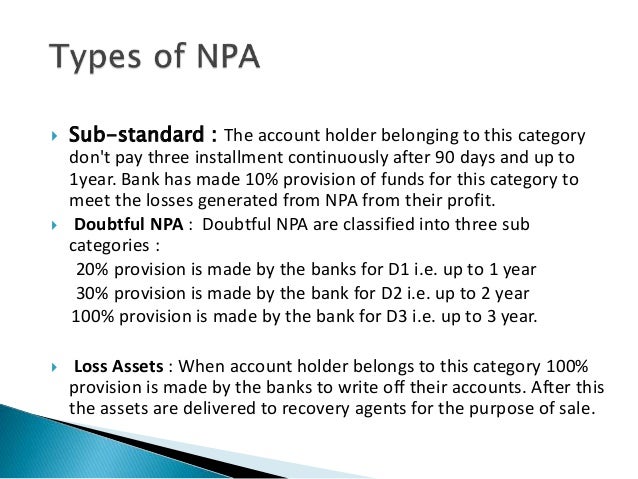
    • The assets of the banks which don’t perform (that is – don’t bring any return) are called Non Performing Assets (NPA) or bad loans. Bank’s assets are the loans and advances given to customers. If customers don’t pay either interest or part of principal or both, the loan turns into bad loan.
    • According to RBI, terms loans on which interest or instalment of principal remain overdue for a period of more than 90 days from the end of a particular quarter is called a Non-performing Asset.
    • However, in terms of Agriculture / Farm Loans; the NPA is defined as under: For short duration crop agriculture loans such as paddy, Jowar, Bajra etc. if the loan (installment / interest) is not paid for 2 crop seasons, it would be termed as a NPA. For Long Duration Crops, the above would be 1 Crop season from the due date.
    source

    Impact of NPA on Economy

    The problem of NPAs in the Indian banking system is one of the foremost and the most formidable problems that had impact the entire banking system. Higher NPA leads to following adverse impact on Economy:

    1. Depositors do not get rightful returns and many times may lose uninsured deposits. Banks may begin charging higher interest rates on some products to compensate Non-performing loan losses
    2. Bank shareholders are adversely affected
    3. Bad loans imply redirecting of funds from good projects to bad ones. Hence, the economy suffers due to loss of good projects and failure of bad investments
    4. When bank do not get loan repayment or interest payments, liquidity problems may ensue.

    Reasons for the rise in NPA in recent years

    • GDP slowdown: Between early 2000’s and 2008 Indian economy were in the boom phase. During this period Banks especially Public sector banks lent extensively to corporates. However, the profits of most of the corporate dwindled due to slowdown in the global and domestic economy, bans in mining projects, delays in environmental related permits ,Land acquisition hurdles and volatility in prices of raw material. This has adversely affected their ability to pay back loans and is the most important reason behind increase in NPA of public sector banks.
    • Relaxed lending Norms: One of the main reasons of rising NPA was the relaxed lending norms especially for corporate honchos when their financial status and credit rating was not analyzed properly. Also, to face competition banks were hugely selling unsecured loans .
    • Priority Sector Lending: There is a myth that main reason for rise in NPA in Public sector banks was Priority sector lending as according to the findings of Standing Committee on Finance , NPAs in the corporate sector are far higher than those in the priority or agriculture sector. However, even if PSL is not the main cause but it is still a cause for rising NPA which can be seen from the fact that As per the latest estimates by the SBI, education loans constitute 20% of its NPAs.
    • The Lack of Bankruptcy code in India and sluggish legal system makes it difficult for banks to recover these loans from both corporate and noncorporate.

    Other factors

    • Banks did not conducted adequate contingency planning, especially for mitigating project risk. They did not factor eventualities like failure of gas projects to ensure supply of gas or failure of land acquisition process for highways.
    • Restructuring of loan facility was extended to companies that were facing larger problems of over-leverage & inadequate profitability. This problem was more in the Public sector banks.
    • Companies with dwindling debt repayment capacity were raising more & more debt from the system.

    Why most NPA in Public sector?

    • Five sectors Textile, aviation, mining, Infrastructure contributes to most of the NPA, since most of the loan given in these sector are by PSB, they account for most of the NPA.
    • Public Sector banks provide around 80% of the credit to industries and it is this part of the credit distribution that forms a great chunk of NPA. Last year, when kingfisher was marred in financial crisis, SBI provided it huge amount of loan which it is not able to recover from it.
    • Less Professional management
    • Political Pressure and interference forces PSB to lend to not so commercially sounds project.

    Steps taken by RBI and Government in last few years to curb NPA

    • Government has launched Mission Indradhanush to make the working of public sector bank more transparent and professional in order to curb the menace of NPA in future.
    • Government has also proposed to introduce Bankruptcy code which will make it easier for banks to Recover the loans from the debtors.
    • RBI introduced number of measures in last few years which include:
      • Tightening the Corporate Debt Restructuring (CDR) mechanism,
      • Setting up a Joint Lenders’ Forum, prodding banks to disclose the real picture of bad loans, asking them to increase provisioning for stressed assets,
      • Introducing a 5:25 scheme where loans are to be amortized over 25 years with refinancing option after every five years, and
      • Empowering them to take majority control in defaulting companies under the Strategic Debt Restructuring (SDR) scheme.

    How to curb the menace of NPA?

    #1. Short Term measures

    • Review of NPA’S/Restructured advances- We need to assess the viability case by case. Viable accounts need to be given more finance for turnaround and unviable accounts should either be given to Asset Reconstruction Company or Management/ownership restructuring or permitting banks to take over the units.
    • Bankruptcy code should be passed as soon as possible. Bankruptcy code will make it easier for banks to recover loans from unviable enterprises.
    • Government should establish ARC with equity contribution from the government and the Reserve Bank of India (RBI). The established ARC should take the tumor (of non-performing assets or NPAs) out” of the banking system. An ARC acquires bad loans from banks and financial institutions, usually at a discount, and works to recover them through a variety of measures, including sale of assets or a turnaround steered by professional management. Relieved of their NPA burden, the banks can focus on their core activity of lending.

    #2. Long term Measures

    • Improving credit risk management– This includes credit appraisal, credit monitoring, and efficient system of fixing accountability and analyzing trends in group leverage to which the borrowing firm belongs to
    • Sources/structure of equity capital– Banks need to see that promoter’s contribution is funded through equity and not debt.
    • Banks should conduct necessary sensitivity analysis and contingency planning while appraising the projects and it should built adequate safeguards against such external factors.
    • Strengthen credit monitoring– Develop an early warning mechanism and comprehensive MIS(Management information system) can play an important role in it.MIS must enable timely detection of problem accounts, flag early signs of delinquencies and facilitate timely information to management on these aspects.
    • Enforce accountability- Till now lower ring officials considered accountable even though loaning decisions are taken at higher level. Thus sanction official should also share the burden of responsibility.
    • Restructured accounts should treated as non performing and technical write offs where Banks remove NPA’S from their balance sheets Permanently should be dispensed with.
    • Address corporate governance issues in PSB- This includes explicit fit and proper criteria for appointment of top executives and instituting system of an open market wide search for Chairman.

    References:

  • संपादकीय और विचार, 16 अप्रैल: बाबासाहेब अम्बेडकर, लोक अदालत और पल्माइरा की कहानी

    आज के लिंक-

    1. लोक अदालत : विवादों के निपटारे की एक वैकल्पिक व्यवस्था

    लिंक- http://www.deshbandhu.co.in/newsdetail/13080/9/200#.VxHdQdR97IU

    (लोक अदालत भारत में विवादों के निपटारे की एक वैकल्पिक व्यवस्था है। विधिक सेवा प्राधिकरण अधिनियम की धारा 19(5) के अनुसार लोक अदालत को अधिकारिता प्राप्त है। लोक अदालत के विषय में विस्तृत जानकारी आप उपरोक्त लिंक से प्राप्त कर सकते हैं)

    2. डॉ. अम्बेडकर जीवन दर्शन

    लिंक- http://pib.nic.in/newsite/hindifeature.aspx?relid=47181

    (पीआइबी पर प्रकाशित इस लेख में आप बाबासाहेब अम्बेडकर के जीवन की कुछ बातों को जान सकेंगे. हालांकि उनके जीवन को जानने के लिए यह आलेख नाकाफ़ी है लेकिन फिर भी मूलभूत जानकारी के लिए इसे पढ़ा जाना चाहिए)

    3. महज दो साल में ये शहर तबाह हो गया

    लिंक- http://www.bbc.com/hindi/international/2016/04/160415_vert_cul_palmyra_ruins_cj

    (यह कहानी सीरिया के शहर पल्माइरा की है, जो उजड़ चुका था, फिर भी उजाड़ दिया गया. जब इस्लामिक स्टेट ने पिछले साल पल्माइरा पर कब्ज़ा कर लिया, तो उन्होंने इस ऐतिहासिक शहर के खंडहरों को डायनामाइट से उड़ा दिया. इस बारे में आप बीबीसी पर प्रकाशित इस रिपोर्ट को पढ़िए.)

  • sri

    please provide news in TELUGU if possible along with hindi.

  • हिंदी संपादकीय और विचार: 15 अप्रैल

    आज के लिंक-

    1. ‘सागरमाला’ राष्‍ट्रीय परिप्रेक्ष्‍य योजना प्रस्‍तुत की गई

    लिंक- http://pib.nic.in/newsite/hindirelease.aspx?relid=47245

    (सागरमाला सरकार का एक प्रमुख कार्यक्रम है जिसका उद्देश्‍य देश में बंदरगाहों की अगुवाई में विकास की गति तेज करना है. यह योजना चार रणनीतिक पहलुओं पर आधारित है, वे रणनीतियाँ कौन कौन सी हैं, इसके बारे में आप उपरोक्त लिंक पर क्लिक कर जान सकते हैं.)

    2. ई-मंडी की पगडंडी

    लिंक- http://hindi.business-standard.com/storypage.php?autono=117711

    (सरकार द्वारा ई-मंडी की शुरुआत की गई है. नया एकीकृत इलेक्ट्रॉनिक मंच सीमित तरीके से शुरू हुआ है लेकिन फिर भी यह किसानों की तमाम समस्याओं को हल करेगा. देश के सभी 585 प्रमुख बाजारों को मार्च 2018 तक ई-प्लेटफार्म से जोडऩे की योजना है. उपरोक्त लिंक से इस बारे में और जानिये)

    3. क्यों कोलार खदान के फिर खुलने से देश की जेब पर पड़ रहा बोझ कुछ कम हो सकता है

    लिंक- http://satyagrah.scroll.in/article/100421/opening-of-kolar-mines-can-reduce-indias-import-bill

    (सिंधु घाटी सभ्यता से लेकर ब्रिटिश हुकूमत और फिर आजाद भारत तक भरपूर सोना देती रही कोलार खदान को सरकार फिर शुरू करने वाली है. उपरोक्त लिंक द्वारा आप कोलार के बारे में कई महत्वपूर्ण तथ्य और जानकारी हासिल कर सकते हैं.)

  • श्रमेव जयते, वित्तीय समावेशन और अंत्योदय: विस्तृत आलेख श्रृंखला(भाग-3)

    मित्रों,
    विस्तृत आलेख श्रृंखला के इस भाग में आज आप सरकार की तीन योजनाओं के बारे में जानेंगे- श्रमेव जयते कार्यक्रम, जन धन से जन सुरक्षा और अंत्योदय योजना. उम्मीद है इस श्रृंखला के पिछले दो भाग आपने ज़रूर पढ़े होंगे. आज के अनुवाद पढ़ने के लिए आपको पिछली बार की तरह ही नीचे दिए गए लिंक पर जाना है और सीडी एक्सप्लेन(CD Explain) पर क्लिक करना है.

    1. पंडित दीनदयाल उपाध्याय श्रमेव जयते कार्यक्रम

    लिंक- https://www.civilsdaily.com/pandit-deendayal-upadhyay-shramev-jayate-karyakram/

    2. जन धन से जन सुरक्षा तक- वित्तीय समावेशन और सुरक्षा की ओर

    लिंक- https://www.civilsdaily.com/story/financial-inclusion-in-india-and-its-challenges/

    3. दीनदयाल उपाध्याय अंत्योदय योजना

    लिंक- https://www.civilsdaily.com/deen-dayal-upadhyaya-antyodaya-yojana/

    इस श्रृंखला का पिछले भाग जिसमें हमने हेल्प, नीरांचल और नई पूंजीगत वस्तु नीति के बारे में बताया था, उन्हें पढ़ने के लिए नीचे दिए लिंक पर क्लिक कीजिये. हमारी कोशिश रहेगी कि प्रत्येक तीन दिनों के अंतराल पर इस श्रृंखला को आगे बढ़ाते रहें.

    भाग- 2 https://www.civilsdaily.com/%E0%A4%B9%E0%A5%87%E0%A4%B2%E0%A5%8D%E0%A4%AA-%E0%A4%A8%E0%A5%80%E0%A4%B0%E0%A4%BE%E0%A4%82%E0%A4%9A%E0%A4%B2-%E0%A4%94%E0%A4%B0-%E0%A4%AA%E0%A5%82%E0%A4%82%E0%A4%9C%E0%A5%80%E0%A4%97%E0%A4%A4/

  • Maritime India Summit 2016: Key Takeaways

    Maritime India Summit 2016 (MIS 2016) is a maiden flagship initiative of the Ministry of Shipping.

    Maiden = First time ever. First time ever translates to a higher probability of it finding its way in the IAS Prelims this year.

    Why do we say so? If you wrote the IAS prelims in 2014, you would remember the National Biodiversity Express initiative launched by GoI that year and how a few questions from E&B found their source in the released pamphlet. So, no harm in giving this a look, right?

    Focus Area for intervention which are important for your review:

    • Port Modernization
    • New Port Development
    • Inland Waterways
    • Green Initiatives in Ports

    Maritime Potential of Indian States

    If you are loath to read through the commentary, make sure you go through this infographic (in desktop mode – click on the pic to enlarge) & make quick notes.


    #1. Port Modernization

    India has 12 Major Ports, administered by the Central Government, and around 200 notified Non-Major Ports, administered by the State Governments. In 2014-15, out of the 200 Non-Major Ports, 69 ports were reported to have handled cargo traffic.

    • Kandla was the last major port built by India – 1950
    • India plans to add 8 major ports to this list of 12. Source: ET

    Fodder points – 

    1. The infrastructure sector, particularly the Maritime Sector, is expected to grow significantly with the increase in international and domestic trade volumes
    2. Since about 95% of India’s trade by volume is via the maritime route (Source : NTDPC), there is a continuous need to develop India’s ports and trade related infrastructure to accelerate growth in the manufacturing industry and to aid the ‘Make in India’ initiative.

    #2. New Port Development

    Why is there a need you may ask?

    1. Capacity Saturation – Ports such as JNPT, Paradip have limited capacity to expand and are saturated with traffic
    2. Non-availability of Ports – There are few specific stretches along the coastline which do not have an operational port. In absence of the port at such locations, the cargo is forced to travel longer distances to use alternate ports
    3. Strategic Locations – The southern tip of India is optimally located as it falls under the East-West trade route. However most of transshipment cargo from India is dependent on ports of Colombo and Singapore. Hence, we need to fulfill this need

    Potential Projects? Greenfield major ports to be developed at

    • Vadhavan (Maharashtra) – MOU was signed by JNPT. Read here.
    • Sagar Island (West Bengal) – This island, also known as Gangasagar or Sagardwip, is a place of Hindu pilgrimage
    • Paradip Satellite Port (Odhisha) – What is a satellite port?
    • Cuddalore/Sirkazhi (Tamil Nadu)
    • Machilipatnam/Vodarevu

    Question: Find out the difference between Greenfield and Brownfield projects. A term often used in PPP parlance. 

    #3. Inland Waterways

    India has an extensive network of inland waterways in the form of rivers, canals, backwaters and creeks. Of the total navigable length of 14,500 km, 5200 km of the river and 4000 km of canals can be used by mechanized crafts.

    India has recognized 106 waterways of which 6 are declared as national waterways – 


    #4. Green Initiatives in Ports

    • Solar and wind based power systems at all the Major Ports across the country
    • What’s the plan? Solar energy capacity at 8 major ports + Wind energy capacity at 3 major ports

    Key initiatives (Fodder points):

    • The Ministry of Shipping has recently introduced an incentive scheme under which the Ministry will share up to 50% of the total project cost that promote the use of green energy
    • Anti-fouling System Convention of International Maritime Organization has been incorporated in the Merchant Shipping Act, 1958
    • Use of bio-diesel at Haldia Dock Complex


    Sources: http://www.maritimeinvest.in 

    If you have time and you want to venture out and see the other heads of developments, do go and visit the website, especially carved out for this summit. 

  • National Agricultural Market: How is this a necessity for India?

    Scope of discussion

    • State of Indian Agriculture & renewed focus on increasing a farmer’s income – Facts
    • What was wrong with APMCs? Mains
    • Quick facts on NAM – Prelims

    State of Indian Agriculture & renewed focus on increasing a farmer’s income

    If we go back in time (aug 2015) and read this PIB release – National Agricultural Market – A Harbinger of Change, we would realise that government realised (yet again) the importance of agriculture in Indian economy.

    While the Government has rolled out large number of programmes to improve yield levels on a sustainable basis, it recognises the need for creating a competitive market structure in the country that will generate marketing efficiency.

    Question: Good time to go back in time and revise the programs launched to improve yield levels. Would you like to write them out for us in the comments?

    The net result out of this concern this –

    The Department of Agriculture & Cooperation formulated a Central Sector scheme for Promotion of National Agriculture Market through Agri-Tech Infrastructure Fund (ATIF) through provision of the common e-platform.

    What was wrong with APMCs?

    Here’s a crisp answer from Quora,

    The APMC (Agricultural Produce Market Committees) is a relic of the past that forces the farmers to sell their produce only to middlemen approved by the government in authorized Mandis (markets). Thus, if you are a vegetable producer and I’m a supermarket, I cannot directly buy from you. Both of us need to go through a broker. This increases prices for the end buyer and unnecessarily adds redtape.

    • An Agricultural Produce Market Committee is a marketing board established by state governments of India
    • One main function of which is basically to provide a platform for farmers to sell their produce

    The challenges posed by present day APMCs – 

    1. Fragmentation of State into multiple market areas, each administered by separate APMC
    2. Separate licences for each mandi are required for trading in different market areas within a state. This means that we have limited the first point of sale for the farmer. He has to come to the local mandi – which could be both good and bad depending upon how it is governed
    3. Licensing barriers leading to conditions of monopoly
    4. Opaque process for price discovery

    The need to unify the markets both at State and National level was therefore, clearly the requirement of time. Think of it as an e-commerce platform with a marketplace model and not an inventory one. Every farmer has his own webpage (or something to the tune of that).

    Quick facts on NAM

    National Agriculture Market is going to implemented by the Department of Agriculture & Cooperation through Small Farmers Agribusiness Consortium (SFAC).

    NAM is not replacing the mandis. NAM is an online platform with a physical market or mandi at the backend enabling buyers situated even outside the state to participate in trading at the local level.

    It seeks to leverage the physical infrastructure of mandis through an online trading portal, enabling buyers situated even outside the state to participate in trading at the local level.

    source: Financialexpress.com

    NAM is currently being launched in 21 mandis and it will offer trade in –

    • chana,
    • castor seed,
    • paddy,
    • wheat,
    • maize,
    • onion,
    • mustard and tamarind

    Cons:

    1. Fruits and vegetables, where there often are prices fluctuations, are yet to be included in the NAM platform
    2. Country’s two biggest mandis—Azadpur (Delhi) and Vashi (Mumbai)—have not yet agreed to come on board
    3. What about interstate taxes and levies? NAM does not say anything on that!

    Questions:

    1. How will NAM function and what are the benefits that it would bring?
    2. What needs to be done on ground to make sure that NAM is successful?


    Source: Ref1 | Ref2 | Ref3
  • संपादकीय और विचार: 14 अप्रैल

    आज के लिंक अन्तर्राष्ट्रीय संबंध और पर्यावरण के लिहाज़ से महत्वपूर्ण है-

    1. भारत-अमरीका देंगे एक-दूसरे को फ़ौजी सुविधाएं

    लिंक- http://www.bbc.com/hindi/india/2016/04/160413_america_india_military_agreement_tk

    (प्रस्तावित समझौते के तहत भारत के जहाज को अगर तेल लेना है या फर्निशिंग करानी है तो वो अमरीका में करवा सकता है और अमरीका भी भारत में यह कर सकता है. अमरीका के साथ यह सहमति कितनी अहम है और इसके फ़ायदों के साथ ही इससे क्या मुश्किलें हो सकती हैं, इस बारे में आप उपरोक्त लिंक पर पढ़ हैं)

    2. दक्षिण एशिया वन जीवन प्रवर्तन नेटवर्क

    लिंक- http://pib.nic.in/newsite/hindirelease.aspx?relid=47213

    (दक्षिण एशिया वन जीवन प्रवर्तन नेटवर्क आठ देशों: अफगानिस्तान, बांग्लादेश, भूटान, भारत, मालदीव, नेपाल, पाकिस्तान एवं श्रीलंका से निर्मित एक क्षेत्रीय नेटवर्क है. क्या हैं इसके उद्देश्य और यह काम करेगा इसे आप उपरोक्त लिंक पर पढ़ सकते हैं)

    3. मिस्र करेगा दो द्वीपों को सऊदी अरब के हवाले

    लिंक- http://www.dw.com/hi/%E0%A4%AE%E0%A4%BF%E0%A4%B8%E0%A5%8D%E0%A4%B0-%E0%A4%95%E0%A4%B0%E0%A5%87%E0%A4%97%E0%A4%BE-%E0%A4%A6%E0%A5%8B-%E0%A4%A6%E0%A5%8D%E0%A4%B5%E0%A5%80%E0%A4%AA%E0%A5%8B%E0%A4%82-%E0%A4%95%E0%A5%8B-%E0%A4%B8%E0%A4%8A%E0%A4%A6%E0%A5%80-%E0%A4%85%E0%A4%B0%E0%A4%AC-%E0%A4%95%E0%A5%87-%E0%A4%B9%E0%A4%B5%E0%A4%BE%E0%A4%B2%E0%A5%87/a-19181673

    (मिस्र की सरकार सऊदी अरब के साथ मैरीटाइम डिमार्केशन एकॉर्ड पर हस्ताक्षर किए, जिसके तहत मिस्र के दो द्वीप तिरान और सनाफिर सऊदी अरब की जलसीमा में पड़ते हैं. भौगोलिक दृष्टिकोण से और आईआर के लिहाज़ से इस आलेख को देखा जाना चाहिए.)