💥UPSC 2026, 2027, 2028 UAP Mentorship (March Batch) + Access XFactor Notes & Microthemes PDF

Search results for: “”

  • Centre restores Modified Interest Subvention Scheme (MISS)

    The Union Cabinet has decided to restore the interest subvention on short-term agriculture loans to 1.5% for all financial institutions, including cooperative banks.

    What is the news?

    • The Union Cabinet has approved to restore Interest Subvention on short term agriculture loans to 1.5% for all financial institutions.
    • Thus, Interest Subvention of 1.5% will be provided to lending institutions for the financial year 2022-23 to 2024-25 for lending short term agri-loans upto Rs 3 lakh to the farmers.

    What is MISS?

    • Kisan Credit Card scheme was introduced for farmers, to empower them to purchase agriculture products and services on credit at any time.
    • To ensure that the farmers have to pay a minimal interest rate to the bank, the GoI introduced Interest Subvention Scheme (ISS), now renamed as Modified Interest Subvention Scheme (MISS).
    • It aims to provide short term credit to farmers at subsidized interest rates.

    Features of MISS

    • Under this scheme, short term agriculture loan upto Rs. 3.00 lakh is available to farmers engaged in Agriculture and other allied activities including Animal Husbandry, Dairying, Poultry, fisheries etc. at the rate of 7% p.a.
    • An additional 3% subvention (Prompt Repayment Incentive – PRI) is also given to the farmers for prompt and timely repayment of loans.
    • Therefore, if a farmer repays his loan on time, he gets credit at the rate of 4% p.a.
    • For enabling this facility to the farmers, GoI provides Interest Subvention (IS) to the Financial Institutions offering this scheme.
    • This support is 100% funded by the Centre, it is also the second largest scheme of DA&FW as per budget outlay and coverage of beneficiaries.

    Benefits of MISS

    • Ensuring hassle-free credit availability at cheaper rate to farmers has been the top priority of GoI.
    • Increase in Interest Subvention will ensure sustainability of credit flow in the agriculture sector as well as ensure financial health and viability of the lending institutions.
    • Banks will be able to absorb increase in cost of funds and will be encouraged to grant loans to farmers for short term agriculture requirements and enable more farmers to get the benefit of agriculture credit.
    • This will also lead to generation of employment since short term agri-loans are provided for all activities including Animal Husbandry, Dairying, Poultry, fisheries.
    • Farmers will continue to avail short term agriculture credit at interest rate of 4% per annum while repaying the loan in time.

    Who gets the subvention?

    • The lending institutions include- Public Sector Banks, Private Sector Bank, Small Finance Banks, Regional Rural Banks, Cooperative Banks and Computerized PACS directly ceded with commercial banks.


    UPSC 2023 countdown has begun! Get your personal guidance plan now! (Click here)

  • Curbing inflation in tomatoes, onions and potatoes requires streamlining their value chains

    Context

    The higher the weight of food in the overall CPI, the more difficult it is for the monetary policy squeeze alone to contain inflation.

    Inflation challenge in Indian economy

    • Under the FRBM Act, The RBI has the unenviable task of keeping inflation within the 4+/-2 per cent range.
    • But lately, despite its best efforts, inflation has remained defiant and above its tolerance band.
    • The RBI’s major policy tool, the repo rate has already been hiked by 90 basis points, raising it to 4.9 per cent in June.
    • It is likely to rise to at least 5.5 per cent, if not more, over the course of this financial year.
    • But this will not be enough to tame inflation due to the nature and structure of inflation in India.

    How India’s CPI basket is different

    • The CPI basket in India comprises of 299 commodities grouped into six major categories.
    •  The food and beverages group has a weight of 45.86 per cent (with food at 39.06 per cent, prepared meals at 5.55 per cent and non-alcoholic beverages at 1.26 per cent).
    • High weight of food in overall CPI: It is this overwhelmingly high weight of food in overall CPI, based on the consumer expenditure survey (CES) data of 2011-12, that distinguishes Indian inflation from many other developed countries where the food weight is much smaller.
    • It is much lower in Germany (8.5 per cent), the UK (9.3 per cent), the US (13.42 per cent), Canada (15.94 per cent), France (16.49 per cent), Australia (16.8 per cent), China (19.9 per cent), and Japan (26.3 per cent). Even developing nations like South Africa (17.24 per cent), Brazil (25.5 per cent), and Pakistan (34.83 per cent) have lesser weightage of food in overall CPI than India.
    •  The higher the weight of food in the overall CPI, the more difficult it is for the monetary policy squeeze alone to contain inflation.

    Tomato inflation

    • Interestingly, of the 299 commodities that comprise CPI, the highest contributor to overall inflation was tomatoes at 8.9 per cent.
    • Inflation in tomatoes was stupendously high at 158.8 per cent (year-on-year).
    • One of the prime reasons was the low base effect as inflation in June 2021 was minus 14.4 per cent.
    • Due to low price realisation last year, this year tomato farmers shifted acreage to other crops.
    • On top of that, some tomato growing areas got flooded, while many others faced heat waves that further depressed tomato supplies.
    •  It is for this reason a scheme called TOP (Tomatoes, Onions, and Potatoes) and allocated Rs 500 crore to streamline their value chains.
    •  But the scheme went to the Ministry of Food Processing, and was expanded to TOTAL by including several other vegetables.
    • Without having a champion, like Verghese Kurien was for milk, this scheme (from TOP to TOTAL) got diffused in focus and has not shown any visible impact in improving the value chains of vegetables.
    • Way forward: The real solution to tomato inflation may lie beyond the ambit of the RBI.
    • Processing: It requires linking tomato value chains to processing of at least 10 per cent of tomato production into tomato paste and puree during bumper years and using them when fresh tomato prices spike.
    • Reduce GST: Further, to enhance the affordability of processed tomatoes, its GST rates need to be reduced from 12 per cent to 5 per cent.
    • This would also help farmers to stabilise their incomes and avoid the typical cobweb problem they face in case of perishables.

    Way forward

    • So, monetary policy alone may not be as effective in the Indian case.
    • Revise CPI: India desperately needs to revise its CPI with the latest consumption survey weights.
    • Our parliamentarians must recognise the limitations that the RBI faces in taming inflation.

    Conclusion

    The upshot of all this is that the nature and structure of inflation in India is different than in developed countries.

    UPSC 2022 countdown has begun! Get your personal guidance plan now! (Click here)

  • Centre raises thresholds for prosecution under Customs Act

    The government has raised the thresholds for prosecutions and arrests under the Customs Act to ₹50 lakh from ₹20 lakh for smuggling and illegal imports of goods in baggage, and from ₹1 crore to ₹2 crore for cases involving commercial fraud.

    What is Custom Duty?

    • Customs duty refers to the tax imposed on goods when they are transported across international borders.
    • In simple terms, it is the tax that is levied on import and export of goods.
    • Custom duty in India is defined under the Customs Act, 1962, and all matters related to it fall under the Central Board of Excise & Customs (CBEC).
    • The government uses this duty to raise its revenues, safeguard domestic industries, and regulate movement of goods.
    • The rate of Customs duty varies depending on where the goods were made and what they were made of.

    Types of custom duty

    • Basic Customs Duty (BCD): It is the duty imposed on the value of the goods at a specific rate at a specified rate of ad-valorem basis.
    • Countervailing Duty (CVD): It is imposed by the Central Government when a country is paying the subsidy to the exporters who are exporting goods to India.
    • Additional Customs Duty or Special CVD: It is imposed to bring imports on an equal track with the goods produced or manufactured in India.
    • Protective Duty: To protect interests of Indian industry
    • Safeguard Duty: It is imposed to safeguard the interest of our local domestic industries. It is calculated on the basis of loss suffered by our local industries.
    • Anti-dumping Duty: Manufacturers from abroad may export goods at very low prices compared to prices in the domestic market. In order to avoid such dumping, ADD is levied.


    UPSC 2023 countdown has begun! Get your personal guidance plan now! (Click here)

  • India-UK Relations

    Context

    • The year 2022 is significant for both India and the UK as our country commemorates the 75th anniversary of its Independence and the two celebrate 75 years of bilateral ties.
    • India-UK relations were elevated to a Comprehensive Strategic Partnership in 2021, based on a shared commitment towards democracy, fundamental freedoms and multilateralism.

    Background of the India-UK ties

    • Partnership: The historical legacy has its own imprint on the relationship. But what is truly remarkable is the broad range of partnerships that have evolved between the two countries, transcending trade, investment and strategic affairs.
    • Close ties: This broader partnership between the world’s fifth and sixth largest economies has its foundations on three critical aspects: education, common law system and the increasingly influential role and impact of the Indian diaspora in the UK.
    • Shared values: The India-UK partnership is based on shared values, respect for the rule of law and common law, and institutional integrity protected by democratic institutions in the both the countries.

    What progress has been made in the India-UK relationship?

    1.Economic: During 2019-20, trade between the two countries stood at US$ 15.45 billion with the balance in favor of India. Between April 2021-February 2022, Indian exports to the UK stood at US$ 9.4 billion (2.5% of India’s exports). The imports in the corresponding period were US$ 6.59 billion (1.2% of India’s imports). There is a scope for significant improvement. Both countries expect that the bilateral trade can reach US$ 100 billion by 2030.

    2.Defense and Security: India and the UK signed the Defence and International Security Partnership (DISP) in November 2015. It provides a strategic roadmap and direction to the evolving India-UK Defence Relations. At present some 70 companies in the UK supply goods for aircraft and related equipment besides supporting platforms like the Jaguar, Mirage and Kiran aircraft.

    3.Indian Diaspora: Around 1.5 million people of Indian origin live in Britain. Indian diaspora are making significant contributions to the British Society. This includes 15 Members of Parliament, three members in Cabinet, and two in high office as Finance and Home Ministers.

    4.Education: The UK-India Education and Research Initiative (UKIERI) was launched in 2005. A new ‘UKEIRI Mobility Programme: Study in India’ was also launched in 2019. Under this Britain’s universities collaborate with Indian partners and send UK students to India.

    5.Health: The successful partnership between Oxford University, AstraZeneca and SII on COVID-19 vaccine demonstrated the potential of Indian and UK expertise working together to solve international challenges. The two sides are also working on pandemic preparedness, Antimicrobial Resistance (AMR), digital health, Ayurveda and alternative medicines, as well as health worker mobility.

    What is the significance of India-UK Relationship?

    1.Regional and global issues of mutual interest: A healthy relationship between the two is imperative for enhancing cooperation in the Indo-Pacific, Afghanistan, UNSC, G20 and Commonwealth. For instance, India welcomed the UK’s accession in the Indo-Pacific Ocean’s Initiative under the Maritime Security pillar.

    2.Tackling Climate Change: The cooperation between them can be helpful to achieve the goals of the Paris Agreement and in implementing the Glasgow Climate Pact. For instance, the countries have agreed to work for early operationalisation of the Global Green Grids-One Sun One World One Grid Initiative (OSOWOG) under ISA. They are also working on the IRIS platform under CDRI which was jointly launched by India and UK at COP26.

    3.Supporting 3rd World Countries: Through the Global Innovation Partnership, India and UK have agreed to co-finance up to £ 75 million to support the transfer and scale up of climate smart sustainable innovations to third countries. The novel GIP Fund created under this Partnership will also aim to raise additional £ 100 million from the market to support Indian innovations.

    3.Strategic Considerations: India can engage with the UK to counter China’s rise in the Indian Ocean Region. The UK on other hand can use India as an alternative destination to China and its companies can invest in India as part of China plus one strategy. It is the business strategy to avoid investing only in China and diversify business into other countries.

    Challenges in India-UK relations

    1.BREXIT

    • Impact on Diaspora– Many members of Indian Diaspora in Britain had voted against BREXIT because it is likely that Indian IT Professional in Britain will face tough competition when UK will open up its border for more skilled migration.
    • Impact on Indian Companies in UK– A hard Brexit would inevitably impact more than 800 Indian companies in UK in crucial sectors of British economy Indian. But data has shown that companies are increasing investments in the UK and creating many thousands of new jobs. This demonstrates that, Brexit or no Brexit, India supports Britain.
    • Impact on India-EU Relations –With €72.5 billion worth of India-EU trade and €19.4 billion of India UK trade at stake, all partners needed to think through this issue carefully in the business and commercial context. Brexit seems to be a challenge to the India EU strategic partnership but India would need to learn to manage its relations with the EU without UK
    • Impact on Trade–Forging a Free Trade Agreement with India will not be a priority for UK as it leaves EU. Instead, Britain would initially focus on tackling existing barriers to trade. But India should grab the opportunity to fill the trade gap in UK, post-Brexit.

    2.Visas and Immigration

    • Illegal Migration: There are more than 1 lakh illegal Indian immigrants in UK. Britain has started putting pressure on Indian government to ensure that Indians who have no right to remain in UK be sent back to India
    • Latest Measures: On the other hand, a white paper on post-Brexit visas and immigration strategy has been unveiled. It is expected to benefit Indian students and professionals, with a focus on skills rather than country of origin. An annual cap of 20,700 on the number of skilled work visas issued will also be removed.

    3.Terrorism

    • In the context of Brexit, unlike the United States’ contemporary view, India continues to be hyphenated with Pakistan in London’s outlook.
    • India states the fact that bilateral relations went beyond the economic realm to issues such as security and terrorism were not being heeded in Britain, despite continuous efforts by India over the past decades.

    4.Totalization agreement

    • The UK government has also made it mandatory for people to pay a health care surcharge as part of their immigration application.
    • When employees are there for a short term as part of their work, it is important that they get to keep their hard-earned money rather than giving UK thousands of pounds of free money as social security taxes.
    • Therefore, it is important for UK and India to sign the totalization agreement at the earliest.
    • The totalization agreement with the UK would have exempted Indian professionals who are working for a certain period of time in the UK from paying those social security taxes if they are paying such taxes in India.

    Way forward

    • The historical baggage also needs to be addressed cooperatively to diminish the possibility of hindrance in future cooperation.
    • The India-United Kingdom are dynamic democracies and the world’s leading economies with impressive advancements in human resources, manufacturing, innovation, research, education, space, defence, green technologies, and clean energy, among other areas.
    • This relationship can be utilized for the betterment of the fields and more collaborations should be undertaken.

    Conclusion

    • As we celebrate the historic collaboration between the UK and India in producing the Covishield vaccine, and look forward to the much-awaited signing of the bilateral Free Trade Agreement, we should not lose sight of the tremendous power that transnational university-wide collaborations can leverage in the accord. Education, research and knowledge partnership ought to become the centre-piece of the India-UK relationship at 75, as we move forward.

    Mains question

    Q.Analyse India-UK bilateral relations with scope of upscaling and challenges they need to overcome .


  • Deciding the terms of debate on freebies, subsidies and compensation

    Context

    The Reserve Bank of India, in a report published in June, linked the precarious state of state finances to “freebies”, particularly power subsidies, and last week, the Supreme Court, waded into the debate, recommending the creation of an expert body to examine the matter.

    Political, economic and institutional context

    • The determination of what is a good or bad freebie is and always will be a political choice.
    • A constructive debate must necessarily locate itself in the underlying political, economic and institutional context in which these so-called freebies are a feature of our electoral politics.
    • In the Public Interest Litigation filed in the Supreme Court, the petitioner has argued that “irrational freebies… is analogous to bribery”.
    • Commodification of electoral process: The problem with this framing is that it commodifies the electoral process and strips voters of their agency.
    • Voters, in this framing, are passive, unsophisticated actors who can be bought and therefore there is a need to be vigilant.
    • The honourable court had gone a step further, arguing for an expert, independent body, rather than Parliament, to tackle the issue.
    • This is judicial overreach and it privileges “experts” over legitimate democratic negotiation and strikes at the core of the political bargain.
    • Politics is central to welfare, not experts.

    Economic context

    • In that spirit, a debate on the merits and demerits of freebies is important but this debate cannot be divorced from the economic context.
    • India’s structural transformation, particularly since 1991, has been slow and unique.
    • Despite abundant low-skilled labour, our growth trajectory has mostly skipped manufacturing, growing instead on the back of a far smaller, high-skilled services sector.
    • Consequently, as economist Amit Basole has shown the bulk of jobs our economy generated even in its peak growth years were in the largely informal, low value add construction sector.
    • The distributional consequences of this have been significant.
    • Under-employment and low inter-generational mobility have been persistent features of the Indian economy resulting in deep inequalities.
    • Growth lifted a large population out of poverty.
    • However, as the World Bank data show, most of those who escaped poverty between 2005-2012 moved into the vulnerable group — one income shock away from falling below the poverty line.
    • Somewhat reassuringly, democracy created pressure on our politics to respond to these economic failures.
    • It is in this context that the demand for so-called freebies has found legitimate place in our democracy.

    Challenges

    • While democratic pressures led to the halting creation of limited social protection in the form of PDS and MGNREGA, they did not translate into investments in core public and merit goods — health and education being the most critical.
    • It is these accumulated failures that have created the new political logic that we confront today.
    • A logic where welfare freebies are being offered to compensate citizens for what economic growth has failed to do.

    Conclusion

    The answer does not lie in rapping state governments on the knuckles for being profligate. It lies in building a renewed democratic consensus on our economic and institutional growth path.

    UPSC 2023 countdown has begun! Get your personal guidance plan now! (Click here)

  • How to bring Indian women into the workforce?

    Fewer than one in five Indian women are in the labour force. Four out of five are neither working nor looking for work.

    Why in news?

    • India has one of the world’s lowest female labour force participation rates (LFPR).
    • This means the productive potential of half of the population goes unutilized.

    Why women’s LFPR is so low in India?

    • There are many reasons:
    1. A lack of demand for women workers;
    2. Poor working conditions including low wages,
    3. Safety concerns and exploitation;
    4. Girls studying longer; migration;
    5. Nuclearization of families where there are fewer women to share domestic responsibilities; and
    6. Middle-income effect is where women stop working because the household has enough income.
    • The root of much of this is deep-set patriarchy and neglect for women’s claim to their equal place in a man’s world.

    Why enhancing women’s LFPR is critical?

    • Research and experience highlight that when women have money, they spend it on the well-being of their families.
    • From Brazil’s Bolsa Familia to the Pradhan Mantri Garib Kalyan package for women with Jan Dhan accounts, policymakers have tried to reap the benefits of putting money in women’s hands.
    • One way to do this is to ensure that more women have jobs, higher wages, and equal pay.

    What is needed to improve women’s employment?

    • Persistent effort must be directed toward community sensitization to root out patriarchal social norms.
    • In addition to enforcing existing regulations like minimum wages, there must be supportive ancillary policies including childcare; secure transport; lighting; safety at work; and quotas in hiring, corporate boards, and politics  to  foster  more  women  in  leadership.

    What obstacles do we confront?

    • Correcting asymmetries of power is hard, especially when it entails changing convention.
    • Men who are blind to their privilege, or will be forced to share their privileges, will resist change.
    • Engendered discrimination results in a lack of labour market demand for women workers.
    • This is visible in policies such as honorariums instead of wages for Anganwadi and Asha workers.
    • It is also evident from over-reliance on home-based work for women, on and offline, instead of doing the hard work to ensure equal opportunity, outcomes, and real choice.

    What happens if we don’t act?

    • A concerted effort to advance gender equity must be a central priority over the next 25 years.
    • Evidence shows that economic disempowerment of women can result in losses of 10% of GDP in industrialized economies and over 30% in South Asia and in the Middle East and North Africa.
    • India’s GDP could grow by nearly ₹3 trillion if women were brought into the labour market and given access to formal, ‘decent’ work opportunities.

    Way forward

    • If we improve women’s labour force participation, not only do we harness the massive productive potential of half of the population, but their earnings will yield enormous dividends for the future of the country and economy.


    UPSC 2023 countdown has begun! Get your personal guidance plan now! (Click here)

  • Govt incurs revenue loss of ₹1.84 lakh crore

    The opposition has questioned the government over the corporate tax cut that led to a revenue loss of ₹1.84 lakh crore to the public exchequer as per a report of the Parliamentary Committee on Estimates.

    Why in news?

    • The Public Estimates Committee found such a huge revenue loss for the government.
    • The middle class was charged at a peak tax rate of 30% against 22% for the corporates. Quiet antithetical!
    • The centre on the other hand has repeatedly claimed that the corporate tax cut would help increase tax collection.

    What is Corporate Tax?

    • Domestic as well as foreign companies are liable to pay corporate tax under the Income-tax Act.
    • While a domestic company is taxed on its universal income, a foreign company is only taxed on the income earned within India i.e. is being accrued or received in India.
    • For the purpose of calculation of taxes under Income tax act, the types of companies can be defined as under:
    1. Domestic Company is one which is registered under the Companies Act of India and also includes the company registered in the foreign countries having control and management wholly situated in India. A domestic company includes private as well as public companies.
    2. Foreign Company is one which is not registered under the company’s act of India and has control & management located outside India.

    Why has the government slashed Corporate Tax?

    • The corporate tax cut is part of a series of steps taken by the government to tackle the slowdown in economic growth since the start of pandemic.
    • The most immediate reason behind the tax cut may be the displeasure that various corporate houses have shown against the government’s policies.
    • Many investors, for instance, were spooked by the additional taxes on them that were announced by the government during the budget in July and began pulling money out of the country.
    • The government hoped that the new, lower tax rates will attract more investments into the country and help revive the domestic manufacturing sector which has seen lackluster growth.

    Why Corporate Tax?

    • The corporate tax rate is a major determinant of how investors allocate capital across various economies.
    • So there is constant pressure on governments across the world to offer the lowest tax rates in order to attract investors.
    • Tax cuts, by putting more money in the hands of the private sector, can offer people more incentive to produce and contribute to the economy.

    Impact of the rate cut

    • The present cut in taxes can make India more competitive on the global stage by making Indian corporate tax rates comparable to that of rates in East Asia.
    • At the same time, if it manages to sufficiently revive the economy, the present tax cut can help boost tax collections and compensate for the loss of revenue.
    1. Relief to big companies
    • Big companies got a relief of close to 10 percentage points in the effective tax rate including cess and surcharge.
    1. Enhanced competitiveness
    • India was earlier at disadvantage because of a couple of factors and on top of it was the high corporate tax rate.
    • After this cut, base corporate tax rate in India has become competitive and should help boost investment.

    III. Enhanced EoDB

    • Singapore with 17 per cent tax rate, and Vietnam, Thailand, Cambodia and Taiwan with 20 per cent base tax rates are the only countries offering lower rates than India
    • India is now much better than China in terms of rate, transparency, and tax administration so companies can now look at India for setting up new units.

    Criticisms of the move

    • Some see the present tax cut simply as a concession to corporate houses rather than as a structural reform that could boost the wider economy.
    • They believe that the current economic slowdown is due to the problem of insufficient demand which cannot be addressed just through tax cuts and instead advocate greater government spending to boost the economy.
    • Others, however, argue that lacklustre demand faced by sectors like automobiles is merely a symptom of supply-side shocks such as the GST that have affected various businesses and caused job losses.
    • If so, tax cuts and other supply-side reforms can indeed help the economy recover from its slump.

    Back2Basics: Public Estimates Committee

    • The Committee on Estimates constituted for the first time in 1950, is a Parliamentary Committee consisting of 30 members, elected every year by the Lok Sabha from amongst its Members.
    • The Chairperson of the Committee is appointed by the Speaker from amongst its members.
    • A Minister cannot be elected as a member of the Committee and if a member after selection to the Committee is appointed a Minister, the member ceases to be a Member of the Committee from the date of such appointment.

    Term of Office

    • The term of office of the Committee is one year.

    Functions

    • The functions of the Estimates Committee are:
    1. to report what economies, improvements in organisation, efficiency or administrative reform, consistent with the policy underlying the estimates may be effected;
    2. to suggest alternative policies in order to bring about efficiency and economy in administration;
    3. to examine whether the money is well laid out within the limits of the policy implied in the estimates; and
    4. to suggest the form in which the estimates shall be presented to Parliament.

    UPSC 2023 countdown has begun! Get your personal guidance plan now! (Click here)

  • Ethanol Blending

    Prime Minister has announced that India has achieved its target of blending 10% sugarcane-extracted ethanol in petrol, ahead of schedule.

    What is ethanol blending?

    • Blending ethanol with petrol to burn less fossil fuel while running vehicles is called ethanol blending.
    • Ethanol is an agricultural by-product which is mainly obtained from the processing of sugar from sugarcane, but also from other sources such as rice husk or maize.
    • Currently, 10% of the petrol that powers your vehicle is ethanol.
    • Though we have had an E10 — or 10% ethanol as policy for a while, it is only this year that we have achieved that proportion.
    • India’s aim is to increase this ratio to 20% originally by 2030 but in 2021, when NITI Aayog put out the ethanol roadmap, that deadline was advanced to 2025.

    Why need ethanol blending?

    • Ethanol blending will help bring down our share of oil imports (almost 85%) on which we spend a considerable amount of our precious foreign exchange.
    • Secondly, more ethanol output would help increase farmers’ incomes.
    • India’s net import of petroleum was 185 million tonnes at a cost of $55 billion in 2020-21.
    • A successful ethanol blending programme can save the country $4 billion per annum.

    What are first-generation and second-generation ethanols?

    • With an aim to augment ethanol supplies, the government has allowed procurement of ethanol produced from other sources besides molasses — which is first-generation ethanol or 1G.
    • Other than molasses, ethanol can be extracted from materials such as rice straw, wheat straw, corn cobs, corn stover, bagasse, bamboo and woody biomass, which are second-generation ethanol sources or 2G.
    • While inaugurating the Indian Oil Corporation’s (IOC) 2G ethanol plant last week, PM referred to not only the prospect of higher farmer income but also dwelt upon the advantages of farmers selling the residual stubble — left behind after rice is harvested — to help make biofuels.
    • This means lesser stubble burning and therefore, lesser air pollution.

    How have other countries fared?

    • Though the U.S., China, Canada and Brazil all have ethanol blending programmes, as a developing country, Brazil stands out.
    • It had legislated that the ethanol content in petrol should be in the 18-27.5% range, and it finally touched the 27% target in 2021.

    How does it impact the auto industry?

    • At the time of the NITI Aayog report in June last year, the industry had committed to the government to make all vehicles E20 material compliant by 2023.
    • This meant that the petrol points, plastics, rubber, steel and other components in vehicles would need to be compliant to hold/store fuel that is 20% ethanol.
    • Without such a change, rusting is an obvious impediment.

    Are there other alternatives?

    • Auto industry prefer the use of biofuels as the next step, compared to other options such as electric vehicles (EV), hydrogen power and compressed natural gas.
    • This is mainly because biofuels demand the least incremental investment for manufacturers.
    • Even though the industry is recovering from the economic losses bought on by the pandemic, it is bound to make some change to comply with India’s promise for net-zero emissions by 2070.

    What are the challenges before the industry when it comes to 20% ethanol blended fuel?

    • Key challenge is the optimisation of engines for higher ethanol blends and the conduct of durability studies on engines and field trials before introducing E20 compliant vehicles.
    • Storage is going to be the main concern, for if E10 supply has to continue in tandem with E20 supply, storage would have to be separate which then raises costs.

    Sources for ethanol in India

    The plan was to divert its excess sugar production to produce ethanol, 3.5 million tonnes in 2021-22 and 6 million tonnes the next year, in addition to grains like rice, corn, and barley.

    • Using surplus rice: The government’s food department revealed its plans to divert 17 million tonnes of surplus rice from its food stocks of 90 million tonnes to produce ethanol.
    • Sugarcane: This is in addition to the 2 million tonnes of sugar which is already being diverted to produce ethanol.

    How would this benefit the country?

    • Cost saving: A successful biofuels programme can save India $4 billion or about ₹30,000 crore every year by lowering import of petroleum products.
    • Emission cut: Ethanol is also less polluting and offers equivalent efficiency at a lower cost than petrol.
    • Biofuel’s policy boost: Rising production of grains and sugarcane and feasibility of making vehicles compliant to ethanol-blended fuel makes its biofuels policy a strategic requirement.
    • Early rollout: Towards this, govt has put in place interest subsidies for distilleries to expand capacity while auto firms have agreed to make compatible vehicles.

    What are the unintended effects of the policy?

    • Unsustainability of cash-crops: Increasing reliance on biofuels can push farmers to grow more water-intensive crops like sugarcane and rice.
    • Huge water requirement: Currently use 70% of the available irrigation water, negating some positive impact on the environment of using more ethanol.
    • Food and nutrition security: The move could impact India’s hunger situation by limiting the coverage of the food security schemes.
    • Food inflation: Diversion of mass consumption grains can also push food prices up.

    How will it impact crop diversification?

    • Monotonous crops: Although the biofuels policy stresses on using less water-consuming crops, farmers prefer to grow more sugarcane and rice due to price support schemes.
    • Water stress: Growing more of them can lead to an adverse impact in water-stressed areas in states.

    What about food security?

    • It is unethical to use edible grains to produce ethanol in a country where hunger is rampant.
    • India is already a poor performer in Global Hunger Index.
    • Although about 80 crore people are now receiving subsidized food grains, calculations show that over 10 crore eligible households are still excluded.


    UPSC 2023 countdown has begun! Get your personal guidance plan now! (Click here)

  • Practice of talaq-e-hasan not so improper: Supreme Court

    The Supreme Court has prima facie observed that the Muslim personal law practice of talaq-e-hasan is “not so improper”.

    What is Talaq-e-hasan?

    • Talaq-e-hasan is a form of divorce by which a Muslim man can divorce his wife by pronouncing talaq once every month over a three-month period.

    Why did the apex court say this?

    • The SC Bench said a Muslim woman has the option to divorce by the process of khula by returning the dower (mahr) or something else that she received from her husband or without returning anything.
    • This can be as per agreed by the spouses or Qadi’s (court) decree depending on the circumstances.

    Petitioner’s contention

    • The petitioner argued that talaq-e-hasan and other forms of unilateral extra-judicial divorce is an evil plague similar to sati.
    • Talaq-e-hasan is arbitrary, irrational and contrary to Articles 14, 15, 21 and 25 and international conventions on civil rights and human rights, the petition submitted.
    • There should be a gender neutral, religion neutral, uniform grounds of divorce and uniform procedure of divorce for all citizens, it read.
    • The petitioner argued that the practice in question was “neither harmonious with the modern principles of human rights and gender equality nor an integral part of Islamic faith”.
    • The practice discriminates against Muslim women as they cannot resort to it against their husbands.

    Why in news?

    • The apex court, while striking down triple talaq in the Shayara Bano case, did not address the issue of talaq-e-hasan.
    • The unilateral practice of divorce was is definitely defies morality.


    UPSC 2023 countdown has begun! Get your personal guidance plan now! (Click here)

  • African cheetahs still stuck in transit

    India’s ambitious project to translocate African cheetahs has missed an unofficial deadline of August 15.

    Asiatic Cheetah

    • Cheetah, the world’s fastest land animal was declared extinct in India in 1952.
    • The Asiatic cheetah is classified as a “critically endangered” species by the IUCN Red List, and is believed to survive only in Iran.
    • It was expected to be re-introduced into the country after the Supreme Court lifted curbs for its re-introduction.

    Distribution of cheetahs in India

    • Historically, Asiatic cheetahs had a very wide distribution in India.
    • There are authentic reports of their occurrence from as far north as Punjab to Tirunelveli district in southern Tamil Nadu, from Gujarat and Rajasthan in the west to Bengal in the east.
    • Most of the records are from a belt extending from Gujarat passing through Maharashtra, Madhya Pradesh, Uttar Pradesh, Chhattisgarh, Jharkhand and Odisha.
    • There is also a cluster of reports from southern Maharashtra extending to parts of Karnataka, Telangana, Kerala and Tamil Nadu.
    • The distribution range of the cheetah was wide and spread all over the subcontinent. They occurred in substantial numbers.
    • The cheetah’s habitat was also diverse, favouring the more open habitats: scrub forests, dry grasslands, savannahs and other arid and semi-arid open habitats.

    What caused the extinction of cheetahs in India?

    • The major reasons for the extinction of the Asiatic cheetah in India:
    1. Reduced fecundity and high infant mortality in the wild
    2. Inability to breed in captivity
    3. Sport hunting and
    4. Bounty killings
    • It is reported that the Mughal Emperor Akbar had kept 1,000 cheetahs in his menagerie and collected as many as 9,000 cats during his half-century reign from 1556 to 1605.
    • The cheetah numbers were fast depleting by the end of the 18th century even though their prey base and habitat survived till much later.
    • It is recorded that the last cheetahs were shot in India in 1947, but there are credible reports of sightings of the cat till about 1967.

    Conservation objectives for their re-introduction

    • Based on the available evidence it is difficult to conclude that the decision to introduce the African cheetah in India is based on science.
    • Science is being used as a legitimising tool for what seems to be a politically influenced conservation goal.
    • This also in turn sidelines conservation priorities, an order of the Supreme Court, socio-economic constraints and academic rigour.
    • The issue calls for an open and informed debate.

    Issues in re-introduction

    • Experts find it difficult whether the African cheetahs would find the sanctuary a favorable climate as far as the abundance of prey is concerned.
    • The habitat of cheetahs is needed to support a genetically viable population.


    UPSC 2023 countdown has begun! Get your personal guidance plan now! (Click here)

  • Super Vasuki: India’s longest train

    The Railways conducted a test run of its longest freight train, Super Vasuki, with 295 loaded wagons carrying over 27,000 tonnes of coal.

    Super Vasuki

    • The 3.5-km-long freight train covered the distance of about 267 km between Korba in Chhattisgarh and Rajnandgaon in Nagpur.
    • It was run by the South East Central Railway (SECR).
    • The Railways plans to use this arrangement (longer freight trains) more frequently, especially to transport coal in peak demand season to prevent fuel shortages in power stations.

    Feats achieved

    • This is the longest and heaviest freight train ever run by the Indian Railways.
    • The train takes about four minutes to cross a station.
    • The amount of coal carried by Super Vasuki is enough to fire 3,000 MW of power plant for one full day.
    • This is three times the capacity of existing railway rakes (90 cars with 100 tonnes in each) that carry about 9,000 tonnes of coal in one journey.


    UPSC 2023 countdown has begun! Get your personal guidance plan now! (Click here)

  • fiscal federalism in India

    Context

    The centralisation of fiscal powers in India has been blamed for the poor fiscal health of the states.

    Centralisation of fiscal powers: A background

    • Jawaharlal Nehru believed that socio-economic inequities could be addressed through the planning process.
    • A degree of centralisation in fiscal power was required to address the concerns of socio-economic and regional disparities.
    • As a result asymmetric federalism is inherent to the Indian Constitution.
    • India was never truly federal — it was a ‘holding together federalism’ in contrast to the ‘coming together federalism,’ in which smaller independent entities come together to form a federation (as in the United States of America).
    • In fact, the Government of India Act 1935 was more federal in nature than the Constitution adopted on January 26, 1950 as the first offered more power to its provincial governments.
    • Historically, India’s fiscal transfer worked through two pillars, i.e., the Planning Commission and the Finance Commission. 
    • But the waning of planning since the 1990s, and its abolition in 2014, led to the Finance Commission becoming a major means of fiscal transfer as the commission itself broadened its scope of sharing all taxes since 2000 from its original design of just two taxes — income tax and Union excise duties.
    •  Today, the Finance Commission became a politicised institution with arbitrariness and inherent bias towards the Union government.
    • Tamil Nadu government constituted a committee under Justice P.V. Rajamannar in 1969, the first of its kind by a State government, to look at Centre-State fiscal relations and recommend more transfers and taxation powers for regional governments.

    Declining fiscal capacity of the states

    • While States lost their capacity to generate revenue by surrendering their rights in the wake of the Goods and Services Tax (GST) regime, their expenditure pattern too was distorted by the Union’s intrusion, particularly through its centrally sponsored schemes.
    • The ability of States to finance current expenditures from their own revenues has declined from 69% in 1955-56 to less than 38% in 2019-20.
    • While the expenditure of the States has been shooting up, their revenues did not.
    • Stagnant revenue: Since States cannot raise tax revenue because of curtailed indirect tax rights — subsumed in GST, except for petroleum products, electricity and alcohol — the revenue has been stagnant at 6% of GDP in the past decade.

    Implications of fiscal centralisation in India

    • Use of non-divisive cess: Even the increased share of devolution, mooted by the Fourteenth Finance Commission, from 32% to 42%, was subverted by raising non-divisive cess and surcharges that go directly into the Union kitty.
    •  This non-divisive pool in the Centre’s gross tax revenues shot up to 15.7% in 2020 from 9.43% in 2012, shrinking the divisible pool of resources for transfers to States.
    • Cut in the corporate tax: The recent drastic cut in corporate tax, with its adverse impact on the divisible pool, and ending GST compensation to States have had huge consequences.
    • States paying high interest rates: States are forced to pay differential interest — about 10% against 7% — by the Union for market borrowings.
    • Centrally sponsored schemes curbing autonomy:  There are 131 centrally sponsored schemes, with a few dozen of them accounting for 90% of the allocation, and States required to share a part of the cost.
    • They spend about 25% to 40% as matching grants at the expense of their priorities.
    • These schemes, driven by the one-size-fits-all approach, are given precedence over State schemes, undermining the electorally mandated democratic politics of States.
    • In fact, it is the schemes conceived by States that have proved to be beneficial to the people and that have contributed to social development.
    • Driven by democratic impulses, States have been successful in innovating schemes that were adopted at the national level.
    • The diversion of a State’s own funds to centrally sponsored schemes, thereby depleting resources for its own schemes, violates constitutional provision.
    • Deepening inequality: The World Inequality Report estimates ‘that the ratio of private wealth to national income increased from 290% in 1980 to 555% in 2020, one of the fastest such increases in the world.
    • The poorest half of the population has less than 6% of the wealth while the top 10% nearly grab two-third of it’.
    • India’s tax-GDP ratio has been one of the lowest in the world — 17% of which is well below the average ratios of emerging market economies and OECD countries’ about 21% and 34%, respectively.
    • Its income tax base has been very narrow.
    • Indirect tax still accounts for about 56% of total taxes.
    • Instead of strengthening direct taxation, the Union government slashed corporate tax from 35% to 25% in 2019 and went on to monetise its public sector assets to finance infrastructure.

    Conclusion

    In sum, India’s fiscal federalism driven by political centralisation has deepened socio-economic inequality, belying the dreams of the founding fathers who saw a cure for such inequities in planning. It has not altered inter-state disparities either.

    UPSC 2022 countdown has begun! Get your personal guidance plan now! (Click here)

  • 17th August 2022| Daily Answer Writing Enhancement(AWE)

    Topics for Today’s questions:

    GS-1        Salient features of Indian Society, Diversity of India.

    GS-2        Mechanisms, laws, institutions and bodies constituted for the protection and betterment of these vulnerable sections.

    GS-3        Cyber Security

    GS-4      Attitude: content, structure, function; its influence and relation with thought and behaviour; moral and political attitudes; social influence and persuasion.

    Question 1)


    Q.1 Critically assess the government’s move on raising the age of marriage of women in India from 18 to 21 years. (10 Marks)


    Question 2)

    Q.2 In view of the recent Parliamentary Standing Committee report, discuss the issues faced by the National Commission for Scheduled Tribes (NCST) and suggest measures that can be adopted to strengthen it. (10 Marks)

    Question 3)

    Q.3 Highlighting the vulnerability of India’s critical infrastructure to cyber attacks, discuss the various steps taken by the government to boost cyber security. (10 Marks)

    Question 4)  

    Q.4 Distinguish between attitude and behaviour. How attitude of an individual influence its behaviour? (10 Marks)


    HOW TO ATTEMPT ANSWERS IN DAILY ANSWER WRITING ENHANCEMENT(AWE)?

    1. Daily 4 questions from General studies 1, 2, 3, and 4 will be provided to you.

    2. A Mentor’s Comment will be available for all answers. This can be used as a guidance tool but we encourage you to write original answers.

    3. You can write your answer on an A4 sheet and scan/click pictures of the same.

    4.  Upload the scanned answer in the comment section of the same question.

    5. Along with the scanned answer, please share your Razor payment ID, so that paid members are given priority.

    6. If you upload the answer on the same day like the answer of 11th  February is uploaded on 11th February then your answer will be checked within 72 hours. Also, reviews will be in the order of submission- First come first serve basis

    7. If you are writing answers late, for example, 11th February is uploaded on 13th February , then these answers will be evaluated as per the mentor’s schedule.

    8. We encourage you to write answers on the same day. However, if you are uploading an answer late then tag the mentor like @Staff so that the mentor is notified about your answer.

    *In case your answer is not reviewed, reply to your answer saying *NOT CHECKED*. 

    1. For the philosophy of AWE and payment: 

  • Q.4 Distinguish between attitude and behaviour. How attitude of an individual influence its behaviour? (10 Marks)

    Mentor’s Comments-

    • In the introduction, define what is is attitude and behaviour.
    • In the body, mention the difference between attitude and behaviour. Also, mention how attitude shapes behaviour.
    • Conclude accordingly.
  • Q.3 Highlighting the vulnerability of India’s critical infrastructure to cyber attacks, discuss the various steps taken by the government to boost cyber security. (10 Marks)

    Mentor’s Comments-

    • Briefly write about India’s critical infrastructure.
    • Highlight the vulnerability of India’s critical infrastructure to cyber attacks.
    • Mention the steps taken by the government to boost cyber security in India.
    • Conclude accordingly.
  • Q.2 In view of the recent Parliamentary Standing Committee report, discuss the issues faced by the National Commission for Scheduled Tribes (NCST) and suggest measures that can be adopted to strengthen it. (10 Marks)

    Mentor’s Comments-

    • Introduce with a short note on the recent Parliamentary Committee report on National Commission for Scheduled Tribes (NCST).
    • Discuss the issues faced by National Commission for Scheduled Tribes (NCST).
    • Suggest measures that can be adopted to strengthen it.
  • Q.1 Critically assess the government’s move on raising the age of marriage of women in India from 18 to 21 years. (10 Marks)

    Mentor’s Comments-

    • Introduce the answer with the recent amendment regarding the age of marriage in India.
    • Substantiate the merits of the government’s move in raising age of marriage for women.
    • Highlight the demerits of the same move.
    • Conclude with a way forward.
  • This Independence Day, Get ready to secure a seat among the top 15000 to write IAS Mains 2023 | Avail a Flat 20% discount on mentoring by Santosh Sir.

    This Independence Day, Get ready to secure a seat among the top 15000 to write IAS Mains 2023 | Avail a Flat 20% discount on mentoring by Santosh Sir.

    To commemorate 75th Independence day, CivilsDaily will be giving a 20% scholarship for Smash Prelims 2023 enrollments between 15th-21st August 2023

    CLICK:- Download Smash Prelims 2023 Timetable


    Only 10000 out of around 11 Lakhs aspirants who appear, qualify in the UPSC Prelims. Just the 1%. This leaves no scope for mistakes, yet many of you keep committing the same mistakes again and again. 

    Considering the competition, complexity, and vastness of the syllabus, and a long drawn-out preparation cycle clearing IAS prelims becomes a formidable challenge for almost 99% of the aspirants. The key lies in staying in the green zone.


    Table of content:

    1. Staying in the Green Zone
    2. About Santosh sir
    3. Smash Prelims 2023 and 20% Independence week scholarship
    4. 6 pillared approach of Smash Prelims
    5. Success Stories of Smash Prelims 2022

    Stay in the Green Zone of Optimum performance with Santosh sir’s Mentorship

    In UPSC Prelims preparation it is not just the number of mocks you had attempted, syllabus covered, or UPSC experience you have had that matters but it is rather a combination of many factors. (Click here to discuss with a senior mentor)

    UPSC preparation is a long journey and ups and downs, are a part of it. While intensity or motivation can give you a high for a few days but it is consistency that will sail you through. You got to stay in the green zone of optimum preparation for the longest period of time.

    Under Santosh sir’s mentorship, students can feel consistency and improvement in UPSC Prelims preparation.

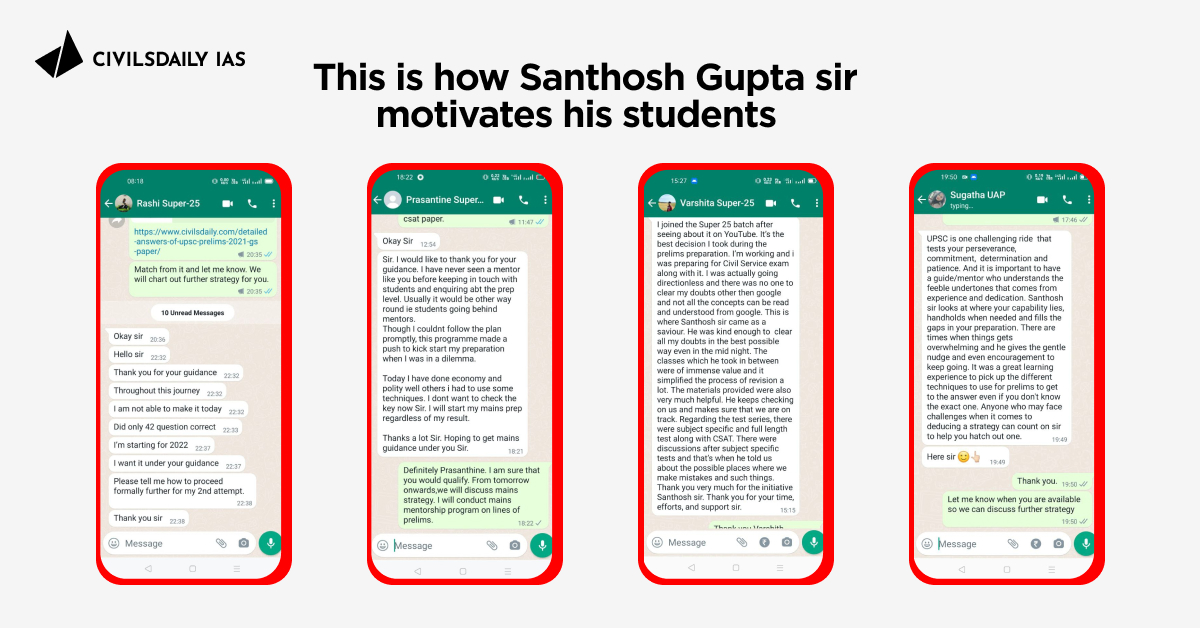
    Santosh sir is always there to ensure his students are following the right sources, makes them understand the concepts, plans strategies for his students, reviews and analyses their progress even on 1-1 calls. Along with academics, he is there with his students through the bouts of demotivation and lows.

    A quick bit about Santosh Gupta:

    Santosh Gupta sir has scored above 140 twice in UPSC prelims and always 120 plus in all 6 attempts. He wrote all 6 mains and appeared for Interviews 3 times. He has qualified UPSC EPFO and BPSC 56-59th also. He has been teaching and mentoring UPSC aspirants for the last 5 years with tremendous interest in the environment and ecology and Polity.

    Consistent effort as per a well-devised strategy and expert mentorship of Santosh sir will sail you through this challenge.

    Tavishi failed thrice in the Prelims before but after joining Santosh sir’s mentorship cleared Prelim 2022 in her 4th attempt. Schedule a call with Tavishi’s mentor

    SMASH PRELIMS 2023: PERSONALIZED MENTORSHIP, TEST SERIES, LECTURES, NOTES

    CLICK:- Download Smash Prelims 2023 Timetable

    Fill up the form below to avail 20% scholarship for Smash Prelims 2023 program.

    Our Smash Prelims Program started as a pilot project last year with an aim to introduce step-wise improvement in our chosen 40 aspirants. Over a period of 2 months, Santhosh sir inculcated confidence in aspirants who were either newbies or gave too many attempts. This year, we achieved a remarkable 80% success ratio. This year, we have set our eyes on 100%. Yes, we are as ambitious and aspirational just like any other UPSC aspirant.

    Moreover, aspirants must be prepared for the googlies thrown at them by UPSC in the Prelims (new things being tried out by UPSC- like options, topics, etc).

    Only barrier between your success and your failure is YOU. If required, change yourself and keep working on your strengths and weaknesses.


    About 6 pillared approach of Smash Prelims 2023

    Pillar-1: 44 Prelims test

    Prelims Tests: 44 (14 Basic + 8 Advanced + 6 CA tests + 10 Full tests + 6 CSAT tests)

    Pillar-2: Special Value Additions Notes and Classes by Santosh Gupta

    50 Special classes on topics including Polity, History, Economics, Geography, Sessions to cover Environment innovatively, Science & Technology and more.

    Pillar-3: Mentorship calls

    One-to-one mentorship by core faculty and toppers

    • One to one Mentor calls after tests
    • Habitat/WhatsApp support from mentors
    • Frequent sessions with toppers for support and guidance.
    You are 8 times more likely to clear Prelims 2023 with Santosh sir’s mentorship

    Pillar-4: Weekly zoom session by Santosh Gupta 

    Doubt clearance and continuous improvement

    Pillar-5: Learn Question-solving 

    • Strategic Live 1000 Questions solving with Santosh Gupta sir for Prelims-2023
    • Learn Art of Question-solving: Using Logical approach + Elimination techniques
    • Live Question solving of Previous year’s questions

    Pillar-6: Current Affairs

    Specifically made Current affairs notes + Live classes by core faculty for the entire two years for prelims.

    You are 8 times more likely to clear Prelims 2023 with Santosh sir’s mentorship under Smash Prelims program

    What CivilsDaily’s Smash Prelims students have to say?

    Success Stories of Smash Prelims 2022

    From failing twice-thrice to clearing Prelims 2022

    80% of the Smash Prelims students cleared UPSC Prelims 2022. In 2023 we will take this up to 95%

    Click and Enroll here

    CLICK:- Download Smash Prelims 2023 Timetable

  • Labour welfare necessity

    Context

    • One of the biggest economic fallout of the pandemic has been the deteriorating labour market conditions.
    • In the years ahead when the health crisis subsides and the economy witnesses a rebound, the healing of the labour market may take some more time. This is because the impact of recovery on this market is always felt with a lag.
    • Given the ebb and flow of the pandemic, the growth recovery is likely to be fragmented and will weigh on the number and types of jobs available.

    Definition

    • Labour welfare relates to taking care of the well-being of workers by employers, trade unions, governmental and non-governmental institutions and agencies.
    • Welfare includes anything that is done for the comfort and improvement of employees and is provided over and above the wages.

    What are labour rights?

    • Labour rights or workers’ rights are both legal rights and human rights relating to labour relations between workers and employers. These rights are codified in national and international labour and employment law. In general, these rights influence working conditions in relations of employment.

    Why labour law is needed

    • Labour law aims to correct the imbalance of power between the worker and the employer; to prevent the employer from dismissing the worker without good cause; to set up and preserve the processes by which workers are recognized as ‘equal’ partners in negotiations about their working conditions etc.

    Constitutional mandate

    • Article 41 – The state shall within the limits of its economic capacity and development make effective provision for securing the right to work, to education and to public assistance in cases of unemployment, old age, sickness and disablement and in other cases of underserved want.
    • Article 42 – The state shall make provision for securing just and humane conditions of work and for maternity relief.

    Necessity for welfare

    • There were only 25 million during the initial period of industrial growth, while the strength of the workers is increasing year after year and hence, need for a mechanism to look into the welfare of the labour.
    • Workers put in long hours of work in unhealthy surrounding and the drudgery of the factory work continues to have adverse effect. To counter these welfare measures were felt necessary.
    • As a result of hardwork, they fall prey to alchoholism, gambling and other immoral activities results in absenteeism and other problems in the organisation. Hence the need was felt.

    Scope for labour welfare in India

    • Contribute to the productivity of labour and efficiency of the enterprise.
    • Raise the standard of living of workers by indirectly reducing the burden on their purse.
    • Be in tune and harmony with similar services obtaining in a neighbouring community where an enterprise is situated.
    • Be based on an intelligent prediction of the future needs of industrial work and be so designed as to offer a cushion to absorb the shock of industrialization and urbanization
    • Be administratively viable and essentially development in outlook.

    Government steps in this direction

    • Social Security Measures: The social security measures would help man to face the contingencies as such it is difficult for him either to work or to get work and support himself and his family. Thus social security measure provides a self balancing social insurance or assistance from public funds.
    • Social Insurance: is described as the giving in return for contribution, benefits up to subsistence level, as of right and without a means test, so that an individual may build freely upon it.
    • Social Assistance: is provided as an supplement to social insurance for those needy persons who cannot get social insurance payments and is offered after a means test.
    • Public Service: is a programme constituting the third main type of social security. They are financed directly by the government from its general revenues in form of cash payments or services to every member of the community falling within a defined category.

    Case study of Finland

    • Universal basic income pilot project: For two years Finland’s government gave 2,000 unemployed citizens €560 a month with no strings attached. It was the first nationwide basic income experiment. The concept is slowly becoming difficult for people to ignore.

    Challenges in labour welfare in India

    • Technical glitches: Under the Constitution of India, Labour is a subject in the concurrent list where both the Central and State Governments are competent to enact legislation. As a result, a large number of labour laws have been enacted catering to different aspects of labour e.g. occupational health, safety, employment etc.
    • Loopholes: Because of the predominantly heavy-handed labour regulations (also called as Inspector Raj) with exploitable gaps, the MNCs and domestic organizations have resorted to alternate ways i.e. employing contract labour at less than half the payroll of a permanent employee.
    • Gaps in labour laws: One of the main reasons for labour reforms is the concept of contract labour. Trade Unions suggest that this concept itself should be removed. There is stringent hiring and firing process defined in Industry Disputes Act. It makes it mandatory for the organization to seek Government permission before removing an employee.

    Conclusion

    • Labour Welfare helps labourers improve their working conditions, providing social security and raising their standard of living.
    • Raise the employee’s morale use the workforce more effectively besides removing dissatisfaction help to develop loyalty in workers towards the organization.

    Mains question

    Q.What is labour welfare according to you? Why it is needed? Explain the challenges in front of Indian labour reforms.


    UPSC 2023 countdown has begun! Get your personal guidance plan now! (Click here)

  • Justice Lalit appointed 49th CJI

    Justice Uday Umesh Lalit was appointed the 49th Chief Justice of India (CJI) after President Droupadi Murmu signed his warrant of appointment.

    How is CJI selected?

    • Justice U.U. Lalit is the senior-most judge in the Supreme Court now.
    • The ‘Memorandum of Procedure of Appointment of Supreme Court Judges’ says “appointment to the office of the CJI should be of the seniormost Judge of the SC considered fit to hold the office”.
    • The process begins with the Union Law Minister seeking the recommendation of the outgoing CJI about the next appointment.

    What is the time frame?

    • The Minister has to seek the CJI’s recommendation at the “appropriate time”.
    • The Memorandum does NOT elaborate or specify a timeline.

    Making final appointment

    The Memorandum says:

    1. Receipt of the recommendation of the CJI
    2. The Union Minister of Law, Justice and Company Affairs will put up the recommendation to the PM
    3. PM will advise the President in the matter of appointment
    4. President of India appoints the CJI

    Chief Justice of India: A brief background

    • The CJI is the chief judge of the Supreme Court of India as well as the highest-ranking officer of the Indian federal judiciary.

    Appointment

    • The Constitution of India grants power to the President to nominate, and with the advice and consent of the Parliament, appoint a chief justice, who serves until they reach the age of 65 or until removed by impeachment.
    • Earlier, it was a convention to appoint seniormost judges.
    • However, this has been broken twice. In 1973, Justice A. N. Ray was appointed superseding 3 senior judges.
    • Also, in 1977 Justice Mirza Hameedullah Beg was appointed as the chief justice superseding Justice Hans Raj Khanna.

    Qualifications

    The Indian Constitution says in Article 124 (3) that in order to be appointed as a judge in the Supreme Court of India, the person has to fit in the following criteria:

    • He/She is a citizen of India and
    • has been for at least five years a Judge of a High Court or of two or more such Courts in succession; or
    • has been for at least ten years an advocate of a High Court or of two or more such Courts in succession; or
    • is, in the opinion of the President, a distinguished jurist

    Functions

    • As head of the Supreme Court, the CJI is responsible for the allocation of cases and appointment of constitutional benches which deal with important matters of law.
    • In accordance with Article 145 of the Constitution and the Supreme Court Rules of Procedure of 1966, the chief justice allocates all work to the other judges.

    On the administrative side, the CJI carries out the following functions:

    • maintenance of the roster; appointment of court officials and general and miscellaneous matters relating to the supervision and functioning of the Supreme Court

    Removal

    • Article 124(4) of the Constitution lays down the procedure for removal of a judge of the Supreme Court which is applicable to chief justices as well.
    • Once appointed, the chief justice remains in the office until the age of 65 years. He can be removed only through a process of removal by Parliament as follows:
    • He/She can be removed by an order of the President passed after an address by each House of Parliament supported by a majority of the total membership of that House and by a majority of not less than two-thirds of the members of that House present.
    • The voting has been presented to the President in the same session for such removal on the ground of proven misbehavior or incapacity.


    UPSC 2023 countdown has begun! Get your personal guidance plan now! (Click here)

More posts