The Union Health Ministry stated that India has no reported Ebola cases and the current risk remains minimal, while closely monitoring the outbreak in Central Africa.
Key Highlights
The outbreak involves Ebola Virus Disease caused by the Bundibugyo virus strain.
Affected regions include:
Democratic Republic of the Congo
Uganda
Measures Taken by India
Enhanced surveillance at airports and ports
Monitoring of international travellers from affected regions
Isolation and quarantine preparedness
Coordination with relevant ministries and agencies
Agencies Involved
National Centre for Disease Control (NCDC)
Integrated Disease Surveillance Programme (IDSP)
Indian Council of Medical Research (ICMR)
About Ebola Virus Disease (EVD)
Severe viral haemorrhagic fever affecting humans and primates.
Spread through:
Direct contact with infected bodily fluids
Contaminated surfaces
Infected animals
Symptoms
Fever
Weakness
Bleeding
Organ failure in severe cases
What is PHEIC?
A Public Health Emergency of International Concern is declared by WHO under the International Health Regulations (IHR) when an outbreak:
Poses international public health risk
Requires coordinated global response
[2015] Among the following, which were frequently mentioned in the news for the outbreak of Ebola virus recently? (a) Syria and Jordan (b) Guinea, Sierra Leone and Liberia (c) Philippines and Papua New Guinea (d) Jamaica, Haiti and Surinam
Officials of the Directorate of Revenue Intelligence (DRI) seized two live Indian Red Sand Boa snakes in Warangal, Telangana, during an operation against illegal wildlife trade.
Key Highlights
The operation was conducted by the Hyderabad zonal unit of DRI.
Officials acted on intelligence regarding illegal sale of live snakes in the grey market.
Two live snakes were recovered from the suspect’s bag during an undercover decoy operation.
About Indian Red Sand Boa
Scientific name: Eryx johnii
Non-venomous burrowing snake species found in India.
Often targeted in illegal wildlife trade due to superstitions and false medicinal beliefs.
Legal Protection
The species is protected under: Schedule I of the Wild Life (Protection) Act, 1972
Significance of Schedule I
Provides the highest level of legal protection.
Hunting, possession, and trade are prohibited.
Action Taken
The snakes and accused were handed over to the Forest Range Officer, Warangal.
Further investigation is underway to identify possible wildlife trafficking networks.
[2017] In India, if a species of tortoise is declared protected under Schedule I of the Wildlife (Protection) Act, 1972, what does it imply? [A] It enjoys the same level of protection as the tiger. [B] It no longer exists in the wild, a few individuals are under captive protection; and not it is impossible to prevent its extinction. [C] It is endemic to a particular region of India. [D] Both (b) and (c) stated above are correct in this context.
The Supreme Court of India expressed “serious reservations” about aspects of its earlier judgment denying bail to Umar Khalid and Sharjeel Imam in the Delhi riots conspiracy case under the Unlawful Activities (Prevention) Act, 1967 (UAPA).
Key Observations by the Court
The Court reaffirmed that:
“Bail is the rule, jail is the exception.”
Justice Ujjal Bhuyan stated that prolonged incarceration without timely trial violates:
Right to life
Personal liberty
Speedy trial under Article 21 of the Constitution of India
Section 43-D(5) of UAPA
Restricts grant of bail if accusations appear “prima facie true”.
Creates a very low threshold for the prosecution to oppose bail.
Court’s Observation
Courts cannot keep an accused indefinitely jailed merely because charges appear prima facie true.
Delayed trials can convert pre-trial detention into punishment itself.
Reference to K.A. Najeeb Judgment
The Court referred to the K.A. Najeeb Judgment, which held that constitutional courts can grant bail despite UAPA restrictions when incarceration becomes excessively prolonged.
Constitutional Principle
Presumption of innocence remains a cornerstone of criminal justice.
Section 43-D(5) remains subordinate to Article 21.
Background of the Case
Delhi Police booked Umar Khalid and others under UAPA in connection with the 2020 Delhi riots conspiracy case linked to protests against the Citizenship Amendment Act (CAA).
Umar Khalid had spent over five years in prison as an undertrial.
[2020] Consider the following statements: 1. The Constitution of India defines its ‘basic structure’ in terms of federalism, secularism, fundamental rights and democracy. 2. The Constitution of India provides for ‘judicial review’ to safeguard the citizens’ liberties and to preserve the ideals on which the Constitution is based. Which of the statements given above is/are correct? a) 1 only b) 2 only c) Both 1 and 2 d) Neither 1 nor 2
PYQ Relevance[UPSC 2023] The expansion and strengthening of NATO and a stronger US-Europe strategic partnership works well in India.” What is your opinion about this statement? Give reasons and examples to support your answer.Linkage: The PYQ tests understanding of how changing geopolitical alignments in Europe affect India’s strategic interests. Similar to the PYQ, the article examines how evolving European security architecture creates new strategic opportunities and challenges for India.
Mentor’s Comment
The Prime Minister of India visited Oslo, Norway on May 18 and 19 for the 3rd India-Nordic Summit. This visit was important as India’s ties with Nordic countries are entering a strategic phase. Earlier, relations focused on climate, innovation and digitalisation. However, the Ukraine war, NATO expansion, Arctic competition and critical mineral concerns have increased the region’s strategic importance for India. The Arctic is warming over three times faster than the global average, affecting India’s monsoon, Himalayan glaciers and maritime security, making closer Nordic engagement increasingly important.
How Has the Strategic Context of India-Nordic Relations Changed?
Shift in geopolitical environment
Ukraine War: Reshaped Europe’s security architecture and altered strategic calculations.
Trans-Atlantic Strains: Renewed uncertainty in European security has increased Nordic strategic importance.
NATO Expansion:Finland and Sweden joining NATO has transformed Nordic security architecture.
Russia-China Polar Partnership: Expands geopolitical competition into Arctic spaces through cooperation on shipping and energy.
Transition from functional to strategic cooperation
Earlier Focus: Climate cooperation, digitalisation, innovation and blue economy dominated engagement.
What Are the Challenges Before India’s Arctic Turn?
Insufficient Ice-Class Ships: Restricts India’s ability to utilise Arctic routes.
Great Power Rivalries: Russia-West tensions complicate Arctic engagement.
High Infrastructure Costs: Arctic operations require advanced technology and significant investments.
Governance Constraints/ Observer Status: India lacks formal decision-making power in the Arctic Council.
Conclusion
The Oslo Summit represents a strategic inflection point in India-Nordic relations. The Arctic’s growing geopolitical and economic relevance means that India can no longer treat Nordic engagement as peripheral or climate-centric. A calibrated “northward turn” through Arctic diplomacy, resilient supply chains, maritime cooperation and clean-energy partnerships can strengthen India’s strategic autonomy, climate resilience and economic competitiveness.
India’s Arctic Policy (2022): Key Pillars Science and Research: Expands polar research and climate studies. Climate and Environmental Protection: Supports sustainable Arctic governance. Economic and Human Development: Facilitates investment and connectivity. Transportation and Connectivity: Examines emerging shipping routes.Governance and International Cooperation: Strengthens multilateral engagement. National Capacity Building: Enhances polar expertise. Arctic CouncilEstablished: 1996 (Ottawa Declaration) Members: Canada, Denmark, Finland, Iceland, Norway, Russia, Sweden and USA. India’s Status: Observer since 2013. Function: Facilitates cooperation on environmental protection and sustainable development. Northern Sea RouteDefinition: Shipping corridor along Russia’s Arctic coast. Importance: Reduces travel distance between Europe and Asia.
Donald Trump visited China during May 13-15 and this visit assumes significance because it occurred amid an unusually volatile global environment. This is marked by the Iran crisis, disruption risks in the Strait of Hormuz, and escalating tensions around Taiwan. The visit came after nearly a decade of worsening U.S.-China relations driven by tariffs, technology restrictions, and strategic mistrust. Despite no formal agreements, the meeting marked a symbolic “thaw” after prolonged confrontation. Both sides acknowledge the need to restore stability in arguably the world’s most consequential bilateral relationship.
Why did Trump’s China visit acquire strategic significance amid global instability?
Iran Crisis: Escalating Iran-U.S. tensions threatened closure of the Strait of Hormuz, a critical global oil chokepoint. Stability between major powers became necessary to prevent wider economic disruption.
Taiwan Tensions: Taiwan’s pro-independence political developments intensified Chinese concerns regarding reunification and sovereignty claims.
Global Economic Stakes: U.S.-China relations affect global trade flows, supply chains, commodity prices, and financial stability.
Strategic Timing: The visit occurred after years of tariff escalation and deteriorating diplomatic relations, making even symbolic engagement politically important.
Domestic Political Context: U.S. mid-term electoral pressures incentivised Trump to seek economic gains and business opportunities.
How have U.S.-China relations evolved from cooperation to strategic rivalry?
Economic Interdependence: Four decades of trade integration initially produced deep commercial linkages and mutual dependence.
Trade War (2018): Trump initiated tariff measures against Chinese imports to reduce trade imbalances and strategic dependence.
Technology Competition: Restrictions emerged over semiconductors, AI, and advanced technologies, especially high-end graphics processing units (GPUs).
Strategic Distrust: Competition expanded beyond economics into military posturing, Indo-Pacific influence, and ideological rivalry.
Taiwan Factor: Beijing increasingly viewed American engagement with Taiwan as interference in its sovereignty concerns.
Why did both countries seek a “stability framework” despite persistent rivalry?
Economic Costs: Tariff escalation harmed both economies and disrupted global markets.
Energy Security Concerns: Strait of Hormuz disruptions created urgency for coordinated responses due to oil dependence.
Conflict Avoidance: Both sides recognised risks of unintended military escalation, especially regarding Taiwan.
Global Responsibility: As leading powers, instability between both states generates worldwide economic spillovers.
What were the major issues discussed during the Trump-Xi meeting?
Trade Expansion: China explored increased purchases of U.S. soybeans, beef, and energy products.
Technology Restrictions: Beijing sought relaxation of American restrictions on high-end GPU exports.
Civil Aviation Deals: China reportedly offered to purchase 200 Boeing aircraft and 450-500 American aircraft engines, although commercial arrangements remained unconfirmed.
Energy Cooperation: China expressed willingness to import more U.S. oil to reduce dependence on vulnerable maritime routes.
Taiwan Question: Xi Jinping strongly reiterated China’s position that U.S. handling of Taiwan remains the central obstacle in bilateral relations.
Iran Crisis: Discussions included coordination amid instability caused by the Iran-U.S. confrontation.
Why did the visit remain largely symbolic despite high expectations?
Absence of Agreements: No joint statement, treaty, or major agreement emerged from the meeting.
Unresolved Structural Issues: Tariffs, technology restrictions, military competition, and Taiwan disputes remained unresolved.
Trust Deficit: Strategic mistrust between both leaderships continues to limit institutional cooperation.
Domestic Political Constraints: Both leaders faced domestic constituencies discouraging major concessions.
Continuing Strategic Competition: Economic engagement coexists with long-term geopolitical rivalry.
Can U.S.-China competition be managed without confrontation?
Strategic Stability: Requires mechanisms to prevent escalation despite persistent rivalry.
Competitive Coexistence: Suggests coexistence through selective cooperation in trade, climate, and crisis management while competing strategically.
Crisis Communication: Diplomatic channels reduce risks of accidental escalation.
Mutual Restraint: Stable management of Taiwan remains critical to avoiding military conflict.
Institutional Engagement: Continued high-level summits preserve diplomatic communication even during disagreement.
Conclusion
The Trump-Xi meeting did not transform U.S.-China relations, yet it demonstrated recognition that unmanaged rivalry between major powers carries unacceptable global risks. The future trajectory will likely involve competitive coexistence rather than reconciliation, where limited cooperation coexists with enduring strategic distrust. Stability in this relationship will remain central to global economic and geopolitical order.
Value Addition Thucydides Trap Refers to conflict risk when a rising power challenges an established power.Coined from historical rivalry between Athens and Sparta.Frequently applied to U.S.-China strategic competition. G2 Concept Refers to U.S.-China cooperation as joint managers of global order.Suggests coordinated leadership in trade, climate, finance, and security.China informally invoked the idea during the visit.
PYQ Relevance
[UPSC 2022] The USA is facing an existential threat in the form of China, that is much more challenging than the erstwhile Soviet Union. Explain.
Linkage: The PYQ tests understanding of the U.S.-China strategic rivalry, great power competition, trade-tech conflict, and geopolitical implications. The article directly examines the attempt to stabilise worsening U.S.-China relations despite tensions.
India’s renewable energy capacity has expanded rapidly, with renewables contributing more than half of India’s installed power capacity for the first time. However, this growth has exposed a major challenge: energy storage. As renewable energy use increases, inadequate storage systems are creating concerns over grid stability and reliable electricity supply. The issue has become more important as India aims to achieve 500 GW renewable energy capacity by 2030, but storage infrastructure remains insufficient.
How does inadequate storage undermine India’s renewable energy transition?
Intermittency Problem: Solar generation ceases after sunset, while wind output fluctuates according to weather conditions. This creates instability in electricity availability.
Demand-Supply Mismatch: Electricity demand often peaks during evening hours, whereas solar generation remains concentrated during daytime, creating temporal imbalance.
Grid Stability Risks: Large-scale renewable integration without storage increases frequency fluctuations and voltage instability, affecting grid reliability.
Renewable Curtailment: Surplus renewable electricity often remains unused during periods of excess generation due to inadequate storage infrastructure.
Thermal Dependence: Limited storage necessitates continued dependence on thermal power plants for balancing electricity demand.
Why has energy storage become central to India’s power transition?
Renewable Expansion: Renewable energy now accounts for more than half of India’s installed power capacity, indicating a structural shift in the energy mix.
2030 Energy Target: India aims to achieve 500 GW of renewable energy capacity by 2030, making storage essential for effective grid integration.
Peak Demand Management: Storage systems release electricity during high-demand periods, reducing shortages and supply disruptions.
Energy Security: Domestic storage capacity reduces dependence on imported fossil fuels and strengthens energy resilience.
What are the major energy storage technologies available to India?
Pumped Hydro Storage (PHS)
Operating Mechanism: Stores electricity by pumping water to an elevated reservoir during surplus generation and releasing it through turbines during peak demand.
Established Technology: Represents the most mature and widely deployed large-scale storage technology globally.
Installed Capacity: India currently possesses nearly 7.2 GW of pumped hydro storage capacity.
Future Expansion: The Central Electricity Authority (CEA) projects nearly 94 GW of PHS capacity by 2035-36.
Key Advantage: Ensures long-duration storage and utility-scale grid balancing.
Battery Energy Storage Systems (BESS)
Technology Base: Primarily relies on Lithium-Ion Phosphate (LFP) batteries, recognised for declining costs, higher efficiency and longer life cycles.
Operating Mechanism: Stores electricity during surplus renewable generation and discharges power when output declines.
Current Capacity: India currently possesses nearly 0.27 GW battery storage capacity.
Projected Requirement: Battery storage requirement is projected to reach nearly 80 GW by 2035-36.
Auction Momentum: Around 10,658.94 MW / 28,739.32 MWh of BESS capacity remains under implementation.
Concentrated Solar Thermal Storage: Uses mirrors to concentrate sunlight and heat molten salts, enabling electricity generation during non-solar hours.
Compressed-Air Energy Storage: Stores compressed air underground during excess generation and releases it to produce electricity during peak demand.
Flywheel Energy Storage: Stores rotational kinetic energy and supports short-duration grid frequency regulation.
Gravity Energy Storage: Converts gravitational potential energy into electricity by lifting and lowering heavy masses.
Why is India falling short in energy storage deployment?
Slow Deployment Pace: Storage installation has not kept pace with rapid renewable capacity expansion.
Import Dependence: India imports nearly 75-80% of lithium-ion cells, creating supply-chain vulnerability.
High Cost Structure: Battery systems account for nearly 90% of total storage project costs, affecting affordability.
Policy Gaps: Long-term resource adequacy planning for storage remains insufficient.
Critical Mineral Dependence: Dependence on imported lithium, cobalt and rare earth minerals exposes India to geopolitical risks.
How prepared is India institutionally for large-scale renewable integration?
CEA Planning: The National Electricity Plan (NEP) projects a requirement of nearly 47 GW / 188 GWh battery storage and 94 GW / 676 GWh pumped hydro capacity by 2035-36.
What are the policy alternatives for strengthening India’s storage ecosystem?
Domestic Manufacturing: Strengthens battery ecosystems through PLI incentives and domestic mineral processing.
Critical Mineral Strategy: Ensures secure overseas access to lithium, cobalt and nickel reserves.
Market Mechanisms: Facilitates storage viability through time-of-day pricing and ancillary service markets.
Hybrid Renewable Projects: Integrates solar, wind and storage for round-the-clock electricity supply.
Research and Innovation: Supports emerging technologies such as sodium-ion and solid-state batteries.
Regulatory Reforms: Ensures long-term procurement frameworks and storage deployment certainty.
Conclusion
India’s renewable energy transition now depends not only on increasing generation capacity but also on strengthening energy storage systems. Rapid expansion of solar and wind power without adequate storage can undermine grid stability and energy reliability. Expanding battery storage, pumped hydro capacity and domestic manufacturing, along with regulatory support, will be critical to ensuring a stable, secure and sustainable clean energy transition.
Government Policies and Schemes Supporting Energy Storage in India National Framework for Promoting Energy Storage Systems (2023): It provides the overall policy framework for integrating energy storage into generation, transmission and distribution systems. It recognises storage as a key enabler of renewable energy integration. PLI Scheme for Advanced Chemistry Cell (ACC) Battery Storage (2021): Supports domestic battery manufacturing through a ₹18,100 crore Production Linked Incentive (PLI) programme. Targets establishment of 50 GWh ACC battery manufacturing capacity to reduce import dependence on lithium-ion batteries. Viability Gap Funding (VGF) Scheme for Battery Energy Storage Systems (BESS): Provides financial support to make battery storage commercially viable and accelerate grid-scale deployment of BESS projects. Operational guidelines were issued in 2024. Tariff-Based Competitive Bidding (TBCB) Guidelines for BESS (2022): Enables transparent procurement of storage capacity by power distribution companies and improves investor confidence. Energy Storage Obligation (ESO): Mandates power utilities to integrate a minimum share of energy storage alongside renewable procurement to ensure grid reliability and peak balancing. Green Energy Corridor Programme: Expands transmission infrastructure to facilitate integration of renewable energy and storage systems into the national grid. ISTS Charges Waiver for Renewable + Storage Projects: Waives inter-state transmission charges for co-located renewable energy and storage projects, improving project viability.
PYQ Relevance
[UPSC 2022] Do you think India will meet 50 percent of its energy needs from renewable energy by 2030? Justify your answer. How will the shift of subsidies from fossil fuels to renewables help achieve the above objective? Explain
Linkage: The PYQ tests understanding of India’s renewable energy transition, structural bottlenecks and policy support required for achieving energy targets. The article expands the debate beyond renewable generation to issues of grid stability, intermittency and reliable power supply.
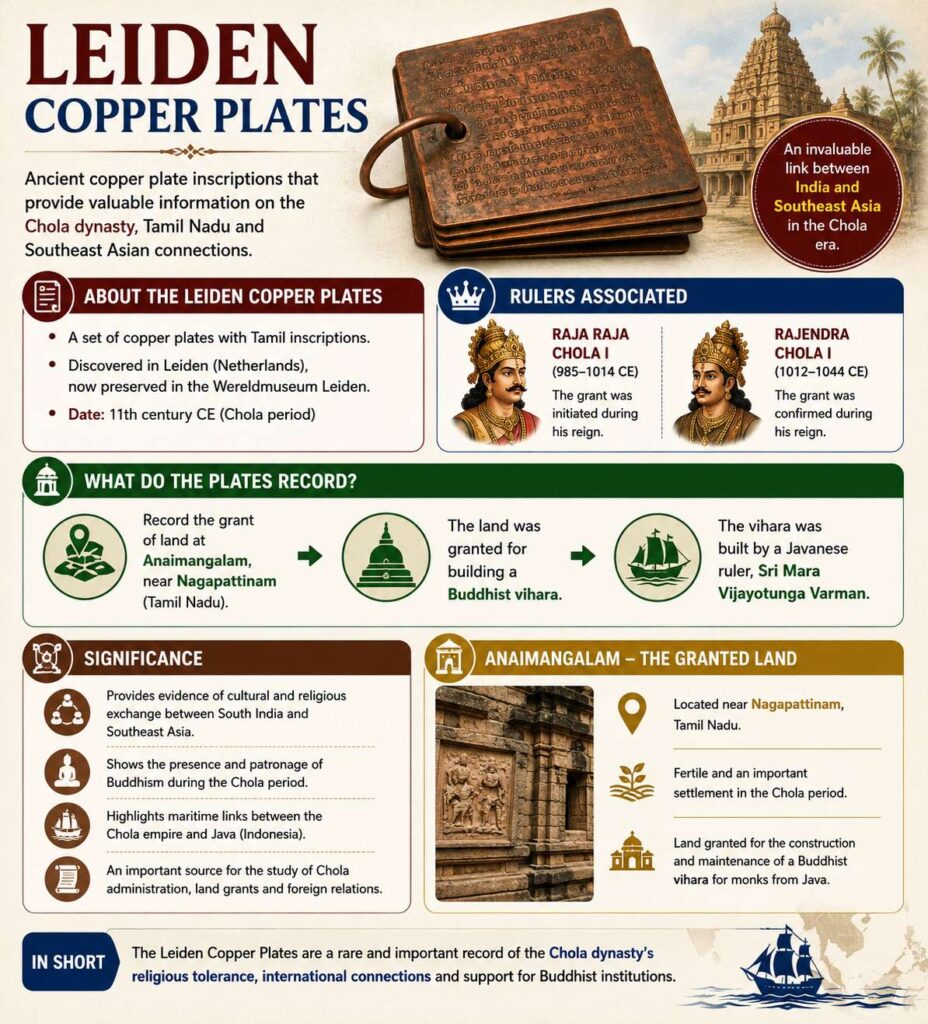
The Chola-era Anaimangalam copper plates, popularly known as the Leiden copper plates, were returned to India from the Leiden University during Prime Minister Narendra Modi’s visit to the Netherlands.
Key Highlights
The copper plates had remained in Leiden University’s possession since 1862.
Historians termed the repatriation a major step in returning India’s cultural heritage.
Archaeologists also called for the return of the Velvikkudi copper plates from the British Museum.
About the Leiden Copper Plates
Associated with Raja Raja Chola I and Rajendra Chola I.
Record the grant of land at Anaimangalam near Nagapattinam for building a Buddhist vihara.
The vihara was built by a Javanese ruler, Sri Mara Vijayotunga Varman.
Historical Significance
Demonstrates religious tolerance during the Chola period.
Shows a Shaivite Chola ruler supporting a Buddhist institution.
Reflects India’s maritime and cultural links with Southeast Asia.
Features of the Plates
Consist of:
21 large plates
3 small plates
Written in:
Sanskrit
Tamil
Plates carry Chola royal insignia:
Tiger (Chola emblem)
Fish (Pandya symbol)
Bow (Chera symbol)
[2025] Who among the following led a successful military campaign against the kingdom of Srivijaya, the powerful maritime state, which ruled the Malay Peninsula, Sumatra, Java and the neighbouring islands? (a) Amoghvarsha (Rashtrakuta) (b) Prataprudra (Kakatiya) (c) Rajendra 1 (Chola) (d) Vishnuvardhana (Hoysala)
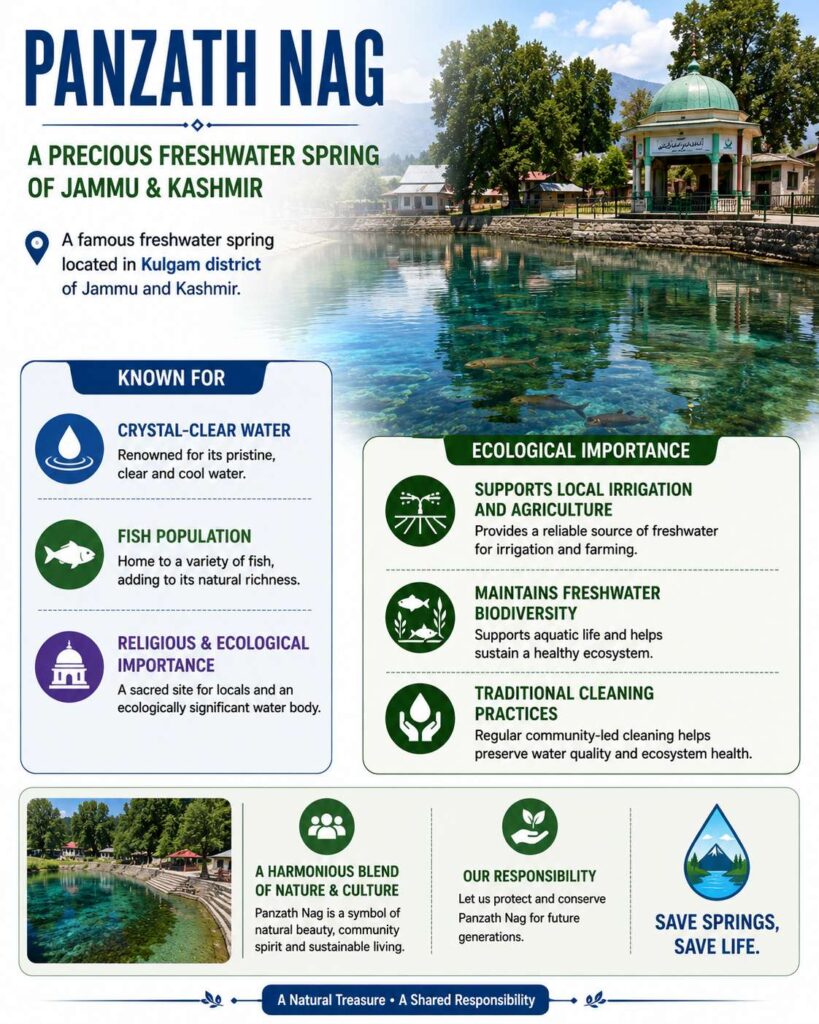
Hundreds of people participated in the traditional fishing and spring-cleaning festival at Panzath Nag in Kashmir.
About Panzath Nag
A famous freshwater spring located in Kulgam district of Jammu and Kashmir.
Known for:
Crystal-clear water
Fish population
Religious and ecological importance
Ecological Importance
Supports local irrigation and agriculture.
Maintains freshwater biodiversity.
Traditional cleaning helps preserve water quality and ecosystem health.
[2014] Every year, a month-long ecologically important campaign/festival is held during which certain communities/tribes plant samplings of fruit-bearing trees. Which of the following are such communities/tribes? (a) Bhutia and Lepcha (b) Gond and Korku (c) Irula and Toda (d) Sahariya and Agariya
Prime Minister Narendra Modi visited Norway for the first bilateral visit by an Indian Prime Minister in 43 years.
Bilateral Talks
PM Modi held talks with Norwegian Prime Minister Jonas Gahr Støre focusing on:
Trade
Energy cooperation
Technology partnerships
Global conflicts
3rd Nordic-India Summit
The visit included the 3rd Nordic-India Summit with leaders of:
Norway
Sweden
Finland
Iceland
Denmark
Major Agenda Areas
Trade and investments
Energy security
Climate and green transition
Digital infrastructure
Space cooperation
Global conflicts:
Russia-Ukraine war
Gaza conflict
Iran crisis
Energy Cooperation
Norway is a major exporter of oil and natural gas.
Discussions included LNG supplies to India.
Norwegian company Equinor recently supplied LNG to India under a 15-year agreement.
Economic Relations
Over 700 Nordic firms operate in India.
Around 150 Indian firms operate in Nordic countries.
India’s trade with Nordic countries is about $19 billion.
[2024] Consider the following countries: 1. Finland 2. Germany 3. Norway 4. Russia How many of the above countries have a border with the North Sea? [A] Only one [B] Only two [C] Only three [D] All four
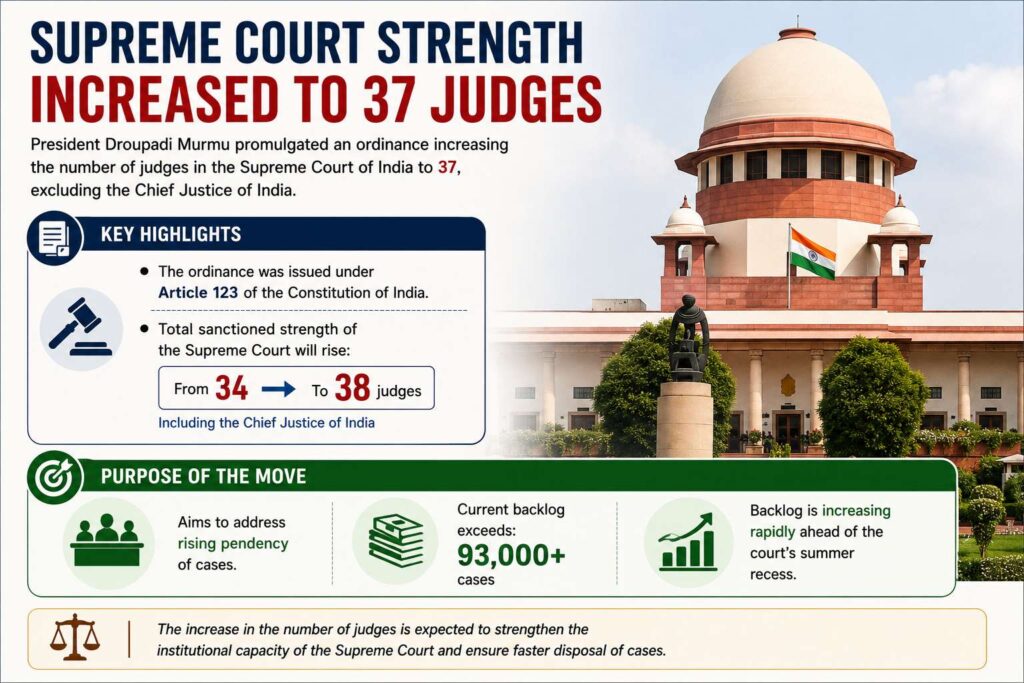
President Droupadi Murmu promulgated an ordinance increasing the number of judges in the Supreme Court of India to 37, excluding the Chief Justice of India.
Key Highlights
The ordinance was issued under Article 123 of the Constitution of India.
Total sanctioned strength of the Supreme Court will rise:
From 34 to 38 judges
Including the Chief Justice of India
Purpose of the Move
Aims to address rising pendency of cases.
Current backlog exceeds: 93,000 cases
Backlog is increasing rapidly ahead of the court’s summer recess.
Amendment Made
The ordinance amended Section 2 of the Supreme Court (Number of Judges) Act, 1956.
Replaced “33” with “37” judges excluding the CJI.
Article 124 of the Constitution of India
Originally provided for:
Chief Justice of India
Not more than seven judges
Parliament can increase the number by law.
Evolution of Supreme Court Strength
1950: 7 judges
1956: 10
1960: 13
1977: 17
1986: 25
2009: 30
2019: 33
2026: 37
Present Vacancy Situation
Current vacancies include:
Seat of former CJI B. R. Gavai
Vacancy after retirement of Rajesh Bindal
More retirements due in 2026:
Justice J.K. Maheshwari
Justice Pankaj Mithal
Justice Sanjay Karol
Ordinance Rules
Ordinance must be approved by Parliament after reassembly.
It ceases to operate after six weeks if not approved by both Houses.
[2025] With Reference to the Indian polity, consider the following statements: I. An Ordinance can amend any central Act. II. An Ordinance can abridge a Fundamental Right. III. An Ordinance can come into effect from a back date. Which of the statements given above are correct? [A] I and II only [B] II and III only [C] I and III only [D] I, II and III