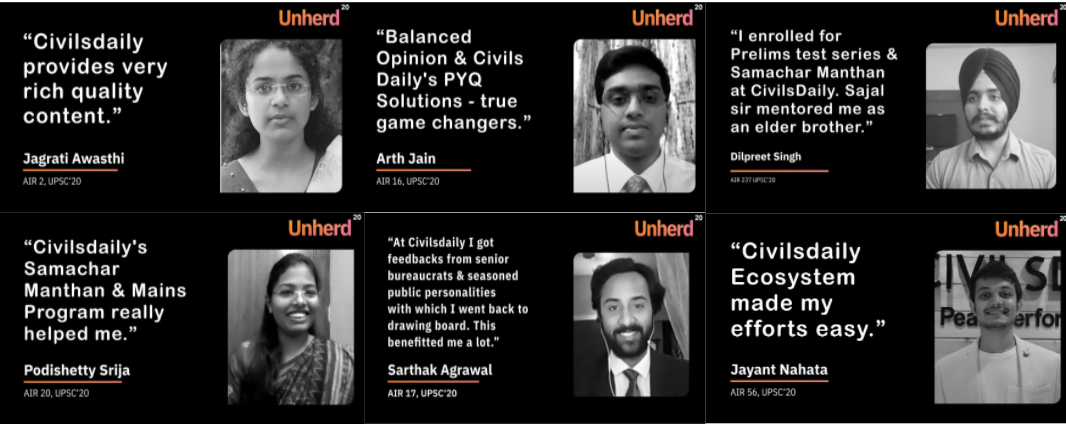
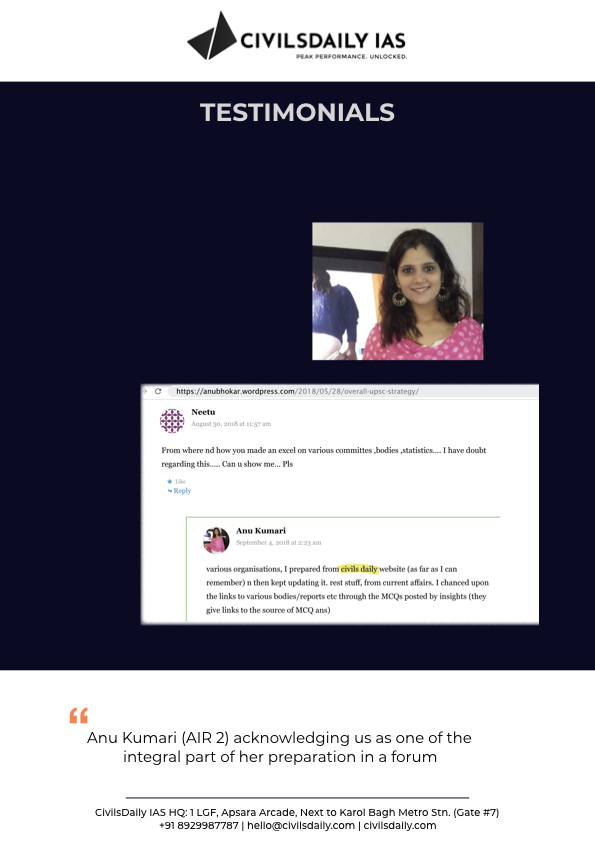
Ultimate Assessment Program and Foundation Program includes –
Mentorship (1:1, throughout the preparation till Interview stage)
Masterclasses (complete GS syllabus covered, Only provided in Foundation course)
Samachar Manthan (Current affairs Programme)
Decimate Prelims (Prelims Crash course)
Mains Answer Writing Initiative (On a weekly basis)
Smash Mains (upon Qualifying prelims 2023)
Essay Guidance Program (To score above 120+ in Essay Mains Paper)
Interview Guidance Program (more than 1 mock interview will be conducted with a panel)
Civilsdaily IAS Community for Peer to Peer Interaction
Get all the Civilsdaily courses under Smash Foundation Course for 60% off after you attend our scholarship test and score above the cut-off marks!
Are you a beginner who has no idea about UPSC, but want to check if you have the aptitude for the same? Do you want to assess your performance and interest in UPSC before targetting 2023 preparation?
Then, we have got the perfect opporunity for you. Presenting, Civilsdaily’s UPSC CS 2023, Free-To-Register National Scholarship on 13th & 20th March 2022 .
Last year’s scholarship test by Civilsdaily has seen a phenomenal response and pan India interest for the test. Many toppers have emerged out of the test to be subsequently mentored in the Civilsdaily Foundation Program. So aspirants, ensure you don’t miss out on the benefits of the test.
An average aspirant, pays for Prelims Course, Mains Program, Interview Guidance, Test Series & Study Materials all separately. The fees then comes up to 2-3 Lakhs for one attempt alone.
Identifying this issue, Civilsdaily has designed the Flagship Foundation Course for 2023 aspirants. This course covers the entire 3-stage journey of a UPSC aspirant. From Prelims to Interview -1:1 Mentorship, Weekly Test Series, Classes & Study Materials will be provided.
Another benefit of the program is that it’s an umbrella course wherein an aspirant can access other paid courses of Civilsdaily for FREE.
The main objective of the program is to identify and nurture serious aspirants to become future UPSC toppers. And that’s why we have designed a scholarship test.
Our foundation course will be intensive yet personalised. You will be getting individual coaching on how to conquer the basics, develop analytical skills, inculcate conceptual clarity and acquire the necessary knowledge to face the unpredictable and dynamic UPSC.
Apart from conducting subject-wise classes that covers all the Prelims-Mains syllabus from scratch, aspirants will follow a customised timetable and will complete their revision on a daily basis to attempt our weekly prelims and mains tests. Once the test is over, they will get a strategy call from a mentor, who will clear their doubts and tell them how to improve their performance from next test onwards.
Simply put, like Ekalavya you will be getting a unique coaching experience that eludes other UPSC aspirants. Even aspects like Essay, Ethics and CSAT which is ignored in other normal coaching programs, will be covered over here with tests, mentorship, classes and notes.
If you take the upcoming free UPSC national scholarship test and come out with flying colours, you will get about 60% scholarship on the Civilsdaily Flagship Foundation Course.
Details of the Civilsdaily Free National Scholarship Test
Date – 13th March & 20th March, 2022.
Please Click on Submit after finishing the Test.
Mode: Online
Registration Fee – Free
Language: English
Time: 2 Hrs
Syllabus: GS Paper 1 (Preliminary exam)
No. of Questions: 100
Date: 13th March & 20th March
Time: 10 AM
Result: 27/03/2022
Why should you take the CD’s Scholarship Test?
1. Test your preparation on UPSC-CSE grade questions, at national level.
2. Chance to compete against the best. See where you stand.
3. Identify your subjectwise strengths, weak points, and problem areas before you start preparation.
4. Mentors will provide personalised counselling based on your performance in the scholarship test.
5. A detailed discussion will help you navigate through the challenges during the preparation.
6. Achieve up to 60% scholarship in our exclusive umbrella foundation course.
As the program is rigorous and involves individual attention, we can take only limited enrollments. Hence, we are conducting a Scholarship Exam to identify serious UPSC aspirants on 13th and 20th of March. Depending on your relative score, you can get up to a 60% scholarship.
We are looking for
1. Serious and hardworking aspirants.
2. Ready to dedicate a minimum of 5-8 hours daily.
3. Can complete assigned targets and tests without fail.
4. Only 1 thought in mind and that is – to clear UPSC Civil Services 2023.
5. Willing to take constructive feedback from mentors after each test.
GS-1 Salient features of Indian Society, Diversity of India.
GS-2 Parliament and State legislatures—structure, functioning, conduct of business, powers & privileges and issues arising out of these.
GS-3 Indian Economy
GS-4 Attitude: Content, structure, function; its influence and relation with thought and behaviour; moral and political attitudes; social influence and persuasion.
HOW TO ATTEMPT ANSWERS IN DAILY ANSWER WRITING ENHANCEMENT(AWE)?
Daily 4 questions from General studies 1, 2, 3, and 4 will be provided to you.
A Mentor’s Comment will be available for all answers. This can be used as a guidance tool but we encourage you to write original answers.
You can write your answer on an A4 sheet and scan/click pictures of the same.
Upload the scanned answer in the comment section of the same question.
Along with the scanned answer, please share your Razor payment ID, so that paid members are given priority.
If you upload the answer on the same day like the answer of 11th February is uploaded on 11th February then your answer will be checked within 72 hours. Also, reviews will be in the order of submission- First come first serve basis
If you are writing answers late, for example, 11th February is uploaded on 13th February , then these answers will be evaluated as per the mentor’s schedule.
We encourage you to write answers on the same day. However, if you are uploading an answer late then tag the mentor like @Staff so that the mentor is notified about your answer.
*In case your answer is not reviewed, reply to your answer saying *NOT CHECKED*.
In the intro, mention the rising cruise oil prices due to the Ukraine crisis.
In the body mention the ways in which RBI could manage the borrowing programme to reduce the disruption such as spreading the borrowing program over four quarters, reconfiguring the borrowing schedule to entice the market players, giving push to the small savings schemes, listing of LIC etc.
In the intro, mention that in the 2019 Lok Sabha elections, women’s participation exceeded that of men for the first time.
In the body mention the growing women’s participation and representation in India. Mention that women currently make up 14.6 per cent of MPs in the Lok Sabha, which is a historic high. In the implications mention that the growing turnout of women voters could influence political parties’ programmatic priorities and improve their responsiveness to women voters’ interests, preferences, and concerns, including sexual harassment and gender-based violence.
Conclude by mentioning the need for passing the Women’s Reservation Bill.
Amid Ukraine crisis and high oil prices, the larger concern is how the government and the RBI will navigate this period at a time of record government borrowings, and prevent domestic interest rates from hardening.
The Triffin paradox in current context
It is ironic that even as emerging economies running current account deficits are getting punished by a depreciating currency and a hardening of interest rates, we are witnessing the US dollar appreciating and US treasuries strengthening.
The most common argument for such a macroeconomic paradox is named after the economist Robert Triffin (the Triffin Paradox).
It postulates that the US current account deficit is purely a reflection of the US supplying large amounts of dollars to fulfil the world’s demand.
In other words, central banks across the world must build up claims on the US to back their domestic money growth.
Dollar’s dominance
Former US Federal Reserve Chairman Bernanke even extended this argument in 2005 to the “saving glut” proposition by espousing that emerging economies were accumulating foreign exchange reserves in dollars, and diverting domestic savings to buy US treasuries.
There are several counter arguments to this view that effectively state that the dominance of the US dollar is inevitable in the global financial architecture, and it is purely a fault of emerging market economies.
Need for the unconventional tools to avoid the disruption by government borrowing
This can be done in the following ways
1] Spread the borrowing over four quarters after taking real-time view of disruption
Every year, the government front-loads its large borrowing programme by completing 60 per cent of the borrowings in the first half of the year.
This time, the RBI and the government may take a real-time view of disruptions and spread the borrowings over four quarters, keeping the initial two quarters light.
The borrowing programme can also be announced as per a quarterly schedule and there could be even two auctions during the week.
These steps could smoothen out the non-disruptive elements in government borrowings.
2] Reconfigure the borrowing program
For example, as rates move up, banks tend to prefer short-term investments while insurance companies, provident funds and others prefer longer-term investments.
Given this, the borrowing schedule can be reconfigured with a higher proportion of short-and medium-tenor securities being offered in the initial months, while pushing back the longer tenor securities to the second half of the year.
3] Push Small Savings Schemes
Third, small savings collections have significantly exceeded budget estimates.
The government could think of giving a push to small savings schemes such as the Sukanya Samriddhi Yojana (SSY).
The SSY has witnessed the registration of 2.82 crore girl children in the seven years since its inception in 2015, leaving enough room for further mop-up.
The newly opened accounts may even be given an enhanced savings limit in the first year to catch up for the years lost for these new additions.
4] Listing of LIC
LIC currently holds around Rs 23.5 trillion worth of government bonds, higher than even than the RBI.
LIC’s G-sec holding is around 19 per cent, while in comparison the banking system’s ownership stands at around 38 per cent.
Thus LIC’s listing should augur well for the bond market as the insurance behemoth may have to deploy a greater share of inflows in safer avenues domestically.
This is a plausible option as banks may have to readjust their deposits into credit as the economic recovery gains momentum.
Conclusion
Rising oil prices have placed policymakers in an unenviable position. If higher oil prices are fully passed through, it will result in higher inflation and hence higher rates as a consequence. In such a scenario it is best to follow the first option by using unconventional policy measures.
Since its inception, UPSC-CSE has had toppers from various academic and socio-economic backgrounds who have cracked the exam with flying colours. It’s clear that one doesn’t have to go to Delhi or a coaching centre to crack UPSC-CSE.
If education, geographical and economic background doesn’t matter, then what does? Attitude, or precisely consistency. If you are persistent and adamant to clear UPSC- CSE and have given more than two attempts till now, then you must replace that with consistency. Because, being persistent might lead you to the door, but it’s consistency that unlocks it.
In last month’s Samanvaya 1-on-1 counselling sessions, our expert Civilsdaily mentors reached out to aspirants to address their concerns regarding UPSC-CSE preparation. These are the responses they often heard from them —
How do I start preparing after a gap of 3-4 months?
It’s easy for me to maintain consistency in GS Preparation but not Revision
I study daily, but can only remain focused for 2-3 hours. How do I improve?
My long working hours don’t allow me to study daily.
Why am I losing interest in completing a subject? It’ s easier to read a new subject everyday.
This week, we have decided to answer all these questions and take additional questions in our personalised & motivational counselling session
Key-Takeaways from This Week’s Samanvaya, Free 1-on-1 Counselling Session?
If you want to experience the same mentorship as Rishab Sharma, then here’s the good news – your first UPSC mentorship is on us and is absolutely free! All you have to do is confirm your slot now.
This prompted us to reach out to one of our students who is currently an IPS officer, Rishabh Sharma. He cleared the exam in 2020 with AIR 454. After his first attempt, Rishabh had enrolled in Smash Mains program underSajal sir and also attended our free interview program. Cracking the mighty UPSC-CSE the second time, Rishabh explains what consistency means to him —
UPSC doesn’t just test your intellect. It tests your patience, mental strength, your emotions, the very character of yours . As far as the journey of CSE is concerned you might know when to start, but you never know when the journey will come to an end. So be consistent and enjoy the journey.
Every topper follows a plan, a method or strategy that makes it easier for them to study on a daily basis and complete the traget modules of the day. In this free live counselling session, we will explain the many ways you can do to avoid faltering on your preparation.
1. The difference between a consistent study pattern v/s an inconsistent one. How UPSC-CSE becomes easier over time with consistency?
2. Social media distraction. How to avoid spending long hours on social media?
3. Number of ideal breaks everyday. Why is it necessary to reward yourself with a short break from time to time?
4. Best way to plan your timetable in advance? Why daily timetable should not be rigid but yearly timetable should be well defined?
5. How to remain consistent when you are not opting for coaching?
6. What are the practical methods to maintain regularity in studies. Tips to sustain the fire and passion for studies.
7. Why using Public Libraries is a way to remain consistent in UPSC-CSE preparation?
8. What are the 4 factors that determine if you can remain consistent for a year? If not, then why should you work on them first before starting UPSC-CSE preparation?
Get Motivated to Maintain Overall Consistency for UPSC
It’s understandable we are humans and not programmable robots who can maintain the same level of interest everyday. However, maintaining an overall consistency throughout our preparation is neccessary to clear this competitive and vast exam.
Our philosophy behind MENTORSHIP is to get you out of this Snooze cycle. This ensures that you are the BEST VERSION of yourself in this journey. If you are under the impression that mentorship is weekly calls you attend, then you are mistaken, my friend. Trust us, your mentor will be your ‘FRIEND, PHILOSOPHER AND GUIDE’.
TO EACH THEIR OWN – Every aspirant is different. Their strengths and weaknesses are different. Their time availability is also different. Identifying this is important so you don’t end up making unrealistic targets and lose momentum. Your mentor will make sure you start slow but remain consistent to build your confidence. Making your schedule structured based on our experience of working with 2500+ students is our first priority.
TRACK YOUR PROGRESS – When you see yourself grow, it becomes easier to motivate yourself to push boundaries. Tracking your progress can happen in many ways like mentorship calls or chat sessions or by regular tests. The idea is to ensure that you don’t go off track in your preparation, and even if you do, we have your back.
EVOLUTION – A constant guidance is important to bring consistency to your UPSC preparation. Guidance is not about clearing your doubts or asking you to study when you don’t. It is also about the evolution of your preparation. This is where you and your mentor work as a team. A constant effort to PLAN AND BUILD UP YOUR ABILITY to learn in a faster and more efficient way.
TALK IT OUT – The biggest hurdle in achieving your highest level of consistency is the emotional part. Every now and then, you. surround yourself with negative thoughts, you feel scared and depressed. Instead of resolving these emotional issues, you avoid them as it seems like a waste of your precious time. You have to understand that ignoring emotional troubles does not solve them. What your doing is building an emotional time bomb that may burst a week before your mains or prelims! This is where your MENTOR AS A FRIEND comes in. All our mentors have been through this journey. We understand your fears and anxieties. So, TALK IT OUT.
Don’t let inconsistency keep you away from your dreams.
Fill up the SAMANVAYA form given below. Let us know your problems and we will find a solution to it, just like our students say ” TOGETHER WE CAN AND WE WILL”. BOOK YOUR SLOT FOR YOUR FREE 1-0N-1 COUNSELLING SESSION IN THE NEXT 24 HOURS
How has Civilsdaily Mentorship, helped Aspirants become Toppers?
The most difficult challenge faced by EVERY candidate is inconsistency. Be it inconsistency in studies, answer-writing practice, covering the syllabus, or revision, every candidate finds it difficult to cope with. Buthow do successful candidates manage to FIGHT Inconsistency so consistently?
In UPSC 2020, Civilsdaily helped 80+ students secure ranks in their exams. In the top 100, every 3rd ranker was a Civilsdaily student.
A very recent success story would be Vishwa Shah, student of Civilsdaily Mentor, Sukanya Ma’am. Vishwa has cleared the GPSC exam to become the Deputy Superintendent of Police in Gujarat. He has penned a thank-you note yesterday. Heartiest Congratulations to Vishwa!
One of our other Civilsdaily Student, Shubham Nagargojecleared the exams in 2020 to become an IPS Officer. Shubham was gracious enough to let us know how he felt about Civilsdaily Samanvaya Guidance under Parth sir.
To know how all of them cleared the exam with our mentorship, visit the UnherdPodcast.
Now that results are announced for UPSC 2021 Prelims, out of 15 out of 25 students of Santhosh Gupta sir have been recommended to Mains. One such student, Rahul expresses his gratitude and extends his appreciation.
Most of our Mentors like Sudhanshu sir, Sajal sir, Santhosh sir, Pravin sir, Parth Verma sir and Sukanya Ma’am were UPSC aspirants themselves and have attended UPSC Mains more than five times and UPSC Interview more than twice. Hence their mentorship is always a blend of the best test series, comprehensive notes and current affairs knowledge.
All of them dedicate their time weekly to give 1-on-1 mentorship to every student where they discuss last week’s performance and next week’s approach.
Be it Telegram, Whatsapp or Habitiat channels, they are always available and clear student’s doubts in a turnaround time of 24 Hours.
Why Civilsdaily Mentors are the GPS for Your UPSC-CSE Preparation
Remember there is always light at the end of the tunnel and if you want to get out of the tunnel you have to follow the direction of the light! Our mentors’ give you direction which is divided into daily modules. All you have to do is study and complete them on time.
As every year passes by, we don’t get confident by the previous years’ performance and become laidback. Instead, we become more hungry to convert all our students into toppers.REGISTER HERE TO SCHEDULE YOUR FIRST FREE SAMANVAYA COUNSELLING SESSION IN NEXT 24 HOURS
How are Current Civilsdaily Students Gearing up for UPSC-CSE 2022?
Initially, our Civilsdaily student Smriti wasn’t confident about Prelims when she began her preparation. Though she had joined Civilsdaily in 2020, she started studying for UPSC-CSE back in 2019. At that time, Smriti had enrolled in multiple institutes. Though, most of these institutes had promised a personal mentor, she was unable to get in touch with them on a daily basis. Also those mentors never scheduled test-series on a weekly basis. Hence, despite preparing for a year, Smriti had scored only 35 marks out of 200 in her first test series by Civilsdaily.
She then started writing 20-25 test series over the course of UAP 2021 and in her last test, her scores have drastically improved. She now scores in the range of 130-135 marks in prelims’ and 110+ in mains’ papers.
In Smriti’s own words she describes her Samanvaya Mentorship Experience to be —
“Our parents provide us financial and emotional support, friends provide us moral support and the right mentor gives you logistic and logical support for UPSC. There are days when I felt I won’t be able to compete against lakhs of aspirants. That’s when my mentor, Ravi sir reminded me of my improvement and encouraged me that I can crack it with the same consistency. We need someone, who tells us we are performing well especially when we cannot see that ourselves. The mentorship at Civilsdaily helped me become mentally stronger as a person. In other institutes, mentors are allotted only for doubt resolution. But at Civilsdaily, I am getting end-to-end mentorship via value added notes, classes, test series and detailed evaluation.”
Similarly our another Civilsdaily student, Ashishsums up his Samanvaya experience with Civilsdaily mentor,Pravin Sir, “Because of Pravin sir’s support, I am able to understand a topic in lesser time.”
This is how Pravin sir evaluates Ashish’s Mains Test Series every week. After every test series evaluation, Pravin sir schedules a 1 hour call to discuss how Ashish can improve his marks and the sources he can refer for key topics.
It’s Your Turn Get the Free 40 Min Counselling Session By a CD Mentor
Civilsdaily mentors are so dedicated, consistent and focused for your UPSC goal, that you will eventually become focused into turning your dreams to reality.
At the core of Civilsdaily UPSC mentorship, lies the fact that each one of you will have a unique journey while preparing for the exam. Some will get through on the first attempt without much effort while others will take both more time and more effort.
We want to understand you better to help you optimize your journey so you can focus on the right things and not waste time on the wrong ones. We are asking you to tap into the valuable experiences of mentors who underwent the same grind and realize the pitfalls and understand the shortcuts to make it.
In the first counselling session, we will understand your weaknesses. We then help you to stick to one plan or strategy throughout your preparation. We will then follow up with you on a daily basis to check if you are right on track. TALK TO OUR MENTORS & CLARIFY YOUR DOUBTS NOW
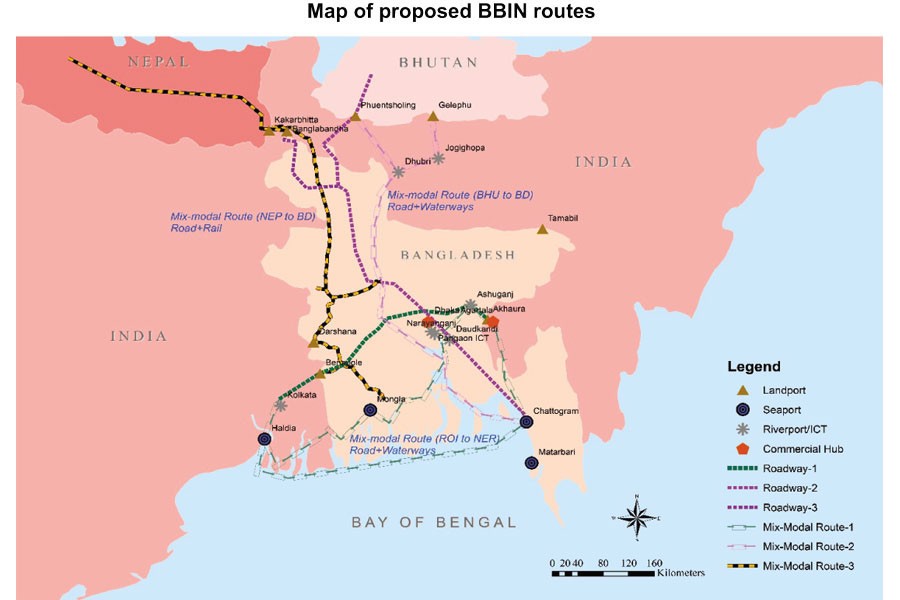
With Bhutan continuing to sit out the Motor Vehicles Agreement (MVA) of the sub-regional Bangladesh-Bhutan-India-Nepal (BBIN) grouping, a meeting of the other three countries was held to discuss the next steps in operationalizing the agreement for the free flow of goods and people between them.
What is Motor Vehicles Agreement (MVA)?
India, Nepal, Bhutan and Bangladesh signed a Motor Vehicles Agreement (MVA) for the Regulation of Passenger, Personal and Cargo Vehicular Traffic among the four South Asian neighbours.
It was signed on 15 June 2015 at the BBIN transport ministers meeting in Thimpu, Bhutan.
The act will facilitate a way for a seamless movement of people and goods across their borders for the benefit and integration of the region and its economic development.
Key terms of the Agreement
Trans-shipment of goods: Cargo vehicles will be able to enter any of the four nations without the need for trans-shipment of goods from one country’s truck to another’s at the border.
Free transport: The agreement would permit the member states to ply their vehicles in each other’s territory for transportation of cargo and passengers, including third-country transport and personal vehicles.
Electronic permit: As per the agreement each vehicle would require an electronic permit to enter another country’s territory, and border security arrangements between nations’ borders will also remain.
Ultra-security: Vehicles are fitted with an electronic seal that alerts regulators every time the container door is opened.
Implementation status of the agreement
The agreement will enter into force after it is ratified by all four member nations.
The agreement has been ratified by Bangladesh, India and Nepal.
The lower house of the Bhutanese parliament approved the agreement in early 2016, but it was rejected by the upper house in November 2016.
Bhutan has requested for a cap to be fixed on the number of vehicles entering its territory
What next?
India remains “hopeful” that Bhutan could change its position on the project, it was decided at a meeting in November 2021 to go ahead for now, given that there are no new signals from Thimphu on the project.
Progress on the seven-year-old project has been slow, despite several trial runs being held along the Bangladesh-India-Nepal road route for passenger buses and cargo trucks.
There are still some agreements holding up the final protocols.
Back2Basics: Bangladesh, Bhutan, India, Nepal (BBIN)
BBIN Initiative is a sub-regional architecture of countries in Eastern South Asia, a sub-region of South Asia.
The group meets through the official representation of member states to formulate, implement and review quadrilateral agreements across areas such as water resources management, connectivity of power, transport, and infrastructure.
Responding to the crisis, EU Member States made the unprecedented decision to activate a major European Union’s Council Directive, known as the Temporary Protection Directive (TPD).
What is Temporary Protection?
The EU Commission describes “temporary protection” under the TPD as an “exceptional measure to provide immediate and temporary protection to displaced persons from non-EU countries and those unable to return to their country of origin”.
The directive applies when there is a risk that the standard asylum system is struggling to cope with demand stemming from a mass influx risking a negative impact on the processing of claims.
Objectives of this protection
To both establish minimum standards for giving temporary protection to displaced persons
To promote a balance of effort between Member States in receiving and bearing the consequences of receiving such persons
Why establish standards?
The Commission gives two reasons for doing so:
It reduces disparities between the policies of EU States on the reception and treatment of displaced persons in a situation of mass influx.
It promotes solidarity and burden-sharing among EU States with respect to receiving large numbers of potential refugees at one time.”
What obligations does the TPD place upon EU states?
According to the European Commission, the TPD “foresees harmonised rights for the beneficiaries of temporary protection”, which include:
Residence permit for the duration of the protection (which can last from 1-3 years),
Appropriate information on temporary protection,
Access to employment,
Access to accommodation or housing,
Access to social welfare or means of subsistence,
Access to medical treatment,
Access to education for minors,
Opportunities for families to reunite in certain circumstances, and
Guarantees for access to the normal asylum procedure
The TPD also contains provisions for the return of displaced persons to their country of origin, unless they have committed serious crimes or they “pose a threat to security from the benefit of temporary protection”.
Kashmir’s highly fertile alluvial soil deposits called ‘karewas’ are being destroyed in the name of development, much to the peril of local people
What are Karewas?
The Kashmir valley is an oval-shaped basin, 140 km long and 40 km wide, trending in the NNW–SSE direction.
It is an intermountain valley fill, comprising of unconsolidated gravel and mud.
A succession of plateaus is present above the Plains of Jhelum and its tributaries.
These plateau-like terraces are called ‘Karewas’ or ‘Vudr’ in the local language.
These plateaus are 13,000-18,000 metre-thick deposits of alluvial soil and sediments like sandstone and mudstone.
This makes them ideal for cultivation of saffron, almonds, apples and several other cash crops.
Significance of Karewas
Today, the karewa sediments not only hold fossils and remnants of many human civilisations and habitations, but are also the most fertile spots in the valley.
Kashmir saffron, which received a Geographical Indication (GI) tag in 2020 for its longer and thicker stigmas, deep-red colour, high aroma and bitter flavour, is grown on these karewas.
How are they formed?
The fertility of these patches is believed to be the result of their long history of formation.
When formed during the Pleistocene period (2.6 million years to 11,700 years ago), the Pir Panjal range blocked the natural drainage in the region and formed a lake spanning 5,000 sq km.
Over the next few centuries, the water receded, making way for the valley and the formation of the karewas between the mountains.
Threats to Karewas
Despite its agricultural and archaeological importance, karewas are now being excavated to be used in construction.
Between 1995 and 2005, massive portions of karewas in Pulwama, Budgam and Baramulla districts were razed to the ground for clay for the 125-km-long Qazigund-Baramulla rail line.
The Srinagar airport is built on the Damodar karewa in Budgam.
This Spotlight is a part of our Mission Nikaalo Prelims-2022.
You can check the broad timetable of Nikaalo Prelims here
Session Details
Morning 12 PM – Prelims Spotlight Session
Evening 06 PM – TIKDAM/MCQs Session
Evening 08 PM – Tests on Alternate Days
Join our Official telegram channel for Study material and Daily Sessions Here
9th Mar 2022
The Constitution of India is the supreme law of India. The document lays down the framework demarcating fundamental political code, structure, procedures, powers, and duties of government institutions and sets out fundamental rights, directive principles, and the duties of citizens.
It was adopted by the Constituent Assembly of India on 26 November 1949 and became effective on 26 January 1950. The constitution replaced the Government of India Act 1935 as the country’s fundamental governing document, and the Dominion of India became the Republic of India. To ensure constitutional autonomy, its framers repealed prior acts of the British parliament in Article 395.
The constitution declares India a sovereign, socialist, secular, democratic republic, assuring its citizens justice, equality and liberty, and endeavors to promote fraternity. The original 1950 constitution is preserved in a helium-filled case at the Parliament House in New Delhi. The words “secular” and “socialist” were added to the preamble in 1976 during the emergency.
The Indian constitution is the world’s longest for a sovereign nation. At its enactment, it had 395 articles in 22 parts and 8 schedules. At about 145,000 words, it is the second-longest active constitution – after the Constitution of Alabama – in the world.
Articles in Indian Constitution: As the written constitution is a compact document like a book, it has various parts, parts have various chapters, chapters have various articles.
The constitution has a preamble and 395 articles, which are grouped into 25 parts. With 12 schedules and five appendices, it has been amended 103 times; the latest amendment became effective on 14 January 2019. Despite various amendments, the number of articles in the Constitution still remains 395. There is nothing like Article 396. The new articles are always inserted in between i.e. Article 31A.
IMPORTANT TITBIT: If counted separately there are 444 Articles but in the Constitution of India there are only 396 Articles. The rest are merely clauses or sub-clauses added later. The reason behind this is that there is a rule that no one can alter the basic structure of the COI. Now a problem came up, which was how to include more articles as you cannot add a 397th article as it would be against the Basic Structure Doctrine, so a solution that came up, which was that to include the new articles in clauses or sub-clauses of the existing articles.
Here are the lists of various important Articles of the Indian Constitution.
S.No
Article
Deals with
1
1
Name and Territory of Union
2
3
New States Formation, Alteration of Boundaries, etc.
3
13
Laws inconsistent with or in derogation of the Fundamental Rights
4
14
Equality before Law (popularly known as Right to Equality)
5
15
Prohibition of Discrimination (on basis of religion, race, caste, sex or place of birth)
6
16
Equality in case of Public Employment
7
17
Abolition of Untouchability
8
18
Abolition of Titles
9
19
Protection of Certain Rights to Freedom (popularly known as Right to Freedom)
10
19a
Freedom of Speech & Expression
11
19b
Right to Peaceful Assembly
12
19c
Freedom of Association
13
19d
Right to Move Freely through India
14
19e
Freedom of Settlement & Residence
15
19f
(Omitted as a fundamental right – governed by article 300A.) Right to Own Personal Property.
16
19g
Freedom to Practise any Profession, Occupation, Trade or Business
17
21
Right to Life and Personal Liberty
18
21A
Right to Education
19
23
Prohibition of Human Trafficking and Forced Labour
20
24
Prohibition of Child Labour
21
25
Freedom to Practise & Propagate Religion Freely
22
29
Protection of Interests of Minorities
23
32
Remedies for enforcement of Fundamental Rights including writs
24
44
Uniform Civil Code
25
50
Separation of Judiciary from Executive
26
51
Promotion of International Peace and Security
27
51A
Fundamental Duties
28
72
Powers of President to Grant Pardons etc.
29
76
Attorney-General of India
30
78
Duties of Prime Minister
31
85
Sessions of Parliament, Prorogation and Dissolution
32
93
The Speaker & Deputy Speaker of Lok Sabha
33
100
Voting in Houses
34
105
Powers, Privileges, etc. of Members of Parliament
35
106
Salaries and Allowances of Members of Parliament
36
108
Joint Sitting of both Houses of Parliament
37
109-110
Money Bills
38
112
Budget
39
123
President’s Power to Promulgate Ordinance while Parliament in Recess
40
127
Appointment of ad hoc Judges in the Supreme Court
41
139
Supreme Court’s Powers to Issue Certain Writs
42
141
Supreme Court’s Law Binding on All Courts
43
148-149
Comptroller and Auditor-General of India
44
155
Appointment of Governor
45
161
Power of Governors to Grant Pardon etc.
46
165
Advocate-General for the State
47
167
Duties of Chief Minister
48
224
Appointment of Additional & Acting Judges in High Courts
49
224A
Appointment of Retired Judges in High Courts
50
226
Power of High Courts to issue writs
51
280
Finance Commission
52
312
All India Services
53
324
Election Commission
54
335
SCs and STs claim to Services and Posts
55
343
Official Language
56
352
National Emergency
57
356
President’s Rule in case of Failure of Constitutional Machinery in States
58
360
Financial Emergency
59
368
Power of Parliament to Amend the Constitution
60
370
Temporary provisions with respect to the state of Jammu and Kashmir
61
392
Power of the President to remove difficulties
Schedules of the Indian Constitution:
Like a book contains appendices to explain things and provide extra info, the constitution contains various schedules. They are Lists that categorize and tabulate bureaucratic activity and policy of the Government. They are kept separate because it is a lengthy document and hence, not included in the original text of constitution but they are very much part of the constitution.
Important Titbits:
Originally they were 8 in number, now they are 12.
The 4 new schedules were added: IX through the 1st Constitution Amendment Act 1951); X through Anti-Defection Law 52nd CAA 1985; XI through the 73rd CAA Panchayati Raj 1992 and XII through the 74th CAA Municipality 1992.
Matters added to the 9th schedule after 24th April 1973 (Kesavananda Bharati Case) are not immune to judicial review (I.R. Coelho case)
Schedules of Indian Constitution
Numbers
Subject Matter
First Schedule
Names of the States and their territorial jurisdiction.
Names of the Union Territories and their extent.
Second Schedule
Provisions relating to the emoluments, allowances, privileges and so on of:
The President of India
The Governors of States
The Speaker and the Deputy Speaker of the Lok Sabha
The Chairman and the Deputy Chairman of the Rajya Sabha
The Speaker and the Deputy Speaker of the Legislative Assembly in the states
The Chairman and the Deputy Chairman of the Legislative Council in the states
The Judges of the Supreme Court
The Judges of the High Courts
The Comptroller and Auditor-General of India
Third Schedule
Forms of Oaths or Affirmations for:
1. The Union ministers
2. The candidates for election to the Parliament
3. The members of Parliament
4. The judges of the Supreme Court
5. The Comptroller and Auditor-General of India
6. The state ministers
7. The candidates for election to the state legislature
8. The members of the state legislature
9. The judges of the High Courts
Fourth Schedule
Allocation of seats in the Rajya Sabha to the states and the union territories.
Fifth Schedule
Provisions relating to the administration and control of scheduled areas and scheduled tribes.
Sixth Schedule
Provisions relating to the administration of tribal areas in the states of Assam, Meghalaya, Tripura and Mizoram.
Seventh Schedule
Division of powers between the Union and the States in terms of List I (Union List), List II (State List) and List III (Concurrent List). Presently, the Union List contains 100 subjects (originally 97), the state list contains 61 subjects (originally 66) and the concurrent list contains 52 subjects (originally 47).
Eighth Schedule
Languages recognized by the Constitution. Originally, it had 14 languages but presently there are 22 languages. They are: Assamese, Bengali, Bodo, Dogri (Dongri), Gujarati, Hindi, Kannada, Kashmiri, Konkani, Mathili (Maithili), Malayalam, Manipuri, Marathi, Nepali, Oriya, Punjabi, Sanskrit, Santhali, Sindhi, Tamil, Telugu, and Urdu. Sindhi was added by the 21st Amendment Act of 1967; Konkani, Manipuri and Nepali were added by the 71 st Amendment Act of 1992; and Bodo, Dongri, Maithili and Santhali were added by the 92nd Amendment Act of 2003.
Ninth Schedule
Acts and Regulations (originally 13 but presently 282) 19 of the state legislatures dealing with land reforms and the abolition of the zamindari system and of the. Parliament dealing with other matters. This schedule was added by the 1st Amendment (1951) to protect the laws included in it from judicial scrutiny on the ground of violation of fundamental rights. However, in 2007, the Supreme Court ruled that the laws included in this schedule after April 24, 1973, are now open to judicial review.
Tenth Schedule
Provisions relating to the disqualification of the members of Parliament and State Legislatures on the ground of defection. This schedule was added by the 52nd Amendment Act of 1985, also known as Anti-defection Law.
Eleventh Schedule
Specifies the powers, authority and responsibilities ofPanchayats. It has 29 matters. This schedule was added by the 73rd Amendment Act of 1992.
Twelfth Schedule
Specifies the powers, authority, and responsibilities of Municipalities. It has 18 matters. This schedule was added by the 74th Amendment Act of 1992.
The Gujarat government has marked 100 years of the Pal-Dadhvav killings, calling it a massacre “bigger than the Jallianwala Bagh”.
Pal-Dadhvav Massacre
The massacre took place on March 7, 1922, in the Pal-Chitariya and Dadhvaav villages of Sabarkantha district, then part of Idar state.
The day was Amalki Ekadashi, which falls just before Holi, a major festival for tribals.
Villagers from Pal, Dadhvav, and Chitariya had gathered on the banks of river Heir as part of the ‘Eki movement’, led by one Motilal Tejawat.
The movement was to protest against the land revenue tax (lagaan) imposed on the peasants by the British and feudal lords.
Tejawat, who belonged to Koliyari village in the Mewad region of Rajasthan, had also mobilised Bhils from Kotda Chhavni, Sirohi, and Danta to participate.
The fateful day
Tejawat had been outlawed by the Udaipur state, which had announced a Rs-500 reward on his head.
The Mewad Bhil Corps (MBC), a paramilitary force raised by the British that was on the lookout for Tejawat, heard of this gathering and reached the spot.
On a command from Tejawat, nearly 2000 Bhils raised their bows and arrows and shouted in unison- ‘We will not pay the tax’.
The MBC commanding officer, HG Sutton, ordered his men to fire upon them creating a huge stampede.
Nearly 1,000 tribals (Bhils) fell to bullets. While the British claimed some 22 people were killed, the Bhils believe 1,200-1,500 of them died.
The National Supercomputing Mission (NSM) has now deployed “PARAM Ganga”, a supercomputer at IIT Roorkee, with a supercomputing capacity of 1.66 Petaflops.
What is a Supercomputer?
A supercomputer is a computer with a high level of performance as compared to a general-purpose computer.
The performance of a supercomputer is commonly measured in floating-point operations per second (FLOPS) instead of million instructions per second (MIPS).
Since 2017, there are supercomputers which can perform over a hundred quadrillion FLOPS (peta FLOPS).
Since November 2017, all of the world’s fastest 500 supercomputers run Linux-based operating systems.
PARAM Ganga
PARAM Ganga is designed and commissioned by C-DAC under Phase 2 of the build approach of the NSM.
It is based on a heterogeneous and hybrid configuration of Intel Xeon Cascade lake processors, and NVIDIA Tesla V100.
There are 312 (CPU+GPU+HM) nodes with a total peak computing capacity of 1.67 (CPU+GPU+HM) PFLOPS performance.
The cluster consists of compute nodes connected with the Mellanox (HDR) InfiniBand interconnect network.
The system uses the Lustre parallel file system and operating system is CentOS 7.x.
Back2Basics: National Supercomputing Mission (NSM)
NSM is a proposed plan by GoI to create a cluster of seventy supercomputers connecting various academic and research institutions across India.
In April 2015 the government approved the NSM with a total outlay of Rs.4500 crore for a period of 7 years.
The mission was set up to provide the country with supercomputing infrastructure to meet the increasing computational demands of academia, researchers, MSMEs, and startups by creating the capability design, manufacturing, of supercomputers indigenously in India.
Currently there are four supercomputers from India in Top 500 list of supercomputers in the world.
Aims and objectives
The target of the mission was set to establish a network of supercomputers ranging from a few Tera Flops (TF) to Hundreds of Tera Flops (TF) and three systems with greater than or equal to 3 Peta Flops (PF) in academic and research institutions of National importance across the country by 2022.
This network of Supercomputers envisaging a total of 15-20 PF was approved in 2015 and was later revised to a total of 45 PF (45000 TFs), a jump of 6 times more compute power within the same cost and capable of solving large and complex computational problems.
When did India initiate its efforts to build supercomputers?
India’s supercomputer program was initiated in the late 1980s, when the United States ceased the export of a Cray Supercomputer due to technology embargos.
This resulted in India setting up C-DAC in 1988, which in 1991, unveiled the prototype of PARAM 800, benchmarked at 5 Gflops. This supercomputer was the second-fastest in the world at that time.
Since June 2018, the USA’s Summit is the fastest supercomputer in the world, taking away this position from China.
As of January 2018, Pratyush and Mihir are the fastest supercomputers in India with a maximum speed of Peta Flops.
What are the phases of the National Supercomputing Mission?
Phase I:
In the first phase of the NSM, parts of the supercomputers are imported and assembled in India.
A total of 6 supercomputers are to be installed in this phase.
The first supercomputer that was assembled indigenously is called Param Shivay. It was installed in IIT (BHU) located in Varanasi.
Similar systems, Param Shakti (IIT Kharagpur) and Param Brahma (IISER, Pune) were also later installed within the country.
The rest will be installed at IIT Kanpur, IIT Hyderabad and Jawaharlal Nehru Institute of Advanced Studies (JNIAS).
Phase II:
The supercomputers that are installed so far are about 60% indigenous.
The 11 systems that are going to be installed in the next phase will have processors designed by the Centre for Development of Advanced Computing (C-DAC) and will have a cumulative capacity of 10 petaflops.
These new systems are to be constructed more cost-effectively than the previous ones.
One of the 11 proposed supercomputers will be installed
at C-DAC exclusively for small and medium enterprises so that they can train employees as well as work on supercomputers at a very low cost.
Phase III:
The third phase aims to build fully indigenous supercomputers.
The government had also approved a project to develop a cryogenic cooling system that rapidly dispels the heat generated by a computing chip. This will be jointly built together by IIT-Bombay and C-DAC.
Ultimate Assessment Program and Foundation Program includes –
Mentorship (1:1, throughout the preparation till Interview stage)
Masterclasses (complete GS syllabus covered, Only provided in Foundation course)
Samachar Manthan (Current affairs Programme)
Decimate Prelims (Prelims Crash course)
Mains Answer Writing Initiative (On a weekly basis)
Smash Mains (upon Qualifying prelims 2023)
Essay Guidance Program (To score above 120+ in Essay Mains Paper)
Interview Guidance Program (more than 1 mock interview will be conducted with a panel)
Civilsdaily IAS Community for Peer to Peer Interaction
Get all the Civilsdaily courses under Smash Foundation Course for 60% off after you attend our scholarship test and score above the cut-off marks!
Are you a beginner who has no idea about UPSC, but want to check if you have the aptitude for the same? Do you want to assess your performance and interest in UPSC before targetting 2023 preparation?
Then, we have got the perfect opporunity for you. Presenting, Civilsdaily’s UPSC CS 2023, Free-To-Register National Scholarship on 13th & 20th March 2022 .
Last year’s scholarship test by Civilsdaily has seen a phenomenal response and pan India interest for the test. Many toppers have emerged out of the test to be subsequently mentored in the Civilsdaily Foundation Program. So aspirants, ensure you don’t miss out on the benefits of the test.
An average aspirant, pays for Prelims Course, Mains Program, Interview Guidance, Test Series & Study Materials all separately. The fees then comes up to 2-3 Lakhs for one attempt alone.
Identifying this issue, Civilsdaily has designed the Flagship Foundation Course for 2023 aspirants. This course covers the entire 3-stage journey of a UPSC aspirant. From Prelims to Interview -1:1 Mentorship, Weekly Test Series, Classes & Study Materials will be provided.
Another benefit of the program is that it’s an umbrella course wherein an aspirant can access other paid courses of Civilsdaily for FREE.
The main objective of the program is to identify and nurture serious aspirants to become future UPSC toppers. And that’s why we have designed a scholarship test.
Our foundation course will be intensive yet personalised. You will be getting individual coaching on how to conquer the basics, develop analytical skills, inculcate conceptual clarity and acquire the necessary knowledge to face the unpredictable and dynamic UPSC.
Apart from conducting subject-wise classes that covers all the Prelims-Mains syllabus from scratch, aspirants will follow a customised timetable and will complete their revision on a daily basis to attempt our weekly prelims and mains tests. Once the test is over, they will get a strategy call from a mentor, who will clear their doubts and tell them how to improve their performance from next test onwards.
Simply put, like Ekalavya you will be getting a unique coaching experience that eludes other UPSC aspirants. Even aspects like Essay, Ethics and CSAT which is ignored in other normal coaching programs, will be covered over here with tests, mentorship, classes and notes.
If you take the upcoming free UPSC national scholarship test and come out with flying colours, you will get about 60% scholarship on the Civilsdaily Flagship Foundation Course.
Details of the Civilsdaily Free National Scholarship Test
Date – 13th March & 20th March, 2022.
Please Click on Submit after finishing the Test.
Mode: Online
Registration Fee – Free
Language: English
Time: 2 Hrs
Syllabus: GS Paper 1 (Preliminary exam)
No. of Questions: 100
Date: 13th March & 20th March
Time: 10 AM
Result: 27/03/2022
Why should you take the CD’s Scholarship Test?
1. Test your preparation on UPSC-CSE grade questions, at national level.
2. Chance to compete against the best. See where you stand.
3. Identify your subjectwise strengths, weak points, and problem areas before you start preparation.
4. Mentors will provide personalised counselling based on your performance in the scholarship test.
5. A detailed discussion will help you navigate through the challenges during the preparation.
6. Achieve up to 60% scholarship in our exclusive umbrella foundation course.
As the program is rigorous and involves individual attention, we can take only limited enrollments. Hence, we are conducting a Scholarship Exam to identify serious UPSC aspirants on 13th and 20th of March. Depending on your relative score, you can get up to a 60% scholarship.
We are looking for
1. Serious and hardworking aspirants.
2. Ready to dedicate a minimum of 5-8 hours daily.
3. Can complete assigned targets and tests without fail.
4. Only 1 thought in mind and that is – to clear UPSC Civil Services 2023.
5. Willing to take constructive feedback from mentors after each test.
For a proper appraisal of the relations between gender and democracy, we ought to examine the links between violence, representation, and the political participation of women.
Role of women in South Asian democracy
Historically, one of the peculiar paradoxes of South Asian democracy has been the continued presence of strong women leaders at the executive centre coupled with a generally appalling condition of women in society at large.
South Asia has had the largest number of women heads of state — including Sirimavo Bandaranaike, Chandrika Kumaratunga, Indira Gandhi, Khaleda Zia, Sheikh Hasina, and Benazir Bhutto — of any region in the world till recently.
Under-represented: While women have played very visible and important roles at the higher echelons of power and at the grassroots level in social movements, they have been under-represented in political parties as officials and as members of key decision-making bodies.
Electoral representation of women in India
In India, women currently make up 14.6 per cent of MPs (78 MPs) in the Lok Sabha, which is a historic high.
Although the percentage is modest, it is remarkable because women barely made up 9 per cent of the overall candidates in 2019.
In electoral representation, has fallen several places in the Inter-Parliamentary Union’s global ranking of women’s parliamentary presence, from 117 after the 2014 election to 143 as of January 2020.
In terms of electoral quotas, there were two outstanding exceptions in the 2019 general elections.
Voluntary parliamentary quota: West Bengal under Mamata Banerjee and Odisha under Naveen Patnaik opted for voluntary parliamentary quotas, fielding 40 per cent and 33 per cent women candidates, respectively.
Growing turnout of women voters and its implications
Assertion of citizenship rights: In 1962, the male voter turnout in India was 16 percentage points higher than for women. Six decades later, in the 2019 Lok Sabha elections, women’s participation exceeded that of men for the first time.
This suggests an increasing assertion of citizenship rights among women.
The growing turnout of women voters could influence political parties’ programmatic priorities and improve their responsiveness to women voters’ interests, preferences, and concerns, including sexual harassment and gender-based violence.
Women-centric schemes: The state government in Bengal ran and highlighted many women-centric schemes that potentially played a central role in their victory.
The central government must be commended for its achievements in two areas in particular: Its DBT schemes such as the Pradhan Mantri Vaya Vandana Yojana and the Pradhan Mantri Surakshit Matritva Abhiyan.
As a result, maternal mortality rate has reduced from 167 (2011-13) to 113 (2016-18).
The Maternity Benefit (Amendment) Bill, 2017 is another landmark achievement that extended the paid maternal leave to 26 weeks from the existing 12 weeks.
Way forward
Government must use its parliamentary majority to finally pass the Women’s Reservation Bill, as was promised in their 2014 election manifesto.
Until that happens, the initiative taken by the governments of Banerjee and Patnaik to increase women’s parliamentary presence must serve as an inspiration to other Indian states.
Conclusion
The extent to which parties represent women and take up their interests is closely tied to the health and vitality of democratic processes.
GS-1 History of the world will include events from 18th century such as industrial revolution, world wars, redrawal of national boundaries, colonization, decolonization, political philosophies like communism, capitalism, socialism etc.— their forms and effect on the society.
GS-2 Bilateral, regional and global groupings and agreements involving India and/or affecting India’s interests.
GS-3 Achievements of Indians in science & technology; indigenization of technology and developing new technology
GS-4 Attitude: Content, structure, function; its influence and relation with thought and behaviour; moral and political attitudes; social influence and persuasion.
HOW TO ATTEMPT ANSWERS IN DAILY ANSWER WRITING ENHANCEMENT(AWE)?
Daily 4 questions from General studies 1, 2, 3, and 4 will be provided to you.
A Mentor’s Comment will be available for all answers. This can be used as a guidance tool but we encourage you to write original answers.
You can write your answer on an A4 sheet and scan/click pictures of the same.
Upload the scanned answer in the comment section of the same question.
Along with the scanned answer, please share your Razor payment ID, so that paid members are given priority.
If you upload the answer on the same day like the answer of 11th February is uploaded on 11th February then your answer will be checked within 72 hours. Also, reviews will be in the order of submission- First come first serve basis
If you are writing answers late, for example, 11th February is uploaded on 13th February , then these answers will be evaluated as per the mentor’s schedule.
We encourage you to write answers on the same day. However, if you are uploading an answer late then tag the mentor like @Staff so that the mentor is notified about your answer.
*In case your answer is not reviewed, reply to your answer saying *NOT CHECKED*.