Since its inception, UPSC-CSE has had toppers from various academic and socio-economic backgrounds who have cracked the exam with flying colours. It’s clear that one doesn’t have to go to Delhi or a coaching centre to crack UPSC-CSE.
If education, geographical and economic background doesn’t matter, then what does? Attitude, or precisely consistency. If you are persistent and adamant to clear UPSC- CSE and have given more than two attempts till now, then you must replace that with consistency. Because, being persistent might lead you to the door, but it’s consistency that unlocks it.
In last month’s Samanvaya 1-on-1 counselling sessions, our expert Civilsdaily mentors reached out to aspirants to address their concerns regarding UPSC-CSE preparation. These are the responses they often heard from them —
How do I start preparing after a gap of 3-4 months?
It’s easy for me to maintain consistency in GS Preparation but not Revision
I study daily, but can only remain focused for 2-3 hours. How do I improve?
My long working hours don’t allow me to study daily.
Why am I losing interest in completing a subject? It’ s easier to read a new subject everyday.
Open to All, Free Live Webinar by IPS Officer Rishabh Sharma sir
This prompted us to reach out to one of our students who is currently an IPS officer, Rishabh Sharma. He cleared the exam in 2020 with AIR 454. After his first attempt, Rishabh had enrolled in Smash Mains program underSajal sir and also attended our free interview program. Cracking the mighty UPSC-CSE the second time, Rishabh explains what consistency means to him —
UPSC doesn’t just test your intellect. It tests your patience, mental strength, your emotions, the very character of yours . As far as the journey of CSE is concerned you might know when to start, but you never know when the journey will come to an end. So be consistent and enjoy the journey.
Every topper follows a plan, a method or strategy that makes it easier for them to study on a daily basis and complete the traget modules of the day. In this free live webinar, Rishab Sharma IPS will be explaining the many ways he ensured that he never faltered on his preparation.
What you will be learning from Rishab Sharma IPS in this webinar?
1. The difference between a consistent study pattern v/s an inconsistent one. How did UPSC-CSE become easier for Rishab Sharma IPS due to consistency?
2. Social media distraction. How did Rishabh Sharma IPS avoid spending long hours on social media?
3. Number of ideal breaks everyday. Why is it necessary to reward yourself with a short break from time to time?
4. Did Rishabh Sharma IPS plan his timetable in advance? Why daily timetable should not be rigid but yearly timetable should be well defined?
5. How to remain consistent when you are not opting for coaching? Rishabh Sharma answers.
6. What are the practical methods to maintain regularity in studies. Tips to sustain the fire and passion for studies by Rishab Sharma IPS
7. Why using Public Libraries is a way to remain consistent in UPSC-CSE preparation? How helpful is it according to Rishabh Sharma?
8. What are the 4 factors that determine if you can remain consistent for a year? If not, then why should you work on them first before starting UPSC-CSE preparation?
It’s understandable we are humans and not programmable robots who can maintain the same level of interest everyday. However, maintaining an overall consistency throughout our preparation is neccessary to clear this competitive and vast exam.
We hope this webinar by Rishabh Sharma IPS will give you a fresh and clear start to prepare for UPSC-CSE 2022-23
Since its inception, UPSC-CSE has had toppers from various academic and socio-economic backgrounds who have cracked the exam with flying colours. It’s clear that one doesn’t have to go to Delhi or a coaching centre to crack UPSC-CSE.
If education, geographical and economic background doesn’t matter, then what does? Attitude, or precisely consistency. If you are persistent and adamant to clear UPSC- CSE and have given more than two attempts till now, then you must replace that with consistency. Because, being persistent might lead you to the door, but it’s consistency that unlocks it.
In last month’s Samanvaya 1-on-1 counselling sessions, our expert Civilsdaily mentors reached out to aspirants to address their concerns regarding UPSC-CSE preparation. These are the responses they often heard from them —
How do I start preparing after a gap of 3-4 months?
It’s easy for me to maintain consistency in GS Preparation but not Revision
I study daily, but can only remain focused for 2-3 hours. How do I improve?
My long working hours don’t allow me to study daily.
Why am I losing interest in completing a subject? It’ s easier to read a new subject everyday.
Open to All, Free Live Webinar by IPS Officer Rishabh Sharma sir
This prompted us to reach out to one of our students who is currently an IPS officer, Rishabh Sharma. He cleared the exam in 2020 with AIR 454. After his first attempt, Rishabh had enrolled in Smash Mains program underSajal sir and also attended our free interview program. Cracking the mighty UPSC-CSE the second time, Rishabh explains what consistency means to him —
UPSC doesn’t just test your intellect. It tests your patience, mental strength, your emotions, the very character of yours . As far as the journey of CSE is concerned you might know when to start, but you never know when the journey will come to an end. So be consistent and enjoy the journey.
Every topper follows a plan, a method or strategy that makes it easier for them to study on a daily basis and complete the traget modules of the day. In this free live webinar, Rishab Sharma IPS will be explaining the many ways he ensured that he never faltered on his preparation.
What you will be learning from Rishab Sharma IPS in this webinar?
1. The difference between a consistent study pattern v/s an inconsistent one. How did UPSC-CSE become easier for Rishab Sharma IPS due to consistency?
2. Social media distraction. How did Rishabh Sharma IPS avoid spending long hours on social media?
3. Number of ideal breaks everyday. Why is it necessary to reward yourself with a short break from time to time?
4. Did Rishabh Sharma IPS plan his timetable in advance? Why daily timetable should not be rigid but yearly timetable should be well defined?
5. How to remain consistent when you are not opting for coaching? Rishabh Sharma answers.
6. What are the practical methods to maintain regularity in studies. Tips to sustain the fire and passion for studies by Rishab Sharma IPS
7. Why using Public Libraries is a way to remain consistent in UPSC-CSE preparation? How helpful is it according to Rishabh Sharma?
8. What are the 4 factors that determine if you can remain consistent for a year? If not, then why should you work on them first before starting UPSC-CSE preparation?
It’s understandable we are humans and not programmable robots who can maintain the same level of interest everyday. However, maintaining an overall consistency throughout our preparation is neccessary to clear this competitive and vast exam.
We hope this webinar by Rishabh Sharma IPS will give you a fresh and clear start to prepare for UPSC-CSE 2022-23
HOW TO ATTEMPT ANSWERS IN DAILY ANSWER WRITING ENHANCEMENT(AWE)?
Daily 4 questions from General studies 1, 2, 3, and 4 will be provided to you.
A Mentor’s Comment will be available for all answers. This can be used as a guidance tool but we encourage you to write original answers.
You can write your answer on an A4 sheet and scan/click pictures of the same.
Upload the scanned answer in the comment section of the same question.
Along with the scanned answer, please share your Razor payment ID, so that paid members are given priority.
If you upload the answer on the same day like the answer of 11th February is uploaded on 11th February then your answer will be checked within 72 hours. Also, reviews will be in the order of submission- First come first serve basis
If you are writing answers late, for example, 11th February is uploaded on 13th February , then these answers will be evaluated as per the mentor’s schedule.
We encourage you to write answers on the same day. However, if you are uploading an answer late then tag the mentor like @Staff so that the mentor is notified about your answer.
*In case your answer is not reviewed, reply to your answer saying *NOT CHECKED*.
In the introduction, mention the repeated demand for ban on opinion polls.
In the body, mention issues such as biased nature of polls, manipulation, lack of information about polls, which results in lack of free and fair elections, and also undue influence. In the way forward mention setting up an independent regulator, self-regulation etc.
Conclude by mentioning the need to make elections free and fair by regulating opinion polls.
Fill Samanvaya form to discuss and resolve your UPSC IAS preparation issues, doubts, and insecurities with us.
Finding success in the UPSC journey requires every aspirant to identify their “weak” areas and rectify them.
I think my number of revisions of the syllabus is still less.
Why are my marks stagnant in the mock test? Do I need a new book?
Should I change the optional subject?
At any given point during preparation days, these questions cross every aspirant’s mind. While it is important to have the right technique aka “smart study” strategy for this examination but is that enough?
MENTAL HEALTH as an issue has always carried a sense of stigma in Indian society. So, why should the stress and anxiety associated with UPSC preparation be treated any differently!
Even if you are one of those courageous extroverts who speak about these mental challenges, you always have that one friend who sends you a motivational quote to get you over your MOOD SWINGS with some extra advice to memorize the quote as it can be helpful for GS 4 and essay.
Honestly, sometimes you need more than a motivational quote. In our interaction with some 1000+ students, even the smallest act of acknowledging an aspirant’s anxiety and stress can go a long way in maintaining the right frame of mind during preparation.
GAIN THE RIGHT CONFIDENCE TO HANDLE BOTH SUCCESS AND FAILURE
Emotional Stability is crucial to remain sane during this preparation and also to enjoy the whole process. The first step towards a balanced approach is to identify that as a human having lows and highs is pretty much normal. If you are not able to finish the decided target, then it is alright to feel bad and push yourself a little extra for the next day. What you need to avoid is “unhealthy behaviour”. For example, putting yourself under so much pressure that your performance starts to deteriorate or belittling yourself that it starts to affect your confidence.
We are not here to diagnose any clinical conditions. But as former aspirants and gaining years of experience through mentorship, we are a big advocate of people’s interaction for healthy minds.
Sometimes, in this preparation, all you need is a person to hear you out and understand you. And unfortunately, some of us are not able to find that one person in our family or friends. There is no shame in asking for emotional help. It helps if you have a person who can listen to your worries and reduce some of your pressure. Talking to your mentor can make you feel supported in the toughest times. The worst part of silo preparation is that aspirants tend to create the idea that all these emotional upheavals are exclusive to them. Trust us this is not true!
Why Mentorship helps you double your efforts in half the time?
A holistic UPSC preparation includes the right technique to complete your syllabus, revisions and mock test and a healthy mindset.
Reach out to us if you feel like nothing is going right in your preparation. Talk to our mentors about your emotional worries, and remove the burden of anxieties from your preparation.
Lack of direction in your UPSC IAS preparation, an absence of a well-defined strategy and inability to make required necessary changes either due to lack of guidance or awareness are the biggest killers of your LBSNAA dream.
Therefore, it is essential for you to get your approach rectified and tuned as per the demands of UPSC. If you feel lost in UPSC preparation and have been gripped by negativity, self-doubt, and demotivation, this is for you.
Fill the Samanvaya form for a free on-call mentorship session. We’ll call you within 24 hours.
Abhishek has benefited from Civilsdaily’s approach, so did 70+ candidates who cleared UPSC IAS 2019
The Perfect exam cracking pattern
Integrate them in your preparation. We’ll tell you how to do itIt’s about how ‘you’ should be doing it instead of how someone else did it. That is the ‘elephant in the room’.
1. First step starts with thisSamanvayacall: Once you fill in the form, our senior mentors will have a 1-to-1 detailed discussion (on-callbased on which we create a step by step plan for next week, next month and so on.
2. You are given access to our invite-only chat platform, Habitat where you can connect with mentors, ask your daily doubts, discuss your test-prep questions and have real-time live sessions on news and op-eds, and find your optional groups.
Daily target monitoring.
3. The third and the most personalized tier is the dedicated 1 on 1 mentor allotment who stays with you through the course of your UPSC preparation – always-on chat and on scheduled calls to help you assess, evaluate, and chart the next milestone of your IAS 2022/2023 journey.
Daily target monitoring on Habitat
Who are you?
Working Junta? If you are preparing for IAS 2022-23 and working simultaneously, we can help you strategize and decipher the IAS exam and design a timetable that fits right in your hectic schedule.
First-time prep? If you are in the last year of college or thinking of dropping a year and preparing for IAS 2022-23 full time, we’ll help you pick the right books and craft a practical & personalstrategy.
Have appeared before? and weren’t successful. We’ll help you identify your mistakes, rectify them for the necessary course correction. Let this be your final and successful attempt.
You just have to take 5 minutes out and fill this form: Samanvaya For IAS 2022-23
Fill up the following details in Samanvaya form given below to schedule a free one-on-one mentorship session with senior mentors from Civilsdaily. We’ll call you within 24 hours.
Don’t forget to check your email after form submission to download your free Tikdam e-book and Civilsdaily’s IAS starter material.
The Centre has issued a new policy on the accreditation of journalists, introducing an entire section about reasons that can result in the suspension of the accreditation.
What is the Policy for Accreditation?
The new policy lays down guidelines on how PIB accreditation will be granted to eligible journalists.
It is prepared by the Ministry of Information and Broadcasting (I&B) and issued by the Press Information Bureau.
At the moment there are 2,457 PIB-accredited journalists in the country.
Conditions laid
For the first time, it specifies conditions that can result in the journalist losing accreditation.
The new policy has ten points that may result in the accreditation being canceled, including if a journalist is charged with a “serious cognizable offense”.
If a journalist acts in a manner that is prejudicial to the following conditions, his/ her accreditation can be canceled:
Sovereignty and integrity of India
Security of the nation
Friendly relations with foreign states
Public order
Decency or morality or
Defamation or incitement of an offense
In relation to Contempt of Court
Accreditation is also liable to be withdrawn/suspended if it is found to have been misused.
Who is eligible for accreditation?
Applications for accreditation are vetted by a Central Press Accreditation Committee headed by the DG, PIB.
After a journalist applies, a mandatory security check is conducted by the Home Ministry, which includes police verification of the journalist’s residence.
(1) Journalists
But a journalist needs to have a minimum of five years of professional experience as a full-time working journalist or a cameraperson in a news organization, or a minimum of 15 years as a freelancer to become eligible.
Veteran journalists, with over 30 years of experience, and who are older than 65 years of age, too are eligible.
Accreditation is only available for journalists living in the Delhi NCR region.
Similar rules apply to foreign news organizations and foreign journalists.
(2) Newspapers
A newspaper or a periodical needs to have a minimum daily circulation of 10,000, and news agencies must have at least 100 subscribers.
(3) Digital platforms and others
The policy has introduced a provision that journalists working with digital news platforms are also eligible, provided the website has a minimum of 10 lakh unique visitors per month.
How does accreditation help?
Professional status: The policy mentions that the accreditation does not “confer any official or special status” on the journalists, but only recognizes them as “professional working journalists”.
Reporting important offices: In certain events where VVIPs or dignitaries such as the President, the Vice President, or the Prime Minister are present, only accredited journalists are allowed to report from the premises.
Source Identity: Accreditation ensures that a journalist is able to protect the identity of his or her sources.
Authencity: An accredited journalist does not have to disclose who he or she intends to meet when entering offices of union ministries, as the accreditation card is valid for entry.
Perks and benefits: Accreditation brings certain benefits for the journalist and his or her family, like being included in the Central Government Health Scheme, and some concessions on railway tickets.
What concerns does this raise?
Intimidation: This could result, at times, in such powers trying to intimidate journalists or to block information from coming out.
Alleged defamation: A common tool used by powerful people is filing of defamation cases against journalists and media platforms.
Prevents constructive criticism: Journalists often report on issues and policy decisions that the government may not like.
Subjectivity of criteria: The new policy’s provision about acting “in manner which is prejudicial to the sovereignty and integrity of India can be subjective.
No watchdog: The policy is silent on who will decide if a journalist’s conduct violates any of these conditions.
Media trials: Any investigative story on sensitive issues could be held to be in violation of any of these provisions.
As tensions peaks over Ukraine the United States could exclude Russia from the Society for Worldwide Interbank Financial Telecommunication (SWIFT).
What is SWIFT?
SWIFT is an international network for banks worldwide to facilitate smooth money transactions globally.
It is basically a messaging network used by banks and financial institutions globally for quick and faultless exchange of information pertaining to financial transactions.
The Belgium-headquartered SWIFT connects more than 11,000 banking and securities organization in over 200 countries and territories.
First used in 1973, it went live in 1977 with 518 institutions from 22 countries, its website states.
What exactly is it?
SWIFT is merely a platform that sends messages and does not hold any securities or money.
It facilitates standardized and reliable communication to facilitate the transaction.
How does it facilitate banking?
Each participant on the platform is assigned a unique eight-digit SWIFT code or a bank identification code (BIC).
If a person, say, in New York with a Citibank account, wants to send money to someone with an HSBC account in London, the payee would have to submit to his bank the London-based beneficiary’s account number along with the eight-digit SWIFT code of the latter’s bank.
Citibank would then send a SWIFT message to HSBC. Once that is received and approved, the money would be credited to the required account.
How is the organization governed?
SWIFT claims to be neutral. Its shareholders, consisting of 3,500 firms across the globe, elect the 25-member board, which is responsible for oversight and management of the company.
It is regulated by G-10 central banks from Belgium, Canada, France, Germany, Italy, Japan, The Netherlands, the UK, the US, Switzerland, and Sweden, alongside the European Central Bank.
Its lead overseer is the National Bank of Belgium.
The SWIFT oversight forum was established in 2012.
The G-10 participants were joined by the central banks of India, Australia, Russia, South Korea, Saudi Arabia, Singapore, South Africa, the Republic of Turkey, and the People’s Republic of China.
Europe, Middle East, and Africa are highest contributors to SWIFT.
What happens if one is excluded from SWIFT?
US excluding Russia from SWIFT could have serious repercussions on how Russian banks carry out international financial transactions.
If a country is excluded from the most participatory financial facilitating platform, its foreign funding would take a hit, making it entirely reliant on domestic investors.
This is particularly troublesome when institutional investors are constantly seeking new markets in newer territories.
An alternative system would be cumbersome to build and even more difficult to integrate with an already expansive system.
Are any countries excluded from SWIFT?
Iranian banks were ousted from the system in 2018 despite resistance from several countries in Europe.
This step, while regrettable, was taken in the interest of the stability and integrity of the wider global financial system, and based on an assessment of the economic situation.
The Union Health Minister has launched the Intensified Mission Indradhanush (IMI) 4.0.
About IMI 4.0
The IMI 4.0 will have three rounds and will be conducted in 416 districts (including 75 districts identified for Azadi ka Amrit Mahotsav) across 33 States and UTs, a Health Ministry statement said.
It will immensely contribute in filling the gaps and make lasting gains towards universal immunisation.
It will ensure that Routine Immunisation (RI) services reach the unvaccinated and partially vaccinated children and pregnant women” he said.
What is Mission Indradhanush ?
With the aim to increase the full immunisation coverage, the PM launched Mission Indradhanush in December 2014.
It aimed to cover the partially and unvaccinated pregnant women and children in pockets of low immunisation coverage, high-risk and hard-to-reach areas and protect them from vaccine preventable diseases.
The first two phases of the Mission resulted in 6.7% increase in full immunisation coverage in a year.
Aims and objectives
It aims to immunize all children under the age of 2 years, as well as all pregnant women, against eight vaccine-preventable diseases.
The diseases being targeted are diphtheria, whooping cough, tetanus, poliomyelitis, tuberculosis, measles, meningitis and Hepatitis B.
In 2016, four new additions have been made namely Rubella, Japanese Encephalitis, Injectable Polio Vaccine Bivalent and Rotavirus.
In 2017, Pneumonia was added to the Mission by incorporating the Pneumococcal conjugate vaccine under Universal Immunisation Programme
Spacex’s newest fleet of satellites is tumbling out of orbit after being struck by a solar storm.
Solar Storm
A solar storm or a Coronal Mass Ejection as astronomers call it is an ejection of highly magnetized particles from the sun.
These particles can travel several million km per hour and can take about 13 hours to five days to reach Earth.
Earth’s atmosphere protects us, humans, from these particles.
But the particles can interact with our Earth’s magnetic field, induce strong electric currents on the surface and affect man-made structures.
How did they impact SpaceX satellites?
The issue came up due to increased drag created by the solar storm in the upper reaches of the Earth’s atmosphere.
These storms cause the atmosphere to warm and atmospheric density at our low deployment altitudes to increase.
In fact onboard GPS suggests the escalation speed and severity of the storm caused atmospheric drag to increase up to 50 percent higher than during previous launches.
History of solar storms
The first recorded solar storm occurred in 1859 and it reached Earth in about 17 hours.
It affected the telegraph network and many operators experienced electric shocks.
A solar storm that occurred in 1921 impacted New York telegraph and railroad systems and another small-scale storm collapsed the power grid in Quebec, Canada in 1989.
A 2013 report noted that if a solar storm similar to the 1859 one hit the US today, about 20-40 million people could be without power for 1-2 years, and the total economic cost will be $0.6-2.6 trillion.
Why are they a cause of concern?
The Sun goes through an 11-year cycle – cycles of high and low activity.
It also has a longer 100-year cycle.
During the last three decades, when the internet infrastructure was booming, it was a low period.
And very soon, either in this cycle or the next cycle, we are going towards the peaks of the 100-year cycle.
So it is highly likely that we might see one powerful solar storm during our lifetime.
Scientists in the United Kingdom have achieved a new milestone in producing nuclear fusion energy or imitating the way energy is produced in the Sun. The record and scientific data from these crucial experiments are a major boost for ITER.
ITER Project
ITER is international nuclear fusion research and engineering megaproject, which will be the world’s largest magnetic confinement plasma physics experiment.
The goal of ITER is to demonstrate the scientific and technological feasibility of fusion energy for peaceful use.
Project details
The project is funded and run by seven member entities—the European Union, India, Japan, China, Russia, South Korea and the United States.
The EU, as host party for the ITER complex, is contributing about 45 per cent of the cost, with the other six parties contributing approximately 9 per cent each.
Construction of the ITER Tokamak (doughnut-shaped apparatus) complex started in 2013 and the building costs were over US$14 billion by June 2015.
How does it work?
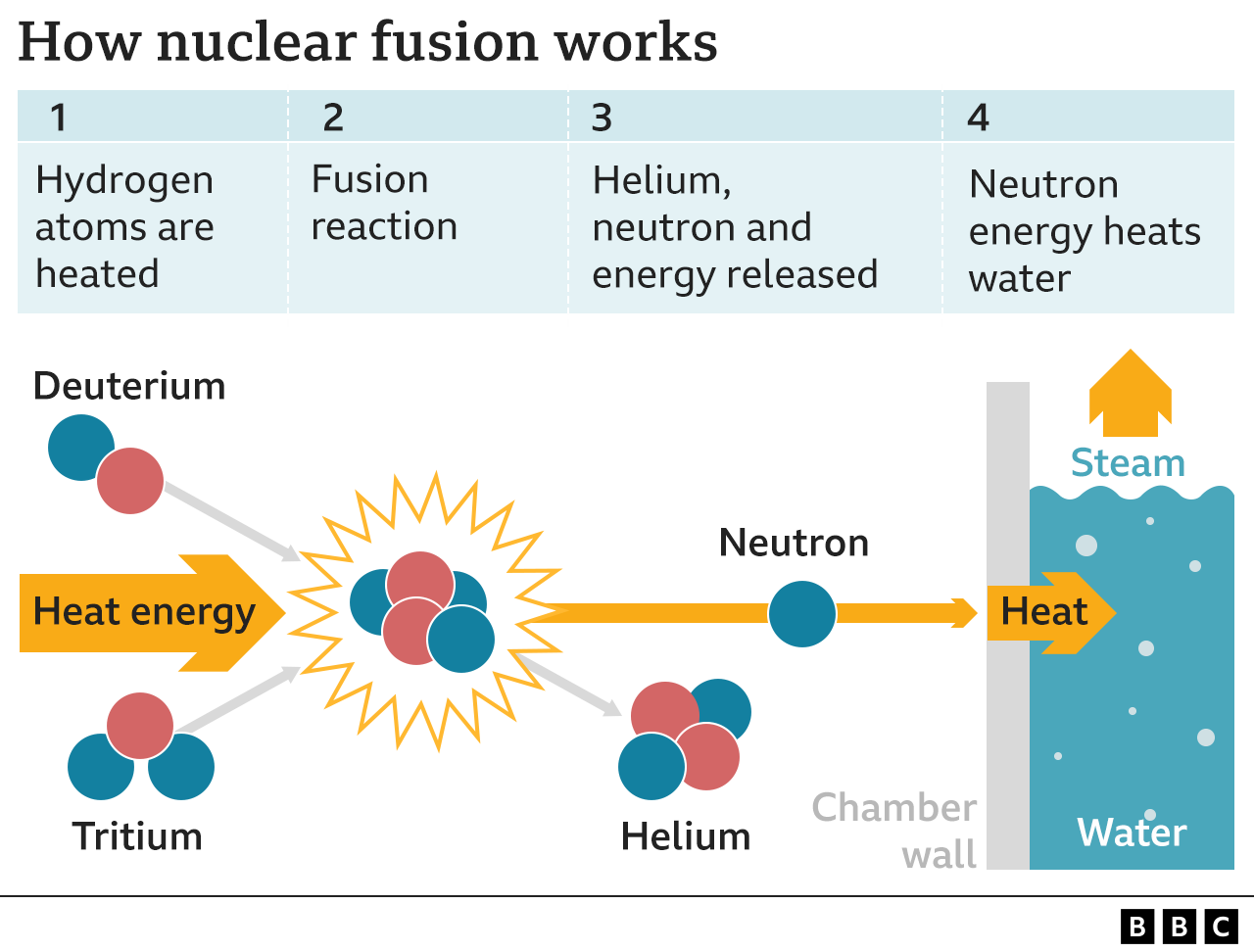
Hydrogen plasma will be heated to 150 million degrees Celsius, ten times hotter than the core of the Sun, to enable the fusion reaction.
The process happens in a doughnut-shaped reactor, called a tokamak, which is surrounded by giant magnets that confine and circulate the superheated, ionized plasma, away from the metal walls.
The superconducting magnets must be cooled to -269°C (-398°F), as cold as interstellar space.
Scientists have long sought to mimic the process of nuclear fusion that occurs inside the sun, arguing that it could provide an almost limitless source of cheap, safe and clean electricity.
Unlike in existing fission reactors, which split plutonium or uranium atoms, there’s no risk of an uncontrolled chain reaction with fusion and it doesn’t produce long-lived radioactive waste.
Back2Basics: Nuclear Fusion
Nuclear fusion is the process of making a single heavy nucleus (part of an atom) from two lighter nuclei. This process is called a nuclear reaction.
The nucleus made by fusion is heavier than either of the starting nuclei. It releases a large amount of energy.
Fusion is what powers the sun. Atoms of Tritium and Deuterium (isotopes of hydrogen, Hydrogen-3 and Hydrogen-2, respectively) unite under extreme pressure and temperature to produce a neutron and a helium isotope.
Along with this, an enormous amount of energy is released, which is several times the amount produced by fission.
Scientists continue to work on controlling nuclear fusion in an effort to make a fusion reactor to produce electricity.
How it is different from nuclear fission?
Simply put, fission is the division of one atom into two (by neutron bombardment), and fusion is the combination of two lighter atoms into a larger one (at a very high temperature).
Nuclear fission takes place when a large, somewhat unstable isotope (atoms with the same number of protons but a different number of neutrons) is bombarded by high-speed particles, usually neutrons.
Since its inception, UPSC-CSE has had toppers from various academic and socio-economic backgrounds who have cracked the exam with flying colours. It’s clear that one doesn’t have to go to Delhi or a coaching centre to crack UPSC-CSE.
If education, geographical and economic background doesn’t matter, then what does? Attitude, or precisely consistency. If you are persistent and adamant to clear UPSC- CSE and have given more than two attempts till now, then you must replace that with consistency. Because, being persistent might lead you to the door, but it’s consistency that unlocks it.
In last month’s Samanvaya 1-on-1 counselling sessions, our expert Civilsdaily mentors reached out to aspirants to address their concerns regarding UPSC-CSE preparation. These are the responses they often heard from them —
How do I start preparing after a gap of 3-4 months?
It’s easy for me to maintain consistency in GS Preparation but not Revision
I study daily, but can only remain focused for 2-3 hours. How do I improve?
My long working hours don’t allow me to study daily.
Why am I losing interest in completing a subject? It’ s easier to read a new subject everyday.
Open to All, Free Live Webinar by IPS Officer Rishabh Sharma sir
This prompted us to reach out to one of our students who is currently an IPS officer, Rishabh Sharma. He cleared the exam in 2020 with AIR 454. After his first attempt, Rishabh had enrolled in Smash Mains program underSajal sir and also attended our free interview program. Cracking the mighty UPSC-CSE the second time, Rishabh explains what consistency means to him —
UPSC doesn’t just test your intellect. It tests your patience, mental strength, your emotions, the very character of yours . As far as the journey of CSE is concerned you might know when to start, but you never know when the journey will come to an end. So be consistent and enjoy the journey.
Every topper follows a plan, a method or strategy that makes it easier for them to study on a daily basis and complete the traget modules of the day. In this free live webinar, Rishab Sharma IPS will be explaining the many ways he ensured that he never faltered on his preparation.
What you will be learning from Rishab Sharma IPS in this webinar?
1. The difference between a consistent study pattern v/s an inconsistent one. How did UPSC-CSE become easier for Rishab Sharma IPS due to consistency?
2. Social media distraction. How did Rishabh Sharma IPS avoid spending long hours on social media?
3. Number of ideal breaks everyday. Why is it necessary to reward yourself with a short break from time to time?
4. Did Rishabh Sharma IPS plan his timetable in advance? Why daily timetable should not be rigid but yearly timetable should be well defined?
5. How to remain consistent when you are not opting for coaching? Rishabh Sharma answers.
6. What are the practical methods to maintain regularity in studies. Tips to sustain the fire and passion for studies by Rishab Sharma IPS
7. Why using Public Libraries is a way to remain consistent in UPSC-CSE preparation? How helpful is it according to Rishabh Sharma?
8. What are the 4 factors that determine if you can remain consistent for a year? If not, then why should you work on them first before starting UPSC-CSE preparation?
It’s understandable we are humans and not programmable robots who can maintain the same level of interest everyday. However, maintaining an overall consistency throughout our preparation is neccessary to clear this competitive and vast exam.
We hope this webinar by Rishabh Sharma IPS will give you a fresh and clear start to prepare for UPSC-CSE 2022-23
There is a consensus that privatization is the panacea. Policymakers often cite the private sector’s ability to grow faster. This may not always be true.
Meaning of Privatisation
It means the transfer of ownership, management, and control of the public sector enterprises to the private sector. India adopted a mixed economy model, where the Public Sector Enterprises (PSEs) were established on a socialistic pattern of development. However, due to the poor performance of several PSEs and the consequent huge fiscal deficits, privatization was pursued.
Privatization can suggest several things-
Migration of something from the public sector to the private sector.
It is also used as a metonym for deregulation when a massively regulated private firm or industry becomes less organized.
Government services and operations may also be (denationalised) privatised. In these circumstances, private entities are tasked with the application of government plans or the execution of government assistance that had earlier been the vision of state-run companies. Some instances involve law enforcement, revenue collection, and prison management.
Privatization of the public sector companies by selling off parts of the equity of PSEs to the public is known as disinvestment.
Objectives of Privatisation
1. Providing strong momentum for the inflow of FDI
2. Improving the efficiency of public sector undertakings (PSUs)
The efficiency of PSUs is improved by giving them the autonomy to make decisions.
Some companies were given special categories of Navratna and Miniratna.
3.Reduce the fiscal burden on the government in maintaining PSEs.
Ways of Privatisation
Government companies are transformed into private companies in two ways.
Transfer of ownership
Government companies can be converted into private companies in the following two ways:
By the withdrawal of the government from the ownership and management of public sector companies
By the outright sale of public sector companies.
Disinvestment
Disinvestment, or divestment, refers to the act of a business or government selling or liquidating an asset or subsidiary or the process of dilution of a government’s stake in a PSU.
The rationale for disinvestment is that the government has no business to be in a business. Thus, the government continues to disinvest in sectors where private companies are already the dominant player.
However, there are six methods of privatization.
Public sale of shares
Public auction
Public tender
Direct negotiations
Transfer of control of enterprises that were controlled by the state or by municipalities
Lease with a right to purchase
Benefit of Disinvestment
Improves corporate governance: It would result in the introduction of corporate governance in the privatized companies by freeing the PSEs from Government control and giving more scope to innovation. Enhanced corporate and with the introduction of independent Directors.
Develops and deepens the capital market through the spread of equity culture: The disinvestment would benefit the small investors and employees as it would lead to a wider distribution of wealth in the form of public offerings of privatized companies.
Disinvestment funds can be utilized for long-term goals such as:
Financing large-scale infrastructure development.
Investing in the economy to encourage spending
Expansion and Diversification of the firm
Repayment of Government Debts: Almost 40-45% of the Centre’s revenue receipts go towards repaying public debt/interest
Investing in social programs like health and education
Fiscal space for the relocation of resources locked with CPSEs: Disinvestment also assumes significance due to the prevalence of an increasingly competitive environment, which makes it difficult for many PSUs to operate profitably. This leads to a rapid erosion of the value of the public assets making it critical to disinvest early to realize a high value.
Resources locked in sectors developed enough to raise money from the market are channelized into areas of the economy that are less likely to access resources for the market because of their stage of economic development. Letting go of these assets is best in the long-term interest of the taxpayers as the current yield on these investments is abysmally low.
Unlocking of shareholder value: It is done with the help of issuing IPO. IPO means Initial Public Offering. It is a process by which a privately held company becomes a publicly-traded company by offering its shares to the public for the first time. Offering an IPO is a money-making exercise. Every company needs money for expansion, to improve their business, to better the infrastructure, to repay loans, etc.
Employees: Employees of a firm are benefitted by disinvestment through:
Pay rises, which has been done in past disinvestments.
Greater opportunities and avenues for career growth and further employment generation through capacity expansion.
Is privatization a solution?
No significant difference in performance: Studies indicate that the gap in growth (and service) between public sector undertakings (PSUs) with autonomy and private firms is not significant.
Experience of the privatization in the UK: One study highlighted that the famed British privatization initiative of British Airways, British Gas, and the Railways led to no systemic difference in performance.
Evidence on performance after privatization is even more mixed in developing countries.
Multiple factors: Growth post-privatization is often due to multiple factors, for example, better funding under a private promoter versus a starved government budget, a better business cycle.
Failure of Privatisation
Privatization as a revenue source: As a state, we have sought to hock our generational wealth in PSUs for the past two decades, with limited success.
Failure to raise funds: Actual receipts from disinvestment have always fallen significantly short of targets.
In total, between FY11 and FY21, about ₹5 lakh crore was raised (that is, about 33% of just FY22’s projected fiscal deficit (PRS India, 2021) – some of this, notably through stake sale to other PSUs.
Considering social and institutional constraints, it is a slow process. For instance, BPCL’s long-awaited journey.
Challenges
Challenge of valuation: For instance, about 65% of about 300 national highway projects have been recording significant toll collection growth; any valuations of such assets will need to ensure they capture potential growth in toll revenue, as NHAI’s highway expansion bears fruit and the economy recovers.
Social consequences: There were about 348 CPSUs in existence in 2018, with a total investment of ₹16.4 trillion and about 10.3 lakh employees in Central Public Sector Enterprises (in 2019). Push for massive privatization resulting in mass layoffs in a period of low job creation.
Concentration of wealth: A greater concentration of public assets in select private hands is also a medium-term concern. About 70% of all profits generated in the corporate sector in FY20 were with just 20 firms.
Across sectors, a whiff of oligopoly is emerging – cigarettes continue to be dominated by a single player, paints have one entity with ~40% in FY21, airports now have a new operator with about six airports plus a 74% stake in Mumbai’s international airport, while telecom has just three players left.
Such concentration, mixed with the privatization of public assets, is likely to lead to higher usage fees (already being seen in telecom) and inflation, coupled with a loss of strategic control.
Way forward
Outright privatization is not a solution: Selective PSU Reform must be considered.
The Maruti model is instructive – the government had a joint venture with the Suzuki Corporation, but ceded control, despite Suzuki having only 26% shareholding, in return for a push by Suzuki for greater exports from India and manufacture of global models in India
Stake sale route: Empirical evidence highlights that stake sales are considered a preferred route (about 67% of all PSUs sales in about 108 countries between 1977 and 2000 were conducted via this route), as it gives time to ensure price discovery, allowing improved performance to raise valuations over time.
Global Experience: In China, for the past few decades, growth has been led by corporatized PSUs, all of them held under a holding company (SASAC), which promotes better governance, appoints leadership, and executes mergers and acquisitions.
In Singapore, the Ministry of Finance focuses on policymaking, while the holding firm is focused on corporatizing and expanding its PSUs on a global scale.
PSUs with greater autonomy, with the government retaining control via a holding firm, can also be subject to the right incentives.
Conclusion
The time has come to take a relook at privatization. Simply pursuing this path, while utilizing such proceeds for loan write-offs or populist giveaways in the election cycle will not do.
This January 15th, India celebrated its 74th Army Day, to offer remembrance to the enlightening journey of courage and sacrifice of the Indian Army.
In this article, we will look back at how the year gone by has been for the Indian Army, the security challenges they faced and continue to face in the year ahead, their preparedness in meeting these challenges and the opportunities in further enhancing our defence capabilities.
Why is this year special?
Ans. New Combat Uniform
The Indian Army will be provided with new combat uniform for its personnel aimed to provide more comfort and sustainability.
The new uniform will increase the comfort of women officers as well.
The new uniform is provided with a digital disruptive pattern and won’t be available in the open market.
The uniform has been designed by keeping 4Cs in mind: comfort, climate, camouflage and confidentiality.
They will be barcoded and QR coded to maintain the uniqueness and will be available only through the ordnance chain or military canteens.
Why do we need an Army?
India is not the member of any traditional military alliance and thus has to maintain an independent military capability.
The army is tasked to retain its strategic autonomy while protecting itself against possible threats to its unity and integrity.
The Indian Armed Forces are structured to deal with the possible threats from potential adversaries as part of its capability to carry out its mandated role and tasks.
Role played by Indian Army
The primary role of the Indian Army is to ensure the territorial integrity of the nation by deterrence or by waging war.
The secondary role of the Army is to provide assistance to civil authorities, when requisitioned, to respond to heightened law and order situations, for disaster management or for providing essential services.
A brief background of Indian Army
The Indian Army is the third largest army in the world in terms of size, based on the number of personnel.
But this description obfuscates the fact that it is not as powerful as what such a portrayal should signify.
This implies its capacity to undertake military operations optimally in the multi-domain, technology dominated battlefields of the future.
Challenges to Indian Army
The Indian Army essentially remains a force largely organised, equipped and trained to fight wars.
That is not to say that the Army cannot carry out its role and tasks successfully in the current context, more so, if it is provided the requisite means.
Nonetheless, it needs no emphasis that the Army needs to modernize expeditiously if it has to be prepared to take on the security challenges of the future.
[A] Future Security Scenarios
Disputed neighbours: India’s threats and challenges in the military realm primarily emanate from the historically inherited territorial disputes over which five wars have already been fought.
Nuke and the Military: All wars will be fought under a nuclear overhang, implying that escalation to the level of nuclear exchanges is possible, and must be planned for.
Unresolved territorial disputes going ugly: The fact that the existing territorial disputes are ‘land-centric’ highlights the pre-dominant role of the Army in the Indian security context.
Proxy-wars through radicalization: Pakistan, has been running a sub-conventional campaign against India since the early 1990s which essentially involves stoking militancy and pushing cross-border terror modules.
Nukes plus terror: Nuclear ‘sabre-rattling’ is used in conjunction with the cross-border terror strikes, to prevent India from ‘raising the ante’ and retaliating with a punitive conventional response.
[B] Changing Nature of Conflicts
Hybrid Warfare: In the aftermath of the Afghanistan and Iraq wars of the first decade of this century, the world has witnessed a reduction in full-fledged ‘state vs state’ wars.
It appear to be the new norm, involving a combination of two or more of the following:
Conventional / Regular warfare: – state vs state wars, primarily waged by conventional forces or regular troops on both/ all sides.
Irregular warfare: Conflict against a state by employing trained combatants who are not regular military. Pakistan has launched such ‘irregulars’ in all its wars against India.
Asymmetric warfare: War between sides whose military power differs greatly, waged by the weaker side using non-traditional means like terrorism. Ex. Jihadists vs Army
Unconventional warfare: War waged by a country using means other than established forms of armed conflict, to make the adversary capitulate even without a classical war (economic wars, water wars, legal wars etc.)
Technological/ Informational warfare: Combination of cyber, space, electronic, propaganda, psychological, media and social media wars.
There are perceptible threats that all above discourses might happen simultaneously if any war escalates.
Present perceptible threats
As most of our current threats pertain to conventional conflict over:
Disputed land borders
Insurgencies and cross-border terrorism
Natural calamities and their mitigation
Disaster management
Need of the hour:
[A] Capability Building
In keeping with its mandated roles, the Army has to ensure multi-dimensional capability to deal with the threats from our potential adversaries (external as well as internal).
Capability building of the Army is a continuing process, where budget, especially capital funds, are requested for annually, based on the projected needs for implementing a 15 year long term perspective plan.
[B] Modernisation Needs of the Army
Technological advancement: The Army of the future will have to be technologically oriented, with many more specialists, as compared to generalists.
Modern equipment: It will have to be equipped progressively with modern weapons and weapon systems, supported by technology based processes and automation to meet the needs and challenges of the future battlefield.
Arms and ammunitions: Accordingly, the Army will need to replace or upgrade its ageing inventory of weapons and equipment while also restructuring and right-sizing in a transformational way.
As far as weapons and equipment are concerned, the Army needs the following on priority to replace or rejuvenate vintage equipment as part of the capability development programme:
Infantry – The infantry, which is continuously being employed in counter-terrorist or counter-insurgency operations, needs to be empowered immediately by provision of new generation lightweight assault rifles, bullet proof jackets and helmets, hand held thermal imagers (HHTIs) etc.
Artillery–Adequate quantities of new artillery guns, including indigenously manufactured Dhanush systems, as well as more lethal, precision artillery systems like BrahMos cruise missiles, Smerch and Pinaka rocket systems, need to be inducted immediately.
UAVs – More quantities of Unmanned Aerial Vehicles (UAVs) of latest technology must be inducted in adequate numbers for surveillance and precision attack operations in both peace and war.
Mechanised Forces–Additional quantities of ‘current technology’, T-90 tanks and ICVs, night enabled and equipped with long range ant-tank guided missiles, need to be inducted on priority.
Army Aviation–Acquisition of three squadrons’ worth of new generation Apache attack helicopters into the Army Aviation has been reportedly sanctioned, as a follow up of the Air Force order.
Air Defence (AD) –The Army AD is undergoing a total revamp of equipment. The various army air defence weapon acquisition projects for acquisition of all types of surface to air missile systems as well as upgrading old generation systems.
Engineers- The combat engineers need to be provided new generation of bridging equipment,mine-laying equipment as well as mine clearance equipment. Where possible, old equipment must be upgraded indigenously.
Challenges in Capability Building
There are huge ongoing challenges in the process of capacity building of the Indian Army. The more important of these are discussed as follows:
Capital crunch: It has been the experience for many years now that adequate capital funds for modernisation are not allotted.
Budgetary constraints: Considering that the modernisation plans of the Army are lagging far behind already, budgetary constraints will play an important part in formulating and executing plans for the future.
Sizing constraints: The Indian Army must cap its overall numbers at the current level of 1.3 million, while making fresh efforts at making up the shortfall of officers.
Strategic constraints: Currently, military planning is hamstrung by lack of a clearly articulated and integrated military strategy. In such a situation, the three wings of the military are left to devise their own strategies and philosophies.
Lack of modernisation: An alarmingly large percentage of equipment is of old vintage, due to many proposals for acquisition and upgradation of new equipment having been inordinately delayed.
Quality issues: Arms and ammunition over the years undergo quality degradation.
Procurement issues: There is lack of sustained effort within the Army to develop expertise on defence procurement and financial issues. The Army remains rooted to the outdated policies of employing ‘generalists’ rather than ‘specialists’.
Way forward
India needs to progressively build capability of hard military power, soft power and demonstrated power in its quest to be recognised as a ‘regional power with global influence’.
Right-sizing: The Indian Army needs to undergo transformation and ‘right-sizing’ towards becoming an optimised modern force, with a more efficient ‘teeth to tail’ ratio.
Logistics optimization: Our logistics need to be integrated and optimised on priority.
Interoperability: Enhanced jointness and interoperability as promised under the integrated theatre command needs to be implemented at its earliest.
Re-orientation: The Indian Army must fully operationalize the concept of the Reorganised Army’s Multi-role Quick Reaction Force (RAMFOR).
Enhancing informational warfare capability: Special Operations, Cyber and Space Commands must be provided manpower from within the existing establishment.
Policy input for strategizing: And last but not the least, the government must provide guidance to the military through issue of national security strategy, defence policy and military strategy.
Conclusion
There can be no doubt that the Indian Army needs to be modernised on priority.
To achieve this objective, the Government and the Army will have to take a look at the entire issue afresh and come up with innovative solutions to address the various obstacles standing in the way.
Fill Samanvaya form to discuss and resolve your UPSC IAS preparation issues, doubts, and insecurities with us.
Finding success in the UPSC journey requires every aspirant to identify their “weak” areas and rectify them.
I think my number of revisions of the syllabus is still less.
Why are my marks stagnant in the mock test? Do I need a new book?
Should I change the optional subject?
At any given point during preparation days, these questions cross every aspirant’s mind. While it is important to have the right technique aka “smart study” strategy for this examination but is that enough?
MENTAL HEALTH as an issue has always carried a sense of stigma in Indian society. So, why should the stress and anxiety associated with UPSC preparation be treated any differently!
Even if you are one of those courageous extroverts who speak about these mental challenges, you always have that one friend who sends you a motivational quote to get you over your MOOD SWINGS with some extra advice to memorize the quote as it can be helpful for GS 4 and essay.
Honestly, sometimes you need more than a motivational quote. In our interaction with some 1000+ students, even the smallest act of acknowledging an aspirant’s anxiety and stress can go a long way in maintaining the right frame of mind during preparation.
GAIN THE RIGHT CONFIDENCE TO HANDLE BOTH SUCCESS AND FAILURE
Emotional Stability is crucial to remain sane during this preparation and also to enjoy the whole process. The first step towards a balanced approach is to identify that as a human having lows and highs is pretty much normal. If you are not able to finish the decided target, then it is alright to feel bad and push yourself a little extra for the next day. What you need to avoid is “unhealthy behaviour”. For example, putting yourself under so much pressure that your performance starts to deteriorate or belittling yourself that it starts to affect your confidence.
We are not here to diagnose any clinical conditions. But as former aspirants and gaining years of experience through mentorship, we are a big advocate of people’s interaction for healthy minds.
Sometimes, in this preparation, all you need is a person to hear you out and understand you. And unfortunately, some of us are not able to find that one person in our family or friends. There is no shame in asking for emotional help. It helps if you have a person who can listen to your worries and reduce some of your pressure. Talking to your mentor can make you feel supported in the toughest times. The worst part of silo preparation is that aspirants tend to create the idea that all these emotional upheavals are exclusive to them. Trust us this is not true!
Why Mentorship helps you double your efforts in half the time?
A holistic UPSC preparation includes the right technique to complete your syllabus, revisions and mock test and a healthy mindset.
Reach out to us if you feel like nothing is going right in your preparation. Talk to our mentors about your emotional worries, and remove the burden of anxieties from your preparation.
Lack of direction in your UPSC IAS preparation, an absence of a well-defined strategy and inability to make required necessary changes either due to lack of guidance or awareness are the biggest killers of your LBSNAA dream.
Therefore, it is essential for you to get your approach rectified and tuned as per the demands of UPSC. If you feel lost in UPSC preparation and have been gripped by negativity, self-doubt, and demotivation, this is for you.
Fill the Samanvaya form for a free on-call mentorship session. We’ll call you within 24 hours.
Abhishek has benefited from Civilsdaily’s approach, so did 70+ candidates who cleared UPSC IAS 2019
The Perfect exam cracking pattern
Integrate them in your preparation. We’ll tell you how to do itIt’s about how ‘you’ should be doing it instead of how someone else did it. That is the ‘elephant in the room’.
1. First step starts with thisSamanvayacall: Once you fill in the form, our senior mentors will have a 1-to-1 detailed discussion (on-callbased on which we create a step by step plan for next week, next month and so on.
2. You are given access to our invite-only chat platform, Habitat where you can connect with mentors, ask your daily doubts, discuss your test-prep questions and have real-time live sessions on news and op-eds, and find your optional groups.
Daily target monitoring.
3. The third and the most personalized tier is the dedicated 1 on 1 mentor allotment who stays with you through the course of your UPSC preparation – always-on chat and on scheduled calls to help you assess, evaluate, and chart the next milestone of your IAS 2022/2023 journey.
Daily target monitoring on Habitat
Who are you?
Working Junta? If you are preparing for IAS 2022-23 and working simultaneously, we can help you strategize and decipher the IAS exam and design a timetable that fits right in your hectic schedule.
First-time prep? If you are in the last year of college or thinking of dropping a year and preparing for IAS 2022-23 full time, we’ll help you pick the right books and craft a practical & personalstrategy.
Have appeared before? and weren’t successful. We’ll help you identify your mistakes, rectify them for the necessary course correction. Let this be your final and successful attempt.
You just have to take 5 minutes out and fill this form: Samanvaya For IAS 2022-23
Fill up the following details in Samanvaya form given below to schedule a free one-on-one mentorship session with senior mentors from Civilsdaily. We’ll call you within 24 hours.
Don’t forget to check your email after form submission to download your free Tikdam e-book and Civilsdaily’s IAS starter material.
Smash Prelims Program is back after a thumping success in Prelims 2021. Out of 25 students Santosh sir has mentored, 15 have cleared prelims this time.Our students were kind enough to take time out of their hectic Mains preparation and let us know how Santosh sir’s mentorship benefitted them in the exams. We wish them all the very best for the upcoming Mains exam from 7th January onwards!
https://youtu.be/oTRUMSOQEY4
Why Your Focus for Next 5 Months Must be About Scoring Above Cut-Off Marks in UPSC-CSE Prelims? Isn’t the last 1 Month Enough for This?
Every year, the competition for UPSC-CSE is increasing while vacancies are decreasing drastically. This year there are only 712 vacancies as against 2019 which had 927 vacancies. However, atleast 10 lakh students will attempt the prelims exam. This is why right now, it’s important to start having an Olympic Athlete mindset. You need to daily focus on scoring above the cut-off marks in your test series.
Civilsdaily Student and 2019 UPSC-CSE AIR 8 Topper Abhishek Saraf had practiced nearly 6000+ MCQs under us to clear prelims!
What makes prelims tough? It’s because the paper is unpredictable. If this year, science questions are a breeze then the next year you will have to answer advanced concept-based questions. Unlike Mains, Prelims has negative markings.
Toppers like Pranav Vijayvergiya (AIR 65) andSwati Sharma(AIR 17) have found Prelims to be tougher than Mains. In fact, Pranav failed to clear Prelims thrice. But, in his fourth attempt he took Civilsdaily mentorship and cleared Prelims, Mains and Interview in one shot!
Are you feeling low that you are unable to get the required cut-off marks in your test series. Worry not, for about 65% of the UPSC toppers have said that they scored below cut-off marks till December. But by June, they were able to boost their marks to get through the prelims hurdle. It’s time to be like them now.
One has to be good at elimination methods to choose the right option amongst two similar ones. Our Smash Prelims Program started as a pilot project last year with an aim to introduce step-wise improvement in our chosen 25 aspirants. Over a period of 2 months, Santhosh sir inculcated confidence in aspirants who were either newbies or gave too many attempts. This year, we achieved a remarkable 60% success ratio. Next year, we have set our eyes on 100%. Yes, we are ambitious and aspirational just like any other UPSC aspirant.
Why is Mentorship Required for UPSC-CSE Prelims in Every Step – From Test Series, to Study Materials, Classes to Doubt Resolution?
If you are appearing for UPSC-CSE 2022 exams, you might have completed your entire prelims and mains syllabus right now. So what are your main priorities right now? To succeed in UPSC-CSE Prelims 2022, you have to check all these boxes in terms of preparation—
You need clear strategy for next 150 days.
You need to revise effectively to remember whole syllabus at the eve of exam.
You need to practice lots of tests to score accurately, to understand elimination techniques and reduce exam anxiety.
You need to revise current affair of 1.5 years that you have been studying daily.
You need a mentor to fill the critical gaps that have been ignoring till now as you had no one to address them for you.
Santhosh Sir’s Weekly Zoom Session
Do you want to have a mentor who conducts and evaluates medium to advanced test series regularly? A mentor explains to you the different kinds of elimination techniques after you have taken a test series. Before attending a test do you want the mentor to discuss with you the study materials required for the test and provide the right notes with integrated current affairs? While studying a subject, you might have umpteen number of questions. Having someone who responds quickly and explains the topics in simple terms saves your time. And, after a test do you want an experienced mentor to discuss the right answers and motivate you? Do you want the mentor to provide you classes on static+dynamic prelims topics? If yes, then this is the right program for you! The registrations are open for all UPSC 2022 aspirants
Self Preparation with Mentorship: What do Civilsdaily Students think of Santosh Sir’s Mentorship for UPSC-CSE Prelims?
Santhosh Sir, Core Civilsdaily Mentor. He has attended Interview Thrice & Cleared Prelims 6/6 times with above 145 marks.
We asked Santosh sir’s students about their opinion on mentorship — if it was something that saved their time or wasted their time in studies and this is what they had to say:
Kamini: “If I can say in one word, then Santosh sir’s mentorship is unique. Before I joined his program, I used to score 90 marks in Full Length Test Series. Santhosh sir had done in depth analysis of my test papers and suggested ways to reduce the negatives. Right now I am able to score 100+ in advanced test series of not only Civilsdaily but other institutes. He is always available to clear my doubts and solve my issues on call or phone. No issue is too big enough for Santosh sir. He has always told me after you finish a test series, read the same topics again and take another test series the same day to see if your marks improve. From Santosh sir’s polity and economic survey notes, we got questions in 2021 Prelims. I always feel its better to do self studies with mentorship than join coaching institutes and get spoon fed with information.”
Sweetie Raj: “I am a banking professional, living with a joint family. Attending coaching classes is out of question because I won’t have time to read the books myself. Santosh sir helps me self-study by providing me mentorship daily. I study daily from 9PM to 3AM. Santosh sir has been available for 1 hour strategy calls even during this time. No other teacher would have wanted me to succeed as much as he wants me to. I can understand concepts by myself and don’t need help in that. I want someone who pushes me to complete the target modules, checks if I did my mains answer writing for the day and analyses the previous year question papers with me. Because of Santosh sir, I understood that its just not enough reading one book but at the same time I dont have to waste time reading many books. He tells me the topic-wise sources to refer. Also he has designed a study plan for me that I can follow every week. Once, I told Santhosh sir I was missing test series discussion classes as it was conducted at 7PM. Immediately, he provided me recorded videos and kept the session at 8.30PM.”
Specific Features of Smash Prelims 2022 by Santosh Sir
Sincere aspirants who are scoring in the range of 80-90 marks must not attend last minute crash courses right now. They should instead focus on self revision, test series practice and guided mentorship to qualify for UPSC Prelims 2022. Here are the features of Prelims Focused Program by Civilsdaily —
Pillar-1
PRELIMS TESTS:
40 Full Length Tests(12 Basic + 6 Advanced + 10 CA tests + 8 Full tests + 4 CSAT).
In addition to this, in the month of January, we will have 60 sectional tests for practice. This will have 50 questions each. Hence, totally 100 Test Papers (40 FLTs + 60 Sectional Test Papers)
CHECK OUT THE TEST SERIES PROGRAM ON FEBRUARY 15TH & REGISTER ASAP.
VALUE ADDITIONS NOTES AND CLASSES BY VETERAN CIVILSDAILY MENTORS like SUDHANSHU SIR, SAJAL SIR & SUKANYA MA’AM
Polity: Sudhanshu sirwill conduct two sessions covering all the Polity Fundamentals, a session analyzing past year papers, another session on important current affairs related to polity this year and will discuss your test solutions.
History: Santosh Gupta sir will conduct a session on Sectoral Developments in Modern History, a session analyzing past year papers, and test discussion.
Economy: Sajal sir will conduct sessions on economic survey, trend analysis, discussion of most important economic current affairs, past year paper analysis, and economy final test discussion.
Geography: Santosh sir will conduct sessions on the most difficult aspects like Geography Mapping, Economic Geography, and Indian Agriculture.
Environment:Sukanya Ma’amwill cover sessions on Environment innovatively. Key concepts like vegetation and biome, Indian wildlife, conventions and protocols, national parks and sanctuaries, agriculture and sustainable development, and environment current affairs will be covered.
Science & Technology: This year’s prelims paper questioned on the basic concepts of science. Keeping this in mind, Santosh Gupta sir will conduct 2 sessions on One basic concept and current affairs of science and technology.
2. Civilsdaily Current Affairs Magazines for 1 year
3. Civilsdaily compilations of Yojna, Kurukshetra, PRS and RS TV.
4. Civilsdaily Budget And Economic Survey Summary.
5. Handouts on key subject-wise static topics to remember the terms and definitions for Prelims 2022.
Pillar-3
Santosh Gupta sir’s mentorship program
1. Introductory mentor call to every aspirant immediately upon commencement of program.
2. Weekly zoom strategy session by Santosh sir for doubt clearance and continuous improvement.
3. 1-1 mentor calls after 3-4 tests by mentor. After every test series, zoom sessions will be conducted by Birendra sir with all members of the batch for test discussion.
4. Support from mentors on the Habitat Group.
5. Frequent sessions with toppers for support and guidance. will have these special features for aspirants.
6. Mentor will guide on the FCE Approach i.e the Factual and Conceptual Methods of Elimination.
7. Mentor call as per request and mandatory check up call by mentor once a month.
Toppers’ Speak: How Civilsdaily Mentorship Helped Me Clear UPSC?
https://www.youtube.com/watch?v=DSwO38weHAA
About Santosh Gupta Sir
Santosh sir has scored above 140 twice in UPSC prelims and 120 plus in all 6 attempts. He has written all 6 mains and has appeared for Interviews 3 times. He has qualified UPSC EPFO and BPSC 56-59th also. As the Prelims coordinator at Civilsdaily, he has helped 15 out of 25 students clear the prelims examination this year.
HOW TO ATTEMPT ANSWERS IN DAILY ANSWER WRITING ENHANCEMENT(AWE)?
Daily 4 questions from General studies 1, 2, 3, and 4 will be provided to you.
A Mentor’s Comment will be available for all answers. This can be used as a guidance tool but we encourage you to write original answers.
You can write your answer on an A4 sheet and scan/click pictures of the same.
Upload the scanned answer in the comment section of the same question.
Along with the scanned answer, please share your Razor payment ID, so that paid members are given priority.
If you upload the answer on the same day like the answer of 11th February is uploaded on 11th February then your answer will be checked within 72 hours. Also, reviews will be in the order of submission- First come first serve basis
If you are writing answers late, for example, 11th February is uploaded on 13th February , then these answers will be evaluated as per the mentor’s schedule.
We encourage you to write answers on the same day. However, if you are uploading an answer late then tag the mentor like @Staff so that the mentor is notified about your answer.
*In case your answer is not reviewed, reply to your answer saying *NOT CHECKED*.