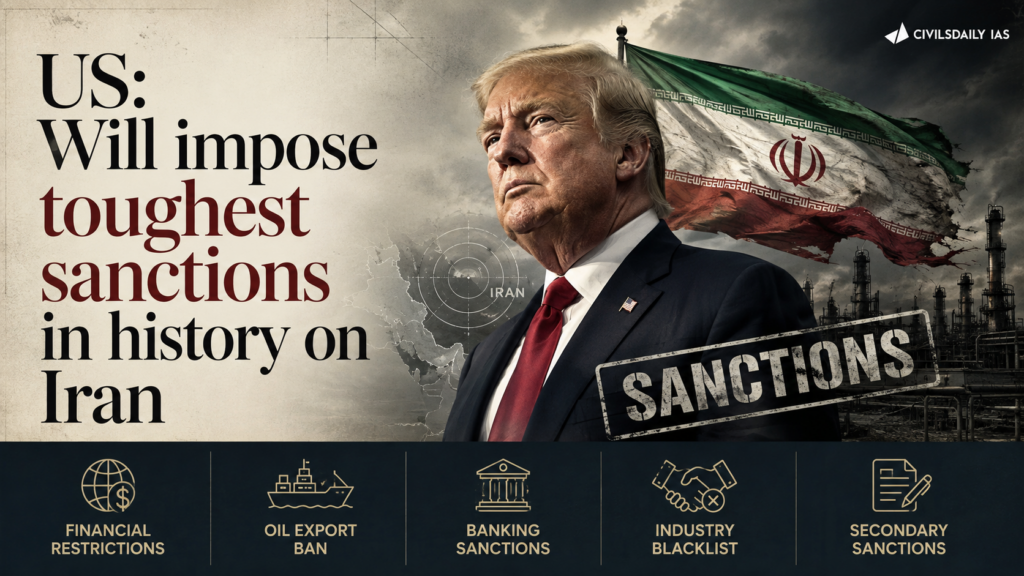
Why in the News
The United States Treasury Secretary announced on 20 August 2026 that Washington will impose the toughest sanctions in history on Iran, to be layered on an existing naval blockade, with the stated objective of collapsing the Iranian government. The United States President separately warned that any country whose financial institutions, businesses, airports or government entities provide any type of lifeline to Iran will itself face economic consequences. That warning converts a bilateral war into a compliance problem for every third country that trades with Iran.
What are secondary sanctions?
- Definition: Secondary sanctions penalise persons and firms in third countries for dealing with a sanctioned state, even where that dealing is lawful in their own jurisdiction. They extend a national measure into an extraterritorial one.
- How they bite: The penalty is exclusion, since a firm that trades with the target loses access to the sanctioning state’s financial system, markets and correspondent banking.
- Why the currency matters: Their reach depends on the sanctioning state’s currency being used for settlement, which is why United States measures affect countries that have no dispute with Washington.
What is a naval blockade?
- Definition: A naval blockade is the use of warships to prevent vessels entering or leaving a state’s ports or coastline. It operates through force, unlike sanctions, which operate through law and financial exclusion.
What does the announced sanctions package actually threaten?
- Stated severity: The United States Treasury Secretary said Washington will impose the toughest sanctions in history on Iran.
- Combination with the blockade: He described the approach as combining the existing blockade on Iran with the new sanctions, rather than replacing one with the other.
- Stated objective: He said the approach would work in Iran and that Washington was going to collapse the government there.
- Announced framing: The United States President promised economic warfare and isolation on an unprecedented scale, although details were scant.
- Detail still pending: The Treasury Secretary said he would hold a press conference on Monday to set out the specifics.
Why does the lifeline warning make this a problem for third countries?
- The categories named: The warning covers any country that allows its financial institutions, businesses, airports or government entities to provide any type of lifeline to Iran.
- The threatened consequence: Such a country would itself face economic consequences, stated as tremendous in scale.
- The timing: The warning was issued on Wednesday, ahead of the sanctions announcement, which places third countries on notice before the measures are published.
- Breadth of the categories: Airports and government entities extend the threat beyond banking to transport and to state to state dealings.
- Absence of a threshold: No minimum value or category of transaction was specified, so the scope of what counts as a lifeline remains undefined.
Why have the two ceasefires failed to hold?
- Origin of the war: The United States began the war alongside Israel nearly six months before the sanctions announcement.
- Two attempts: The United States and Iran twice announced ceasefire deals, in April and in June.
- Their stated purpose: Both aimed to restore the free flow of shipping through Hormuz as a path towards ending the conflict.
- Both collapsed: Both deals quickly crumbled, even as Israel largely withdrew from the fighting.
- Leadership transition in Tehran: A 40 day commemoration ceremony for the former Iranian Supreme Leader was held in Karbala on 20 August 2026, attended by Iran’s Parliament Speaker.
What is Iran’s counter-position?
- Characterisation of the measures: Iran’s foreign ministry condemned the fresh United States economic and trade sanctions, saying they targeted ordinary Iranians.
- The legal charge: The ministry described the measures as economic terrorism and as crimes against humanity.
- Attribution of motive: The Iranian Foreign Minister called the announcement an attempt to divert American public opinion from domestic financial problems, including record debt and rising interest rates.
- The wider claim: He argued that American economic terrorism threatens the global economy and the national sovereignty of countries around the world.
- The retained lever: Tehran continues its own economic pressure campaign by keeping the Strait of Hormuz largely closed.
Why has Oman become the pivot of the Hormuz question?
- A separate negotiation: Iran has been negotiating an agreement on managing the Strait of Hormuz with Oman, and has said several times in recent weeks that an agreement was close.
- The American response: The United States President responded to those negotiations on Monday by warning that he might bomb the Gulf state if it gets in the way.
- The anomaly in that threat: Oman is a longstanding United States security partner, which makes the threat a warning to an ally rather than to an adversary.
- Oman’s stated position: The Omani Foreign Minister said lasting security in the strait required a permanent peace in the region and rejected further escalation.
- Its diplomatic posture: He made the statement after meeting his Japanese counterpart, which places the strait’s management within a wider set of energy importing interests.
What does the escalation mean for India?
- Energy route exposure: A large share of India’s crude, liquefied natural gas (LNG) and liquefied petroleum gas (LPG) imports transits the Strait of Hormuz, so the strait’s closure raises India’s landed energy costs regardless of who supplies the cargo.
- Precedent of forced exit: India stopped importing Iranian crude in May 2019 after United States waivers under the sanctions regime lapsed, ending what had been one of its largest supply relationships.
- Connectivity investment at risk: India signed a ten year contract in May 2024 to operate the Shahid Beheshti terminal at Chabahar port in Iran, an asset whose viability depends on the sanctions environment.
- Corridor implications: The International North South Transport Corridor to Russia and Central Asia runs through Iranian territory, so secondary sanctions affect a route India built to bypass Pakistan.
- Existing exposure to secondary measures: India has already navigated the Countering America’s Adversaries Through Sanctions Act, 2017 over its purchase of the S-400 air defence system, which shows the compliance question is not new.
Challenges to a sanctions-led approach
- Poor record at producing regime change: Comprehensive sanctions rarely dislodge governments and often consolidate them. Eg. Cuba has been under a United States embargo since 1962 without a change of political system.
- Humanitarian burden falls on civilians: Restrictions on banking and shipping obstruct food and medicine even when formally exempted. Eg. Iran’s foreign ministry stated that the measures targeted ordinary Iranians and amounted to crimes against humanity.
- Evasion through parallel networks: Targets build shadow fleets, front companies and barter arrangements that blunt enforcement. Eg. United States sanctions on Hezbollah have repeatedly targeted courier networks and exchange houses used as fronts for cash movement.
- Erosion of the sanctioning currency’s role: Extraterritorial reach pushes third countries to settle trade outside the dollar. Eg. India has implemented the Special Rupee Vostro Account framework for invoicing, payment and settlement of international trade in rupees.
- Alliance friction: Threats against partners weaken the coalition needed for enforcement. Eg. The United States President warned he might bomb Oman, a longstanding American security partner, over its Hormuz negotiations with Iran.
- Counter escalation by the target: A sanctioned state with a chokepoint can impose costs on the sanctioning coalition’s own economies. Eg. Iran keeps the Strait of Hormuz largely closed, which carries 20 percent of global oil and 20 percent of global LNG.
- Legal contestation of extraterritoriality: Third states dispute the authority of one country to regulate transactions between two others. Eg. The European Union’s Blocking Statute was updated in 1996 and again in 2018 to shield European firms from United States extraterritorial sanctions on Iran.
Conclusion
The United States has moved from military coercion to declared economic warfare against Iran, pairing an existing naval blockade with sanctions described as the toughest in history and aimed openly at collapsing the government in Tehran. The lifeline warning extends the measures to third countries, while Iran retains its own lever by keeping the Strait of Hormuz largely closed and negotiating its management with Oman. The next milestone is the United States Treasury Secretary’s announced press conference on Monday setting out the details, with the Iran Oman understanding on the strait the other outstanding variable.
About Economic Statecraft
- About: Economic statecraft is the use of economic instruments, positive and negative, to change another state’s behaviour without resorting to force.
- Rationale: It exists because military action is costly and diplomatic protest is weak, so states seek an intermediate instrument that imposes real cost while remaining below the threshold of war.
- Positive inducements: Aid, trade preferences, market access and investment offered to secure a policy change.
- Comprehensive sanctions: Blanket restrictions on trade and finance with an entire economy, which impose broad cost but weak targeting.
- Targeted or smart sanctions: Asset freezes, travel bans and entity listings aimed at named individuals, firms and sectors, designed to spare the general population.
- Primary sanctions: Prohibitions binding on the sanctioning state’s own persons, firms and jurisdiction.
- Secondary sanctions: Penalties on third country persons for dealing with the target, which give a national measure global reach.
- Multilateral sanctions: Measures mandated by the United Nations Security Council under Chapter VII, binding on all member states.
Key Concerns Regarding Economic Statecraft
- Sovereignty and extraterritoriality: Secondary sanctions require states to enforce another state’s foreign policy inside their own jurisdiction. Eg. The French bank BNP Paribas paid about $8.9 billion to United States authorities in 2014 for processing transactions involving Sudan, Iran and Cuba.
- Humanitarian spillover: Financial de-risking by banks blocks exempted humanitarian trade because compliance officers avoid any exposure to a sanctioned jurisdiction. Eg. The Swiss Humanitarian Trade Arrangement was created in 2020 because ordinary banking channels would not carry payments for food and medicine to Iran.
- Fragmentation of the payments system: Repeated use of currency dominance as leverage accelerates the construction of alternative settlement channels and reduces future leverage. Eg. Russia built the System for Transfer of Financial Messages in 2014 as a domestic substitute for international bank messaging channels.
- Weak exit mechanism: Sanctions are politically easy to impose and hard to lift, so they persist beyond the objective they were designed to achieve. Eg. The Jackson Vanik amendment of 1974 remained applicable to Russia until its repeal in 2012, long after the emigration restrictions it targeted had ended.
- Measurement problem: There is no agreed method to establish that a policy change was caused by sanctions rather than by other pressures, which makes evaluation contested. Eg. Iranian oil exports fell sharply after the reimposition of sanctions in 2018 while the nuclear programme expanded, leaving both outcomes attributed to the same measures.
Laws and Instruments Governing Sanctions
- Charter of the United Nations, 1945: Article 41 empowers the Security Council to decide measures not involving the use of armed force, including complete or partial interruption of economic relations, which are binding on all member states.
- International Emergency Economic Powers Act, 1977: The principal United States statute allowing the President to declare a national emergency and regulate or block transactions with foreign persons.
- Iran Sanctions Act, 1996: Originally the Iran and Libya Sanctions Act, it introduced penalties on foreign firms investing in Iran’s energy sector, establishing the secondary sanctions template.
- Comprehensive Iran Sanctions, Accountability and Divestment Act, 2010: Widened the reach of energy sector sanctions and brought refined petroleum supply to Iran within their scope.
- Countering America’s Adversaries Through Sanctions Act, 2017: Codified sanctions against Iran, Russia and North Korea and limited the President’s discretion to waive them.
India’s Measures to Manage Sanctions and Energy Risk
- Special Rupee Vostro Account framework: A Reserve Bank of India mechanism for invoicing, payment and settlement of international trade in rupees, reducing dependence on third currency settlement.
- Chabahar port agreement: A ten year contract signed in May 2024 to operate the Shahid Beheshti terminal, giving India a sea route to Afghanistan and Central Asia that bypasses Pakistan.
- International North South Transport Corridor: A multimodal ship, rail and road route linking India to Russia and Central Asia through Iran, shortening transit time against the Suez route.
- Strategic Petroleum Reserve: Underground crude caverns at Visakhapatnam, Mangaluru and Padur operated by Indian Strategic Petroleum Reserves Limited to cushion supply interruptions.
- Supplier diversification: Term and spot procurement spread across Russian, West Asian, West African and American grades to reduce dependence on any single sanctioned or chokepoint dependent source.
Key Facts about United States Iran Relations
- 1979 Islamic Revolution: Ended the monarchy and was followed by the seizure of the United States embassy in Tehran and the severing of diplomatic relations.
- 1984 designation: The United States designated Iran a state sponsor of terrorism, which triggered a standing set of trade and aid restrictions.
- Joint Comprehensive Plan of Action, 2015: Concluded in July 2015 between Iran and the P5+1 group, it limited Iran’s enrichment in exchange for sanctions relief.
- 2018 withdrawal: The United States withdrew from the agreement in May 2018 and reimposed sanctions under a maximum pressure strategy.
- India’s exit from Iranian crude: India ended imports of Iranian crude oil in May 2019 after United States waivers expired.
- Strait of Hormuz weight: The strait carries about 20 million barrels of oil a day, 20 percent of global oil and 20 percent of global LNG.
Back2Basics: Strait of Hormuz
- Designation: A maritime chokepoint connecting the Persian Gulf to the Gulf of Oman and the Arabian Sea.
- Littoral states: Iran lies on the northern shore and controls seven of the eight islands in the strait, while Oman controls the southern entrance through the Musandam exclave.
- External presence: The United States Fifth Fleet, headquartered in Bahrain, acts as the external guarantor of transit through the strait.
- Energy weight: It carries the highest concentration of energy flow of any chokepoint in the world.
- Comparative chokepoints: The Strait of Malacca carries 23.7 percent of global seaborne trade and 80 percent of China’s energy imports, Bab el Mandeb carries 8.7 percent of global trade as the sole southern gateway to the Suez Canal, and the Suez Canal itself carries 12 percent of global maritime commerce with closure adding 9 to 17 sailing days.
Challenges in the West Asian Security and Energy Order
- Chokepoint dependence with no land alternative: Pipeline bypasses cover only a fraction of the volume that moves by sea. Eg. Closure of the Strait of Hormuz affects 20 million barrels a day, which no existing pipeline network can absorb.
- Non state armed actors controlling shorelines: Sea lanes can be closed by groups that hold coastline without holding a state. Eg. The Houthis control the eastern Yemeni shore of Bab el Mandeb in practice.
- Proxy networks that survive sanctions on the principal: Financial pressure on a state does not disable the armed groups it funds. Eg. The United States redesignated Hezbollah for service to the Iranian government under the command of the Islamic Revolutionary Guard Corps Quds Force.
- Overlapping external guarantors: Multiple outside powers with competing objectives raise the risk of miscalculation. Eg. The United States threatened to strike Oman over its Hormuz talks while relying on Omani mediation with Iran.
- Absence of a regional security architecture: There is no equivalent of a regional organisation with dispute settlement authority for the Gulf. Eg. The management of the Strait of Hormuz is being negotiated bilaterally between Iran and Oman rather than through any regional body.
- Energy revenue concentration in importing economies: Importing states have limited fiscal room to absorb a price shock. Eg. Every $1 per barrel increase raises India’s oil import bill by up to $2 billion on an annualised basis.
- Recognition and legitimacy disputes: Contested political authority complicates any negotiated settlement. Eg. Iran’s own leadership transition was marked by a 40 day commemoration for the former Supreme Leader in August 2026.
Way Forward
- Seek carve outs early rather than after listing: India should engage the United States Treasury on humanitarian, food and connectivity carve outs before the sanctions text is notified.
- Protect the Chabahar exemption: Press for the continuation of the project specific exemption that has allowed the Shahid Beheshti terminal to operate, given its Afghanistan and Central Asia connectivity function.
- Accelerate non dollar settlement channels: Expand the Special Rupee Vostro Account framework and rupee invoicing so that legitimate trade is not hostage to correspondent banking access.
- Diversify the maritime route, not only the supplier: Build term contracts with Atlantic basin and West African producers whose cargoes do not transit Hormuz.
- Support de-escalation through the Oman channel: Back a negotiated framework for managing the strait, since reopening it does more for importing economies than any adjustment to sanctions design.
- Insulate the corridor investments: Structure International North South Transport Corridor participation through non sanctioned entities and multilateral instruments to limit exposure.
- Build reserve depth ahead of escalation: Complete Phase II of the Strategic Petroleum Reserve so that a sanctions driven supply interruption does not translate immediately into a price shock.
“[2018, GS2, 15] In what ways would the ongoing US-Iran Nuclear Pact Controversy affect the national interest of India? How should India respond to this situation?”