Two ambitious schemes of the Central government such as Soil Health Card and mandatory neem-coating of urea were supposed to promote balanced use of fertilisers. However, far from weaning farmers from urea, annual consumption of this nitrogenous fertiliser has only risen from 30 to 35 million tonnes (mt) in the last five years.
Rise in sales of not only urea but also DAP: This year, not only have urea sales gone up by 3.7 per cent during April-October over the same period of 2021, it has grown even more, at 16.9 per cent, for di-ammonium phosphate (DAP).
Sales are not in correct proportion: It has come even as sales of all other fertilisers including complexes containing nitrogen (N), phosphorus (P), K (potash) and sulphur (S) in different proportions have fallen.
Urea and DAP are the dominant choice of Indian farmers: In other words, instead of balanced use of plant nutrients based on soil testing and specific crop requirement, Indian farmers are effectively applying just urea and DAP both high-analysis fertilisers containing 46 per cent N and P respectively.
What are the reasons for increasing use of Urea and DAP Fertilizers?
The non-urea fertiliser is decontrolled or fixed by the companies: The government has fixed the maximum retail price (MRP) of urea at Rs 5,628 per tonne. The MRPs of other fertilisers are technically decontrolled, but companies have been “told” not to charge more than Rs 27,000/tonne for DAP.
Informally fixed prices are higher: The informally-fixed MRPs are higher at Rs 29,000-31,000 and Rs 34,000 per tonne for NPKS complexes and muriate of potash (MOP) respectively, but farmers have little incentive to buy at these prices.
DAP is cheaper to apply: Farmers are reluctant to apply complexes such as 10:26:26:0, 12:32:16:0 and 20:20:0:13 when DAP is cheaper and has 46 per cent P as well as 18 per cent N.
Price is the primary concern for over micronutrients: The fact that DAP does not contain K, S or other macro and micro nutrients wouldn’t matter to a majority of farmers. For them, choice of fertilisers is primarily a function of prices.
Subsidies on individual ferlizers are to be blamed: Underpricing of urea (a historical phenomenon) and DAP (recent) is a product of subsidy-induced market distortions, for which the blame lies squarely with the Government.
Ideal ratio for N:P:K and effects of excessive use
Ideal ratio v/s current NPK ratio: The effects of these the current NPK ratio is about 13:5:1, as against the ideal 4:2:1 would ultimately show up in crop yields.
Plants will respond poorly: Plants, like humans, will respond poorly to fertilisers if only one or two nutrients are given in excess.
Disturbs soil health: Excessive use of chemical fertilizers kills all the microorganisms available in the soil, which are so essential for maintaining soil health
What the government can do?
Changing the subsidy policies: The Government should replace subsidies on individual fertiliser products with a flat per-hectare cash transfer, maybe twice a year.
E- wallet account for money transfer only to purchase fertilizers: Every farmer can have an e-wallet account into which this money can be credited before the kharif and rabi planting seasons. The e-wallet may be used only for the purchase of fertilisers.
Maintaining stock of basic fertilizers: The government can maintain a stock of basic fertilisers, including urea and DAP, to ensure no untoward price rise even in a decontrol scenario.
Have you heard? “PM PRANAM” scheme
In order to reduce the use of chemical fertilisers by incentivising states, the Union government plans a new scheme – PM PRANAM, which stands for PM Promotion of Alternate Nutrients for Agriculture Management Yojana.
The proposed scheme intends to reduce the subsidy burden on chemical fertilisers.
This burden if uneased, is expected to increase to Rs 2.25 lakh crore in 2022-2023, which is 39% higher than the previous year’s figure of Rs 1.62 lakh crore.
The scheme will not have a separate budget and will be financed by the “savings of existing fertiliser subsidy” under schemes run by the Department of fertilisers.
Conclusion
The compulsions of electoral politics have clearly trumped concerns over soil nutrient imbalances. Price distortions in fertilisers will not help farming in the long run. Govt can offer acreage-based cash transfers.
Mains Question
Q. Despite government efforts to reduce nitrogenous fertilizers, the annual consumption of these fertilizers is increasing. Discuss the reasons and what government can do more?
If principal contradictions must determine strategic priorities, New Delhi should decide what its principal contradiction is. China is contemporary India’s principal strategic contradiction. Every other challenge, be it Pakistan, internal insurgencies, and difficulties in relations with its neighbours, fall in the category of secondary contradictions.
What is principal contradiction?
The concept of a principal contradiction is one that poses the most intense challenge to an individual/organisation, and has the power to shape its future choices and consequent outcomes useful method of optimising and prioritising strategic decision-making.
Straightforward question over the decisions taken by the policymakers: Major decisions in New Delhi’s strategic decision matrix should pass the China test, which amounts to asking and answering a rather straightforward question: “does x or y decision/development/relationship help deal with the China challenge, or not?”
China test a tool for policy making: A perspicacious ‘China test’ can help prioritise strategic decision making in the longer run, at least as an analytical tool with potential policy utility.
Elements of ‘China test’
From an operational point of view, the ‘China test’ consists of three distinct elements.
Assessment of Indian decisions: an assessment of how a certain Indian decision or a specific regional development square with Chinese regional strategy or interests.
Assessment if the decisions need Modifications: An assessment of whether India’s decision or a certain regional development would require India to make modifications at the level of secondary contradictions.
Assessment if it requires a major policy change: An assessment of whether this would require any major policy changes internally. Let me highlight the utility of the ‘China test’ using a few examples.
Analysis of India-U.S. relations applying the China test
Relations are more of Interest driven: New Delhi has had a complicated relationship with Washington which is increasingly getting normalised and interests-driven. Despite its withdrawal from the region, Washington is seeking to re-engage southern Asia (Pakistan, South Asia in general, the Indo-Pacific, and perhaps even the Taliban).
India’s growing proximity to the U.S: It appears that one of the lessons New Delhi learnt from the standoff with China along the Line of Actual Control in 2020 was that it was perhaps a consequence of India’s growing proximity to the U.S.
lack of/lukewarm India-U.S. strategic engagement in the region may help China: Given that Beijing seeks to dominate the region, it is clearly not in its interest to see an American reengagement of the region or growing India-U.S. proximity. If so, the lack of/lukewarm India-U.S. strategic engagement in the region is precisely what would help Beijing’s long-term objectives.
Analysis of India-Russia relations applying the China test
Relations in the wake of Ukraine war: India-Russia relations in the wake of the Ukraine war are among the most debated bilateral relationships in the world today.
Question arises by applying the China test: India-Russia relations in the face of western pressure on India to decouple from Moscow. “Does continuing its relationship with Moscow help New Delhi better deal with the China challenge?”
What the U.S. and its allies offer India to condemn Russia: The U.S. and its allies would like India to stop engaging with Moscow and condemn its aggression against Ukraine which India has refused to do so far. In return, there is on offer greater accommodation of Indian interests including perhaps diplomatic and political support against Chinese aggression.
The challenge of growing proximity between Moscow and Beijing: There is also the growing proximity between Moscow and Beijing which reduces the robustness of India-Russia relations. So, does the China test require New Delhi to continue to engage with Moscow against all these odds?
What could be the consequences If India chooses to accept the US offer and deviate from strong India-Russia ties?
Sino-Russian cooperation is likely to strengthen: In the absence of an India-Russia relationship, the extent of Sino-Russian cooperation is likely to strengthen, and India will be cut out of the continental space to its north and west.
China may replace India as a Natural beneficiary of energy at discounted price and thereby support to Pakistan: New Delhi continues to get discounted energy, cheaper defence equipment If India decides to break away from Russia, many of these could come to a grinding halt, and the natural beneficiary of such an eventuality will, undoubtedly, be China. This could also push Moscow towards Pakistan with or without some nudging from Beijing.
India a trusted partner for Russia: It is also important to note that Moscow is not keen to have China dominate the strategic space around it and has been keen to balance the growing influence of China in Central Asia with partners such as New Delhi. New Delhi’s turn away from Moscow will ensure that China gets a free hand in Central Asia too. In one sense, therefore, the China piece best explains the enigma called India-Russia relations.
Avoiding the short-term temptation and look a bigger picture: New Delhi should not give into the short-term temptation of not being on the wrong side of China given its long-term implications. While the fears of such a relationship irking China may not be entirely unjustified, they invariably play into the Chinese strategy of boxing India in the region.
Break away from Russia may likely to play in Chinese strategy for Boxing India: If indeed New Delhi was to completely break away from Russia (as India’s U.S. and western partners have asked India to), Such a decision is most likely to play into China’s hands. India-Russia relations are on the wane, there is a strong rationale for New Delhi to continue its relationship with Moscow which is China.
China test require India to pacify its relationship with Pakistan: The question to ask here is “does making (relative) peace with Pakistan help India better deal with China?”. For China, the best-case scenario is an India vigorously preoccupied with Pakistan which ensures that India is not focused on the growing threat from China, thereby providing Beijing with the opportunity to displace traditional Indian primacy in South Asia. So, for India, a course-correction on Pakistan, even if it is only post facto, is a strategically sensible one.
Focus should on China, more than the Pakistan: What India should actively seek is not a balance of power in South Asia with Pakistan but balancing Chinese power in Southern Asia. Hence, India’s objective in South Asia should be to seek a pacification of conflicts with Pakistan, so that it can focus on China.
Conclusion
For New Delhi, the message from the China test is a rather straightforward one that the smart balancing China in Southern Asia and beyond must form a key element in India’s grand strategic planning and decision making.
Mains question
Q. What do you understand by the concept of principal contradiction? Explain it shortly keeping China at the Centre of India’s strategic planning and decision making.
Apple recently announced that it will be increasing the number of data points protected by end-to-end encryption on iCloud.
What is end-to-end encryption?
End-to-end encryption is a communication process that encrypts data being shared between two devices.
It prevents third parties like cloud service providers, internet service providers (ISPs) and cybercriminals from accessing data while it is being transferred.
The process of end-to-end encryption uses an algorithm that transforms standard text into an unreadable format.
This format can only be unscrambled and read by those with the decryption keys, which are only stored on endpoints and not with any third parties including companies providing the service.
This encryption has long been used when transferring business documents, financial details, legal proceedings, and personal conversations.
It can also be used to control users’ authorisation when accessing stored data, which seems to be what Apple intends to do.
Where is it used?
End-to-end encryption is used to secure communications.
Some of the popular instant-messaging apps that use it are Signal, WhatsApp, iMessage, and Google messages.
However, instant messaging is not the only place where user data is protected using end-to-end encryption.
It is also used to secure passwords, protect stored data and safeguard data on cloud storage.
Why are tech companies using it?
Preventing data breach: Tech companies often cite data breach issue.
Extra protection: Encryption puts extra layer of protection that would protect valuable digital information against hacking attacks.
Prevent snooping: It is also seen as a technology that secures users’ data from snooping by government agencies, making it a sought-after feature by activists, journalists, and political opponents.
Capital generation: It showcases any company’s position as a provider of secure data storage and transfer services.
What does it mean for users?
End-to-end encryption ensures that user data is protected from unwarranted parties including service providers, cloud storage providers, and companies that handle encrypted data.
Encrypted data can only be decrypted by trusted devices.
No one else can access this data and it remains secure even in the case of a data breach in the cloud storage.
Why are government agencies unhappy with it?
The FBI in a statement expressed displeasure at the idea of increasing use of end-to-end encryption by technology companies.
It said that while it remains a strong advocate of encryption schemes that give “lawful access by design”, that would enable tech companies “served with a legal order” to decrypt data.
Attempts by government agencies across the globe, in the past, to access encrypted data hosted and stored by tech companies have met with strong resistance.
Law enforcement agencies seeks to weaken encryption with backdoors.
Thus is considered ill-advised and could compromise the reliability of the internet.
The age of consent for sex in India is 18 under the POCSO Act.
Consent given by a girl aged below 18 is not regarded as valid and sexual intercourse with her amounts to rape.
What are the terms of the POCSO Act?
Under the POCSO Act, 2012, considers a child anyone below 18 years of age.
Even if the girl is 16 years old, she is considered a “child” under the POCSO Act and hence her consent does not matter, and any sexual intercourse is treated as rape.
Issues with such consent
Consent is ignored: It thus opens the accused up to stringent punishment.
Child abuse charges are ruled out: There have been several instances when the courts have quashed criminal proceedings of rape and kidnapping.
Misuse of the provision: The court is often convinced that the law is being misused to suit one or the other party.
Case study
In 2019, a study, Why Girls Run Away to Marry – Adolescent Realities and Socio-Legal Responses inIndia, was published by Partners for Law in Development,
It made a case for the age of consent to be lower than the age of marriage to decriminalise sex among older adolescents to protect them from the misuse of law.
Is the law being misused?
(1) Foiling consensual relations
Sometimes, disgruntled parents file a case to foil a relationship between two adolescents or children on the threshold of adolescence.
POCSO is often used by parents who want to control who their daughters or sons want to marry.
(2) Coercion for marriage:
The study noted that in many cases, a couple elopes fearing opposition from parents resulting run away to get married.
The parents then book the boy for rape under the POCSO Act and abduction with the intent to marry under IPC or the Prohibition of Child Marriage Act, 2006.
Judicial interpretations for lower age of consent
In 2021, in the Vijaylakshmi vs State Rep case, the Madras High Court, while dismissing a POCSO case, said the definition of ‘child’ under Section 2(d) of the POCSO Act can be redefined as 16 instead of 18.
The court suggested that the age difference in consensual relationships should not be more than five years.
This, it said, will ensure that a girl of an impressionable age is not taken advantage or duped sexually of by a person who is much older.
Policy measures so far
A parliamentary committee is looking into the Prohibition of Child Marriage (Amendment) Bill, 2021 which seeks to increase the minimum age of marriage for women to 21 years.
Rights activists feel instead of helping the community, raising the age may force vulnerable women to remain under the yoke of family and social pressures.
Way forward
With the courts and rights activists seeking an amendment to the age of consent criteria, the ball lies in the government’s court to look into the issue.
In the meantime, adolescents have to be made aware of the stringent provisions of the POCSO Act and also the IPC.
Cyclone Mandous crossed the north Tamil Nadu coast with fierce winds and heavy downpour.
Cyclone Mandous
‘Mandous’ was a name submitted by WMO member United Arab Emirates and is pronounced as ‘Man-Dous.’
It means ‘treasure box’ in Arabic.
What are Tropical Cyclones?
A tropical cyclone is an intense circular storm that originates over warm tropical oceans and is characterized by low atmospheric pressure, high winds, and heavy rain.
Cyclones are formed over slightly warm ocean waters. The temperature of the top layer of the sea, up to a depth of about 60 meters, need to be at least 28°C to support the formation of a cyclone.
This explains why the April-May and October-December periods are conducive for cyclones.
Then, the low level of air above the waters needs to have an ‘anticlockwise’ rotation (in the northern hemisphere; clockwise in the southern hemisphere).
During these periods, there is an ITCZ in the Bay of Bengal whose southern boundary experiences winds from west to east, while the northern boundary has winds flowing east to west.
Once formed, cyclones in this area usually move northwest. As it travels over the sea, the cyclone gathers more moist air from the warm sea which adds to its heft.
Requirements for a Cyclone to form
There are six main requirements for tropical cyclogenesis:
Sufficiently warm sea surface temperatures
Atmospheric instability
High humidity in the lower to middle levels of the troposphere
Enough Coriolis force to develop a low-pressure centre
A pre-existing low-level focus or disturbance
Low vertical wind shear
How are the cyclones named?
In 2000, a group of nations called WMO/ESCAP (World Meteorological Organisation/United Nations Economic and Social Commission for Asia and the Pacific) decided to name cyclones.
It comprised Bangladesh, India, the Maldives, Myanmar, Oman, Pakistan, Sri Lanka and Thailand, decided to start naming cyclones in the region.
After each country sent in suggestions, the WMO/ESCAP Panel on Tropical Cyclones (PTC) finalized the list.
The WMO/ESCAP expanded to include five more countries in 2018 — Iran, Qatar, Saudi Arabia, United Arab Emirates and Yemen.
Basics
Cyclones
The atmospheric disturbances which involve a closed circulation of air around a low pressure at the center and high pressure at the periphery, rotating anti-clockwise in the northern hemisphere and clockwise in the southern hemisphere (due to the Coriolis force) are called “cyclones”.
Cyclones are broadly classified into two types based on the latitudes of their origin-
Tropical cyclones
Temperate/Extra-tropical cyclones
Tropical Cyclones
Tropical cyclones develop in the region between the tropics of Capricorn and Cancer. These are violent storms that originate over oceans in tropical areas and move on to the coastal regions bringing large-scale destruction caused by violent winds, very heavy rainfall and storm surges. These cyclones are one of the most devastating natural calamities.
Tropical cyclones mostly move along with the direction of trade winds, so they travel from east to west and make landfall on the eastern coasts of the continents.
Tropical cyclones are known by different names depending on the regions of the world. They are known as Hurricanes in the Atlantic, Typhoons in the Western Pacific and South China Sea, Willy-willies in Western Australia and Cyclones in the Indian Ocean.
Temperate Cyclones/Extra-Tropical Cyclones
It occurs between 30°-60° latitude in both hemispheres (in between the Tropic of Cancer and the Arctic circle in the northern hemisphere and in between the Tropic of Capricorn and the Antarctic Circle in the southern hemisphere).
These cyclones move with the westerlies and are therefore oriented from west to east.
To increase the productivity of its indigenous petite Badri cow that grazes on the medicinal herbs of the Himalayas, Uttarakhand is now planning for its genetic enhancement.
Badri Cow
Badri/Pahari desi cow is a native cow species of Uttarakhand.
This cow grazes in the Himalayas on native herbs and shrubs and hence its milk has high medicinal value.
These cattle are well adapted to the hilly terrain and the climatic conditions of Uttarakhand.
This sturdy and disease-resistant breed is found in hilly regions of the Almora and Pauri Garhwal districts of Uttarakhand.
Disease resistance is a very important characteristic of this breed as it rarely gets any disease.
Medicinal benefits
This breed is blessed with strong immunity.
The milk of the Badri cow contains almost 90% A2 beta-casein proteins – and is one of the highest in any indigenous varieties.
Antioxidants in pure desi ghee help the body better absorb vitamins and minerals, thus boosting immunity.
Butyric acid in Badri cow ghee helps strengthen immunity by increasing T-cell production in the gut which helps fight against allergens.
Why in news?
The State authorities proposed to use sex-sorted semen technology to improve production of Badri cattle.
They also proposed to opt for the embryo transfer method in order to produce more cattle of high genetic stock.
Economic significance of Badri cow
The Badri ghee is available at the rate of ₹3,000 to ₹5,000 per kg.
There is a huge marketing potential for gaumutra ark (distilled cow urine), cow dung, and Panchgavya (the five products of the cow, including milk, curd, ghee, dung and urine).
The logo for India’s upcoming G20 presidency was officially unveiled recently at the Hornbill festival in Nagaland.
What is Hornbill Festival?
The Hornbill Festival is a celebration held every year from 1 – 10 December, in Kohima, Nagaland.
The festival was first held in the year 2000.
It is named after the Indian hornbill, the large and colourful forest bird which is displayed in the folklore of most of the state’s tribes.
Festival highlights include the traditional Naga Morungs exhibition and the sale of arts and crafts, food stalls, herbal medicine stalls, flower shows and sales, cultural medley – songs and dances, fashion shows etc.
About Great Indian Hornbill
IUCN status: Vulnerable (uplisted from Near Threatened in 2018), CITES: Appendix I
The great hornbill (Buceros bicornis) also known as the great Indian hornbill or great pied hornbill, is one of the larger members of the hornbill family.
The great hornbill is long-lived, living for nearly 50 years in captivity.
It is predominantly fruit-eating, but is an opportunist and preys on small mammals, reptiles and birds.
Its impressive size and colour have made it important in many tribal cultures and rituals.
A large majority of their population is found in India with a significant proportion in the Western Ghats and the Nilgiris.
The nesting grounds of the birds in the Nilgiris North Eastern Range are also believed to support some of their highest densities.
Their ecological significance
Referred to as ‘forest engineers’ or ‘farmers of the forest’ for playing a key role in dispersing seeds of tropical trees, hornbills indicate the prosperity and balance of the forest they build nests in.
Threats
Hornbills used to be hunted for their casques — upper beak — and feathers for adorning headgear despite being cultural symbols of some ethnic communities in the northeast, specifically the Nyishi of Arunachal Pradesh.
Illegal logging has led to fewer tall trees where the bird’s nest.
Try this PYQ:
In which of the following regions of India are you most likely to come across the ‘Great Indian Hornbill’ in its natural habitat? (CSP 2016)
Only 24 weeks or less than 170 days are left for UPSC Prelims 2023. Starting today only those aspirants will be able to clear the Prelims who have a well-laid-out plan, the best or most relevant resources (notes, tests, etc.), guidance, and most important of all, a will to succeed.
This is for you if:
You haven’t been able to clear prelims for the past 2-3 years
Perform well in mocks but get stuck in the 70-85 marks range in UPSC Prelims.
You don’t know how to approach a Prelims paper: should you go for the accuracy or maximum number of questions, should you start from questions 1 to 100, or go section-wise.
Don’t know the logical techniques to tackle bouncer-type completely random questions
Can’t use smart and intelligent ways rather than just end up working hard without any use.
Do you know that only 0.02% of aspirants are able to go beyond 120+ consistently? Achieving this in next 165 days will need a rock solid strategy.
Santosh Gupta
Let me reiterate the facts: Of all the candidates applying for IAS Prelims 2023, only 1% of them will clear Prelims 2023 it. And only a fraction of that will go beyond 120+ marks. Santosh sir, cleared all his 6 UPSC Prelims, every time scoring 120+ marks. Even his UPSC 2022 students scored 130+ without breaking a sweat.
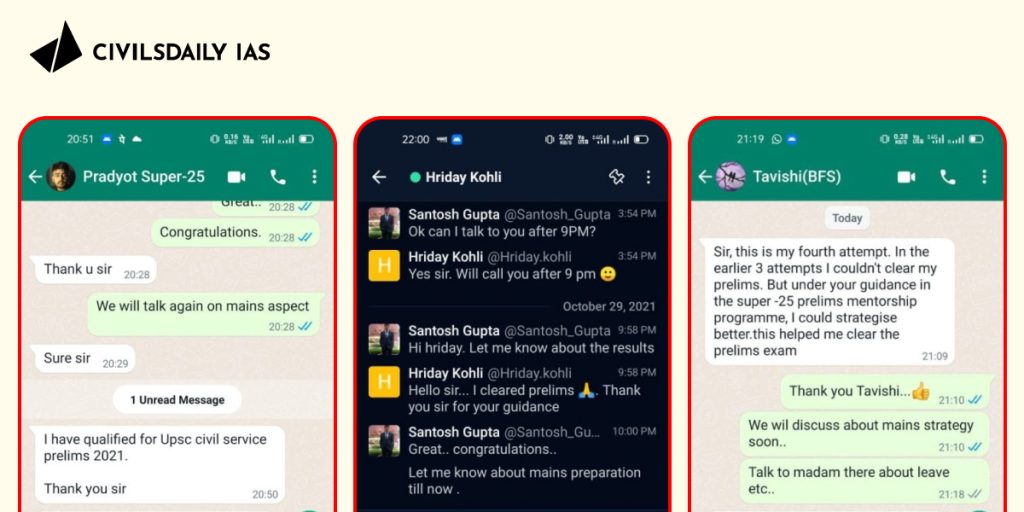
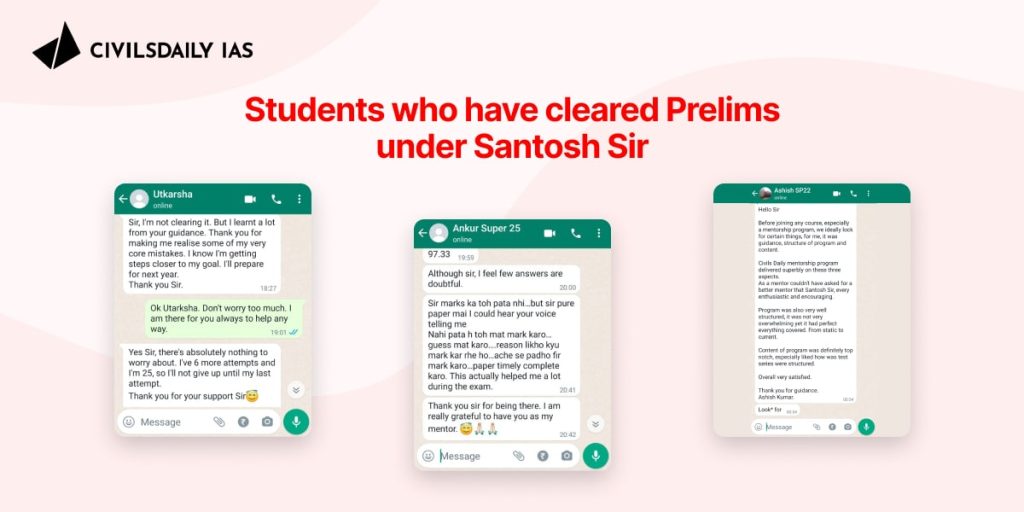
Santosh sir has been helping aspirants clear UPSC Prelims year after year. Here is a screenshot of his students who wrote Mains 2022.
Tavishi failed thrice in the Prelims before but after joining Santosh sir’s mentorship cleared Prelim 2022 on her 4th attempt.
Santosh sir will be taking an important webinar for UPSC 2023 aspirants.
Webinar Details: How to Smash Prelims 2023 in the next 165 days? Get a rock solid 24 week’s strategy and Prelims PDF notes
We will email the invitation, Zoom link, and notes.
What you’ll learn in the Webinar?
How to prepare for UPSC Prelims 2023 successfully starting today? With less than 6 months in hand, how to go forward?
Santosh sir will share a workable and proven strategy for the next 165 days (around 24 weeks), including both micro and macro plans.
A brief trend analysis of the past 5 yrs’ UPSC Prelims GS 1 paper. How to change your preparation methods right now?
How to cover the massive UPSC prelims syllabus? both GS and Current Affairs
Most Probable Topics to Cover for Prelims 2023 for every GS subject.
How to cover Current Affairs? How many months of Current Affairs should be covered? From where?
The 10 Steps of tackling Prelims 2023. How to maximize revision and minimize study materials?
Learn time management –
Before the exam– Studying more and effectively in less time.
Inside the exam hall. Most of the time, twisted questions force you to take more time to answer.
How to filter out and attempt easy questions in the first round quickly and move on to the next with which moderate to difficult questions? will be discussed thoroughly.
Time-Tested Elimination Techniques. How to use these techniques in sample questions? only generalized preparation is not enough. You have to be ready for the worst. Besides usual ordinary questions, you have to solve more or less offbeat questions. Remember, Offbeat questions require an offbeat approach and it gets 120+ in prelims for you. So, how to apply ‘Intelligent guessing’, ‘the way of thinking, and ‘Core common sense.
How to stay alert at the 5 worst mistakes areas, like unknown extremely factual questions, Random questions such as from sports in 2021, Questions from old current affairs, Ques. that are not directly from current affairs but inspired by current affairs, and Questions based on common sense such as questions in prelims-2021
How to avoid silly mistakes by using common sense to the plausibility of statements given. Usually, low-confident aspirants do not attempt these types of questions and overconfident ones make mistakes by overthinking.
How to solve bouncer kind of questions? Around 5 questions in every paper have been asked by UPSC about which you have no idea and might have not even come across while preparing but they can make or break your chance.
Santosh sir has scored above 140 twice in UPSC prelims and 120 plus in all 6 attempts. He has written all 6 mains and has appeared for Interviews 3 times. He has qualified for UPSC EPFO and BPSC 56-59th also. As the Prelims head at Civilsdaily, he has helped 15 out of 25 students clear the prelims examination this year.
What The Hindu mentioned about Civilsdaily Mentorship?
While hearing a petition seeking a ban on forced conversions, Division Bench judge of the apex court said, “The purpose of charity should not be conversion. Every charity or good work is welcome, but what is required to be considered is the intention,” The observation, loaded with significant implications, is to be considered in the light of the provisions of the Constitution relating to people’s fundamental right to freedom of religion, its legislative history and judicial interpretation.
Right to freedom of thought, conscience and religion before the constitution of India: The Universal Declaration of Human Rights 1948, which was before the makers of the future Constitution for independent India had proclaimed: “Everyone has the right to freedom of thought, conscience and religion; this right includes freedom to change his religion or belief, and freedom, either alone or in community with others and in public or private, to manifest his religion or belief in teaching, practice, worship and observance” [Article 18].
Extensive debate on religious freedom as a people’s right in the Constituent Assembly: Keeping this in mind, religious freedom as a people’s right was repeatedly debated in the Constituent Assembly. In cognisance of Christianity’s traditions of evangelism and proselytisation, it was to include the right to propagate religion.
Journey of a Right to freedom of religion before and after The Constitution
British rulers facilitated conversion to their religion: The British rulers of India, who were never shy of introducing measures to facilitate the conversion of others to their faith.
British rulers enacted Native Converts Marriage Dissolution Act in 1866: They had enacted in 1866 a Native Converts Marriage Dissolution Act to provide the facility of divorce to married Indians who converted to Christianity and were thereupon deserted by their non-converting spouses.
The Act recently dropped which was once thought to by the law commission of India: After Independence, the Law Commission of India recommended that this Act be revised to make it a general law on the effect of post-marriage change of religion, but the government did not take any action on it. The original Act remained in force till recently but was eventually dropped from the statute book by the Repealing and Amending Act of 2017.
Alerted by the missionaries’ princely states enforced anti conversion laws: Alerted by the missionaries’ evangelistic activities, several princely states of the pre-Independence era had enforced anti-conversion laws Raigarh, Udaipur and Bikaner among them.
Constitution Bench in case where state freedom of religion Acts was challenged: During 1967-68, state legislatures in Orissa and Madhya Pradesh enacted similar laws, both ostensibly titled as Freedom of Religion Act. Christian leaders lost no time in challenging their constitutional validity in the Supreme Court. Heading a Constitution Bench, Chief Justice of the time AN Ray, argued that converting people interfered with their religious freedom and held that Article 25 granted “not the right to convert another person to one’s own religion but (only) to transmit and spread one’s religion by an exposition of its tenets” .
The Constitution Bench decision inspired some other states to enact similar laws: Beginning with the Arunachal Pradesh Freedom of Religion Act 1978. Today there are such laws in about half of our states. Some of these have been either newly enacted or made more stringent, since the beginning of the present political dispensation in 2014. All of them prohibit converting people from one to another religion without their free will and, to indicate this, use various expressions like force, fraud, inducement and allurement.
Drafts on the conversion: While the first draft of the future Constitution proposed to restrain conversion except by one’s own free will, the second was to recognise the “right to preach and convert within limits compatible with public order and morality.”
Constitution recognised the right to propagate: Eventually, the Constitution recognised the right to propagate, along with freedom of conscience and the right to profess and practice, one’s religion as people’s fundamental right. Prima facie, individuals’ right to forsake their religion by birth and embrace another faith was integral to freedom of conscience
Supreme Courts observations regarding the right to propagate: As regards the propagation of religion, in two cases decided in 1954, the apex court observed that Article 25 covered every individual’s right “to propagate his religious views for the edification of others” (RP Gandhi) and that “it is the propagation of belief that is protected, no matter whether the propagation takes place in a church or monastery, or in a temple or parlour meeting” (Shirur Math).
Do you know this interesting news?
The Bombay High Court has recently held that the freedom of conscience of a person “includes a right to openly say that he does not believe in any religion”
Mahatma Gandhi’s view on freedom of religion
Mahatma Gandhi once said that “all faiths are equally true though equally imperfect”
He had pleaded that, instead of converting others to one’s own faith, “our innermost prayer should be that a Hindu should be a better Hindu, a Muslim a better Muslim and a Christian a better Christian” (Young India, 1924).
He had also once said: “If I had power and could legislate I should stop all proselytising” (Harijan, 1935).
Article 25(1) of the Constitution guarantees the “freedom of conscience and the right freely to profess, practise and propagate religion”.
It is a right that guarantees a negative liberty — which means that the state shall ensure that there is no interference or obstacle to exercise this freedom.
However, like all fundamental rights, the state can restrict the right for grounds of public order, decency, morality, health and other state interests.
Conclusion
An observation made by the Supreme Court on “forced conversions” is to be considered in the light of the provisions of the Constitution relating to people’s fundamental right to freedom of religion, its legislative history and judicial interpretation and set the future roadmap to make. Pluralism and inclusiveness are characterized by religious freedom. Its purpose is to promote social harmony and diversity.
Mains question
Q. What is Fundamental right to freedom of religion? What was Mahatma Gandhi’s view on religion? How it is interpreted in the constitution of India?