💥UPSC 2026, 2027, 2028 UAP Mentorship (March Batch) + Access XFactor Notes & Microthemes PDF

Search results for: “”

  • Why is Parliament silent on Voiding of NJAC: Vice-President

    njac

    VP asked the two Houses for not taking cognizance, over the last seven years, of the 2015 Supreme Court judgment setting aside the Constitutional amendment to constitute the National Judicial Appointment Commission (NJAC).

    Background

    • Since few days, Judiciary and Executive are at loggerheads.
    • VP pointed out that the amendment had been passed with unprecedented support by both Houses and approval from 16 State Assemblies.
    • However, on October 16, 2015, the Supreme Court ruled that it was not in consonance with the basic structure of the Constitution, and scrapped the legislation.

    What was NJAC?

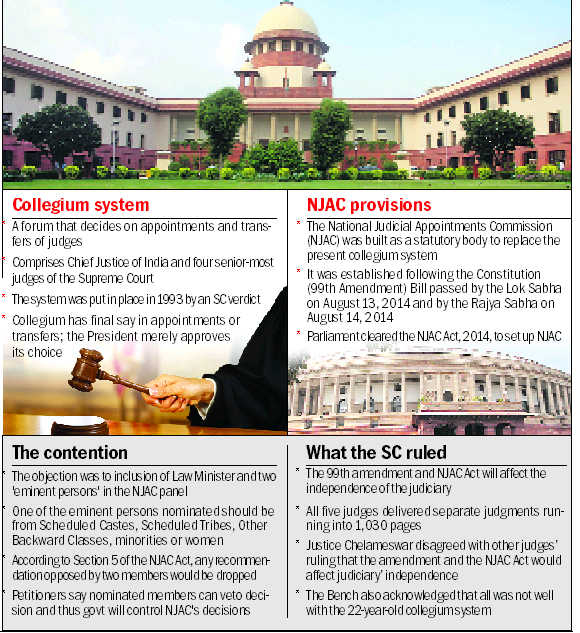
    • The NJAC was a body which was proposed to make appointments of Chief Justices, Supreme Court judges, and High Court judges in a more transparent manner as compared to the existing collegium system.
    • It sought to replace the Collegium System.
    • It was proposed via the National Judicial Appointments Commission Bill, 2014.
    • The bill was passed by both the houses; Lok Sabha and Rajya Sabha, and also received the President’s assent.
    • The commission was established by the 99th Constitutional Amendment Act, 2014.
    • The Act proposed that the members of NJAC would be composed of members from the legislative, judicial, and civil society.

    Composition of NJAC

    • Chief Justice of India would be the Chairman of the NJAC
    • Two senior-most judges of the Supreme Court
    • The Law and Justice Minister
    • Two eminent persons would be selected by a committee which would be composed of the Prime Minister, the Chief Justice of India and the Leader of Opposition

    Why was the NJAC Act struck down?

    • The five-judge SC bench struck down the NJAC Act along with the 99th Constitutional Amendment Act in a 4:1 ratio.
    • It was repealed by a five-judge bench, famously known as the Fourth Judges Case, 2015.
    • It was termed ‘unconstitutional’ and was struck down, citing it as having affected the independence of the judiciary.

    Benefits of the NJAC Act

    Justice Chelameshwar praised the NJAC Act because-

    • Transparent process: It involved a smooth and transparent process for the appointment of judges.
    • Brings checks and balances: the exclusion of checks and balances principle leads to the destruction of the basic structure of the Constitution.
    • Seeks balance of power: In a democratic setup, the executive cannot be completely excluded.
    • Global examples: In the dissent order, an example of the United States of America was given, where the head of the Executive is conferred with the power to appoint the judges.

    Issues with collegium system

    • Alleged favouritism: The collegium system does not provide any guidelines or criteria for the appointment of the Supreme Court judges and it increases the ambit of favouritism.
    • Ambiguous process: The absence of an administrative body is also a reason for worry because it means that the members of the collegium system are not answerable for the selection of any of the judges.
    • Isolating the executive: The check and balance principle is necessary because it ensures that no organ of democracy is exercising its power in an excessive manner.
    • Extra-constitutional nature: The collegium system tells us that even though the collegium system is not mentioned anywhere in the Constitution, rather it has evolved over a period of time from different landmark cases.
    • Lack of transparency: Nepotism has been often witnessed in the judiciary due to a lack of criteria for the appointment of judges.

    What can we, as aspirants, observe here?

    • After analyzing both NJAC and the collegium system, it can be inferred that neither of the methods is complete and both lack certain aspects.
    • Many former judges and legal experts are supporting the NJAC.
    • However, legal jurists are divided on NJAC, with some supporting it while others calling for amendments to the Act.
    • It is quite evident that neither the collegium system nor the NJAC is accurate; both have some shortcomings.

    Way forward

    • NJAC needs to be amended to keep the judiciary independent.
    • According to Justice Deepak Gupta, retired senior civil servants need to be inducted into the body appointing judges.
    • The Supreme Court needs to lay down certain guidelines for appointing judges and those guidelines should be strictly followed and codified.
    • Apart from that, all the notifications should be issued in the public domain to make the process more transparent.


    Click and get your FREE Copy of CURRENT AFFAIRS Micro Notes

    (Click) FREE 1-to-1 on-call Mentorship by IAS-IPS officers | Discuss doubts, strategy, sources, and more

  • Bill to amend Multi-State Cooperative Societies Act introduced in LS

    The Multi-State Cooperative Societies (Amendment) Bill, 2022, aimed at bringing in transparency in the sector, was introduced in the Lok Sabha.

    What is MSCS Act, 2002?

    • Cooperatives are a state subject, but there are many societies such as those for sugar and milk, banks, milk unions etc. whose members and areas of operation are spread across more than one state.
    • The MSCS Act was passed to govern such cooperatives.
    • For example, most sugar mills along the districts on the Karnataka-Maharashtra border procure cane from both states.

    What are Multi-State Cooperatives?

    • They draw their membership from two or more states, and they are thus registered under the MSCS Act.
    • Their board of directors has representation from all states they operate in.
    • Administrative and financial control of these societies is with the central registrar, with the law making it clear that no state government official can wield any control on them.

    Why does the government plan to amend the Act?

    (1) Issues with Central Registrar

    • The exclusive control of the central registrar, who is also the Central Cooperative Commissioner, was meant to allow smooth functioning of these societies.
    • The central Act cushions them from the interference of state authorities so that these societies are able to function in multiple states.
    • What was supposed to facilitate smooth functioning, however, has created obstacles.
    • For state-registered societies, financial and administrative control rests with state registrars who exercise it through district- and tehsil-level officers.

    (2) Multiple checks and balances

    • Thus if a sugar mill wishes to buy new machinery or go for expansion, they would first have to take permission from the sugar commissioner for both.
    • Post this, the proposal would go to the state-level committee that would float tenders and carry out the process.
    • While the system for state-registered societies includes checks and balances at multiple layers to ensure transparency in the process, these layers do not exist in the case of multistate societies.
    • Instead, the board of directors has control of all finances and administration.

    (3) Lack of govt control

    • There is an apparent lack of day-to-day government control on such societies.
    • Unlike state cooperatives, which have to submit multiple reports to the state registrar, multistate cooperatives need not.
    • The central registrar can only allow inspection of the societies under special conditions — a written request by one-third of the members of the board.
    • Inspections can happen only after prior intimation to societies.

    (4) Lack of infrastructure

    • The on-ground infrastructure for central registrar is thin — there are no officers or offices at state level, with most work being carried out either online or through correspondence.
    • For members of the societies, the only office where they can seek justice is in Delhi, with state authorities expressing their inability to do anything.

    (5) Ponzi schemes functioning as MCS

    • There have been instances across the country when credit societies have launched ponzi schemes taking advantage of these loopholes.
    • Such schemes mostly target small and medium holders with the lure of high returns.
    • Fly-by-night operators get people to invest and, after a few instalments, wind up their operations.

    Need for Amendment

    • At present, India has more than 1,500 multi-State cooperative societies.
    • The Bill seeks to strengthen governance, reform the electoral process, improve the monitoring mechanism, and ensure ease of doing business in multi-State cooperative societies.
    • It also aims to improve the composition of boards and ensure financial discipline, besides enabling the raising of funds in multi-State cooperative societies.

    Key establishments under the Amendment Bill

    • In order to make the governance of multi-State cooperative societies more democratic, transparent and accountable, the Bill has provisions for setting up of –
    1. Cooperative Election Authority,
    2. Cooperative Information Officer and
    3. Cooperative Ombudsman.

    Other features

    • Constitution of interim board: The Bill allows the central registrar to declare any multi-state cooperative society as sick. The Central government may, on the recommendation of the registrar, appoint an interim board for a maximum of five years. The central registrar can also declare a cooperative to be viable within the five years. The board of directors before the cooperative was declared sick shall be reinstated.
    • Elections: The Act states that elections shall be conducted by the existing board. The Bill amends this to state that the Central government may appoint a Cooperative Election Authority to conduct elections in cooperative societies to be prescribed.
    • Constitution of Fund: The Bill states that the central government shall set up the Cooperative Rehabilitation and Reconstruction Fund. A cooperative society shall credit 0.005% to 0.1% of its turnover to the fund, provided it does not exceed Rs 3crores per year.


    Click and get your FREE Copy of CURRENT AFFAIRS Micro Notes

    (Click) FREE 1-to-1 on-call Mentorship by IAS-IPS officers | Discuss doubts, strategy, sources, and more

  • Who exactly counts your Vote after polling?

    For a country like India where each individual constituency can have lakhs of voters, counting votes is a complex process that requires both pace and precision.

    Where are the Votes counted?

    • Ideally, all votes should be counted in one location in the constituency.
    • However, during General Elections, when seats are larger with multiple Assembly constituencies, many counting centres can be appointed, depending on the number of votes that need to be counted.
    • The location(s) for counting votes is decided by the Returning Officer (RO), with multiple centres in assembly segments being under the supervision of the Assistant Returning Officers (ARO).
    • In counting centres, ideally all votes are counted in one big hall having multiple tables.
    • However, if the RO feels there is a risk of overcrowding, more rooms may be opened up after permission from the Election Commission (EC).

    Role of Returning Officer

    • The RO is appointed for each constituency by the Election Commission.
    • During the duration of the election, the RO is the highest authority in the constituency having a wide range of powers in order to peacefully and impartially conduct elections.
    • With respect to counting of votes, the RO has the following duties:
    1. To designate the counting centres and get them approved by the Commission well in advance;
    2. To send notice to the candidates about the place, date and time of counting of votes;
    3. To appoint and train counting staff;
    4. To count the votes and declare the result.
    • ROs themselves do not count all votes but verify the counting at multiple stages and announce the results.
    • They are the final authority in the matter of vote counting in an election.

    Supervision of the process

    • A counting room will have multiple counting tables with each counting a set number of postal ballots/EVMs on a round-to-round basis.
    • On each table, there is a counting supervisor and up to two assistants who do the actual counting.
    • They should be gazetted officers and are appointed by the RO.
    • They receive specific training pertaining to the tasks they are expected to undertake.
    • For instance, for those counting postal ballots, the training is different from that received for counting EVM votes.

    Observers in the counting process

    • The EC appoints observers at each counting room, who are supposed to record the proceedings and file a report.
    • They are generally employees of the GoI, and are tasked with the duty to oversee overall functioning of the election apparatus.
    • Candidates who were on the ballot are also allowed in the counting room along with their representatives.
    • All parties and candidates send counting agents in order to ensure that votes are counted fairly and according to procedure, and lodge complaints, if any.


    Click and get your FREE Copy of CURRENT AFFAIRS Micro Notes

    (Click) FREE 1-to-1 on-call Mentorship by IAS-IPS officers | Discuss doubts, strategy, sources, and more

  • ISRO to establish SpaceTech Innovation Network (SpIN)

    spin

    The Indian Space Research Organisation (ISRO) has signed a MoU with Social Alpha, a multistage innovation curation and venture development platform, to launch SpaceTech Innovation Network (SpIN).

    SpaceTech Innovation Network (SpIN)

    • SpIN is India’s first dedicated platform for innovation, curation, and venture development for the burgeoning space entrepreneurial ecosystem.
    • SpIN will primarily focus on facilitating space tech entrepreneurs in three distinct innovation categories:
    1. Geospatial Technologies and Downstream Applications;
    2. Enabling Technologies for Space & Mobility; and
    3. Aerospace Materials, Sensors, and Avionics.

    Key initiative

    • SpIN has launched its first innovation challenge for developing solutions in areas of maritime and land transportation, urbanization, mapping, and surveying.
    • The selected start-ups and innovators will be able to access both Social Alpha’s and ISRO’s infrastructure and resources as per the prevailing guidelines.
    • They will be provided active hand-holding in critical areas, including access to product design, testing and validation infrastructure, and intellectual property management.


    Click and get your FREE Copy of CURRENT AFFAIRS Micro Notes

    (Click) FREE 1-to-1 on-call Mentorship by IAS-IPS officers | Discuss doubts, strategy, sources, and more

  • The soft approach: India-Myanmar

    Myanmar

    Context

    • On November 20-21, Indian Foreign Secretary Vinay Kwatra made a two-day visit to Myanmar. The Indian Ministry of External Affairs (MEA) in a press release stated that he met with members of the military junta that is currently ruling the country and discussed security and stability in the border areas, human trafficking issues (several Indian nationals have been victims), and infrastructure development.

    Click and get your FREE Copy of CURRENT AFFAIRS Micro Notes

    Myanmar

    What are the interpretations over the foreign Secretary’s visit?

    • Myanmar’s national portal says discussion on friendly relations: According to Myanmar National portal, the two sides held discussions on Myanmar-India friendly relations, exchanged views on the promotion of bilateral cooperation and the implementation of Myanmar’s peace process.
    • India’s no mention of Myanmar’s return to democracy: The MEA statement made no mention of any Indian interest in seeing Myanmar return to the path of democracy or the release of political prisoners and other tricky issues.
    • Emphasis on completing the ongoing projects: On the contrary, the foreign secretary spoke about continued Indian support for “people-centric socio-economic developmental projects” and early completion of connectivity projects including the Kaladan Multimodal Transit Transport Project and the Trilateral Highway between India, Myanmar, and Thailand.
    • Assured development Programs: It appears that infrastructure and developmental projects were a big emphasis during the visit because Kwatra also assured the Myanmar junta about projects under Rakhine State Development Program and Border Area Development Program.
    • Contradictory omissions: Despite the MEA press release not mentioning it, the MEA spokesperson Arindam Bagchi tweeted that the foreign secretary had discussions on several important issues including “India’s support to democratic transition in Myanmar.”

    Myanmar

    Background of the different interpretations

    • MEA’s 2021 statement that India’s interest in Myanmar’s return to democracy: Contrast this with the December 2021 statement that the MEA issued following then-Foreign Secretary Harsh Vardhan Shringla’s visit where he emphasized India’s interest in seeing Myanmar’s return to democracy at the earliest; release of detainees and prisoners; resolution of issues through dialogue; and complete cessation of all violence.”
    • India’s strong and consistent support to ASEAN: He had also reiterated that India’s strong and consistent support to the ASEAN initiative and expressed hope that progress would be made in a pragmatic and constructive manner, based on the five point consensus.

    Myanmar

    What are the India’s concerns?

    • Human trafficking emerged as the major issue: Human trafficking has emerged as a major issue in Myanmar, with several criminal syndicates running a racket luring Indian citizens with fake job prospects. The MEA spokesperson, according to media reports, cautioned Indian nationals of being wary of trafficking. IT companies recruiting Indian workers in the pretext of jobs in Thailand, who were then taken to Myanmar. There have been reportedly close to 200 Indian nationals who have been duped into this job racket.
    • China’s support to Military Junta: Since the military coup, China has improved on its good relations with the military junta, providing much-needed support for the Myanmar leadership in the face of international opprobrium.
    • Chinas’ high investment in Myanmar: China reportedly has been a key source of foreign investment in Myanmar. China’s multiple projects include several high-speed railway lines and dams as well as a $2.5 billion investment in a gas-fired power plant. The China-Myanmar Economic Corridor, which consists of oil and gas pipelines and infrastructure development projects run into billions of dollars.
    • China’s aim to get better access to Indian ocean: Of particular interest to China is the deep sea port that China plans to develop at Kyaukphyu, on Myanmar’s west coast, this will possibly give China better access to the Indian Ocean, which China has been eyeing for a while.
    • Budding relationship between Myanmar and Pakistan a cause of concern: According to media reports, Myanmar took the delivery of six JF-17 light-weight multi-role fighter jets from Pakistan in 2018 after signing a contract two years earlier in 2016. Myanmar was to get another batch of 10 aircraft although the date of delivery is unknown.

    Rational behind India’s changed interest in Myanmar’s return to democracy

    • Pragmatism on account of the growing presence and inroads of China in Myanmar has possibly pushed India to give up on its moralizing about democracy and increase its outreach to Naypyidaw.
    • While the pro-democracy elements within Myanmar as well as India’s strategic partners in ASEAN may not be particularly pleased with this outreach, especially India dropping ASEAN’s Five-Point Consensus on Myanmar, it appears that New Delhi sees itself as having not too many choices

    Conclusion

    • Strategic factors appear to be driving India’s greater engagement with the military junta, especially fear of China and Pakistan making inroads into the country. India has to maintain delicate balance while dealing with the ruling military junta.

    Mains question

    Q. In the backdrop of much speculations about the recent visit of India’s foreign secretary to Myanmar. Discuss India’s evolving position, which shows a soft approach towards the ruling military junta.

    (Click) FREE1-to-1 on-call Mentorship by IAS-IPS officers | Discuss doubts, strategy, sources, and more

  • The ‘Global South’ Narrative

    south

    As India assumed the presidency of the G20 group of countries for 2022 to 2023, EAM S Jaishankar said on December 1 that India would be the voice of the Global South that is otherwise under-represented in such forums.

    What is ‘Global South’?

    • The term has since been used multiple times, such as when Jaishankar said of ongoing global conflicts, “polarisation may occur elsewhere, the people who suffer most are the Global South”.
    • ‘Global North’ refers loosely to countries like the US, Canada, Europe, Russia, Australia and New Zealand, while ‘Global South’ includes countries in Asia, Africa and South America.

    Behind the binary difference: ‘Global North’ and the ‘Global South’

    • For a long time in the study of international political systems, the method of categorising countries into broad categories for easier analysis has existed.
    • The concepts of ‘East’ and ‘West’ is one example of this, with the Western countries generally signifying greater levels of economic development and prosperity among their people.
    • Eastern countries were considered as being in the process of that transition.

    What are other such categorizations?

    • Another similar categorisation is of First World, Second World and Third World countries.
    • It referred to countries associated with the Cold war-era alliances of the US, the USSR, and non-aligned countries, respectively.
    • The idea of the “third” world underlined that it was not only different from the “first” — the capitalist West — but also and the second — the socialist “East”.

    Concept behind: World Systems Approach

    • At the centre of these concepts is the World Systems approach introduced by sociologist Immanuel Wallerstein in 1974, emphasising an interconnected perspective of looking at world politics.
    • He said there are three major zones of production: core, peripheral and semi-peripheral.
    • The core zones reap profits, being the owners of cutting-edge technologies – countries like the US or Japan.
    • Peripheral zones, on the other hand, engage in less sophisticated production that is more labour-intensive.
    • In the middle are countries like India and Brazil.

    Need for new terms

    (1) Global shift of powers

    • In the post-Cold War world, the First World/Third World classification was no longer feasible.
    • This is because when the Communist USSR disintegrated in 1991, most countries had no choice but to ally at some level with the capitalist US – the only remaining global superpower.

    (2) Monolithic classification

    • The East/West binary was seen as often perpetuating stereotypical thinking about African and Asian countries.
    • Categorising incredibly diverse countries into a monolith was felt to be too simplistic.
    • Also, the idea that some countries were ‘developed’ while others were not was thought to be too wide a classification, inadequate for accurately discussing concerns.

    (3) Issues with Developed vs. Developing

    • Writing in 2014 from the perspective of his organisation’s philanthropic activities, Bill Gates said of the ‘developing’ tag.
    • It found an irony that- any category that lumps China and the Democratic Republic of Congo together confuses more than it clarifies.
    • Some so-called developing countries have come so far that it’s fair to say they have developed.
    • A handful of failed states are hardly developing at all. Most countries are somewhere in the middle.

    Emergence of Global South

    • Colonial past: A big commonality between the South countries is that most have a history of colonization, largely at the hands of European powers.
    • No say since de-colonization: Region’s historical exclusion from prominent international organizations – such as from the permanent membership of the UN is intriguing.
    • Consciousness for decision-making: As bodies like the UN and the IMF are involved in major decision-making that affect the world in terms of politics, economy and society, the exclusion is seen by these countries as contributing to their slower growth.
    • Economic emergence: China and India have emerged economically sound in the past two decades.
    • Declining US hegemony: Many consider the world to now be multipolar rather than one where the US alone dominates international affairs.
    • Climate reparations: In the ongoing debate adds Northern countries paying for funding green energy, having historically contributed to higher carbon emissions.

    Criticism of the classification

    • Only few players: South simply aims to replace the North and the positions it occupies, again continuing a cycle in which a few countries accumulate crucial resources.
    • More of a India vs. China competition: Much controversy currently surrounds the question of whether elites of the global South and ‘rising powers’ genuinely have the intention to challenge the dominant structures of global capitalist development”.
    • Anti-china motive: China’s tentative “going out” strategy at the turn of the century eventually morphed into the expansive Belt and Road Initiative.

    Where does India stand?

    • No further diplomatic groupism: EAM S Jaishankar India’s objective is not to rebuild a global trade union against the North.
    • Bridging the divide: India is eager to become a bridge between the North and the South by focusing on practical outcomes rather than returning to old ideological battles.

    Challenges

    • Political consistency: In the past, India’s ideological enthusiasm for the Global South was not matched by material power and political will.
    • Bridging the neighbours: India must also come to terms with the fact that the Global South is not a coherent group and does not have a single shared agenda.
    • Despaired south: There is much differentiation within the South today in terms of wealth and power, needs and capabilities.
    • Defiance from NAM: India’s Third World strategy (and Non-Aligned Movement) in the Cold War era was undermined by multiple internal and regional conflicts within the Global South.

    Way ahead

    • More engagement in neighborhood: Championing the Global South today would demand more active Indian engagement with the messy regional politics within the developing world.
    • Political coherence: If India can translate this ambition into effective policy, there will be no contradiction between the simultaneous pursuit of universal and particular goals.


    Click and get your FREE Copy of CURRENT AFFAIRS Micro Notes

    (Click) FREE 1-to-1 on-call Mentorship by IAS-IPS officers | Discuss doubts, strategy, sources, and more

  • Day 3 | Daily Answer Wars| CD WarZone

    Topics for Today’s question:

    GS-3          Disaster and disaster management.

    Question)


    HOW TO ATTEMPT ANSWERS IN DAILY ANSWER WARS (DAW)?

    1. Daily 1 question either from General Studies 1, 2, 3 or 4 will be provided via live You Tube video session.
    2. Announcement video: https://www.youtube.com/watch?v=HYgIxGFXIbA ; Day 2 winners: Avi M, Pooja Khande, Avinash, Ritu, Archana, Deepali, Nikhil
    3. You can write your answer on an A4 sheet and scan/click pictures of the same.
    4. The answer needs to be submitted by joining the telegram group given in the link below.

      https://t.me/cdwarzone

    *In case your answer is not reviewed, reply to your answer saying *NOT CHECKED*. 

    1. For the philosophy of Daily Answer Wars and payment: 
  • What is missing in Delhi’s breathing

    Delhi

    Context

    • Every year around Deepavali, and like clockwork, Delhi’s air quality makes it to the headlines. As firefighters we are doing well, but as planners doing very little. While nature will not change, emissions can be reduced. While a lot has been written and said about Delhi’s air quality, the question that still has to be answered is this: why is nothing changing after all these years?

    Air pollution and its impact

    • Air pollution a health crisis in making: Increasingly polluted air is a hazard and a health crisis in the making, in fact, it is already one.
    • Air pollution related death in India: India now reports 2.5 million air pollution-related deaths annually.
    • Air pollution not confined to external hazard: Pollution not only makes our throats and eyes burn but is much more insidious.
    • Pollutants can enter bloodstreams: Some pollutants are so small that they are able to enter the bloodstream with ease, impacting almost every organ in the body and leading to the onset of health issues such as stroke, heart diseases, respiratory diseases and cancer, to name just a few serious health problems.

    Click and get your FREE Copy of CURRENT AFFAIRS Micro Notes

    Delhi

    Critique: Why is nothing changing after all these years?

    • Applying same approach without through evaluation: A principal reason is that year after year, we are doing the same things to try and address the problem without actually trying to evaluate why those measures are not effective.
    • Inefficiency of Commission for Air Quality Management: The Government formed the Commission for Air Quality Management, which, unfortunately, did not offer anything new. This body essentially issued the same orders the Ministry and the Environment Pollution (Prevention and Control) Authority used to, with just a slight change in the language used.
    • Same advisory every year than the preventive measures: Every year schools are closed, people are advised to to stay indoors, or carpool and work from home, bans on firecrackers are reinforced, construction stopped, trucks and cars not allowed to enter the city, and industries running on fuel shut. These measures, and several others, are akin to dressing a bullet wound with band-aid.

    Analysis: Is it only stubble burning is the culprit behind Delhi’s air pollution?

    • Delhi’s bad air when stubble is not being burnt: Stubble burning in the neighbouring States being identified as the main culprit. However, the reality is that Delhi’s air is bad even when stubble is not being burnt.
    • Burning of biomass in and around Delhi: The burning of biomass in and around Delhi, if audited properly, would be the same as stubble burning in other States. Unfortunately, none of the bodies, be it the municipal body or the government’s Public Works Department, is willing to take responsibility for this or address and find a solution to the problem.
    • Less compliance on construction activities: Delhi chokes on its own dust and industrial activities. No clarity on how and who is ensuring compliance with the rules relating to the handling of construction and demolition waste.
    • Heavy reliance on private Vehicles which is another major source of pollution: Vehicles are another source of pollution in the city. Despite an expanding fleet of public transport, citizens who primarily use two-wheelers have not moved to using the public transport system, buses and the metro. Reasons for this may include last-mile connectivity, the problem of crowding in buses and metros, and the inability to reach and navigate narrow lanes that two-wheelers can. The state of maintenance of buses could be another reason as well.

    Delhi

    What needs to be done?

    • Look beyond the measures that have already been tried: We have to be creative and look beyond the measures that have already been tried and proved they are at best a short-term solution to a recurring, long-term problem.
    • Making efficient and coordinated governance mechanism: Core issue that needs to be addressed is the governance system. There needs to be a single entity that takes responsibility for air quality management. We cannot operate in silos where one system of governance is responsible for thinking, a second issues orders and a third is responsible for implementation. There need to be an efficient system that works in a coordinated way.
    • Acknowledge the reality and not just taking the actions in the time of crisis: The reality also is that Delhi is not the sole offender. There are many other cities in India where safe levels of air quality are breached regularly. We need to take more comprehensive, long-term measures throughout the year and not just in the days and weeks when it begins to make news.

    Conclusion

    • This is not to say that stubble burning is not a problem. Some solutions have been tried out over the years, but with little success. Unless farmers are adequately compensated, the problem is unlikely to go away. What is required is a fundamental shift in agricultural patterns, and a strong political will to take bold decisions.

    Mains question

    Q. Do you agree with the statement that only stubble burning is the culprit behind Delhi’s air pollution?

  • Price cap on Russia’s Oil and India’s contextual response

    cap

    Context

    • Recently, G7 proposal to impose a price cap on Russian oil came into effect. The proposal, which took months to fructify, seeks to achieve a delicate balance how to starve the Russian state of oil revenues so as to financially cripple its war against Ukraine, but without causing supply disruptions in the global oil market which would cause prices to spiral. The move, however, risks fracturing the global crude oil market.

    Click and get your FREE Copy of CURRENT AFFAIRS Micro Notes

    What is Price cap on Russian oil?

    • The $60 per barrel and denial of infrastructure services to Russian oil: The $60 per barrel cap is intended to cut Russia’s oil revenues while keeping Russian crude on the market by denying insurance, maritime services, and finance provided by the Western allies for tanker cargoes priced above a fixed dollar-per-barrel cap.
    • Aim to hurt Russia’s oil revenue and create a pressure: The US-proposed cap aims to hurt Moscow’s finances while avoiding a sharp oil price spike if Russia’s oil is suddenly taken off the global market.
    • Impact on shipping: Without insurance, tanker owners may be reluctant to take on Russian oil and face obstacles in delivering it.

    cap

    Russian response to the price cap

    • Russia refused to abide by the measure: Russia has said it will not observe a cap and will halt deliveries to countries that do.
    • Retaliate by shutting off the shipments: It could retaliate by shutting off shipments in hopes of profiting from a sharply higher global oil price on whatever it can sell around the sanctions.
    • Russia said price cap will not hurt financing the war: Russia recently said that the cap would not hurt the financing of its “special military operation” in Ukraine.
    • Others buyers may bypass the restrictions putting countries interests first: Buyers in China and India might not go along with the cap, while Russia or China could try to set up their own insurance providers to replace those barred by US, UK and Europe. It is also possible that these countries will find creative ways to bypass the restrictions imposed by the G7.

    cap

    How impacts global oil supply chain?

    • Russian oil can now only be shipped using G7 countries infrastructure: Broadly speaking, Russian oil can now be shipped across the world using the infrastructure of the G7 countries tankers, insurers, etc only if it is sold at a price of $60 per barrel or less.
    • Higher price for buying oil from Russia: This makes buying oil from Russia at a higher price in the week prior to this announcement, Urals crude was trading in the mid-$60s range  a difficult proposition as most of the companies that offer shipping and insurance services are located in these G7 nations.
    • Countries wish to buy are at disadvantage but still not higher than brent crude oil: While Russia has refused to abide by this measure, and the cap will place countries that do opt for buying oil from Russia at a price higher than $60 at a disadvantage, it will still be at a considerable discount compared to Brent crude oil which is currently trading at around $81 per barrel.
    • Countries that continued trade despite of objections: So far, despite objections from western nations, countries like India and China have continued to trade with Russia.

    cap

    India’s response and the bilateral trade with Russia

    • India’s bilateral trade with Russia has surged to an all-time high: In fact, as reported in this paper, India’s bilateral trade with Russia has surged to an all-time high in the first five months of the year (April-August).
    • India putting its interests first and taking advantage of discounted price: Putting its interests first, India has raised its oil imports from Russia, taking advantage of the discounts being offered the country which used to import less than 1 per cent of its import requirement from Russia, now imports around a fifth from it.
    • As India is an oil importer, the trade at discounted price will give some relief in current account deficit and economic stability: After all, for an oil importer like India, which meets an overwhelming share of its requirements through imports, lower crude oil prices will moderate the price pressures in the economy and bring relief to the current account deficit, easing risks to macroeconomic stability.
    • India rejected the so-called moral duty: India has rejected any “moral” duty to join the price cap coalition.

    Conclusion

    • Attempts to use trade as a weapon will only distort the global market and hurt energy-poor consumers not responsible for the war. India’s response so far to the West’s retaliation against Russia for the war in Ukraine has been guided by its sovereign interests. This must continue to be the guiding principle.

    Mains Question

    Q. G7 recently imposed a price cap on Russian oil driven by US and west. In light of this Discuss how it disrupt the global oil supply chain and how India is responding?

    (Click) FREE1-to-1 on-call Mentorship by IAS-IPS officers | Discuss doubts, strategy, sources, and more

More posts
