💥UPSC 2026, 2027, 2028 UAP Mentorship (March Batch) + Access XFactor Notes & Microthemes PDF

Search results for: “”

  • Birth Certificate to be made mandatory for jobs, driving licence, passport, voting right

    The Central government proposes to make birth certificates a mandatory document for almost every sphere of life — admission in educational institutions, inclusion in the voter list, appointment in Central and State government jobs, issue of driving licence and passport.

    Why in news?

    • These changes are proposed in the draft Bill to amend the Registration of Birth and Death (RBD) Act, 1969.

    Registration of Births and Deaths Act (RBD), 1969

    • The registration of births, deaths and stillbirths are compulsory under the provisions of RBD Act in all parts of the Country.
    • The normal period of 21 days (from the date of occurrence) has been prescribed for reporting the birth, death and stillbirth events.
    • Registration of birth and death is already compulsory under the RBD Act, 1969 and violating it is a punishable offence.

    Why need amendment?

    • The database may be used to update the Population Register and the electoral register, and Aadhaar, ration card, passport and driving licence databases after the amendment.
    • Presently, the registration of births and deaths is done by the local registrar appointed by States.

    What are the proposed amendments?

    Ans. Unified Database of Birth and Death

    • It is proposed that the Chief Registrar (appointed by the States) would maintain a unified database at the State level.
    • It would then integrate it with the data at the “national level,” maintained by the Registrar General of India (RGI).
    • The amendments will imply that the Centre will be a parallel repository of data.
    • It shall be mandatory for hospitals and medical institutions to provide a copy of all death certificates, stating the cause of death, to the local registrar apart from the relative of the deceased.

    Significance of the database

    • It would help update:
    1. Population Register prepared under the Citizenship Act, 1955;
    2. Electoral registers or electoral rolls prepared under the Representation of the People Act, 1951
    3. Aadhaar database prepared under the Aadhaar Act, 2016;
    4. Ration card database prepared under the National Food Security Act, 2013;
    5. Passport database prepared under the Passport Act; and
    6. Driving licence database under the Motor Vehicles (Amendment) Act, 2019, and
    7. Other databases at the national level are subject to provisons of Section 17 (1) of the RBD Act, 1969

    What are the newly proposed changes?

    • The centrally-stored birth/death data will be updated in real-time without any human interface required.
    • This would lead to addition and deletion from the electoral roll when an individual turns 18, and after death, respectively.

    Why such move?

    • The government intends to improve compliance by making the registration mandatory to avail basic services such as admission in schools and registration of marriages.
    • Provisions exist for compulsory registration of births and deaths but after the law is amended, it will be


    Click and get your FREE Copy of CURRENT AFFAIRS Micro Notes

    (Click) FREE1-to-1 on-call Mentorship by IAS-IPS officers | Discuss doubts, strategy, sources, and more

  • What are Sacred Grooves?

    sacred

    This newscard is an excerpt from the original article published in the Sunday edition of TH.

    What are Sacred Grooves?

    • Sacred groves of India are forest fragments of varying sizes, which are communally protected, and which usually have a significant religious connotation for the protecting community.
    • It usually consists of a dense cover of vegetation including climbers, herbs, shrubs and trees, with the presence of a village deity and is mostly situated near a perennial water source.
    • Sacred groves are considered to be symbols of the primitive practice of nature worship and support nature conservation to a great extent.
    • The introduction of the protected area category community reserves under the Wild Life (Protection) Amendment Act, 2002 has introduced legislation for providing government protection to community-held lands, which could include sacred groves.

    Historical references

    • Indian sacred groves are often associated with temples, monasteries, shrines, pilgrimage sites, or with burial grounds.
    • Historically, sacred groves find their mentions in Hindu, Jain and Buddhist texts, from sacred tree groves in Hinduism to sacred deer parks in Buddhism for example.
    • Sacred groves may be loosely used to refer to natural habitat protected on religious grounds.
    • Other historical references to sacred groves can be obtained in Vrukshayurveda an ancient treatise, ancient classics such as Kalidasa’s Vikramuurvashiiya.
    • There has been a growing interest in creating green patches such as Nakshatravana

    Regulation of activities in Sacred Grooves

    • Hunting and logging are usually strictly prohibited within these patches.
    • Other forms of forest usage like honey collection and deadwood collection are sometimes allowed on a sustainable basis.
    • NGOs work with local villagers to protect such groves.
    • Traditionally, and in some cases even today, members of the community take turns to protect the grove.

    Threats to such grooves

    • Threats to the groves include urbanization, and over-exploitation of resources.
    • While many of the groves are looked upon as abode of Hindu deities, in the recent past a number of them have been partially cleared for construction of shrines and temples.

    Total grooves in India

    • Around 14,000 sacred groves have been reported from all over India, which act as reservoirs of rare fauna, and more often rare flora, amid rural and even urban settings.
    • Experts believe that the total number of sacred groves could be as high as 100,000.
    • They are called by different names in different states:
    1. Sarna in Bihar
    2. Dev Van in Himachal Pradesh
    3. Devarakadu in Karnataka
    4. Kavu in Kerala
    5. Dev in Madhya Pradesh
    6. Devarahati or Devarai in Maharashtra
    7. Lai Umang in Maharashtra
    8. Law Kyntang or Asong Khosi in Meghalaya
    9. Oran in Rajasthan
    10. Kovil Kadu or Sarpa Kavu in Tamil Nadu

    What lies ahead?

    • The groves have great research value in in situ conservation of rare, endangered and threatened plant species.
    • It is high time that public awareness is created about the importance of these sacred groves, developmental activities are banned and the felling of trees or removal of any other vegetation is completely stopped.
    • This is possible only by way of enacting a special law for the protection and management of sacred groves.
    • As the management practices and other rituals vary from state to state, the concerned state governments may promulgate such an act as suitable for the state.
    • The idea should be to protect certain rare, endangered and threatened plant species in the era of global warming and climate change.


    Click and get your FREE Copy of CURRENT AFFAIRS Micro Notes

    (Click) FREE1-to-1 on-call Mentorship by IAS-IPS officers | Discuss doubts, strategy, sources, and more

  • Industry urges govt. to establish ‘India Rare Earths Mission’

    To counter India’s reliance on China for imports of critical rare earth minerals, industry has urged the government to establish ‘India Rare Earths Mission’.

    What are Rare Earth Metals?

    • The rare earth elements (REE) are a set of seventeen metallic elements. These include the fifteen lanthanides on the periodic table plus scandium and yttrium.
    • Rare earth elements are an essential part of many high-tech devices.
    • They have a wide range of applications, especially high-tech consumer products, such as cellular telephones, computer hard drives, electric and hybrid vehicles, and flat-screen monitors and televisions.
    • Significant defense applications include electronic displays, guidance systems, lasers, and radar and sonar systems.
    • Rare earth minerals, with names like neodymium, praseodymium, and dysprosium, are crucial to the manufacture of magnets used in industries of the future, such as wind turbines and electric cars.

    Minerals

    Applications of REMs in various fields:

    • Electronics: Television screens, computers, cell phones, silicon chips, monitor displays, long-life rechargeable batteries, camera lenses, light-emitting diodes (LEDs), compact fluorescent lamps (CFLs), baggage scanners, marine propulsion systems.
    • Defense Sector: Rare earth elements play an essential role in our national defense. The military uses night-vision goggles, precision-guided weapons, communications equipment, GPS equipment, batteries, and other defense electronics. These give the United States military an enormous advantage. Rare earth metals are key ingredients for making the very hard alloys used in armored vehicles and projectiles that shatter upon impact.
    • Renewable Energy: Solar panels, Hybrid automobiles, wind turbines, next-generation rechargeable batteries, bio-fuel catalysts.
    • Manufacturing: High strength magnets, metal alloys, stress gauges, ceramic pigments, colorants in glassware, chemical oxidizing agent, polishing powders, plastics creation, as additives for strengthening other metals, automotive catalytic converters
    • Medical Science: Portable x-ray machines, x-ray tubes, magnetic resonance imagery (MRI) contrast agents, nuclear medicine imaging, cancer treatment applications, and for genetic screening tests, medical and dental lasers.
    • Technology: Lasers, optical glass, fiber optics, masers, radar detection devices, nuclear fuel rods, mercury-vapor lamps, highly reflective glass, computer memory, nuclear batteries, high-temperature superconductors.

    DO YOU KNOW?

    Metals such as cadmium, lead are often used in manufacturing plastic and over time can enter coastal waters. These are acutely harmful for coastal wildlife and humans.Different kinds of plastic releases different kinds of metals  that may release when exposed to water and UV lights.

    What are the challenges in accessing Critical minerals?

    • Deposits in geopolitically sensitive regions: Reserves are often concentrated in regions that are geopolitically sensitive or fare poorly from an ease of doing business perspective.
    • Controlled production:  A portion of existing production is controlled by geostrategic competitors. For example, China wields considerable influence in cobalt mining in the Democratic Republic of Congo through direct equity investments and its Belt and Road Initiative.
    • Agreements in advance from outside: Future mine production is often tied up in off take agreements, in advance, by buyers from other countries to cater to upcoming demand.

    MineralsA step taken by Indian government for sourcing strategic minerals

    • For sourcing of strategic minerals, the Indian government established Khanij Bidesh  India Limited (KABIL) in 2019 with the mandate to secure mineral supply for the domestic market.

     India Rare Earths Mission

    • Industries in India have urged to set up a Mission, manned by professionals, like the India Semiconductor Mission and make their exploration a critical component of the Deep Ocean Mission plan of the government.
    • It would seek to encourage private sector mining in the sector and diversify sources of supply for these strategic raw materials.
    • The industry group has mooted making rare earth minerals a part of the ‘Make In India’ campaign, citing China’s ‘Made in China 2025’ initiative that focuses on new materials, including permanent magnets that are made using rare earth minerals.

    Why such move?

    • Though India has 6% of the world’s rare earth reserves, it only produces 1% of global output, and meets most of its requirements of such minerals from China.
    • In 2018-19, for instance, 92% of rare earth metal imports by value and 97% by quantity were sourced from China.

    What lies ahead?

    • There is a need to harness the potential of the country’s own rare earth reserves.
    • This would help build domestic capability and broad-base supply sources for such an important and strategic raw material.


  • Darjeeling Tea Industry in Crisis

    tea

    Tea Board officials admitted that Indian tea had not been able to establish itself globally, and that one of its key brands, Darjeeling Tea, was under acute stress.

    About Darjeeling Tea

    • Darjeeling Tea, called the ‘Champagne of Teas’, was the first Indian product to get the GI (Geographical Identification) tag in 2004 for its distinctive aroma and flavour.
    • About 87 gardens in Darjeeling which employ about 55,000 workers produce approximately 7 million kg of tea, most of which is exported.

    Why is it under distress?

    • Garden owners are reeling under higher costs of production and other issues.
    • Inferior quality tea from Nepal is being imported, and then sold and re-exported as premium Darjeeling Tea.
    • Nepal shares similar climatic conditions and terrain, produces tea at a lower price because of less input costs, particularly labour, and fewer quality checks.
    • In 2017, the production of Darjeeling Tea hit a low of 3.21 million kg. Since a substantial market of Darjeeling Tea switched to cheaper varieties of tea, including the imported variety from Nepal.
    • Tea planters and industry experts admit that the tea industry in Darjeeling has not recovered from the damage it incurred in 2017.

    Is climate change impacting production?

    • The decline in production is due to multiple factors, which include climate change, declining yields, and high absenteeism among workers.
    • Because of the hilly terrain of Darjeeling, there is no land left for expansion of tea gardens.
    • The tea bushes are older than other parts of the country.
    • Uprooting and planting them is both time and cost-intensive.


    Click and get your FREE Copy of CURRENT AFFAIRS Micro Notes

    (Click) FREE1-to-1 on-call Mentorship by IAS-IPS officers | Discuss doubts, strategy, sources, and more

  • Places in news: Shiveluch Volcano

    shiveluch

    The Shiveluch volcano on the Kamchatka Peninsula in the Russian Far East has increased its activity and is now in danger of erupting violently.

    About Shiveluch

    • Shiveluch is one of the largest and most active volcanoes in Kamchatka, having erupted at least 60 times in the past 10,000 years.
    • Kamchatka is home to 29 active volcanoes, part of a vast belt of Earth known as the “Ring of Fire” which circles the Pacific Ocean and is prone to eruptions and frequent earthquakes.
    • It has two main parts: Old Shiveluch, which tops 3,283 metres (10,771 ft), and Young Shiveluch – a smaller, 2,800-metre peak protruding from its side.
    • Young Shiveluch lies within an ancient caldera – a large crater-like basin that likely formed when the older part underwent a catastrophic eruption at least 10,000 years ago.
    • It is this part that has become extremely active; the lava dome continues to grow and that stronger “fumarole activity” has been observed.


    Click and get your FREE Copy of CURRENT AFFAIRS Micro Notes

    (Click) FREE1-to-1 on-call Mentorship by IAS-IPS officers | Discuss doubts, strategy, sources, and more

  • Who was Srimanta Sankardeva?

    sankardeva

    ‘Gurujana’ a musical tribute to 15th–16th century Assamese polymath Srimanta Sankardeva was recently released by the PIB.

    Srimanta Sankardeva (1449–1568)

    • Sankardeva was a 15th–16th century Assamese polymath; a saint-scholar, poet, playwright, dancer, actor, musician, artist social-religious reformer and a figure of importance.
    • He is widely credited with building on past cultural relics and devising-
    1. New forms of music (Borgeet)
    2. Theatrical performance (Ankia Naat, Bhaona),
    3. Dance (Sattriya)
    4. Literary language (Brajavali)

    Literary works

    • He has left extensive literary trans-created scriptures (Bhagavat of Sankardev), poetry and theological works written in Sanskrit, Assamese and Brajavali.

    Political influence

    • The Bhagavatic religious movement he started, Ekasarana Dharma and also called the Neo-Vaishnavite movement, influenced two medieval kingdoms – Koch and the Ahom kingdom.
    • His influence spread even to some kingdoms as the Matak Kingdom founded by Bharat Singha, and consolidated by Sarbananda Singha in the latter 18th century endorsed his teachings.
    • The assembly of devotees he initiated evolved over time into monastic centers called Sattras, which continue to be important socio-religious institutions in Assam and to a lesser extent in North Bengal even today.


    Click and get your FREE Copy of CURRENT AFFAIRS Micro Notes

    (Click) FREE1-to-1 on-call Mentorship by IAS-IPS officers | Discuss doubts, strategy, sources, and more


  • 800 subscribers in just 5 days: 500+ answers, 100+ conversations| CD Warzone is on fire | Join CD War Zone 

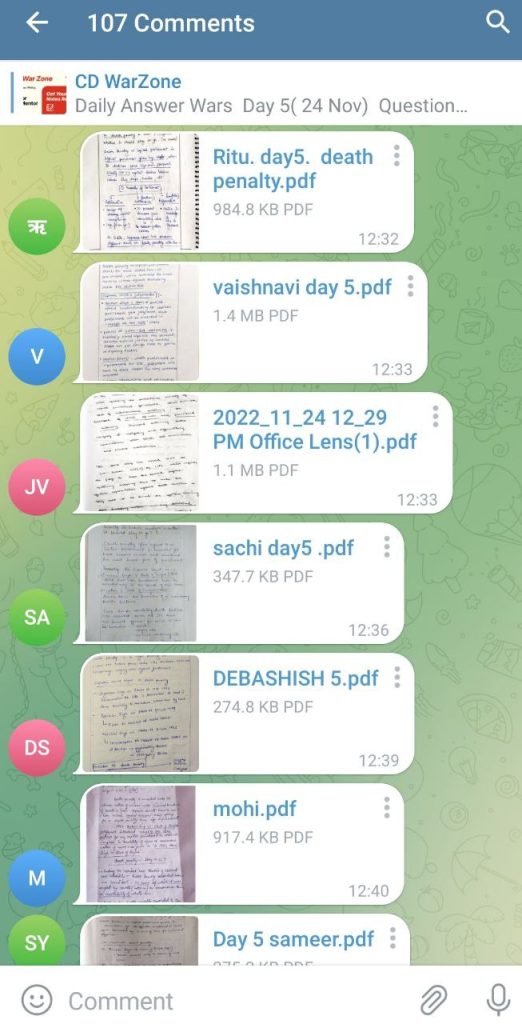
    CD war zone is an initiative started by Civils daily IAS, it is a community where we are collectively writing answers on a daily basis, apart from doing various other productive activities, like doing Daily Check-in, making timetables, discussing current affairs and likewise.

    Why CD War zone? 

    1) Primarily because of Daily Answer Writing, we call it Daily Answer wars. Here we give you one question daily early in the morning, after that Aspirants submit their Answers, Aspirants get to Peer review each other answers as well. In the evening our mentor comes with the feedback of the answer. 

    Join the telegram group here : https://t.me/cdwarzone

    Why are we writing only one answer?

    (https://www.civilsdaily.com/cd-warzone-daily-answer-writing-for-upsc-mains/

    2) Aspirants get to make  “War Notes”, these War notes will help you with UPSC Mains Preparation.

    3) Aspirants become a part of a Close- knit community, who are disciplined and motivated enough to prepare for  UPSC CSE exam. 

    4) Active mentors of Civilsdaily who are there to solve your UPSC related queries. 

    Here is how we start the day 

    Daily Check-in 

    Daily Answer Wars 

    Daily Answer Wars Result 

    Night owl discussions

    Join the telegram group here : https://t.me/cdwarzone

  • Escape the Snooze Mode In Your UPSC Preparation | FREE Samanvaya mentorship form released

    Escape the Snooze Mode In Your UPSC Preparation | FREE Samanvaya mentorship form released

    UPSC CSE is a hard nut to crack. Nowadays, due to easy access to UPSC toppers and self-professed gurus (all thanks to YouTube), even most of beginners ‘supposedly’ know what it takes to clear UPSC still, not every UPSC aspirant can reach LBSNAA.

    We talked to 10000+ aspirants in the last couple of years and mentored over 5000, and it became clear to us that 99.99% of failed candidates get preyed on their self-complacency. 

    Self-complacency breeds inconsistency!

    Most of them think that 1) revising PYQs 2) Revision of textbooks and 3) Solving mock test series are the primary weapon to penetrate UPSC Prelims. At the end of the Prelims exam, they realize their mistakes. UPSC prelims exam is the first phase but not the simplest one. Toppers say, “Prelims is enough to kill your IAS dream”.

    Reading books, and newspapers, making notes, taking classes, and attempting mock tests are the most important psychological factors for the exam. But, a lack of consistency & mentor guidance it’s a deadly setback.

    Most of the aspirants are always in ‘snooze mode’

    Inconsistency in UPSC preparation is like getting up at 5 am. A night before you set up your alarm. The motivation to get up is high at this point. But in the morning, when the alarm rings, we swipe it to the right with a thought “IN 5 MINUTES…FOR SURE!!”. This snooze cycle usually continues for some time till we realize it is 8 am. Already a bad start to the day! To add to it, you will spend the whole day repenting for not being able to get up early, instead of focusing on the time you have. The same goes for UPSC preparation. You set your targets but one slight glitch and your whole preparation go off track. Till the time you yourself realize this mismanagement, it is a bit too late. Anxiety builds up, and performance levels fall. You are not able to achieve even 10% OF YOUR TRUE POTENTIAL on D-day.

    WE ASKED 10000+ STUDENTS ONE SIMPLE QUESTION –

    “WHAT IS THE BIGGEST OBSTACLE THAT YOU ARE FACING IN YOUR UPSC PREPARATION?”

    YOU WILL BE ASTOUNDED THAT ONE ANSWER WAS COMMON IN REPLIES – INCONSISTENCY.

    They are Consistently Inconsistent. Meaning, they go through these highs and lows in their preparation. They are able to study for days or a week but they hit a sudden gap in preparation. Then, they find it very hard to come back. The good news is that we have the solution.

    Our philosophy behind MENTORSHIP is to get you out of this Snooze cycle. This ensures that you are the BEST VERSION of yourself in this journey. If you are under the impression that mentorship is weekly calls you attend, then you are mistaken, my friend. Trust us, your mentor will be your ‘FRIEND, PHILOSOPHER, AND GUIDE’.

    What The Hindu mentioned about Civilsdaily Mentorship

    The Hindu has acknowledged the success rate of CD’s Smash mains Mentorship
    CD’s FREE Mentorship fulfills the IAS dreams of thousands

    How Mentorship can fight inconsistency in preparation?

    TO EACH THEIR OWN – Every aspirant is different. Their strengths and weaknesses are different. Their time availability is also different. Identifying this is important so you don’t end up making unrealistic targets and lose momentum. Your mentor will make sure you start slow but remain consistent to build your confidence. Making your schedule structured based on our experience of working with 2500+ students is our first priority. 

    Tavishi failed thrice in the Prelims before but after joining CD’s mentorship cleared Prelim 2022 on her 4th attempt.

    TRACK YOUR PROGRESS – When you see yourself grow, it becomes easier to motivate yourself to push boundaries. Tracking your progress can happen in many ways like mentorship calls or chat sessions or regular tests. The idea is to ensure that you don’t go off track in your preparation, and even if you do, we have your back.

    EVOLUTION – Constant guidance is important to bring consistency to your UPSC preparation. Guidance is not about clearing your doubts or asking you to study when you don’t. It is also about the evolution of your preparation. This is where you and your mentor work as a team. A constant effort to PLAN AND BUILD UP YOUR ABILITY to learn in a faster and more efficient way.

    TALK IT OUT – The biggest hurdle in achieving your highest level of consistency is the emotional part. Every now and then, you. surround yourself with negative thoughts, you feel scared and depressed. Instead of resolving these emotional issues, you avoid them as it seems like a waste of your precious time. You have to understand that ignoring emotional troubles does not solve them. What your doing is building an emotional time bomb that may burst a week before your mains or prelims! This is where your MENTOR AS A FRIEND comes in. All our mentors have been through this journey. We understand your fears and anxieties. So, TALK IT OUT.

    Don’t let inconsistency keep you away from your dreams.

    Fill up the SAMANVAYA form given below. Let us know your problems and we will find a solution to them, just like our students say ” TOGETHER WE CAN AND WE WILL”.

  • [Burning issue] Draft Digital Personal Data Protection Bill, 2022

    [Burning issue] Draft Digital Personal Data Protection Bill, 2022

    data

    Context

    • The draft Digital Personal Data Protection Bill 2022 has now been released by the Ministry of Electronics and IT (MeitY), and the government is now asking for public comments and consultations on the bill.
    • In this context, this edition of the burning issue will discuss the evolution of privacy bills in India and analyse the current proposed draft data bill.

    Why do we need data protection?

    • Increasing internet use: India currently has over 750 million Internet users, with the number only expected to increase in the future.
    • Data breaches: At the same time, India has among the highest data breaches in the world. Without a data protection law in place, the data of millions of Indians continue to be at risk of being exploited, sold, and misused without their consent.
    • Individual privacy: Data monetization may happen at cost of individual privacy. The most sought-after datasets are those that contain sensitive personal data of individuals, ex. medical history, and financial data.
    • Lack of writ proceedings against corporate action: Unlike state action, corporate action or misconduct is not subject to writ proceedings in India. This is because fundamental rights are, by and large, not enforceable against private non-state entities. This leaves individuals with limited remedies against private actors.

    Background: Evolution of Demand for the data protection

    • The journey towards data protection legislation began in 2011 when the department of Personnel and Training initiated discussions on the Right to Privacy Bill, 2011.
    • The major fillip to the data protection case was given by the K. Puttuswamy judgment, 2017 where the supreme court held the “Right to privacy” as a fundamental right under Article 21- right to life and personal liberty.
    • After the Puttaswamy judgment, the government-appointed B.N Srikrishna committee the drafting of a law for data protection and privacy. This led to the Justice B.N. Srikrishna committee report which later on led to the Personal Data Protection Bill of 2019.

    The previous draft Personal Data Protection Bill, 2019

    The PDP Bill was introduced in Lok Sabha by the Minister of Electronics and Information Technology in 2019. The Bill seeks to provide for the protection of the personal data of individuals and establishes a Data Protection Authority for the same. Here are the key features:

    • Applicability: The Bill governs the processing of personal data by the government, companies incorporated in India and foreign companies dealing with the personaldata of individuals in India.
    • Categorization of data– Personal data is data that pertains to characteristics, traits or attributes of identity, which can be used to identify an individual. The Bill categorizes certain personal data as sensitive personal data. This includes financial data, biometric data, caste, religious or political beliefs, or any other category of data specified by the government, in consultation with the Authority and the concerned sectoral regulator.
    • Data fiduciary and his obligations– A data fiduciary is an entity or individual who decides the means and purpose of processing personal data. Such processing will be subject to a certain purpose, collection and storage limitations. For instance, personal data can be processed only for specific, clear and lawful purposes.
    • Rights of the individual- The Bill sets out certain rights of the individual (or data principal).  These include the right to Obtain confirmation from the fiduciary on whether their data has been processed, Seek correction of inaccurate, incomplete, or out-of-date personal data, Have personal data transferred to any other data fiduciary in certain circumstances and Restrict continuing disclosure of their data by a fiduciary, if it is no longer necessary or consent is withdrawn.
    • Grounds for processing personal data- The Bill allows the processing of data by fiduciaries only if consent is provided by the individual. However, in certain circumstances, personal data can be processed without consent.
    • Data Protection Authority– The Bill sets up a Data Protection Authority which may take steps to protect the interests of individuals, prevent misuse of personal data, and ensure compliance with the Bill. It will consist of a chairperson and six members, with at least 10 years of expertise in the field of data protection and information technology.
    • Transfer of data outside India– Sensitive personal data may be transferred outside India for processing if explicitly consented to by the individual, and subject to certain additional conditions. However, such sensitive personal data should continue to be stored in India. Certain personal data notified as critical personal data by the government can only be processed in India.
    • Exemptions to a government agency– The central government can exempt any of its agencies from the provisions of the Act: In the interest of the security of the state, public order, sovereignty and integrity of India and friendly relations with foreign states. 

    What were the issues with the 2019 Bill?

    • Power to exemption with the state: The Bill’s expansive exemptions allowed the state to exempt the entire application of the law simply as if it was “expedient” to do so in the interest of national security or public order.
    • Powers without accountability: The PDP Bill, 2019 as well as the JPC’s version established a strong regulator (the Data Protection Authority) with a lot of power, but very little independence or accountability.
    • Data localisation: The Bill imposed a strong data localisation mandate, requiring companies to store all sensitive personal data and critical personal data (which was not defined) in India.
    • Subsuming the personal and non-personal data: The JPC recommended subsuming the regulation of personal data and non-personal data within a single legislation, even though it undermined the Puttaswamy mandate to ensure the protection of personal data.

    Latest Draft Digital Data Protection Bill:

    The PDP Bill, 2019, prepared by MeitY, was referred to a Joint Parliamentary Committee (JPC) for review. JPC tabled the report of the JPC on the PDP Bill, 2019, as well as the draft Data Protection Bill 2021, in the parliament.

    On August 3 this year, MeitY withdrew the 2021 Bill, stating that a more “comprehensive legal framework” will be presented soon. This led to the current DPDP Bill, 2022.

    According to an explanatory note for the bill, it is based on seven principles:

    • Lawful use: The first is that “usage of personal data by organizations must be done in a manner that is lawful, fair to the individuals concerned and transparent to individuals.”
    • Purposeful dissemination: The second principle states that personal data must only be used for the purposes for which it was collected.
    • Data minimization: Bare minimum and only necessary data should be collected to fulfill a purpose.
    • Data accuracy: At the point of collection. There should not be any duplication.
    • Duration of storage: The fifth principle talks of how personal data that is collected cannot be “stored perpetually by default,” and storage should be limited to a fixed duration.
    • Authorized collection and processing: There should be reasonable safeguards to ensure there is “no unauthorized collection or processing of personal data.”
    • Accountability of users: The person who decides the purpose and means of the processing of personal data should be accountable for such processing.

    Key features of the bill

    Data Principal and Data Fiduciary

    • The bill uses the term “Data Principal” to denote the individual whose data is being collected.
    • The term “Data Fiduciary” the entity (can be an individual, company, firm, state etc.), which decides the “purpose and means of the processing of an individual’s personal data.”
    • The law also makes a recognition that in the case of children –defined as all users under the age of 18— their parents or lawful guardians will be considered their ‘Data Principals.’

    Defining personal data and its processing

    • Under the law, personal data is “any data by which or in relation to which an individual can be identified.”
    • Processing means “the entire cycle of operations that can be carried out in respect of personal data.”
    • So right from collection to storage of data would come under processing of data as per the bill.

    Individual’s informed consent

    • The bill also makes it clear that individual needs to give consent before their data is processed.
    • Every individual should know what items of personal data a Data Fiduciary wants to collect and the purpose of such collection and further processing.
    • Individuals also have the right to withdraw consent from a Data Fiduciary.
    • The bill also gives consumers the right to file a complaint against a ‘Data Fiduciary’ with the Data Protection Board in case they do not get a satisfactory response from the company.

    Language of information

    • The bill also ensures that individuals should be able to “access basic information” in languages specified in the eighth schedule of the Indian Constitution.
    • Further, the notice of data collection needs to be in clear and easy-to-understand language.

    Significant Data Fiduciaries

    • The bill also talks of ‘Significant Data Fiduciaries, who deal with a high volume of personal data.
    • The Central government will define who is designated under this category based on a number of factors ranging from the volume of personal data processed to the risk of harm to the potential impact on the sovereignty and integrity of India.

    Data protection officer & Data auditor

    • Such entities will have to appoint a ‘Data protection officer’ who will represent them.
    • They will be the point of contact for grievance redressal.
    • They will also have to appoint an independent Data auditor who shall evaluate their compliance with the act.

    Right to erase data, right to nominate

    • Data principals will have the right to demand the erasure and correction of data collected by the data fiduciary.
    • They will also have the right to nominate an individual who will exercise these rights in the event of death or incapacity of the data principal.

    Cross-border data transfer

    • The bill also allows for cross-border storage and transfer of data to “certain notified countries and territories.”
    • However, an assessment of relevant factors by the Central Government would precede such a notification.

    Financial penalties

    • The draft also proposes to impose significant penalties on businesses that undergo data breaches or fail to notify users when breaches happen.
    • Entities that fail to take “reasonable security safeguards” to prevent personal data breaches will be fined as high as Rs 250 crore.
    • As per the draft, the Data Protection Board — a new regulatory body to be set up by the government — can impose a penalty of up to ₹500 crore if non-compliance by a person is found to be significant.

    What distinguishes this bill from its earlier versions?

    • Gender neutrality:  Significantly, and for the first time in the country’s legislative history, the terms ‘her’ and ‘she’ have been used irrespective of an individual’s gender. This, as per the draft, is in line with the government’s philosophy of empowering women.
    • Imbibes best global practices: To prepare it, best global practices were considered, including a review of data protection legislations of Australia, the European Union (EU), Singapore, and a prospective one of the USA.
    • Comprehensiveness: The draft has outlined six ‘Chapters’ and a total of twenty-five points. The ‘Chapters’ are: ‘Preliminary,’ ‘Obligations of Data Fiduciary,’ ‘Rights and Duties of Data Principal,’ ‘Special Provisions,’ ‘Compliance Framework,’ and ‘Miscellaneous.’
    • Special emphasis for child protection: If personal data is likely to cause harm to a child, its processing will not be allowed.

    Positive aspects of the bill

    • Widening the scope of data: Narrowing the scope of the data protection regime to personal data protection is a welcome move, as it resonates with the concerns of various stakeholders.
    • Harnessing economic potential: Now non-personal data could be used to unlock social and economic value to benefit citizens, businesses, and communities in India with appropriate safeguards in place.
    • Doing away with an aggressive push for Data localisation:  Relaxing data localisation provisions to notify countries to which data can flow, could aid India in unlocking the comparative advantage of accessing innovative technological solutions from across the globe, which in turn helps domestic companies.
    • Free flow of data: In addition, the free flow of data will help startups access cost-effective technology and storage solutions, as our research shows.
    • Allowing data transfers: This will also ensure that India is not isolated from the global value chain, helping businesses stay resilient in production and supply chain management and fostering overseas collaboration.
    • Introduction of the concept of ‘Deemed Consent’: It enables the processing of the Personal Data of an individual without his/her explicit consent, where it is “reasonably expected that the Data owner would provide such Personal Data”.

    Some criticisms of the bill

    • Wordplay: There had been the use of open-ended language such as “as necessary” or “as may be prescribed”.
    • Govt monopoly: The Bill did not seem to work towards protecting people, but ensured that the government retains all power without any checks or balances.
    • Exemption provisions: The government has been given the power to exempt not only government agencies but any entity that is collecting user data, from having to comply with the provisions of this bill when it is signed into law.
    • No protection against data breach: The Executive in India has a track record of exploiting to expand its powers. There is no right for compensation to individuals in case of a data breach. They have no right to data portability.
    • Appointments to data protection board- The draft law leaves the appointment of the chairperson and members of the Data Protection Board entirely to the discretion of the central government. “While the Data Protection Authority was earlier envisaged to be a statutory authority (under the 2019 Bill), the Data Protection Board is now a central government set-up board.
    • Narrow Focus: It is focused on personal data and excludes non-personal data, which was a demand by the industry and civil society alike. It eliminates the categorisation of personal data into sensitive and critical.

    Global comparison: What other Nations data laws specify

    An estimated 137 out of 194 countries have put in place legislation to secure the protection of data and privacy, with Africa and Asia showing 61% (33 countries out of 54) and 57% adoption respectively, according to data from UNCTAD intergovernmental organisation within the United Nations Secretariat. 

    EU MODEL

    • The GDPR focuses on a comprehensive data protection law for the processing of personal data. It has been criticised for being excessively stringent and imposing many obligations on organisations processing data, but it is the template for most of the legislation drafted around the world.
    • There are certain exemptions such as national security, defence, public security, etc, but they are clearly defined and seen as exclusions on the periphery.

    US MODEL

    • Privacy protection is largely defined as “liberty protection” focused on the protection of the individual’s personal space from the government. It is viewed as being somewhat narrow in focus because it enables the collection of personal information as long as the individual is informed of such collection and use.
    • The US template has been viewed as inadequate in key respects of regulation. There is no comprehensive set of privacy rights or principles in the US that, like the EU’s GDPR, addresses the use, collection, and disclosure of data. Instead, there is limited sector-specific regulation.
    • The approach towards data protection is different for the public and private sectors. The activities and powers of the government vis-a-vis personal information are, however, sufficiently well-defined and addressed by broad legislation such as the Privacy Act, the Electronic Communications Privacy Act, etc. For the private sector, there are some sector-specific norms.

    CHINA MODEL

    • New Chinese laws on data privacy and security issued over the last 12 months include the Personal Information Protection Law (PIPL), which came into effect in November 2021.
    • It gives Chinese data principals new rights as it seeks to prevent the misuse of personal data. The Data Security Law (DSL), which came into force in September 2021, requires business data to be categorized by levels of importance and puts new restrictions on cross-border transfers. The law includes stringent penalties, with fines as high as RMB 50 million, or up to 5% of a company’s turnover in the previous financial year. 

    Way forward

    • Compensation for breach: A provision should be put in place in the law to compensate individuals in the event of a data breach as available in the EU’s GDPR.
    • Giving statutory status: to the proposed Data Protection Board for better functioning of the board and reduce executive interference. Appointments to the board should be done through a committee on similar lines to that of NHRC and other bodies.
    • More comprehensive: More provisions should be incorporated in the draft legislation rather than leaving it to the Executive to frame provisions.
    • Respecting privacy: Rights such as data portability and the right to opt-out of data collection must be included. The right to privacy must be respected which, critics argue, seems to be lacking in this case.

    Click and get your FREE Copy of CURRENT AFFAIRS Micro Notes

    (Click) FREE1-to-1 on-call Mentorship by IAS-IPS officers | Discuss doubts, strategy, sources, and more

More posts