💥Join UPSC 2027,2028 Mentorship (July Batch) + XFactor Notes & Microthemes PDF

Archives: Stories

  • Roads, Highways, Cargo, Air-Cargo and Logistics infrastructure – Bharatmala, LEEP, SetuBharatam, etc.

    Challenges, opportunities & criticism of the Real Estate Regulatory Bill 2016

    The Real Estate Regulatory Bill, 2016 is being hailed as a much-needed step to reform the real estate sector. It will help regulate the sector and bring in clarity for both buyers and developers.

    What was the need for regulation in the real estate?

    • The real estate sector has some issues such as a lengthy process for project approvals, lack of clear land titles, and prevalence of black money
    • There wasn’t complete transparency as far as govt approvals were concerned
    • There were also instances when projects were sold without adequate clearances
    • The delayed projects, sometimes by up to years and arbitrary changes in layout plans are rampant in the sector

    How does the Bill seeks to regulate the sector?

    The basic thrust of this Bill is to regulate the delivery of projects to home buyers. It provides them a legal safeguard for their investment, and seeks to address timely delivery of houses. It seeks to enforce the contract between the developer and buyer and act as a fast track mechanism to settle disputes

    • It establishes state level regulatory authorities called Real Estate Regulatory Authorities (RERA)
    • The Bill establishes state level tribunals called Real Estate Appellate Tribunals.  Decisions of RERAs can be appealed in these tribunals
    • It makes mandatory the disclosure of all information for registered projects like details of promoters, layout plan, land status, schedule of execution and status of various approvals
    • The Bill prohibits a developer from changing the plan in a project unless two-thirds of the allottees have agreed for such a change
    • It says that builders must specify the time-frame for completion of projects and stick to it, or be ready to pay penalties
    • The Bill mandates that 70% of the amount collected from buyers of a project be used only for construction of that project This provision will effectively allow developers to continue their practice of diverting funds collected for a project towards land acquisition or other projects, and will work in their favour by also allowing them to grow their land and/or project portfolio>

    How will the Real Estate Regulatory Authorities help improve the sector?

    • Residential real estate projects need to be registered with RERAs, except few
    • Promoters cannot book or offer these projects for sale without registering them
    • Real estate agents dealing in these projects also need to register with RERAs
    • On registration, the promoter need to provide details of the project to the RERA

    Challenges ahead

    • The Bill will make life difficult for builders, as they would face more red-tapeism now, especially in procuring relevant approvals.
    • This Bill does not address the developers demand of a single-window clearance from the govt
    • The implementation of the Bill is up to the states, it leaves builders with greater chances of being harassed

    Impact

    • Timely completion of projects would lead to a steady increase in supply of homes
    • It is expected that these measures will eventually bring down home prices and increase demand
    • It will be good for the overall economy too, as the housing sector has strong backward (cement, steel and other building material industries) and forward (furniture and furnishings, interior decoration, electrical and electronics) linkages with other industries
    • More number of job creation in the economy

    Criticism

    • The builder lobbies argued that the bill should have a time-frame for municipal and other authorities to give timely approvals, because the delay in approvals lead to delays in handing over possession of apartments
    • In terms of pricing, which is governed by circle rates, it will be difficult to monitor

    Future

    • The states’ support for faster clearances to projects will be required to make this Bill successful
    • Govt is also trying to bring in a National Urban Rental Housing Policy, which would take into account the requirements of tenancy hassles in modern days

    Published with inputs from Pushpendra


    Sagarmala Project: Smart ports for Blue Revolution in India

    The Union Cabinet chaired by the Prime Minister Modi, on March,2015 gave its ‘in-principle’ approval for the concept and institutional framework of Sagarmala Project. Let’s take a glance on it.


    What’s the prime objective of Sagarmala?

    The prime objective of the Sagarmala project is to promote port-led direct and indirect development and to provide infrastructure to transport goods to and from ports quickly, efficiently and cost-effectively.

    What’s the current issue and background of ports in India?

    • At present there are around 200 ports (small and big) in the country, of these, only 12 are major ports which are government owned ports, which handle about 58% of sea-borne traffic.
    • These major ports operate as Trusts under the Major Ports Trust Act, 1963, except for the Port of Ennore, which is a company under the Companies Act.
    • There are legacy issues with these govt owned major ports, they do not keep pace with emerging technology, requirements of international trade, emerging trends in containerisation, flexible rules, size of ships etc.

    Which are the 12 Major Ports ?

    These are Kolkata (including Dock Complex at Haldia), Visakhapatnam, Chennai, V.O. Chidambaranar (Tuticorin), Cochin, New Mangalore, Mormugao, Jawaharlal Nehru Port Trust (JNPT), Mumbai, Kandla and Ennore.


    Just, Look back into the history?

    In 2003, then PM Vajpayee proposed Project Sagarmala with following features:

    • Setup Sagarmala Development Authority (Similar to National highway authority of India).
    • It will get money via Maritime development cess. (5 paise per kg on cargo).
    • It will improve ports, shipping industry, inland water transport, coastal shipping.
    • PPP and FDI to gather more investment.

    Then, which are the Key pillars to achieve Smart-development ?

    • Supporting and enabling Port-led Development through appropriate policy and institutional interventions.
    • Providing for an institutional framework for ensuring inter-agency and states’ collaboration for integrated development.
    • Port Infrastructure Enhancement, including modernization and setting up of new ports.
    • Efficient Evacuation to and from hinterland.

    What are some of the measures to make Smart Ports?

    • Ports should be registered as Companies under Companies Act.
    • The port administration should only look after the provisions of infrastructure and safety and not day-to-day running of the port
    • There is still no regulation to control the trade practices.
    • Hence, there is a dire need to introduce a regulatory architecture that takes care of ex-ante declaration of rates of services.

    Then, what’s the plan to implement such a vast initiative?

    • For a comprehensive and integrated planning for “Sagarmala”, a National Perspective Plan (NPP) for the entire coastline shall be prepared within six months.
    • It will identify potential geographical regions to be called Coastal Economic Zones (CEZ).
    • While preparing the NPP, synergy and integration with planned Industrial Corridors, Dedicated Freight Corridors, National Highway Development Programme, Industrial Clusters and SEZs would be ensured.

    What are the suggestions for effective mechanism at state level?

    • Set up State Sagarmala Committee to be headed by CM / Minister in Charge of Ports.
    • Sagarmala Coordination and Steering Committee (SCSC) shall be constituted under the chairmanship of the Cabinet Secretary and others.
    • This Committee will provide coordination between ministries, state governments and agencies connected with implementation and review the progress of implementation of the National Perspective Plan.

    How does it ensure the sustainable development in CEZ?

    • This would be done by synergising and coordinating with State Governments and line Ministries of Central Government through their existing programmes.
    • Such as those related to community and rural development, tribal development and employment generation, fisheries, skill development, tourism promotion etc.
    • In order to provide funding for such projects and activities that may be covered by departmental schemes a separate fund by the name ‘Community Development Fund’ would be created.

    What’s the role of Institutional Framework ?

    • It has to provide for a coordinating role for the Central Government.
    • It should provide a platform for central, state governments and local authorities to work in tandem and coordination under the established principles of cooperative federalism.

    What’s the role of NSAC?

    A National Sagarmala Apex Committee (NSAC) is envisaged for overall policy guidance and high level coordination, and to review various aspects of planning and implementation of the plan and projects.

    So, Is it Good to have smart ports on the line of Smart Cities?

    Can you answer some questions?

    #1. Can you examine the bottlenecks in Indian port infrastructure and list the initiative taken in recent times to address this issue?

    #Q.2 Indian port infrastructure can be revamped by Sagarmala project by effective management? critically comment.


    Published with inputs from Arun
  • Electoral Reforms In India

    Time and again, many electoral reforms have been proposed by various committees, Law Commission and ECI itself. A discussion on these crops up during every election. We’ve tried to comprehensively list the proposed reforms under various sub-headings. A brute-force memorization of all this information is not required. Go through this list so that you have a background while reading news items on Electoral Reforms and ECI.
    I.Amendment to the Constitution of India
    1. Constitutional protection for all members of the Commission.
    2. Budget of the Commission to be ‘charged’ on the CFI.
    3. Independent Secretariat for the Commission.
    II.Electoral Roll Matters
    While Army personnel are allowed to vote, Navy and Airforce are not.
    There are no provisions for overseas electors to vote despite being eligible to do so. Amendments proposed provide the option of proxy voting or postal ballot voting.
    At present, the Electoral Rolls prepared by the Election Commission are not used by the State Election Commissions leading to duplication of effort and errors costing both in terms of time and money. Common Electoral Rolls to be used in local elections was a recommendation endorsed by the Law Commission.
    III.Election Management Issues
    At present, filing false declarations about the background of the candidate attracts penalty under Section 125A of The Representation of the People Act, 1951. The offence is punishable by up to 6 months, or with fine, or with both.
    The Commission has proposed that the punishment under section 125A should be increased to 2 years’ imprisonment without the alternative clause of  fine, and also that the offence should be included in the list of offences listed in sub-section (1) of section 8 which would attract disqualification on conviction irrespective of the term if sentence. The Commission also proposed that furnishing of false affidavit or suspension of material information in the affidavit should also be specified as ground for challenging the election under section 100 (1) of The Representation of the People Act, 1951.
    In S. Subramaniam Balaji vs Govt. Of T.Nadu & Ors, the SC observed that “although, the law is obvious that the promises in the election manifesto cannot be construed as ‘corrupt practice’ under section 123 of The Representation of the People Act, the reality cannot be ruled out that distribution of freebies of any kind, undoubtedly, influences all people. It shakes the root of free and fair elections to a large degree. In this regard the EC has proposed an amendment to RPA, 1951 allowing Adjournment of poll or countermanding of elections on ground of bribery.
    IV.Election Officials and Logistics
    Use of Totalizer Machines
    EVM totalizer can count votes of multiple Electronic Voting Machines (EVMs) simultaneously. This way the results of votes in a group of EVMs can be taken without ascertaining the result in individual EVM corresponding to polling booth.
    As per the present provisions in The Conduct of Elections Rules, 1961, votes in the EVMs are to be counted polling station wise, which leads to situations where voting pattern in various localities/pockets become known to everyone. There is a view that this can result in victimization and/or discrimination and intimidation of electors of particular localities. This issue can be addressed by use of totalizer that can be used for taking out the results of voting in a group of 14 EVMs without revealing the votes in individual EVMs.
    V.Nomination of Candidates
    Contesting the elections from 2 seats  – At present as per RPA 1951, a person is allowed to contest from 2 seats. However it is imperative that he has to vacate one of the two seats should he win both. This leads to holding by-elections which causes inconvenience to voters and financial expenditure. The amendment to RPA 1951 calls for removal of this provision of contesting from 2 seats.
    VI.De- Criminalization of politics
    2. Misuse of religion for electoral gain
    3. Making bribery in elections a cognizable offence
    VII.Reforms relating to Political Parties
    1. De-registration of political parties
    2. Tax Relief for Political Parties
    3. Compulsory Maintenance of Accounts by Political Parties
    4. Accounting and Auditing Report of Political Parties
    5. Form 24A under Rule 85B of The Conduct of Elections Rules, 1961
    6. Prohibition on Anonymous Donations
    7. Sale of Coupons
    8. Maintenance of separate bank accounts by each contesting candidate for poll expenses
    9. Cap on Expenditure by Political Party on a Candidate for election campaign
    10. Ceiling of campaign expenditure by political parties
    11. Limit the Number of Star Campaigners
    12. Time period for maintaining books of account under section 77 of The Representation of the People Act, 1951
    VIII.Election campaign and advertisements
    1. Ban on exit polls and opinion polls
    2. Ban on Government Sponsored Advertisement before elections
    3. Section 126 of The Representation of the People Act, 1951
    4. Paid news in connection with elections
    5. Section 125A of The Representation of the People Act, 1951
    IX.Election Expenses and Election Petitions
    1. Ceiling on Election Expenditure to legislature from Local Authorities’, Graduates’ and Teachers’ Constituencies
    2. Election expenditure in case of adjournment of poll under section 52 of The Representation of the People Act, 1951
    3. Appointment of additional judges in the High Courts
    PDF for proposed electoral reforms –  PROPOSED ELECTORAL REFORMS
  • Financial Inclusion in India and Its Challenges

    From Jan Dhan to Jan Suraksha: A Journey towards Financial Inclusion and Security


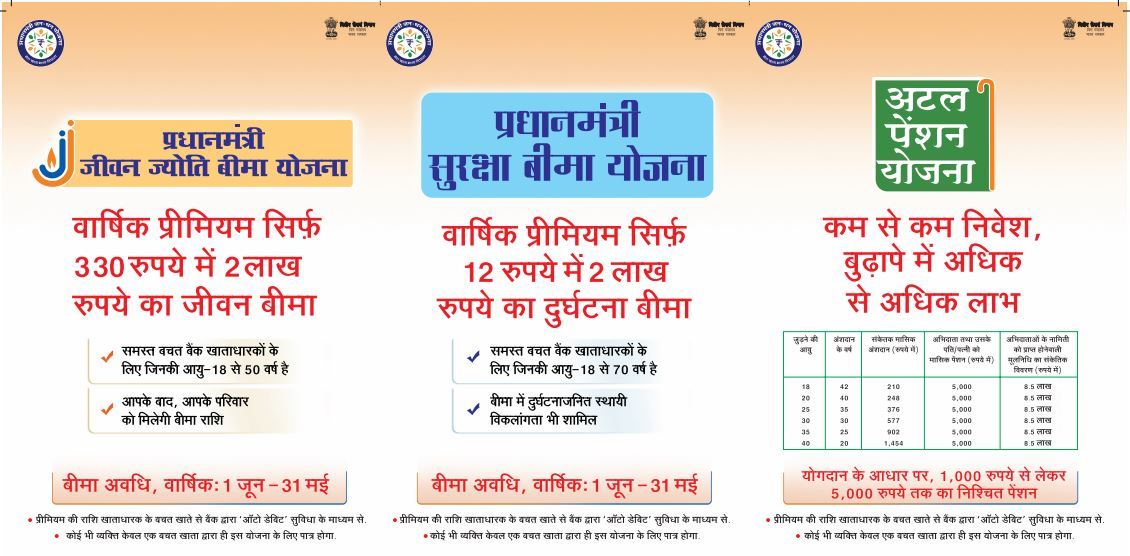
    The budget 2015-16 had announced 3 Social Security Schemes:

    #1. Pradhan Mantri Suraksha BimaYojna (PMSBY)
    #2. Pradhan MantriJeevan Jyoti Bima Yojana (PMJJBY)
    #3. Atal Pension Yojana (APY)

    Why the schemes?

    • India faces the biggest challenge of providing banking facilities and insurance coverage to all
    • Having access to institutional finance has so far remained a far cry to a vast chunk of rural population
    • As of May 2015, only 20% of India’s population has any kind of insurance and only 11% has any kind of pension scheme
    • Insurance is a way of managing risks & give necessary protections in case of financial loss
    • When one has an insurance policy, certain rights and protections are derived out of it to the person and his family
    • There is a dire need for providing social security at a very nominal cost to the millions and economic empowerment of the poor Answer in comments.>
    • PMJDY is a major step to bring people across the country closer to institutionalized finance, and save them from the clutches of informal financiers
    • However, most of the PMJDY accounts had zero balance initially. The government aims to reduce the number of such zero balance accounts by using these schemes Answer in comments.>

    PMSBY & PMJJBY:


    • Implementation: The scheme will be offered by all Public Sector General Insurance Companies and all other insurers who are willing to join the scheme and tie-up with banks for this purpose
    • Govt Contribution: Various Ministries can co-contribute premium for various categories of their beneficiaries from their budget or from Public Welfare Fund created in this budget from unclaimed money
    • Auto-debit: The premium amount will be auto debited from subscriber’s bank account
    • The schemes will be linked to the bank accounts opened under the Pradhan Mantri Jan Dhan Yojana scheme

    Criticisms of PMSBY:

    • Private banks have complained that the Govt should focus on upper middle class instead of the poorer section
    • Western scholars have argued that financial inclusion is a myth and serving such large number of people would only increase the burden and work-load of public sector

    Criticisms of PMJJBY:

    • The banks have complained that revenue received will be very low
    • Some bankers have claimed that amount they are receiving is not sufficient to cover the service costs
    • Insurers have also pointed out that no health certificate or information of pre-existing disease is required for joining

    Atal Pension Yojana

    • It focuses on the unorganized sector where nearly 400 million employees representing more than 80% of all employees are engaged Answer in comments.>
    • The aim is to make sure that needy people could get fixed amount when they get old
    • It is the improved version of Swavalamban scheme, launched in 2010-11, which has been found lacking in clarity with regard to pension benefits at the age after 60

    Features:

    • All citizen of India aged between 18-40 years are eligible
    • A guaranteed minimum monthly pension will be provided to the subscribers varying from Rs. 1000 to Rs. 5000 per month
    • The pension amount depends on contribution by subscriber
    • Government of India will guarantee the minimum benefit of pension
    • Most interesting part of the scheme is that the government will contribute 50% of the contribution made by the subscriber or Rs. 1000 whichever is lower
    • However, contribution by the govt is available for only those who are not income tax payers and are not covered by any Statutory Social Security Schemes
    • Bank account holder of Any Bank account is eligible

    Suraksha Bandhan drive- Spreading the social security message

    • Aim: To take forward the Govt’s objective of creating a universal social security system in the country, targeted especially at the poor and the under-privileged
    • Participating Banks supported by the participating Insurance Companies are carrying out local outreach, awareness building and enrolment facilitation under the drive
    • Public service organizations supported by peoples representatives are participating in these efforts through various outreach activities such as enrolment drives, camps etc. in large numbers during this period
  • Swachh Bharat Mission

    Lets get to the basics of Cess, before we explore more about Swachh Bharat Cess.

    cess-head-for-blog


    What is a Cess?

    Cess is a tax on tax, temporary levied by the govt. to achieve a specific objective. Generally, it is expected to be levied till the time the govt. gets enough money for that purpose.

    For instance, the education cess, that is levied currently, is meant to finance basic education in the country.

    What is the quantum of revenue generated through Cess?

    • The education and higher education cesses are budgeted to bring approx. Rs 30,000 crore this year.
    • The road cess on petroleum is budgeted to net just under Rs 50,000 crore.
    • There is also a cess on exports, clean energy, etc.

    The total amount from cesses is Rs 1.16 lakh crore.

    What is the criticism against Cesses?

    • The problem with cesses is that it becomes permanent in nature.
    • These levies are back door entry instead of levying taxes.

    How Cess is different from Surcharge?

    Surcharge is also a tax on tax, which is imposed on incomes above a certain level with a view to reduce the inequalities further.

    • There is a surcharge of 12% on individuals whose taxable income exceeds Rs. 1 crore.
    • Similarly, there is also a surcharge of 10% on the domestic companies whose taxable income exceeds Rs.10 crore, and also a surcharge of 5% on the foreign companies whose taxable income exceeds Rs.10 crore.

    Now, let’s now come to the core of the topic

    cess-infograph


    What is Swachh Bharat Cess?

    The resources generated from the cess will be utilised for financing and promoting initiatives towards Swachh Bharat. It is a step towards involving each and every citizen in making contribution to Swachh Bharat.

    • Govt. has introduced a cess of 0.5% on all services and 2% on air services.
    • The revenue department is preparing a list of services which will attract the additional 2% cess provided for in the Budget 2015-16, over and above the proposed 14%.

    Where does the proceeds of the Swachh Bharat Cess go?

    The proceeds of the Swachh Bharat cess would be first credited to the Consolidated Fund of India. The govt. would be able to utilise it after due appropriation is made by Parliament by law. This will later go to Swachh Bharat Kosh.

    The Government expects to collect around Rs 10,000 crore from Swachh Bharat cess for full year

    Why does it goes against the principle of fiscal federalism?

    • The central divisible pool excludes levies classified as surcharges and cess for specific purpose.
    • The entire proceeds would remain with the Centre and need not be compulsorily shared with the states.
    • Swachh Bharat cess, to some extent, is a vague pretext for a cess, unlike the ones for national highways or high-speed rail corridors, which can be more effectively implemented at the Central level.

    What will be the impact of GST on the cess?

    There is no input credit available on this cess, which goes against the very principle of the GST and thereby weakens the Centre’s case for pushing through GST.

    The cesses and surcharges would be subsumed once the GST is rolled out. So both for tax payers and states, this is for the time being.


    Published with inputs from Pushpendra
  • Transition From MDG to SDG: Issues & Concern

    193 Countries Agreed on 17 Sustainable Development Goals. Why?

    After 3 years of negotiations and debate, 193 countries agreed to a set of 17 development goals more bold and ambitious than anything that has come before them.

    But what are Sustainable Development Goals? Where have they evolved from?

    These 17 Sustainable Development Goals (SDGs) – part of a wider 2030 Agenda for Sustainable Development – build on the Millennium Development Goals (MDGs).

    There were 8 MDGs and they are going to expire by the end of this year (2015).


    But why didn’t we just renew them? Why was there a need to re-evaluate and re-program the development goals?

    1. The MDGs as you can see were very focus, concrete, target oriented which was a good thing to begin with, right?
    2. Wrong – The structures and 8 categorisation metrics ended up being so rigid that we left out other more important areas.

    A 2015 UN assessment of the MDGs found they fell short for many people:

    “The assessment of progress towards the MDGs has repeatedly shown that the poorest and those disadvantaged because of gender, age, disability or ethnicity are often bypassed.”

    Okay, fair point. So what do these SDGs look like? What went into the process of coming up with these 17 blocks of SDGs?

    In response to the accusation that the MDGs were too narrow in focus, the SDGs set out to tackle a whole range of issues, from gender inequality to climate change.

    The unifying thread throughout the 17 goals and their 169 targets is the commitment to ending poverty.

    Eradicating poverty in all its forms and dimensions, including extreme poverty, is the greatest global challenge and an indispensable requirement for sustainable development. 


    The consultation process to arrive at these 17 SDGs was one of the most transparent exercise ever to be undertaken in the UN history.

    A million voices formed the part of the process.


    Very quickly then, listing down the goals:

    1) End poverty in all its forms everywhere

    2) End hunger, achieve food security and improved nutrition, and promote sustainable agriculture

    3) Ensure healthy lives and promote wellbeing for all at all ages

    4) Ensure inclusive and equitable quality education and promote lifelong learning opportunities for all

    5) Achieve gender equality and empower all women and girls

    6) Ensure availability and sustainable management of water and sanitation for all

    7) Ensure access to affordable, reliable, sustainable and modern energy for all

    8) Promote sustained, inclusive and sustainable economic growth, full and productive employment, and decent work for all

    9) Build resilient infrastructure, promote inclusive and sustainable industrialisation, and foster innovation

    10) Reduce inequality within and among countries

    11) Make cities and human settlements inclusive, safe, resilient and sustainable

    12) Ensure sustainable consumption and production patterns

    13) Take urgent action to combat climate change and its impacts (taking note of agreements made by the UNFCCC forum)

    14) Conserve and sustainably use the oceans, seas and marine resources for sustainable development

    15) Protect, restore and promote sustainable use of terrestrial ecosystems, sustainably manage forests, combat desertification and halt and reverse land degradation, and halt biodiversity loss

    16) Promote peaceful and inclusive societies for sustainable development, provide access to justice for all and build effective, accountable and inclusive institutions at all levels

    17) Strengthen the means of implementation and revitalise the global partnership for sustainable development


    Published with inputs from Sumer