💥Crack UPSC In 1st Attempt | Admission Open | Ultimate Assessment Program 2027/2028

Subject: Agriculture

  • Explain the factors influencing the decision of the farmers on the selection of high value crops in India.

    In 2022-23, fruits and vegetables accounted for 28.3% of the Gross Value Output, surpassing cereals for the first time, and the horticulture sector contributed about 33% to the agriculture GVA.

    Factors Influencing the Selection of High-Value Crops by Farmers in India

    Policy & Institutional Factors

    Government Incentives – Schemes like MIDH, PMKSY, Operation Greens, Mission for Integrated Development of Horticulture.

    Export Promotion Policies- APEDA support, agri-export zones, GI tagging

    Economic Factors

    Higher Profitability- Fruits, spices, floriculture and plantation crops offer greater income per hectare than cereals.

    Availability of Credit & Insurance – Eg-

    Agro-Climatic Factors

    Agro-Climatic Suitability – Eg- grapes in Maharashtra, apples in Himachal.

    Availability of Irrigation- Eg- Sugarcane in western UP and Maharashtra

    Technological Factors

    Availability of HYV Seeds – Eg- GM Seeds, precision farming, tissue culture

    Extension services – e-NAM price signals, Krishi Vigyan Kendras guide crop selection.

    Storage, Processing, and Value Chains – Eg- Mango pulp processing in Andhra Pradesh

    Social Factors

    Agriculture Startups – Educated rural youth adopt commercial high-value crops. Eg- Agroponics near Urban Centers

    Rising urbanisation and changing diets. Eg- organic food market growing @ CAGR 20%

    Environmental & Sustainability Factors

    Climate Resilience- Shift towards drought-resistant crops like millets, medicinal plants.

    Soil Health Consideration – Crop diversification is adopted to restore nutrient balance and reduce dependency on fertilisers.

    Water Efficiency – Crops with lower water requirement and higher value (Eg-, spices, horticulture) are preferred in water-stressed areas.

    Shift to high-value crops can be a key driver of doubling farmers’ income and sustainable agriculture.
  • How does nanotechnology offer significant advancements in the field of agriculture? How can this technology help to uplift the socio-economic status of farmers?

    Nanotechnology refers to the science and application of materials at the nanoscale (1-100 nm), where particles exhibit unique physical, chemical, and biological properties. In agriculture, these nano-sized materials make farming more productive and sustainable.

    Nanotechnology offering significant advancements in agriculture

    Nano-fertilisers improve nutrient-use efficiency to 90-100% – boosts yields. Eg- Nano-urea and nano-DAP introduced by IFFCO.

    Controlled-release nano-pesticides reduce chemical load, minimise residue on crops, and improve efficacy against pests. Eg- nano-Silver

    Bridging micronutrient deficiency – Eg- Nano Zinc and Nano Copper liquids.

    Enables nanoscale gene delivery – quickly and safely transport DNA into plant cells – Improves crop breeding

    Soil health improvement – Nano-clays and nano-zeolites enhance soil moisture retention and restore degraded soils in dry regions.

    Crop Protection – Applying silica nanoparticles to leaves shield plants from high temperatures.

    Precision agriculture – Nanosensors monitor soil moisture, nutrient levels, and plant health.

    Post-harvest protection – Nano-coatings on fruits and vegetables extend shelf life by 2-3 times.

    Irrigation efficiency – Nanomaterials remove contaminants and improve water quality for irrigation.

    Seed quality enhancement – Nanopriming improves seed vigour and early germination.

    Nano-Biosensors can identify plant diseases at an early stage through biomarker detection

    Food Packaging – Eg- use of nanocomposites in making antimicrobial and oxygen-barrier coatings – reduce spoilage and food waste.

    Role of nanotechnology in uplifting the socio-economic status of farmers

    Reduced input costs – Nano-fertilisers cut fertilizer usage by 50%

    Higher yields and productivity due to improved nutrient uptake by crops

    Nano-coatings and nanosensors reduce post-harvest losses (currently 15-20%).

    Improved climate resilience – nano-enabled seed treatments help stabilise production during droughts, heatwaves, and soil degradation

    Access to premium markets – Residue-free nano-pesticides help farmers sell to export markets with strict safety standards.

    Local production of nano-inputs, nano-coatings, and sensor devices can generate rural micro-enterprises and FPO-led businesses.

    Health and environmental benefits – Reduced chemical use lowers health expenditures, improves soil fertility, and supports sustainable long-term income.

    Challenges of Nanotechnology in Agriculture

    High cost and limited awareness of nano-inputs limit large scale adoption.

    Nanophytotoxicity can hinder plant growth, reduce photosynthesis, and affect seed germination.

    Bioaccumulation concerns – Nanoparticles may accumulate in vital organs through food chains, with unclear long-term health effects.

    Groundwater contamination risk due to leaving of Mobile nanoparticles into aquifers.

    Toxicity to pollinators – Continuous exposure to nanoparticles through pollen can harm bees.

    Lack of regulatory standards – India lacks clear biosafety guidelines and permissible limits

    Pollution risks as Non-biodegradable nanoparticles may remain in ecosystems.

    When science meets scale, when innovation becomes inclusive, when technology drives transformation, the foundation for great achievements is laid – PM Modi

    Food Processing

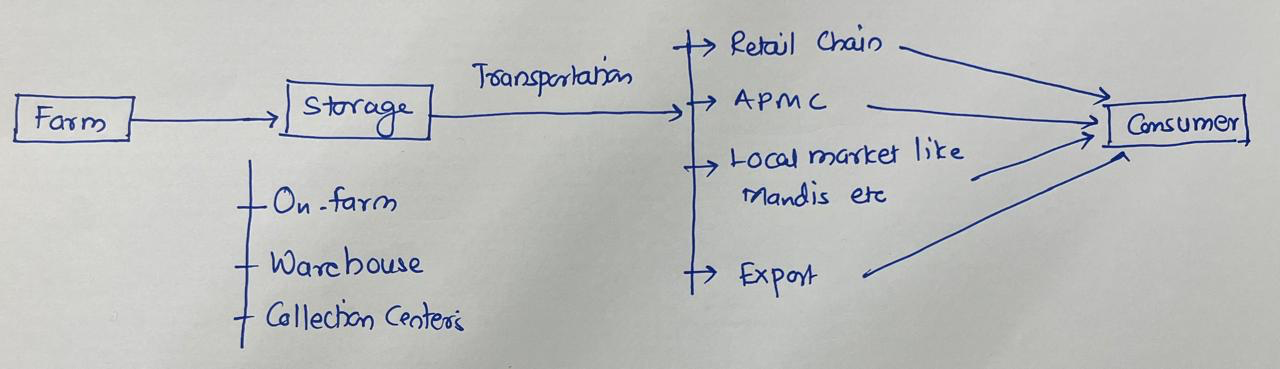
  • Elaborate the scope and significance of supply chain management of agricultural commodities in India.

    The agricultural supply chain refers to activities involved in moving agricultural produce from farm to consumers.

    Scope of Supply Chain Management of Agricultural Commodities

    Post-Harvest Management- Handling, cleaning, grading, drying to reduce losses.

    Storage & Warehousing – Scientific storage, packhouses, warehouses, silos.

    Cold Chain for Perishables – Pre-cooling, refrigerated transport, cold storages.

    Transportation & Logistics – Efficient transport, aggregation, multimodal connectivity. Eg- Kisan Rail.

    Organised Retail & Export Integration: Connecting farmers with supermarkets, processors, exporters, and e-commerce channels. Eg- e-NAM

    Value Addition & Processing – packaging, branding, food processing.

    Export & Quality Compliance – Eg- SPS standards, AGMARK, FSSAI certification

    Significance of Supply Chain Management

    Reduces Post-Harvest Losses: India loses nearly (FAO).

    Enhances Farmer Income due to reduced intermediaries. Eg- FPOs increase farmer income by 20-25% (SFAC).

    Price Stability: Better logistics reduce volatility and transaction costs.

    Boosts Agri-Exports due to better quality products & cold chain infrastructure. Eg- $53 billion in 2022-23.

    Promotes Crop Diversification: Encourages high-value crops like horticulture, dairy, spices, and fisheries.

    Strengthens Food & Nutritional Security: Efficient supply chains ensure timely availability and safe, hygienic food across regions.

    Supports Rural Employment & Agri-Processing: Creates jobs in storage, logistics, milling, packaging, and retail.

    Challenges to Agricultural Supply Chain Management

    High Post-Harvest Losses: 6-18% losses due to poor handling, storage gaps, and weak cold chain.

    Inadequate Infrastructure: Limited cold storages, packhouses, rural warehouses, and multimodal logistics.

    Fragmented Supply Chains: Small landholdings (0.74 Hectare) and inefficient APMCs

    Low Digital Adoption: Eg- only around 1500 APMCs integrated with APMCs

    Strengthening supply chain management is key to ‘Doubling Farmers Income’. This can be done through

    Expand modern storage

    Promote FPO-led aggregation

    Reform APMC laws

    Promote value addition and FPIs.

    Develop export-oriented supply chains with SPS labs and certification.

    Enhance multimodal logistics

  • Consider the following statements

    Consider the following statements :
    1. The Commission for Agricultural Costs and Prices recommends the Minimum Support Prices for 32 crops.
    2. The Union Ministry of Consumer Affairs, Food and Public Distribution has launched the National Food Security Mission.
    Which of the statements given above is/are correct ?

  • Consider the following statements

    Consider the following statements :
    1. Sweet orange plant is propagated by grafting technique
    2. Jasmine plant is propagated by layering technique.
    Which of the statements given above is/are correct ?

  • Consider the following statements

    Consider the following statements:
    1. The Union Government fixes the Statutory Minimum Price of sugarcane for each sugar season
    2. Sugar and sugarcane are essential commodities under the Essential Commodities Act
    Which of the statements given above is/are correct?

  • Consider the following statements

    Consider the following statements:
    1. Maize can be used for the production of starch.
    2. Oil extracted from maize can be a feedstock for biodiesel.
    3. Alcoholic beverages can be produced by using maize.
    Which of the statements given above is/are correct?

  • Consider the following pairs

    Consider the following pairs:
    Region : Well-known for the production of
    1. Kinnaur : Arecanut
    2. Mewat : Mango
    3. Coromondal : Soyabean
    Which of the above pairs is/are correctly matched?

  • Consider the following

    Consider the following:

    1. Areca nut
    2. Barley
    3. Coffee
    4. Finger millet
    5. Groundnut
    6. Sesamum
    7. Turmeric

    The Cabinet Committee on Economic Affair, has announced the Minimum Support Prick for which of the above?

  • Consider the following statements

    Consider the following statements:

    1. Agricultural soils release nitrogen oxides into environment.
    2. Cattle release ammonia into environment.
    3. Poultry industry releases reactive nitrogen compounds into environment.

    Which of the statements given above is/are correct?