💥Mains Ready By December. Smash Mains & Smash PYQ Admissions Open

Subject: Agriculture

  • [3rd September 2026] The Hindu OpED: Many layers

    [3rd September 2026] The Hindu OpED: Many layers

    Question (2024, GS3): “Elucidate the importance of buffer stocks for stabilizing agricultural prices in India. What are the challenges associated with the storage of buffer stock? Discuss.
    Linkage: This question directly addresses the core policy tool used in onion management: state-led procurement and buffer stocking to counter short-term price volatility. It highlights the storage and logistical bottlenecks that lead to post-harvest collapses.

    Mentor Comment

    Onion price management has again run through a sequence of export restrictions and post collapse procurement, and neither has protected the farmer or the consumer. Since the 1960s Indian food policy has balanced affordable consumer prices against remunerative producer prices, with state intervention aimed at managing short term volatility rather than the underlying cause. Erratic weather and the absence of long term relief have made that balancing act harder to hold. The tension is that every corrective step arrives after farmers have already made production decisions and after prices have already collapsed, so the intervention reaches neither all farmers nor all grades of produce.

    What has the Centre’s onion trade policy been since 2023?

    1. The export ban: The government banned onion exports from December 2023 to May 2024.
    2. The price floor that replaced it: A minimum export price of $550 per tonne was imposed, which sets the lowest price at which a consignment may legally leave the country and works as a soft restriction on exports. A 40 per cent export duty was imposed alongside it.
    3. The rollback: The duty was reduced to 20 per cent in September 2024 and abolished in April 2025.

    Why does intervention after the event fail farmers?

    1. Policy changes after the sowing decision: The government often changes its position after farmers have made production decisions based on the price they expected.
    2. The procurement price was below cost: During the rabi harvest, onion farmers in Maharashtra, the country’s principal supplier, argued that the Centre’s procurement price of ₹12.35 per kg would not cover cultivation costs.
    3. The correction came too late for many: The Centre subsequently raised the price to up to ₹26.45 per kg. Many farmers could not capture the higher value, including some who had already sold at ₹1 per kg because of low quality and lack of storage.
    4. Coverage is partial by grade: Intervening after prices have already collapsed does not reach all farmers or all grades of produce.

    What pressures exposed the flaw this year?

    1. Rainfall at the wrong point in the cycle: Abnormal rainfall at the time of harvest hit the crop directly.
    2. A kharif shortfall in the main supplying State: Maharashtra recorded a 5 per cent to 7 per cent drop in the kharif crop.
    3. Onion resists buffering: The known difficulties of storing onion and of maintaining large buffers compound every supply shock rather than absorbing it.
    4. Manipulation is the secondary issue: The government has alluded to some price manipulation, and the dominant problem remains that policy keeps reacting rather than acting in advance.

    What proactive measures does the record point to?

    1. Storage: Improving storage options is the first named measure, since it is what allows a crop to be held past a price trough.
    2. Trade policy stability: A less erratic trade policy would let farmers price the export channel into their sowing decisions.
    3. Inter regional movement: Moving stock more efficiently between regions addresses the distribution failure rather than the production one.
    4. Price shock protection: Protecting farmers against price shocks is the fourth measure, and it operates before a collapse rather than after it.

    Does Tamil Nadu’s targeted subsidy resolve the problem or move it?

    1. The design: Tamil Nadu will buy 1,000 tonnes of onions to distribute 1 kg per ration card at ₹35.
    2. What it gets right: The design discourages hoarding while allowing private retail prices to cool down.
    3. The delivery channel is the risk: Distribution runs through a dry grain public distribution system network, which was not built for a crop that spoils quickly.
    4. The economic case has a threshold: That case could collapse if post harvest losses exceed 10 per cent to 15 per cent, and onion is more susceptible to such losses than wheat or rice.
    5. Persistence is the second risk: The case also weakens if the subsidy has to be continued rather than used once.
    6. Replication would exhaust the buffer: If other States adopt similar measures, the Central buffer could be quickly exhausted, more so given this year’s high storage losses of around 30 per cent.
    7. Pressure transfers to the Centre: The State scheme will impose pressure on the Centre to maintain a steady supply behind it.

    Challenges to stabilising onion prices

    1. Onion is bulky, perishable and stored without a cold chain: Farm level storage relies on ventilated structures whose losses rise sharply in a wet post monsoon. Eg. The traditional onion chawls of Nashik are open sided sheds with no humidity control.
      The Fix: Link the storage capital subsidy to a verified ventilation and moisture standard rather than to built area alone.
    2. Production is geographically concentrated: A weather event in one district cluster moves the national price because supply is not spread across regions. Eg. Lasalgaon in Nashik sets the reference price for the country’s onion trade.
      The Fix: Build procurement and modern storage capacity in Madhya Pradesh, Karnataka and Gujarat so the national price is not set by one belt.
    3. Sudden trade restrictions cost long term market access: Buyers who lose supply once diversify permanently, so the export channel is thinner when the surplus returns. Eg. Bangladesh and Sri Lanka shifted to Chinese, Pakistani and Egyptian onion during the Indian export restrictions.
      The Fix: Announce any trade measure with a fixed minimum notice period and a stated expiry date written into the notification.
    4. Procurement covers only a buffer, not the crop: Agency purchase is sized to stabilise consumer supply, so the price the farmer receives is still set by the open market. Eg. National Agricultural Cooperative Marketing Federation of India (NAFED) buying is confined to buffer accumulation and market release.
      The Fix: Add a deficiency price payment triggered on the mandi price falling below assessed cultivation cost, paid directly rather than through purchase.
    5. Farmers sow without a forward price signal: Acreage decisions are made months before the price is known, which is what produces the alternating glut and shortage. Eg. A remunerative rabi price pulls extra acreage into the next kharif sowing and depresses that crop’s price.
      The Fix: Publish an official pre sowing advisory each season carrying expected national acreage and an indicative price band.

    Conclusion

    Onion policy is being run as a series of corrections applied after the price has already moved. What remains unreconciled is that every correction reaches the farmer after both the sowing decision and the distress sale are complete. Storage capacity and orderly movement of stock are the only interventions that operate before a collapse rather than after it. Whether the Centre holds one trade regime steady through a full price cycle is the test of whether the approach has changed.

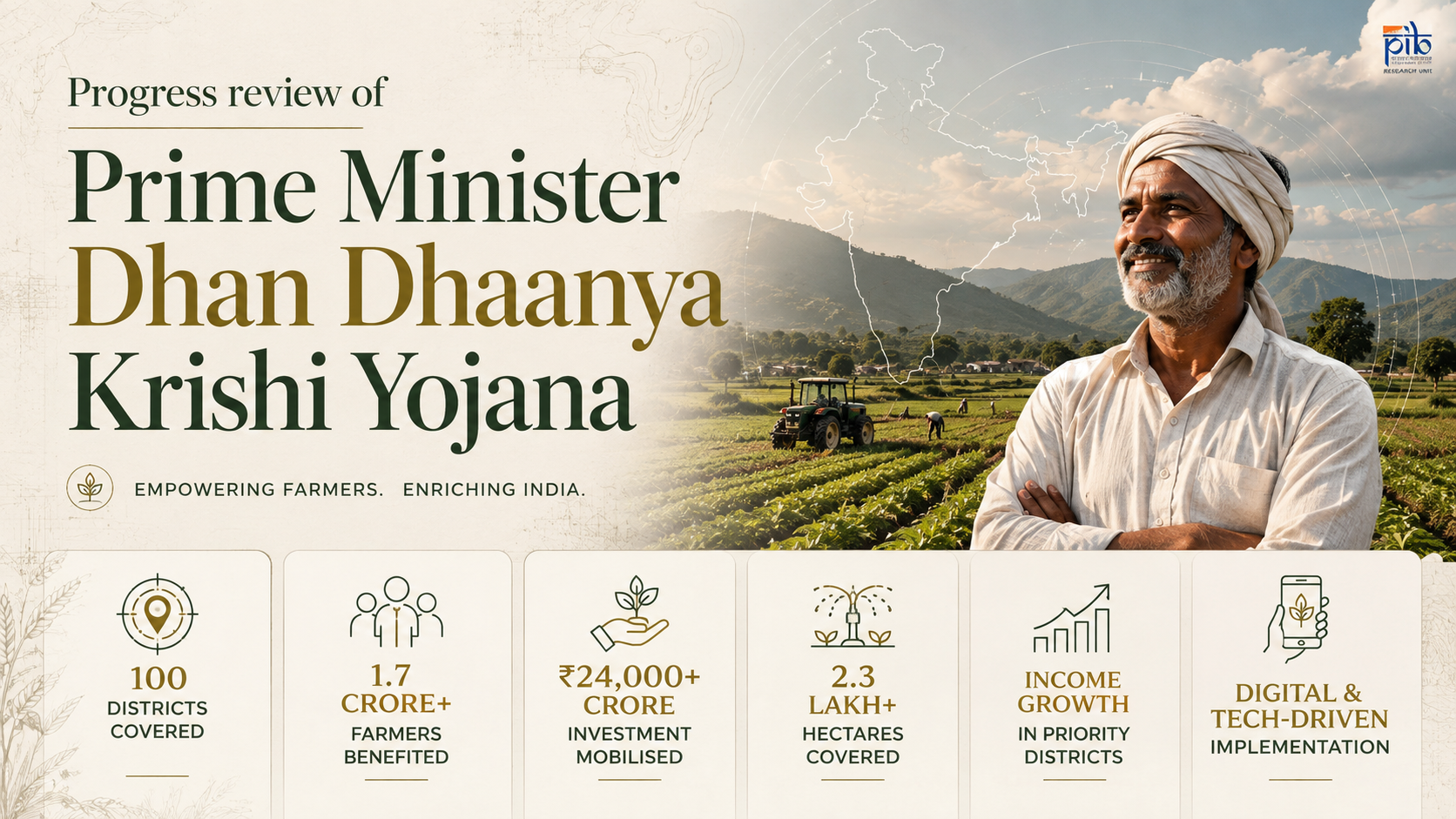
  • Progress review of Prime Minister Dhan Dhaanya Krishi Yojana

    Progress review of Prime Minister Dhan Dhaanya Krishi Yojana

    Why in News

    The Union Minister of Agriculture and Farmers Welfare reviewed the implementation progress of the Prime Minister Dhan Dhaanya Krishi Yojana (PMDDKY).

    Core facts

    1. What it is: PMDDKY is a district focused agriculture development scheme. It converges existing schemes to raise farm productivity in India’s weakest performing agricultural districts.
    2. Implementing ministry: Ministry of Agriculture and Farmers Welfare is the nodal ministry. Multiple line departments contribute converged schemes.
    3. Coverage: The scheme targets 100 districts. Districts are selected on three parameters. The parameters are low agricultural productivity, low cropping intensity, and low credit disbursement.
    4. Convergence design: The scheme pools 36 existing schemes across 11 departments. It layers these on a single district plan rather than creating a new fund line.
    5. Release specific review figures: The specific progress numbers, district status, and targets reported in PRID 2305501 could not be verified from PIB this run. They are not reproduced here.

    Static Context

    1. Origin: The scheme was announced in the Union Budget 2025 to 2026. The Union Cabinet approved it in July 2025.
    2. Duration: The scheme runs for 6 years from 2025 to 2026.
    3. Model: The scheme is modelled on the Aspirational Districts Programme. That programme uses ranking, convergence, and competitive monitoring to lift the weakest districts.
    4. Focus areas: The scheme covers productivity, crop diversification, sustainable agriculture, irrigation and water conservation, post harvest storage at panchayat and block level, and farm credit.
    5. Monitoring: District, State, and National level committees oversee the scheme. NITI Aayog and assigned Central Nodal Officers support monitoring.

    Prelims angle

    1. Number of districts covered: 100 districts.
    2. Selection parameters: low productivity, low cropping intensity, low credit disbursement.
    3. Number of converged schemes: 36 schemes across 11 departments.
    4. Parent design model: Aspirational Districts Programme.
    5. Nodal ministry: Ministry of Agriculture and Farmers Welfare.

    Mains angle

    GS3, agriculture theme (major crops, cropping patterns, agricultural productivity, and scheme convergence). A question can ask how a convergence and district targeting model raises productivity in low performing agricultural districts. It can also ask how crop diversification and integrated farming raise small farmer incomes.

    “[2022, GS3, 15] What is Integrated Farming System ? How is it helpful to small and marginal farmers in India ?”

    “[2025, GS3, 10] Explain the factors influencing the decision of the farmers on the selection of high value crops in India.”

  • ‘Despite US tariffs, our fish export has increased… now exporting to the UK, Japan, China, Thailand and EU’

    ‘Despite US tariffs, our fish export has increased… now exporting to the UK, Japan, China, Thailand and EU’

    Why in the News

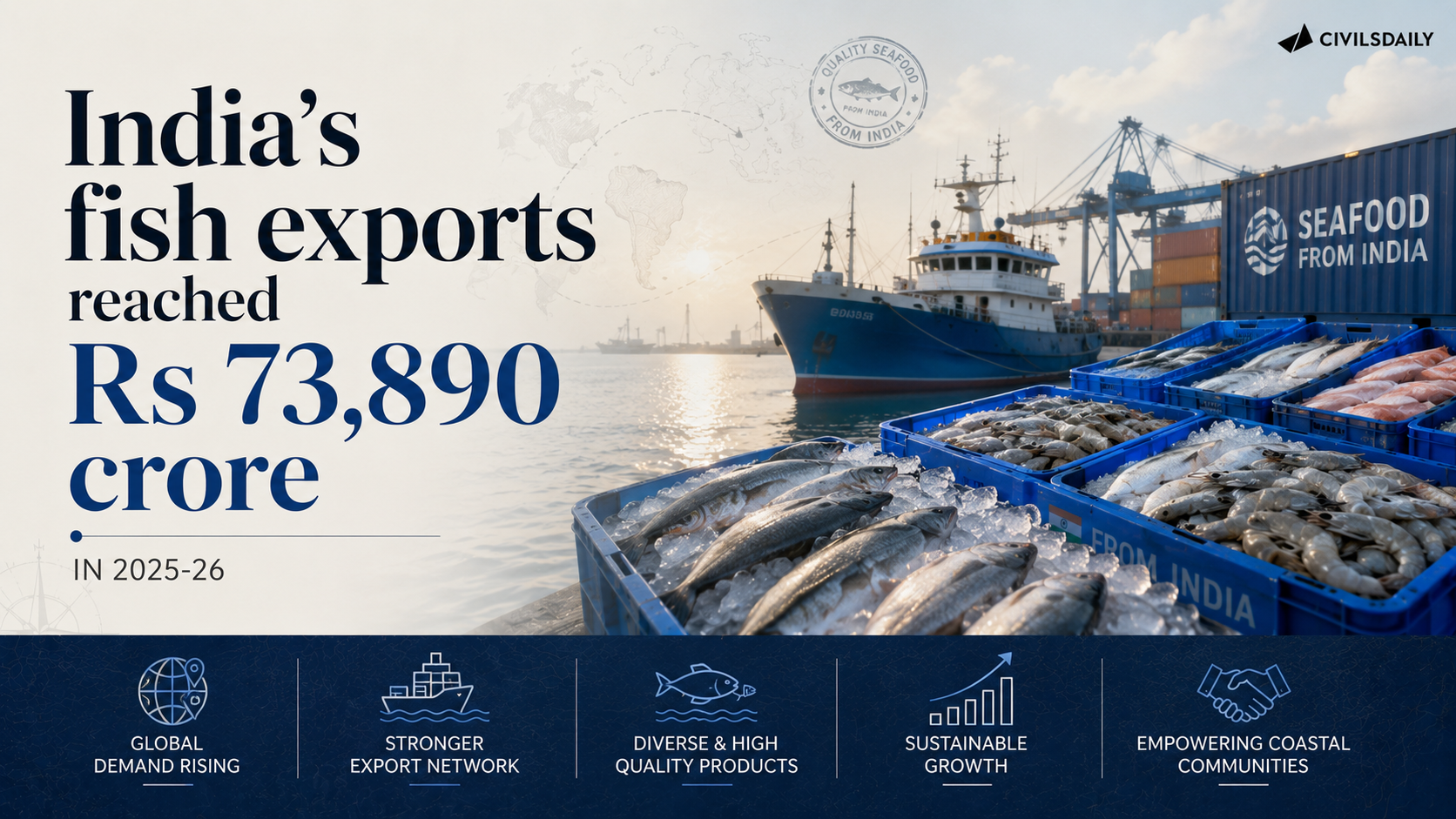
    India’s fish exports reached Rs 73,890 crore in 2025-26, an increase of about Rs 11,000 crore over the previous year. The United States imposed a tariff of more than 58 per cent on Indian goods in 2025, and shipments to that market fell by around 19 to 20 per cent. Growth of more than 20 per cent in the European Union and in countries with which India has signed free trade agreements covered the shortfall. The Union Minister for Fisheries, Animal Husbandry and Dairying set out this record alongside the production and infrastructure results claimed for the Blue Revolution, the Pradhan Mantri Matsya Sampada Yojana and the Fisheries and Aquaculture Infrastructure Development Fund. The tension is that the exports absorbing the tariff are marine products, and the production growth being cited is led by inland fisheries, which contribute only about 2 per cent of export earnings.

    How has fish production moved since 2013-14?

    1. Output has more than doubled: Total fish production rose from 95.79 lakh tonnes in 2013-14 to 197.75 lakh tonnes in 2024-25, a growth of 115 per cent.
    2. Inland fisheries led it: Inland production grew by 147 per cent over the same period.
    3. What paid for it: More than Rs 39,000 crore was invested through the Blue Revolution launched in 2015, the Pradhan Mantri Matsya Sampada Yojana and the Fisheries and Aquaculture Infrastructure Development Fund.
    4. The livelihood base: Three crore people work directly as fishers or fish farmers, and about six crore livelihoods depend on the wider value chain.
    5. An administrative separation: The fisheries department was carved out of the agriculture ministry in 2019 and given a ministry of its own.

    What does Bihar’s shift show about inland fisheries?

    1. A dependence reversed: Around 90 to 95 per cent of the fish sold in Bihar earlier came from Andhra Pradesh, and that share is now about 5 per cent.
    2. The production jump: Bihar’s output has grown eleven times since 2005 to approximately 10.89 lakh tonnes.
    3. From buyer to seller: Bihar now sends freshwater fish to Nepal, West Bengal and Jharkhand.

    How were export markets rebuilt after the tariff?

    1. The base being defended: Fish exports had risen from Rs 30,213 crore in 2013-14 to Rs 62,408 crore in 2024-25 before the tariff was imposed.
    2. Exporters were redirected: The ministry pushed exporters toward new destinations in coordination with the Marine Products Export Development Authority (MPEDA), the statutory body under the commerce ministry that promotes marine product exports.
    3. The outreach: Round table conferences were held with ambassadors and high commissioners of 49 countries.
    4. Where the fish now goes: The new markets are the United Kingdom, Japan, China, Thailand and several European Union countries.
    5. What is actually shipped: Inland and freshwater fish make up only about 2 per cent of exports, so the earnings growth is in marine products.

    What did India change to meet importing countries’ requirements?

    1. Antibiotics were banned: European countries and the United Kingdom refuse fish produced using harmful antibiotics, and India prohibited their use in response.
    2. Origin travels with the fish: A traceability framework requires the origin of the fish to be established through a QR code.
    3. A domestic quality problem runs alongside: Farmed mangur is being confiscated in Bihar over its effect on native species and on local livelihoods, and injections used to accelerate its growth carry a health risk.

    Why is deep sea fishing being opened around Lakshadweep and the Andamans?

    1. The loss being addressed: Almost one lakh tonnes of tuna were believed to die naturally in those waters for want of fishing infrastructure.
    2. The gap in effort: Indian vessels were not fishing in the Exclusive Economic Zone (EEZ), the belt extending 200 nautical miles from the baseline within which a coastal state holds rights over living and non living resources, or on the high seas beyond it.
    3. What has been put in place: Fishing infrastructure for the islands was announced in the 2024 Budget, guidelines for the Exclusive Economic Zone and the high seas were formulated, and investor meetings were held in both island groups.
    4. The security condition: Only vessels carrying the national flag will be permitted to fish on the high seas, on the ground that the sea is a national security concern.
    5. The target species: Tuna is the intended catch, among the most expensive fish in the world and in high global demand.

    How are fishing communities being protected against climate risk?

    1. Transponders on vessels: Fishing vessels are being fitted with transponders connected to satellites.
    2. Contact and early warning: A fisher at sea for 15 to 20 days can stay in touch with family through an Android phone linked to the transponder, and alerts warn of approaching storms and direct vessels away from danger.
    3. A fuel saving by product: The same system indicates where fish are likely to be found, which cuts searching time and fuel use.
    4. The stated limit of the mandate: Rising sea temperatures and changing rainfall are treated as sitting with the environment ministry rather than with the fisheries ministry.

    Why does India’s livestock scale not convert into exports?

    1. The scale: India ranks first in the world in milk production and second in egg production.
    2. The barrier: Foot and mouth disease and brucellosis in the animal population restrict how much India can export.
    3. The response: Vaccination campaigns aimed at eradicating foot and mouth disease have brought outbreaks down from 132 in 2019 to 40.
    4. A domestic standards question: Four States have banned analogue paneer, an artificial product that is not made from milk and that carries a health risk.

    How is the stray cattle problem being addressed at source?

    1. It is a State subject: Management of stray animals sits with State governments rather than with the Centre.
    2. Sex sorted semen changes the calf ratio: Artificial insemination using sex sorted semen produces around 90 per cent female calves.
    3. Why the abandoned animals are male: Most animals left on roads are male, since tractors have replaced oxen in farm work.
    4. The incentive being created: More female calves mean more milk and more income, giving an owner a reason to rear the animal rather than abandon it.

    What is the Centre’s role in panchayat finance?

    1. The constitutional position: Under the 73rd Constitutional Amendment the panchayat is a distinct tier of government, and the laws governing its functioning are State laws.
    2. On the Panchayats (Extension to the Scheduled Areas) Act, 1996: The Act completes three decades this year and its implementation is delayed in several States. The stated central position is that States hold the power to legislate here, so the Centre does not intervene.
    3. What the Centre transfers: The Centre releases the grants recommended by the Finance Commission to States in a 90:10 ratio determined by population and geographical conditions.
    4. The release condition: States must pass the money on to panchayats within 10 days, failing which the second instalment is withheld.
    5. Performance linked grants: The Sixteenth Finance Commission has recommended that 20 per cent of the grant be performance based, which forces panchayats to develop their own revenue sources.
    6. Capacity building: Training of elected representatives, including women representatives, is run with trainers drawn from institutions such as the Indian Institute of Management Ahmedabad.
    7. Bihar’s reservation record: Bihar reserved 50 per cent of seats for women in Panchayati Raj institutions in 2006 and in local bodies in 2007, and women were 53 per cent of those elected in the last panchayat election.

    Conclusion

    Production was never the constraint here. Exports held up because the ministry found new buyers and met the residue and traceability conditions those buyers impose, which is a compliance achievement rather than a fishing one. The marker to watch is whether the island investor meetings convert into Indian flagged vessels actually working the Exclusive Economic Zone.

    Back2Basics

    1. Administering department: Implemented by the Department of Fisheries under the Ministry of Fisheries, Animal Husbandry and Dairying.
    2. Launch and outlay: Launched in 2020 with an investment of Rs 20,050 crore, the largest ever committed to the fisheries sector in India.
    3. Objectives: Raise fish production and productivity, modernise the value chain from harvest to market, and double the incomes of fishers and fish farmers.
    4. Targeted beneficiaries: Fishers, fish farmers, fish workers and vendors, fisheries cooperatives and fish farmer producer organisations.

    Matching Previous Year Question

    “[2015, GS3, 12 marks] Livestock rearing has a big potential for providing non-farm employment and income in rural areas. Discuss suggesting suitable measures to promote this sector in India.”
  • Pradhan Mantri Fasal Bima Yojana crop insurance record

    Why in the News

    PIB set out the coverage and claims record of the Pradhan Mantri Fasal Bima Yojana (PMFBY). PMFBY is the national crop insurance scheme.

    Core facts

    1. What it is: PMFBY provides crop insurance against non preventable natural risks. Cover runs from pre sowing to post harvest.
    2. Coverage record: About 56.96 crore farmer applications were insured since inception.
    3. Claims paid: About Rs 1,54,469 crore was paid in claims since inception.
    4. Farmer premium: Farmers pay 2 percent for Kharif crops, 1.5 percent for Rabi crops and 5 percent for commercial and horticultural crops. The government pays the balance premium.
    5. Design principle: The scheme follows a One Nation, One Crop, One Premium approach. It removed premium capping so full admissible claims are paid.
    6. Technology: Loss assessment uses remote sensing, drones and smartphones. Key systems are YES-TECH (Yield Estimation System based on Technology) and CROPIC (Collection of Real time Observations and Photographs of Crops).

    Static Context

    1. Launch: PMFBY was launched in 2016. It replaced earlier crop insurance schemes.
    2. Voluntary since 2020: Enrolment became voluntary for all farmers from the 2020 revamp. It was earlier compulsory for loanee farmers.
    3. Delivery platform: The National Crop Insurance Portal (NCIP) digitises enrolment, premium flow and claims.
    4. Implementing ministry: The scheme is run by the Ministry of Agriculture and Farmers Welfare.

    Prelims angle

    1. Premium hook: Farmer premium is 2 percent Kharif, 1.5 percent Rabi, 5 percent commercial and horticultural. A uniform 2 percent for all crops is incorrect.
    2. Scope hook: The scheme covers post harvest losses from cyclones and unseasonal rain, and localised risks such as hailstorm and landslide.
    3. Tech hook: YES-TECH for yield estimation and CROPIC for photograph based crop verification.
    4. Year hook: Launched in 2016, voluntary since 2020.

    Mains angle

    GS3 (agricultural risk, crop insurance, subsidies). A question can ask how crop insurance protects small and marginal farmers against climate risk.

    Matching Previous Year Question

    “[2016, GS3, 12.5 marks] Give the vulnerability of Indian agriculture to vagaries of nature, discuss the need for crop insurance and bring out the salient features of the Pradhan Mantri Fasal Bima Yojana (PMFBY). [2016] With reference to ‘Pradhan Mantri Fasal Bima Yojana’, consider the following statements: 1. Under this scheme, farmers will have to pay a uniform premium of two percent for any crop they cultivate in any season of the year. 2. This scheme covers post-harvest losses arising out of cyclones and unseasonal rains. Which of the statements given above is/are correct? (a) 1 only (b) 2 only (c) Both 1 and 2 (d) Neither 1 nor 2 Answer: (b)”

  • Per Drop More Crop expands water efficient micro irrigation

    Why in the News

    PIB detailed the reach of the Per Drop More Crop (PDMC) component of national irrigation policy. Revised guidelines widen the water management activities that states can fund.

    Core facts

    1. What it is: Per Drop More Crop promotes drip and sprinkler irrigation. The aim is higher water use efficiency at the farm.
    2. Coverage record: About 83.06 lakh hectares were brought under micro irrigation from 2015-16 to 2023-24. About 30.55 lakh hectares of that were added in the last three years.
    3. Central assistance: About Rs 18,714.69 crore was released to states since inception.
    4. Subsidy pattern: Assistance is 55 percent for small and marginal farmers and 45 percent for other farmers. Northeastern and Himalayan states get 25 percent higher unit cost support.
    5. Revised guidelines: States can now plan micro level water management works such as diggi construction and water harvesting under the scheme.
    6. Figure caveat: Some current media figures cite about 115 lakh hectares and 12.30 lakh farmers. Those could not be verified on a fetchable PIB detail page, so the PIB verified figure of 83.06 lakh hectares is used above.

    Static Context

    1. Parent scheme history: PDMC ran under the Pradhan Mantri Krishi Sinchayee Yojana (PMKSY) from 2015-16 to 2021-22. Since 2022-23 it runs under the Rashtriya Krishi Vikas Yojana (RKVY).
    2. Micro Irrigation Fund: The Micro Irrigation Fund (MIF) was created with the National Bank for Agriculture and Rural Development (NABARD). Its initial corpus was Rs 5,000 crore.
    3. Interest support: The Fund gives states a 3 percent interest subvention on loans for micro irrigation expansion.
    4. PMKSY mandate: PMKSY, launched in 2015, follows the goal of Har Khet Ko Paani and improved on farm water use.

    Prelims angle

    1. Umbrella hook: PDMC now sits under RKVY, earlier under PMKSY.
    2. Fund hook: The Micro Irrigation Fund is with NABARD, corpus Rs 5,000 crore.
    3. Concept hook: Micro irrigation cuts fertiliser and nutrient loss and can check groundwater depletion. It is not the only means of dryland irrigation.

    Mains angle

    GS3 (types of irrigation and irrigation systems). A question can ask how micro irrigation addresses India’s water stress and how coverage can be widened.

    Matching Previous Year Question

    “[2021, GS3, 10 marks] How and to what extent would micro-irrigation help in solving India’s water crisis? [2016, GS3, 12.5 marks] What is water-use efficiency? Describe the role of micro-irrigation in increasing the water-use efficiency. [2011] With reference to micro-irrigation, which of the following statements is/are correct? 1. Fertilizer/nutrient loss can be reduced. 2. It is the only means of irrigation in dry land farming. 3. In some areas of farming, receding of the groundwater table can be checked. (a) 1 only (b) 2 and 3 only (c) 1 and 3 only (d) 1, 2 and 3 Answer: (c)”

  • Government to introduce fortnightly sugar allocation

    Why in the News

    The Centre has decided to replace the existing monthly sugar quota system with a fortnightly allocation system from September. A physical verification of sugar stocks at mills found that many mills held stocks well beyond their declared monthly returns, that some mills engaged in short selling by selling less sugar than their monthly allocation, and that sugar sold at the start of a month was in some cases lifted by buyers only at the month’s end. The move tightens a monitoring system the government found could be gamed under a monthly cycle.

    Why did the government find the monthly quota system inadequate?

    1. Stock under-declaration: Physical verification showed many mills were holding stocks in excess of what they had declared in their monthly returns to the government.
    2. Short selling: Some mills sold less sugar than the quantity actually allocated to them under the monthly quota, without any monthly-cycle mechanism to catch the shortfall quickly.
    3. Delayed lifting by buyers: In some cases sugar sold by a mill early in the month was dispatched or lifted by the buyer only near the end of the month, defeating the purpose of a monthly release schedule.

    What does the new fortnightly system require?

    1. Split sale mandate: Mills must sell at least 40 percent of their fortnightly allocation in the first week and the remaining balance in the second week.
    2. Faster dispatch: Mills have been directed to dispatch sold sugar within a week of sale, closing the gap that allowed delayed lifting under the monthly system.
    3. Closer monitoring: A fortnightly cycle lets the government track the demand supply position more frequently, respond faster to market changes, and release additional quota where needed.

    Challenges to the fortnightly allocation system

    1. Compliance burden on mills: A fortnightly reporting and dispatch cycle roughly doubles the administrative and logistical load mills previously carried under a monthly system. Eg. Mills must now furnish dispatch proof and stock declarations twice as often, straining smaller mills with limited administrative staff. Fix. Phase in stricter reporting first for mills previously flagged for under-declaration or short selling, rather than applying the full compliance load uniformly from day one.
    2. Enforcement capacity: The scheme depends on the government’s ability to verify declarations at the mill level frequently enough to catch violations before the next cycle begins. Eg. The August verification exercise that triggered this shift was itself a one-time physical check, not a standing monitoring mechanism. Fix. Institutionalise periodic third-party stock audits rather than relying on ad hoc verification drives.

    Conclusion

    The fortnightly allocation system is a direct administrative response to mill-level under-declaration, short selling and delayed dispatch uncovered during stock verification. Crushing for the new sugar year begins on 15 October, with production of 10 lakh tonnes expected in October and 45 lakh tonnes in November, and mills are free to sell without restriction through October.

    Matching Previous Year Question

    No direct PYQ traced in the provided files.

  • Centre lifts ban on wheat exports amid depressed local prices

    Why in the News

    The central government has lifted the ban on wheat exports that it had imposed in 2022, citing depressed domestic wheat prices. The 2022 ban was put in place after a heatwave-hit domestic harvest and global supply disruption from the Russia-Ukraine conflict pushed both international and domestic wheat prices sharply higher, and the government moved to restrict exports to protect domestic supply and price stability. Domestic prices now running below the level that supports farmer incomes has produced the opposite problem the 2022 ban was designed for, prompting the reversal.

    Why was the wheat export ban imposed in 2022, and why lift it now?

    1. 2022 ban responded to a domestic and global price spike: The government banned wheat exports in May 2022 after a heatwave curtailed India’s wheat harvest just as global wheat prices were rising sharply due to the Russia-Ukraine conflict’s disruption of Black Sea grain exports.
    2. Ban was meant to protect domestic food security and price stability: Restricting exports kept domestic wheat supply from being drawn down by exporters chasing the higher international price, a measure meant to shield Indian consumers and the government’s own procurement operations from a global price shock.
    3. Current problem is the reverse, depressed domestic prices: Domestic wheat prices have since fallen to a level the government now assesses as too low to adequately support farmer incomes, the opposite condition from the one that justified the 2022 ban.
    4. Lifting the ban allows exports to absorb surplus domestic supply: Reopening exports gives farmers and traders an additional market outlet beyond domestic demand, which is expected to support prices by allowing surplus stock to move into export channels rather than depressing the domestic market further.

    What does this reversal say about India’s wheat trade policy stance?

    1. India is the world’s second-largest wheat producer: India’s scale of wheat production means its export policy decisions, in either direction, have a visible effect on global wheat supply and price, well beyond India’s own domestic market.
    2. Export policy is being used actively as a price-stabilisation lever: Moving from a ban to a lifted ban within a few years shows the government treating wheat export policy as an active tool to manage domestic price swings in both directions, rather than as a fixed, long-term trade stance.
    3. Signals confidence in current domestic stock levels: Lifting the ban implies the government assesses domestic wheat stocks, including those held for the public distribution system, as adequate to permit exports without risking a repeat of the price and supply concerns that triggered the original ban.

    Conclusion

    The reversal of the 2022 wheat export ban reflects a shift from a supply-protection concern to a price-support concern, as depressed domestic prices have replaced the earlier worry about a domestic and global supply shock. How much export volume actually moves, and how far domestic prices recover, will determine whether the reversal achieves its intended effect for farmers.

    Back2Basics: Minimum Support Price and wheat procurement

    1. The Minimum Support Price (MSP) is the price at which the government commits to procure specified crops, including wheat, from farmers, intended to guarantee a floor price regardless of market fluctuations.
    2. Wheat procurement for the MSP system, along with the Public Distribution System’s buffer stock requirements, is carried out mainly by the Food Corporation of India.
    3. A gap between the market price farmers actually receive and the announced MSP is one of the triggers that can prompt a trade-policy response such as an export ban or its reversal.
    4. India’s wheat export policy has swung between restriction and liberalisation multiple times in recent years, tracking domestic price and stock conditions.

    Matching Previous Year Question

    “[2024, GS3, 15 marks] Elucidate the importance of buffer stocks for stabilizing agricultural prices in India. What are the challenges associated with the storage of buffer stock? Discuss.”

  • After Minister, Secy’s kin availed of agri subsidy scheme, new rules bar them

    After Minister, Secy’s kin availed of agri subsidy scheme, new rules bar them

    Why in the News

    The National Horticulture Board (NHB) amended the Scheme Guidelines of the Commercial Horticulture and Cold Storage Schemes on 21 August 2026, with immediate effect. The amendment bars holders of constitutional posts, serving ministers, members of legislatures, mayors, district panchayat chiefs and government employees from financial assistance under NHB schemes, and redefines ‘family’ to cover the applicant’s spouse, father, mother, sons and daughters. It follows a 27 June 2026 investigation reporting that a Union Minister of State and the kin of a serving Central government Secretary had availed subsidy for their cucumber farms. The tension is that a scheme designed to promote large scale commercial horticulture had eligibility rules loose enough to route public subsidy to the families of the officials administering the sector.

    What is the Development of Commercial Horticulture scheme?

    1. Purpose: The scheme, formally the Development of Commercial Horticulture through Production and Post-Harvest Management of Horticulture Crops, promotes commercial farming of horticultural crops on a large scale, meaning cultivation for profit rather than subsistence.
    2. Crops covered: It covers three vegetables, capsicum, cucumber and tomato, and eight varieties of flowers including rose, lilium and chrysanthemum.
    3. The assistance it offered: The scheme offered a maximum subsidy of 50 per cent of the project cost, capped per family.
    4. Who runs it: It is administered by the National Horticulture Board, an autonomous body under the Ministry of Agriculture and Farmers’ Welfare.

    Who is now barred from the subsidy?

    1. Constitutional post holders: Present holders of constitutional posts are ineligible for financial assistance under NHB schemes.
    2. Elected representatives and office bearers: Present ministers and ministers of state, members of the Lok Sabha and the Rajya Sabha, members of State Legislative Assemblies and Councils, mayors of municipal corporations and chairpersons of district panchayats are ineligible.
    3. Serving government employees: Serving employees of Central and State government ministries and departments, public sector undertakings, autonomous bodies and local bodies are ineligible, except Multi-Tasking Staff, Class-IV and Group D employees.
    4. Pensioners above a threshold: Superannuated and retired pensioners receiving a monthly pension of Rs 10,000 or more are ineligible, excluding the same Multi-Tasking Staff, Class-IV and Group D categories.
    5. Groups of farmers: A group of farmers is the fifth barred category, closing the route by which several individuals could apply jointly.
    6. A single concession: Family members of persons in the barred categories may avail one-time assistance, subject to the revised definition of family.

    How has the definition of ‘family’ changed?

    1. The new definition: For determining eligibility under NHB schemes, ‘family’ now comprises the applicant’s spouse, father, mother, sons and daughters.
    2. The definition it replaces: The old guidelines defined family as the husband, wife and dependent minor children, which left adult children and parents free to apply separately.
    3. One member per family: Only one member of a family is eligible to avail financial assistance under NHB schemes, whether individually or through a Hindu Undivided Family, a partnership or proprietorship firm, or as a director of a company.
    4. Assistance is attributed to the family: Financial assistance availed by any member of a family is treated as assistance availed by that family, and no further assistance is admissible to any other member under any NHB scheme or component.
    5. The unutilised balance is forfeited: The bar applies irrespective of any unutilised portion of the maximum admissible ceiling, and constitutes the final entitlement of the family across all NHB schemes and components.

    What else did the amendment change?

    1. The subsidy rate was cut: The subsidy component was reduced from 50 per cent to 35 per cent for beneficiaries in general category states.
    2. A higher rate for hill and North Eastern states: The rate is 45 per cent in North Eastern and Himalayan states, retaining a differential for higher cost regions.
    3. Cold storage assistance was capped: The maximum subsidy for cold storage capacity was capped at Rs 2 crore.
    4. A voluntary exit route was created: A beneficiary may, during the prescribed lock-in period, voluntarily opt out by refunding the entire subsidy amount with applicable interest, and is then discharged from the obligations and restrictions arising from the assistance.
    5. Misrepresentation now carries recovery: Suppression, misrepresentation or furnishing of incorrect information to obtain assistance renders the applicant liable for recovery of the assistance released, along with applicable interest.
    6. The stated objective: The NHB circular states the amendments are meant to rationalise financial assistance, ensure equitable distribution of benefits, prevent duplication of subsidy, and make implementation more transparent and effective.

    What prompted the amendment?

    1. The Minister’s own case: A 27 June 2026 report found that Bhagirath Choudhary, Minister of State in the Union Ministry of Agriculture and Farmers’ Welfare, availed a Rs 99 lakh subsidy for his farm in 2025 under the same scheme administered by his own ministry.
    2. The subsidy was returned: He returned the subsidy amount to the government a month later.
    3. The Secretary’s kin: The same investigation showed that the wife, son and mother of senior Indian Administrative Service officer Naresh Pal Gangwar, then serving as Secretary of the Department of Animal Husbandry and Dairying, were among the beneficiaries of the scheme.
    4. A posting was withdrawn: The government appointed that officer as Higher Education Secretary on 23 July 2026, and cancelled the appointment on 10 August 2026 before he joined.
    5. The design gap the cases exposed: Neither case required a false declaration, because the old ‘family’ definition covered only husband, wife and dependent minor children, and no category of applicant was excluded by office.

    Challenges to the National Horticulture Board subsidy scheme

    1. Verification of family relationships is self declared: The Board has no independent database linking an applicant to parents, adult children or spouse, so the widened definition depends on the applicant disclosing it. Eg. The barred cases surfaced through a newspaper investigation rather than through scheme level scrutiny. Fix. Seed applications with Aadhaar based family linkage from the ration card or land record database, so a second application from the same family is flagged automatically.
    2. Corporate structures can defeat the one-member rule: The bar covers a Hindu Undivided Family, a firm and a directorship, but not shareholding through nominees or layered entities. Eg. The revised rule lists specific vehicles rather than applying a beneficial ownership test. Fix. Apply a beneficial ownership disclosure requirement above a defined shareholding threshold, on the model used for company law filings.
    3. A lower subsidy rate deters the small grower: The reduced rate raises the own contribution needed for a poly-house or a cold store, which is harder for a one hectare holder than for a large operator. Eg. Protected cultivation and cold storage carry high fixed setup costs regardless of holding size. Fix. Retain the higher rate for small and marginal holders and Farmer Producer Organisations while applying the reduced rate to larger project sizes.
    4. Cold storage assistance concentrates geographically: Capital subsidy flows to states that already have storage clusters and applicants able to raise the balance capital. Eg. Cold storage capacity in India remains concentrated in a few states, leaving wide gaps elsewhere. Fix. Ring-fence a share of the cold storage corpus for districts with no existing capacity, appraised against a mapped storage deficit.
    5. Lock-in monitoring is weak: The new voluntary exit and recovery provisions assume the Board can track asset use through the lock-in period, which requires physical inspection capacity it does not have. Eg. The guidelines rely on the beneficiary approaching the Board rather than on periodic verification. Fix. Mandate geo-tagged and time-stamped asset verification at fixed intervals during the lock-in, released through the scheme portal.
    6. No public beneficiary register exists: Without a searchable list of who received what, the same defect can recur undetected until it is reported externally. Eg. Both the Minister’s case and the Secretary’s family’s case came to light through an outside investigation. Fix. Publish a district-wise beneficiary register with name, project and sanctioned amount, on the model of the public disclosure already used for fertiliser and food subsidy transfers.

    Conclusion

    The scheme guidelines have been amended by an NHB circular dated 21 August 2026 and apply with immediate effect, so the barred categories and the widened family definition already govern fresh applications. The amendment also cuts the subsidy rate for general category states, caps cold storage assistance at Rs 2 crore, and creates a voluntary refund route out of the scheme. The circular sets no further date or review milestone, and the operative test will be whether the widened family definition is verified at application stage rather than after the fact.

    “[2018, GS3, 15 marks] Assess the role of National Horticulture Mission (NHM) in boosting the production, productivity and income of horticulture farms. How far has it succeeded in increasing the income of farmers?”

  • A dry spell along the Cauvery river

    A dry spell along the Cauvery river

    Why in the News

    Karnataka appealed to the Cauvery Water Management Authority (CWMA) on 11 August to cut its daily release to Tamil Nadu from 12,000 cusecs to 10,000 cusecs. It warned of a severe drinking water shortage if more water were released for crops in the Cauvery basin. Tamil Nadu had already chosen not to open the Mettur dam for irrigation on the customary date of 12 June, given a poor south-west monsoon forecast attributed to a super El Nino. Large tracts of the Cauvery delta consequently remain barren in a season that normally carries two crops. The dispute is no longer only between an upper and a lower riparian State, because Karnataka is simultaneously rationing its own canal irrigation and committing reservoir water to Bengaluru’s drinking supply.

    What is the Cauvery water-sharing arrangement?

    1. The dispute predates the States: The sharing of the Cauvery is a vexed issue going back more than 130 years, to agreements between the Mysore Kingdom and the Madras Presidency that were drawn without regard to any future State boundary.
    2. The award fixes an annual quota and a monsoon share: The Cauvery Water Disputes Tribunal and the Supreme Court provided for Karnataka to release 123.14 thousand million cubic feet of the 177.25 thousand million cubic feet annual quota during the south-west monsoon. That share is mostly meant to support paddy cultivation in the Samba season.
    3. A central authority administers the sharing: The CWMA was set up in June 2018 by the Union government to handle water-sharing from the Cauvery among Karnataka, Tamil Nadu, Kerala and Puducherry.
    4. A technical committee advises it: The Cauvery Water Regulation Committee (CWRC) assesses storage and crop requirement and recommends releases to the CWMA, and both bodies sit under the Supreme Court’s continuing supervision.

    What is a cusec?

    1. A cusec measures flow, not volume: A cusec is one cubic foot per second, so a release order of 12,000 cusecs fixes the rate at which water must cross the inter-State point rather than a total quantity.

    What is a TMC?

    1. A TMC measures volume: A thousand million cubic feet (TMC) is a stock of water, roughly 28.3 million cubic metres. Reservoir capacity and annual quotas are stated in TMC rather than in the cusecs used for daily obligations.

    Why does the delta’s cropping calendar depend on a single dam opening date?

    1. One release date sets the whole season: Water released from the Mettur dam, built in Salem district across the Cauvery, on 12 June for irrigation ordinarily reaches Tiruvarur about 300 km downstream by 23 or 24 June. This year nothing reached it.
    2. Two seasons run off that release: Paddy is ordinarily cultivated across 5.3 lakh acres in the delta during the short-term Kuruvai season, followed by 12.9 lakh acres during the longer Samba-Thaladi season.
    3. Samba is the season that matters: Samba transplantation begins in late July or early August and the harvest ends in mid-January, and the crop is both a food security crop and the mainstay of the delta’s rural economy.
    4. Kuruvai is the higher-yield gamble: The shorter-duration Kuruvai crop can offer higher yields and is largely dependent on groundwater drawn through energised pumpsets rather than on canal water.
    5. The acreage has already collapsed: Tamil Nadu government data put the area under paddy cultivation this year at 4.5 lakh acres, against the 5.3 lakh acres the Kuruvai season alone normally covers.

    How is Karnataka rationing its own irrigation?

    1. Farmers sowed against official advice: Farmers across Karnataka’s Cauvery basin defied advice against sowing water-intensive crops such as paddy and sugarcane this season, amid a predicted deficient monsoon and inadequate inflows into the basin’s reservoirs.
    2. A brief August revival encouraged them: The Krishna Raja Sagara (KRS) reservoir has a full level of 124.8 feet. It rose from 93 to 94 feet to over 100 feet within days in the first week of August before stagnating at 109 feet.
    3. The canal system runs off that reservoir: The Visvesvaraya canal system draws water from the KRS reservoir, located across the Cauvery near Mysuru, and serves the Mandya belt.
    4. Releases were cut to four rotational cycles: The Cauvery Irrigation Advisory Committee, a regional body chaired by the Karnataka Water Resources Minister, met in Bengaluru on 19 August and decided to release canal water in only four rotational cycles during the crop season instead of continuously.
    5. The stated purpose is storage, not irrigation: The decision was taken to conserve reservoir storage and ensure water availability for other needs, including drinking water.
    6. Rotation does not sustain a standing crop: A pattern of about 15 days of release followed by 15 days without will not provide enough water for paddy and sugarcane, and leaves farmers able to grow only dry crops.

    What are farmers at the canal’s tail end facing?

    1. The tail end gets water last or not at all: A farmer in Kuntanahalli village of Maddur taluk in Mandya district has raised a paddy nursery on a two-acre plot lying at the tail end of the Visvesvaraya canal system.
    2. The window is measured in days: Without water in the next 7 to 10 days he loses both the sowing season and the Rs 8,000 already spent on raising the nursery.
    3. Switching crops is not a safe alternative: Semi-dry crops such as ragi, pulses and oilseeds are the fallback, and heavy rain arriving late can damage a ragi crop just as its absence damages paddy.
    4. Position on the canal decides outcomes: Paddy transplantation is nearly complete in Karekura and Hosahalli, close to the KRS reservoir, and even there farmers who normally take two crops a year doubt the second.
    5. Losing a crop means becoming a labourer: Most agricultural labourers in the region earn Rs 400 to Rs 500 for a day’s work from 7 a.m. to noon, which is the fallback income for a farmer whose second crop fails.
    6. Sugarcane is exposed for longer: A standing sugarcane crop in Pandavapura taluk needs another nine months before harvest, and without timely rain may not even be fit for use as cattle fodder.
    7. Debt is the binding constraint: Farmers have taken interest-free short-term loans from primary agricultural cooperative credit societies and high-interest loans from microfinance companies, and are seeking a waiver and restraint on aggressive recovery agents.

    Does Bengaluru’s drinking water come at the cost of the Cauvery’s irrigators?

    1. A new drinking water stage is already sanctioned: The Cauvery Stage VI drinking water project is a Rs 6,939 crore initiative approved by the Karnataka government this February.
    2. It adds a fixed annual claim on the river: The project requires an additional 6 thousand million cubic feet of Cauvery water every year, which is a permanent first charge rather than a seasonal allocation.
    3. The service area extends beyond the city: It will supply 500 million litres per day to roughly 30 lakh residents in Bengaluru and the adjoining towns of Bidadi, Hoskote, Anekal, Devanahalli and Nelamangala.
    4. The diversion is from the same reservoir: Farmers in Maddur taluk are bracing for confrontation with the State government over the proposed diversion of KRS water. Their canal draws from the same reservoir.
    5. The competing claim is now internal: The canal rationing decision was justified by the need to protect drinking water, so the same argument that limits releases to Tamil Nadu also limits releases to Karnataka’s own irrigators.

    Why has farmer protest stayed muted this year?

    1. Mobilisation has fallen flat: Protests over poor rainfall and releases to Tamil Nadu have remained muted compared with previous years, and a Karnataka bandh called by a Kannada activist on 13 August drew a lukewarm response outside parts of Maddur taluk.
    2. Farm bodies cannot bring out their own members: The organising secretary of the Mandya District Raithara Hitharakashana Samithi, a farmers’ welfare committee, records that farmers who are the main stakeholders are not responding to calls for struggle.
    3. Ruling party leaders are discouraging the streets: Cultivators say ruling party leaders are warning them against joining what they call an “Opposition trap”, and against the police stations and court appearances that follow a protest.
    4. The Chief Minister has publicly discouraged it: The Karnataka Chief Minister has chastised activists for staging Cauvery protests “for the sake of publicity”, and warned against wading into the river after the Water Resources Department issued a flood alert over releases from the near-brimming Kabini reservoir.
    5. The State’s own position is two-sided: The Chief Minister has acknowledged that Karnataka’s dams are not yet full and vowed to protect farmers’ interests. The same statement emphasised compliance with directions on releasing water to Tamil Nadu.
    6. Farmers question the State’s legal effort: The president of the State Sugarcane Farmers’ Association questions whether the government and its legal team have made a strong enough case before the CWRC, the CWMA and the Supreme Court about the water crisis inside Karnataka.

    What positions have the two States taken?

    1. Tamil Nadu blames storage and shortfall in releases: Low storage at the Mettur dam and Karnataka’s failure to release a sufficient share of the water it received in June and July are the two grounds Tamil Nadu cites for the barren delta.
    2. The reservoir is far below the release threshold: The Mettur dam level is now about 85 feet against a full capacity of 120 feet, and farmer bodies argue that no water should be released until the level reaches at least 100 feet.
    3. The opening date is still unannounced: The Tamil Nadu government has not announced when the Mettur dam will be opened, and it continues its legal battle with Karnataka to secure the State’s share.
    4. It is contesting the reduction in court: Tamil Nadu has strongly opposed Karnataka’s push to reduce releases and is pressing the Supreme Court to ensure strict adherence to the mandated 12,000 cusecs daily flow.
    5. The position is framed as a rights claim: The Tamil Nadu Chief Minister has said the legitimate rights of lower riparian States and the livelihoods dependent on assured river flows must be fully protected.

    What does the delta contribute and what is it losing?

    1. The delta is the State’s rice bowl: Located along the eastern coast and spanning Thanjavur, Tiruvarur, Mayiladuthurai and Nagapattinam, it is characterised by fertile alluvial soil and a tropical climate carried by the Cauvery’s flow.
    2. It supplies most of the State’s procured paddy: During the 2025-26 procurement year, from 1 September 2025 to 31 July 2026, the region contributed 39.5 lakh tonnes of paddy out of a Statewide procurement of 57.5 lakh tonnes.
    3. The failure is visible across districts: A drive of over 200 km from Tiruchi through Thanjavur, Thiruvaiyaru, Tiruvarur and Mannargudi shows largely barren paddy fields where the previous year showed continuous green.
    4. The official acreage may overstate the crop: Some agriculturists dispute the reported figure, citing stunted growth and crops showing signs of withering, which make an area-sown count unreliable as a measure of what will be harvested.
    5. The loss spreads beyond the fields: Economic activity in the region is crippled by the erosion of livelihood opportunities, and shops and other businesses in Mannargudi now down their shutters by 7 p.m.
    6. The poorest bear it first: Much of the zone remains economically backward with a majority dependent on agriculture, and Scheduled Castes, who live there in large numbers, constitute the dominant segment of landless agricultural labourers.

    Why is groundwater not a fallback for the delta?

    1. The water table is falling even between two rivers: In Peramur, about 10 km from Thiruvaiyaru and located between the Cauvery and its branch the Coleroon, the water level is going down.
    2. Extraction technology has migrated to the delta: Submersible pumpsets, once more common in the dry districts of Coimbatore and Dharmapuri, have become commonplace in the delta.
    3. Over-extraction has damaged the resource permanently: Excess withdrawal has led to salinity ingress in many areas, which removes land from cultivation rather than merely reducing a season’s yield.
    4. The Kuruvai fallback is therefore closing: The shorter crop that depends on pumped groundwater is becoming harder to raise in the very years when canal water fails, so the two sources fail together rather than covering for each other.

    What do farmers want, and what will they get?

    1. Compensation demands have begun: Several farmers’ groups have started demanding compensation for crop losses across the delta.
    2. The announced waiver is considered inadequate: Farmers are unhappy with the crop loan waiver scheme announced by the Tamil Nadu Chief Minister and are seeking a full, unconditional waiver of up to Rs 1 lakh for every farmer who has taken a crop loan.
    3. Relief is conditional on a disaster classification: Any compensation will be subject to the Union and State governments’ norms for natural disasters and to a survey by the departments concerned.
    4. Officials are still counting on the monsoon: With about a month left in the season, officials continue to hope for a revival that would allow at least a partial Samba crop.

    Challenges to Cauvery water sharing

    1. The award has no distress-year formula: The allocation assumes a normal monsoon and offers no proportionate sharing rule for a deficit year, so every shortfall becomes a fresh contest. Eg. Karnataka’s request to cut releases from 12,000 to 10,000 cusecs has to be argued case by case rather than settled by a rule. Fix. Notify a pro-rata distress sharing schedule tied to measured basin inflow, so releases fall automatically and equally in a deficit year.
    2. Drinking water and irrigation are not ranked: The award prioritises drinking water in principle without capping how much a growing city may draw, so urban demand expands against a fixed river. Eg. Delhi’s drinking water share of the Yamuna has been litigated against upstream States in the Supreme Court for over two decades. Fix. Fix an audited ceiling on urban drawal from the basin, conditional on the city reusing a notified share of its treated wastewater.
    3. The Article 262 bar is routinely circumvented: Article 262 lets Parliament exclude the courts from water disputes, and States nonetheless reach the Supreme Court through special leave petitions under Article 136. Eg. The Cauvery allocation has been litigated in the Supreme Court repeatedly after the Tribunal’s award. Fix. Amend the Inter-State River Water Disputes Act, 1956 to make a tribunal award final on quantum, leaving only implementation questions justiciable.
    4. Tribunals take decades to decide: Article 262 sets no time limit, so an award arrives after the cropping economy it was meant to govern has already changed. Eg. The Cauvery Water Disputes Tribunal took 17 years to deliver its decision. Fix. Enact the pending Inter-State River Water Disputes (Amendment) Bill and apply its timelines to disputes already before a tribunal.
    5. Flow data is contested rather than shared: Each State measures inflow and utilisation on its own gauges, so the basic facts of a deficit year are disputed before the sharing question is reached. Eg. Karnataka and Tamil Nadu differ on how much of the June and July inflow was actually released downstream. Fix. Operate a single telemetered gauge network under the CWMA with readings published in real time and binding on both States.
    6. The dispute pays politically: Regional parties gain from an unresolved conflict, so neither an implementation habit nor a negotiated settlement is rewarded at the ballot. Eg. A bandh call and a protest ban were both issued in the same fortnight in Karnataka this month. Fix. Route inter-State negotiation through the Inter-State Council under Article 263, where a recorded agreement carries a political cost to abandon.

    Conclusion

    A deficient monsoon has converted the Cauvery allocation from a sharing arrangement into a distress-year contest that the award was never designed to settle. Karnataka is rationing its own canal command to four rotational cycles and committing an additional annual volume to Bengaluru’s drinking supply. Tamil Nadu’s delta has lost a season because the Mettur dam was never opened. The immediate decisions rest with the Cauvery Water Management Authority on the daily release rate and with the Tamil Nadu government on the dam opening date. Neither will be settled this season without a rule for sharing a shortfall, which is exactly what the existing award does not contain.

    “[2024, GS3, 15 marks] What are the major challenges faced by Indian irrigation system in recent times? State the measures taken by the government for efficient irrigation management.”

  • Buffalo meat exports boom: Read the message

    Why in the News

    India’s buffalo meat exports hit a record 5.1 billion dollars in 2025-26 and are set to cross 6 billion dollars in the current financial year. The boom rests on a market for culled unproductive buffaloes that lets dairy farmers turn their herds over, and the same herd turnover logic is blocked for cattle by a political prohibition.

    What is India’s buffalo meat export trade?

    1. The product: Buffalo meat, known in international trade as carabeef, is meat obtained from buffaloes and is exported almost entirely in deboned and frozen form.
    2. The source animal: The animals culled are mostly buffaloes not giving enough milk and males, which have no role in a dairy herd beyond breeding.
    3. The export channel: Exports are allowed only through government approved abattoirs and processing plants, which is what makes compliance with importing country standards enforceable at the point of slaughter.
    4. The quality regime: The trade operates under internationally recognised quality and hygiene standards, and the product is now positioned on its own profile rather than as a cheaper alternative to regular cattle beef.

    What is a spent animal in dairy farming?

    1. Definition: A spent animal is a milch animal that has passed the productive phase of its lactation life and no longer yields enough milk to justify the cost of maintaining it.
    2. Why the term matters here: India’s buffalo meat comes from spent buffaloes that have outlived their usefulness as milkers, not from animals reared for meat.

    What is unit value realisation?

    1. Definition: Unit value realisation is the average price earned per physical unit of a good exported, calculated by dividing total export value by total export quantity.
    2. What it indicates: A rise in unit value realisation with volumes unchanged shows the product is being sold into a higher grade market rather than simply in larger quantity.

    What is the inter calving interval?

    1. Definition: The inter calving interval is the period between two successive calvings of the same animal, and it determines how frequently the animal returns to a fresh lactation.
    2. Why it matters: A longer interval means fewer lactations across an animal’s productive life, so lifetime milk output falls even where daily yield is unchanged.

    What do the buffalo meat export figures show about the trade’s position?

    1. A record year: Buffalo meat exports reached a record 5.1 billion dollars in 2025-26.
    2. The projection: Exports are set to cross 6 billion dollars in the current financial year.
    3. Price realisation: Unit value realisations have risen from below 3,000 dollars to more than 4,000 dollars per tonne over the last two to three years.
    4. Established markets: The industry has built a market across countries in Southeast Asia, West Asia and Africa.
    5. New markets: Uzbekistan, Russia and Georgia are the more recent additions to the destination list.
    6. The repositioning: The rise in realisation followed concerted effort at raising the product profile of Indian buffalo meat, which shows the gain came from grading and standards rather than from volume alone.

    How does the buffalo meat trade support India’s dairy economy?

    1. It creates a market for the unproductive animal: By creating a market for unproductive buffaloes, meat plants have enabled farmers to replace low yielding and ageing animals with high milking and fresh stock.
    2. It removes a direct maintenance cost: The fodder, feed, water and labour that go towards maintaining an unproductive animal are a direct cost on the farmer with no returning output.
    3. It removes an opportunity cost: The same fodder, feed, water and labour, if allocated to a more productive bovine, would produce output, so keeping an unproductive animal costs the farmer the foregone milk as well.
    4. It makes herd turnover possible: Regular herd turnover is essential for any viable dairy enterprise, and turnover is only possible where the exiting animal has a destination.
    5. It avoids competition for scarce resources: The buffaloes going to the slaughterhouse are not competing for scarce feed and water with the ones giving milk, which makes the arrangement more sustainable than one where both are maintained.
    6. It supports rising milk demand: Consumption of milk, especially high fat milk, is growing in India on the back of rising incomes, and buffalo milk is the high fat segment of that demand.

    What does the Brazil and United States model show about India’s dual purpose bovine economy?

    1. Brazil, separate herds for separate purposes: Brazil rears cattle separately for milk and for beef, with beef production built on dedicated meat breeds rather than on animals exiting a dairy herd.
    2. United States, the same separation: The United States also rears cattle separately for milk and beef, so its beef supply is generated by a purpose built industry independent of dairy herd turnover.
    3. India’s contrasting structure: In India the meat comes from spent buffaloes that have outlived their usefulness as milkers, so the meat industry is a downstream consequence of dairying rather than a parallel industry.
    4. What the comparison establishes: The comparison rests on these two country cases alone, and it establishes one design point, that India’s meat output is structurally tied to the productivity cycle of its dairy herd and cannot expand independently of it.

    Why can buffaloes alone not meet India’s growing milk demand?

    1. Lower yields: Buffalo milk yields are lower compared to yields from crossbred cows, so the same herd size produces less milk.
    2. Later entry into production: The age at which a buffalo first begins producing milk is higher than for a crossbred cow, which shortens its productive life within a given lifespan.
    3. Longer inter calving intervals: Buffalo inter calving intervals are longer, which reduces the number of lactations an animal delivers across its productive years.
    4. The medium term conclusion: Buffaloes alone cannot supply India’s increasing milk requirement from a medium to long term perspective, whatever support the meat export market provides to buffalo rearing.
    5. What follows for cattle: A scientific approach to culling unproductive animals is therefore necessary in cattle too, whether for breeding and reproductive efficiency or for redirecting finite resources to higher yielding stock.

    Why does the same culling logic that sustains buffalo dairying not extend to cattle?

    1. The economics are identical: An unproductive cow imposes the same fodder, feed, water and labour cost on the farmer as an unproductive buffalo, and the same foregone output.
    2. The outlet is not: Buffaloes have a legal and organised outlet through approved abattoirs, while cattle slaughter is prohibited or heavily restricted in most States.
    3. The consequence for the farmer: Without an outlet, the farmer either maintains an animal that yields nothing or abandons it, and neither choice permits the herd turnover a viable dairy enterprise requires.
    4. The consequence for the herd: Blocked turnover holds low yielding animals inside the national cattle herd, which suppresses average productivity and works against the very breed improvement programmes the State funds.
    5. Where the decision sits: The choice on scientific culling in cattle is a political one, and the political leadership cannot avoid taking that call if dairy productivity is to rise.

    Challenges to India’s buffalo meat export trade

    1. Dependence on a narrow set of importing markets: A large share of export value goes to a small group of destinations, so a single import ban moves the whole trade. Eg. Restrictions on Indian buffalo meat by importing countries on animal health grounds have previously stalled shipments to major West Asian destinations.
    2. Animal disease status: India’s foot and mouth disease status keeps several high value markets closed regardless of processing standards. Eg. Japan, South Korea and the European Union remain effectively closed to Indian bovine meat on foot and mouth disease grounds.
    3. Concentration in approved plants: Exports flow only through government approved abattoirs and processing plants, and their number and geographic spread limit the trade’s capacity. Eg. Approved integrated abattoirs are concentrated in a few States in northern and western India, leaving southern producers dependent on long distance animal transport.
    4. Transport and cruelty compliance: Long distance movement of animals to approved plants attracts enforcement action and litigation under animal welfare law. Eg. The Prevention of Cruelty to Animals (Regulation of Livestock Markets) Rules, 2017 restricted sale of cattle for slaughter in animal markets before they were stayed and later withdrawn.
    5. Informal segment outside the regime: Domestic slaughter for local consumption occurs largely in municipal and unregistered facilities outside the export quality regime, which carries public health and reputational risk for the whole sector. Eg. Municipal slaughterhouses in several cities have been ordered shut by courts and tribunals for effluent and hygiene violations.
    6. Currency and tariff exposure: Realisations in dollar terms are sensitive to exchange rate movement and to tariff changes in destination markets. Eg. The shift of Indian buffalo meat into Russia and Georgia followed changes in trade access rather than any change in Indian production.
    7. Substitution by competing suppliers: Brazil and Australia compete in the same low and mid price bovine meat segments with disease free status and larger scale. Eg. Brazilian beef has displaced Indian buffalo meat in several Southeast Asian markets during periods of price parity.

    Conclusion

    The buffalo meat export boom is not merely a trade success, it is evidence that a legal culling market is what allows a dairy herd to renew itself. Record exports of 5.1 billion dollars in 2025-26 rest on animals that had stopped producing milk and were therefore consuming feed, water and labour without return. The same logic applies to cattle, where blocked turnover keeps low yielding animals in the herd and holds average productivity down. What remains unresolved is the political decision on scientific culling in cattle, without which breed improvement spending will keep working against a herd it cannot renew.

    “[2015, GS3, 12.5] Livestock rearing has a big potential for providing non-farm employment and income in rural areas. Discuss suggesting suitable measures to promote this sector in India.”