đŸ’„Join UPSC 2027,2028 Mentorship (July Batch) + XFactor Notes & Microthemes PDF

Subject: Art and Culture

  • Behdeinkhlam Festival celebrated in Meghalaya

    Why in the News?

    The Behdienkhlam Festival of Pnar (Jaintia) community in Meghalaya was recently celebrated.

    Behdeinkhlam Festival celebrated in Meghalaya

    About Behdienkhlam Festival:

    • Cultural Role: Major religious and cultural festival of the Pnar (Jaintia) community in Meghalaya.
    • Location: Four-day festival held in Jowai, West Jaintia Hills.
    • Meaning: Means driving away the plague or evil.
    • Timing: Celebrated in mid-July after sowing season.
    • Purpose: Prayers for a good harvest and community cleansing.
    • Faith: Observed mainly by followers of the Niamtre religion.
    • Women’s Role: Women offer food to ancestors but do not dance in rituals.

    Key Features:

    • Rituals: Dolois perform rites to drive away disease and evil.
    • Symbolic Act: Youth beat rooftops with bamboo sticks to expel evil.
    • Rots: 30–40 ft decorated bamboo structures with social themes.
    • Khnong Ritual: Teams pull a large wooden beam and immerse it in mud.
    • Dad-Lawakor: Traditional football-like game predicting harvest success.
    • Celebrations: Mass dancing at Wah Aitnar pool with drums and pipes.
    [UPSC 2012] Chapchar Kut is a festival celebrated in the state of:

    Options: (a) Arunachal Pradesh (b) Assam (c) Mizoram* (d) Sikkim


  • Literature in News: Thirukkural

    Why in the News?

    Tamil Nadu CM stressed the need to declare the Thirukkural as a national book and to set up a major organisation in Delhi to promote Thiruvalluvar’s ideas.

    Literature in News: Thirukkural

    About Thirukkural:

    • Overview: Thirukkural is a classical Tamil literary work consisting of 1,330 couplets (kurals), each containing seven words.
    • Form and Message: Composed in the Kural Venba poetic form, it is renowned for its universal values, secular ethics, and moral guidance that transcend time, religion, and culture.
    • Authored by: The text is traditionally attributed to Thiruvalluvar, also known simply as Valluvar.
    • How old is it: Scholars date the text between 300 BCE and 500 CE, though its exact period remains debated.
    • Components: The Thirukkural is divided into 3 major sections:
      1. Aram (Virtue / Dharma): Deals with personal morality, non-violence, and ethical conduct—emphasizing values such as truth, charity, self-control, and compassion.
      2. Porul (Wealth / Artha): Focuses on social, political, and economic life, including governance, justice, taxation, warfare, diplomacy, and administration.
      3. Inbam (Love / Kama): Explores human emotions, love, and personal relationships, especially themes of romance, domestic life, and emotional well-being.

    Key Features of Thirukkural:

    • Ethical Emphasis: Promotes timeless values like non-violence (ahimsa), truth, self-restraint, gratitude, and hospitality.
    • Societal Themes: Highlights issues such as education, friendship, agriculture, social justice, and temperance.
    • Cultural Reverence: Referred to by honorifics such as “Tamil Veda” and “Divine Book”, symbolizing its moral and spiritual stature.
    • Literary Qualities: Celebrated for its brevity, clarity, and philosophical depth, making it accessible and universally admired.

    Back2Basics: Sangam Literature

    • Overview: It refers to the ancient body of Tamil texts composed during the Sangam period, traditionally dated from 3rd century BCE to 3rd century CE.
    • Meaning: The word Sangam means “assembly” or “academy”, referring to gatherings of Tamil poets under the patronage of Pandya kings.
    • Historical Context: According to Tamil tradition, there were three Sangams:
      1. First Sangam (Madurai): No known literary works have survived.
      2. Second Sangam (Kapadapuram): Only Tolkappiyam (grammar and poetics) survives.
      3. Third Sangam (Madurai): Source of most surviving Sangam literature.
    • Nature and Content:
      • Literary Form: Written in classical Tamil poetry, the texts reflect secular themes like love, war, charity, governance, agriculture, and trade.
      • Societal Insight: Offers a detailed glimpse into the social, political, and economic life of ancient Tamil society.
    • Key Texts:
      • Tolkappiyam: The earliest Tamil grammar and work on poetic theory.
      • Ettuthogai (Eight Anthologies): Collections of short poems.
      • Pattupattu (Ten Idylls): Longer narrative poems.
      • Padinenkilkanakku (Eighteen Minor Works): Didactic works focused on ethics and morality.
      • Three Epics: Silappatikaram, Manimekalai, Sivaga Sindamani/. These were compiled later but are deeply influenced by Sangam themes.


    [UPSC 2023] Which one of the following explains the practice of Vattakirutal’ as mentioned in Sangam poems?

    Options: (a) Kings employing women bodyguards

    (b) Learned persons assembling in royal courts to discuss religious and philosophical matters

    (c) Young girls keeping watch over agricultural fields and driving away birds and animals

    (d) A king defeated in a battle committing ritual suicide by starving himself to death*


  • ‘Maratha Military Landscapes’ included in the UNESCO World Heritage List

    Why in the News?

    The ‘Maratha Military Landscapes’ of India have been inscribed on the UNESCO World Heritage List under the cultural category during the 47th session of the World Heritage Committee held in Paris.

    About Maratha Military Landscapes:

    • Overview: A network of 12 forts showcasing the Maratha Empire’s military architecture and strategic fortification from the 17th to 19th centuries.
    • Time Period: Developed between 1670 CE (Shivaji’s era) and 1818 CE (end of Peshwa rule).
    • Geographical Spread: 11 forts in Maharashtra and 1 in Tamil Nadu (Gingee Fort), covering hill, coastal, forest, plateau, and island terrains.
    • Key Forts: Salher, Shivneri, Lohgad, Raigad, Rajgad, Pratapgad, Khanderi, Suvarnadurg, Panhala, Vijaydurg, Sindhudurg (Maharashtra); Gingee (Tamil Nadu).
    • Types:
      • Hill forts: Rajgad, Raigad
      • Hill-forest: Shivneri
      • Coastal: Suvarnadurg, Vijaydurg
      • Island: Khanderi, Sindhudurg
    • Protection:
      • 8 forts by Archaeological Survey of India (ASI)
      • 4 forts by Maharashtra’s Directorate of Archaeology & Museums
    • Ideology: Reflects Shivaji’s military decentralization, terrain-based defense, and self-sustaining fort systems.
    • Tagged under cultural criteria:
      • (iii) Exceptional testimony to a cultural tradition
      • (iv) Outstanding example of military architecture
      • (vi) Association with historic events and traditions

    What are UNESCO World Heritage Sites?

    • A WHS is a landmark or area recognized for its cultural, historical, natural, or scientific value to humanity.
    • It is governed by the UNESCO World Heritage Convention (1972).
      • India formally signed the Convention on November 14, 1977.
    • Sites are selected by the World Heritage Committee, comprising 21 elected state parties.
    • Categories include:
      • Cultural (e.g., forts, temples, cities)
      • Natural (e.g., forests, parks, biodiversity sites)
      • Mixed (having both cultural and natural value)
    • Selection is based on 10 criteria (6 cultural + 4 natural); at least one must be met.
    • Once inscribed, sites are eligible for global recognition, protection, and funding.


    [UPSC 2024] Consider the following properties included in the World Heritage List released by UNESCO:

    1. Shantiniketan 2. Rani-ki-Vav 3. Sacred Ensembles of the Hoysalas 4. Mahabodhi Temple Complex at Bodhgaya

    How many of the above properties were included in 2023?

    Options: (a) Only one (b) Only two* (c) Only three (d) All four


  • [pib] Dhammachakra Pravartana Divas

    Why in the News?

    The International Buddhist Confederation (IBC) recently celebrated Ashadha Purnima, also known as Dhammachakra Pravartana Divas at Mulagandha Kuti Vihara, Sarnath.

    About Dhammachakra Pravartana Divas:

    • First Sermon: It marks the day when Gautama Buddha delivered his first sermon after attaining enlightenment.
    • Date of Observance: The day is observed annually on the full moon of Ashadha (Ashadha Purnima), usually in July.
    • Name and Location: The sermon, called Dhammacakkappavattana Sutta, was delivered at Deer Park (Isipatana), Sarnath, near Varanasi.
    • Core Teachings Introduced: It laid the foundational teachings of Buddhism by introducing the Four Noble Truths and the Noble Eightfold Path.
    • Formation of Sangha: His five former ascetic companions—Kaundinya, Bhaddiya, Vappa, Mahanama, and Assaji—became the first monks of the Buddhist Sangha.
    • Symbolic Representation: The Dharma Chakra (Wheel of Dharma) symbolizes this “turning of the wheel of law” and spread of the Buddha’s teachings.
    • Significance:
      • Monastic Practice: It marks the beginning of the Varsha Vassa, a three-month monastic retreat during the rainy season.
      • Religious Importance: It is the second most important Buddhist festival after Buddha Purnima.

    Modern Day Significance:

    • Ambedkarite Movement: In India, it is also significant for commemorating Dr. B.R. Ambedkar’s conversion to Buddhism with his followers at Deekshabhoomi, Nagpur (14 October 1956).
    • Social Commitment: On this day, millions reaffirm their commitment to Buddhist values and the 22 vows taken to renounce caste-based discrimination.
    • Global Observance: The day is celebrated internationally under various names—Esala Poya (Sri Lanka), Asanha Bucha (Thailand), and Asadha Purnima (India).

    Tap to read more about philosophical tenets of Buddhism.

    Back2Basics: Buddhist Councils

    Council Date & Venue Patron & President Objective Key Outcomes
    1st Buddhist Council 483 BCE, Rajagriha (Bihar) Ajatashatru (Haryanka dynasty), Presided by Mahakasyapa To preserve the Buddha’s teachings after his Mahaparinirvana Vinaya Pitaka compiled by Upali (rules for monks)
    Sutta Pitaka compiled by Ananda (discourses of Buddha)
    2nd Buddhist Council 383 BCE, Vaishali (Bihar) Kalasoka (Shishunaga dynasty), Presided by Sabakami To resolve disputes over lax discipline and the ‘Ten Points’ followed by Vaishali monks – Split into Sthaviravadins (orthodox) and Mahasamghikas (liberal)
    – Reaffirmation of stricter Vinaya rules
    3rd Buddhist Council 247 BCE, Pataliputra (Patna) Ashoka (Maurya dynasty), Presided by Moggaliputta Tissa To eliminate heretical monks and consolidate Buddhist doctrine – Compilation of Abhidhamma Pitaka
    – Composition of Kathavattu (philosophical debates)
    – Launch of Buddhist missions to 9 countries
    4th Buddhist Council 72 CE, Kashmir Kanishka (Kushan dynasty), Presided by Vasumitra (with Asvaghosha) To formalize doctrines and address doctrinal splits – Formal split into Hinayana and Mahayana schools
    – Compilation of Vibhasha Sastras (commentaries)
    5th Buddhist Council 1871 CE, Mandalay (Burma) Burmese Monarchy To preserve Buddhist texts 729 stone slabs inscribed with the Pali Canon
    – Considered a Burmese affair; not internationally recognized
    6th Buddhist Council 1954 CE, Yangon (Burma) Burmese Govt & International Sangha To commemorate 2500 years of Buddhism and preserve Theravada canon – Global recitation and review of entire Pali Canon
    – Participation from monks across Buddhist countries


    [UPSC 2008] The concept of Eight-fold path forms the theme of-

    Options: (a) Dipavamsa (b) Divyavadana (c) Mahaparinibban Sutta (d) Dharma Chakara Pravartana Sutta*


  • Dalai Lama and His Reincarnation

    Why in the News?

    Turning 90 on July 6, 2025, the 14th Dalai Lama gave his clearest message yet that the Dalai Lama lineage will continue, challenging China’s stance.

    Who is the Dalai Lama?

    • Spiritual Head: The Dalai Lama leads the Gelug (Yellow Hat) school, the most influential tradition in Tibetan Buddhism.
    • Meaning: The title “Dalai Lama” means “Ocean of Wisdom”, first conferred in the 16th century by Mongol ruler Altan Khan.Role: He is considered the reincarnation of Avalokiteshvara, the Bodhisattva of Compassion, in human form.

    Tenzin Gyatso: the 14th Dalai Lama:

    • Early Life: The 14th Dalai Lama, Tenzin Gyatso, was born in 1935 in Taktser, Tibet, and enthroned in 1940 after recognition in 1939.
    • Exile to India: Following China’s occupation of Tibet, he took asylum in India in 1959 and established the Tibetan Government-in-Exile in Dharamsala.
    • Political Transition: In 2011, he relinquished political authority, handing it over to an elected leader of the Tibetan Parliament-in-Exile (TPiE) but retained his spiritual role.
    • Global Peace Advocate: He received the 1989 Nobel Peace Prize for non-violent advocacy and is a prominent promoter of interfaith harmony and secular ethics.

    Key Notes on Tibetan Buddhism:

    • Theology: Tibetan Buddhism blends Mahayana philosophy, Tantric (Vajrayana) rituals, and Bon traditions.
    • Major Schools: It includes four schools—Nyingma, Kagyu, Sakya, and Gelug—with the Gelug school founded by Je Tsongkhapa in the 14th century.
    • Reincarnation System: Leaders like the Panchen Lama and Karmapa are part of the Tulku system, believed to be reincarnated teachers.
    • Textual Foundation: Core texts include the Kangyur (Buddha’s teachings) and Tengyur (commentaries by scholars).
    • Meditation Traditions: Practices like Dzogchen and Mahamudra focus on realizing the true nature of mind.
    • Institutional Legacy: Monasteries such as Drepung, Ganden, and Tashi Lhunpo are vital centers for learning and ritual.
    • Global Influence: Tibetan Buddhism thrives across the Himalayas and is expanding globally, especially in Western countries.
    [UPSC 2018] With reference to Indian history, who among the following is a future Buddha, yet to come to save the world?

    Options: (a) Avalokiteshvara (b) Lokesvara (c) Maitreya* (d) Padmapani


  • Prada-Kolhapuri Cultural Misappropriation Debate

    Why in the News?

    The Prada incident, involving footwear resembling India’s GI-tagged Kolhapuri chappals, has reignited debates on cultural respect, equitable benefit sharing, and the need for stronger global enforcement of GI rights.

    prada

    About the Kolhapuri Chappal Controversy:

    • Cultural Origin: They originated in Kolhapur and nearby districts in Maharashtra and Karnataka, dating back to the 12th–13th century, once worn by royals.
    • Craftsmanship and Features: These chappals are handmade from vegetable-tanned leather, use no nails or synthetic parts, and feature a T-strap design in natural tones.
    • GI Tag Recognition: They received a GI tag in 2019, covering eight districts across the two states.
    • Allegations Against Prada: Italian luxury brand Prada was accused of unauthorised cultural appropriation for selling similar sandals without acknowledging the traditional origin.
    • Global Enforcement Gap: The controversy highlights the limited international protection for GI-tagged goods and the need for stronger legal safeguards abroad.

    Earlier Cultural Misappropriation Cases:

    • Basmati Rice (1997): The US Patent and Trademark Office granted a patent to Ricetec Inc., claiming new “lines and grains” of basmati rice. After diplomatic and legal pressure, Ricetec was barred from using the term “Basmati.”
    • Turmeric (1995): A U.S. patent was granted for turmeric’s wound-healing properties, a use long documented in Ayurveda. CSIR successfully challenged and had the patent revoked.
    • Neem (2000): The European Patent Office revoked a patent granted to the USDA and W.R. Grace for neem-based antifungal formulations, citing that such usage existed in Indian traditional knowledge.

    Back2Basics: Geographical Indication (GI) Tags

    • Purpose: A GI tag is a form of intellectual property that certifies a product’s origin from a specific place where its quality or reputation is uniquely linked to that location.
    • Significance: GI tags help preserve cultural heritage, promote rural livelihoods, and enable market access for indigenous communities.
    • Legal Framework in India: In India, GI registration is governed by the Geographical Indications of Goods (Registration and Protection) Act, 1999, in force since 2003, and managed by the DPIIT, Ministry of Commerce.
    • Ownership and Validity: A GI tag is collectively owned by local producers, valid for 10 years, and renewable indefinitely, unlike private trademarks.
    • Examples of GI Goods: India has 658 GI goods, including Darjeeling tea, Madhubani paintings, Pashmina shawls, Chanderi sarees, and Kancheepuram silk.
    • Jurisdiction of Protection: GI protection is territorial, meaning legal misuse can only be challenged within the registered country, unless separately protected abroad.
    • Global Legal Backing: GI rights are supported by international treaties like the Paris Convention (1883) and the TRIPS Agreement (1995).
  • UP’s Salkhan Fossil Park makes it to UNESCO tentative list

    Why in the News?

    Salkhan Fossil Park, also known as Sonbhadra Fossils Park, has been recently added to UNESCO’s Tentative List for World Heritage Sites.

    About Salkhan Fossil Park:

    • Location: It is located in Salkhan village, Sonbhadra district, Uttar Pradesh.
    • Fossil Significance: It is renowned for its stromatolite fossils, ancient layered structures formed by cyanobacteria through photosynthesis.
    • Age of Fossils: These fossils are estimated to be up to 1.4 billion years old, dating to the Mesoproterozoic era.
    • Scientific Value: Preserved in Bhander limestone of the Vindhyan Supergroup, the site is one of the world’s richest Proterozoic rock collections.
    • Significance:
      • Evolutionary Insights: The fossils offer key evidence of early microbial life and events like the Great Oxidation Event, helping us understand Earth’s early biosphere.
      • Ecological Context: It lies within the Kaimoor Wildlife Sanctuary, enhancing its ecological and conservation value.

    Back2Basics: UNESCO’s Tentative List

    • Definition: It is a country’s inventory of sites proposed for future inclusion on the UNESCO World Heritage List.
    • Nomination Process: A site must be on the Tentative List for at least one year before formal nomination.
    • Evaluation Criteria: Sites are assessed for natural, cultural, or mixed heritage value, based on global significance.
    • India’s Status: As of June 2025, India has 63 sites on its Tentative List, spanning ecosystems, monuments, and landscapes.
    • Benefits of Inclusion: While not guaranteeing World Heritage status, inclusion raises awareness, improves funding, and strengthens conservation.
    [UPSC 2024] Consider the following properties included in the World Heritage List released by UNESCO:

    1. Shantiniketan 2. Rani-ki-Vav 3. Sacred Ensembles of the Hoysalas 4. Mahabodhi Temple Complex at Bodhgaya

    How many of the above properties were included in 2023?

    Options: (a) Only one (b) Only two* (c) Only three (d) All four


  • Puri Rath Yatra of Lord Jagannath

    Why in the News?

    The annual Rath Yatra of Lord Jagannath at Puri, Odisha, has begun today.

    About Rath Yatra:

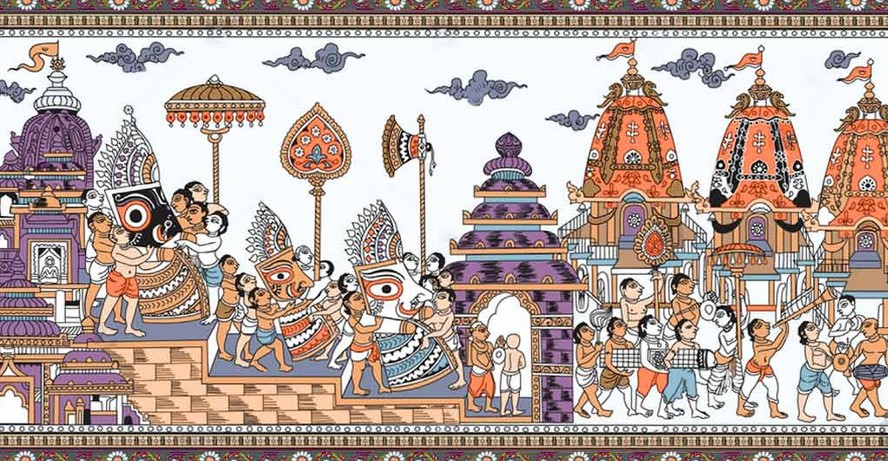
    • About: Rath Yatra is an annual Hindu chariot festival celebrated in Puri, Odisha, in honour of Lord Jagannath, a form of Lord Vishnu.
    • Legend: The festival commemorates the journey of Lord Jagannath, along with his siblings Lord Balabhadra and Devi Subhadra, from the Jagannath Temple to the Gundicha Temple, their birthplace.
    • Occurrence: It is held on the second day of Ashadha Shukla Paksha (June–July), according to the Odia calendar.
    • Procession: The deities are placed in three massive wooden chariots and pulled by devotees along the Grand Road (Bada Danda) for about 3 km.
    • Significance: It is one of the four sacred pilgrimages (Char Dham) in Hinduism and allows non-Hindus to have darshan of the deities, unlike entry to the temple.

    Key Events of the Rath Yatra:

    • Pahandi Bije: The ceremonial procession where the deities are carried from the temple to the chariots.
    • Chhera Panhara: A ritual where the Puri King sweeps the chariots with a golden broom, signifying humility and equality.
    • Three Chariot Pulling: Devotees pull the chariots—Nandighosa (Jagannath), Taladhwaja (Balabhadra), and Darpadalan (Subhadra)—toward Gundicha Temple.
    • Bahuda Yatra: The return journey to the Jagannath Temple, held on the 10th day of Ashadha Shukla Paksha.
    • Poda Pitha Offering: The deities are offered traditional cakes at Mausimaa Temple during their return.
    • Suna Besha: On return, the deities are adorned with gold ornaments on their chariots.
    • Niladri Bije: Final ritual where the deities re-enter the sanctum; marks the end of the Rath Yatra.
    • Rasagola Divas: Devotees offer Rasagola sweets to Goddess Lakshmi to appease her for not being included in the journey.

    Back2Basics: Jagannath Puri Temple

    • The Jagannath Temple in Puri, Odisha, is a major Vaishnavite shrine dedicated to Lord Jagannath, a form of Sri Krishna.
    • The current structure was rebuilt starting in the 10th century by Anantavarman Chodaganga Deva of the Eastern Ganga dynasty.
    • The temple showcases the Oriya style of architecture, known for sculptural richness and graceful forms.
    • It spans over 400,000 sq. ft., enclosed by the 20-foot-high Meghanada Pacheri.
    • An inner wall, called Kurma Bedha, surrounds the main sanctum.
    • Main Structural Sections:
      1. Deula/Vimana/Garba Griha: Sanctum sanctorum housing the deities on the Ratnavedi, built in Rekha Deula style.
      2. Mukhashala: The frontal porch.
      3. Nata Mandir/Jagamohan: The audience or dancing hall.
      4. Bhoga Mandapa: The hall of offerings.


    [UPSC 2009] Mahamastakabhisheka, a great religious event, is associated with and done for who of the following?

    Options: (a) Bahubali * (b) Buddha (c) Mahavir (d) Nataraja


  • Ambubachi Mela at Kamakhya Temple

    Why in the News?

    Pilgrims have begun arriving in Guwahati, Assam, for the Ambubachi Mela, held annually at the Kamakhya Temple, one of the most sacred centres of Tantric Shaktism in India.

    About Ambubachi Mela:

    • Festival Overview: Ambubachi Mela is an annual Hindu fertility festival celebrated at the Kamakhya Temple in Guwahati, Assam.
    • Timing and Season: It is held during the Assamese month of Ahaar (mid-June), coinciding with the monsoon season.
    • Religious Significance: The festival marks the annual menstruation of Goddess Kamakhya symbolising fertility and life-giving power.
    • Ritual Closure: During the festival, the sanctum sanctorum (innermost sacred chamber) of the temple is closed for three days to observe the goddess’s retreat.
    • Ceremonial Reopening: The temple reopens ceremonially on the fourth day, when lakhs of devotees gather for darshan.
    • Pilgrim Footfall: It is considered the largest religious gathering in Northeast India, with pilgrims arriving from across the country.
    • Etymology: The name ‘Ambubachi’ literally means ‘water flowing’ (denoting menstruation and the flow of life).
    • Spiritual Tradition: The practice is rooted in Tantric traditions (esoteric spiritual practices focusing on divine feminine energy).
    • Cultural Observance: During this time, agricultural activities are halted to honour the goddess’s rest and align with nature’s rhythms.

    Notable Features:

    • No Idol Worship: No idol is worshipped; instead, the process of menstruation itself (biological and divine function) is venerated.
    • Sacred Tokens: Devotees receive pieces of red cloth as sacred amulets.
    • Spiritual Discipline: The mela includes ritual abstentions (temporary renunciation of daily activities), devotional silence, and spiritual observance (religious discipline).

    About Kamakhya Temple:

    • Mythology: It is one of the 51 Shakti Peethas (sacred sites where body parts of Goddess Sati are believed to have fallen).
    • Location: It is located on Nilachal Hill beside the Brahmaputra River in Guwahati, Assam.
    • Architectural Style: Architecturally, the temple follows the Nilachala Style (a blend of North Indian Nagara and Mughal Saracenic architecture).
    • Structural Layout: The structure includes 5 chambers:
      • Garbhagriha (sanctuary where the main deity resides),
      • Antarala (vestibule or connecting passage),
      • Jaganmohan (main audience hall),
      • Bhogmandir (ritual chamber where offerings are made), and
      • Natmandir (hall for performances and religious gatherings).
    • Sacred Symbol: Instead of an idol, the temple houses a yoni-shaped stone (symbol of the goddess’s womb and creative energy).
    • Tantric Centre: It is one of the most revered Tantric pilgrimage sites (destinations for practitioners of spiritual and mystical rituals).
    • Cultural Depth: The temple’s rituals and legends have deep mythological (related to ancient stories and beliefs), astronomical, and cultural significance, especially during Ambubachi.


    [UPSC 2017] Consider the following pairs : Traditions Communities

    1. Chaliha Sahib Festival — Sindhis

    2. Nanda Raj Jaat Yatra — Gonds

    3. Wari-Warkari — Santhals

    Which of the pairs given above is/are correctly matched?

    Options: (a) 1 only *(b) 2 and 3 only (c) 1 and 3 only (d) None of the above


  • In news: Prime Ministers Museum and Library 

    Why in the News?

    The 47th Annual General Meeting (AGM) of the Prime Ministers’ Museum and Library (PMML) Society, chaired by the Prime Minister, was recently held.

    About the Prime Ministers’ Museum and Library (PMML)

    • Overview: The PMML, earlier called the Nehru Memorial Museum and Library (NMML), is located at Teen Murti House, just south of Rashtrapati Bhavan in New Delhi.
    • Origin: Built in 1929–30 as the residence of the Commander-in-Chief of British India, it was designed by Robert Tor Russel as part of Lutyens’ Delhi.
    • Nehru’s Residence: After independence, it became the home of Prime Minister Jawaharlal Nehru from 1948 to 1964 and was later dedicated to him following his death.
    • Establishment: The PMML Society was founded on April 1, 1966, while the original museum was inaugurated on November 14, 1964, by President Dr S. Radhakrishnan to commemorate Nehru’s 75th birth anniversary.
    • Renaming in 2023: The name was changed from NMML to PMML to reflect a broader mandate — documenting and honouring all Indian Prime Ministers, not just Nehru.
    • Administrative Structure: PMML is an autonomous institution under the Ministry of Culture, with the Prime Minister of India as the head of the Society.
    • Mission and Scope: The institution promotes advanced research in modern and contemporary Indian history, especially related to Prime Ministers, governance, and the evolution of Indian democracy.
    • Key Institutions: PMML includes:
      • The Pradhanmantri Sangrahalaya (Museum).
      • A world-class library.
      • The Centre for Contemporary Studies.
      • The Nehru Planetarium.