💥Mains Ready By December. Smash Mains & Smash PYQ Admissions Open

Subject: Basic Sciences

  • SpaceX Starship: World’s biggest rocket set for first test flight

    starship

    SpaceX is preparing for the first test flight of Starship, which is the most powerful rocket ever built.

    About SpaceX Starship

    • Starship is a fully reusable spacecraft designed and built by SpaceX with the primary goal of sending humans to the Moon, Mars, and beyond.

    Key objectives

    • SpaceX aims to use Starship to establish a self-sustaining human settlement on Mars.
    • The ultimate goal is to enable humans to become a multi-planetary species.
    • It also aims to make Starship reusable, reducing the cost of spaceflight and bringing down the price to a few million dollars per flight.
    • In the long run, the company aims to achieve full and rapid reusability of the spacecraft.


    Features

    Details

    Design and configuration
    • Made up of two parts: a 50-meter tall spacecraft and a 70-meter tall Super Heavy rocket booster.
    • Spacecraft has six Raptor engines; Super Heavy Booster has 28 Raptor engines.
    • Payload capacity of up to 100 metric tons and features a large heat shield.
    • Interior can be configured for up to 100 passengers or cargo.
    Manoeuvrability
    • Designed to be fully reusable, with vertical take-off and landing on Earth, Moon, and Mars.
    • Can be refuelled in orbit for deeper space travel and for establishing a human settlement on Mars.
    Construction and materials
    • Built using durable and cost-effective stainless steel material.
    • Stainless steel also provides heat protection during re-entry into the Earth’s atmosphere.
    Power and thrust
    • Powered by methane and liquid oxygen fueled Raptor engines.
    • Generates 17 million pounds of thrust more than twice that of the Saturn V rockets used for the Apollo missions.


  • Omicron evolved strategies to evade T Cell Immunity

    t cell

    Central idea: The SARS-CoV-2 virus has the ability to evade CD8 T cells, which are important in reducing the viral load and clearing the infection by detecting and killing infected cells.

    What is the news?

    • A recent study has revealed that the SARS-CoV-2 virus has the ability to modulate MHC I expression in host cells.
    • MHC I is crucial in alerting the immune system to virally infected cells.
    • The virus has evolved multiple strategies to inhibit MHC I expression, which is not seen in the case of the influenza virus.

    What is T Cell Immunity?

    • Like B cells, which produce antibodies, T cells are central players in the immune response to viral infection.
    • For your immune system to fight off any kind of invader, such as a virus, you need a kind of white blood cell called a B cell, which makes antibodies, and a similar-looking white blood cell called a T cell.
    • T cells can play different roles altogether.
    • They can act as “killer cells”, attacking cells which have been infected with a virus or another kind of pathogen, or they can act as “helper cells” by supporting B cells to produce antibodies.

    How do they function?

    • Alongside antibodies, the immune system produces a battalion of T cells that can target viruses.
    • Some of these, known as killer T cells (or CD8+T cells), seek out and destroy cells that are infected with the virus.
    • Others, called helper T cells (or CD4+T cells) are important for various immune functions, including stimulating the production of antibodies and killer T cells.
    • T cells do not prevent infection, because they kick into action only after a virus has infiltrated the body. But they are important for clearing an infection that has already started.
    • In the case of COVID-19, killer T cells could mean the difference between a mild infection and a severe one that requires hospital treatment.


  • What is Magnetoresistance?

    magnet


    Researchers in the UK, led by Nobel laureate Andre Geim, have discovered magnetoresistance in graphene – a single-atom-thick layer of carbon atoms bonded in a honeycomb pattern – that further distinguishes this ‘wonder’ material.

    Graphene’s anomalous Giant Magnetoresistance (GMR)

    • Graphene displayed an anomalous giant magnetoresistance (GMR) at room temperature.
    • GMR is the result of the electrical resistance of a conductor being affected by magnetic fields in adjacent materials.
    • It is used in hard disk drives and magnetoresistive RAM in computers, biosensors, automotive sensors, micro-electromechanical systems, and medical imagers.

    What is GMR?

    • GMR is a phenomenon where the electrical resistance of a conductor is affected by magnetic fields in adjacent materials.
    • Say a conductor is sandwiched between two ferromagnetic materials (commonly, metals attracted to magnets, like iron).
    • When the materials are magnetised in the same direction, the electrical resistance in the conductor is low.
    • When the directions are opposite each other, the resistance increases.

    Significance of the finding

    • The magnetoresistance observed in the graphene-based device was almost 100 times higher than that observed in other known semimetals in this magnetic field range.
    • In the study, the magnetoresistance in monolayer graphene at 27º C held between two layers of boron nitride increased by 110% under a field of 0.1 tesla.
    • To compare, the magnetoresistance in these conditions increases by less than 1% in normal metals.
    • The team attributed this to the presence of a ‘neutral’ plasma and the electrons’ mobility.

    Try this MCQ

    Which of the following best describes magnetoresistance?

    (a) The magnetic resistance of a conductor to electrical current flow

    (b) The phenomenon where the electrical resistance of a conductor is affected by magnetic fields in adjacent materials

    (c) The ability of a conductor to produce a magnetic field when an electrical current is passed through it

    (d) The resistance of a magnet to demagnetization by an external magnetic field


    [wpdiscuz-feedback id=”pez2u7d573″ question=”Please leave a feedback on this” opened=”1″]Post your answers here.[/wpdiscuz-feedback]


  • What is Large Hadron Collider (LHC)?

    hadron

    Central idea: The article provides an overview of the LHC, its construction, how it works, and what it has discovered. It also discusses the future of the LHC, including plans to upgrade it and build a bigger version.

    Large Hadron Collider (LHC)

    • The Large Hadron Collider (LHC) is the world’s largest science experiment built by the European Organisation for Nuclear Research (CERN).
    • It is a collider that smashes two beams of particles in opposite directions and these particles are hadrons.
    • The LHC is on the energy frontier of physics research, conducting experiments with highly energized particles.
    • Currently, the LHC is being warmed up for its third season of operations following upgrades that have made it more sensitive and accurate.

    How does the LHC work?

    • Hadrons are subatomic particles made up of smaller particles, and the LHC typically uses protons.
    • Protons are energized by accelerating them through a narrow circular pipe that is 27 km long.
    • The pipe encircles two D-shaped magnetic fields created by almost 9,600 magnets.
    • Protons are accelerated through the beam pipe by rapidly switching the direction of the magnetic field.
    • Eventually, protons move at 99.999999% of the speed of light, according to the special theory of relativity.

    What happens when particles are smashed?

    • When two antiparallel beams of energized protons collide head-on, the energy at the point of collision is equal to the sum of the energy carried by the two beams.
    • The highest centre-of-mass collision energy the LHC has achieved so far is 13.6 TeV.
    • At the moment of collision, there is chaos, and energy coalesces into different subatomic particles under the guidance of the fundamental forces of nature.
    • Different particles take shape depending on the amount and flavour of energy available.

    What has the LHC found so far?

    • The LHC consists of nine detectors, and they study particle interactions in different ways.
    • The ATLAS and CMS detectors discovered the Higgs boson in 2012 and confirmed their findings in 2013.
    • Using the data from collisions, scientists have tested the predictions of the Standard Model of particle physics, observed exotic particles, and pieced together information about extreme natural conditions.

    What is the LHC’s future?

    • The LHC has not been able to find ‘new physics’ that can explain the nature of dark matter or why gravity is such a weak force.
    • One way forward is to improve the LHC’s luminosity by 10x by 2027 through upgrades.
    • Another idea is to build a bigger and more powerful version of the LHC, based on the hypothesis that it can find ‘new physics’ at even higher energies.
    • Physicists are divided on whether to invest in building a bigger machine or less expensive experiments with guaranteed results.

    B2BASICS

    What is Hadron?

    • Hadron is any member of a class of subatomic particles that are built from quarks and thus react through the agency of the strong force. The hadrons embrace mesons, baryons (e.g., protons, neutrons, and sigma particles), and their many resonances.

    CERN

    • European Organisation for Nuclear Research (CERN) is the world’s largest nuclear and particle physics laboratory.
    • CERN is based in Geneva on the French-Swiss border. It has 23 member states.
    • India in 2016 became an associate member of the CERN. Indian scientists have played a significant role in the ALICE experiment, which is a dedicated experiment for search and study of Quark Gluon Plasma (QGP).

    Try this MCQ

    Which of the following is a subatomic particle made up of smaller particles and is commonly used in the Large Hadron Collider (LHC)?

    (a) Protons

    (b) Electrons

    (c) Neutrons

    (d) Photons


    [wpdiscuz-feedback id=”uv5cuojqwi” question=”Please leave a feedback on this” opened=”1″]Post your answers here.[/wpdiscuz-feedback]


  • Physicists discover new Uranium Isotope

    uranium

    Physicists in Japan have discovered a new isotope of uranium, with atomic number 92 and mass number 241.

    Uranium

    • Uranium is a naturally occurring chemical element with the symbol U and atomic number 92.
    • It is a heavy metal that is radioactive and found in small quantities in rocks and soils worldwide.
    • Uranium has several isotopes, which are atoms that have the same number of protons but different numbers of neutrons.

    Isotopes of Uranium

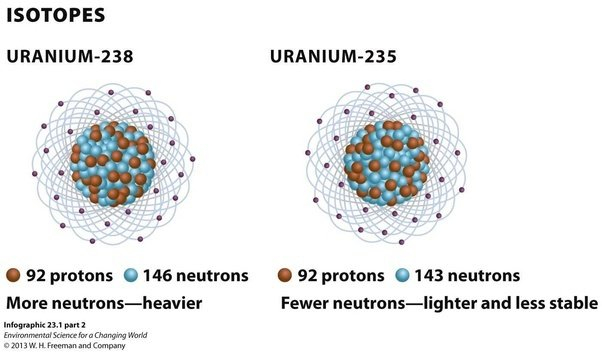
    The most common isotopes of uranium are uranium-238 and uranium-235.

    1. Uranium-238: It is the most abundant isotope of uranium, accounting for over 99% of natural uranium. It has 92 protons and 146 neutrons in its nucleus. It is not fissile, which means it cannot sustain a nuclear chain reaction. However, it is fertile, which means it can absorb neutrons and undergo radioactive decay to produce other isotopes such as plutonium-239, which is fissile.
    2. Uranium-235: It is the second most abundant isotope of uranium, accounting for less than 1% of natural uranium. It has 92 protons and 143 neutrons in its nucleus. Unlike uranium-238, it is fissile, which means it can sustain a nuclear chain reaction. It is used as fuel in nuclear reactors and as the primary material for nuclear weapons.

    How are isotopes created?

    • Isotopes can be created through natural processes or artificial processes in a laboratory.
    • Isotopes are created through natural processes such as radioactive decay, cosmic ray interactions, and nuclear fusion reactions in stars.
    • For example, carbon-14 is created in the Earth’s upper atmosphere when cosmic rays interact with nitrogen atoms.
    • Isotopes can also be created artificially through nuclear reactions.
    • This involves bombarding atoms with particles such as protons, neutrons, or alpha particles, which can change the number of protons and/or neutrons in the nucleus.

    How uranium-241 was found?

    • To find uranium-241, the researchers accelerated uranium-238 nuclei into plutonium-198 nuclei using the KEK Isotope Separation System (KISS).
    • In a process called multinucleon transfer, the two isotopes exchanged protons and neutrons, resulting in nuclear fragments with different isotopes.
    • The researchers identified uranium-241 and measured the mass of its nucleus using time-of-flight mass spectrometry.
    • Theoretical calculations suggest that uranium-241 could have a half-life of 40 minutes.

    Significance of the discovery

    • The discovery is significant because it refines our understanding of nuclear physics, particularly the shapes of large nuclei of heavy elements and how often they occur.
    • This information helps physicists to design models for nuclear power plants and exploding stars.

    Also, what are Magic numbers?

    • There is a particular interest in ‘magic number’ nuclei, which contain a certain number of protons or neutrons that result in a highly stable nucleus.
    • Lead (82 protons) is the heaviest known ‘magic’ nucleus, and physicists have been trying to find the next element with magic numbers.
    • The researchers hope to extend their systematic mass measurements towards many neutron-rich isotopes, at least to neutron number 152, where a new ‘magic number’ is expected.

    Conclusion

    • The discovery of the new neutron-rich uranium isotope is a major breakthrough in nuclear physics, as it provides essential information for understanding the behavior of heavy elements.
    • The researchers’ aim to extend their measurements to other neutron-rich isotopes reflects their commitment to exploring the frontiers of nuclear science and to improve our understanding of the universe.
    • Discovering new magic number nuclei through these measurements could have practical applications in designing safer and more efficient nuclear power plants and understanding the properties of exploding stars.


  • IIT Mandi’s novel catalyst to make Hydrogen more viable fuel

    hydrogen

    Scientists at IIT Mandi have created an innovative carbon-based catalyst that can enhance the efficiency of water electrolysis to generate green hydrogen.

    Water electrolysis and its Challenges

    • Water electrolysis is the process of splitting water molecules into hydrogen and oxygen using electricity inside an electrolyser.
    • However, this process consumes a lot of electrical energy.
    • A well-known solution is to use a catalyst to induce the water molecules to split at a much lower energy.
    • The better catalysts are often based on the metals iridium and ruthenium, which are expensive, in great demand in other sectors, and not consistently stable as the reaction progresses.

    IIT’s breakthrough: Development of Laser Carbon

    • Researchers have developed a porous carbon material containing nitrogen that functions both as a catalyst and as the anode in electrolyser units.
    • This material, called “laser carbon,” was produced by exposing a sheet of a polymer called polyimide to a laser beam, which carbonised the exposed bits, leaving the remainder rich in nitrogen.

    How does laser carbon work?

    • The nitrogen atoms in laser carbon draw electron clouds towards themselves, rendering the nearby carbon atoms to bond with atoms or molecules containing electron pairs.
    • This makes the location of these atoms active sites for the oxygen evolution reaction (OER).
    • OER is a bottleneck in this ideal reaction process because it proceeds slowly, with many intermediate steps, lowering the total reaction efficiency.
    • Laser carbon offers to fix this problem by reducing the OER overpotential, which means the reaction kicks off sooner and proceeds with more vigor.

    Advantages of laser carbon

    Laser carbon has several advantages over other carbon-based catalysts.

    • It is “highly power efficient,” cheaper to produce, has a simpler synthesis technique, and “can be batch-manufactured with a laser.”
    • The manufacturing process is also environment-friendly, as no waste is generated, and there are no wet chemicals that would require disposal.
    • Additionally, it does not require a substrate as it is self-supported in the form of a film, acting as both electrode and electrocatalyst.

    Challenges

    • The catalytic activity of laser carbon may not be as high as that of some metals but is comparable.
    • Further improvements in the fabrication process and use of other polymers may address this challenge.

  • Scientists spot Piezoelectric Effect in Liquids

    peizo

    Central idea: Scientists have recently discovered evidence of the piezoelectric effect in liquids for the first time. This effect has only been observed in solids for the past 143 years. This new finding challenges the theory that describes this effect and opens doors to previously unanticipated applications in electronic and mechanical systems.

    What is Piezoelectric Effect?

    • The piezoelectric effect occurs when a body develops an electric current when it is squeezed.
    • It has been observed in quartz crystals (SiO2), which are used in wristwatches, clocks, and various instruments that convert mechanical stress to a current.

    Recent observation

    • The piezoelectric effect was found in pure 1-butyl-3-methyl imidazolium bis(trifluoromethyl-sulfonyl)imide and 1-hexyl-3-methyl imidazolium bis(trifluoromethylsulfonyl)imide.
    • Both of these liquids are ionic liquids, which means that they are made of ions instead of molecules, and were found at room temperature.

    Why is the effect in liquids surprising?

    • Liquids do not have an organized structure like solids, which is why the piezoelectric effect has only been expected in solids until now.
    • However, the scientists found the effect in pure ionic liquids at room temperature, challenging the current understanding of the effect.
    • The magnitude of the piezoelectric effect in the first liquid was 16 millivolt per newton (mV/N) and in the second, 17 mV/N, in both cases within a margin of 1 mV/N.

    What is the strength of the effect?

    • In the experiment, the scientists found that the strength of the piezoelectric effect in the two ionic liquids they tested was lower than that of quartz by a factor of 10.
    • However, this is still a significant discovery since it opens the door to new applications.

    Possible applications

    • The discovery of the piezoelectric effect in liquids opens the door to previously inaccessible applications that have fewer environmental issues than many currently used piezoelectric materials.
    • Additionally, these liquids displayed the inverse piezoelectric effect, which could be used to control how the liquids bend light passing through them by passing different currents through them, creating lenses with dynamic focusing abilities.


  • What is Biotransformation Technology?

    bio

    Central idea: The article highlights the issue of plastic waste generated by e-commerce giant Amazon and the need for a biotransformation technology that can make plastics biodegradable and its potential applications in reducing plastic waste in various industries.

    Amazon’s Plastic Waste Problem

    • Amazon generated 321 million kilograms (709 million pounds) of plastic from packaging waste in 2021.
    • The amount of plastic waste generated by Amazon in 2021 is enough to circle the Earth over 800 times as air pillows.

    What is Biotransformation Technology?

    • Biotransformation technology is a novel approach to ensure plastics that escape refuse streams are processed efficiently and broken down.
    • The technology was co-developed by Polymateria and the Imperial College in London, UK.
    • Plastics made using this technology are given a pre-programmed time during which the manufactured material looks and feels like conventional plastics without compromising on quality.
    • Once the product expires and is exposed to the external environment, it self-destructs and biotransforms into bioavailable wax, which is then consumed by microorganisms, converting waste into water, CO2, and biomass.
    • The technology is the world’s first that ensures polyolefins fully biodegrade in an open environment without causing any microplastics.

    bio

    Need for Biotransformation Technology

    • India generates 3.5 billion kgs of plastic waste annually, and a third of it comes from packaging waste.
    • In 2019, plastic packaging waste from e-commerce firms was estimated at over a billion kilograms worldwide.
    • Amazon generated nearly 210 million kgs (465 million pounds) of plastic from packaging waste in 2019.
    • Up to 10 million kgs (22.44 million pounds) of Amazon’s plastic packaging ended up in the world’s freshwater and marine ecosystems as pollution in 2019.

    Application of this technology

    • The food packaging and healthcare industries are the two prime sectors that could use this technology to reduce waste.
    • The increase in cost is relatively small compared to conventional plastic which does not contain this technology.
    • Some well-known Indian firms in the food and packaging industries deploy such technologies.
    • Within healthcare and pharma industries, this technology provides biodegradable solutions for non-woven hygiene products like diapers, sanitary napkins, facial pads, etc.

    India’s initiatives to tackle plastic pollution

    • Phased elimination: The Indian government launched a plastic waste management gazette to help tackle the ever-growing plastic pollution caused by single-use plastics. The government imposed a ban on single-use plastics last year to bring a stop to its use in the country.
    • National Dashboard on Elimination of Single-Use Plastic and Plastic Waste Management: It brings all stakeholders together to track the progress made in eliminating single-use plastic and effectively managing such waste.
    • Extended Producer Responsibility (EPR) portal: It helps in improving accountability traceability, and facilitating ease of compliance reporting in relation to EPR obligations of the producers, importers, and brand-owners.
    • Lifecycle monitoring: India has developed a mobile app to report single-use plastics grievances to check the sale, usage, or manufacturing of single-use plastics in their area.

    Alternatives to Reducing Plastic Waste

    • A switch to jute or paper-based packaging could potentially cut down plastic waste.
    • Wooden packaging is yet another alternative, but that will make the packaging bulkier and increase the cost.
    • The alternatives can be made using coir, bagasse, rice and wheat bran, plant and agricultural residue, banana and areca leaves.


    Are you an IAS Worthy Aspirant? Get a reality check with the All India Smash UPSC Scholarship Test

    Get upto 100% Scholarship | 900 Registration till now | Only 100 Slots Left

  • World’s 1st Sand Battery developed in Finland

    sand

    Finland has successfully installed the world’s first sand battery that can store heat from various energy sources for months.

    What is the Sand Battery System?

    • The battery is a massive steel silo, 7 m tall and 4 m wide with 100 tonnes of sand, and was installed in Finland’s Kankaanpaa town in June 2022.
    • It is connected to the town’s centralised heating network that keeps buildings and public water systems warm.
    • The storage system has three main components:
    1. Sand silo,
    2. Electrical air heater, and
    3. Air-to-water heat exchanger

    Working principle

    • For charging the sand silo, air is heated to 600°C in the electrical air heater.
    • The hot air is then circulated inside the silo using a heat-exchange pipe and blowers to raise the temperature of the sand at the silo’s core to 600°C.
    • When the storage enters the discharging stage, the blowers are used to pump air into the pipe inside the sand silo.
    • Once the air reaches 200°C, it is transferred to the air-to-water heat exchanger, where it is used to boil water.
    • It is then sent to the heating network.

    Electricity Requirements and Capacity of the Battery

    • The storage system requires electricity at all times to charge the battery, monitor the temperature during standby, and run the blowers when the battery is used.
    • The installed battery can store 8 megawatt-hours (MWh) of energy and release heat at 0.1 MW, which is enough to provide heating and hot water for about 100 homes and a public swimming pool.

    Advantages of Sand as a Heat Storage Material

    • The Finnish researchers replaced water with sand in the battery system because of its advantages.
    • Sand can be heated up to 600 degrees Celsius (°C), whereas water starts to boil at 100°C.
    • It also has low heat conductivity, which reduces energy loss.

    Importance of Heat Energy

    • Heat accounts for half of the world’s energy use, followed by transport (30 per cent) and electricity (20 per cent), as per the International Energy Agency (IEA).
    • Currently, 80 per cent of the world’s energy comes from dirty fossil fuels.


    Are you an IAS Worthy Aspirant? Get a reality check with the All India Smash UPSC Scholarship Test

    Get upto 100% Scholarship | 900 Registration till now | Only 100 Slots Left

  • What is Generative AI?

    generative ai

    Central idea: Google and Microsoft have added generative AI to their search engines and browsers, as well as to consumer products such as Gmail, Docs, Copilot 365, Teams, Outlook, Word, Excel, and more.

    What is Generative AI?

    • Like other forms of artificial intelligence, generative AI learns how to take actions from past data.
    • It creates brand new content – a text, an image, even computer code – based on that training, instead of simply categorizing or identifying data like other AI.
    • The most famous generative AI application is ChatGPT, a chatbot that Microsoft-backed OpenAI released late last year.
    • The AI powering it is known as a large language model because it takes in a text prompt and from that writes a human-like response.

    Generative AI products offered by Google and Microsoft

    generative ai

    • Google and Microsoft have added generative AI to their search engines and browsers, as well as to consumer products such as Gmail, Docs, Copilot 365, Teams, Outlook, Word, Excel, and more.
    • In Google’s Gmail and Docs, generative AI can help users write documents automatically, such as a welcome email for employees.
    • Copilot 365, a feature of Microsoft 365 apps, can generate spreadsheets on command or even write an entire article on Word, depending on the topic.
    • Both companies are making generative AI platforms and models a part of their cloud offerings, Microsoft Azure and Google Cloud.

    What are Google and Microsoft offering?

    • In Google’s Gmail and Docs, generative AI will help users write documents automatically.
    • For instance, an HR executive can simply ask the AI app to write a welcome email for employees, instead of typing out the document.
    • Similarly, Microsoft has ‘Copilot 365’ for its Microsoft 365 apps, which includes Teams, Outlook, Word and Excel.
    • Here, AI could generate a spreadsheet on command, or even write down an entire article on Word (depending on the topic).
    • Copilot can also match entries on Calendar with emails, and generate quick, helpful pointers that a person should focus on in their meetings.

    How can these developments impact human workforce?

    • The technology is currently not very accurate and often provides incorrect responses, despite being popular.
    • During the initial demonstrations of these products, Google and Microsoft were found to give inaccurate responses.
    • While these products may have utility, they are not yet capable of replacing humans in the workplace.
    • Humans are better suited to check information generated by AI.

    Various challenges posed

    • Bias: The data that is used to train generative AI systems can be biased, leading to biased outputs.
    • Misinformation: Since generative AI systems learn from the internet or training data which itself may have been inaccurate, they could increase the spread of misinformation online.
    • Security: Generative AI systems could be used to create deepfakes or other forms of digital manipulation that could be used to spread disinformation or commit fraud.
    • Ethics: There are ethical concerns around the use of generative AI, particularly when it comes to issues like privacy, accountability, and transparency.
    • Regulation: There is a need for regulatory frameworks to ensure that generative AI is used responsibly and ethically, and that it does not have any negative impacts on society.


    Are you an IAS Worthy Aspirant? Get a reality check with the All India Smash UPSC Scholarship Test

    Get upto 100% Scholarship | 900 Registration till now | Only 100 Slots Left