đŸ’„Join UPSC 2027,2028 Mentorship (July Batch) + XFactor Notes & Microthemes PDF

Subject: Biodiversity

1. Ecology & Ecosystems
2. Indian Biodiversity

  • Species in news: Abortelphusa Namdaphaensis

    A crab specie was recently named after Arunachal Pradesh’s pristine forests on the edge of a small stream in Namdapha Tiger Reserve.

    Try this question from CSP 2020:

    Q.With reference to India’s Biodiversity, Ceylon frogmouth, Coppersmith barbet, Gray-chinned minivet and White-throated redstart are:

    (a) Birds
    (b) Primates
    (c) Reptiles
    (d) Amphibians

    Abortelphusa Namdaphaensis

    • The species, a small freshwater crab species, is a tribute to Namdapha, the largest protected area in the Eastern Himalayan Biodiversity Hotspot and the Abor Hills.
    • It is the first Gecarcinucidae to be found in the Himalayan region. Freshwater crabs are divided into two families/categories: Potamidae and Gecarcinucidae.
    • Both differ in abdomen shape and size. Potamidae species have a broad triangular abdomen, whereas, in Gecarcinucidae, the abdomen is mostly T-shaped.
    • While the Gecarcinucidae is found in the peninsular region, the Western Ghats and the Eastern Ghats, Potamidae are found in the Himalayan region.

    What makes it special?

    • The new species was found in a dry area, despite being a “freshwater” crab.
    • Freshwater crabs use their gills to absorb dissolved oxygen from water, but for food, breeding, and other purposes, they do not need water, and thus roam on the land near water.
    • The only reason it was possible to spot this on land is that the habitat around the water body has been preserved, untouched even.
    • Of the 125 freshwater crabs in India, the north-east accounts for 37. Arunachal Pradesh has 15 and Assam has 21.
    • The discovery highlights the potential of Arunachal Pradesh as one of the richest biodiversity hotspots in the country.

    Back2Basics: Namdapha

    • Namdapha (named a National Park in 1983) is known for its rich biodiversity and believed to be the rare area that harbours four large cats: tigers, snow leopards, clouded leopards and leopards.
    • The Abor Hills, bordered by the Mishmi Hills and Miri Hills, is historically known for the Abor Expedition.
    • It is a punitive expedition against the Abors in the North-Eastern Frontier Agency (which corresponds to parts of present-day Assam and Arunachal Pradesh) from October 1911 to April 1912.
    • The expedition had thrown up a plethora of new floral and faunal species, making it a zoological and botanical expedition as well.
  • Species in news: Madhuca Diplostemon

    A tree species, long believed extinct, has been rediscovered after a gap of more than 180 years from a sacred grove in Kollam district.

    Try this PYQ:

    Q.Consider the following statements:

    1. Biodiversity hotspots are located only in tropical regions.
    2. India has four biodiversity hotspots i.e., Eastern Himalayas, Western Himalayas, Western Ghats and Andaman and the Nicobar Islands.

    Which of the above statements is/ are correct?

    (a) 1 only

    (b) 2 only

    (c) Both 1 and 2

    (d) Neither 1 nor 2

    Madhuca diplostemon

    • Scientists have identified the tree as Madhuca diplostemon (family Sapotaceae), a threatened species of the Western Ghats whose specimen was first collected in 1835.
    • In 1835, Robert Wight, a surgeon-botanist with the East India Company, had collected three specimens of the species.
    • Only one mature tree has been found so far, which makes this remarkable rediscovery extremely valuable from a scientific, environmental and conservation point of view.
    • Since the species is represented only by one specimen in a single locality, it is eligible to be categorised ‘Critically Endangered’ by the IUCN.
  • Species in news: Kalinga Frog

    Indian scientists have reported a first-of-its-kind discovery of morphological phenotypic plasticity (MPP) in the Kalinga cricket frog.

    Try this PYQ:

    Q.Consider the following statements:

    1. Biodiversity hotspots are located only in tropical regions.
    2. India has four biodiversity hotspots i.e., Eastern Himalayas, Western Himalayas, Western Ghats and Andaman and the Nicobar Islands.

    Which of the above statements is/ are correct?

    (a) 1 only

    (b) 2 only

    (c) Both 1 and 2

    (d) Neither 1 nor 2

    Kalinga Frog

    • The Kalinga Frog (Fejervarya Kalinga) was recently identified species which was documented in 2018.
    • The species was encountered several times during field expeditions in the Western Ghats. However, the physical characteristics vary entirely from the known species of Eastern Ghats.
    • However, it has been reported from the central Western Ghats, with the evidence of considerable MPP.
    • It was the only genetic analysis that helped prove that physically different-looking frogs from eastern and western ghats were the same.

    What is MPP?

    • The morphological phenotypic plasticity (MPP) is the ability of an organism to show drastic morphological (physical features) variations in response to natural environmental variations or stimuli.
    • The term “phenotype” refers to the observable physical properties of an organism, which include the organism’s appearance, development, and behaviour.
  • What is Khazan Farming System?

    The Salim Ali Bird Sanctuary in low-lying floodplains of Goa is characterized by an estuarine agricultural system called Khazan farming.

    Try this question from our AWE initiative:

    How far is the Integrated Farming System (IFS) helpful in sustaining agricultural production? (10 Marks)

    Khazan Farming

    • The low-lying floodplains of Goa host an estuarine agricultural system called Khazan farming.
    • This system is a carefully designed topo-hydro-engineered agro-aquacultural ecosystem mainly based on the regulation salinity and tides.

    How does it work?

    • Centuries ago, people in this region reclaimed low-lying brackish coastal floodplains and mangrove forests.
    • They constructed bunds using locally available material to prevent the ingress of saltwater, which killed the halophilic mangroves.
    • To control the flow of tidal waters, they built openings in bunds fitted with one-way gates.
    • These channels would fill in with the oncoming tide and bring with them fish, crab and shrimp, and the gates would automatically shut when the water level was equal on both sides.
    • This prevented the water from overflowing into the fields used to grow paddy and which has a low tolerance to salt.
    • When the tide receded, these gates would open outwards automatically, allowing the water to drain out.
    • During this time, a bag net was set at the gate to catch fish that had entered in earlier.

    Benefits of Khazan

    • Every bit of space was precious and used efficiently — the bunds were used to grow a variety of vegetables.
    • The Khazan system allowed for the farmer and the fisher to harmoniously coexist and was the key to sustaining what is considered Goa’s staple — fish, curry and rice.

    Why is it neglected these days?

    • Today, for various reasons, but primarily due to post-independence agrarian reforms of 1961, these lands largely lie fallow and are in a state of decay.
    • Lack of cultivation and maintenance of the bunds and sluice gates is leading to their breaching and the natural reclamation of these fallow lands by mangroves.
    • Moreover, mangroves are protected by law and it is illegal to cut them.
    • Areas that have these trees growing on them also come under the purview of the coastal regulation zone (CRZ); according to the 2011 notification, the mangrove areas are classified as CRZ I and cannot be developed upon.

    Back2Basics: Salim Ali Bird Sanctuary

    • The Salim Ali Bird Sanctuary is Goa’s smallest protected area — it comprises barely two square kilometres of lush mangrove forests.
    • The sanctuary is located on ChorĂŁo, one of Goa’s estuarine islands in the Mandovi river approximately five kilometres from capital Panaji.
    • The sanctuary and its surrounds are home to marsh crocodiles, smooth-coated otter, the unique glossy-marsh snake that feeds on crabs, mud lobsters, sap-sucking sea slugs, among others.
  • Bats and their Ecological Significance

    The COVID pandemic has magnified our fear of bats, but their conservation is crucial to prevent such events from arising again.

    Try this PYQ from CSP 2014:

    Q.Consider the following:

    1. Bats
    2. Bears
    3. Rodents

    The phenomenon of hibernation can be observed in which of the above kinds of animals?

    (a) 1 and 2 only

    (b) 2 only

    (c) 1, 2 and 3

    (d) Hibernation cannot be observed in any of the above

    Bats

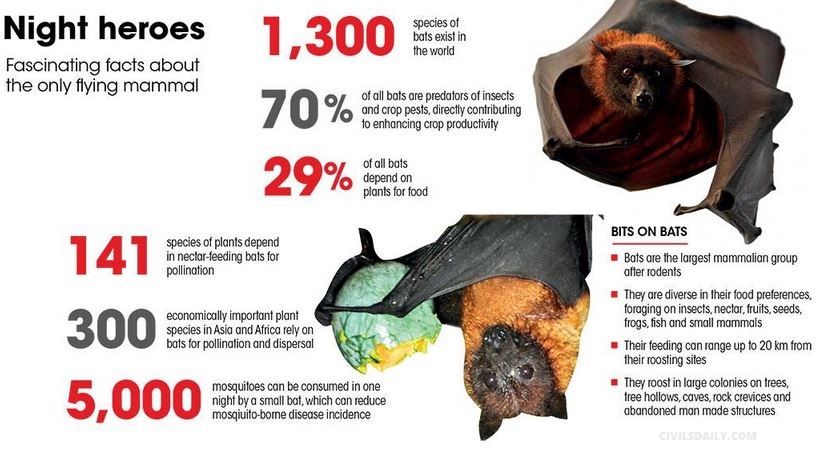
    • Bats are the largest mammalian group after rodents, with over 1,300 species making up a quarter of all mammals.
    • They occur on all continents except Antarctica and are particularly diverse in South Asia, with 114 species of insect-eating bats and 14 fruit bats, also known as “flying foxes”, occurring in India.
    • They roost in large colonies on trees, tree hollows, caves, rock crevices and abandoned manmade structures.
    • They play a unique role in maintaining ecosystem structure, making a singular contribution to our food production, economy and well-being.
    • They are the only mammals capable of true flight and have a unique sonar-based echolocation mechanism to capture prey at night.

    Their significance

    1) Seed dispersal

    • About 29 per cent of all bats depend upon plants for food.
    • The diet of fruit-eating bats consists largely of flowers and fruits such as mangoes, bananas, guavas, custard apples, figs, tamarind and many species of forest trees.
    • Therefore, bats play a vital role in seed dispersal and forest regeneration. Studies have shown that seedlings raised from bat dispersed seeds show higher germination and vigorous growth.

    2) Pollination

    • Studies have found that bats play a vital role in pollination, mainly of large-flowered plants, and in crop protection.
    • Fruit bats (Megachiroptera) being large, require big flowers with copious amounts of nectar.
    • Bats are major pollinators for many species of mangroves which are important for coastal ecosystems and local livelihoods.

    3) Production boost

    • Insects are a major problem for agriculture, destroying up to 26 per cent of the annual production of crops worldwide every year, roughly amounting to $470 billion.
    • Insectivorous bats, which make up 70 per cent of all bat species, are voracious predators of nocturnal insects and crop pests.
    • Some large insectivorous bats are also reported to feed on small rodents. Thus they contribute directly to enhancing the crop productivity with tremendous economic impact.

    4) Soil fertility

    • Bats contribute significantly to soil fertility and nutrient distribution due to their large numbers, high mobility and varied habitats for roosting and foraging.
    • Bat droppings provide organic input to soil and facilitate nutrient transfer, contributing to soil fertility and agricultural productivity. The practice is harmless vis-a-vis human health.

    5) Health benefits

    • Several species of bats, in fact, contribute to human health by reducing populations of mosquitoes and other insect vectors that spread malaria, dengue, chikungunya and other diseases.
    • It is reported that a small bat may feed on almost 5,000 mosquitoes each and every feeding night far more than other measures adopted to eliminate them.

    Their conservation

    • According to the IUCN, about 5 per cent of bats are categorised as endangered and another 11 per cent are data deficient.
    • Further, some species of fruit bats are categorised under Schedule 5 of the Wildlife (Protection) Act, 1973, along with other vermin species like rats, making it difficult to legally conserve them.

    Conclusion

    • The pandemic has demonstrated that conservation of biodiversity and natural habitats is absolutely essential to prevent such events from arising again.
    • Understanding the role played by bats helps us appreciate how their absence can greatly affect all facets of our lives.
    • Viruses don’t jump directly from bats or other animals to humans.
    • Rather, illicit trade in wildlife, high levels of hunting for the consumption of wild meat, and destruction of natural habitats are responsible for this.
  • Species in news: Cestrum nocturnum

    Nilgiris forest officials are restoring native Shola habitats in places overrun by the invasive species ‘Cestrum nocturnum’.

    Try this PYQ from CSP 2018:

    Q.Why is a plant called Prosopis juliflora often mentioned in the news?

    (a) Its extract is widely used in cosmetics.

    (b) It tends to reduce the biodiversity in the area in which it grows

    (c) Its extract is used in the pesticides.

    (d) None of the above

    Cestrum nocturnum

    • Cestrum nocturnum is commonly known by the names night-blooming jasmine and raatrani.
    • It is native to the West Indies but naturalized in South Asia.
    • Its spread is a threat to all Shola and grassland habitats as it does not allow any native flora to thrive.
    • The plants unless completely removed with their roots, keep sprouting and keep taking over Shola and native grasslands.
  • Species in news: Golden Birdwing

    A Himalayan butterfly named golden birdwing is now India’s largest recorded butterfly.

    Try this MCQ:

    Q.The Himalayan Golden Birdwing recently seen in news is a:

    a)Biggest butterfly

    b)Smallest avian specie

    c)Biggest freshwater fish

    d)Honeybee

    Golden Birdwing

    • A Himalayan butterfly named golden birdwing is now India’s largest, a record the southern birdwing held for 88 years.
    • The male golden birdwing is much smaller at 106 mm.
    • With a wingspan of 194 mm, the female of the species is marginally larger than the southern birdwing (190 mm) that Brigadier William Harry Evans, a British military officer and lepidopterist, recorded in 1932.
    • It was an individual of the southern birdwing which was then treated as a subspecies of the common birdwing.

    Other butterflies in news

    • The Malabar Banded Peacock or the Buddha Mayoori which was recently declared the ‘State Butterfly’ of Kerala will have a dedicated butterfly park in Kochi.
    • Tamil Nadu has also recently declared Tamil Yeoman (Cirrochroa Thais)as its state butterfly to symbolise its rich natural and cultural heritage, in a move aimed at boosting the conservation efforts of the attractive insects.
    • Other states to have state butterflies are Maharashtra (Blue Mormon), Uttarakhand (Common peacock), Karnataka (Southern birdwings).
  • Species in news: Assam keelback snake

    More than a century after it was first seen, the Assam keelback — a snake species endemic to the region — was rediscovered in 2018 at the Poba Reserve Forest (RF) by a team from Wildlife Institute of India (WII).

    Try this question from CSP 2018:

    Q.In which one of the following State Pakhui Wildlife Sanctuary is located?

    (a) Arunachal Pradesh (b) Manipur (c) Meghalaya (d) Nagaland

    Assam Keelback Snake

    • The species is small — about 60 cm long, brownish, with a patterned belly.
    • This particular keelback does not belong to the generalized keelback snake of India but is rather a unique genus (Herpetoreas).
    • It was discovered 129 years ago by Samuel Edward Peel, a British tea planter based in Upper Assam.
    • The snake’s ‘lost’ status has a lot to do with the habitat it occupies — in this case, a lowland evergreen forest.
    • These forests have been selectively degraded during the last 100 years: tea plantations have been made, selective logging has taken place, and many other activities such as oil exploration and coal mining.

    Is the snake under threat?

    • Most snakes and other reptiles are categorised as ‘data deficient’ in the IUCN list.
    • There is practically no information available about it and it is difficult to determine its status.
  • Species in news: Globba Andersonii Plant

    A team of researchers have “rediscovered” a rare species called Globba andersonii from the Sikkim Himalayas near the Teesta River valley region after a gap of nearly 136 years.

    Try this question from CSP 2016:

    Q.With reference to ‘Red Sanders’, sometimes seen in the news, consider the following statements:

    1. It is a tree species found in a part of South India.
    2. It is one of the most important trees in the tropical rain forest areas of South India.

    Which of the above statements is/are correct?

    (a) 1 only

    (b) 2 only

    (c) Both 1 and 2

    (d) Neither 1 nor 2

    Globba Andersonii

    IUCN status: Critically Endangered

    • Globba andersonii is characterised by white ïŹ‚owers, non-appendaged anthers (the part of a stamen that contains the pollen) and a “yellowish lip”.
    • The plant, known commonly as ‘dancing ladies’ or ‘swan flowers’ was thought to have been extinct until its “re-collection”, for the first time since 1875.
    • The earliest records of the collection of this plant were dated between the period 1862-70 when it was collected by Scottish botanist Thomas Anderson from Sikkim and Darjeeling.
    • Then, in 1875, the British botanist Sir George King, had collected this taxon from the Sikkim Himalayas.