💥Join UPSC 2027,2028 Mentorship (July Batch) + XFactor Notes & Microthemes PDF

Subject: Conservation & Mitigation

1. Conservation Progs.
2. Worldwide initiatives
3. Mitigation Strategies
4. Conventions and Protocols

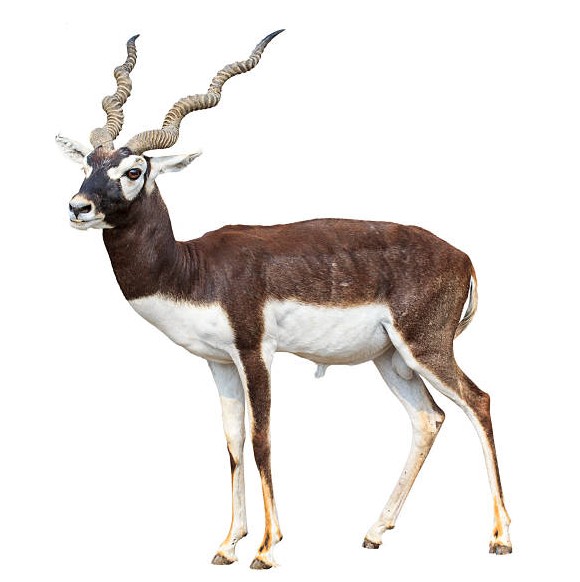
  • Blackbuck Re-Introduction in Chhattisgarh

    Why in the News?

    Chhattisgarh launched a five-year Blackbuck Reintroduction Plan (2021–2026) at Barnawapara Wildlife Sanctuary to revive the species after 50 years of local extinction.

    Blackbucks have vanished from Chhattisgarh by the 1970s, primarily due to poaching, habitat loss, and grassland encroachment.

    About the Blackbuck (Antilope cervicapra):

    • Habitat: Native to India and Nepal, commonly found in Rajasthan, Gujarat, Madhya Pradesh, Odisha, and Tamil Nadu.
    • Physical Traits: Medium-sized antelope with males having spiral horns and black coats; known as the fastest land mammal in India.
    • Behaviour: Diurnal grazer that thrives in open plains and grasslands.
    • Ecological Role: Serves as an indicator species for grassland ecosystem health.
    • State Animal: Designated as the State Animal of Punjab, Haryana, and Andhra Pradesh.
    • Cultural Symbolism: Represents purity in Hinduism and good fortune in Buddhism.
    • Legal Protection:
      • Wildlife (Protection) Act, 1972: Schedule I.
      • IUCN Red List: Least Concern.
      • CITES: Appendix III.
    [UPSC 2017] In India, if a species of tortoise is declared protected under Schedule I of the Wildlife (Protection) Act, 1972, what does it imply?

    Options: (a) It enjoys the same level of protection as the tiger. *

    (b) It no longer exists in the wild, a few individuals are under captive protection; and how it is impossible to prevent its extinction.

    (c) It is endemic to a particular region of India.

    (d) Both (b) and (c) stated above are correct in this context.


  • Carbon Di-oxide Levels in 2024 set new records: WMO

    Why in the News?

    The World Meteorological Organization (WMO) reported that carbon dioxide (CO₂) concentrations reached a record 423.9 ppm in 2024, marking the highest annual increase (3.5 ppm) since global measurements began in 1957.

    About WMO Report 2025:

    • Publisher: Issued by the World Meteorological Organization (WMO), the UN specialised agency for weather, climate, and water systems.
    • Document: The 2025 Greenhouse Gas Bulletin presents global atmospheric data for carbon dioxide (CO), methane (CH), and nitrous oxide (NO).
    • Global Record: Confirms 2024 as the warmest year ever, with average temperatures 1.55 °C above pre-industrial (1850–1900) levels.
    • Context & Timing: Released ahead of COP30 (Belém, Brazil) to guide mitigation policies and national climate commitments.
    • Key Warning: Notes a record surge in CO and the weakening of natural carbon sinks such as oceans and forests.

    Key Highlights about Greenhouse Gases:

    • Carbon Dioxide (CO): Global mean reached 423.9 ppm in 2024, up 3.5 ppm from 2023, the largest annual rise since 1957. Concentrations are 152 % above pre-industrial (278.3 ppm); land and ocean sinks are declining in efficiency.
    • Methane (CH): Climbed to 1,942 ppb, 166 % above pre-industrial levels; ~60 % of emissions stem from livestock, fossil fuels, and rice cultivation.
    • Nitrous Oxide (NO): Reached 338 ppb, 25 % higher than pre-industrial; emitted mainly from fertiliser use, biomass burning, and industry; the third major long-lived GHG.
    • Drivers of Increase: Human emissions, El Niño-linked droughts and wildfires, and reduced oceanic absorption, especially from the Amazon and southern Africa in 2024.

    Implications and Risks:

    • Warming Acceleration: CO₂ causes ~66 % of total warming and 79 % over the last decade; persistent buildup locks in long-term temperature rise.
    • Weakening Carbon Sinks: Warmer seas and drought-stricken lands absorb less CO₂, reinforcing a feedback loop of accumulation.
    • Extreme Events: Intensified heatwaves, floods, droughts, and wildfires signal proximity to irreversible tipping points like ice-sheet loss and coral die-off.
    [UPSC 2012] The increasing amount of carbon dioxide in the air is slowly raising the temperature of the atmosphere, because it absorbs

    Options: (a) the water vapour of the air and retains its heat.

    (b) the UV part of the solar radiation.

    (c) all the solar radiations.

    (d) the infrared part of the solar radiation. *


  • CG HC upholds cancellation of Forest Rights of Villagers

    Why in the News?

    The Chhattisgarh High Court has dismissed a petition challenging the cancellation of Community Forest Rights (CFRs) granted to villagers of Ghatbarra in the Hasdeo Arand forest, an area where Adani Enterprises–linked coal mines operate.

    Background of the Case:

    • Dispute Origin: The District-Level Committee (DLC) revoked CFR titles in 2016, citing that the area had already been diverted for mining in 2012 with MoEF clearance.
    • Petitioners’ Claim: The Hasdeo Arand Bachao Sangharsh Samiti argued that the Forest Rights Act (FRA), 2006 provides no revocation clause and that villagers were not given a fair hearing before cancellation.
    • Court’s View: The High Court upheld the State’s decision, calling the 2013 CFR grant a “mistake” void ab initio, and legally cancellable.

    Key Judicial Findings:

    • Legality of Revocation: FRA lacks explicit revocation provision, but erroneous grants may be rectified; hence cancellation was valid.
    • Prior Approvals Prevail: 2012 MoEFCC mining clearance overrode subsequent CFR grants.
    • State Mineral Ownership: FRA does not affect the State’s control over minerals beneath forest land.
    • Locus Standi: Petitioners lacked standing after the Forest Rights Committee withdrew; no authorised village representation remained.
    • Suppression of Facts: Petitioners had earlier challenged land acquisition (case dismissed in 2022) but failed to disclose it.

    Significance:

    This ruling marks the first judicial interpretation of whether forest rights granted under the Forest Rights Act, 2006 (FRA) can be revoked or cancelled, despite the Act containing no explicit provision for cancellation.

    About the Forest Rights Act (FRA), 2006:

    • Overview: The Scheduled Tribes and Other Traditional Forest Dwellers (Recognition of Forest Rights) Act, 2006, commonly called the Forest Rights Act (FRA).
    • Purpose: Enacted to correct historical injustices faced by forest-dwelling communities deprived of traditional land and resource rights during colonial rule.
    • Core Objective: Ensures tenurial security, livelihood protection, and ecological stewardship of forest-dependent populations.
    • Beneficiaries: Covers Scheduled Tribes (STs) and Other Traditional Forest Dwellers (OTFDs) who have lived in and depended on forests for generations.
    • Scope: Recognises both individual and collective rights over forest land and produce, extending to cultivation, habitation, and minor forest produce use.
    • Governance Principle: Empowers Gram Sabhas as the central authority for recognising and managing forest rights, reinforcing local autonomy.
    • Integration Goal: Aligns forest governance with tribal self-rule, complementing the Panchayats (Extension to Scheduled Areas) Act, 1996 (PESA).

    Key Features of the FRA:

    • Individual & Community Rights: Legal recognition for occupation, cultivation, residence, and use/sale of minor forest produce.
    • Community Forest Resource (CFR) Rights: Grants Gram Sabhas control to protect, regenerate, and manage community forests.
    • Habitat Rights: Protects Particularly Vulnerable Tribal Groups (PVTGs) and pre-agricultural forest communities.
    • Governance Structure: Multi-level verification, Gram Sabha → Sub-Divisional Committee → District-Level Committee, for rights adjudication.
    • Development Provisions: Allows limited diversion of forest land for public utilities with Gram Sabha consent.
    • Eviction Safeguard: No eviction until claims are fully processed and rights recognised.
    • Decentralised Oversight: Empowers Gram Sabha as the final decision-making authority on forest rights and management.
    • Legal Integration: Reinforces PESA’s participatory governance and community-led conservation in Scheduled Areas.
    [UPSC 2021] At the national level, which ministry is the nodal agency to ensure effective implementation of the Scheduled Tribes and Other Traditional Forest Dwellers (Recognition of Forest Rights) Act, 2006?

    Options: (a) Ministry of Environment, Forest and Climate Change
    (b) Ministry of Panchayati Raj
    (c) Ministry of Rural Development
    (d) Ministry of Tribal Affairs*


  • Sustainable Aquaculture in Mangrove Ecosystems (SAIME) Initiative

    Why in the News?

    The SAIME Initiative, developed by the Nature Environment and Wildlife Society (NEWS) in the Sundarbans of West Bengal, has been conferred Global Technical Recognition by the Food and Agriculture Organization (FAO) of the United Nations.

    What is SAIME Initiative?

    • Concept: A multi-stakeholder partnership model integrating shrimp aquaculture with mangrove restoration in the Sundarbans.
    • Implementing Agencies: Developed by the Nature Environment and Wildlife Society (NEWS) with support from the Global Nature Fund (Germany), Naturland, and Bangladesh Environment & Development Society (BEDS).
    • Purpose: Promotes climate-adaptive, conservation-linked livelihoods balancing ecological health with local economic growth.
    • Implementation: Covers 29.84 hectares with 42 fish farmers, achieving 100% rise in net profits through low-input, eco-friendly methods.
    • Target Group: Focuses on climate-vulnerable coastal communities, encouraging chemical-free shrimp farming to build coastal resilience.

    Core Features and Approach:

    • Ecosystem Integration: Maintains 5–30% mangrove cover within aquaculture ponds, directly linking productivity with ecosystem restoration.
    • Community Participation: Adopts a bottom-up co-management model, involving local farmers in planning, monitoring, and benefit-sharing.
    • Sustainable Practices: Utilises mangrove litter as shrimp feed, cutting chemical dependence and improving natural nutrient cycles.
    • Climate Resilience: Mitigates cyclones, salinity intrusion, and erosion, functioning as a nature-based adaptation system.
    • Economic Efficiency: Promotes low-input, high-yield aquaculture, enhancing smallholder profitability and resource efficiency.
    • Environmental Benefits: Supports carbon sequestration, biodiversity conservation, and blue carbon economy objectives.
    • Global Alignment: Advances SDG-13 (Climate Action), SDG-14 (Life Below Water), and SDG-15 (Life on Land) through integrated coastal sustainability.

    About the Sundarbans:

    Sustainable Aquaculture in Mangrove Ecosystems (SAIME) Initiative

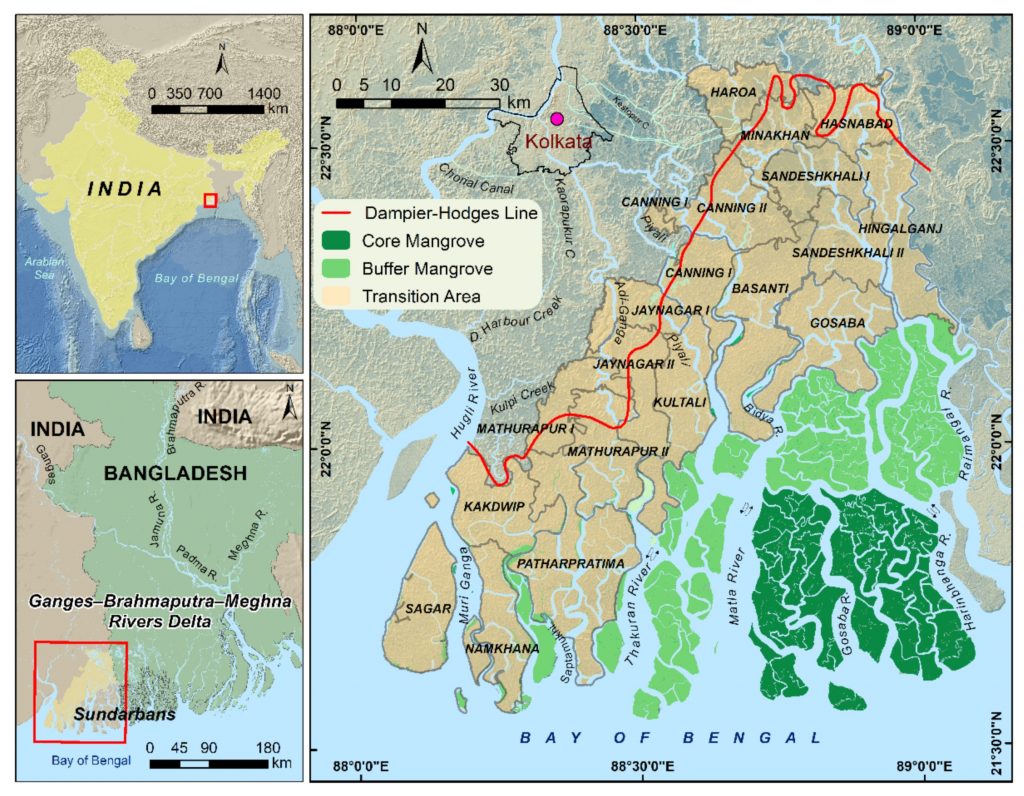
    • Location: Situated in the South and North 24-Parganas districts of West Bengal, at the southern tip of the Gangetic Delta, where the Ganga, Brahmaputra, and Meghna rivers meet the Bay of Bengal.
    • Area: Currently spans 2,585.89 sq km, with an expansion proposal to 3,629.57 sq km, making it the largest mangrove forest in the world.
    • Status: Designated as a Tiger Reserve, National Park, Biosphere Reserve, and a UNESCO World Heritage Site (since 1987).
    • Topography: Characterised by a dense network of tidal creeks, estuaries, and 105 mangrove-covered islands, influenced by daily tidal inundation.
    • Flora and Fauna:
      • Flora: Dominated by Avicennia, Rhizophora, Sonneratia, and Heritiera species.
      • Fauna: Includes Royal Bengal Tiger, Fishing Cat, Estuarine Crocodile, Irrawaddy Dolphin, King Cobra, and several endangered bird species.
    • Boundaries:
      • East: Bangladesh border (Raimangal & Harinbhanga rivers)
      • South: Bay of Bengal
      • North/West: Matla, Bidya, and Gomdi rivers
    • Ecological Importance: Acts as a natural shield against cyclones and tsunamis, a carbon-rich ecosystem, and a vital nursery ground for fisheries — forming the ecological heart of India’s blue economy and coastal resilience framework.


    [UPSC 2023] Which one of the following is the best example of repeated falls in sea level, giving rise to present-day extensive marshland?

    Options: (a) Bhitarkanika Mangroves

    (b) Marakkanam Salt Pans

    (c) Naupada Swamp

    (d) Rann of Kutch*


  • IUCN Redlist Update of Indian Species

    Why in the News?

    In the latest State of India’s Birds (SoIB) 2025 report and IUCN assessment, four bird species dependent on these ecosystems have been uplisted, reflecting alarming habitat loss and population decline.

    Bird Species Uplisted by IUCN:

    1. Indian Courser (Cursorius coromandelicus):
      • Endemic to the Indian Subcontinent.
      • Uplisted from Least Concern → Near Threatened due to loss of grasslands and fallow land.
    2. Indian Roller (Coracias benghalensis): Uplisted to Near Threatened; impacted by habitat conversion and electrocution from power lines.
    3. Rufous-tailed Lark (Ammomanes phoenicura): Uplisted to Near Threatened; declining due to intensive agriculture and land-use change.
    4. Long-billed Grasshopper-Warbler (Locustella major): Uplisted to Endangered; severely impacted by loss of reedbeds and open scrub habitat.

    About State of India’s Birds (SoIB) Assessment:

    • Overview: SoIB is conducted by the State of India’s Birds Partnership, a consortium of 13 government and non-government institutions, including BNHS, WII, ZSI, SACON, WTI, WWF-India, ATREE, NCF, FES, Wetlands International – South Asia, NCBS, and NBA.
    • Coverage: Of 1,360 bird species assessed globally, 12 species were from India.
    • Findings:
      • 8 species downlisted (showing improved conservation trends).
      • 4 species uplisted, highlighting heightened risk of extinction.
    • The report underscores the fragility of India’s open-country habitats, which support a unique but shrinking avifaunal diversity.
  • Graded Response Action Plan (GRAP)

    Why in the News?

    The Commission for Air Quality Management (CAQM) has invoked Stage I of the Graded Response Action Plan (GRAP) across the Delhi–NCR as air quality slipped into the ‘poor’ category (AQI 211) after more than three months.

    What is Air Quality Index (AQI)?

    • Purpose: Quantifies pollution levels and health impact using major pollutants — PM₂․₅, PM₁₀, SO₂, NO₂, CO, O₃, NH₃, Pb.
    • Scale:
      1. 0–50 = Good
      2. 51–100 = Satisfactory
      3. 101–200 = Moderate
      4. 201–300 = Poor
      5. 301–400 = Very Poor
      6. 401–450 = Severe
    • >450 = Severe Plus
    • Interpretation: Higher AQI ⇒ greater exposure risk, particularly for children, elderly, and respiratory patients.

    About Graded Response Action Plan (GRAP):

    • Objective: To ensure anticipatory, graded, and region-wide responses that reduce PM₂․₅ and PM₁₀ concentrations, controlling emissions from vehicles, dust, and industries.
    • Coverage: Applies across Delhi, Haryana, Uttar Pradesh, Rajasthan, and other NCR districts, ensuring uniform regional implementation.
    • Legal Mandate: Issued under Section 5 of the Environment (Protection) Act, 1986, binding on all NCR states and agencies.
    • Genesis: Approved by the Supreme Court in 2016 (M.C. Mehta vs. Union of India) and notified in Jan 2017 by MoEFCC under the Environment (Protection) Act, 1986.
    • Implementation: Initially enforced by EPCA (till 2020); now implemented by the Commission for Air Quality Management (CAQM) established via ordinance in Oct 2020.
    • Functioning: CAQM works with CPCB, IMD, and IITM Pune, which provide forecast-based modelling for pre-emptive action.
    • Key Stages of Action:
      1. Stage I (Poor: 201–300): Road sweeping, water sprinkling, dust control at sites, solid-waste removal, old-vehicle enforcement.
      2. Stage II (Very Poor: 301–400): Hotspot regulation, DG set restrictions, enhanced public transport.
      3. Stage III (Severe: 401–450): Ban on BS-III petrol & BS-IV diesel cars, construction halt, school closures.
      4. Stage IV (Severe+ >450): Complete construction ban, truck entry restriction (essentials exempted), curbs on non-essential vehicles.
    [UPSC 2024] According to the Environmental Protection Agency (EPA), which one of the following is the largest source of sulphur dioxide emissions?

    Options: (a) Locomotives using fossil fuels

    (b) Ships using fossil fuels

    (c) Extraction of metals from ores

    (d) Power plants using fossil fuels*


  • Snow Leopards are the world’s least genetically diverse Big Cat

    Why in the News?

    A new Stanford University-led study has revealed that the Snow Leopard has the lowest genetic diversity among all big cats, even lower than the Cheetah.

    Snow Leopards are the world’s least genetically diverse Big Cat

    About Snow Leopard:

    • Overview: Also called the “ghost of the mountains”; Belongs to the genus Panthera but genetically distinct from tigers and leopards, with unique adaptations for alpine life.
    • Physical Features: Thick pale-gray fur with rosettes, powerful hind limbs, and a long, muscular tail that aids balance and warmth.
    • Habitat: Found at altitudes between 3,000–5,500 metres, thriving in rugged, snow-covered mountain ranges and alpine meadows.
    • Geographical Distribution:
      • In India: Present in Ladakh, Himachal Pradesh, Uttarakhand, Sikkim, Arunachal Pradesh, and parts of Jammu & Kashmir.
      • Globally: Distributed across Central and South Asian mountain systems, including the Himalayas, Pamirs, and Tien Shan.
    • Population Status:
      • Global estimate: 4,500–7,500 individuals.
      • India: Approximately 718 individuals, representing 10–15% of the global total.
    • Conservation Status:
      • IUCN Red List: Vulnerable
      • CITES: Appendix I
      • Wildlife (Protection) Act, 1972 (India): Schedule I
    • National Conservation Measures:
      • Project Snow Leopard (2009): Integrates community participation in Himalayan conservation.
      • SECURE Himalaya Project (GEF–UNDP): Focuses on sustainable ecosystem management.
      • Himalaya Sanrakshak (2020): Enlists local guardians for high-altitude habitats.
      • National Protocol on Population Assessment (2019):  Ensures standardized monitoring.

    Ecological Significance:

    • Apex Predator Role: Serves as the top carnivore in the Himalayan and Central Asian alpine ecosystems, maintaining the balance between herbivores like blue sheep, ibex, and argali.
    • Indicator of Ecosystem Health: Its presence reflects ecosystem integrity, as it thrives only in undisturbed, well-connected, prey-rich habitats.
    • Climate Regulation: Snow leopard landscapes, glaciers, permafrost zones, and alpine grasslands, act as major carbon sinks and regulate water flows to nearly two billion people across Asia.
    • Biodiversity Link: By controlling herbivore populations, it prevents overgrazing, thus preserving alpine vegetation and soil stability.
    • Cultural and Economic Value: Revered in Himalayan folklore and central to eco-tourism-based livelihoods, symbolizing coexistence between humans and nature.
    • Transboundary Importance: Its habitat spans across 12 range countries, making it a flagship species for international cooperation under the Global Snow Leopard and Ecosystem Protection Programme (GSLEP).
    [UPSC 2012] Consider the following:

    1. Black-necked crane 2. Cheetah 3. Flying squirrel 4. Snow leopard

    Which of the above are naturally found in India? Options: (a) 1, 2 and 3 only (b) 1, 3 and 4 only* (c) 2 and 4 only (d) 1, 2, 3 and 4


  • Greenhouse Gas Emission Intensity (GEI) Target Rules, 2025

    Why in the News?

    The Centre has notified the first legally binding Greenhouse Gas Emission Intensity (GEI) Target Rules, 2025 for four high-emission sectors:  aluminium, cement, chlor-alkali, and pulp & paper.

    This marks a critical step in operationalising the Carbon Credit Trading Scheme (CCTS), 2023.

    Back2Basics: Greenhouse Gas Emission Intensity (GEI)

    • Overview: GEI is the amount of GHGs emitted per unit of product output or economic activity;  for example, the emissions released in producing one tonne of cement, aluminium, or steel.
    • Unit of Measurement: Expressed in tonnes of carbon dioxide equivalent (tCOe) per unit of product.
    • Composition:
      • Primary gases: Carbon dioxide (CO₂), Methane (CH₄), Nitrous oxide (N₂O).
      • Synthetic gases: Hydrofluorocarbons (HFCs), Perfluorocarbons (PFCs), Sulphur hexafluoride (SF₆).
    • Purpose: GEI helps measure the efficiency of industrial production in terms of emissions.
    • Policy Significance: Reducing GEI aligns industrial operations with national and global climate commitments, particularly under the Paris Agreement (2015), where India has pledged to cut its emissions intensity of GDP by 45% by 2030 (from 2005 levels).

    About Greenhouse Gas Emission Intensity (GEI) Target Rules, 2025:

    • Notification: Issued by the MoEFCC on October 8, 2025, these are India’s first legally binding emission intensity targets for industries.
    • Objective: To limit greenhouse gas emissions per unit of product output in high-emission sectors, thereby promoting low-carbon industrial growth and aligning with India’s Paris Agreement commitment to reduce emission intensity of GDP by 45% by 2030 (from 2005 levels).
    • Coverage: Applies to 282 industrial units across four sectors– cement (186 units), aluminium (13), chlor-alkali (30), and pulp & paper (53).
    • Compliance Period: 2025–26 and 2026–27; emission limits expressed in tCOe (tonnes of CO equivalent) per unit of product.
    • Mechanism:
      • Units achieving targets earn carbon credits (certified by the Bureau of Energy Efficiency).
      • Non-compliant units must buy credits or face environmental compensation under CPCB oversight.
    • Purpose: To operationalise India’s domestic carbon market, encourage technology upgrades, and institutionalise market-based climate compliance.
    • Outcome: Marks transition from voluntary energy-efficiency drives (PAT Scheme) to a legally enforceable carbon-intensity regime, integrating emission monitoring, trading, and compliance.

    What is the Carbon Credit Trading Scheme (CCTS), 2023?

    • Launched by: Ministry of Power in 2023 to establish a domestic carbon trading market under India’s Energy Conservation Act framework.
    • Objective: To create a structured mechanism for generating, certifying, and trading carbon credits earned through verified emission reductions.
    • Administered by: Bureau of Energy Efficiency (BEE), which issues Carbon Credit Certificates (CCC) to compliant industries.
    • Framework:
      • Industries meeting or exceeding GEI targets receive tradable credits.
      • Entities failing to meet targets must purchase credits to offset excess emissions.
      • Credits are traded on the Indian Carbon Market (ICM) platform.
    • Purpose: To make emission reduction economically incentivised, transforming carbon from a cost burden into a market asset.
    • Global Parallel: Similar to the EU Emissions Trading System (2005) and China’s National Carbon Market (2021).
    • Significance: Integrates energy efficiency, emission control, and fiscal instruments to drive India’s net-zero transition through a market-based, transparent, and measurable approach.
    [UPSC 2025] Consider the following statements:

    I. Carbon dioxide (CO₂) emissions in India are less than 0.5 t CO₂/capita.

    II. In terms of CO₂ emissions from fuel combustion, India ranks second in Asia-Pacific region.

    III. Electricity and heat producers are the largest sources of CO₂ emissions in India.

    Which of the statements given above is/are correct?

    Options:

    (a) I and III only (b) II only (c) II and III only * (d) I, II and III


  • Southeast Asia’s Coral Cryobank Initiative

    Why in the News?

    The Philippines is establishing Southeast Asia’s first Coral Larvae Cryobank at the Coral Triangle to preserve and restore coral species using advanced cryogenic techniques.

    What is the Coral Triangle?

    • Extent: A 5.7 million sq km marine zone covering Indonesia, Malaysia, Papua New Guinea, the Philippines, Solomon Islands, and Timor-Leste.
    • Biodiversity: Hosts 76 % of coral species, 33 % of reef fish, 6 of 7 turtle species, and vast mangrove ecosystems.
    • Human Link: Supports 120 million people via fishing and tourism.
    • Threats: Facing global warming, coral bleaching, destructive fishing, and pollution; UNEP warns 90 % of reefs may vanish by 2050 if warming exceeds 1.5 °C — underscoring the Cryobank’s urgency.

    About Coral Cryobank Initiative:

    • Overview: A project to freeze and preserve coral larvae and symbiotic algae at ultra-low temperatures, ensuring long-term survival of coral genetic material.
    • Launch & Coordination: Initiated by the University of the Philippines Marine Science Institute, supported by Taiwan.
    • Regional Network: Links institutes across Philippines, Taiwan, Indonesia, Malaysia, and Thailand, forming a network of coral cryobanks within the Coral Triangle.
    • Cryopreservation Technique: Uses vitrification, where larvae are treated with cryo-protectants and rapidly frozen in liquid nitrogen (–196 °C); laser-assisted thawing revives and regrows them within milliseconds.
    • Model Species: Initially focuses on Pocillopora (cauliflower coral), later extending to Acropora and Galaxia, key reef-building corals.
    • Significance:
      • Genetic Insurance: Serves as a biological seed bank, conserving coral diversity for future reef restoration.
      • Scientific Breakthrough: Marks a milestone in marine cryobiology by preserving large, lipid-rich coral larvae.
      • Cooperation: Enhances Southeast Asian collaboration in marine science and conservation.
    [UPSC 2022] “Biorock Technology” is talked about in which one of the following situations?

    (a) Restoration of damaged coral reefs *

    (b) Development of building materials using plant residues

    (c) Identification of areas for exploration/extraction of shale gas

    (d) Providing salt licks for wild animals in forests.


  • Cost of convenience, health hazards a a side effect of using digital tools

    Introduction

    India’s embrace of the digital revolution has been rapid and transformative. From smartphones to smart homes, electronics have become integral to urban living. However, this transformation carries a dark underbelly: the mounting crisis of e-waste. In 2025, India generated 2.2 million tonnes of e-waste, becoming the third-largest generator globally, after China and the United States. Despite having a formal recycling capacity of over 2.2 million MT, more than half of India’s e-waste is still processed informally, exposing millions to toxic substances. The issue is not just environmental but also a public health catastrophe, disproportionately affecting the poor and marginalised.

    Why is e-waste in the news?

    India’s e-waste problem is no longer a distant warning but an immediate crisis. The country has seen a 150% surge in e-waste since 2017–18 (0.71 MT to 2.2 MT in 2025), with projections of doubling by 2030. Cities like Seelampur (Delhi), Moradabad (UP), and Bhiwandi (Maharashtra) have emerged as hotspots of informal recycling, where toxic fumes and crude dismantling methods poison both workers and residents. Despite 322 formal recycling units, informal handlers dominate the sector, creating one of the sharpest contrasts between policy design and ground reality.

    The Escalating Burden of E-Waste

    1. Third-largest generator: India stands only behind China and the U.S., producing 2.2 MT of e-waste in 2025.
    2. Rapid growth: A 150% surge in seven years, expected to double by 2030.
    3. Urban hotspots: Over 60% of e-waste originates from just 65 cities; major hubs include Seelampur, Mustafabad, Moradabad, and Bhiwandi.

    Why informal recycling is a ticking time bomb

    1. Crude methods: Manual dismantling, open burning, and acid leaching without protective equipment.
    2. Toxic substances: Release of over 1,000 hazardous chemicals, including heavy metals (lead, cadmium, mercury, chromium), POPs (dioxins, furans), and fine particulate matter (PM₂.₅ and PM₁₀).
    3. Alarming air quality: PM₂.₅ levels in Seelampur exceed 300 µg/m³ — over 12 times higher than WHO’s safe limit of 25 µg/m³.

    How does e-waste impact human health?

    1. Respiratory illnesses: Workers show 76–80% prevalence of chronic bronchitis, asthma, persistent coughing (MDPI Applied Sciences, 2025).
    2. Neurological damage: Lead exposure linked to cognitive impairment, reduced IQ, attention deficits. WHO warns millions of children are at risk.
    3. Skin & ocular disorders: Rashes, burns, dermatitis; in Guiyu (China), exposure linked to miscarriages and preterm births.
    4. Genetic and systemic effects: DNA damage, oxidative stress, altered immune functions; children show higher vulnerability.
    5. Syndemic environment: E-waste risks compound poverty, malnutrition, and unsafe housing, worsening outcomes for urban poor.

    Policy response: Progress and gaps

    1. E-Waste (Management) Rules, 2022: Strengthened Extended Producer Responsibility (EPR), mandatory registration, incentives for formalisation.
    2. Weak enforcement: As of 2023–24, only 43% of e-waste was officially processed.
    3. Legal hurdles: Capping of EPR credit prices led to legal disputes with manufacturers.
    4. Gap: Informal handlers still dominate, undermining scientific recycling capacity.

    The Way Forward

    1. Formalise the informal: Integrate kabadiwalas through skill certification, PPE provision, healthcare, social security.
    2. Strengthen enforcement: Empower Pollution Control Boards, mandate digital tracking & audits.
    3. Expand medical surveillance: Health camps and long-term studies, especially on children in hotspots.
    4. Foster innovation: Promote local recycling technologies, decentralised treatment hubs.
    5. Raise awareness: Mass campaigns and school-level education on e-waste.

    Conclusion

    India’s digital empowerment cannot come at the cost of environmental collapse and human suffering. The e-waste crisis is not only a question of waste management but also of justice and public health. Unless India formalises its informal sector, strengthens enforcement, invests in technology, and raises awareness, the cost of convenience will continue to erode both ecosystems and human dignity.

    PYQ Relevance

    [UPSC 2018] What are the impediments in disposing the huge quantities of discarded solid wastes which are continuously being generated? How do we remove safely the toxic wastes that have been accumulating in our habitable environment?

    Linkage: The article on e-waste directly links to this PYQ as it highlights impediments like dominance of informal recycling, weak enforcement of E-Waste Rules, and lack of awareness, while also suggesting safe disposal measures such as formalisation, digital tracking, PPE use, decentralised hubs, and scientific recycling methods.