💥Join UPSC 2027,2028 Mentorship (July Batch) + XFactor Notes & Microthemes PDF

Subject: Conservation & Mitigation

1. Conservation Progs.
2. Worldwide initiatives
3. Mitigation Strategies
4. Conventions and Protocols

  • Why has IUCN red-flagged the Western Ghats?

    Why in the News?

    The IUCN’s World Heritage Outlook 4 has downgraded India’s Western Ghats, Manas, and Sundarbans National Parks to “Significant Concern” due to climate change, tourism, invasive species, and road expansion.

    About IUCN World Heritage Outlook:

    • Overview: Launched in 2014 by the International Union for Conservation of Nature (IUCN) to evaluate the long-term conservation prospects of all natural and mixed UNESCO World Heritage Sites.
    • Cycle & Methodology: Conducted every three years (2014, 2017, 2020, 2025) using scientific data, field reports, remote-sensing, and expert review to assess retention of Outstanding Universal Value (OUV).
    • Coverage: The 2025 edition (World Heritage Outlook 4) assesses 200+ sites worldwide, measuring their state, threats, and management effectiveness.
    • Assessment Categories:
      1. Good – Values secure.
      2. Good with Some Concerns – Moderate threats.
      3. Significant Concern – Serious pressures.
      4. Critical – Imminent loss of key values.

    Key Findings World Heritage Outlook 4:

    • Global Trends: “Positive outlook” sites fell from 63 % (2020) to 57 % (2025); ≈40 % of sites now face significant or critical challenges.
    • Dominant Threats: Climate change has overtaken hunting and logging as the leading pressure, joined by tourism overload, invasive species, and infrastructure expansion.
    • Management Gaps: Only half of sites effectively funded or staffed; weak law enforcement and community participation slow recovery.
    • Positive Models: China (Mt Wuyi, Mt Huangshan) and Sri Lanka (Sinharaja) show improvement through youth involvement and sustainable tourism.
    • Policy Relevance: Serves as a “litmus test for global conservation”, informing the Kunming–Montreal Global Biodiversity Framework (2022) and supporting the 30×30 goal.

    Key Findings on India’s Western Ghats:

    • UNESCO Status: Inscribed in 2012 as a serial World Heritage Site; one of the world’s eight hottest biodiversity hotspots across six states (Gujarat → Tamil Nadu).
    • 2025 Outlook Rating: Classified as “Significant Concern” due to rising ecological stress and habitat fragmentation.
    • Biodiversity: Home to 325 globally threatened species; endemics include Nilgiri tahr, Malabar civet, Lion-tailed macaque, Nilgiri flycatcher.
    • Major Threats:
      1. Hydropower & Infrastructure – e.g., ₹ 5,843 crore Sillahalla Pumped Storage Project (1,000 MW) altering river systems.
      2. Unregulated Tourism – garbage, wildlife disturbance, elephant conflicts.
      3. Monoculture Expansion – tea, coffee, rubber replacing native forests.
      4. Climate Shift – upslope migration of species like the Black-and-Orange Flycatcher.
      5. Invasive Flora – eucalyptus and acacia reducing soil fertility.
    • Conservation Imperatives: Strengthen eco-sensitive zone rules, restore corridors, and expand community-based initiatives (Eco-Development Committees, MGNREGS).
    • Regional Significance: Regulates South India’s monsoon and river systems (Godavari, Krishna, Kaveri) sustaining 245 million people.
    • Outlook Note: Despite threats, recovery is achievable through landscape-level management, sustainable tourism, and native vegetation restoration.
  • Saranda’s Forests and the case for a ‘Sanctuary’ before Supreme Court

    Why in the News?

    The Supreme Court of India, led by the Chief Justice of India (CJI), directed the Jharkhand government to submit an undertaking to notify a new wildlife sanctuary in the Saranda Forest, West Singhbhum district.

    Judicial Background and Case Chronology:

    • Origin: Stemmed from NGT’s July 2022 order directing Jharkhand to notify Saranda as a Wildlife Sanctuary or Conservation Reserve.
    • Petitioner’s Argument: Claimed Saranda was already a “game sanctuary” (1968, Bihar), deemed protected under the Wildlife (Protection) Act, 1972.
    • Non-Compliance: State inaction led the case to the Supreme Court, which between Nov 2024–Sept 2025 repeatedly criticised delay and evasive conduct.
    • SC Intervention: CJI D. Y. Chandrachud-led Bench (Apr 16, Sept 17 hearings) condemned “dilly-dallying tactics” and demanded clarity on committees altering sanctuary boundaries in mining belts.

    Back2Basics: What is a Wildlife Sanctuary?

    • Legal Basis: Under Section 18, Wildlife (Protection) Act 1972, areas declared by States to protect flora, fauna, and habitats.
    • Objective: Preserve ecological integrity, sustain biodiversity, and enable natural regeneration.
    • Permissible Use: Limited human activities, grazing, fuelwood, traditional use, allowed with Chief Wildlife Warden’s permission.
    • Prohibitions: Hunting, felling, quarrying, mining banned under Sections 27–33.
    • Continuity Clause: Section 66(3) deems all pre-1972 “game sanctuaries” as wildlife sanctuaries.
    • Governance: Managed by State Forest Department; often part of eco-sensitive zones under the Environment (Protection) Act 1986.
    • Examples: India has 550+ sanctuaries, incl. Chilika, Bhadra, Periyar, many upgraded to national parks or tiger reserves.

    About Saranda Forest:

    • Location: West Singhbhum, Jharkhand; ~856 sq km (816 reserved, rest protected forest).
    • Etymology: “Saranda” in Ho language = “seven hundred hills.”
    • Vegetation: Dense Sal (Shorea robusta) forests with bamboo, mahua, terminalia; among India’s richest Sal ecosystems.
    • Waterbodies: the Karo River and the Koina River.
    • Ecological Role: Identified by WII as a biogeographic bridge between Jharkhand and Odisha within the Eastern Himalaya Biodiversity Hotspot.
    • Fauna: Asian elephant, four-horned antelope, sloth bear, leopard, civet, diverse birds and butterflies.
    • Elephant Corridors: Links to Keonjhar & Sundargarh (OD) and Hasdeo-Arand (CG).
    • Threats: Illegal iron/manganese mining, fragmentation, pollution, flagged by Justice M. B. Shah Commission (2014).
    • Economic Value: Holds ~26 % of India’s iron ore reserves, mined by SAIL and private lessees.

    Significance of Supreme Court’s Ruling (2025):

    • Directive: Ordered Jharkhand to notify 31,468 ha (314.68 sq km) of Saranda as a Wildlife Sanctuary, enforcing NGT 2022 order.
    • Legal Strengthening: Reinforces Wildlife Act 1972, Forest (Conservation) Act 1980, and Environment (Protection) Act 1986.
    • Ecological Impact: Grants protection to Sal canopy, corridors, and watersheds, ensuring habitat connectivity with Odisha.
    • Mining Clause: Existing valid leases (e.g., SAIL) remain unaffected, balancing economy and ecology.
    • Tribal Safeguards: Upholds rights of Ho & Munda Adivasis under FRA 2006 and PESA 1996.
    • Outcome: Sanctuary notification to curb deforestation, revive corridors, and enhance carbon sequestration.
    • Precedent Value: Sets national model for reconciling mining, tribal rights, and biodiversity in resource-rich landscapes.
    [UPSC 2018] Consider the following statements:

    1. The definition of “Critical Wildlife Habitat” is incorporated in the Forest Rights Act, 2006.

    2. For the first time in India, Baigas have been given Habitat Rights.

    3. Union Ministry of Environment, Forest and Climate Change officially decides and declares Habitat Rights for Primitive and Vulnerable Tribal Groups in any part of India.

    Which of the statements given above is/are correct?

    (a) 1 and 2 only* (b) 2 and 3 only (c) 3 only (d) 1, 2 and 3


  • Central Asian Mammals Initiative (CAMI)

    Why in the News?

    Central Asian countries have endorsed a new six-year Work Programme (2025–2031) under the Central Asian Mammals Initiative (CAMI) to conserve 17 migratory mammal species across shared borders.

    What is the Central Asian Mammals Initiative (CAMI)?

    • Origin & Launch: Established in 2014 at the 11th Conference of the Parties (COP11) to the Convention on the Conservation of Migratory Species (CMS) in Quito, Ecuador.
    • Purpose: Aims to halt population decline and ensure long-term survival of migratory mammals across Central Asia’s steppes, deserts, and mountain ecosystems through coordinated conservation.
    • Participating Countries: Involves 14 range states, Afghanistan, Bhutan, China, India, Iran, Kazakhstan, Kyrgyzstan, Mongolia, Nepal, Pakistan, Russia, Tajikistan, Turkmenistan, and Uzbekistan.
    • Framework: Provides a transboundary conservation platform uniting governments, NGOs, and scientific institutions to address poaching, habitat loss, climate threats, and migration barriers.
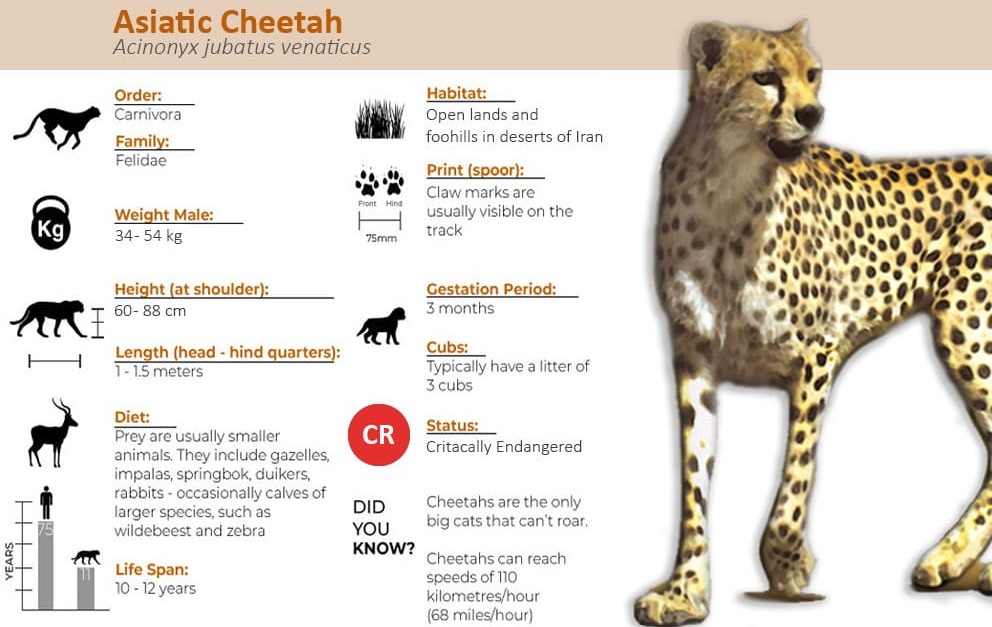
    • Species Focus: Covers 17 migratory mammals, including argali sheep, Asiatic cheetah, snow leopard, saiga antelope, wild yak, wild camel, Przewalski’s horse, and Bukhara deer.
    • Work Programme (2025–2031): Adopted at Tashkent (Uzbekistan); prioritises key landscapes, ecological corridors, and community-based conservation partnerships.
    • Approach: Integrates science, cross-border policy harmonisation, and pastoral community engagement, promoting coexistence between wildlife and livelihoods.
    • Key Partners: Supported by IUCN, WWF, CMS Secretariat, and national agencies to strengthen ecosystem connectivity across Central Asia.

    Back2Basics: Convention on the Conservation of Migratory Species (CMS)

    • Objective: To conserve migratory species and their habitats across borders, sustaining ecological networks throughout their migratory ranges.
    • Establishment: Signed on 23 June 1979 in Bonn, Germany, under UNEP; entered into force in 1983.
    • Unique Mandate: The only global treaty exclusively protecting terrestrial, marine, and avian migratory species.
    • Legal Instruments:
      • Agreements – binding treaties for specific species/regions.
      • MoUs – non-binding cooperation arrangements.
    • Conference of the Parties (COP): The CMS decision-making body adopting strategies like CAMI.
    • Membership: Over 130 Parties worldwide, promoting science-based conservation and international cooperation.
    • Global Significance: Aligns with SDG-15 (Life on Land) and the Convention on Biological Diversity (CBD).
    • Next COP: CMS COP15, to be held March 23–29, 2026, in Brazil, will review and advance regional frameworks including CAMI.
  • Great Green Wall of Andhra Pradesh

    Why in the News?

    Andhra Pradesh launched the Great Green Wall project, inspired by Africa’s Great Green Wall, to turn its 1,034 km Bay of Bengal coast into a bio-shield against cyclones and sea-level rise.

    About Great Green Wall of Andhra Pradesh:

    • Overview: Launched as a flagship coastal afforestation and climate resilience project; Forms part of the state’s Coastal Green Mission, aligning with SDG 13 (Climate Action) and India’s National Coastal Mission.
    • Objective: To protect Andhra Pradesh’s 1,034 km Bay of Bengal coastline from cyclones, tsunamis, and sea-level rise.
    • Inspired by: Africa’s Great Green Wall, adapted for India’s eastern coastal ecosystems.
    • Target: Enhance Andhra Pradesh’s green cover from 30% (2025) to 37% by 2029 and 50% by 2047 through sustained plantation and protection efforts.

    Key Features:

    • Geographical Coverage: Extends from Tirupati to Srikakulam, spanning the full 1,034 km coastline.
    • Width: Green belt stretches up to 5 km inland, with a variable width of 50–200 metres.
    • Core Species: Plantation includes mangroves, casuarina, palmyra, bamboo, and other shelterbelt trees.
    • Launch Site: Officially inaugurated at Surya Lanka Beach (Bapatla district) on 11 September 2025.
    • Community Role: Involves Self-Help Groups, eco-clubs, MGNREGS workers, fishermen, and local coastal communities.
    • Integration: Develops green buffers around ports, SEZs, industrial corridors, and aquaculture ponds.
    • Funding: Supported by CAMPA, MISHTI, Green Credit Programme, MGNREGS, CSR funds, and District Mineral Funds.
  • [22nd October 2025 ] The Hindu Op-ed: Unreliable air and noise data, real-time deception

    PYQ Relevance

    [UPSC 2023] Describe the key points of the revised Global Air Quality Guidelines (AQGs) recently released by the WHO. How are these different from its last update in 2005? What changes in India’s National Clean Air Programme are required to achieve these revised standards?

    Linkage: This PYQ directly links to the article’s focus on unreliable air quality data and weak monitoring under NCAP. Since pollution is a recurring UPSC theme, it highlights how aligning India’s policies with updated WHO standards demands scientific integrity and credible data.

    Mentor’s Comment

    When truth itself is blurred by flawed data, governance becomes an illusion. India’s air and noise monitoring systems, meant to be the foundation of environmental policy, are now under scrutiny for misleading the nation with inaccurate data. This is not just a story about malfunctioning sensors but about the collapse of scientific integrity, accountability, and public trust. The issue is no longer technical; it is constitutional, affecting citizens’ Right to Health and Life.

    Why in the News

    Two major failures in India’s environmental monitoring systems, Delhi’s Real-Time Air Pollution Network and Lucknow’s National Ambient Noise Monitoring Network, have exposed disturbing lapses in data integrity and governance. For the first time, even raw government data is being accused of misleading the public by understating pollution levels. Sensors placed in less polluted areas, faulty installations under tree cover, and outdated noise regulations have collectively raised alarm. This is significant because policy credibility, public health, and India’s global environmental reputation now stand compromised.

    Introduction

    Environmental governance in India has entered a critical phase. Despite massive investments and advanced technology, monitoring systems for air and noise pollution have failed to inspire confidence. When environmental data is unreliable, policies derived from it lose direction. As Delhi continues to suffocate under toxic smog and Lucknow’s soundscape exceeds permissible decibel levels, the larger question emerges — can real-time governance be meaningful when real-time data is deceptive?

    Policy Built on Sand: When Data Loses Credibility

    1. Flawed Sensors: Multiple audits, including the Comptroller and Auditor General (CAG) report, reveal that several air-quality sensors in Delhi are placed behind walls or under tree cover, leading to inaccurate readings.
    2. Misleading Reports: Delhi’s official Air Quality Index (AQI) often shows “moderate” levels even as citizens gasp through toxic smog, undermining public trust.
    3. Governance Crisis: When data itself is unreliable, policy decisions on stubble burning, vehicular restrictions, and industrial emissions lose legitimacy.
    4. International Impact: Weak monitoring erodes India’s credibility under the Paris Agreement and WHO Air Quality Standards.

    Sound of Silence: Noise Monitoring Failure in Lucknow

    1. Defective Network: Lucknow’s National Ambient Noise Monitoring Network fails to record accurate decibel levels; sensors are either malfunctioning or poorly calibrated.
    2. Outdated Regulation: India continues to rely on the Noise Pollution (Regulation and Control) Rules, 2000, which are inadequate and below WHO standards.
    3. Weak Enforcement: Penalties are minor, compliance is poor, and urban noise remains unregulated, especially around airports and religious places.
    4. Constitutional Concern: The Supreme Court recently transferred pleas on noise around Delhi Airport to the NGT, acknowledging that noise is a public health and fundamental rights issue under Articles 19 and 21.

    Science or Spectacle: Technology Without Transparency

    1. Spectacle over Substance: Governments deploy shiny monitoring hardware but ignore scientific calibration and audits.
    2. Opacity in Data: Citizens are misled when real-time pollution data is selectively downplayed to show moderate levels.
    3. Public Deception: Misleading indices delay judicial intervention and suppress citizen voices demanding clean air.
    4. Democratic Erosion: Governance becomes a contest between citizens and industries, with flawed numbers protecting inaction.

    The Human Cost: Health and Life Expectancy

    1. Health Impact: Exposure to NO₂ and PM2.5 not only weakens lungs but also accelerates myopia and aggravates asthma in children.
    2. Data from Reports: The Air Quality Life Index (Energy Policy Institute) shows that if Delhi met WHO air standards, life expectancy would rise by 8.2 years.
    3. National Toll: Across India, air pollution cuts life expectancy by nearly 5 years, making this a silent epidemic.
    4. Flawed Data = Lost Lives: When monitoring fails, policies fail, and citizens continue to breathe poison unknowingly.

    Restoring Credibility: Science as the Foundation

    1. Independent Oversight: India lacks an independent audit panel for environmental monitoring, unlike global norms.
    2. Enforcement Gaps: Though CPCB has clear guidelines on sensor location and calibration, implementation remains lax.
    3. Need for Citizen Oversight: Making raw data publicly accessible and encouraging third-party audits will restore trust.
    4. Beyond Bureaucracy: Environmental monitoring should be treated not as a formality, but as a scientific and ethical duty.

    Conclusion

    India’s real-time air and noise monitoring crisis is a wake-up call. The credibility of environmental governance rests not on political optics but on scientific truth. Without transparent data and independent audits, policies lose legitimacy and citizens lose trust. The real cost is borne not in GDP but in children’s lungs and sleepless nights. Science, integrity, and public accountability must anchor India’s environmental data revolution, else we risk turning real-time monitoring into real-time deception.
  • Indian wolf (Canis lupus pallipes) to be classified as new species by IUCN

    Why in the News?

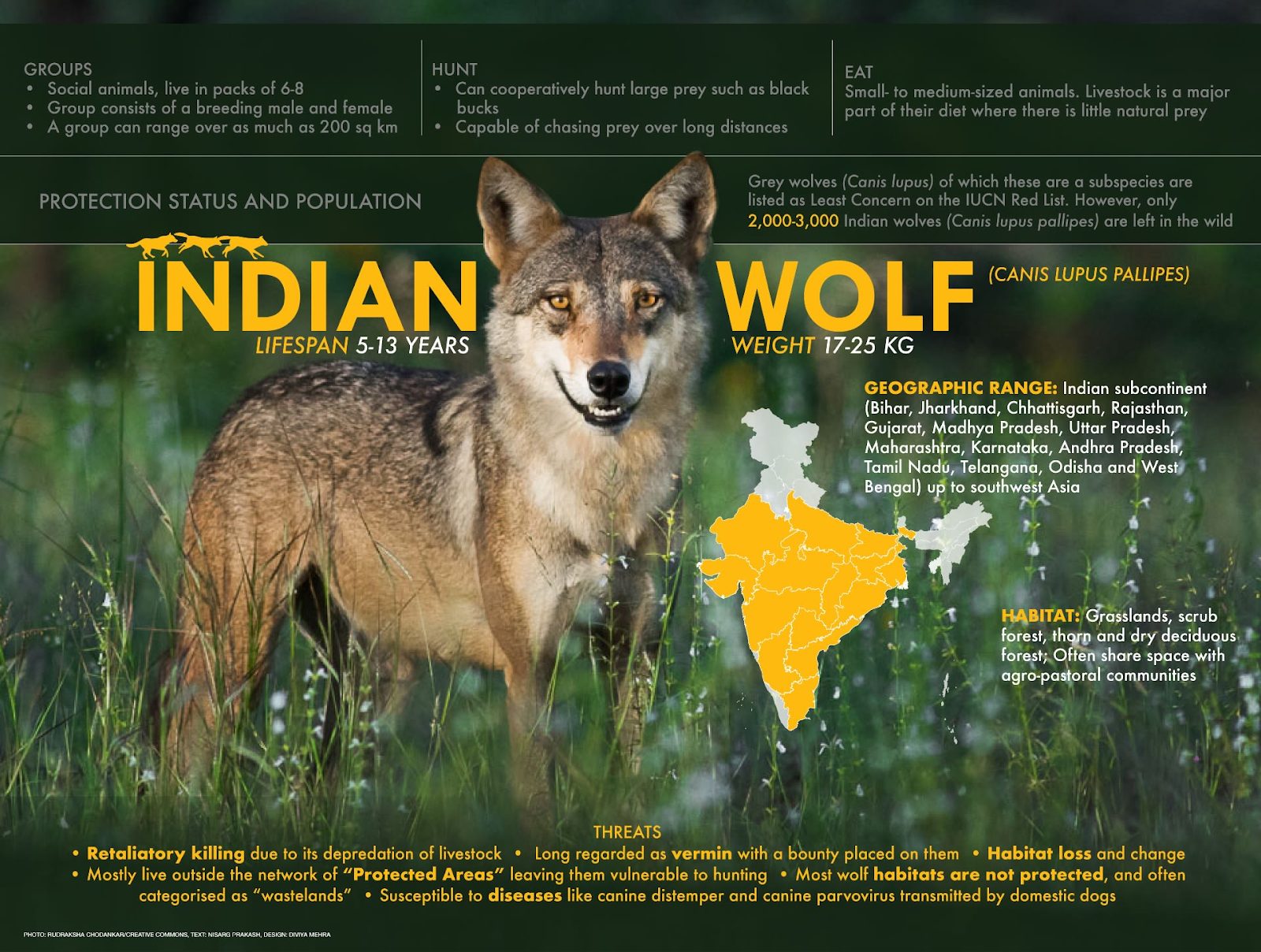
    The IUCN has separately evaluated the Indian wolf (Canis lupus pallipes) from the gray wolf, suggesting it may be recognised as a distinct Canis species.

    Indian wolf (Canis lupus pallipes) to be classified as new species by IUCN

    About Indian Wolf (Canis lupus pallipes):

    • Overview: Also called the Peninsular Wolf or Indian Grey Wolf; proposed as Canis indica owing to genetic divergence 110,000–200,000 years ago.
    • Distinct Lineage: Genomic studies identify it as the oldest surviving wolf lineage, basal to all other Canis lupus subspecies.
    • Distribution: Found across Deccan Plateau, Gujarat, Rajasthan, Madhya Pradesh, Maharashtra, Karnataka, and Andhra Pradesh, extending into Pakistan and Iran; only 12.4 % of its range lies inside protected areas.
    • Population Status (2025): Estimated 2,877–3,310 individuals (IUCN Red List 2025) — classified as Vulnerable.
    • Legal Protection: Listed in *Schedule I of the Wildlife (Protection) Act, 1972, prohibiting hunting, trapping, or killing <citation needed>.
    • Habitat: Prefers scrublands, dry grasslands, and thorn forests, increasingly threatened by agriculture, solar projects, and highways.
    • Ecological Role: Functions as a top predator regulating prey such as blackbuck, chinkara, hares, and rodents in India’s open ecosystems.
    • Social Behaviour: Lives in packs of 6-8 members, exhibiting cooperative hunting and silent coordination strategies.

    Evolutionary and Taxonomic Significance:

    • Early Divergence: Fossil and genetic data show divergence from Eurasian and Himalayan wolves well before the last Ice Age, evolving within India’s semi-arid zones.
    • Evolutionary Importance: Serves as a key model for studying wolf evolution, adaptation, and behaviour in tropical and dry environments.
    • Taxonomic Debate: Researchers propose recognition as a distinct species (Canis indica) based on unique genetic, ecological, and behavioural traits.
    [UPSC 2024] Question: Consider the following statements:

    Statement-I: The Indian Flying Fox is placed under the “vermin” category in the Wild Life (Protection) Act, 1972.

    Statement-II: The Indian Flying Fox feeds on the blood of other animals.

    Which one of the following is correct in respect of the above statements?

    Options: (a) Both statement I and Statement II are correct and statement II explains statement I

    (b) Both Statement-I and Statement-II are correct, but Statement-II does not explain Statement-I

    (c) Staement- I is correct , but Statement II is incorrect*

    (d) Statement-I is incorrect, but Statement-II is correct


  • IMO’s 2023 Greenhouse Gas (GHG) Strategy

    Why in the News?

    The International Maritime Organisation (IMO) delayed a vote on its 2027 carbon pricing plan under the 2023 Greenhouse Gas (GHG) Strategy after U.S. pressure, stalling efforts for net-zero shipping by 2050.

    What the IMO is trying to achieve?

    • Decarbonisation Goal: Targets net-zero emissions in global shipping by 2050, aligning with the Paris Agreement’s 1.5 °C limit; shipping contributes 2–3 % of global CO.
    • Carbon Intensity Reduction: Implements fuel-efficiency standards and CIIs to cut CO per tonne-mile of cargo transported.
    • Fuel Transition: Promotes shift from heavy fuel oil to green ammonia, methanol, hydrogen, and biofuels, supported by a global carbon pricing framework.
    • Equitable Transition: Upholds common but differentiated responsibilities, offering financial and technological aid to developing and island nations.
    • Market-Based Mechanisms: Developing carbon-pricing and fuel-levy systems to internalise environmental costs and fund innovation.
    • Regulatory Uniformity: Seeks to avoid fragmented regional rules (e.g., EU ETS) by maintaining global maritime emission standards.

    About IMO’s 2023 Greenhouse Gas (GHG) Strategy:

    • Adoption: Finalised in July 2023 at Marine Environment Protection Committee (MEPC-80) (London) under the MARPOL Annex VI framework.
    • Carbon Intensity Targets: Cut 40 % by 2030 (vs 2008) and strive for 70 % by 2040.
    • Net-Zero Timeline: Achieve full sectoral decarbonisation by 2050.
    • Zero/Low-Emission Fuels: Ensure 5 % (aspire 10 %) of shipping energy from near-zero-GHG fuels by 2030; expand hydrogen and electrified propulsion.
    • Fuel & Emission Standards: Introduce Global Fuel Standard (GFS) and Global Pricing Mechanism (GPM) by 2027, covering ships above 5,000 GT (~85 % of emissions).
    • MRV Framework: Strengthen monitoring, reporting, and verification with emission databases and compliance audits.
    • Support Mechanisms: Establish GHG Fund to assist developing states in retrofits, technology adoption, and port upgrades.

    Significance: 

    • Global Climate Milestone: First binding, worldwide roadmap for a high-emission transport sector outside aviation.
    • Regulatory Shift: Moves from voluntary action to enforceable standards in maritime law.
    • Strategic Impact: Positions the IMO as a key climate-governance body, linking trade regulation and environmental responsibility.
    [UPSC 2024] According to the Environmental Protection Agency (EPA), which one of the following is the largest source of sulphur dioxide emissions?

    Options: (a) Locomotives using fossil fuels

    (b) Ships using fossil fuels

    (c) Extraction of metals from ores

    (d) Power plants using fossil fuels*


  • Status of Elephants in India Report (2025)

    Why in the News?

    The Wildlife Institute of India (WII) released its report “Status of Elephants in India” on October 14, 2025, marking the country’s first-ever DNA-based elephant population estimation.

    Elephants in India:

    • Overview: Elephas maximus, Asian Elephant, listed as Endangered (IUCN); protected under Schedule I of the Wildlife (Protection) Act 1972 and Appendix I of CITES.
    • National Importance: India sustains over 60 % of the global wild Asian elephant population, making it a global conservation stronghold.
    • Conservation Framework:
      • Project Elephant (1992) – habitat protection, research, corridor restoration, and conflict management.
      • Elephant Reserves – 33 notified across 15 states, covering ~80,000 sq km.
      • Corridor Initiatives – joint mapping of ~101 corridors by WII, WWF-India, and WTI to ensure genetic connectivity.
    • Major Landscapes:
      • Western Ghats – dense forests with corridor fragmentation.
      • North-Eastern Hills – contiguous habitats under human pressure.
      • Central India & Eastern Ghats – isolated herds with high conflict.
      • Shivalik–Gangetic Plains – corridor bottlenecks amid dense settlements.
    • Ecological Role: Elephants act as ecosystem engineers, dispersing seeds, maintaining forest–grassland balance, and regulating hydrology.

    About Status of Elephants in India Report (2025):

    • Publisher & Framework: Released by the Wildlife Institute of India (WII) under Project Elephant. It employs, for the first time in India, a DNA-based mark–recapture (genetic) estimation method for elephant census.
    • Census Period & Title: Conducted between 2021–2025, termed the Synchronous All-India Population Estimation of Elephants (SAIEE 2021-25).
    • Feature: Combines genetic sampling, field transects, and spatial-capture–recapture modelling.
    • Scientific Advancement: Establishes India’s first genetic reference library for elephants, linking individuals, herds, and landscapes for improved long-term monitoring.
    • Policy Context: Conducted under Project Elephant (1992) to align with national targets for corridor protection, conflict mitigation, and ecosystem restoration.

    Key Highlights:

    • Total Population (2025): 22,446 wild Asian elephants estimated nationwide using genetic data.
    • Previous Estimate (2017): About 29,964; apparent ~25 % drop due to new methodology rather than actual decline.
    • Regional Distribution:
      • Western Ghats Landscape: 11,934 (≈ 53 %)
      • North-East & Brahmaputra Plains: 6,559 (≈ 22 %)
      • Shivalik Hills & Gangetic Plains: 2,062 (≈ 9 %)
      • Central India & Eastern Ghats: 1,891 (≈ 8 %)
    • State-wise Concentration: Karnataka (6,013), Assam (4,159), Tamil Nadu (3,136), Kerala (2,785), Uttarakhand (1,792), Odisha (912).
    • Demographic Insights: DNA profiling enabled sex ratio identification, family linkages, and migration-corridor tracking, turning a static census into a dynamic population map.
    • Conservation Implications: WII urges genetic recensuses every 5 years, restoration of identified corridors, and integration of coexistence models in land-use planning.
    [UPSC 2020] With reference to Indian elephants, consider the following statements:

    1. The leader of an elephant group is a female.

    2. The maximum gestation period can be 22 months.

    3. An elephant can normally go on calving till the age of 40 years only.

    4. Among the States in India, the highest elephant population is in Kerala.

    Which of the statements given above is/are correct?

    Options: (a) 1 and 2 only * (b) 2 and 4 only (c) 3 only (d) 1, 3 and 4 only


  • What are Green Crackers?

    Why in the News?

    The Supreme Court of India has temporarily permitted the sale and bursting of green crackers in the Delhi–NCR region from October 18 to 21 for Diwali celebrations.

    Background and Judicial Origin:

    • Trigger: Severe air pollution episodes during Diwali (2016–2017) pushed Delhi’s Air Quality Index (AQI) beyond 500, creating a public-health emergency.
    • Supreme Court Intervention (2018):
      • Affirmed that cultural freedom cannot override the Fundamental Right to Life (Article 21).
      • Banned conventional firecrackers containing heavy metals such as barium, lead, and mercury.
      • Directed CSIR to develop less-polluting alternatives, with PESO (Petroleum and Explosives Safety Organisation) tasked to test and certify them.
    • Outcome: Introduction of green crackers as a compromise solution balancing festive traditions with public-health protection.
    • Legal Oversight: The Supreme Court continues to monitor compliance, permitting use only within fixed time windows and under strict emission-control standards.

    About Green Crackers:

    • Overview: Green crackers are eco-friendly fireworks developed by the Council of Scientific and Industrial Research – National Environmental Engineering Research Institute (CSIR-NEERI) to curb air pollution during festive celebrations.
    • Chemical Composition: Manufactured using modified formulations that exclude barium nitrate and significantly reduce sulphur and aluminium content, thereby cutting toxic emissions.
    • Emission Reduction: These crackers emit about 30 % less particulate matter (PM. and PM₁₀) and 10 % less sulphur dioxide (SO) and nitrogen oxides (NO) than conventional firecrackers.
    • Identification & Legality: Each authorised packet carries the Green Fireworks logo and a QR code verifiable through the CSIR-NEERI Green QR Code App; crackers without codes are illegal.
    • Purpose: Designed to retain the cultural and festive appeal of fireworks while mitigating health and environmental impacts in pollution-prone regions such as Delhi-NCR.

    Types of Green Crackers:

    1. SWAS (Safe Water Releasable): Releases water vapour during combustion to reduce dust and temperature, lowering particulate emissions.
    2. STAR (Safe Thermite Cracker): Uses thermite-based reactions instead of conventional oxidisers, producing bright light and sound with reduced toxic output.
    3. SAFAL (Safe Minimal Aluminium): Limits metallic fuel content, maintaining luminosity and sound intensity while reducing aluminium and sulphur emissions.

    All three maintain sound levels around 100–120 dB, comparable to traditional fireworks but with a cleaner emission profile and shorter atmospheric residence time.

    [UPSC 2024] What is the common characteristic of the chemical substances generally known as CL-20, HMX and LLM-105, which are sometimes talked about in media?

    (a) These are alternatives to hydro- fluorocarbon refrigerants

    (b) These are explosives in military weapons *

    (c) These are high-energy fuels for cruise missiles

    (d) These are propulsion fuels for rocket


  • Rising carbon dioxide levels

    Introduction

    The atmospheric concentration of carbon dioxide (CO₂), the most significant greenhouse gas responsible for climate change, has increased by a record amount between 2023 and 2024, according to the World Meteorological Organization (WMO). The global average CO₂ concentration reached 423.9 parts per million (ppm) in 2024, 3.5 ppm higher than in 2023, representing the steepest one-year increase since records began.

    This unprecedented rise coincides with 2024 being the hottest year on record, with average global temperatures 1.55°C higher than pre-industrial levels, breaching the 1.5°C limit scientists consider critical to prevent irreversible impacts.

    Why This Is a Big Deal

    This spike is unprecedented in modern climate history. Never before have CO₂ levels risen so sharply in a single year. It not only breaks the trend of relative stability observed over the last decade but also exposes the collapse of the global climate response despite the Paris Agreement. The rate of increase (3.5 ppm) is more than four times the average annual increase recorded between 2011 and 2020.

    What makes this even more concerning is that both human-induced emissions (from fossil fuels, deforestation, and industrial activity) and natural feedback loops (like reduced ocean absorption and forest diebacks) are now amplifying each other, creating a self-perpetuating climate crisis.

    What Is Driving the Surge in CO₂ Concentrations?

    1. Record-breaking increase: Global average CO₂ near Earth’s surface reached 423.9 ppm in 2024, marking a 3.5 ppm rise, the largest annual jump ever.
    2. Failure of climate frameworks: Despite international efforts under the Paris Agreement, emissions continue to climb, reflecting inadequate implementation and weak compliance.
    3. Global warming feedback: Higher temperatures reduce oceans’ capacity to absorb CO₂ and increase droughts and wildfires, releasing more carbon into the atmosphere.
    4. Burning of fossil fuels: Continued dependence on coal, oil, and gas remains the primary driver, responsible for more than 90% of anthropogenic CO₂ emissions.

    How Are Natural Sinks Losing Their Absorptive Power?

    1. Reduced ocean absorption: Warmer oceans have absorbed less CO₂ in 2024 due to decreased solubility of gases in higher temperatures.
    2. Forest fires and droughts: A spike in wildfires and prolonged dry spells reduced the CO₂-absorbing capacity of trees and grasslands.
    3. Feedback loops: The decline of natural sinks worsens CO₂ imbalance, which in turn leads to even greater heat trapping and further degradation of these ecosystems.

    How Do Other Greenhouse Gases (GHGs) Compare?

    1. Methane (CH₄): Second-most potent GHG, rose by 8 parts per billion in 2024 to reach 1,924 ppb, slightly below last decade’s average but still historically high.
    2. Nitrous oxide (N₂O): Increased by 1 ppb to 338 ppb in 2024, contributing to long-term warming effects due to its 270-year lifespan.
    3. Relative potency: While CH₄ and N₂O are more heat-trapping per molecule, CO₂ dominates because of its sheer volume and persistence in the atmosphere for thousands of years.

    Why Is This Rise Unprecedented?

    1. Historical contrast: From the 1960s to 2010, CO₂ levels rose by 0.8 ppm per year; between 2011–2020, it increased by 2.4 ppm annually, far below the 2023–24 jump of 3.5 ppm.
    2. Crossing planetary limits: This rise pushed Earth past the 1.5°C warming threshold, previously considered a safe boundary.
    3. Interlinked causes: WMO attributes this to a mix of human emissions and natural CO₂ variability, indicating global climate systems are destabilizing.

    Challenges for Global Climate Action

    1. WMO warning: The new data underscores the difficulty in curbing GHG accumulation in the atmosphere.
    2. Failure of control mechanisms: Despite decades of negotiations, anthropogenic activities continue unchecked.
    3. Feedback intensification: Natural processes, once climate stabilizers, are now acting as amplifiers of warming.
    4. Paris Agreement setback: The emission reduction targets for 2030 are unlikely to be met, while global temperatures already breached the 1.5°C mark.

    Conclusion

    The record-breaking surge in CO₂ levels between 2023 and 2024 is not just a statistical anomaly, it’s a planetary red alert. The intertwining of human actions and natural feedback loops signifies that climate change has entered a runaway phase unless drastic global mitigation is undertaken. The failure to meet emission targets and the collapse of natural carbon sinks highlight that the climate crisis is no longer a distant threat, it’s a present emergency demanding immediate collective action.

    PYQ Relevance

    [UPSC 2022] Discuss global warming and mention its effects on the global climate. Explain the control measures to bring down the level of greenhouse gases which cause global warming, in the light of the Kyoto Protocol, 1997.

    Linkage: The article is important as it highlights the sharpest-ever rise in global CO₂ levels, signalling a critical climate tipping point and the failure of existing global frameworks like the Kyoto and Paris Agreements to curb emissions. It links directly with the question by showing how unchecked greenhouse gases are intensifying global warming and threatening climate stability.