💥Join UPSC 2027,2028 Mentorship (July Batch) + XFactor Notes & Microthemes PDF

Subject: Conservation & Mitigation

1. Conservation Progs.
2. Worldwide initiatives
3. Mitigation Strategies
4. Conventions and Protocols

  • BS-VII Emission Norms

    Why in the News?

    To align India’s automobile sector with global standards, the government is planning to introduce BS VII emission norms by 2026-27.

    About BS7 Norms:

    • Overview: India’s equivalent of Euro 7 emission standards, aimed at reducing vehicular pollution and aligning with global benchmarks.
    • Coverage: Applies uniformly to cars, vans, buses, trucks, petrol, diesel, hybrid, and electric vehicles.
    • On-Board Monitoring (OBM): New system to monitor tailpipe emissions in real time, covering NOx, ammonia, PM, engine gases.
    • Non-Exhaust Regulation: First-time regulation of brake dust (PM) and tyre microplastics.
    • EV Standards: Introduces battery safety, durability, and longevity index to lower raw material use and build consumer confidence.
    • Digital Safeguards: Ensures vehicles are not tampered with and remain within emission limits.
    • Testing Scope: Expands checks to real driving conditions beyond lab-based cycles.

    Key Differences: BS6 vs BS7

    • OBD vs OBM: BS6 used On-Board Diagnostics (OBD); BS7 brings OBM for direct emission monitoring.
    • NOx Standards: BS6 allowed 60 mg/km petrol, 80 mg/km diesel; BS7 sets uniform 60 mg/km.
    • Coverage: BS6 regulated exhaust only; BS7 adds non-exhaust (brakes, tyres).
    • EV Inclusion: BS6 ignored EVs; BS7 regulates battery life, safety, and replacement cycles.
    • Testing: BS6 relied on defined test cycles; BS7 uses broader real-world conditions.
    • Technology Push: BS7 compels automakers towards advanced emission-control systems and turbo, direct-injection engines.
    • Cost Factor: BS7 compliance raises vehicle costs; some older models may be discontinued.

    History of Emission Norms in India:

    Year / Period Key Development
    1991 Mass emission norms introduced for petrol vehicles.
    1992 Mass emission norms introduced for diesel vehicles.
    April 1995 Mandatory catalytic converters in new petrol cars in Delhi, Mumbai, Kolkata, Chennai; unleaded petrol (ULP) introduced.
    2000 Introduction of Euro I equivalent “India 2000” norms for passenger and commercial vehicles; stricter norms for two-wheelers.
    2001 Euro II equivalent Bharat Stage II (BS II) norms introduced in Delhi, Mumbai, Chennai, Kolkata.
    August 2002 First Auto Fuel Policy announced, outlining emission and fuel roadmap up to 2010.
    April 2005 Bharat Stage III (BS III) norms implemented in 13 metro cities; rest of India continued with BS II.
    April 2010 Bharat Stage IV (BS IV) implemented in 13 metro cities; rest of India adopted BS III.
    October 2014 BS IV extended to 20 more cities.
    2013 Auto Fuel Policy 2025 submitted to MoPNG (Ministry of Petroleum & Natural Gas), outlining roadmap up to 2025.
    April 2017 Nationwide implementation of BS IV.
    April 2020 Direct leap to BS VI (skipping BS V) due to severe pollution in Delhi NCR.
    Upcoming (BS VII) To be aligned with Euro 7 standards: stricter norms, On-Board Monitoring (OBM), coverage of brake & tyre emissions, and EV battery standards.


    [UPSC 2004] Consider the following statements:

    1. The Oil Pool Account of Government of India was dismantled with effect from 1-4-2002.

    2. Subsidies on PDS kerosene and domestic LPG are borne by Consolidated Fund of India.

    3. An expert committee headed by Dr. R.A. Mashelkar to formulate a national auto fuel policy recommended that Bharat Stage-II Emission Norms should be applied throughout the country by 1 April, 2004.

    Which of these statements given above are correct?

    Options: (a) 1 and 2 (b) 2 and 3 (c) 1 and 3 (d) 1, 2 and 3*


  • Researchers develop Red Ivy Plant-Based Wound-Healing Pad

    Why in the News?

    Researchers at JNTBGRI has developed a multifunctional wound-healing pad using nanomaterials, inspired by the red ivy plant (Strobilanthes alternata), traditionally used in folk medicine.

    About the Red Ivy Plant:

    • Overview: Strobilanthes alternata, locally called murikooti pacha, belonging to the Acanthaceae family.
    • Habitat: Found abundantly in tropical regions, including India.
    • Traditional Use: Used in folk medicine for treating cuts and wounds.
    • Scientific Discovery: JNTBGRI, Palode isolated acteoside, a natural bioactive compound, for the first time in this plant.
    • Therapeutic Use: Acteoside, known elsewhere for medicinal activity, showed high wound-healing efficacy at 0.2% concentration in red ivy.

    Features of the Wound-Healing Pad:

    • Design: India’s first multifunctional herbal wound dressing pad, combining traditional knowledge with nanotechnology.
    • Components: Electro-spun nanofiber layer (biodegradable, porous, antimicrobial barrier); Acteoside + neomycin sulfate blend (healing and infection control); Sodium alginate sponge (absorbs exudates); Activated carbon layer (controls odour).
    • Significance: Affordable, scalable, and a model of herbal medicine integrated with modern nanotech innovation.
    [UPSC 2021] Which one of the following is used in preparing a natural mosquito repellent?

    Options:

    (a) Congress grass (b) Elephant grass (c) Lemongrass* (d) Nut grass


  • Vultures and Pandemic Prevention

    Why in the News?

    Vultures, vital for carcass disposal and disease control, are key to pandemic preparedness.

    About Vulture Species in India:

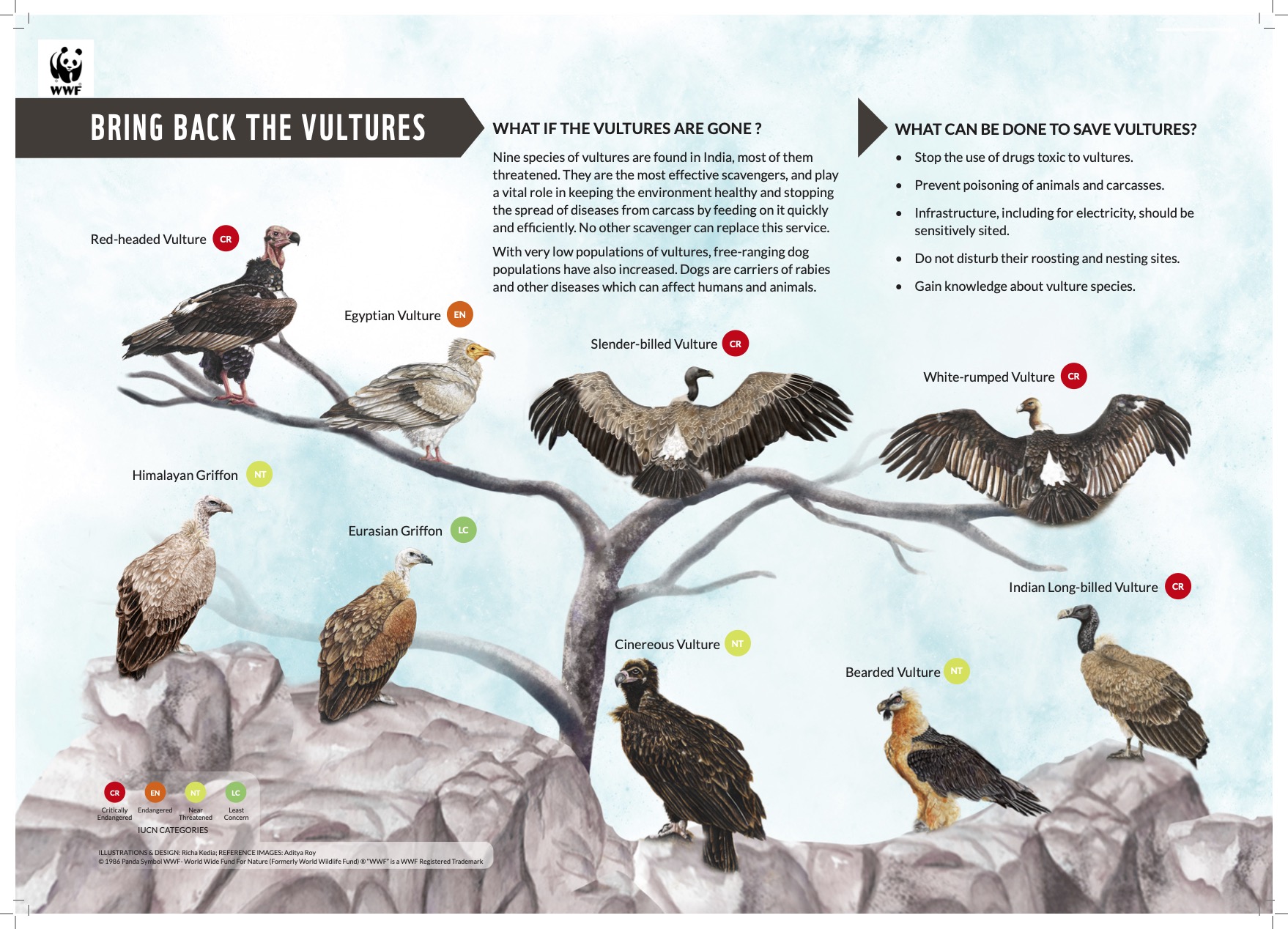
    • Overview: Vultures are among 22 global species of large scavenger birds, found mostly in tropics and subtropics.
    • Ecological Role: Serve as nature’s garbage collectors, preventing disease spread and maintaining balance in ecosystems.
    • Indian Diversity: India hosts 9 species — Oriental white-backed, Long-billed, Slender-billed, Himalayan, Red-headed, Egyptian, Bearded, Cinereous, and Eurasian Griffon.

    Vultures and Pandemic Prevention

    Distribution and Population Trends:

    • Historic Abundance: In the 1980s, India had over 40 million vultures, often in large groups near carcass dumps.
    • Population Crash: Since the 1990s, numbers have declined by over 95%, mainly due to diclofenac poisoning from veterinary use.
    • Flyway Connection: Vultures are part of the Central Asian Flyway (CAF), linking breeding sites in Central Asia with South Asia’s wintering zones.
    • Global Relevance: The CAF spans 30+ countries, making vulture conservation a regional and international public health concern.

    Vultures and Pandemic Preparedness:

    • Carcass Disposal: By consuming dead animals, vultures stop spread of pathogens such as anthrax, Clostridium botulinum, rabies.
    • Bio-Monitor Role: As first responders at carcasses, they act as natural surveillance systems, reducing risks of zoonotic spillover.
    • Conservation Gap: Protection of vultures is rarely included in One Health strategies, despite being low-cost compared to pandemic response.
    • Community Involvement: Local communities coexisting with vultures can aid in awareness, conservation, and disease monitoring, but remain underutilised.
    [UPSC 2012] Vultures which used to be very common in Indian countryside some years ago are rarely seen nowadays. This is attributed to:

    (a) the destruction of their nesting sites by new invasive species disease among them

    (b) a drug used by cattle owners for treating their diseased cattle persistent and fatal*

    (c) scarcity of food available to them

    (d) a widespread, persistent and fatal disease among them


  • Swachh Vayu Survekshan, 2025

    Why in the News?

    Indore, already recognized as the cleanest city in India, has topped the list of million-plus population cities in the Swachh Vayu Survekshan 2025.

    Swachh Vayu Survekshan, 2025

    About Swachh Vayu Survekshan (SVS), 2025:

    • Overview: Annual survey by the Ministry of Environment, Forest and Climate Change (MoEFCC) under the National Clean Air Programme (NCAP).
    • Objective: Promotes healthy competition among cities and accelerates implementation of air quality measures.
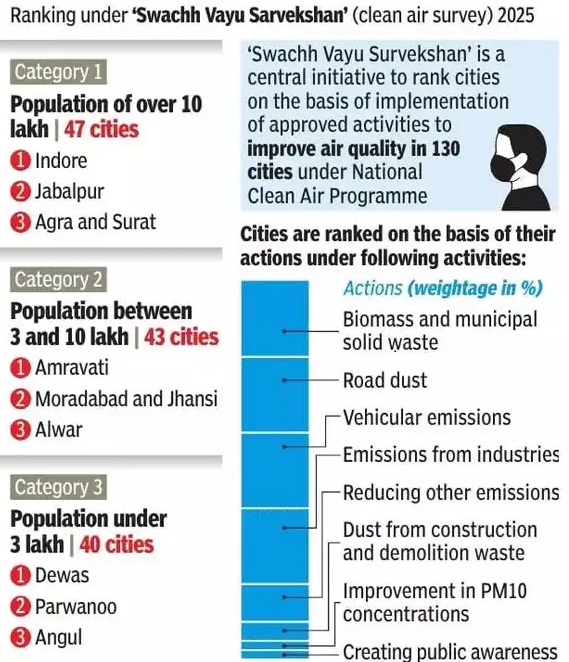
    • Coverage: Includes 130 cities, grouped into 3 categories: million-plus population, 3–10 lakh population, and under 3 lakh population.
    • Parameters: Cities assessed on 8 factors such as road dust mitigation, solid waste management, vehicular emission control, industrial emission control, construction and demolition waste handling, public awareness, and particulate matter (PM10/PM2.5) reduction.
    • Methodology: Uses a multi-tier evaluation focusing on both on-ground actions and measurable outcomes.

    Key Findings of SVS, 2025:

    • Top Performer: Indore ranked 1st among million-plus cities, regaining its position after slipping to 6th in 2024. It had also topped in 2023, while Lucknow topped the inaugural edition in 2022.
    • Other Million-Plus Rankings: Jabalpur 2nd, Agra and Surat 3rd, Navi Mumbai 4th, Kanpur 5th, Bhopal 6th, Allahabad 7th, Chandigarh 8th, Ahmedabad–Pune–Nagpur 10th, Varanasi and Raipur 11th, Lucknow 15th, Hyderabad 22nd, Mumbai 25th, Jaipur 26th, Delhi 32nd, Bengaluru 36th, Kolkata 38th, Chennai 41st.
    • 3–10 Lakh Cities: Amravati 1st, Jhansi and Moradabad joint 2nd, Alwar 3rd.
    • Under-3 Lakh Cities: Dewas 1st, Parwanoo 2nd, Angul 3rd.
    • Air Quality Data: Indore recorded PM10 at 83 μg/m³ in 2024–25, slightly higher than 82 μg/m³ in 2017–18. Cities like Chennai (58 μg/m³), Varanasi (59 μg/m³), Bengaluru (68 μg/m³), and Hyderabad (81 μg/m³) showed lower PM10 levels than Indore.
    • Overall Trends: 103 of 130 cities reduced PM10 since 2017–18. 64 cities achieved a 20% reduction, while 25 cities achieved a 40% reduction. Only 22 cities met the national standard of ≤60 μg/m³, with Chennai the only metro (58 μg/m³). Among metros, Mumbai recorded the highest decline (44%), followed by Kolkata (37%), Hyderabad (26%), Bengaluru (26%), Delhi (15%), and Chennai (12%).
    [UPSC 2022] In the context of WHO Air Quality Guidelines, consider the following statements:

    1. The 24-hour mean of PM 2.5 should not exceed 15 μg/m3 and annual mean of PM 2.5 should not exceed 5 μg/m3.

    2. In a year, the highest levels of ozone pollution occur during the periods of inclement weather.

    3. PM 10 can penetrate the long barrier and enter the bloodstream.

    4. Excessive ozone in the air can trigger asthma.

    Which of the statements given above are correct?

    Options: (a) 1,3 and 4 (b) 1 and 4 only* (c) 2,3 and 4 (d) 1 and 2 only


  • The making of an ecological disaster in the Nicobar

    Introduction

    The Great Nicobar Island Project, with an estimated expenditure of ₹72,000 crore, has sparked unprecedented controversy. Instead of strengthening India’s ecological security and inclusive growth, the project threatens to uproot indigenous communities such as the Nicobarese and the Shompen, destroy one of the world’s richest biodiversity hotspots, and expose the island to severe natural disaster risks. By bypassing constitutional bodies, statutory protections, and scientific warnings, the project raises fundamental questions about governance, justice, and sustainability in India’s developmental trajectory.

    Uprooting Tribal Communities

    1. Nicobarese displacement: The project site overlaps with ancestral villages of the Nicobarese, already displaced once by the 2004 tsunami. Their hope of return will now be permanently extinguished.
    2. Shompen threat: The Shompen, classified as a Particularly Vulnerable Tribal Group (PVTG), face cultural and ecological extinction as their reserve land is denotified and forests destroyed.
    3. Violation of tribal safeguards: Article 338A mandates consultation with the National Commission for Scheduled Tribes, which was bypassed. The Tribal Council’s objections were ignored after being “rushed” into signing a no-objection letter, later revoked.

    Mockery of Legal and Regulatory Safeguards

    1. Social Impact Assessment failure: The 2013 Act on Land Acquisition and Rehabilitation excluded Nicobarese and Shompen from consideration, denying them stakeholder status.
    2. Forest Rights Act ignored: The Shompen’s authority to regulate and protect forests was bypassed.
    3. Constitutional neglect: Bodies like NCST and local tribal councils were side-lined, undermining democratic accountability.

    The Farce of Compensatory Afforestation

    1. Massive tree felling: The Ministry projects 8.5 lakh trees may be cut, but independent estimates put the figure between 32–58 lakh.
    2. Afforestation mismatch: Compensatory afforestation is planned in Haryana, thousands of kilometres away, with a completely different ecology.
    3. Mining contradiction: A quarter of this afforestation land has been auctioned for mining, nullifying the mitigation strategy.
    4. CRZ violation: Port site falls under CRZ 1A, which prohibits construction due to turtle nesting sites and coral reefs.

    Ecological and Wildlife Concerns

    1. Nicobar long-tailed macaque: Primatologists’ warnings on its survival risks were ignored.
    2. Sea turtle nesting mis-assessed: Surveys were conducted off-season, compromising accuracy.
    3. Dugong impact underestimated: Drone-based surveys only covered shallow waters.
    4. Biased assessments: Reports were allegedly conducted under duress, undermining credibility.

    A Disaster-Prone Location

    1. Tsunami precedent: In 2004, the island subsided by 15 feet.
    2. Seismic zone risk: A 6.2 magnitude earthquake in July 2025 reinforced its vulnerability.
    3. Jeopardising investment: Infrastructure and lives face catastrophic risk from earthquakes and tsunamis.

    Conclusion

    The Great Nicobar Project symbolizes an ecological and humanitarian misadventure where short-term ambitions eclipse constitutional morality, environmental prudence, and tribal justice. The survival of the Nicobarese and Shompen, along with an irreplaceable ecosystem, hangs in the balance. True development must integrate ecological sustainability and social justice rather than sacrifice them at the altar of misplaced mega-infrastructure.

    Value Addition

    Way Forward

    • Inclusive Development with Tribal Consent
      • Ensure free, prior, and informed consent of Nicobarese and Shompen communities in line with the Niyamgiri judgment (2013).
      • Empower tribal councils in decision-making as mandated by the Forest Rights Act (2006).
    • Strengthening Legal and Institutional Safeguards
      • Consult the National Commission for Scheduled Tribes (NCST) and respect constitutional provisions under Article 338A.
      • Strengthen Social Impact Assessments with participation of affected communities.
    • Rethinking Compensatory Afforestation
      • Undertake afforestation within island ecosystems, not in distant states like Haryana.
      • Promote ecosystem restoration rather than mere plantation drives.
    • Ecologically Sensitive Area Protection
      • Enforce CRZ 1A norms protecting turtle nesting sites, coral reefs, and coastal biodiversity.
      • Recognise Great Nicobar as an Ecologically Sensitive Zone (ESZ) under Environment Protection Act.
    • Disaster-Resilient Planning
      • Recognise that Great Nicobar lies in Seismic Zone V and redesign infrastructure accordingly.
      • Adopt a low-impact development model suited for fragile ecosystems (eco-tourism, research hubs, small-scale renewable energy).
    • Alternative Growth Models
      • Focus on sustainable livelihoods for locals (fisheries, forest produce, heritage tourism).
      • Leverage the island’s location for strategic security through minimal-impact naval installations, avoiding large-scale civilian displacement.

    PYQ Relevance

    [UPSC 2017] ‘Climate Change’ is a global problem. How India will be affected by climate change? How Himalayan and coastal states of India will be affected by climate change?

    Linkage: The Great Nicobar Project directly links to this PYQ as it illustrates how climate change impacts combine with ill-planned development to heighten risks. Rising sea levels and intensifying cyclones threaten India’s coastal states, while Great Nicobar, lying in a seismically active and tsunami-prone zone, showcases the compounded vulnerability of fragile ecosystems and communities. Thus, it exemplifies how coastal regions face existential risks when climate change interacts with unsustainable projects.

  • Why Punjab keeps flooding

    Introduction

    Punjab, often called the “food bowl of India,” is paradoxically one of the most flood-prone states in the country. Drained by three perennial rivers, the Ravi, Beas, and Sutlej, along with seasonal tributaries and hill streams, Punjab has historically thrived on its fertile floodplains. Yet, the very rivers that make its land abundant also bring recurring devastation. The 2025 floods, among the worst in recent memory, have once again underlined the dual challenge of geography and governance. With 3.8 lakh people affected, 11.7 lakh hectares of farmland destroyed, and 43 lives lost, the floods highlight not just natural vulnerability but also systemic mismanagement.

    Why Punjab’s Floods Are Back in the Spotlight

    Punjab is currently experiencing one of the most destructive floods in decades, with unprecedented rainfall in Himachal Pradesh, J&K, and Punjab itself swelling rivers beyond capacity. What makes this year’s floods significant is the scale: all 23 districts have been declared flood-hit, and the breach of Madhopur barrage gates has worsened devastation. While heavy rains are not new, institutional failures, especially in dam management by the Bhakra Beas Management Board (BBMB), and delayed warnings have amplified the crisis, making the situation worse than previous floods of 1955, 1988, 1993, 2019, and 2023.

    Rivers as Both Boon and Bane

    1. Three perennial rivers – Ravi, Beas, and Sutlej traverse Punjab, carrying immense alluvium and making the state highly fertile.
    2. Seasonal rivers and choes – Rivers like Ghaggar and hill streams add to Punjab’s complex hydrology.
    3. Agricultural abundance – Punjab produces nearly 20% of India’s wheat and 12% of its rice, despite occupying only 1.5% of landmass.
    4. Recurring floods – Heavy monsoons, particularly in upstream catchments (Himachal and J&K), frequently overwhelm dhussi bundhs (earthen embankments), as seen in 1955, 1988, 1993, 2019, 2023, and now 2025.

    Why Do Dams Intensify Flooding

    1. Upstream damsBhakra (Sutlej), Pong (Beas), and Thein/Ranjit Sagar (Ravi) play a central role in regulating river flow.
    2. Rule curve dilemma – The BBMB maintains high reservoir levels in July–August for irrigation and power, leaving little cushion for sudden heavy inflows.
    3. Sudden releases – Emergency releases during extreme rainfall cause flash floods downstream, as seen with Pong dam’s unprecedented 20% higher inflows than 2023.
    4. Governance issue – Punjab feels marginalized in BBMB decisions, especially after 2022 rule changes allowing all-India officers to head the Board.

    Human Factors Worsening the Crisis

    1. Barrage failures – On August 26, two gates of the Madhopur barrage collapsed after Thein dam releases, flooding Pathankot, Gurdaspur, and Amritsar.
    2. Weak embankmentsIllegal mining has eroded dhussi bundhs, reducing their ability to withstand pressure.
    3. Poor coordination – Lack of communication between upstream and downstream departments delayed gate operations.
    4. Neglected desilting – Experts estimate that ₹4,000–5,000 crore investment in desilting and embankment strengthening could prevent far greater losses.

    Larger Governance Failures

    1. BBMB’s narrow mandate – Prioritizes irrigation and power, neglecting flood management.
    2. Delayed warnings – Punjab officials allege sudden releases with little time for evacuation.
    3. Political tensions – Punjab’s Water Resources Minister accused the Centre of ignoring Punjab’s plight.
    4. Environmentalists’ view – Experts stress that flood cushions, transparent decision-making, and scientific dam operations are essential to prevent repeated tragedies.

    Conclusion

    Punjab’s floods are not just a story of heavy rain but of fragile governance structures. Nature may trigger floods, but poor dam management, illegal mining, weak embankments, and lack of timely communication convert them into disasters. Strengthening embankments, enforcing transparent dam operations, and giving Punjab a greater role in BBMB are urgent needs. Unless governance catches up with geography, Punjab will continue to oscillate between abundance and devastation.

    UPSC Relevance

    [UPSC 2024] Flooding in urban areas is an emerging climate-induced disaster. Discuss the causes of this disaster. Mention the features of two such major floods in the last two decades in India. Describe the policies and frameworks in India that aim at tackling such floods.

    Linkage: The Punjab floods of 2025 mirror the challenges of urban floods like Mumbai (2005) and Chennai (2015), where extreme rainfall combined with poor drainage, unplanned construction, and dam mismanagement turned heavy rain into catastrophe. Frameworks like the Disaster Management Act, 2005, the Sendai Framework (2015–30), and National Disaster Management Plan (2019) provide guiding structures, yet governance lapses and weak local preparedness continue to make both rural and urban areas equally vulnerable to flooding.
  • A new leaf- environmental compliance needs to be monitored at all levels

    Introduction

    India’s environmental regulation has long suffered from weak enforcement due to manpower and capacity deficits. The Environment Audit Rules, 2025 seek to fix this by authorising private accredited auditors to monitor compliance, ensuring industries and companies adhere to environmental norms and emerging frameworks like carbon accounting and green credits.

    Why in the News

    The rules are significant because, for the first time, private agencies have been formally allowed to audit environmental compliance, a task previously limited to statutory boards. This shift addresses the chronic resource crunch in pollution control authorities and ties compliance to future-ready mechanisms such as the Green Credit Rules.

    The Expanding Framework of Environmental Monitoring

    1. Current institutional structure: Supported by the Central Pollution Control Board (CPCB), the Regional Offices of the Ministry of Environment, Forest and Climate Change (MoEFCC), and the State Pollution Control Boards (SPCBs)/Pollution Control Committees (PCCs).
    2. Persistent limitations: Severe shortage of manpower, resources, capacity, and infrastructure has hampered effective monitoring.
    3. Press statement: The Ministry itself acknowledged that these deficits weaken enforcement across “the vast number of projects and industries operating nationwide.”

    The Role of Private Environmental Auditors

    1. Accreditation system: Private agencies can now get licensed as environmental auditors.
    2. Comparable to Chartered Accountants: Much like financial auditors, they will assess compliance with environmental laws and best practices in pollution abatement.
    3. Wider application: Their audits will also be relevant for emerging frameworks such as the Green Credit Rules.

    Integrating Green Credit and Carbon Accounting

    1. Green Credit Rules: Individuals and organisations can earn tradeable credits for activities such as afforestation, water conservation, and waste management.
    2. Corporate responsibility: Companies must now account for direct and indirect carbon emissions, requiring sophisticated auditing frameworks.
    3. Gap in state capacity: SPCBs are not equipped to handle complex emission accounting, hence the shift towards specialised auditors.

    Risks of Diluting Core Responsibilities

    1. Neglect at the grassroots: Environmental violations are often most blatant at district, block, and panchayat levels.
    2. Lack of trained staff: Local monitoring agencies remain understaffed and undertrained, allowing many violations to go unchecked.
    3. Need for empowerment: Any new regime must strengthen, not sideline, grassroots institutions.

    Future of Environmental Regulation in India

    1. Beyond policing: Environmental regulation is no longer about enforcement alone but about aligning with global climate goals.
    2. Preparing for the future: Systems must adapt to integrate climate accounting, sustainability audits, and market-based mechanisms like credits.
    3. Balancing act: New reforms must bridge manpower deficits without undermining accountability.

    Conclusion

    The Environment Audit Rules, 2025 represent a decisive shift in India’s environmental governance by institutionalising private auditing in compliance monitoring. While this can bridge long-standing deficits in manpower and expertise, the real test lies in ensuring grassroots empowerment and preventing dilution of State responsibility. Environmental protection cannot be outsourced entirely; instead, it must evolve into a multi-stakeholder responsibility that balances accountability, innovation, and inclusivity.

    PYQ Relevance

    [UPSC 2013]: Enumerate the National Water Policy of India. Taking river Ganges as an example, discuss the strategies which may be adopted for river water pollution control and management. What are the legal provisions for management and handling of hazardous wastes in India?

    Linkage: The UPSC 2013 question on National Water Policy, Ganga pollution control, and hazardous waste laws links well with the Environment Audit Rules, 2025, as both highlight the gap between legal provisions and effective enforcement. The new rules strengthen monitoring by accrediting private auditors, addressing the chronic manpower deficits that plagued river pollution and waste management efforts. They represent an evolution from mere policy frameworks to robust compliance mechanisms.

  • Centre approves creation of ‘Environment Auditors’

    Why in the News?

    The Ministry of Environment, Forest and Climate Change (MoEFCC) has introduced the Environment Audit Rules, 2025, creating an independent class of Environment Auditors.

    Who are the Environment Auditors?

    • Overview: Independent, certified professionals comparable to Chartered Accountants, but for environmental compliance.
    • Accreditation: Certification and registration granted by the Environment Audit Designated Agency (EADA).
    • Responsibilities:
      • Ensure compliance across environmental domains.
      • Conduct project audits and assess performance.
      • Collect and analyze environmental samples.
      • Verify self-reported project data.
      • Check conformity with environmental clearances and consents.
      • Calculate environmental compensation in case of violations.
      • Support implementation of Green Credit Registry, Ecomark Certification, and Coastal Regulation Zone (CRZ) compliance.

    About Environment Audit Rules, 2025:

    • Introduced by: MoEFCC in August 2025.
    • Purpose: Establishes independent auditors to assist Central Pollution Control Board (CPCB), SPCBs, and Pollution Control Committees facing manpower/resource gaps.
    • Objectives:
      • Strengthen monitoring and compliance.
      • Enhance transparency, accountability, credibility.
      • Promote sustainable governance and stakeholder trust.
    • Scope of Audits: Covers compliance with Green Credit Rules, Ecomark Rules 2024, E-Waste Rules 2022, Plastic Waste Rules 2016, Battery Waste Rules 2022, Van (Sanrakshan Evam Samvardhan) Adhiniyam 1980, Wild Life Protection Act 1972 and related rules.
    • Institutional Features:
      • EADA certifies, registers, and monitors auditors.
      • Categories: Certified Environment Auditor (qualified) and Registered Environment Auditor (certified + authorised).
    • Certification Pathways:
      • Recognition of Prior Learning (RPL) for experienced professionals.
      • National Certification Examination (NCE) for new entrants.
    • Registration: Valid for 5 years, renewable on review; requires technical proof and clean track record.
    • Oversight: A Steering Committee (chaired by MoEFCC Additional Secretary) supervises; government retains powers to issue guidelines, resolve disputes, and order audits.
    [UPSC 2022] Which one of the following has been constituted under the Environment (Protection) Act, 1986 ?

    Options: (a) Central Water Commission (b) Central Ground Water Board (c) Central Ground Water Authority* (d) National Water Development Agency


  • Biodiversity Beyond National Jurisdictions (BBNJ) Agreement

    Why in the News?

    The Ministry of Earth Sciences has formed a 12-member committee led by SC lawyer Sanjay Upadhyay to draft a new national law safeguarding India’s maritime and economic interests under the 2023 High Seas Treaty (BBNJ Agreement).

    About the BBNJ (High Seas Treaty) Agreement:

    • Overview: International treaty under the United Nations Convention on the Law of the Sea (UNCLOS), focusing on biodiversity beyond national jurisdiction (high seas).
    • Objective: Conservation and sustainable use of marine biodiversity in international waters (covering ~64% of the world’s oceans).
    • Scope of Provisions:
      • Establishment of Marine Protected Areas (MPAs) in high seas.
      • Regulation of seabed mining and extractive activities.
      • Fair and equitable sharing of benefits from marine genetic resources.
      • Mandatory environmental impact assessments (EIAs) before major projects.
      • Use of both scientific and traditional knowledge, guided by the precautionary principle.
    • Relation to UNCLOS: Would be the third implementing agreement, alongside:
      • 1994 Part XI Implementation Agreement (seabed mineral resources).
      • 1995 UN Fish Stocks Agreement (conservation of migratory fish stocks).
    • Adoption & Status:
      • Agreed in March 2023, open for signature for 2 years from September 2023.
      • Enters into force 120 days after the 60th ratification (currently ratified by 55 countries).
    [UPSC 2022] With reference to the United Nations Convention on the Law of Sea, consider the following statements:

    1. A coastal state has the right to establish the breadth of its territorial sea up to a limit not exceeding 12 nautical miles, measured from baseline determined in accordance with the convention.

    2. Ships of all states, whether coastal or land-locked, enjoy the right of innocent passage through the territorial sea.

    3. The Exclusive Economic Zone shall not extend beyond 200 nautical miles from the baseline from which the breadth of the territorial sea is measured.

    Which of the statements given above are correct?

    Options: (a) 1 and 2 only (b) 2 and 3 only (c) 1 and 3 only (d) 1, 2 and 3*


  • Noise pollution is rising but policy is falling silent

    Introduction

    Noise pollution in India has emerged as a silent but significant public health crisis. With urban decibel levels routinely breaching permissible limits near schools, hospitals, and residential zones, the constitutional promise of dignity and peace is being eroded. Despite a robust legal framework in place since 2000, fragmented enforcement, civic fatigue, and policy inertia have left the issue largely unaddressed. Unlike Europe, where noise-induced illnesses shape policymaking, India remains institutionally and politically silent.

    Why is noise pollution in the news?

    Noise pollution has resurfaced as a pressing issue because of increasing violations in silence zones, lack of updated enforcement mechanisms, and alarming ecological findings. The Central Pollution Control Board’s National Ambient Noise Monitoring Network (NANMN), launched in 2011 as a flagship real-time monitoring system, has become a passive repository with little accountability. In 2024, the Supreme Court reaffirmed that excessive noise is a violation of Article 21. A 2025 ecological study added urgency, revealing that even one night of urban noise disrupts bird song and communication.

    Weaknesses in India’s noise monitoring system

    1. Flawed sensor placement: Many noise monitors are mounted 25–30 feet high, violating CPCB’s 2015 guidelines and recording misleading data.
    2. Data without enforcement: NANMN has been reduced to a dashboard of figures with no link to penalties or compliance.
    3. Fragmented institutions: State Pollution Control Boards, traffic police, and municipalities act in silos, preventing unified action.
    4. Opacity in data: RTI queries remain unanswered, and States like Uttar Pradesh have not released first-quarter 2025 data.

    Noise pollution as a constitutional and legal challenge

    1. Right to life with dignity (Article 21): Supreme Court reaffirmed in 2024 that unchecked urban noise directly undermines mental well-being.
    2. Directive Principle (Article 48A): The State has a duty to protect and improve the environment, but silence on noise policy reflects neglect.
    3. Failure of Silence Zones: Hospitals and schools often record 65–70 dB(A) against the permissible 50 dB(A) daytime and 40 dB(A) nighttime limits set by WHO.

    Human and ecological costs of unchecked urban noise

    1. Mental health erosion: Chronic noise exposure causes disturbed sleep cycles, hypertension, and reduced cognitive function.
    2. Children and elderly at risk: Sensitive groups face aggravated anxiety and cardiovascular problems.
    3. Biodiversity disruption: 2025 Auckland study shows even one night of noise alters bird song complexity, affecting species survival and ecological communication.
    4. Cultural normalisation: Honking, drilling, and loudspeakers have become ambient irritants, tolerated rather than resisted.

    Fragmented governance and symbolic compliance

    1. Weak legal update: Noise Pollution Rules, 2000 have not been revised to reflect rapid urbanisation and logistics-heavy economies.
    2. Institutional silos: No coordination between police, local bodies, and SPCBs, leaving sporadic enforcement drives without systemic change.
    3. Judicial reminders: Despite Noise Pollution (V), In Re (2005, reaffirmed in 2024), state capacity to enforce remains symbolic.

    Towards a national acoustic policy and cultural change

    1. Decentralise monitoring: Grant local governments access to real-time NANMN data.
    2. Link data with penalties: Without enforcement, monitoring becomes performative.
    3. National acoustic policy: Define permissible decibel limits across zones with periodic audits.
    4. Urban planning reforms: Embed acoustic resilience into city designs, zoning, and transport planning.
    5. Sonic empathy campaigns: Similar to seatbelt norms, honking reduction must be internalised through community education.

    Conclusion

    Noise pollution is not an invisible irritant, it is a public health emergency, an ecological disruptor, and a constitutional concern. Without a rights-based framework that treats silence as essential to dignity, India’s urban future risks becoming unliveable. The challenge is not only regulatory but also cultural: fostering a shared ethic of sonic empathy. Silence must not be imposed, but enabled through design, governance, and civic will.

    PYQ Relevance

    [UPSC 2023] What is oil pollution? What are its impacts on the marine ecosystem? In what way is oil pollution particularly harmful for a country like India?

    Linkage: Both oil and noise pollution are invisible pollutants with severe but often neglected impacts — oil disrupts marine ecosystems while noise erodes mental health and biodiversity.

    Like India’s vulnerability to oil spills due to its long coastline, rapid urbanisation makes it highly exposed to noise hazards. In both cases, regulatory frameworks exist but enforcement is fragmented, highlighting a gap between law and practice.