đŸ’„Join UPSC 2027,2028 Mentorship (July Batch) + XFactor Notes & Microthemes PDF

Subject: Conservation & Mitigation

1. Conservation Progs.
2. Worldwide initiatives
3. Mitigation Strategies
4. Conventions and Protocols

  • Land Degradation

    Context

    A key element of sustainable food production is healthy soil because nearly 95 per cent of global food production depends on soil. The current status of soil health is worrisome.

    The threat posed by soil degradation

    • The challenge to food security: Soil degradation on an unprecedented scale is a significant challenge to sustainable food production.
    • About one-third of the earth’s soils is already degraded and alarmingly, about 90 per cent could be degraded by 2050 if no corrective action is taken.
    • Soil degradation in India: While soil degradation is believed to be occurring in 145 million hectares in India, it is estimated that 96.40 million hectares — about 30 per cent of the total geographical area — is affected by land degradation.
    • The FAO’s latest ‘State of the World’s Land and Water Resources for Food and Agriculture’ says: “
soil pollution is also an issue. It knows no borders and compromises the food we eat, the water we drink and the air we breathe.
    • Globally, the biophysical status of 5,670 million hectares of land is declining, of which 1,660 million hectares (29 per cent) is attributed to human-induced land degradation, according to the Food and Agriculture Organisation’s ‘State of Land, Soil and Water’ report.

    Cause of the problem

    • Use of agrochemicals: The excessive or inappropriate use of agrochemicals is one cause of the problem.
    • The global annual production of industrial chemicals has doubled since the beginning of the 21st century, to approximately 2.3 billion tonnes.
    • Extensive use of fertilisers and pesticides led to the deterioration of soil health and contamination of water bodies and the food chain, which pose serious health risks to people and livestock.
    • Salination: Another challenge comes from salinisation, which affects 160 million hectares of cropland worldwide.”

    About Soil Health Card Scheme

    • Soil Health Card (SHC) scheme is promoted by the Department of Agriculture & Co-operation under the Ministry of Agriculture and Farmers’ Welfare.
    • An SHC is meant to give each farmer soil nutrient status of his/her holding and advice him/her on the dosage of fertilizers and also the needed soil amendments, that s/he should apply to maintain soil health in the long run.
    • SHC is a printed report that a farmer will be handed over for each of his holdings.
    • It will be made available once in a cycle of 2 years, which will indicate the status of soil health of a farmer’s holding for that particular period.
    • The SHC given in the next cycle of 2 years will be able to record the changes in the soil health for that subsequent period.
    • Under the programme as of date, soil health cards have been distributed to about 23 crore farmers.
    • The scheme has not only helped in improving the health of the soil, but has also benefited innumerable farmers by increasing crop production and their incomes.

    Progress made so far on soil restoration

    • India is well on course to achieving the restoration of 26 million hectares of degraded land by 2030.
    • A study conducted by the National Productivity Council in 2017 on this programme revealed that there has been a decrease in the use of chemical fertilisers in the range of 8-10 per cent as a result of the application of fertilisers and micro-nutrients as per the recommendations on the soil health cards.
    • Overall, an increase in crop yields to the tune of 5-6 per cent was reported as a result.
    • First organic state in the world: “A Healthy Planet for Healthy Children’’ published by the United Nations Institute for Training and Research and the World Future Council highlighted success stories from various countries — including Sikkim in India, which became the first organic state in the world.

    Way forward

    • Natural farming: Several studies have established that natural farming and organic farming are not only cost-effective but also lead to improvement in soil health and the farmland ecosystem.
    • Agro-ecological practices: With the threat to food security looming large globally, the need of the hour is to adopt innovative policies and agro-ecological practices that create healthy and sustainable food production systems.

    Conclusion

    The time has come for collective global action involving governments and civil society to reverse the alarming trend of soil degradation.

    UPSC 2023 countdown has begun! Get your personal guidance plan now! (Click here)

  • Bedti-Varada Interlinking Project

    Environmental groups in Karnataka have criticised the project to link the Bedti and Varada rivers in Karnataka, calling it ‘unscientific’ and a ‘waste of public money’.

    Bedti-Varada Interlinking Project

    • The Bedti-Aghanashini-Varade river-linking project was also included in the country’s major rivers project devised by the then PM Vajpayee government.
    • The Central Government had created a task force to prepare action plans for interlinking the riverbeds in 2002.
    • The project cost and the source of investments were ascertained and suggested that the project be taken up in 2016.

    Key details

    • The Bedti-Varada project was envisaged in 1992 as one to supply drinking water by the then government.
    • The plan aims to link the Bedti, a river flowing west into the Arabian Sea, with the Varada, a tributary of the Tungabhadra river, which flows into the Krishna, which in turn flows into the Bay of Bengal.
    • A massive dam will be erected at Hirevadatti in Gadag district under the project. A second dam will be built on the Pattanahalla river at Menasagoda in Sirsi, Uttara Kannada district.
    • Both dams will take water to the Varada via tunnels of length 6.3 kilometres and 2.2-km. The water will reach at a place called Kengre.
    • It will then go down a 6.88 km tunnel to Hakkalumane, where it will join the Varada.
    • The project thus envisages taking water from the water surplus Sirsi-Yellapura region of Uttara Kannada district to the arid Raichur, Gadag and Koppal districts.


  • Places in news: Keibul Lamjao National Park (KLNP)

    Activists surrounding the Keibul Lamjao National Park (KLNP) in Manipur have now taken up the cudgels to ensure that the government does not shift the proposed heritage park from the approved site.

    Keibul Lamjao National Park (KLNP)

    • The KLNP is a national park in the Bishnupur district of the state of Manipur in India.
    • It is 40 km2 in area, the only floating park in the world, located in North East India, and an integral part of Loktak Lake.
    • The national park is characterized by floating decomposed plant material locally called Phumdi at the south–eastern side of the Loktak Lake, which has been declared a Ramsar site.
    • It was created in 1966 as a wildlife sanctuary to preserve the natural habitat of the endangered Eld’s deer.
    • In 1977, it was gazetted as national park.

    Key faunas

    • KLNP is home to the last of the brow-antlered deer (Rucervus eldii eldii), one of the most endangered deer in the world.
    • It is locally called as Sangai.
    • The animal is, in fact, in danger of losing its home—most of the phumdis, or floating swamps, are unable to sustain its weight.
    • In 1951, it was reported extinct, but British tea planter and naturalist Edward Pritchard Gee rediscovered it in 1953.


    UPSC 2023 countdown has begun! Get your personal guidance plan now! (Click here)

  • single-use plastic

    The Centre has banned the use of ‘single-use plastic’ from July 1.

    What is the news?

    • The Ministry for Environment, Forest and Climate Change had issued a gazette notification last year announcing the ban, and has now defined a list of items that will be banned from next month.
    • The manufacture, import, stocking, distribution, sale and use of suc plastic, including polystyrene and expanded polystyrene, commodities shall be prohibited with effect from the 1st July, 2022.

    What is Single-Use Plastic?

    • As the name suggests, it refers to plastic items that are used once and discarded.
    • Single-use plastic (SUP) has among the highest shares of plastic manufactured and used — from packaging of items, to bottles (shampoo, detergents, cosmetics), polythene bags, face masks, coffee cups, cling film, trash bags, food packaging etc.
    • It accounts for a third of all plastic produced globally, with 98% manufactured from fossil fuels.
    • SUP also accounts for the majority of plastic discarded – 130 million metric tonnes globally in 2019 all of which is burned, buried in landfills or discarded directly into the environment.
    • On the current trajectory of production, it has been projected that single-use plastic could account for 5-10% of greenhouse gas emissions by 2050.

    SUPs in India

    • India features in the top 100 countries of single-use plastic waste generation – at rank 94 (the top three being Singapore, Australia and Oman).
    • With domestic production of 11.8 million metric tonnes annually, and import of 2.9 MMT, India’s net generation of single-use plastic waste is 5.6 MMT, and per capita generation is 4 kg.

    What are the items being banned?

    • According to the Plastic Waste Management Rules, 2016, there is also a complete ban on sachets using plastic material for storing, packing or selling gutkha, tobacco and pan masala.
    • The items on which the Central Pollution Control Board (CPCB) have announced a ban are earbuds; balloon sticks; candy and ice-cream sticks; cutlery items including plates, cups, glasses, forks, spoons, knives, PVC banners measuring under 100 microns among others.
    • The Ministry had already banned polythene bags under 75 microns in September 2021, expanding the limit from the earlier 50 microns.
    • From December, the ban will be extended to polythene bags under 120 microns.
    • The ban is being introduced in phases to give manufacturers time to shift to thicker polythene bags that are easier to recycle.
    • While manufacturers can use the same machine for 50- and 75-micron bags, the machinery will need to be upgraded for 120 microns.

    Why these items?

    • The choice for the first set of SUPs items for the ban was based on difficulty of collection, and therefore recycling.
    • The enemy is not that plastic exists per se, but that plastic exists forever in the environment.
    • When plastic remains in the environment for long periods of time and does not decay, it turns into microplastics – first entering our food sources and then the human body, and this is extremely harmful.
    • These items are difficult to collect, especially since most are either small, or discarded directly into the environment – like ice-cream sticks.
    • It then becomes difficult to collect for recycling, unlike the much larger items.
    • The largest share of SUP is that of packaging – with as much as 95% of single use belong to this category – from toothpaste to shaving cream to frozen foods.
    • The items chosen are of low value and of low turnover and are unlikely to have a big economic impact, which could be a contributing reason.

    How will the ban be enforced?

    • The ban will be monitored by the CPCB from the Centre, and by the State Pollution Control Boards (SPCBs) that will report to the Centre regularly.
    • Directions have been issued at national, state and local levels — for example, to all petrochemical industries — to not supply raw materials to industries engaged in the banned items.
    • Directions have also been issued to SPCBs and Pollution Control Committees to modify or revoke consent to operate issued under the Air/Water Act to industries engaged in SUP items.
    • Last week, the CPCB issued one-time certificates to 200 manufacturers of compostable plastic and the BIS passed standards for biodegradable plastic.

    What if violation occurs?

    • Those found violating the ban can be penalised under the Environment Protection Act 1986 – which allows for imprisonment up to 5 years, or a penalty up to Rs 1 lakh, or both.
    • Violators can also be asked to pay Environmental Damage Compensation by the SPCB.
    • In addition, there are municipal laws on plastic waste, with their own penal codes.

    How are other countries dealing with single-use plastic?

    • Bangladesh became the first country to ban thin plastic bags in 2002.
    • New Zealand became the latest country to ban plastic bags in July 2019.
    • China issued a ban on plastic bags in 2020 with phased implementation.
    • As of July 2019, 68 countries have plastic bag bans with varying degrees of enforcement.
    • Vanuatu and Seychelles have banned plastic straws outright.


    UPSC 2023 countdown has begun! Get your personal guidance plan now! (Click here)

  • Explained: Occurrence of Lightning

    At least 70 people died in lightning strikes across Uttar Pradesh, Madhya Pradesh and Rajasthan.

    What is lightning?

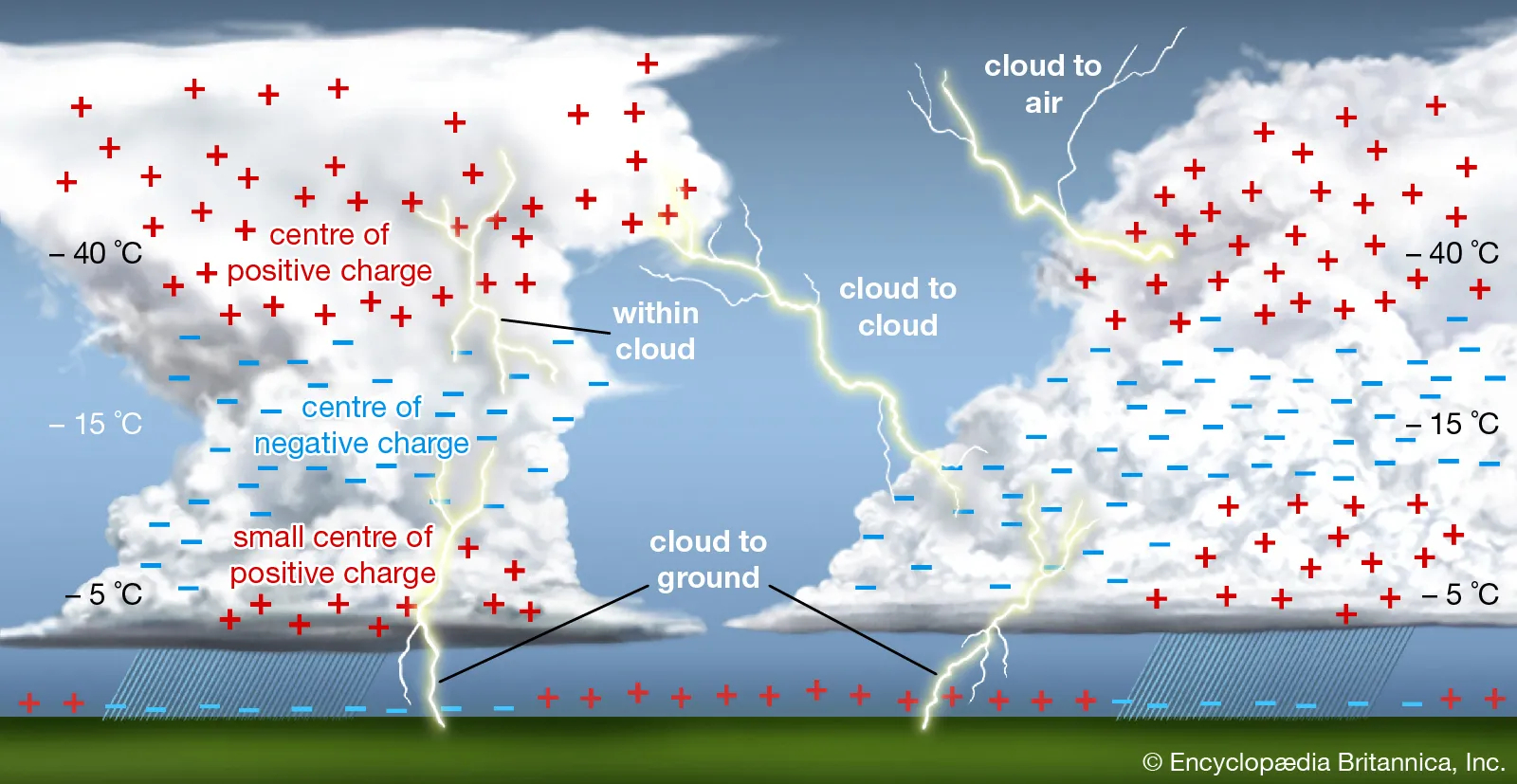
    • Scientifically, lightning is a rapid and massive discharge of electricity in the atmosphere some of which is directed towards earth.
    • The discharges are generated in giant moisture-bearing clouds that are 10-12 km tall.
    • The base of these clouds typically lie within 1-2 km of the Earth’s surface, while the top is 12-13 km away.
    • Temperatures in the top of these clouds are in the range of –35° to –45°C.

    Its formation

    • As water vapour moves upward in the cloud, the falling temperature causes it to condense.
    • As they move to temperatures below 0°C, the water droplets change into small ice crystals.
    • They continue to move up, gathering mass until they are so heavy that they start to fall to Earth.
    • This leads to a system in which, simultaneously, smaller ice crystals are moving up and bigger crystals are coming down.
    • Collisions follow and trigger the release of electrons, a process that is very similar to the generation of sparks of electricity.
    • As the moving free electrons cause more collisions and more electrons, a chain reaction ensues.
    • This process results in a situation in which the top layer of the cloud gets positively charged, while the middle layer is negatively charged.
    • The electrical potential difference between the two layers is huge, of the order of a billion to 10 billion volts.
    • In very little time, a massive current, of the order of 100,000 to a million amperes, starts to flow between the layers.

    Types of lightning

    • Broadly, there are three forms of lightning:
    1. Inter-cloud
    2. Intra-cloud
    3. Cloud-to-ground
    • It is the cloud-to-ground form of lightning that kills humans, as well as animals and livestock, and can substantially damage property.
    • While the Earth is a good conductor of electricity, it is electrically neutral.
    • However, in comparison to the middle layer of the cloud, it becomes positively charged.
    • As a result, about 15%-20% of the current gets directed towards the Earth as well.
    • It is this flow of current that results in damage to life and property on Earth.

    How intensely does it strike?

    • A typical lightning flash is about 300 million volts and 30,000 amps.
    • To put it in perspective, household current is 120 volts and 15 amps.
    • A flash of lightning is enough to light a 100-watt incandescent bulb for about three months.

    Why does lightning kill so many people in India?

    • The reason for the high number of deaths is due to people being caught unawares and more than 70% of fatalities happened due to people standing under isolated tall trees.
    • About 25 per cent of the people were struck in the open.
    • Also, lightning is the direct promulgation of climate change extremities.

    Mitigating lightning incidents

    • Lightning is not classified as a natural disaster in India.
    • But recent efforts have resulted in the setting up of an early warning system that is already saving many lives.
    • More than 96% of lightning deaths happen in rural areas.
    • As such, most of the mitigation and public awareness programmes need to focus on these communities.
    • Lightning protection devices are fairly unsophisticated and low-cost. Yet, their deployment in the rural areas, as of now, is extremely low.
    • States are being encouraged to prepare and implement lightning action plans, on the lines of heat action plans.
    • An international centre for excellence on lightning research to boost detection and early warning systems is also in the process of being set up.


    UPSC 2023 countdown has begun! Get your personal guidance plan now! (Click here)
  • Theri Desert in Tamil Nadu

    Most of us may not know the small desert situated in the state of Tamil Nadu. It consists of red sand dunes and is confined to the Thoothukudi district.

    Theri Desert

    • The red dunes are called theri in Tamil.
    • They consist of sediments dating back to the Quaternary Period and are made of marine deposits.
    • They have very low water and nutrient retention capacity.
    • The dunes are susceptible to aerodynamic lift.
    • This is the push that lets something move up. It is the force that is the opposite of weight.

    Mineral composition of Theris

    • The analysis of the red sand dunes reveal the presence of heavy and light minerals.
    • These include Ilmenite, Magnetit, Rutile, Garnet, Zircon, Diopside, Tourmaline, Hematite, Goethite, Kyanite, Quartz, Feldspar, Biotite.
    • The iron-rich heavy minerals like ilmenite, magnetite, garnet, hypersthene and rutile present in the soil had undergone leaching by surface water.
    • They were then oxidised because of the favourable semi-arid climatic conditions.

    How did they form?

    • Theris appear as gentle, undulating terrain.
    • The lithology of the area shows that the area might have been a paleo (ancient) coast in the past.
    • The presence of limestone in many places indicates marine transgression.
    • The present-day theris might have been formed by the confinement of beach sand locally, after regression of the sea.
    • When high velocity winds from the Western Ghats blew east, they induced migration of sand grains and accumulation of dunes.

    Another story of their formation

    • Another view is that these are geological formations that appeared in a period of a few hundred years.
    • The red sand is brought from the surface of a broad belt of red loam in the plains of the Nanguneri region (about 57 kilometres) by south west monsoon winds during May-September.
    • The winds after draining the moisture behind the Mahendragiri hill and the Aralvaimozhi gap of the Western Ghats become dry and strike the plains in the foothills, where vegetation is sparse.
    • Deforestation and the absence of vegetative cover in the Aralvaimozhi gap and the Nanguneri plains are considered to be the major causes of wind erosion.


    UPSC 2023 countdown has begun! Get your personal guidance plan now! (Click here)

  • Issues with the Environmental Performance Index (EPI)

    Context

    The 2022 Environmental Performance Index (EPI) produced by Yale and Columbia Universities and released on World Environment Day (June 5) has triggered much consternation in India, as the country is ranked last (180th).

    Issues with EPI 2022

    • Ignoring the past effects: Indicators may focus on current rates of increase or decrease in environmental pressures (flows) — as the EPI does for carbon dioxide emissions and tree cover gains — but under-state the accumulated effect (stocks) that relates to actual harm, thereby ignoring past effects.
    • Same standard in different socio-ecological context: When ranking countries, one is essentially applying the same standard across vastly different socio-ecological contexts – this involves difficult choices.
    • For example, the EPI leaves out arsenic in water, which is a major threat in Bangladesh.
    • Difficulty in measurement of frogress on climate change: Climate change is a global environmental problem, and because its effects depend on the accumulation of greenhouse gases over time, measuring progress in a given country is challenging.
    • Climate change mitigation has to be measured against what it is reasonable and fair to expect from different countries, taking into account their past emissions as well as national contexts.
    • There has been an inconclusive 30-year debate on this question; any choice of benchmark involves major ethical choices.
    • EPI has given 38 per cent weight to the climate change in the index.
    • They assume that the world must reach net zero emissions by 2050, and so the appropriate benchmark is whether all countries are reducing emissions and reaching zero by 2050.
    • Against CBDR: This approach is contrary to widely accepted ethical principles, especially the global political agreement on common-but-differentiated-responsibility (CBDR).
    • The Yale-Columbia approach ignores the fact that countries have different responsibilities for past accumulations and are at different levels of emissions and energy use.
    • The inclusion of indicators on emissions intensity and emissions per capita partly addresses this issue, but these two account for 7 per cent of the weight, versus 89 per cent for indicators derived from current emission trends.

    Implications EPI’s approach

    • This approach is guaranteed to make richer countries look good, because they have accumulated emissions in the past, but these have started declining in the last decade.
    •  Meanwhile, poorer countries that have emitted comparatively little in the past, look bad.
    • The EPI’s flawed and biased approach distracts from a much-needed honest conversation about the environment in India.
    • India’s local environmental performance on air, water and forests is deeply problematic.
    • Air quality in India is now the second largest risk factor for public health in India, behind only child and maternal nutrition.
    • Rivers and lakes are increasingly polluted, rivers are drying, groundwater tables are rapidly declining, and gains in tree cover hide declining natural productivity and diversity of forests and grasslands.

    Conclusion

    While indices like these have a limited attention-grabbing purpose, they serve this purpose well only when they are focused, limited to easy-to-measure metrics, and consciously minimise value judgements. The EPI 2022 resoundingly fails this test.

    UPSC 2023 countdown has begun! Get your personal guidance plan now! (Click here)

  • Microplastics found in Antarctica

    Scientists have found microplastics — plastic pieces much smaller than a grain of rice — in freshly fallen Antarctic snow for the first time.

    What are Microplastics?

    • Microplastics are tiny bits of various types of plastic found in the environment.
    • The name is used to differentiate them from “macroplastics” such as bottles and bags made of plastic.
    • There is no universal agreement on the size of microplastics. It defines microplastic as less than 5mm in length.
    • However, for the purposes of this study, since the authors were interested in measuring the quantities of plastic that can cross the membranes and diffuse into the body via the bloodstream.
    • Hence they agreed on an upper limit on the size of the particles as 0.0007 millimetre.

    Why in news?

    • Researchers have found microplastics in the snow samples from the Ross Ice Shelf in Antarctica.

    Threats posed by Microplastics

    • Microplastics has the potential to influence the climate by accelerating melting of ice.
    • They limit growth, reproduction, and general biological functions in organisms, as well as humans.


    Try this PYQ:

    1. Why is there a great concern about the ‘microbeads’ that are released into environment?

    (a) They are considered harmful to marine ecosystems.

    (b) They are considered to cause skin cancer in children.

    (c) They are small enough to be absorbed by crop plants in irrigated fields.

    (d) They are often found to be used as food adulterants.

    Post your answers here.[wpdiscuz-feedback id=”l00nal2to1″ question=”Please leave a feedback on this” opened=”1″][/wpdiscuz-feedback]


    Back2Basics: Ross Ice Shelf

    • Ross Ice Shelf is the largest ice shelf of Antarctica roughly the size of France.
    • It is several hundred metres thick.
    • The nearly vertical ice front to the open sea is more than 600 kilometres long, and between 15 and 50 metres (50 and 160 ft) high above the water surface.
    • Ninety percent of the floating ice, however, is below the water surface.
    • Most of Ross Ice Shelf is in the Ross Dependency claimed by New Zealand.
    • It floats in, and covers, a large southern portion of the Ross Sea and the entire Roosevelt Island located in the east of the Ross Sea.


    UPSC 2023 countdown has begun! Get your personal guidance plan now! (Click here)

  • Tendu Leaves Collection in India

    Tribal residents in Chhattisgarh have decided to file an FIR against an official of the state forest department after he confiscated the tendu leaves that they had collected.

    Tendu Leaves

    • Leaves of tree species Diospyros melanoxyion are used as wrappers of tobacco to produce bidi.
    • This tree is commonly known as “tendu,” but also called “abnus” in Andhra Pradesh, “kendu” in Orissa and West Bengal, “tembru” in Gujarat, “kari” in Kerala, “tembhurni” in Maharahstra, and “bali tupra” in Tamil Nadu.
    • This leaf is considered the most suitable wrapper on account of the ease with which it can be rolled and its wide availability.
    • Tendu is also called ‘green gold’ and is a prominent minor forest produce in India.

    How it is traded?

    • In 1964, the trade in tendu leaves was nationalised in then-undivided Madhya Pradesh.
    • Until then, people were free to sell tendu leaves in markets across the country.
    • Maharashtra adopted the same system in 1969, undivided Andhra Pradesh in 1971, Odisha in 1973, Gujarat in 1979, Rajasthan in 1974 and Chhattisgarh in 2000.
    • Under this arrangement, the state forest department collects tendu leaves, allows their transportation and sells them to traders.

    Why is there a dispute?

    • The dispute is essentially about who has the right to sell the leaves.
    • State governments say only they can do so due to nationalization.
    • On the other hand, tendu leaf collectors cite The Scheduled Tribes and Other Traditional Forest Dwellers (Recognition of Forest Rights) Act, 2006 and the 2013 Supreme Court verdict in the Niyamgiri Case to say private collectors can sell them on their own.
    • Tendu leaf collectors allege that the government gives them a lower price for the leaves, while it fetches a higher price in the open market.

    What do the tribals want?

    • The tribals, after having obtained forest rights leases under the FRA 2006, now want to sell tendu leaves on their own, with the permission of Gram Sabhas and make good profits.
    • Many types of minor forest produce like Mahua, Salbeej or the seeds of the Sal tree (Shorea robusta) and Chironji or Almondette kernels (Buchanania lanzan) are collected and sold by tribals.
    • Hence, there should not be a dispute over tendu leaves.

    Back2Basics: Forest Produce in India

    • Forest produce is defined under section 2(4) of the Indian Forest Act, 1927.
    • Its legal definition includes timber, charcoal, catechu, wood-oil, resin, natural varnish, bark, lac, mahua flowers, trees and leaves, flowers and fruit, plants (including grass, creepers, reeds and moss), wild animals, skins, tusks, horns, bones, cocoons, silk, honey, wax, etc.
    • Forest produce can be divided into several categories.
    • From the point of view of usage, forest produce can be categorized into three types: Timber, Non-Timber and Minor Minerals.
    • Non-timber forest products (NTFPs) are known also as minor forest produce (MFP) or non-wood forest produces (NWFP).
    • The NTFP can be further categorized into medicinal and aromatic plants (MAP), oilseeds, fibre & floss, resins, edible plants, bamboo, reeds and grasses


    UPSC 2023 countdown has begun! Get your personal guidance plan now! (Click here)

  • Rhino reintroduction a hit in Assam Reserves

    The one-horned rhinos of western Assam’s Manas National Park, bordering Bhutan, are expected to have high life expectancy and significant growth in population, the 14th Assam rhino estimation census has revealed.

    Indian Rhino

    • The Indian rhinoceros also called the greater one-horned rhinoceros and great Indian rhinoceros is a rhinoceros native to the Indian subcontinent.
    • It is listed as Vulnerable on the IUCN Red List and Schedule I animal in the Wildlife Protection Act, 1972.
    • It once ranged across the entire northern part of the Indian Subcontinent, along the Indus, Ganges and Brahmaputra River basins, from Pakistan to the Indian-Myanmar border.
    • Poaching for rhinoceros horn became the single most important reason for the decline of the Indian rhino.

    Why in news?

    • The 14th Rhino Population Estimation / Census in Kaziranga National Park counted at least 2613 rhinos including calves, a jump of exactly 200 rhinos since the last census conducted in 2018.
    • Then at least 2413 Rhinos were counted in the national park.

    Threats to Rhinos

    • Ground rhino horn is used in traditional Chinese medicine to cure a range of ailments, from cancer to hangovers, and also as an aphrodisiac.
    • In Vietnam, possessing a rhino horn is considered a status symbol.
    • Due to demand in these countries, poaching pressure on rhinos is ever persistent against which one cannot let the guard down.

    Various protection moves

    • A rhino reintroduction programme under the Indian Rhino Vision 2020 was started in 2006.
    • This entailed the translocation of rhinos from Kaziranga National Park and Pobitora Wildlife Sanctuary besides orphans hand-reared at the Centre for Wildlife Rehabilitation and Conservation at Kaziranga.

    Try this PYQ:

    Q. Consider the following statements:

    1. Asiatic lion is naturally found in India only.
    2. Double-humped camel is naturally found in India only.
    3. One-horned rhinoceros is naturally found in India only.

    Which of the statements given above is/are correct?

    (a) 1 only

    (b) 2 only

    (c) 1 and 3 only

    (d) 1, 2 and 3


    [wpdiscuz-feedback id=”n97ipqb1qb” question=”Please leave a feedback on this” opened=”1″]Post your answers here.[/wpdiscuz-feedback]

    (Note: Comment feature is not available on the app.)


    UPSC 2023 countdown has begun! Get your personal guidance plan now! (Click here)