💥Join UPSC 2027,2028 Mentorship (July Batch) + XFactor Notes & Microthemes PDF

Subject: Conservation & Mitigation

1. Conservation Progs.
2. Worldwide initiatives
3. Mitigation Strategies
4. Conventions and Protocols

  • Highlights of the Seoul Forest Declaration

    The participants from 141 countries gathered in person and online at the 15th World Forestry Congress in Seoul, Republic of Korea adopted the Seoul Forest Declaration.

    Seoul Forest Declaration

    • Shared responsibility: The Declaration urges that responsibility for forests should be shared and integrated across institutions, sectors and stakeholders.
    • Increased investment: Investment in forest and landscape restoration globally needs to triple by 2030 to meet internationally agreed commitments and targets on restoring degraded land.
    • Moving towards circular economy: One of the key takeaways was the importance of moving towards a circular bioeconomy and climate neutrality.
    • Innovative green financing mechanisms: To upscale investment in forest conservation, restoration and sustainable use, and highlighted the potential of sustainably produced wood as a renewable, recyclable and versatile material.
    • Decision-making: It urged the continued development and use of emerging innovative technologies and mechanisms to enable evidence-based forest and landscape decision-making.

    Other takeaways

    • Close cooperation among nations is needed to address challenges that transcend political boundaries.
    • This was strengthened at the Congress by the launch of new partnerships such as the:
    1. Assuring the Future of Forests with Integrated Risk Management (AFFIRM) Mechanism and
    2. Sustaining an Abundance of Forest Ecosystems (SAFE) Initiative

    Back2Basics: World Forestry Congress

    • The first World Forestry Congress first held in Rome in 1926. After that, it is held about every six years by the UN-FAO.
    • In 1954, FAO was entrusted with supporting Congress preparations in close cooperation with the host country and proudly continues to do so today. .
    • It has been providing a forum for inclusive discussion on the key challenges and way forward for the forestry sector.


    UPSC 2023 countdown has begun! Get your personal guidance plan now! (Click here)

  • Ramgarh Vishdhari notified as India’s 52nd Tiger Reserve

    Ramgarh Vishdhari Wildlife Sanctuary is now notified as a tiger reserve after a nod by the Union Ministry of Environment, Forest and Climate Change (MoEF&CC).

    Ramgarh Vishdhari TR

    • Ramgarh Vishadhri, located mostly in Bundi district and in part in Bhilwara and Kota districts.
    • It is also home to the Indian wolf, leopard, striped hyena, chinkara, antelope and foxes among other animals.
    • It is now India’s 52nd tiger reserve and Rajasthan’s fourth, after Ranthambore, Sariska and Mukundra.
    • The reserve will be spread in an area of 1,501.89 sq km.
    • The area has been called ‘critical’ for the movement of tigers by wildlife experts and conservationists.
    • Though the tiger population in Ramgarh itself was not high, it plays an important role in connecting the Ranthambore and Mukundra Tiger Reserves of Rajasthan.

    Back2Basics: Tiger Reserves

    • The Tiger Reserves of India were set up in 1973 and are governed by Project Tiger, which is administrated by the National Tiger Conservation Authority.
    • A National Park or Wildlife Sanctuary that is considered significant for protecting tigers can be additionally designated as a Tiger Reserve.
    • A Tiger Reserve consists of a ‘Core’ or ‘Critical Tiger Habitat’, which is to be managed as an inviolate area, and a ‘Buffer’ or Peripheral area immediately abutting a Core area, which may be accorded a lesser degree of habitat protection.
    • This is the typical zonation of a Tiger Reserve.


    UPSC 2023 countdown has begun! Get your personal guidance plan now! (Click here)

  • Green Manure and its productivity benefits

    The Punjab agriculture department is promoting the cultivation of green manure these days.

    What is the news?

    • Punjab Agro is providing subsidy on the seed at the rate of Rs 2,000 per quintal, which costs Rs 6,300 per quintal without subsidy
    • The farmers can avail its seed from the block level offices of the agriculture department as limited stock is available.

    What is Green Manure?

    • Green manures are crops grown specifically for maintaining soil fertility and structure.
    • It is done by leaving uprooted or sown crops parts, allowing them to wither onto the field and serve as mulch and soil fertilizers.
    • They are normally incorporated back into the soil, either directly, or after removal and composting.
    • There are three main varieties of green manure, including
    1. Dhaincha
    2. Cowpea
    3. Sunhemp
    • Also some crops such as summer moong, mash pulses and guar act as green manure.
    • They can be sown after wheat cultivation

    Characteristics of green manure

    • Green manure must be leguminous in nature
    • They must bear maximum nodules on its roots to fix large amount of atmospheric nitrogen in the soil.

    Various policy initiatives

    • Under Sub- Mission on Seed and Planting Material (SMSP), the govt. provides 50% cost assistance for the distribution of green manure required for a one-acre area per farmer.
    • The Paramparagat Krishi Vikas Yojana (PKVY) promotes cluster-based organic farming with PGS (Participatory Guarantee System) certification.


  • Places in news: Pantanal Wetlands

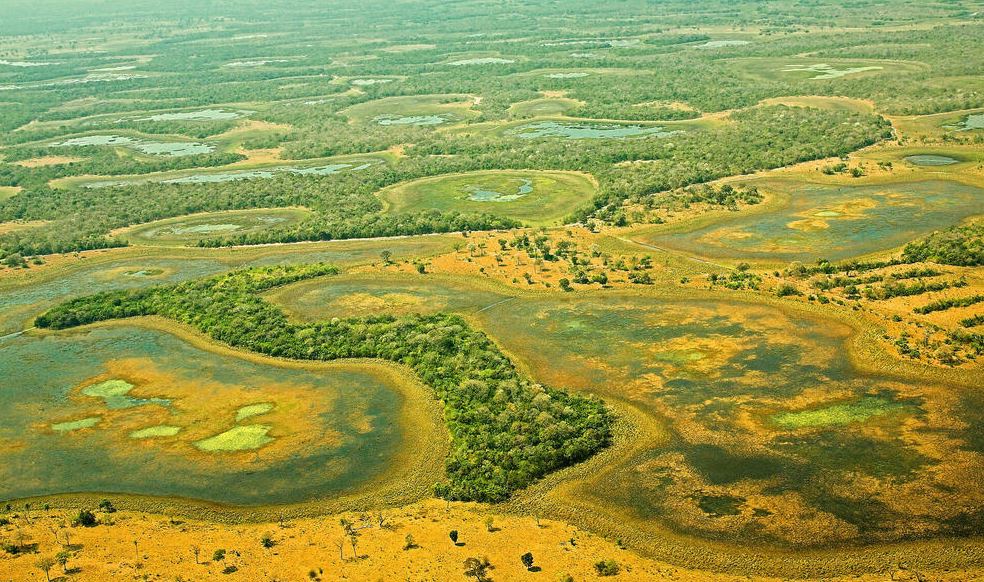
    The world’s largest wetland, the Pantanal in South America, is at the risk of collapse due to legal land-use decisions and proposals.

    About Pantanal

    • The Pantanal is a natural region encompassing the world’s largest tropical wetland area, and the world’s largest flooded grasslands.
    • It is located mostly within the Brazilian state of Mato Grosso do Sul, but it extends into Mato Grosso and portions of Bolivia and Paraguay.
    • It sprawls over an area estimated at between 140,000 and 195,000 square kilometres.
    • Various subregional ecosystems exist, each with distinct hydrological, geological and ecological characteristics; up to 12 of them have been defined.
    • Roughly 80% of the Pantanal floodplains are submerged during the rainy seasons, nurturing a biologically diverse collection of aquatic plants and helping to support a dense array of animal species.

    Significance of Pantanal

    • The Pantanal is a refuge for iconic wildlife. This massive wetland has the largest concentration of crocodiles in the world, with approximately 10 million caimans.
    • Jaguars, the largest feline in the Americas, hunt caiman in the Pantanal, which has one of the highest density of jaguars anywhere the world.

    Threats

    • Around 95% of the Pantanal is under private ownership, the majority of which is used for cattle grazing.


    UPSC 2023 countdown has begun! Get your personal guidance plan now! (Click here)

  • Mother Nature a ‘living being’ with legal entity: Madras HC

    Holding that it is the right time to confer juristic status to ‘Mother Nature’, Justice S. Srimathy of the Madurai Bench of Madras High Court invoked the ‘parens patriae jurisdiction’, and declared ‘Mother Nature’ as a ‘living being’ having the status of a legal entity.

    What is the news?

    • The Madras HC observed that ‘Mother Nature’ was accorded the rights akin to fundamental rights, legal rights, constitutional rights for its survival, safety, sustenance and resurgence in order to maintain its status and also to promote its health and well-being.

    Legal rights for nature: A backgrounder

    • The movement for legal personhood for the environment and animals began in the 1970s.
    • This concept was articulated by Christopher D. Stone in his thesis, Should Trees Have Standing.
    • In this compelling piece, the author makes an argument for the environment to have independent legal rights, much like what was granted by the judgment of the Uttarakhand High Court in 2017.
    • He highlights how the theory of rights has developed over the years and that many inanimate objects have both rights and legal duties. They can sue and be sued.

    What is the case for Madras HC’s personification of nature?

    • The Madras HC has made a personification of nature that focuses on the life-giving and nurturing aspects of nature by embodying it, in the form of the mother.
    • It observed that the court is hereby declaring ‘Mother Nature’ a ‘living being’ having the status of a legal person with all corresponding rights, duties and liabilities of a living person, in order to preserve and conserve it.
    • The State and Central governments are directed to protect ‘Mother Nature’ and take appropriate steps in this regard in all possible ways.

    A different course: Ecological Jurisprudence

    • The onset of climate change and the potential mass extinction of species is accompanied by the gradual closing window of opportunity to take meaningful action.
    • Activists around the world are calling for anthropocentric legal and governance systems to be replaced with ecocentric ones.
    • The last 15 years have seen a dramatic increase in the number of laws based on ecological jurisprudence.
    • Ecological jurisprudence is a philosophy that sees nature not as a set of objects to be exploited but as a community of subjects (humans and non-humans) who are connected through interdependent, reciprocal relationships.

    India’s typical case

    • In 2017, the Uttarakhand HC ruled (in two separate orders) that the Ganga, the Yamuna, their tributaries, and the glaciers and catchments feeding these rivers in Uttarakhand had rights as a “juristic/legal person/living entity”.
    • In 2018, the same HC ruled that the entire animal kingdom had rights similar to that of a living person (Narayan Dutt Bhatt vs Union of India).
    • In March 2020, the Punjab and Haryana High Court passed an order declaring the Sukhna Lake in Chandigarh city a living entity, with rights equivalent to that of a person.

    Beyond Rights

    • Law is a modern human construct. It not only talks in the language of rights and duties that only humans understand but also operationalizes them in a way that can further entrench human-centeredness.
    • In most cases where nature’s rights are recognized in law, they have done so by extending to it the concept of “personhood” in other words, akin to humans and, therefore, having human rights.
    • Hence, any such movement on recognizing the rights of the rest of nature must challenge the fundamental forms of injustices, including capitalism, stateism, anthropocentrism and patriarchy.

    Significance of such status

    • These rights-based laws granting legal personhood for nature aim to shift the legal status of the natural world from being human property to living entities in their own right and subjects of law.
    • This guarantees their right to exist, thrive, evolve and maintain their natural cycles.
    • These rights are not conferred by humans; it is a recognition that these rights have always existed.
    • It lays upon humans the duty to act as guardians for the more-than-human world.

    Issues of implementation

    • Assuming that these rights are recognised, nature or any of its entity cannot represent itself in a court of law.
    • Moreover there is the issue of custodianship.

    What would account for violations?

    • The Uttarakhand court order did not mention what amounted to violation of rights of rivers.
    • In order to be able to truly exercise the rights and implement appropriate redressal, there is a need for a comprehensive definition of the actions that amount to “violation of the rights”.
    • Say, the violation of the rights of rivers may be defined as “any obstruction or impediment that disables the entity from performing its essential ecological functions”.

    Restitution and compensation

    • The New Zealand law has an extensive section lending itself to restitutive, restorative and compensatory action.
    • It acknowledged the government’s decisions and actions for more than a century that resulted in the violation of the health of the Whanganui and the rights, culture and well-being of the indigenous people living along the river.
    • Several specific examples were given, including the dismantling of traditional structures for fishing and river use, a hydroelectric project and mining.
    • Such an acknowledgment is a necessary first step towards seeking appropriate restitutive and compensatory measures.

    Another question: Bioregional Governance

    • Recognizing river ecosystems or other entities of nature as having rights offers the possibility of managing and governing habitats based on the ecological realities of the region.
    • It brings out the bizarre fact that the human-drawn nation state, and political lines on maps in various parts of the world have created conflict situations or disrupted ancient cultural and ecological flows and relations.
    • We need to begin reimagining governance from a bioregional governance point of view.
    • This would also mean bridging the gap between the customary ways of decision making and the current legal frameworks.
    • There is a need for more imaginative lawyers, activists and judges to help move towards an eco-centric and diverse legal framework.

    Way forward

    • There is a need for a comprehensive system to implement and protect their rights.
    • The rights can be safeguarded using the principles of custodianship.
    • The Uttarakhand High Court order named several government functionaries and a couple of independent lawyers as “parents”.
    • An alternative solution is that custodianship or guardianship be given to a body of local communities associated with the river.
    • These communities have traditional or customary rights of the river such as fisherfolk, farmers along the riverbank, and people directly engaged in river-related services.


    UPSC 2023 countdown has begun! Get your personal guidance plan now! (Click here)

  • Places in news: Gulf of Gabes

    A Fuel Ship with 750 tons of diesel sinks off the Gulf Of Gabes in Tunisia.

    Gulf of Gabes

    • The Gulf of Gabes also known as Lesser Syrtis contrasting with the Greater Syrtis in Libya, is a gulf on Tunisia’s east coast in the Mediterranean Sea, off North Africa.
    • The gulf roughly spans the coast from Sfax to Djerba.
    • At the head of the gulf is the city of Gabès (Ghannouche) where the tides have a large range of up to 2.1 m at spring tides.
    • Both Gabès and Sfax are major ports on the gulf, supporting sponge and tuna fisheries, with Gabès being the economic and administrative centre.
    • It is 60 miles (100 km) long and 60 miles wide and is bounded by the Qarqannah (Kerkena) Islands on the northeast and by Jarbah (Djerba) Island on the southeast.

    Regional economy of the gulf

    • Except for the Strait of Gibraltar and the Gulf of Venice, it is the only part of the Mediterranean with a substantial tidal range, causing the uncovering of extensive sandbanks at low water.
    • Sponge and tuna fisheries are located at the main ports of Qābis (Gabès) and ᚢafāqis (Sfax).
    • Oil and natural-gas deposits have been found in the gulf, east of ᚢafāqis.


    UPSC 2022 countdown has begun! Get your personal guidance plan now! (Click here)

  • Species in news: Indian Tent Turtles

    Indian tent turtle is now listed in Schedule –I of the Wild Life (Protection) Act, 1972 and is thereby provided the highest degree of protection.

    Why in news?

    • The Indian tent turtle is threatened due to illegal mining in Narmada River.
    • This turtle has also been widely traded as a pet at aquariums.

    Indian Tent Turtles

    IUCN status: Least Concerned

    • The Indian tent turtle (Pangshura tentoria) is a species of turtle in the family Geoemydidae. The species is endemic to India and Bangladesh.
    • Its preferred habitats are freshwater rivers and swamps.
    • The species is native to India, Nepal and Bangladesh, with three subspecies recorded from the region viz., P. t. tentoria, P. t. circumdata and P. t. flaviventer.
    • t. tentoria occurs in peninsular India and is recorded from Orissa, Maharashtra, Andhra Pradesh, Assam and Madhya Pradesh.
    • t. circumdata occurs in the western tributaries of Ganga and the rivers of Gujarat. It is found in Rajasthan, Madhya Pradesh, Uttar Pradesh and Gujarat.
    • t. flaviventer occurs in the northern tributaries of Ganga and is recorded from Uttar Pradesh, Bihar, West Bengal and Assam.

    Back2Basics:  Wildlife (Protection) Act, 1972

    • WPA provides for the protection of the country’s wild animals, birds and plant species, in order to ensure environmental and ecological security.
    • It provides for the protection of a listed species of animals, birds and plants, and also for the establishment of a network of ecologically-important protected areas in the country.
    • It provides for various types of protected areas such as Wildlife Sanctuaries, National Parks etc.

    There are six schedules provided in the WPA for protection of wildlife species which can be concisely summarized as under:

    Schedule I: These species need rigorous protection and therefore, the harshest penalties for violation of the law are for species under this Schedule.
    Schedule II: Animals under this list are accorded high protection. They cannot be hunted except under threat to human life.
    Schedule III & IV: This list is for species that are not endangered. This includes protected species but the penalty for any violation is less compared to the first two schedules.
    Schedule V: This schedule contains animals which can be hunted.
    Schedule VI: This list contains plants that are forbidden from cultivation.


    UPSC 2022 countdown has begun! Get your personal guidance plan now! (Click here)


  • Conservation of Sacred Grooves

    India’s sacred groves are being gradually altered due to ever-expanding human populations, pollution and removal of biomass; effective conservation is the need of the hour to maintain their functional values

    What are Sacred Grooves?

    • Sacred groves of India are forest fragments of varying sizes, which are communally protected, and which usually have a significant religious connotation for the protecting community.
    • It usually consists of a dense cover of vegetation including climbers, herbs, shrubs and trees, with the presence of a village deity and is mostly situated near a perennial water source.
    • Sacred groves are considered to be symbols of the primitive practice of nature worship and support nature conservation to a great extent.
    • The introduction of the protected area category community reserves under the Wild Life (Protection) Amendment Act, 2002 has introduced legislation for providing government protection to community-held lands, which could include sacred groves.

    Historical references

    • Indian sacred groves are often associated with temples, monasteries, shrines, pilgrimage sites, or with burial grounds.
    • Historically, sacred groves find their mentions in Hindu, Jain and Buddhist texts, from sacred tree groves in Hinduism to sacred deer parks in Buddhism for example.
    • Sacred groves may be loosely used to refer to natural habitat protected on religious grounds.
    • Other historical references to sacred groves can be obtained in Vrukshayurveda an ancient treatise, ancient classics such as Kalidasa’s Vikramuurvashiiya.
    • There has been a growing interest in creating green patches such as Nakshatravana

    Regulation of activities in Sacred Grooves

    • Hunting and logging are usually strictly prohibited within these patches.
    • Other forms of forest usage like honey collection and deadwood collection are sometimes allowed on a sustainable basis.
    • NGOs work with local villagers to protect such groves.
    • Traditionally, and in some cases even today, members of the community take turns to protect the grove.

    Threats to such grooves

    • Threats to the groves include urbanization, and over-exploitation of resources.
    • While many of the groves are looked upon as abode of Hindu deities, in the recent past a number of them have been partially cleared for construction of shrines and temples.

    Total grooves in India

    • Around 14,000 sacred groves have been reported from all over India, which act as reservoirs of rare fauna, and more often rare flora, amid rural and even urban settings.
    • Experts believe that the total number of sacred groves could be as high as 100,000.
    • They are called by different names in different states:
    1. Sarna in Bihar
    2. Dev Van in Himachal Pradesh
    3. Devarakadu in Karnataka
    4. Kavu in Kerala
    5. Dev in Madhya Pradesh
    6. Devarahati or Devarai in Maharashtra
    7. Lai Umang in Maharashtra
    8. Law Kyntang or Asong Khosi in Meghalaya
    9. Oran in Rajasthan
    10. Kovil Kadu or Sarpa Kavu in Tamil Nadu

    What lies ahead?

    • The groves have great research value in in situ conservation of rare, endangered and threatened plant species.
    • It is high time that public awareness is created about the importance of these sacred groves, developmental activities are banned and the felling of trees or removal of any other vegetation is completely stopped.
    • This is possible only by way of enacting a special law for the protection and management of sacred groves.
    • As the management practices and other rituals vary from state to state, the concerned state governments may promulgate such an act as suitable for the state.
    • The idea should be to protect certain rare, endangered and threatened plant species in the era of global warming and climate change.


    UPSC 2022 countdown has begun! Get your personal guidance plan now! (Click here)

  • Rhino population up by 200 in Kaziranga

    The population of the greater one-horned or Indian rhinoceros in the Kaziranga National Park and Tiger Reserve has increased by 200 (from 2413 in 2018) in four years, the latest census of the flagship animal has revealed.

    About Indian Rhino

    • The Indian rhinoceros also called the greater one-horned rhinoceros and great Indian rhinoceros is a rhinoceros native to the Indian subcontinent.
    • It is listed as Vulnerable on the IUCN Red List and Schedule I animal in the Wildlife Protection Act, 1972.
    • It once ranged across the entire northern part of the Indian Subcontinent, along the Indus, Ganges and Brahmaputra River basins, from Pakistan to the Indian-Myanmar border.
    • Poaching for rhinoceros horn became the single most important reason for the decline of the Indian rhino.

    Why are Rhinos poached for horns?

    • Ground rhino horn is used in traditional Chinese medicine to cure a range of ailments, from cancer to hangovers, and also as an aphrodisiac.
    • In Vietnam, possessing a rhino horn is considered a status symbol.
    • Due to demand in these countries, poaching pressure on rhinos is ever persistent against which one cannot let the guard down.

    Try this PYQ:

    Q. Consider the following statements:

    1. Asiatic lion is naturally found in India only.
    2. Double-humped camel is naturally found in India only.
    3. One-horned rhinoceros is naturally found in India only.

    Which of the statements given above is/are correct?

    (a) 1 only

    (b) 2 only

    (c) 1 and 3 only

    (d) 1, 2 and 3


    [wpdiscuz-feedback id=”fp1gk14f8l” question=”Please leave a feedback on this” opened=”1″]Post your answers here.[/wpdiscuz-feedback]

    UPSC 2022 countdown has begun! Get your personal guidance plan now! (Click here)
  • Places in news: Sariska Tiger Reserve

    A massive fire has broken out in the Sariska Tiger Reserve and Air Force helicopters equipped with water sprays are battling to bring it under control.

    Sariska Tiger Reserve

    • Sariska Tiger Reserve is a tiger reserve in Alwar district, Rajasthan.
    • It stretches over an area of 881 sq km comprising scrub-thorn arid forests, dry deciduous forests, grasslands, and rocky hills.
    • This area was a hunting preserve of the Alwar state and was declared a wildlife sanctuary in 1958.
    • It was given the status of a tiger reserve making it a part of India’s Project Tiger in 1978.
    • It is the first reserve in the world with successfully relocated tigers.
    • It is a part of the Aravalli Range and the Khathiar-Gir dry deciduous forests eco-region.

    Existential threats

    • It is rich in mineral resources, such as copper.
    • In spite of the Supreme Court’s 1991 ban on mining in the area, marble mining continues to threaten the environment.

    UPSC 2022 countdown has begun! Get your personal guidance plan now! (Click here)