Why in the News
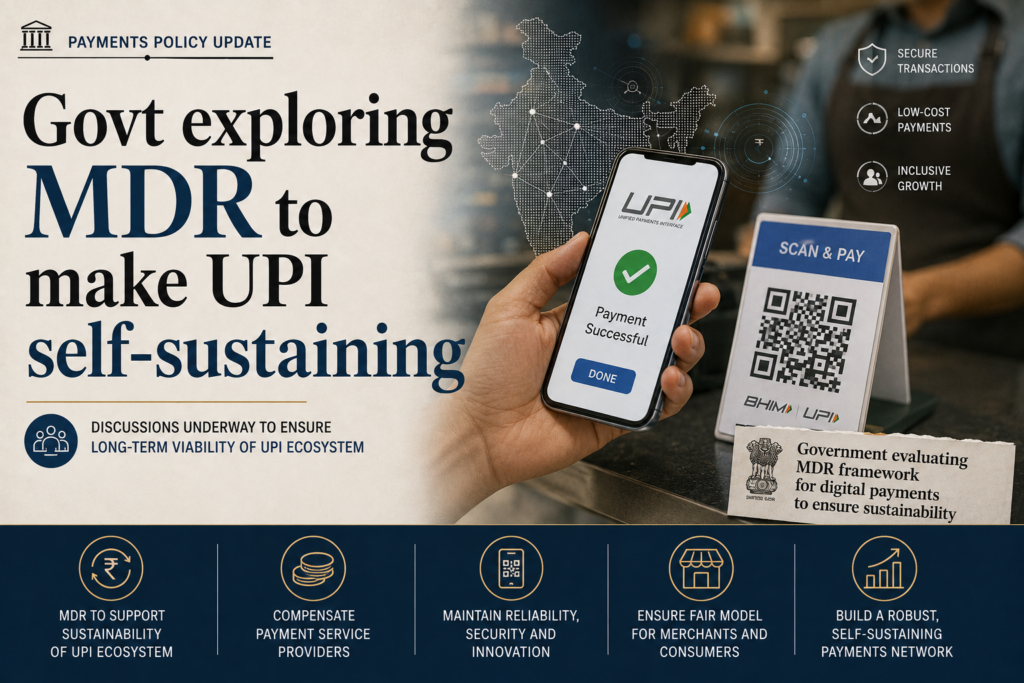
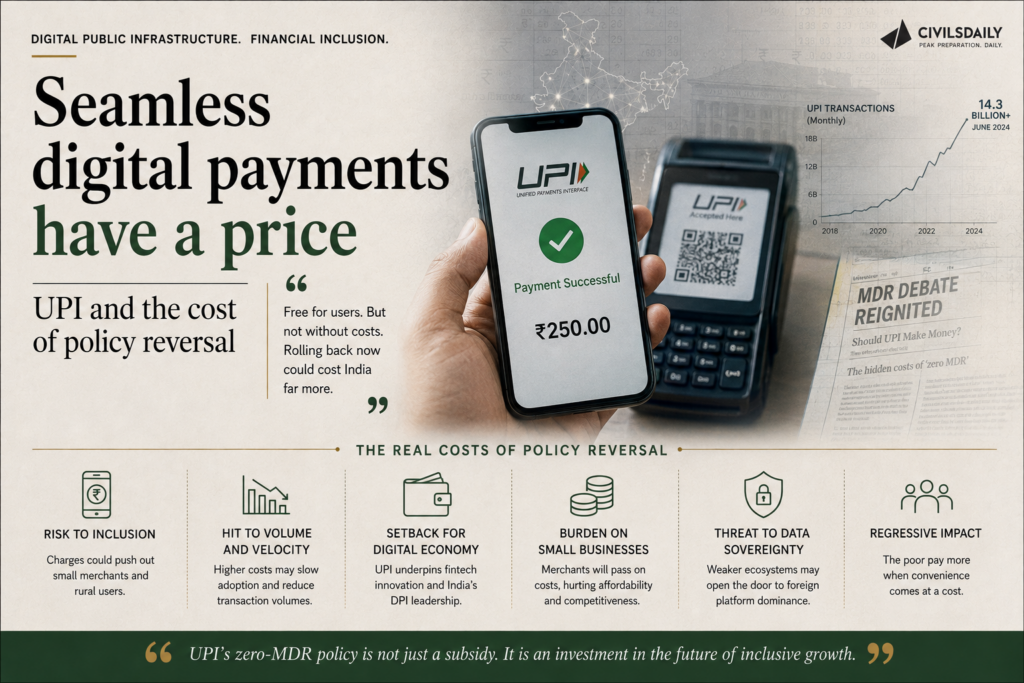
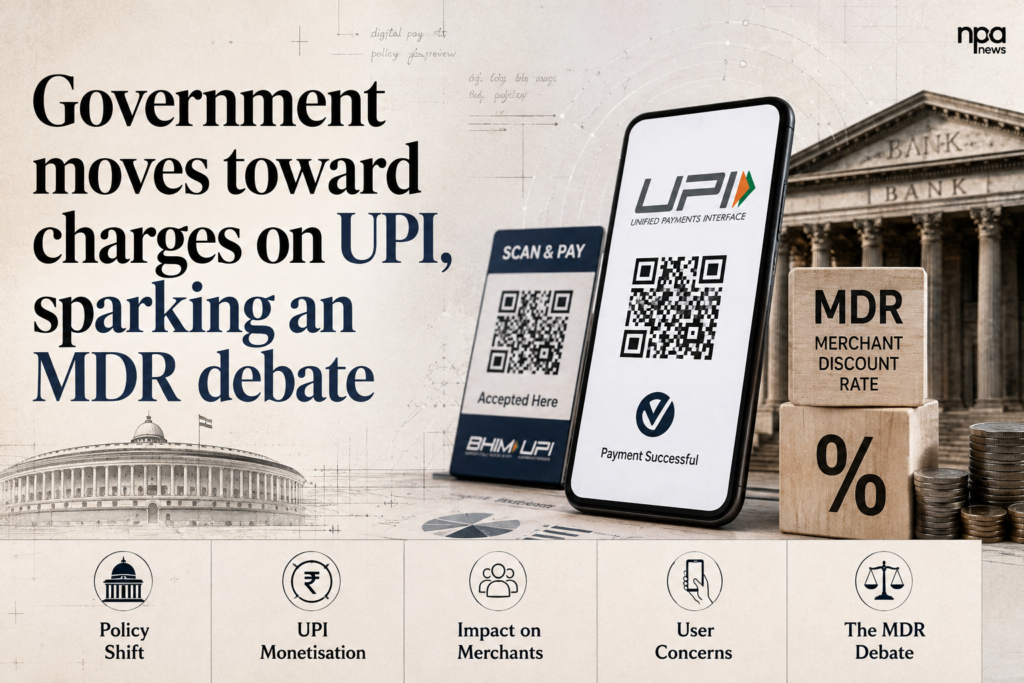
A merchant discount rate of 0.3% on Unified Payments Interface (UPI) transactions of Rs 2,000 and above is expected to be announced within two weeks. Six years of zero pricing built a network that now carries most of India’s digital payment volume without generating the revenue to maintain it, and restoring a fee moves that cost onto merchants while keeping the transaction free for consumers.
What is the merchant discount rate?
- About: The merchant discount rate (MDR) is a fee paid by businesses to payment processors for accepting digital payments, deducted from the amount the merchant receives.
- Who it is shared among: The fee funds the banks, payment service providers and network operators that carry a transaction between the payer and the merchant.
- Its history on UPI: An MDR of up to 0.3% of the transaction value applied to UPI person-to-merchant transactions until December 2019.
- Zero MDR: Zero MDR was introduced in January 2020 to accelerate digital payment adoption and encourage a shift from cash to digital payments.
What is the UPI and Services Steering Committee?
- About: It is the body headed by the National Payments Corporation of India that will determine the merchant discount rate on UPI, its scope and its structure.
What is Section 10A of the Payment and Settlement Systems Act, 2007?
- About: Section 10A is the provision granting statutory protection from charges to specified electronic payment modes, which is what prevented a fee being levied on UPI.
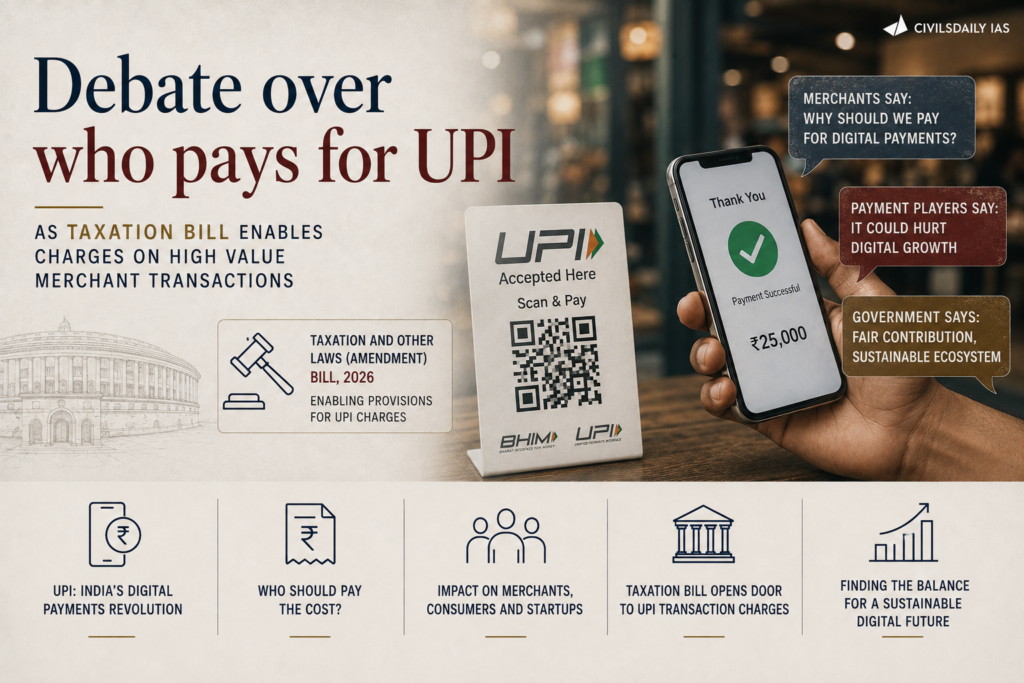
- What changed: The Taxation and Other Laws (Amendment) Bill, 2026 amended Section 10A to pave the way for an MDR on UPI transactions above a certain threshold.
How will the fee actually be brought into effect?
- Step one, the gazette notification: The Department of Financial Services will likely issue a gazette notification within a week specifying which electronic payment modes continue to receive statutory protection from charges.
- Step two, the rate decision: The UPI and Services Steering Committee will then determine the MDR, its scope and its structure.
- The consumer assurance: The government assured during the parliamentary debate on the amending Bill that UPI transactions will remain free for consumers.
Why is a fee being restored after six years of zero pricing?
- Volume outgrew the funding model: UPI transactions jumped sharply after the Covid-19 pandemic, and banks and payment intermediaries ramped up investment in payment infrastructure to carry that load.
- Industry pressure for sustainability: The scale of that investment produced industry calls for the restoration of charges to make the system financially sustainable.
- The interim substitute was a subsidy: The government introduced an incentive scheme providing banks and other ecosystem participants an incentive equivalent to 0.15% MDR on UPI transactions up to Rs 2,000.
- The parliamentary committee’s warning: The Parliamentary Standing Committee on Finance called for early implementation of a tiered MDR framework, warning that delays could leave payment service providers dependent on inadequate government subsidies and weaken investment in payment infrastructure.
How does 0.3% compare with the cost of other payment instruments?
- Credit cards: The prevailing MDR on credit card transactions is 1% to 3% of transaction value.
- Debit cards: The prevailing MDR on debit card transactions runs up to 0.9%.
- UPI at the proposed rate: A reintroduced MDR of 0.3% above a threshold would still be substantially lower than either.
- The subsidy benchmark: The proposed rate is double the implicit rate the exchequer already bears through the incentive scheme on small-value payments.
- The volume the rate applies to: UPI processed 241.62 billion transactions worth Rs 314.23 lakh crore in 2025-26, so even a fraction of a percent applied above a threshold is a large revenue pool.
Why does a free-to-consumer network still have to be paid for by someone?
- The cost does not disappear when the price is zero: Switching, settlement, fraud monitoring and dispute resolution have running costs, and zero MDR moved them from merchants onto banks and the exchequer.
- Subsidy funding is discretionary and can lapse: An incentive scheme depends on an annual budgetary allocation, which is what the Parliamentary Standing Committee on Finance identified as inadequate and unreliable.
- Merchants now bear what consumers do not: Keeping the consumer free means the fee lands on the acceptance side, on the same small merchants whose adoption zero MDR was designed to secure.
- The threshold is doing the distributive work: Applying the fee only at Rs 2,000 and above protects the low-value transactions that dominate UPI by count, and captures the higher-value transactions that dominate by value.
What challenges does reintroducing MDR on UPI face?
- Merchant resistance at the acceptance point: Small merchants may refuse UPI above the threshold or steer customers to cash to avoid the fee. Eg. Cash-on-delivery persists across Indian e-commerce despite a decade of digital payment incentives.
- Transaction splitting to stay below the threshold: A hard cut-off gives both sides a reason to break one payment into two. Eg. A payment of Rs 2,500 broken into two of Rs 1,250 falls below the threshold and carries no fee.
- Erosion of the adoption gains zero MDR bought: The zero-price regime was introduced specifically to shift users from cash, and reversing it risks reversing part of that shift. Eg. Zero MDR was introduced in January 2020 for the stated purpose of accelerating digital payment adoption.
- Concentration risk in the underlying network: A small number of third-party applications carry most UPI volume, so pricing decisions transmit through a narrow set of intermediaries. Eg. The National Payments Corporation of India has repeatedly deferred its own market share cap on third-party application providers.
- Outage and reliability exposure at national scale: A single network carrying most retail payments makes any downtime a systemic event rather than a service failure. Eg. UPI accounted for 85% of India’s digital payment transactions by volume in 2025-26.
- Fraud and mule account misuse growing with volume: Higher-value transactions attract more sophisticated fraud, and the cost of investigation falls on the same intermediaries the fee is meant to fund. Eg. The Reserve Bank of India has repeatedly directed banks to tighten controls on accounts used to route proceeds of digital payment fraud.
- Cross-subsidy questions across instruments: Pricing UPI below cards while both run on shared bank infrastructure distorts the choice of instrument at the counter. Eg. Credit card MDR at 1% to 3% funds reward programmes that UPI cannot match at 0.3%.
Conclusion
Zero MDR delivered adoption at a scale no other retail payment system has reached, and it did so by placing the cost of the network on banks and on the exchequer rather than on its users. Restoring a 0.3% fee above Rs 2,000 converts that subsidy into a price, keeps consumers unaffected and tests whether merchants will absorb the cost at the acceptance point. The measure currently stands at the stage where Section 10A of the Payment and Settlement Systems Act, 2007 has been amended, and the next milestones are a gazette notification from the Department of Financial Services within a week and the rate decision by the UPI and Services Steering Committee within two weeks.
“[2026] Which one of the following statements about Unified Payments Interface (UPI) and Central Bank Digital Currency (Digital Rupee) is NOT correct?
(a) UPI is a real-time payment system but Digital Rupee is akin to sovereign paper currency
(b) In case of UPI, settlement for end users happens instantly; in case of Digital Rupee, wallet balance gets transferred to another wallet (no traditional settlement)
(c) UPI transactions are recorded by banks and reflected in bank statements; in case of Digital Rupee, no data is captured in bank statements
(d) In both the cases (UPI and Digital Rupee), the liability lies with the users and their respective banks