💥Mains Ready By December. Smash Mains & Smash PYQ Admissions Open

Subject: Economics

  • Direct Benefits Transfers

    The government’s DBT plan involves transferring the subsidy amount directly to the beneficiaries’ bank accounts.

    • Here, the government does not have to fiddle around with differential pricing for the underprivileged.
    • This method can effectively address the issue of leakages and go a long way in solving the mis-targeting problem.

    The government has also linked DBT to Aadhaar. Efficient targeting, using Aadhaar-linked data, ensures that the intended beneficiary receives the money in his account, thus helping him as well as reducing the government’s subsidy burden. This has resulted in effectively solving the leakage and mis-targeting problems in some schemes.


    • DBT in India
    • Pre requisite of successful DBT
    • Merits of DBT
    • Demerits of DBT
    • DBT in fertilizers
    • Is India ready to implement DBT in all programmes?
    • Suggestions for improvement
    • Conclusion

    DBT in India

    Direct Benefit Transfer is a mechanism to transfer the subsidy amount directly to the bank account of beneficiaries. Main agendas for DBT is to prevent and address following

    1. Leakages
    2. Delays
    3. Reducing structural expenses in distributing the subsidies in hand
    4. Encouraging everyone to have bank account and achieve financial inclusion.

    Right now it is applied to only 4 areas that too in selected districts:

    1. LPG subsidies
    2. Jnani Suraksha Yojana
    3. Old age pension
    4. Scholarships

    Pre requisite of successful DBT

    source

    Merits of DBT (Direct Benefit Transfer)

    • Leakage and delays are prevented.
    • Reduces Corruptions and black money issue.
    • Reduces economical inequalities in rural areas as everyone gets theire share rightfully.
    • Reducing the government expense on PDS, Cooperative society, bureaucracy to distribute scholarships etc.
    • Reduces time, energy and money of people to get their money/commodity.
    • Encourage free and fair market structure. Earlier subsidised grains entering market through backdoor used to distort the price in market.
    • More circulation of money in economy which will lead to at least 0.5% growth in GDP.
    • Government can better focus on other issues and not engaging in distribution.
    • Transportation charge for FCI and NABARD subsidies for warehouses will be reduced.
    • Slowly importance of MSP will reduce while price a farmer would fetch will increase which is win-win situation for farmers, also non-food crops will get importance which is issue right now in India.
    • Financial institutions will pay attention in rural area once people have cash in their hand.
    • Health facility will get better with private hospital giving facilities once people will have money to get treatment.

    Demerits of DBT

    • Money in the hand of poor may get spent in something other than what is needed, a scholarship needed to be spent in education only, but how government can ensure that, once she has sent it to account
    • Most accounts holder are males who have accessibility to banks, hence it will lead to usage by them only. Females may not get their share if they are the intended beneficiaries
    • With lesser banks in rural parts of India, it will be another overhead for people to get their withdrawal
    • Delay in transfer may create more turbulence as many will flock to banks to check on their balances

    DBT in fertilisers

    Government is embarked on rationalizing subsidies as has been seen in LPG subsidy which saved thousands of crores of government exchequer. Now it has proposed for rolling out DBT for fertilizers as has been mentioned in recent economic survey.

    Pros of DBT in fertilizer –

    • It would be beneficial for minimizing the use of fertilizer which would check degradation of soil nutrients and would prevent water contamination.
    • Farmers would be free from moneylender’s debt trap as now they would have secure money in their bank accounts. It would be helpful for inculcating saving habits also in farmers.
    • Released government control on the fertilization market would drive competition and would enhance productivity.
    • Enhanced financial inclusion and financial literacy will give boost to digital India and skill India.
    • No middlemen > no leakage > benefits to the needy > correct use of tax payer’s money (redistribution of wealth).
    • Less burden on government exchequer > fiscal consolidation target >money transferred in job creation and infrastructure development

    However there are some cons which need to be factored – 

    • More money in hand may lead to misuse like in drug, alcohol, unnecessary shopping or gambling etc.
    • May further widen the gap between big farmers and small farmers.
    • Bio-identification can be detrimental for the personal information of farmers if not properly handled.

    Operational challenges –

    • Management of data whether it may be of land, of status of farmer (landholder, tiller or tenant etc) or pertaining to agriculture practice is not up to the level in our country.
    • Though crores of accounts are opened but still there is a good number of people who are unbanked.
    • Some farmers have little knowledge about banking system so they can fall prey of undue interference.

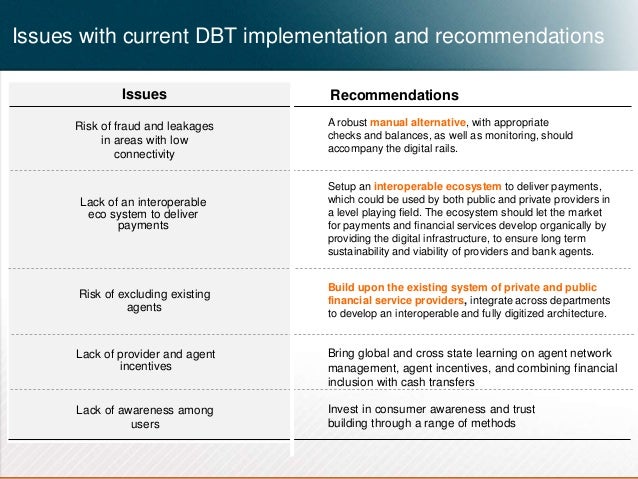
    Is India ready to implement DBT across all programmes?

    The debate of implementing DBT in all subsidy programmes is discussed below. A proper implementation would helpful in following ways –

    • Filling leakages: DBT will help in reducing malpractices like leakages, ultimately giving the beneficiary what he is entitled. Example: LPG subsidy.
    • Increasing incomes: with large number of schemes which are implemented with an intention to increase incomes of the poor, but due to delay and other factors most of the time poor gets subsidy after a long time (like in wages of MNREGA). DBT can reduce these cases.
    • Financial inclusion: with the provision of DBT, poor will get themselves included in financial system of the country, which will help them to get other benefits and will boost their saving.

    Some of the downsides of the implementation – 

    • People may use money for other purposes rather than using it for what it is meant for like in case of PDS.
    • Due to lack of education and financial literacy, poor will keep themselves outside the purview of banks.
    • Inadequate development of the banking channel in rural areas is also a challenge.
    • Lack of adequate documents also leads to exclusion of many poor from banking sector.
    source

    Conclusion

    DBT revolutionized the banking sector by connecting low income segments of society with banks. There is no doubt that DBT has created a firm base for financial inclusion, which will include poor sections to the growth and development processes.

    National Payment Corporation of India (NPCI) has successfully opened 150 million DBT accounts with Adhaar numbers and around 125 million accounts under Jan Dhan Yojana.

    The government is fully relying on this scheme to plug leakages and save costs. It is estimated that over the time it could save up to 1.2% of GDP, which is currently lost in transit.


    References:

  • Tourism Sector

    It’s no secret that our Tourism Industry remains heavily underemployed, highly unregulated and its true potential to both Economy and workforce is still unharnessed. 

    With 32 UNESCO recognized natural and cultural heritage sites, India ranks second in Asia and fifth in the world. Still, India’s share in ITAs (International tourist arrivals) is a paltry 0.6%. 

    source

    Why are International / Foreign Tourists important?

    • For one, they bring in much valued Foreign Currency which contributes to our Foreign Exchange Reserves and keeps our Balance of Payment robust. <Note that Tourist expenditure in India counts as “Exports” under BoP accounting>
    • India’s receipts from tourism during 2012 ranked 16th in the world, and 7th among Asian and Pacific countries (World Tourism Organization Report)
    • It helps stabilize our currency in International Market
    • Builds Brand India (Incredible !ndia campaign has proven to boost foreign tourism more than domestic tourism)
    • Although it is notable that domestic tourists contribute to more than 75% of the revenue from Tourism Sector, but its denominated in INR
      • Note:  Under 7th Schedule division of Powers, Pilgrimages outside India comes under Union’s List while those Inside India is covered by State List.

    India’s Comparative performance in International tourist arrivals (ITAs)

    • ITA simply means the percentage of outbound tourists travelling to another country in proportion to all outbound tourists of the world combined.
    • France has the highest share of ITAs, despite being much smaller than a continent size country like India. (India’s share in ITA is 0.6% compared to 7.8 per cent in France)
      • Foreign tourist arrivals by source country: Largest foreign tourists are from USA, 2nd largest from Bangladesh and third largest from UK.
      • Tamil Nadu witnesses most foreign tourist visits.
    •  Although ITAs in India registered a growth of 10.6%, countries like Vietnam and Indonesia continue to have higher shares of FTAs than India
      • Internationally ranking pitiably 41st in terms of Foreign Footfalls- India gets only 77 lakh foreign tourists every year.
      • Travel & Tourism Competitiveness Report 2015 (World Economic Forum) ranks India 52nd out of 141 countries overall in areas other than Foreign Footfall.
        • India has quite good air transport (ranked 35th)
        • Reasonable ground transport infrastructure (ranked 50th).
    • Target: In next 3-5 years, we want to receive >1 crore tourists (and 1% of the ITAs should be in India)

    Who qualifies as a foreign tourist?

    • Staying at least twenty four hours in the country
    • Purpose of whose journey can be classified as either
      • Leisure (recreation, holiday, health, study, religion and sport)
      • Business, family, mission, meeting
    • Following are excluded from category of Foreign Tourists:
      • Persons arriving to take up an occupation or engage in activities remunerated from within the country are not treated as foreign tourists
      • Nationals of Nepal and Bhutan entering India through land routes, are also not included in the data series on foreign tourism

    Burning issue of Foreign Tourists and Sexual Assaults

    • Its noteworthy that 40% of the foreign tourists who came to India in 2013 were women
    • Delhi has repeatedly topped the survey for being the most unsafe and hostile city for Foreign Tourists.
    • How can this be prevented?
      • Foreign tourists in India are advised to take the same precautions like domestic tourists take
      • Code of conduct for tourist destinations and the stake holders there has also been fixed.
      • Accused should be apprehended by the police authorities within a few days and action be initiated to bring the culprits to justice
      • E.g. In the Madhya Pradesh incident in March, 2013, the accused were tried in a Fast Track Court and sentenced to life imprisonment within four months.

    What are other benefits of Tourism Sector to India?

    Economy: 

    • Contributes to 9% of global GDP, In India’s case it contributed 6.8% of the GDP

    Employment and demographics:

    • It is a labour intensive industry (Employs 8.7% of India’s workforce) and provides livelihood to non-farm sector
    • Although Tourism in India being largely an unorganized sector activity, potential for employment is still untapped
    • Women comprise 70% of the workforce and 50% of the workforce is below 25 years

    Other benefits apart from Employment:

    • Helps preserve heritage and culture (Fundamental Duty and DPSP)
    • Niches such as Rural tourism, and Ecotourism can help reverse migration to urban areas
    • Tourism sector can be a powerful antidote to poverty, it eliminates the disadvantage of market inacessibility suffered by poor in respect of their goods and services by bringing consumers to their doorstep

    Tourism reforms by integration with ongoing schemes

    It is said that Tourism as a sector doesn’t need huge budgetary expenditure for its rise as a “sunrise industry”. Here, we look at some of the ways we can make it so by integrating with ongoing schemes of Government of India.

    1. Infrastructure Reforms and Tourism

    • Sagarmala project beginning with Char Dham Yatra linking Puri Jagannatha Temple to Dwaraka by sea via various places off religious interest enroute
    • MNREGA labour for creating permanent assets like tourism infrastructure and facilities


    2. Taxation Reforms, Startup India and Tourism

    • Solve the Multiple Taxation Issues (give tax concessions to Tourism Sector)
    • Tour Operators don’t need to pay service tax, if serving foreign tourist for foreign trips. (e.g. Yatra.com etc)
    • Special Tourism Zones shall be notified and developed to encourage investment in identified areas along with PPP
    • Incentivize Startups which promote Tourism in Niche areas such as Adventure Tourism, Ecotourism, Rural Tourism
    • Devise a National Tourist Maps promoting Unique / Mystery Spots, and Less Known Destinations


    3. Tourist Training Schools, Skill India and Tourism

    • Skill and Etiquettes training to tour operators
    • Certification programmes like Hunar se Rozgar tak (HSRT) and earn while you learn programs
      • Vocational training for tourist guides hospitality business
      • Aims to train 8th class passouts (upto age of 28 years) in Food Production and Beverages services
      • Conducted through Institute of Hotel Management and Food Craft Institutes
      • Diploma in Tourism Management through ITIs


    4. Swachh Bharat and Tourism:

    • Litter/Recycling Bins at accessible places
    • Special focus on cleanliness and women safety of tourist sites
    • Partnering with Shulabh International (NGO) for scaling up pay-and-use toilets rather than depending on free public utilities (as it has been observed that former type remain more user friendly due to regular maintenance than government ones)


    5. Green Urban Policies and Tourism

    • Attempts should be made to design climatically responsive and location sensitive tourism architecture
    • Use energy efficient materials for pavements leading to a tourist landmark (minimal use of hardscape materials)
    • Solar lighting and use of renewable energy must be encouraged


    6. Conservation and Tourism

    • Adopt the principle of “First Conservation Later Tourism” for Cultural Heritage
    • Discourage fountains and water based elements in areas facing water paucity
    • Discourage large scale illumination in areas with electricity shortage (Without compromising on security, of course)


    7. Sugamya Bharat (Accessible India) and Tourism

    • Promote Universally accessible infrastructure for ease of access by differently abled and elderly
    • Use signages that conform to World Tourism Organization, and UNESCO charters for World Heritage Sites

    Annex: Eased norms for Tourit Visa

    • E-visa
      • Will increase foreign tourists by 25%.
      • Foreigner applies online (as opposed to Consulate/Embassy) he’ll get Visa in five days
    • Visa on arrival
      • Foreigner applies online three days before his arrival in India
      • Gets visa on airport, 30 days validity
      • As of 2015, this facility has been enlarged to cover 180 countries
  • e-Commerce: The New Boom

    The recent changes in e-commerce sector


    DIPP recently notified a new FDI policy for e-commerce and certain other rules <What exactly e-commerce is? Answer in comments>

    What are the rules?

    1. 100% foreign direct investment is permitted in the marketplace model of e-commerce
    2. FDI is not permitted in inventory based model of e-commerce

    Additional to these rules for FDI, the other rules are:

    1. An e-commerce entity may provide logistic, warehousing , order fulfilment, call centre, payment collection and other services
    2. An e-commerce entity will not permit more than 25% of the total sales should not be done by one vendor or its group companies
    3. The seller shall be responsible for post sales, warranty and guarantee of goods sold by it
    4. The e-commerce entity will not directly or indirectly affect the sale price of goods or services while maintaining a level playing field

    What does it mean?

    Now let’s analyse its impacts on various stakeholders, one-by-one

    #1. E-Commerce Players


    • Price determination- This is a grey area with unclear rules. One interpretation could be that Govt will determine the price and not the market. This could upset the markets
    • Clearly defining the models- This is a positive development. The marketplace and inventory based models are now concretely and clearly defined by law
    • Group companies- Group companies (Flipkart- WS Retail, Amazon- Cloudtail) are created to work around the e-retail rule which doesn’t allow FDI in B2C multi-brand retail

    The companies will now have to figure out a new way to scale down sales through their group companies

    • Discounts- The rule in itself is notvery clear as it doesn’t explictly spell out the terms ‘deep discounting’ or ‘discount’

    Example- Amazon uses the term ‘promotional funding’ to describe its discounting model, and as is clear, technically doesn’t affect the actual price of the product

    Even though the note says the rules are effective immediately, discounting has continued as is. It shows that that this is still a grey area

    • Inventory based models- This model, which is effectively under multi brand retail, remains out of the FDI route

    #2. The Consumer

    • E-commerce companies have brought in deep competition in the retail sector by way of offering discounts
    • How are the discounts funded? Part of this is funded through a cash burn, and part through operating efficiencies over the brick and mortar setup <What is cash burn? Answer in comments>
    • Restraints on discounts, if workout in real, consumers will lose a lot of power in terms of price and choice

    #3. Brick and Mortar Players


    • Effects on brick and mortar retailers will depend on how the restraints on discount work out
    • Footfalls in Brick & Mortar retail had dropped dramatically, and the pricing change may now draw consumers back
    • However, e-commerce companies and strong retailer lobbies will obviously work to keep their dominance


    Conclusion:

    • Overall, the move is in the right direction, but it lacks strength and complete clarity on various issues (such as pricing, discounting)
    • The grey area in pricing is very open to interpretation, especially on the point of determining the right price, and could be an anti-market move
    • Retail sectr still remains affected by a lot of interest groups and a solid policy change to actually reform retail remains

    After this, you can read this story for more insights- Disrupting the disruptors (The Hindu)