💥Mains Ready By December. Smash Mains & Smash PYQ Admissions Open

Subject: External Sector

  • India should go all out in its Westward trade push

    After walking away from the RCEP, India needs to find alternative trading partners that can offer the potential for trade expansion. The article suggests a Westward trade push as an alternative.

    Forging trade deals with the Western countries

    • Our rejection of RCEP, which covers much of the eastern hemisphere, had exposed us to the risk of losing out on cross-border commercial relations in a highly dynamic part of the world.
    • To compensate for the opportunity cost of that decision, it was imperative to strike other alliances.
    •  As a part of this, India adopted a roadmap for the rest of this decade to elevate ties with the UK and also moving to revive free-trade talks with the EU.
    • An India-UK plan unveiled recently will raise our bilateral relationship to a ‘comprehensive strategic partnership in such areas as economic affairs, defence and health.
    • The two countries signed a £1-billion trade investment pact that is expected to generate jobs in both.
    • Separately, India and the EU are reportedly working out how to resume stalled negotiations for a trade deal.

    Issues India may face

    • The signing of pacts would involve mutual tariff reductions and the lowering of other barriers, both of which have proven thorny so far.
    • In general, while the West wants us to lower import duties, our negotiators have been citing India’s sovereign right to protect domestic businesses under World Trade Organization rules.
    • Globally, even before covid knocked the wind out of the sails of cargo ships, commerce across borders had been doing badly under the extended effects of a financial crisis that shook things up in 2008-09.
    • But world trade remains a reliable path to global prosperity and must therefore regain its gusto.
    • For us, deal-making would mean opening up markets to imports in lieu of easier access to foreign ones.

    Way forward

    • Concessions that cause very few job losses in India can easily be made. A broad cost-benefit analysis will have to guide our approach to talks, on complex issues like US visa rules which affect our software exports.
    • Since it is governments that thrash out deals, geopolitical convergences are often sought too.
    • We seem to be in a favourable position on this, given the West’s need to keep China’s rise in check.
    • The UK’s Rolls-Royce has just inked a memorandum with Hindustan Aeronautics Ltd for warship engines, a sign of our strategic ties.
    • Technology could come our way from the US, too.
    • If we can leverage an ability to play a role in Asia’s balance of power to our economic benefit, we should.

    Conclusion

    Mutually assured flexibility on tariff concessions would help India and its Western partners score economic gains and also counterbalance China’s growing dominance of world trade.

    —————————————————//———————————-
    B2B

    [pib] India-UK Virtual Summit

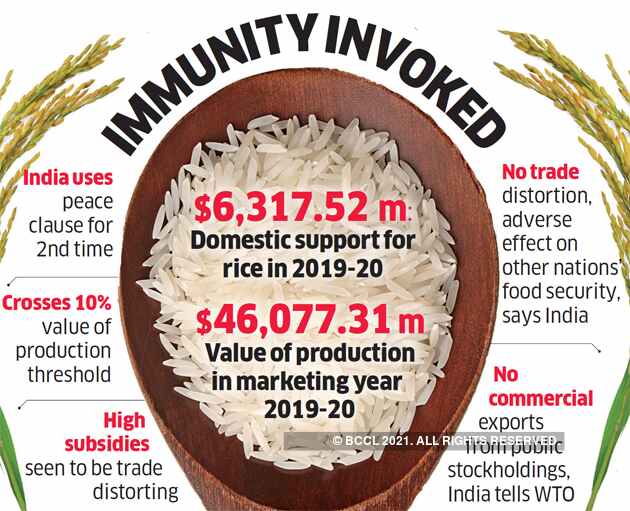
  • India invokes peace clause again as rice subsidies exceed 10% cap

    India has invoked the peace clause at the World Trade Organization (WTO), for the second time, for exceeding the 10 per cent ceiling on support it offered its rice farmers.

    • India had earlier invoked the clause for 2018-19, when it became the first country to do so.
    • India informed the WTO that the value of its rice production in 2019-20 was $46.07 billion while it gave subsidies worth $6.31 billion, or 13.7 per cent as against the permitted 10 per cent.

    What is Peace Clause?

    • The peace clause protects India’s food procurement programmes against action from WTO members in case the subsidy ceilings – 10 per cent of the value of food production in the case of India and other developing countries – are breached.

    What does India told to WTO?

    • India’s breach of commitment for rice arises from support provided in pursuance of public stockholding programmes for food security purposeswhich were in existence as on the date of the Bali Ministerial Decision on Public Stockholding for Food Security Purposes.
    • India said that under its public stockholding programmes for food security purposes, rice, wheat, coarse cereals and pulses, among others, are acquired and released in order to meet the domestic food security needs of the country’s poor and vulnerable population, and “not to impede commercial trade or food security of others. For these reasons only the breach of the de minimis limits for rice is covered by the peace clause.
      Government does not undertake exports on a commercial basis from public stockholdings. Additionally, open market sales of food grains from public stockholding are made provided the buyer gives an undertaking of not exporting from such purchase.
    • The peace clause can’t be challenged and because of this flexibility, distribution of food grains to the poor can be done for free which is crucial during the pandemic.
    • India ensures food security through the minimum support price (MSP) programme, and Public Distribution System and National Food Security Act, 2013.

    Subsidies of WTO:

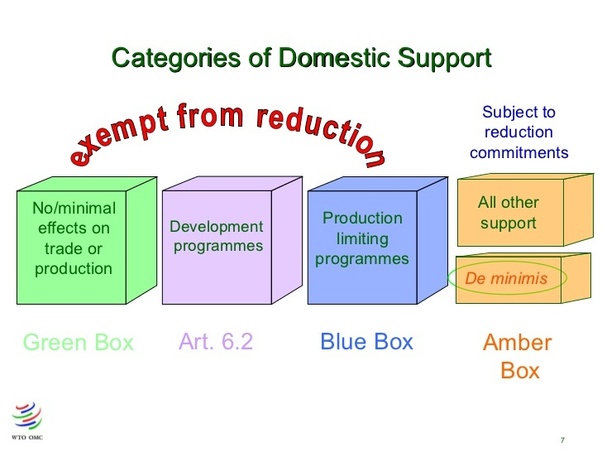
    • In WTO terminology, subsidies in general are identified by “boxes” which are given the colours of traffic lights: green (permitted), amber (slow down — i.e. need to be reduced), red (forbidden).
    • In agriculture, things are, as usual, more complicated.
      • The Agriculture Agreement has no red box.
      • Domestic support exceeding the reduction commitment levels in the amber box is prohibited
      • There is a blue box for subsidies that are tied to programmes that limit production.
    • There are also exemptions for developing countries (sometimes called an “S&D box” or “development box”, including provisions in Article 6.2 of the Agreement).

    Amber Box:

    • Nearly all domestic support measures considered to distort production and trade (with some exceptions) fall into the amber box, which is defined in Article 6 of the Agriculture Agreement as all domestic supports except those in the blue and green boxes.
    • These include measures to support prices, or subsidies directly related to production quantities.
    • These supports are subject to limits: “de minimis” minimal supports are allowed (generally 5% of agricultural production for developed countries, 10% for developing countries); 32 WTO members that had larger subsidies than the de minimis levels at the beginning of the post-Uruguay Round reform period are committed to reduce these subsidies.
    • The reduction commitments are expressed in terms of a “Total Aggregate Measurement of Support”.

    Blue Box:

    • This is the “amber box with conditions” — conditions designed to reduce distortion.
    • Any support that would normally be in the amber box, is placed in the blue box if the support also requires farmers to limit production (details set out in Paragraph 5 of Article 6 of the Agriculture Agreement).
    • At present there are no limits on spending on blue box subsidies.

    Green box:

    • The green box is defined in Annex 2 of the Agriculture Agreement.
    • In order to qualify, green box subsidies must not distort trade, or at most cause minimal distortion.
    • They have to be government-funded (not by charging consumers higher prices) and must not involve price support.
    • They tend to be programmes that are not targeted at particular products, and include direct income supports for farmers that are not related to current production levels or prices. They also include environmental protection and regional development programmes.
    • Green box” subsidies are therefore allowed without limits, provided they comply with the policy-specific criteria set out in Annex 2.
  • Suez Shows Civilization Is More Vulnerable Than We Think

    The recent closure of the Suez Canal highlights the inherent flaw in the global supply chains. Choking of one of the many such points leads to disruption in the global trade.

    Points of vulnerability

    • Suez Canal was blocked this week by a container ship named Ever Given when a gust of wind moved the ship out of the course and grounded it.
    • Egypt has expanded parts of the canal to enable two-way traffic and accommodate larger carriers.
    • The Ever Given ship went off course and got stuck in a part of the waterway that’s still narrow.
    • But it’s also a reminder that even an advanced civilization like ours has points of acute vulnerability. 

    Avoiding single points of failures

    • Systems designers strive to avoid these single points of failure, so that transport, energy and communication networks are able to withstand attacks or unexpected calamities.
    • Technological advances and globalization were also supposed to make us less susceptible to this type of problem.
    • The internet, for example, was conceived as a decentralized system that’s pretty difficult to break, as was Bitcoin.
    • But global infrastructure, defined broadly, still has a surprising number of pinch points.
    • These can be difficult to remedy, as creating back-up options is expensive and counteracts economies of scale.
    • In some cases, the problem is even getting worse:
    • Industries are becoming more concentrated due to corporate takeovers.
    • Big chunks of our lives are now mediated by a just handful of technology companies.
    • The governments are now more cognizant of the political and economic power held by those who control choke points.

    How canal can disrupt the global trade

    • The Panama Canal, the Suez Canal and the Strait of Hormuz are places where container ships and oil tankers are forced to navigate narrow passages.
    • The alternative is a long detour or more expensive air freight.
    • For decades these waterways have been recognized as areas of huge strategic importance and as being susceptible to military or terror attacks.
    • Various back-up routes have been mooted but most haven’t materialized.

    Vulnerabilities in economic sphere

    • In seeking to rid itself of one pinch point — pipelines that traverse Ukraine provides gas to Europ — Germany has created another: the twin Nord Stream gas pipelines that connect Russia and Germany under the Baltic Sea.
    • The U.S. worries these will weaken eastern Europe and increase Germany’s dependence on Russia.
    • In the realm of finance, trillions of dollars of financial instruments are tied to the London interbank offered rate.
    • This rate was easy to manipulate until they were exposed in the years following the 2008 financial crisis.
    • Libor is now being replaced.
    • Similarly, Europe has long relied on the Swift payments system and the U.S. dollar, but that dependence came into question in 2018 as it disagreed with the U.S. over Iran sanctions.
    • In technology, people have warned for years that the U.S. needs a back-up for the Global Positioning System.
    • The system can be spoofed or otherwise disrupted.
    • Semiconductors are where the clearest pinch points are emerging.
    • A global computer chip shortage during Covid has forced auto manufacturers to tear up production plans.
    • Very few companies are able to produce the most advanced chips, due to the technical challenges and vast cost of constructing foundries.
    • The most important of these, Taiwan Semiconductor Manufacturing Co., is based on an island that’s under constant threat of invasion by Beijing.
    • ASML Holding NV of the Netherlands has a monopoly on the machines needed to fabricate the best chips.
    • Now China’s inability to buy the most cutting edge gear from ASML is holding back its own semiconductor ambitions.

    Way forward

    • None of these choke-point problems are easy to resolve.
    • Not only are there geopolitical ambitions at work here but there are also usually trade-offs between building greater resilience and efficiency.
    • But because redundancy offers protection and is therefore a public good, there’s an argument that governments should play a role in providing it.
    • Antitrust polies can be used to challenge monopolies and foster more competition.

    Consider the question “What are the threat emanating from the various forms of choke points to the global trade? Suggest the ways to deal with it.”

    Conclusion

    Having a back-up is a good idea. We learn that when the roof falls in, or when a ship called the Ever Given snarls up the Suez Canal.

  • What is the 2008 Lehman Crisis?

    The fire sale of about $20 billion of Archegos assets, comprising Chinese and US stocks, has sent jitters in the global financial markets, raising worries that the event could be a possible “Lehman moment”.

    What is the Lehman Crisis?

    • The bankruptcy of Lehman Brothers on September 15, 2008, was the climax of the subprime mortgage crisis.
    • After the financial services firm was notified of a pending credit downgrade due to its heavy position in subprime mortgages, the Federal Reserve summoned several banks to negotiate to finance for its reorganization.
    • These discussions failed, and Lehman filed a petition that remains the largest bankruptcy filing in US history, involving more than US$600 billion in assets.

    Note: The subprime mortgage crisis occurred when the real estate market collapsed and homeowners defaulted on their loans.

    What defines the moment?

    • It signalled a limit to the government’s ability to manage the crisis and prompted a general financial panic.
    • Money market mutual funds, a key source of credit, saw mass withdrawal demands to avoid losses, and the interbank lending market tightened, threatening banks with imminent failure.
    • The government and the Federal Reserve system responded with several emergency measures to contain the panic.

    Other terminologies:

    Margin Call

    • Typically, a margin call occurs when the value of an investor’s margin account falls below the broker’s required amount during a market correction or sell-off.
    • As the margin account contains securities bought with borrowed money, a margin call occurs when lenders demand that an investor deposit additional money or securities into the account so that it is brought up to the minimum value.
    • A margin call is usually an indicator that the securities held in the margin account have decreased in value.
    • When a margin call occurs, the investor must choose to either deposit more money in the account or sell some of the assets held in their account.
    • If the investor fails to pay up the margin amount, the lender will resort to the sale of assets lying in the investor’s account.
  • Remission of Duties and Taxes on Export Products (RODTEP) Scheme

    The notification of benefit rates payable to exporters under the Remission of Duties and Taxes on Export Products (RODTEP) scheme is expected to take more time as it is facing ‘teething issues’.

    Try this PYQ:

    Q.Among the following, which one is the largest exporter of rice in the world in the last five years? (CSP 2019)

    (a) China

    (b) India

    (c) Myanmar

    (d) Vietnam

    RODTEP Scheme

    • RoDTEP is a scheme for Exporters to make Indian products cost-competitive and create a level playing field for them in the Global Market.
    • It has replaced the current Merchandise Exports from India Scheme, which is not in compliance with WTO norms and rules.
    • The new RoDTEP Scheme is a fully WTO compliant scheme.
    • It will reimburse all the taxes/duties/levies being charged at the Central/State/Local level which are not currently refunded under any of the existing schemes but are incurred at the manufacturing and distribution process.

    Why need such a scheme?

    • The scheme was announced last year as a replacement for the Merchandise Export from India Scheme (MEIS), which was not found not to be compliant with the rules of the World Trade Organisation.
    • Following a complaint by the US, a dispute settlement panel had ruled against India’s use of MEIS as it had found the duty credit scrips awarded under the scheme to be inconsistent with WTO norms.

    Back2Basics: Merchandise Exports from India Scheme (MEIS)

    • MEIS was launched with an objective to enhance the export of notified goods manufactured in a country.
    • This scheme came into effect on 1 April 2015 through the Foreign Trade Policy and will be in existence till 2020.
    • MEIS intended to incentivize exports of goods manufactured in India or produced in India.
    • The incentives were for goods widely exported from India, industries producing or manufacturing such goods with a view to making Indian exports competitive.
    • The MEIS covered almost 5000 goods notified for the purpose of the scheme.
  • India’s trade with China falls at five-year low

    India’s trade with China last year fell to the lowest since 2017, with the trade imbalance declining to a five-year low on the back of a slump in India’s imports from China.

    Try this PYQ:

    Q.Among the following, which one is the largest exporter of rice in the world in the last five years? (CSP 2019)

    (a) China

    (b) India

    (c) Myanmar

    (d) Vietnam

    India-China Trade

    • Two-way trade in 2020 reached $87.6 billion, down by 5.6%, according to new figures from China’s General Administration of Customs (GAC).
    • India’s imports from China accounted for $66.7 billion, declining by 10.8% year-on-year and the lowest figure since 2016.
    • It, however, rose to the highest figure on record, for the first time crossing the $20 billion-mark and growing 16% last year to $20.86 billion.

    What constitutes India’s import from China?

    • While there was no immediate break-up of the data in 2020, India’s biggest import in 2019 was electrical machinery and equipment, worth $20.17 billion.
    • Other major imports in 2019 were organic chemicals ($8.39 billion) and fertilizers ($1.67 billion), while India’s top exports were iron ore, organic chemicals, cotton and unfinished diamonds.

    India’s exports to China

    • The past 12 months saw a surge in demand for iron ore in China with a slew of new infrastructure projects aimed at reviving growth after the COVID-19 slump.
    • China’s total iron ore imports were up 9.5 per cent in 2020.

    A friction-induced low

    • The trade deficit, a source of friction between India and China, declined to a five year-low of $45.8 billion, the lowest since 2015.
    • Whether 2020 is an exception or marks a turn away from the recent pattern of India’s trade with China remains to be seen.
    • While India’s imports from China declined, so did India’s imports overall with a slump in domestic demand last year.
    • There is, as yet, no evidence to suggest India has replaced its import dependence on China by either sourcing those goods elsewhere or manufacturing them at home.
  • What are Digital Services Taxes?

    Digital services taxes adopted by India, Italy and Turkey discriminate against U.S. companies and are inconsistent with international tax principles, the U.S. Trade Representative’s office has said.

    Do you remember?

    GAFA tax—named after Google, Apple, Facebook, Amazon—is a proposed digital tax to be levied on large technology and internet companies.

    Fact of the matter: Equalization Levy

    • India has earlier expanded the scope of the Equalization Levy, or digital tax, to the sale of goods and services in the country by overseas e-commerce firms.
    • The Equalization Levy was introduced for the first time in 2016 as 6 per cent tax on revenues earned by non-residents from online advertising and related services.
    • The burden of this tax eventually fell on local firms advertising on these platforms.

    Contention for E-Commerce

    • In March 2020, the government expanded the scope of this levy to include the sale of goods and services in the country by overseas e-commerce operators.
    • The transactions were to be taxed at 2 per cent if businesses earned more than Rs 2 crore.
    • Globally, the rate of digital tax varies from 1.5 per cent (in Poland and Kenya) to 15 per cent (Paraguay). In Europe, the tax rate varies from 3 per cent (France, UK, Spain) to 7.5 per cent (Hungary).

    Digital Services Taxes

    • The “digital services tax” (DST) is a levy on the overall revenues earned by the supplier of specific digital services.
    • The DST should not be confused with the so-called “Netflix tax,” which one may find in some western countries.
    • The Netflix tax is essentially a “value-added tax” on digital services where the consumer bears the entire tax burden on the value of the final product.

    The US Question

    • The need to tax digital companies – the likes of Amazon, Google and Netflix – arises because these companies collect digital revenues from countries where they do not have a significant business presence.
    • These are new-age companies, which can use virtual infrastructure to operate in another country.
    • Countries across the globe have felt the need to tax revenues generated by such companies in a particular jurisdiction.
    • Talks began in 2018 under the aegis of the OECD to formalize a framework on what and how to tax revenues earned by such companies in a country in which they have no physical or significant presence.
    • But an abrupt US decision to pull out of the negotiations, involving 137 countries and threats of retaliatory action against those levying digital taxes have hit the 2020 deadline.

    India’s response

    • USTR has concluded the digital taxes imposed by France, India, Italy and Turkey discriminate against big U.S. tech firms, such as Google, Facebook, Apple and Amazon.com
    • For India, it created enormous uncertainty, since the country has always been at the forefront of adopting the concept of taxing foreign digital companies.
    • It is now subject to a probe initiated by the US called the ‘Section 301’ investigations into the digital taxes.

    A populist fuss by the US

    • The US is a bit confused and so is the exiting President. They are not able to decide what they want to do.
    • It is being argued that it could lead to tariffs before Donald leaves office or early in the administration of President-elect Biden.
    • This arguably another populist measure that Trump administration wants to leave behind.

    Conclusion

    • Given that a global consensus at the OECD or even the UN level may take several more months, countries including India are likely to continue with their unilateral DSTs.
    • At this juncture, when economies are reeling under the ill-effects of the pandemic, no country would want to give up its share of revenue and wait for a global consensus to emerge.
  • [pib] Remission of Duties and Taxes on Exported Products (RoDTEP) Scheme

    The Union govt. has decided to extend the benefit of the Scheme for Remission of Duties and Taxes on Exported Products (RoDTEP) to all export goods with effect from 1st January 2021.

    Try this PYQ:

    Q.Among the following, which one is the largest exporter of rice in the world in the last five years? (CSP 2019)

    (a) China

    (b) India

    (c) Myanmar

    (d) Vietnam

    RoDTEP Scheme

    • RoDTEP is a scheme for the Exporters to make Indian products cost-competitive and create a level playing field for them in the Global Market.
    • It has replaced the current Merchandise Exports from India Scheme, which is not in compliance with WTO norms and rules.
    • The new RoDTEP Scheme is a fully WTO compliant scheme.
    • It will reimburse all the taxes/duties/levies being charged at the Central/State/Local level which are not currently refunded under any of the existing schemes but are incurred at the manufacturing and distribution process.

    Why need such a scheme?

    • The scheme was announced last year as a replacement for the Merchandise Export from India Scheme (MEIS), which was not found not to be compliant with the rules of the World Trade Organisation.
    • Following a complaint by the US, a dispute settlement panel had ruled against India’s use of MEIS as it had found the duty credit scrips awarded under the scheme to be inconsistent with WTO norms.

    Back2Basics: Merchandise Exports from India Scheme (MEIS)

    • MEIS was launched with an objective to enhance the export of notified goods manufactured in a country.
    • This scheme came into effect on 1 April 2015 through the Foreign Trade Policy and will be in existence till 2020.
    • MEIS intended to incentivize exports of goods manufactured in India or produced in India.
    • The incentives were for goods widely exported from India, industries producing or manufacturing such goods with a view to making Indian exports competitive.
    • The MEIS covered almost 5000 goods notified for the purpose of the scheme.
  • Importance of Resilient supply chains

    What does supply chain resilience mean? 

    • When assembly lines are heavily dependent on supplies from one country, the impact on importing nations could be crippling if that source stops production intentionally (economic sanction) or unintentionally (natural disaster)
    • Example: Japan imported $169 billion worth from China, accounting for 24% of its total imports. Japan’s imports from China fell by half in February 2020 that impacted Japan’s economic activity.
    • In the context of international trade, supply chain resilience is an approach that helps a country to ensure that it has diversified its supply risk across a clutch of supplying nations instead of being dependent on just one or a few

    Recent incidents that led to supply chain disruption

    • Disruptions in supply chains can be natural or man-made.
    • When the novel coronavirus pandemic broke out, it had an immediate and telling effect on supply chains emanating from China.
    • In Japan’s case, a nuclear disaster (Fukushima Daiichi) caused a sharp drop in Japanese automobile exports to the United States.
    • Terrorist drone attacks on oil refineries in Saudi Arabia in September 2019 resulted in a drop of 5.7 million barrels of oil per day.
    • That attack triggered a steep plunge in Saudi Arabia’s stock market and a sharp spike in global oil prices.
    • Tensions with China led the United States government to impose restrictions on the export of microchips to China’s biggest semiconductor manufacturer SMIC.

    Supply Chain Resilience Initiative (SCRI)

    • Geo-politics and geo-economics can never be truly separated.
    • Also, there is a growing trend of weaponization of trade and technology.
    • China had imposed sanctions on its key exports of grain, beef, wine, coal, etc to Australia for demanding an inquiry into the origins of the coronavirus and advocating a robust Indo-Pacific vision.
    • It is against this backdrop that India, Japan, and Australia initiated the Supply Chain Resilience Initiative (SCRI).
    • It focuses on automobiles and parts, petroleum, steel, textiles, financial services, and IT sectors.
    • The SCRI may be strengthened by the future involvement of France.
    • Kingdom has also shown interest in the SCRI.

    “China plus one” strategy

    • For many Japanese companies, global performance and profits are linked to manufacturing facilities and supply chains in China.
    • Yet, they have shown an early capacity for risk mitigation through the “China Plus One” business strategy.
    • The “China plus one” strategy aims at diversification of investments to the Association of Southeast Asian Nations (ASEAN), India, and Bangladesh.
    • Japan announced a 2.2 billion Relocation Package.
    • Of the companies that availed this package, 57 relocated to Japan, 30 to Southeast Asia, and two to India.

    India’s vulnerability to supply chain disruptions

    • India can ill-afford the shocks of disruption in supply chains.
    • For instance, the pandemic caused a breakdown in global supply chains in the automotive sector.
    • For India, which imports 27% of its requirement of automotive parts from China, this quandary was a wake-up call.
    • It is t is noteworthy is that despite being the fourth largest market in Asia for medical devices, India has an import dependency of 80%. 
    • Given the renewed thrust in the health-care sector, this is the right time to fill gaps through local manufacturing.

    India increasing its presence in global supply chains

    1) Electronic industry

    • India’s electronics industry was worth $120 billion in 2018-2019 and is forecast to grow to $400 billion by 2025.
    • India is enhancing its presence in the global supply chains by attracting investments in the semiconductor components and packaging industry.
    • The Indian electronics sector is gradually shifting away from completely knocked down (CKD) assembly to high-value addition.

    2) Defence sector

    • Defence is among the key pillars of the ‘Atmanirbhar Bharat’ policy.
    • The government is providing a big boost to defence manufacturing under the ‘Make in India’ program.
    • It has identified a negative import list of 101 items.
    • There is a tremendous opportunity for foreign companies to enter into tie-ups with reputed Indian defence manufacturers to tap into the growing defence market in India.

    Consider the question “Pandemic has demonstrated the damage vulnerable supply chains can cause. It also underscored the importance of resilient supply chains. In light of this, examine the importance of diversification of supply chains.”

    Conclusion

    India has the capacity and the potential to become one of the world’s largest destinations for investments, and one of the world’s largest manufacturing hubs, in the aftermath of the pandemic.

  • U.S. puts India on ‘currency manipulators’ monitoring list

    The U.S. Treasury has labelled Switzerland and Vietnam as currency manipulators and added three new names, including India, to a watch list of countries. Earlier it had removed India from the list in March 2019.

    What is Currency Manipulation?

    • Currency manipulation refers to actions taken by governments to change the value of their currencies relative to other currencies in order to bring about some desirable objective.
    • The typical claim – often doubtful – is that countries manipulate their currencies in order to make their exports effectively cheaper on the world market and in turn make imports more expensive.

    Why do countries manipulate their currencies?

    • In general, countries prefer their currency to be weak because it makes them more competitive on the international trade front.
    • A lower currency makes a country’s exports more attractive because they are cheaper on the international market.
    • For example, a weak Rupee makes Indian exports less expensive for offshore buyers.
    • Secondly, by boosting exports, a country can use a lower currency to shrink its trade deficit.
    • Finally, a weaker currency alleviates pressure on a country’s sovereign debt obligations.
    • After issuing offshore debt, a country will make payments, and as these payments are denominated in the offshore currency, a weak local currency effectively decreases these debt payments.

    US treasury’s criteria

    To be labelled a manipulator by the U.S. Treasury:

    • Countries must at least have a $20 billion-plus bilateral trade surplus with the US
    • foreign currency intervention exceeding 2% of GDP and a global current account surplus exceeding 2% of GDP

    Implications for India

    • India has traditionally tried to balance between preventing excess currency appreciation on the one hand and protecting domestic financial stability on the other.
    • India being on the watch list could restrict the RBI in the foreign exchange operations it needs to pursue to protect financial stability.
    • This comes when global capital flows threaten to overwhelm domestic monetary policy.
    • The two most obvious consequences could be an appreciating rupee as well as excess liquidity that messes with the interest rate policy of the RBI.
    • Indian policymakers have to be sensitive for the unpredictable nature of policy-making in the US under Trump, especially concerning global trade.