💥Join UPSC 2027,2028 Mentorship (August Batch) + XFactor Notes & Microthemes PDF

Subject: Federal System

  • Status of the Naga Peace Talks

    The annual report of the Ministry of Home Affairs (MHA) released a report on insurgency-related incidents in Nagaland.

    It recently said that the Isak-Muivah faction of the National Socialist Council of Nagaland (NSCN-IM) was involved in 44% of insurgency-related incidents in 2020.

    Why in news?

    • The Union government had, in 2015, signed a framework agreement with the NSCN-IM to find a solution to the Naga political issue.
    • The negotiations are yet to be concluded.

    Who are the Nagas?

    • The term Naga was created by the British for administrative convenience to refer to a group of tribes with similar origins but distinct cultures, dialects, and customs.
    • The Naga tribes are accumulated in Nagaland, Arunachal Pradesh, Manipur, and Myanmar.

    Why did the Naga insurgency begin?

    • Residing in the Naga hills of Assam during the advent of the British and the annexation of Assam in 1820, the Nagas did not consider themselves a part of British India.
    • The British adopted a way of governance over the Nagas that involved keeping in place their traditional ways of life, customs, and laws while putting British administrators at the top.
    • At the time of the withdrawal of the British, insecurity grew among the Naga tribes about the future of their cultural autonomy after India’s independence.
    • This was accompanied by the fear of the entry of “plains people” or “outsiders” into their territory.

    Do you know?

    In a memorandum to the Simon Commission in 1929, representatives of Naga tribes demanded that Nagas be left free after Independence and not be included in the Indian Union.

    Collective actions of the Nagas

    • Above mentioned factors gave rise to the formation of the Naga Hills District Tribal Council in 1945, which was renamed the Naga National Council (NNC) in 1946.
    • Amid uncertainties over the post-independence future of the Nagas, a section of the NNC, led by Naga leader A.Z. Phizo declared the independence of the Nagas on August 14, 1947.
    • The underground insurgency began in the early 1950s when Mr. Phizo founded the Naga Federal Government (NFG) and its armed wing, the Naga Federal Army (NFA).

    Outcome of the then insurgency

    • The Central Government sent the armed forces into Naga areas to curb the insurgency.
    • It imposed the contentious Armed Forces Special Powers Act (AFSPA) which is still in place in parts of Nagaland.
    • The Nagas, led by Mr. Phizo, demanding an independent state outside of India, boycotted the 1952 and 1957 general elections and armed clashes grew.
    • Unlike other groups in the north east which were accepting some form of autonomy under the Constitution, Nagas rejected this in favour of sovereignty.

    Negotiations with the govt

    • Some leaders among the NNC formed their own group to hold discussions with the government, leading to the formation of the State of Nagaland in 1963.
    • This, however, did not satisfy many in the NNC and NFG, who, following years of negotiations with the government, eventually signed the Shillong Accord of 1975, agreeing to surrender arms and accept the Constitution.

    When did the NSCN come into the picture?

    • This signing of the Shillong Accord was not agreeable with many top leaders of the NNC and those operating from Myanmar.
    • A/c to them, the agreement did not address the issue of Naga sovereignty and coerced them to accept the Constitution.
    • Three NNC rebel leaders, formed the National Socialist Council Of Nagaland (NSCN) to continue the armed movement for ‘independence’.

    Again split in NSCN

    • In 1988, after years of infighting and violent clashes along tribal lines and over the main cause of the movement, the NSCN split into two factions.
    • One, led by Mr. Muiwah and Swu called the NSCN-IM and the other, led by Mr. Khaplang called the NSCN-K.
    • The NSCN-IM demanded and continues to demand for ‘Greater Nagaland’ or Nagalim.
    • It wants to extend Nagaland’s borders by including Naga-dominated areas in the neighbouring States of Assam, Manipur and Arunachal Pradesh.
    • The NSCN-IM has now grown to become the most powerful insurgent group, also playing a role in the creation of smaller groups in other States.

    Where do the peace talks stand now?

    • In 1997, the Government of India got the NSCN-IM to sign a ceasefire agreement to begin the holding of talks with the aim of signing a Naga Peace Accord.
    • After this ceasefire, there have been over a hundred rounds of talks spanning over 24 years between the Centre and the insurgent group, while a solution is still awaited.

    Issues of contention

    • Independence celebration: Nagas across Nagaland, Manipur, Assam and Arunachal Pradesh celebrate August 14 as Independence Day. According to Naga historians, Gandhi agreed that the Nagas would celebrate their independence a day ahead of India, on August 14, 1947.
    • Naga flag: In the Naga narrative, passed down generations by word of mouth, the Naga flag was not designed by a mortal but is of divine origin.
    • Secessionist tendencies: A large section of the Nagas still holds dear the idea of the Naga identity and their tribal roots.

    Way ahead

    • The Naga struggle claimed thousands of lives over decades and devastated countless homes, all over the idea of a sovereign Naga nation.
    • If the NSCN (I-M) accedes to economic and political packages alone, without a separate flag and constitution, it remains to be seen whether it will be seen as a solution, or as a defeat.


    Also read,

    [Burning Issue] Naga Peace Talks

    UPSC 2023 countdown has begun! Get your personal guidance plan now! (Click here)

  • Explained: Arunachal-Assam Boundary Dispute

    Less than a month after the Union government gave the seal of approval to an agreement to partially resolve the disputed sectors on the Assam-Meghalaya border, Arunachal Pradesh CM and his Assam counterpart decided to form district-level committees for settling their inter-state boundary disputes.

    Arunachal-Assam Boundary Dispute

    • Assam has had boundary disputes with all the north-eastern states that were carved out of it.
    • While Nagaland became a State in 1963, Meghalaya first became an Autonomous State in 1970 and a full-fledged State in 1972.
    • Arunachal Pradesh and Mizoram were separated from Assam as Union Territories in 1972 and as States in 1987.
    • None of the new States accepted the “constitutional boundary” that they said was dictated by the partisan administration of undivided Assam without consulting the tribal stakeholders.
    • They also claimed that the disputed areas were traditionally under the control of tribal chieftains before Assam, post-India’s independence, inherited the “imaginary boundaries” drawn during British rule.
    • The issue with Arunachal Pradesh has more to do with a 1951 report prepared by a sub-committee headed by Assam’s first Chief Minister, Gopinath Bordoloi.

    Genesis of the dispute

    • Arunachal Pradesh and Assam have disputes at about 1,200 points along their 804 km boundary.
    • The disputes cropped up in the 1970s and intensified in the 1990s with frequent flare-ups along the border.
    • However, the issue dates back to 1873 when the British government introduced the inner-line permit vaguely separating the plains from the frontier hills.
    • This area became the North-East Frontier Agency (NEFA) in 1954, three years after a notification based on the 1951 report saw 3,648 sq. km of the “plain” area of Balipara and Sadiya foothills being transferred to the Darrang and Lakhimpur districts of Assam.
    • Arunachal has been celebrating its statehood with an eye on China since 1987, but what has been causing resentment is the inability of the people living in the transferred patches.
    • Leaders in Arunachal Pradesh claim the transfer was done arbitrarily without consulting its tribes who had customary rights over these lands.
    • Their counterparts in Assam say the 1951 demarcation is constitutional and legal.

    Earlier attempts for resolving dispute

    • There were several efforts to demarcate the boundary between Assam and NEFA/Arunachal Pradesh between 1971 and 1974.
    • To end the stalemate, a high-powered tripartite committee involving the Centre and the two States was formed in April 1979 to delineate the boundary based on Survey of India maps.
    • About 489 km of the inter-state boundary north of the Brahmaputra River was demarcated by 1984, but Arunachal did not accept the recommendations and staked claim to much of the areas transferred in 1951.
    • Assam objected and approached the Supreme Court in 1989, accusing Arunachal Pradesh of “encroachment”.
    • The apex court-appointed a local boundary commission in 2006 headed by one of its retired judges.
    • In its September 2014 report, this commission recommended that Arunachal Pradesh should get back some of the areas transferred in 1951. However, this did not work out.

    Way forward

    • Following the model adopted in the exercise to resolve the dispute with Meghalaya, Assam and Arunachal Pradesh have agreed to form district-level committees.
    • They will be tasked with undertaking joint surveys in the disputed sectors to find tangible solutions to the long-pending issue based on historical perspective, ethnicity, contiguity, people’s will and administrative convenience.
    • The two States have decided to form 12 such committees involving the districts sharing the boundary. Assam has eight districts touching the boundary with Arunachal Pradesh, which has 12 such districts.

    Conclusion

    • The Assam-Meghalaya boundary agreement has raised hopes of the Assam-Arunachal boundary dispute being resolved.
    • This is especially in light of egging the north-eastern States to end their territorial issues once and for all by August 15, 2022, when the country celebrates 75 years of independence.
    • Moreover, there is a general belief that the region’s sister-States are in a better position to fast-track the resolution since they are ruled by the present regime with the same dispensation at the Centre.


    UPSC 2023 countdown has begun! Get your personal guidance plan now! (Click here)
  • TN clips Governor’s power to appoint VCs

    The Tamil Nadu Assembly has adopted two Bills that seek to empower the government to appoint Vice-Chancellors (VCs) to 13 State universities under the aegis of the Higher Education Department by amending the respective Acts.

    Role of Governors in State Universities

    • In most cases, the Governor of the state is the ex-officio chancellor of the universities in that state.
    • Its powers and functions as the Chancellor are laid out in the statutes that govern the universities under a particular state government.
    • Their role in appointing the Vice-Chancellors has often triggered disputes with the political executive.

    Who is a Chancellor of a University?

    • In India, almost all universities have a chancellor as their titular head whose function is largely ceremonial.
    • The governor of the state, appointed as the union’s representative of state by the president, is the honorary chancellor of all State owned universities.
    • The de facto head of any government university is the vice-chancellor.
    • In private non-profit universities, normally the head of the foundation who has established the university is the chancellor of the university and is the head of the university.

    What about Central Universities?

    • Under the Central Universities Act, 2009, and other statutes, the President of India shall be the Visitor of a central university.
    • With their role limited to presiding over convocations, Chancellors in central universities are titular heads, who are appointed by the President in his capacity as Visitor.
    • The VCs too are appointed by the Visitor from panels of names picked by search and selection committees formed by the Union government.
    • The Act adds that the President, as Visitor, shall have the right to authorize inspections of academic and non-academic aspects of the universities and also to institute inquiries.

    What are the highlights of the TN Bills?

    • The Bills passed in Tamil Nadu stress that “every appointment of the Vice-Chancellor shall be made by the Government from out of a panel of three names” recommended by a search-cum-selection committee.
    • Currently, the Governor, in his capacity as the Chancellor of state universities, has the power to pick a VC from the shortlisted names.
    • The Bills also seek to empower the state government to have the final word on the removal of VCs, if needed.
    • Removal will be carried out based on inquiries by a retired High Court judge or a bureaucrat who has served at least as a Chief Secretary, according to one of the Bills.

    Are other states trying to curtail the Governor’s role in appointing VCs?

    • In December, the Maharashtra Assembly passed a Bill amending the Maharashtra Public Universities Act, 2016.
    • Under the original Act, the Maharashtra government had no say in the appointment of VCs.
    • If the changes take effect, the Governor will be given two names to choose from by the state government.
    • In 2019, the West Bengal government took away the Governor’s authority in appointing VCs to state universities.
    • It has also hinted at removing the Governor as the Chancellor of the universities.
    • But all such motives have been challenged by the University Grants Commission (UGC).

    What is at the root of the differences?

    • In West Bengal, Maharashtra and Tamil Nadu, the elected governments have repeatedly accused the Governors of acting at the behest of the Centre on various subjects, including education.
    • The regulations, which differ from state to state, are often open to interpretation and disputes are routine.
    • In fact, the TN Bills make a case for giving the state government the upper hand in the VC appointment process by citing the examples of Gujarat and Telangana.
    • In Karnataka, Jharkhand and Rajasthan, state laws underline the need for concurrence between the state and the Governor.
    • The terms “concurrence” or “consultation” are absent from state legislation in most cases.

    What is the UGC’s role in this?

    • Education comes under the Concurrent List.
    • But entry 66 of the Union List states — “coordination and determination of standards in institutions for higher education or research and scientific and technical institutions”.
    • This gives the Centre substantial authority over higher education.
    • The UGC plays that standard-setting role, even in the case of appointments in universities and colleges.
    • According to the UGC Regulations, 2018, the “Visitor/Chancellor” — mostly the Governor in states — shall appoint the VC out of the panel of names recommended by search-cum-selection committees.
    • Higher educational institutions, particularly those that get UGC funds, are mandated to follow its regulations.
    • These are usually followed without friction in the case of central universities, but are sometimes resisted by the states in the case of state universities.

    Judicial observations in this regard

    • A Bench of Justices M R Shah and B V Nagarathna said “any appointment as a VC contrary to the provisions of the UGC Regulations can be said to be in violation of the statutory provisions, warranting a writ of quo warranto”.
    • It said every subordinate legislation of the UGC, in this case the one on minimum standards on appointments, flows from the parent UGC Act, 1956.
    • Therefore, being a subordinate legislation, UGC Regulations become part of the Act.
    • In case of any conflict between state legislation and central legislation, central legislation shall prevail by applying the rule/principle of repugnancy as enunciated in Article 254 of the Constitution.
    • It reiterated that the subject ‘education’ is in the Concurrent List of the Seventh Schedule of the Constitution.


    UPSC 2023 countdown has begun! Get your personal guidance plan now! (Click here)

  • Anti-Defection Law

    Vice-President M. Venkaiah Naidu said that there was a need to amend the anti-defection legislation in the country to plug existing loopholes.

    What did VP notice now?

    • Stating that there was no clarity in the law about the time frame for the action of the House Chairperson or Speaker in anti-defection cases.
    • Some cases are taking six months and some even three years.
    • There are cases that are disposed of after the term is over.

    What is Anti-defection Law?

    • The Anti-Defection Law under the Tenth Schedule of the Constitution punishes MPs/ MLAs for defecting from their party by taking away their membership of the legislature.
    • It gives the Speaker of the legislature the power to decide the outcome of defection proceedings.
    • It was added to the Constitution through the Fifty-Second (Amendment) Act, 1985 when Rajiv Gandhi was PM.
    • The law applies to both Parliament and state assemblies.

    Cases considered under the anti-defection law

    The law covers three scenarios with respect to shifting of political parties by an MP or an MLA.

    (1) Voluntary give-up

    • The first is when a member elected on the ticket of a political party “voluntarily gives up” membership of such a party or votes in the House against the wishes of the party.
    • Such persons lose his seat.

    (2) Independent members

    • When a legislator who has won his or her seat as an independent candidate joins a political party after the election.
    • In both these instances, the legislator loses the seat in the legislature on changing (or joining) a party.

    (3) Nominated MPs

    • In their case, the law gives them six months to join a political party, after being nominated.
    • If they join a party after such time, they stand to lose their seat in the House.

    Powers to disqualification

    • Under the anti-defection law, the power to decide the disqualification of an MP or MLA rests with the presiding officer of the legislature.
    • The law does not specify a time frame in which such a decision has to be made.
    • As a result, Speakers of legislatures have sometimes acted very quickly or have delayed the decision for years — and have been accused of political bias in both situations.

    Significant role of the Speaker/Presiding Officer

    • Pandit Nehru had referred to the Speaker as “the symbol of the nation’s freedom and liberty” and emphasized that Speakers should be men of “outstanding ability and impartiality”.
    • Several judgments on the anti-defection law have been rendered by the Supreme Court.
    • A common factor that shows up in these rulings is the blatant, partisan conduct of speakers in state assemblies.

    Reasons for Speakers’ ambiguous action

    • The Speaker continues to belong to a particular political party.
    • The electoral system and conventions in India have ‘not been developed to ensure protection to the office, there are cogent reasons for Speakers to retain party membership.
    • It would be unrealistic to expect a speaker to completely abjure all party considerations while functioning.
    • There are structural issues regarding the manner of appointment of the Speaker and her tenure in office.

    Way forward

    • Parliament may seriously consider a Constitutional amendment to bring in a permanent Tribunal for dealing with defection cases.
    • It is suggested that a scheme should be brought wherein Speakers should renounce all political affiliations, membership, and activity once they have been elected.
    • We can learn from the UK model. In practice, once elected, the Speaker gives up all-partisan affiliation, as in other Parliaments of British tradition.
    • He/she remains in office until retirement, even though the majority may change and does not express any political views during debates.

    Conclusion

    • Impartiality, fairness, and autonomy in decision-making are the hallmarks of a robust institution.
    • It is the freedom from interference and pressures which provide the necessary atmosphere where one can work with an absolute commitment to the cause of neutrality as a constitutional value.


    UPSC 2022 countdown has begun! Get your personal guidance plan now! (Click here)

  • The Delhi MCA Act and the spirit of federalism

    Context

    Recently, both Houses of Parliament passed the Delhi Municipal Corporation (Amendment) Act, 2022, to unify the trifurcated Delhi Municipal Corporations.

    Background of the trifurcation

    • The split-up was first proposed in the 1987 Balakrishnan Committee Report which was bolstered in the 2001 Virendra Prakash Committee Report.
    • The proposal finally took shape in 2011 and the law to trifurcate was enacted.
    • A seven-member Delhi Legislative Assembly Panel was set up in 2001 to study the recommendations and suggest modalities.
    • Trifurcation in 2011: The proposal finally took shape in 2011 and the law to trifurcate was enacted.

    Changes introduced by the amendment

    • The law provides that the power to determine the number of wards, extent of each ward, reservation of seats, number of seats of the Corporation, etc. will now be vested in the Central government. 
    • The number of seats of councillors in the Municipal Corporations of Delhi is also to be decided now by the Central government.
    • By exercising that very power, the number of councillors to the Municipal Corporations of Delhi has been reduced from 272 to 250.
    • The Central government has also taken over powers from the State to decide on matters such as ‘salary and allowances, leave of absence of the Commissioner, the sanctioning of consolidation of loans by a corporation, and sanctioning suits for compensation against the Commissioner for the loss or waste or misapplication of municipal fund or property

    Issues with the changes made

    • The Central government’s line is that the amendment has been passed as in Article 239AA of the Constitution, which is a provision that provides for special status to Delhi.
    • No consultation with Delhi govt.-The large-scale changes by the Central government has been done without any consultation with the Delhi government.
    • Not in line with  Part IXA of the Constitution:  Part IXA specifically states that it will be the Legislature of the State that will be empowered to make laws concerning representation to the municipalities.
    • Part IXA is a specific law while Article 239AA is general law: The argument of the Centre that Article 239AA can be applied over and above Part IXA of the Constitution does not hold good as the latter is a specific law that will override the general law relatable to Article 239AA.
    • Against the federalism: In State of NCT of Delhi vs Union of India judgment the Supreme Court held, “The Constitution has mandated a federal balance wherein independence of a certain required degree is assured to the State Governments.”
    • It was made clear that the aid and the advice of the State government of Delhi would bind the decision of the Lieutenant General in matters where the State government has the power to legislate.
    • No doubt, the amendment to the Delhi Municipal Corporation Act, 1957 will lead to further litigation on the aspect of a sharing of powers between the State of NCT of Delhi and the Central government.

    Conclusion

    The interference of the Centre in matters such as municipal issues strikes a blow against federalism and the celebrated Indian model of decentralisation.

    UPSC 2022 countdown has begun! Get your personal guidance plan now! (Click here)

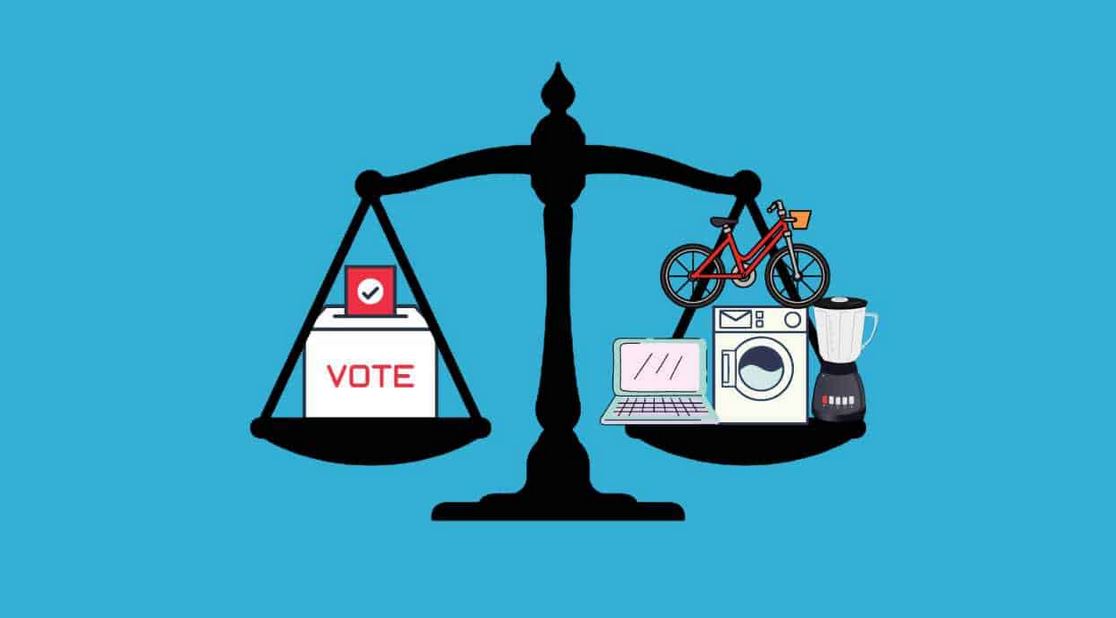
  • Election Freebies and Related Issues

    India could end up facing a Sri Lanka-type economic crisis if it doesn’t stop the “culture of freebies” and subsidies in sectors like agriculture, NITI Aayog member Ramesh Chand has warned.

    What is a Freebie?

    • The term Freebies is not new; rather it is a prevalent culture in Indian politics (in the name of socialism).
    • The political parties are always trying to outdo each other in luring the Indian voters with assorted freebies.
    • From free water to free smartphones the Indian politicians promise everything to attract prospective voters in favour.
    • This trend has gained more momentum in the recent times with the political parties being innovative in their offerings as the ‘traditional free water and electricity’ is no longer sufficient as election goodies.

    Examples of freebies

    1. Promise of Rs 15 lakh in our bank accounts
    2. Free TV, Laptops
    3. Free electricity
    4. Loan waivers
    5. Offering free public transport ride to all women in Delhi

    Why are such policies popular among the public?

    • Failure of economic policies: The answer lies in the utter failure of our economic policies to create decent livelihood for a vast majority of Indians.
    • Quest for decent livelihood: The already low income had to be reoriented towards spending a disproportionately higher amount on education and health, from which, the state increasingly withdrew.
    • Prevailing unemployment:  Employment surveys have shown that employment growth initially slowed down from the 1990s, and then has turned negative over the past few years.
    • Increased cost of living: Real income growth of the marginal sections has actually slowed down since 1991 reforms.
    • Increased consumerism: The poor today also spend on things which appear to be luxuries; cellphones and data-packs are two such examples which are shown as signs of India’s increased affluence.
    • Necessity: For migrant workers, the mobile phone helps them keep in touch with their families back home, or do a quick video-call to see how their infant is learning to sit up or crawl.

    Can Freebies be compared with Welfare Politics?

    • These freebies are not bad. It is a part of social welfare.
    • Using freebies to lure voters is not good.
    • Voter’s greediness may lead to a problem in choosing a good leader.
    • When we don’t have a good leader then democracy will be a mockery.

    Impact of such policies

    • Never ending trail: The continuity of freebies is another major disadvantage as parties keep on coming up with lucrative offers to lure more number of votes to minimize the risk of losing in the elections.
    • Burden on exchequer: People forget that such benefits are been given at the cost of exchequer and from the tax paid.
    • Ultimate loss of poors: The politicians and middlemen wipe away the benefits and the poor have to suffer as they are deprived from their share of benefits which was to be achieved out of the money.
    • Inflationary practice: Such distribution freebie commodity largely disrupts demand-supply dynamics.
    • Lethargy in population: Freebies actually have the tendency to turn the nation’s population into: Lethargy and devoid of entrepreneurship.
    • Money becomes only remedy: Everyone at the slightest sign of distress starts demanding some kind of freebies from the Govt.
    • Popular politics: This is psychology driving sections of the population expecting and the government promptly responds with immediate monetary relief or compensation.

    What cannot be accounted to a freebie?

    • MGNREGA scheme (rural employment guarantee scheme)
    • Right to Education (RTE)
    • Food Security through fair price shops ( under National Food Security Act)
    • Prime Minister Kisan Samman Yojana (PM-KISAN)

    Arguments in favour

    • Social investment: Aid to the poor is seen as a wasteful expenditure. But low interest rates for corporates to get cheap loans or the ‘sop’ of cutting corporate taxes are never criticized.
    • Socialistic policy: This attitude comes from decades of operating within the dominant discourse of market capitalism.
    • Election manifesto: Proponents of such policies would argue that poll promises are essential for voters to know what the party would do if it comes to power and have the chance to weigh options.
    • Welfare: Economists opine that as long as any State has the capacity and ability to finance freebies then its fine; if not then freebies are the burden on economy.
    • Other wasteful expenditure: When the Centre gives incentives like free land to big companies and announce multi-year tax holidays, questions are not asked as to where the money will come from.

    A rational analysis of freebies

    • Winning election and good governance are two different things. The role of freebies to avail good governance is definitely questionable.
    • The social, political and economic consequences of freebies are very short-lived in nature.
    • There are many freebies and subsidies schemes available in many States but we still find starvation deaths, lack of electricity, poor education and health service.
    • Hence the sorrow of the masses of India cannot be solved by freebies or by incentives.

    So are not freebies meant only to attract voters and swing voters by concentrating on a preferential group or community?

    Way forward

    • It can be agreed that a democracy requires popular support for its rule to continue. The sops and freebies to the poor buy it the requisite votes.
    • But the democratic process of election and election promises should be clear. It should not control voters thought.
    • What some people term as ‘populism’ actually constitutes what real economics should be.
    • If you deprive people of what they really need, you will have to throw allurements at them.
    • This can only be stopped if political masters try to follow what economist EA Schumacher had conveyed through his seminal work Small is beautiful – “Treat economics as if people matter.”

    Conclusion

    • There is nothing wrong in having a policy-led elaborate social security programme that seeks to help the poor get out of poverty.
    • But such a programme needs well thought out preparation and cannot be conjured up just before an election.


    UPSC 2022 countdown has begun! Get your personal guidance plan now! (Click here)

  • Language sensitivity and provisions in Constitution

    Context

    Language sensitivity has been a feature of selfhood in the case of every Indian language.

     Sensitivity to language

    • From ancient times, a sensitivity to language difference has almost been the core of Dravidic self-hood.
    • A similar sensitivity existed among the speakers of Prakrits in ancient times.
    • It was in one of the Prakrits that Mahavir had presented his teachings in the sixth century BCE.
    • Eighteen centuries later, Acharya Hemachandra, a major Jain scholar, poet, mathematician and philosopher, produced his Desinamamala, a treatise on the importance of Prakrit words used in Gujarat of his times as against those from Sanskrit.
    • Mahatma Gandhi, who defined the idea of selfhood for India in Hind Swaraj (1909), chose to write this iconic book in Gujarati.

    Constitutional provision

    • The official language used for communication between the States shall be the language that has been in use at the time of adoption of the Constitution.
    • The move from English to Hindi can take place only if, ‘two or more states agree’ for the shift.
    • Article 344 (4) provides for a ‘Committee consisting of thirty members’, ‘twenty’ from the Parliament and ‘ten’ from State assemblies, for safeguarding language-related provisions.

    The distribution between two ministries

    • The functions and the scope of the committee, as laid down by the Constitution, are further clarified by the practice of distribution of language as a subject between two Ministries, the Human Resource Development (HRD) Ministry and the Home Ministry.
    • The scope of the HRD Ministry extends to education and the promotion of cultural expression.
    • The Home Ministry’s scope extends to safeguarding relations of the States with the ‘union’, protecting the linguistic rights of language minorities and the promotion of Hindi.
    • The last of these, the Constitution states, has to be ‘without interference with other languages.

    Data on language decline

    • In 2011, Hindi speakers accounted for 43.63% of the total population, with a total of 52.83 crore speakers.
    • In 1971, the number was 20.27 crore, accounting for 36.99% of the total population.
    • Between 2001 and 2011, the growth in proportion of the population was 2.6%.
    • The next most spoken language, Bangla, had negative growth.
    • It was spoken by 8.30% of Indians in 1991, 8.11% in 2001 and by 8.03% in 2011.
    • Telugu, which slid from 7.87% in 1991, to 7.19% in 2001 and 6.70% in 2011, has a similar story to tell.
    • Tamil recorded 6.32% of the total population in 1991, 5.91% in 2001 and 5.70% in 2011.
    • The only major language to show decadal growth (though small) was Gujarati.
    • And the only small yet scheduled language to show good growth was Sanskrit.

    Reasons for Hindi’s growth

    • The 52.83 crore speakers of Hindi (as recorded in 2011) included not just the speaker of ‘Hindi’ but also those of more than 50 other languages.
    • Bhojpuri and most languages of Himachal Pradesh, Uttarakhand, Chhattisgarh, Rajasthan and Jharkhand have also been pushed into the Hindi package.
    • Had the Census not included these other languages under Hindi, the strength of Hindi speakers would have gone down to about 39 crore, — just a little under 32% of the total population in 2011 — and would have looked not too different from those of other scheduled languages.
    • The data for English speakers is far more truthful. Census 2011 reports a total of 3,88,793 Indians as English speakers (2,59,678 men and 1,29,115 women).

    Hindi in comparison to other languages in the Eighth schedule

    • Among the languages included in the Eighth Schedule, Hindi falls within the younger lot of languages.
    • On the other hand, Tamil, Kannada, Kashmiri, Marathi, Oriya, Sindhi, Nepali and Assamiya have a much longer/older history.
    •  As a language of knowledge too, Tamil, Kannada, Bangla and Marathi (with their abundance of encyclopaedias and historical literature), quite easily outshine Hindi.

    Conclusion

    A language evolves slowly and cannot be forced to grow by issuing ordinances.

    UPSC 2022 countdown has begun! Get your personal guidance plan now! (Click here)

  • Delimitation of Constituencies in Jammu and Kashmir

    Members of the Jammu & Kashmir Delimitation Commission faced protests in Jammu as they embarked on a two-day visit to hold consultations with citizens, civil society groups and political parties.

    What is Delimitation and why is it needed?

    • Delimitation is the act of redrawing boundaries of an Assembly or Lok Sabha seat to represent changes in population over time.
    • This exercise is carried out by a Delimitation Commission, whose orders have the force of law and cannot be questioned before any court.
    • The objective is to redraw boundaries (based on the data of the last Census) in a way so that the population of all seats, as far as practicable, be the same throughout the State.
    • Aside from changing the limits of a constituency, the process may result in a change in the number of seats in a state.

    Delimitation in J&K

    • Assembly seats in J&K were delimited in 1963, 1973 and 1995.
    • Prior to August 5, 2019, carving out of J&K’s Assembly seats was carried out under the J&K Constitution and Jammu and Kashmir Representation of the People Act, 1957.
    • Until then, the delimitation of Lok Sabha seats in J&K was governed by the Constitution of India.
    • However, the delimitation of the state’s Assembly was governed by the J&K Constitution and J&K Representation of the People Act, 1957.
    • There was no census in the state in 1991 and hence no Delimitation Commission was set up by the state until 2001 census.

    Why is it in the news again?

    • After the abrogation of J&K’s special status in 2019, the delimitation of Lok Sabha and Assembly seats in the newly-created UT would be as per the provisions of the Indian Constitution.
    • On March 6, 2020, the government set up the Delimitation Commission, headed by retired Supreme Court judge Ranjana Prakash Desai, which was tasked with winding up delimitation in J&K in a year.
    • As per the J&K Reorganization Bill, the number of Assembly seats in J&K would increase from 107 to 114, which is expected to benefit the Jammu region.

    Factors considered during Delimitation

    • The number of districts had increased from 12 to 20 and tehsils from 52 to 207 since the last delimitation.
    • The population density ranged from 29 persons a square km in Kishtwar to 3,436 persons a square km in Srinagar.
    • The remoteness of the place, inaccessibility etc are also considered during the exercise.

    Concerns raised over Delimitation

    • Jammu vs. Kashmir: Concerns had been expressed over how the delimitation process may end up favoring the Jammu region over Kashmir in terms of the seats.
    • Under-representation of Ladakh: Arguments have been made on how Ladakh has been underrepresented, with demands for statehood/sixth schedule.
    • Non-proportionate reservations: It is argued that seats for STs should’ve been divided in both Jammu province & Kashmir province, as the ST population is almost equal.
  • Explained: The ‘Chandigarh Question’

    The newly elected Punjab Legislative Assembly passed a resolution, moved by the Chief Minister himself, on April 1 in a special session seeking the transfer of Chandigarh to Punjab.

    With this, the ‘Chandigarh question’ has resurfaced, but this time it occupies the national spotlight.

    Establishment of Chandigarh

    • Chandigarh is described as a ‘planned city’ emblematic of ‘Nehruvian modernity’.
    • It is a greenfield city, which was commissioned by the government in independent India to replace Lahore, which went to Pakistan after Partition, as the capital of Punjab.
    • Designed by Le Corbusier in association with Pierre Jeanneret, it is located on the foothills of the Shivalik Himalayas on village land acquired from what was then the Kharar tehsil of Ambala district.
    • It was the capital of undivided Punjab from its inauguration in 1953 till 1966.

    Bifurcation of Punjab and Common Capital

    • Under the Punjab Reorganisation Act, 1966 following the Punjabi Suba movement, Haryana was carved out of the Hindi-speaking regions as a separate State.
    • The hill regions of Punjab were merged with what was then the Union Territory (UT) of Himachal Pradesh.
    • Chandigarh was made a UT and has remained the joint capital of Haryana and Punjab with State assets divided between Punjab and Haryana in a ratio of 60:40.

    What is the Chandigarh issue?

    • Since 1966, the lack of full rights to its capital has remained a vexed issue in Punjab politics.
    • All the governments and most political parties of Punjab have regularly raised the demand for Chandigarh.
    • It has featured in all major developments, whether it is the 1973 Anandpur Sahib resolution, Dharam Yudh Morcha (then separatist movement) and the 1985 Rajiv-Longowal Accord.
    • Since 1966, the Punjab Assembly has passed at least six such resolutions with the last being in 2014 under the Shiromani Akali Dal-Bharatiya Janata Party (SAD-BJP) government.
    • The Centres’ opposition to the latest Assembly resolution is the first time a political party has taken a contrarian stand.

    What is different this time?

    • The immediate provocation this time has been two recent decisions of the Central government: breaking allies with erstwhile govt and withdrawal of farm laws.
    • The Centre also amended the rules governing the functioning of the Bhakra Beas Management Board (BBMB), constituted under the 1966 Act.
    • It changed the eligibility criteria for the two full-time members of the Board which have, though technically open to all Indian officials, by convention gone to officials from Punjab and Haryana.
    • These moves are widely interpreted as a continuation of the Centre’s contentious relationship with the other political parties.
    • It gives an affront blow to Punjab’s claim over Chandigarh.

    What has been the position of the Union government on the city?

    • At the time of the 1966 Act, the Union government with Indira Gandhi as Prime Minister indicated that the UT status to Chandigarh was temporary and that it would be transferred to Punjab.
    • This decision was formalised in 1970 with Mrs Gandhi promising Haryana funds for building its own capital.
    • According to the 1985 Rajiv-Longowal Accord, Chandigarh was to be handed over to Punjab on January 26, 1986 but this never fructified after the assassination of Longowal and the long period of militancy.
    • The recent developments could thus indicate a shift in the Central government’s position.

    What about Haryana?

    • As in Punjab, all parties in Haryana present a common position asserting its claim to the city.
    • It has objected to any move which associates Chandigarh solely with Punjab.

    Is there a distinctive Chandigarh position?

    • Employees and unions of the Chandigarh administration have mostly welcomed the change in service rules since the Central provisions carry more benefits and perks.
    • After decades of existence as a UT, Chandigarh has developed a distinctive cultural character.
    • Given its geographical location it has the presence of many educational institutions, medical establishments and the Army and Air Force.
    • It has developed a unique cosmopolitanism and become a magnet for the youth across the north western region.
    • They city residents thus favour the status quo.

    Way forward

    • While this time the issue has attracted more attention than usual.
    • Its Punjab mandate indicates massive expectations from the electorate including better service conditions from government employees but it has inherited a debt-ridden government.
    • The new govt will have to balance these contending claims in deciding further action.


    UPSC 2022 countdown has begun! Get your personal guidance plan now! (Click here)

  • Assam-Meghalaya Boundary Dispute Resolution

    Assam and Meghalaya partially resolved a 50-year-old dispute along their 884.9 km boundary.

    What is the news?

    • An agreement was signed between Assam CM and his Meghalaya counterpart in the presence of Home Minister Amit Shah in New Delhi.
    • According to the partial boundary deal, Assam will get 18.51 sq. km of the 36.79 sq. km disputed area while Meghalaya will get the remaining 18.28 sq. km.
    • The agreement is expected to pave the way for resolving disputes in the boundary and similar areas of difference between Assam and three other NE States.

    What is the Assam-Meghalaya Boundary Dispute?

    • Meghalaya, carved out of Assam as an autonomous State in 1970, became a full-fledged State in 1972.
    • The creation of the new State was based on the Assam Reorganisation (Meghalaya) Act of 1969, which the Meghalaya government refused to accept.
    • This was because the Act followed the recommendations of a 1951 committee to define the boundary of Meghalaya.
    • On that panel’s recommendations, areas of the present-day East Jaintia Hills, Ri-Bhoi and West Khasi Hills districts of Meghalaya were transferred to the Karbi Anglong, Kamrup (metro) and Kamrup districts of Assam.
    • Meghalaya contested these transfers after statehood, claiming that they belonged to its tribal chieftains.
    • Assam said the Meghalaya government could neither provide documents nor archival materials to prove its claim over these areas.
    • After claims and counter-claims, the dispute was narrowed down to 12 sectors on the basis of an official claim by Meghalaya in 2011.

    Other boundary disputes in North-East

    The states of the Northeast were largely carved out of Assam, which has border disputes with several states.

    During British rule, Assam included present-day Nagaland, Arunachal Pradesh and Meghalaya besides Mizoram, which became separate state one by one. Today, Assam has boundary problems with each of them.

    • Nagaland shares a 500-km boundary with Assam.
    • In two major incidents of violence in 1979 and 1985, at least 100 persons were killed. The boundary dispute is now in the Supreme Court
    • On the Assam-Arunachal Pradesh boundary (over 800 km), clashes were first reported in 1992, according to the same research paper.
    • Since then, there have been several accusations of illegal encroachment from both sides, and intermittent clashes. This boundary issue is being heard by the Supreme Court.
    • The 884-km Assam-Meghalaya boundary, too, witnesses flare-ups frequently. As per Meghalaya government statements, today there are 12 areas of dispute between the two states.

     How did the two governments go about handling the issue?

    • The two States had initially tried resolving the border dispute through negotiations but the first serious attempt was in May 1983 when they formed a joint official committee to address the issue.
    • In its report submitted in November 1983, the committee suggested that the Survey of India should re-delineate the boundary with the cooperation of both the States towards settling the dispute.
    • There was no follow-up action. As more areas began to be disputed, the two States agreed to the constitution of an independent panel in 1985.
    • Headed by Justice Y.V. Chandrachud, the committee submitted its report in 1987.
    • Meghalaya rejected the report as it was allegedly pro-Assam.
    • In 2019, the Meghalaya government petitioned the Supreme Court to direct the Centre to settle the dispute. The petition was dismissed.

    How was the ice broken?

    • In January 2021, Home Minister urged all the north-eastern States to resolve their boundary disputes by August 15, 2022, when the country celebrates 75 years of Independence.
    • It was felt that the effort could be fast-tracked since the region’s sister-States either had a common ruling party.
    • In June 2021, the two States decided to resume talks at the CM level and adopt a “give-and-take” policy to settle the disputes once and for all.
    • Of the 12 disputed sectors, six “less complicated” areas — Tarabari, Gizang, Hahim, Boklapara, Khanapara-Pilingkata and Ratacherra — were chosen for resolving in the first phase.
    • Both States formed three regional committees, one each for a district affected by the disputed sectors.

    What were the principles followed?

    • These committees, each headed by a cabinet minister, were given “five principles” for approaching the issue.
    • These principles are historical facts of a disputed sector, ethnicity, and administrative convenience, willingness of people and contiguity of land preferably with natural boundaries such as rivers, streams and rocks.
    • The committee members conducted surveys of the disputed sectors and held several meetings with the local stakeholders.
    • This paved the way for the March 29 closure of the six disputed sectors.

    Issues with this settlement

    • Officials in Assam said it was better to let go of areas where they did not have any administrative control rather than “live with an irritant forever”.
    • However, residents in the other six disputed sectors feel the “give-and-take” template could spell disaster for them.
    • The fear is more among non-tribal people who could end up living in a “tribal Meghalaya with no rights”.


    UPSC 2022 countdown has begun! Get your personal guidance plan now! (Click here)