💥Join UPSC 2027,2028 Mentorship (August Batch) + XFactor Notes & Microthemes PDF

Subject: Federal System

  • Role of Lieutenant Governor

    The Madras High Court has held that the role of Puducherry’s Lieutenant Governor and that of an elected government in the UT were intertwined as per law, and therefore they were expected to act in unison and not in division.

    What did the court rule?

    • The government headed by the CM and the Administrator/Lieutenant Governor of Puducherry shall work in unison and not in division.
    • The Madras HC set aside a single bench judgment that had held that the Lieutenant Governor (LG) does not have the right to interfere in the daily affairs of the elected government of Puducherry.
    • The HC has held that the Administrator is bound by the aid and advice of the Council of Ministers in matters where the Legislative Assembly is competent to enact laws.
    • This power of Assembly is contemplated under Section 44 of the Government of Union Territories Act, 1962.

    How is Puducherry different from other UTs?

    • UT of Puducherry is headed by the Lieutenant Governor of Puducherry as its nominal head, with a democratically elected CM as real head of the executive.
    • Other union territories don’t have an elected government and legislative assembly.
    • Puducherry, National Capital Territory of Delhi and Jammu and Kashmir (newly formed UT) are the three territories which have democratically elected governments like Indian states.
    • The State legislatures were a creation of the Constitution, whereas the UT legislatures were created under a law such as the Government of UTs Act, 1963.
    • The constitutional provisions, the 1963 Act as well as the Rules of Business of the Government of Puducherry lay expect the Lieutenant Governor to act as a bridge between the local government and the Centre.
    • The Administrator is expected to play the role of an umpire whenever there was a disagreement between the Lieutenant Governor and the Council of Ministers.
  • Election Commission of India unveils roadmap for revamp

    The Election Commission of India (ECI) is considering a series of new reforms proposed by working groups it set up in 2019. Some of them are:

    • New voting methods,
    • Capping the campaign expenditure of political parties,
    • Online registration of new voters at 17 years and
    • Ending social media campaigning 48 hours before polling among the recommendations

    Various suggested reforms

    Voters registration

    • Among the recommendations being considered is replacing all the forms for various voter services, including registration of new voter and change of address, with one single form.
    • Multiple numbers of forms create confusion and affect the efficiency in the process. It is now proposed to have a unified and simplified form for all services to voters.
    • Another recommendation was to start online registration facilities at the school or college-level for all prospective voters at 17 years of age so they can be enrolled in the electoral roll as soon as they become eligible at 18.
    • The ECI also recommended four cut-off dates in a year to enroll as a voter. Currently, January 1 is the qualifying date so those who turn 18 after that date are not eligible to vote the whole year.
    • The ECI has proposed January 1, April 1, July 1 and October 1 as the qualifying dates, while the Law Ministry has suggested two dates — January 1 and July 1.

    Electronic voter cards

    • The ECI also proposed to give out electronic versions of the voter ID card — EPIC — for convenience of voters.
    • Though not specifying the method, one of the recommendations was to look at the “possibility and feasibility of different voting methods”.
    • The IIT-Madras was working on a prototype for an Aadhaar-linked remote voting system for the ECI.
    • The Commission has already implemented one-way online transfer of postal ballots for service and implemented the same for the whole country in 2019.
    • It has been seen that approximately 30% of electors are not able to participate in elections for various reasons.
    • Some of them, as assessed in a report on facilities of domestic migrants may poll to the category of migrants who continue to remain voters at their previous locations.

    Expenditure and campaigning

    • For political parties, the recommendations included online nomination of candidates and a cap on the spending allowed by parties.
    • Currently, individual candidates are allowed a limited expenditure on campaigning.
    • Another recommendation was to impose a “silence period of 48 hours” before polling on social media and print media.
    • Campaigning on electronic media in the last 48 hours before polling is prohibited currently.
  • Explained: Behind Meghalaya violence


    Last week, ethnic violence left three dead in Meghalaya. The violence underlined the ethnic complexities of Meghalaya, with tensions coming back to the fore following the passage of the Citizenship (Amendment) Act.

    Multi-ethnic Meghalaya

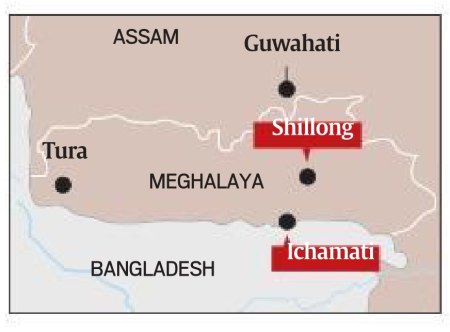
    • Meghalaya became a state in 1972 when it was carved out of Assam. Before that, Shillong, now Meghalaya’s capital, used to be the capital of Assam.
    • Sharing a 443-km border with Bangladesh, Meghalaya has seen decades of migration from areas that are now in Bangladesh, as well as from various Indian states via Assam.
    • Besides the indigenous groups, Meghalaya’s residents include Bengalis, Nepalis, Marwaris, Biharis and members of various other communities.
    • Meghalaya is a tribal majority state, and the indigenous Khasis, Jaintias and Garos are entitled to 80% reservation in government jobs.
    • Various groups have continuously expressed concerns that illegal migration from Bangladesh and the growth of “outsiders” from other states would overwhelm the indigenous communities.

    Meghalaya violence: The CAA context

    • The CAA relaxes the norms for Hindus from Bangladesh (among six religious groups from three countries) for eligibility to apply for Indian citizenship.
    • Long before that, the legislation was already facing protests in the Northeast, including Meghalaya. Eventually, the Centre decided the CAA will not apply in Sixth Schedule areas.
    • The Sixth Schedule of the Constitution has special provisions for administration of certain areas in the Northeast, including almost the whole of Meghalaya.
    • Despite the large exemption, the concerns have persisted in Meghalaya, and demands for an Inner Line Permit (ILP) regime have gathered fresh momentum.
    • If the ILP system is introduced, every Indian citizen from any other state would require a time-bound permit to visit Meghalaya.

    Signals simmering tensions

    • The last four decades have seen numerous incidents of violence in Meghalaya targeted at non-tribals, including from Bengal and Nepal.
    • The latest bout follows a sustained campaign over the implementation of the Inner Line Permit and unrest in the Northeast over the CAA that led to six deaths in Assam two months ago.
    • The violence last week has an immediate context in the anti-CAA campaign and ILP demand.

    Shillong, then and now

    • Shillong has seen violence against “outsiders” several times in the last four decades.
    • The targets were Bengalis in 1979, Nepalis in 1987, and Biharis in 1992.
    • In 2018, Shillong saw clashes between Khasis and Punjab-origin Dalit Sikhs whose ancestors had settled there over 100 years ago.
    • All that began collapsing after Independence, Constitutional institutions set up to safeguard the interest of the tribes came to be popularly perceived as opportunities to convert these tribal areas into exclusive zones of tribal hegemony.
    • The issue of ‘foreigners’ illegally residing in the state of Meghalaya was one of the most important issues which dominated state politics in the 1970s and 1980s.
    • In 1979, the state was plunged into a crisis for the first time since it was created.
  • Still no finality, the third time round

    Context

    There are indications that the new Bodo accord does not spell closure of the statehood movement by Bodo groups.

    Power-sharing experiment under the Sixth Schedule

    • Sixth Schedule expected as a panacea: The experiment of power-sharing and governance under the Sixth Schedule of the Indian Constitution was expected to be the panacea of the ethno-nationalist identity questions in the Northeastern States.
    • Complexities of exclusion: Euphoria, as well as anger over the third Bodo Accord, have, however, held the mirror reflecting the complexities of exclusion of communities in such ethnocentric power-sharing and governance model.

    Specifics of the new Accord

    • The new Accord was signed by the All Bodo Students’ Union (ABSU), United Bodo People’s Organisation and all the four factions of the insurgent outfit- National Democratic Front of Bodoland (NDFB) with Delhi and Dispur on January 27.
      • It promises more legislative, executive and administrative autonomy under the Sixth Schedule to Bodoland Territorial Council (BTC) and expansion of the BTC territory in lieu of statehood.
    • The Bodoland Territorial Area District (BTAD), the autonomous region governed by BTC, will be known as Bodoland Territorial Region (BTR) after demarcation of the augmented territory.

    The emergence of the faultlines in the new Accord

    • What went wrong in the previous Accord? The previous Bodo Accord signed by the erstwhile insurgent outfit, Bodo Liberation Tigers (BLT) with Delhi and Dispur on February 10, 2003, led to the creation of the BTC as a new experiment of territorial autonomy under the Sixth Schedule.
      • No assent by the Governor to any BTC legislation: The constitutionally mandated legislative power of the BTC has been reduced to a farce as the Assam Governor has not given assent to any of the legislation passed by the BTC Legislative Assembly.
    • Intensification of demand for Kamatapur State: Bodo groups have suspended their statehood movement.
      • The new Bodo Accord has triggered the intensification of the movement for Kamatapur State by organisations of the Koch-Rajbongshi community.
      • Overlapping territory: The territory of the demanded Kamatapur State overlaps with the present BTAD, proposed BTR and demanded Bodoland.
    • Demand for ST status: Clamour for Scheduled Tribe (ST) status by the Koch-Rajbongshis, Adivasis and several other non-ST communities has also grown.
    • Faultlines over ST status: Deeper ethnic faultlines in an ethnocentric power-sharing model will become exposed when the Koch-Rajbongshis and the Adivasis are granted ST status, as promised by the government.
      • For, the reservation of seats of BTC is for the STs and not exclusively for the Bodos.
      • The new accord has no clear answer to such critical questions.
      • In BTAD, the ST communities account for 33.50% of the total population and the Bodos account for over 90% of the ST population in the BTAD.
      • The ST populations are an overwhelming majority in territories overseen by nine other autonomous councils under the Sixth Schedule in Assam, Meghalaya, Mizoram and Tripura.
    • Minority governing majority: Such a demographic composition in the BTAD has allowed the space for political mobilisation of other non-Bodo communities.
      • It also allowed the articulation of the campaign that the BTC is a faulty model as it allows the minorities to govern the majorities.
      • Exclusion demand: The organisations of these communities have been demanding exclusion of villages with less than 50% Bodo population from the BTAD.
    • Counter argument by Bodos: Bodo organisations have a counter-argument that non-Bodo is a political identity construction articulated to capture power in the BTAD by certain political forces.
    • The new accord promises to increase the current strength of BTC to 60 from 40 but “without adversely affecting the existing percentage of reservation for tribal[s]”.
    • Constitutional provision for dealing with such situations: Sub-paragraph 2 of the first paragraph of the Sixth Schedule provides that, “If there are different Scheduled Tribes in an autonomous district, the Governor may, by public notification, divide the area or areas inhabited by them into autonomous regions.”
      • However, constitutional amendments were made following the previous Bodo Accord to ensure that this provision shall not apply in respect of the BTAD.
    • What could be the solution to the present situation? The provision of setting up regional autonomous councils under the Sixth Schedule can be explored to create the space for communities aggrieved by exclusion from the power-sharing model of BTC.

    Provision of commission

    • The new accord promises to appoint a commission by the Assam government.
      • What the commission will deal with? It will look into the demands for inclusion of villages with ST majority and contiguous to the BTAD, and exclusion of villages which are contiguous to non-Sixth Schedule areas and have majority non-ST population.
      • However, the core area of the BTAD will continue to have many villages with majority non-ST population which were included for contiguity.

    Evaporating of euphoria over the accord

    • Failure in uniting the four factions: Euphoria among the Bodos over the accord is also fast evaporating with efforts to unite all the four factions of NDFB having turned futile.
      • The factions are divided into two camps.
      • The new accord will be the pivot of political mobilisation in the BTAD during the forthcoming BTC elections due in April.
    • Revival in homeland demand: A shift in the political equilibrium in the BTC resulting from a likely expansion of the ST list in Assam has the potential to keep the Bodos out of power in the BTC and push Bodo organisations to revive their homeland demand

    Conclusion

    Peace will continue to be fragile in Assam’s Bodo heartland until an all-inclusive power-sharing and governance model is evolved under the provisions of the Sixth Schedule.


  • Explained: Assam-Mizoram Boundary Dispute


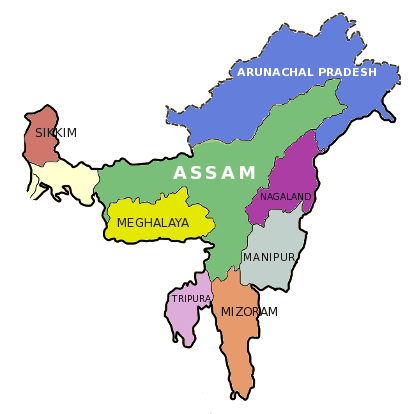
    Assam is at the centre of a fresh inter-State border row in the northeastern region. The Mizoram government has sought the revision of the boundary with Assam, based on the Bengal Eastern Frontier Regulation (BEFR) of 1873 and the Inner Line of the Lushai Hills Notification of 1993.

    Background

    • Since 1962 most of the state borders of states carved out of Assam were divided following the myopic vision of the Central government.
    • On ground these borders still do not run in sync with the tribal territories and identities, creating repetitive conflicts in the region and disturbing its peace.
    • Assam finds itself at the center of all the conflicts since most of the neighboring states were carved out of its territory since independence.
    • This was done to consolidate the Indian Union at the time by catering to the aspirations of the local tribes and including them in the mainstream by giving them independent statehoods.

    What is the dispute?

    • Mizoram shares a 123-km border with southern Assam and has been claiming a 509-square mile stretch “occupied” by the neighbouring State.
    • Mizoram used to be the Lushai Hills district of Assam before being made a Union Territory in 1972 and a State in 1987.
    • Both States have been disputing an extensive stretch of this boundary.

    About Bengal Eastern Frontier Regulation

    • The Inner Line Regulations, commonly referred to as the Inner Line Permit system (ILP), first gained legal effect through the Bengal Eastern Frontier Regulation, 1873.
    • At present the BEFR continues to apply, but only in present-day Arunachal Pradesh, Nagaland and Mizoram.
    • It had been lifted in the whole of Assam, as well as the entirety of present-day Meghalaya.
    • The BEFR allows Arunachal Pradesh, Manipur, Mizoram and Nagaland not to let non-resident Indians in without an inner-line permit for a temporary stay.

    Present status of ILP

    • The Foreigners (Protected Areas) Order, 1958 is the modern embodiment of the ILP.
    • This Order was passed in furtherance of the Foreigners Act, 1946.
    • The Order defined the ‘inner line’ throughout present-day India starting from Jammu and Kashmir and ending at Mizoram.
    • This inner line is different from the one envisioned in the Bengal Frontier Regulations.
    • This line represents the furthest point up to the international border where a foreigner can visit on the strength of a visa alone.
  • Kalasa-Banduri Nala Project


    The cost of Kalasa-Banduri Nala Project on the Mahadayi River skyrockets by 1,674% since inception. It rose from about ₹94 crores (2000) to ₹1,677.30 crores (2020) due to the ongoing inter-State river water dispute.

    Kalasa-Banduri Nala Project

    • The project is undertaken by the Government of Karnataka to improve drinking water supply to the three districts of Belagavi, Dharwad, and Gadag.
    • It was planned in 1989; Goa raised an objection to it.
    • It involves building across Kalasa and Banduri, two tributaries of the Mahadayi river to divert water to the Malaprabha, a tributary of Krishna River.
    • Malaprabha river supplies the drinking water to Dharwad, Belgaum, and Gadag districts.

    About Mahadayi Water Dispute

    • The Mahadayi river basin drains an area of 2032 square kilometres of which 375 square km lies in Karnataka, 77 sq km in Maharashtra and the remaining in Goa.
    • It originates in the Belagavi district of Karnataka, briefly passes through Maharashtra and flows through Goa (where its known as Mandovi), and drains to the Arabian Sea.
    • Since the eighties, Karnataka has been was contemplating linking of Mahadayi with Malaprabha river, a tributary of Krishna.
    • In 2002, Karnataka gave the idea a shape in the form of the Kalasa-Bhanduri project.
    • Goa strongly opposed it as Mahadayi is one of the two rivers the State is dependent on and thus Mahadayi Water Disputes Tribunal was set up in 2010.

    Read more about the Mahadayi Dispute and award of the tribunal at:

    https://www.civilsdaily.com/news/verdict-of-mahadayi-water-disputes-tribunal-comes/

  • [op-ed snap] Optimal delivery or mere optics in Bodo peace deal?

    Context

    It is to be seen if the pact will lead to true autonomy, true peace, and true development.

    What the pact involved?

    • Which groups signed the deal?
      • Four factions of the National Democratic Front of Bodoland (NDFB), along with an influential Bodo students’ organization and a Bodo civilian pressure group, signed the peace agreement with the central and Assam governments.
    • What are the major concessions given?
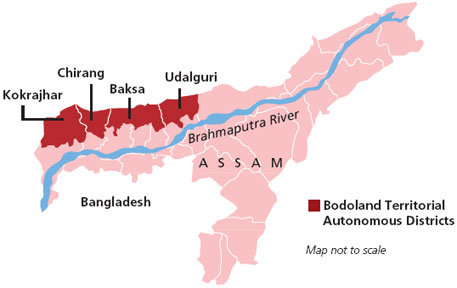
      • The Bodoland Territorial Area Districts, the name given to Kokrajhar, Baksa, Chirang and Udalguri, the four contiguous districts bordering Bhutan and Arunachal Pradesh, will now be known as Bodoland Territorial Region.
      • Acknowledgement of Bodo homeland: The changed nuance from districts to the region is significant as it acknowledges a Bodo homeland within the state of Assam, without separating from Assam.
      • Why this acknowledgement matters: This is dialled down from earlier rebel demands for a breakaway state and later suggestions for Union territory status.
    • What is the significance of the change from district to the region?
      • Satisfying identity aspiration: The renaming is designed to satisfy the identity and aspirations of the Bodo people.
      • Not ceding territory solved tricky matter: Renaming also solved the politically tricky matter of ceding territory for the government of Assam.
      • Ceding territory would also have fuelled similar demands from the other parts of the state like- Karbi Anglong, Dima Hasao and Cachar, which also have homelands of non-Ahom ethnicities.
      • Avoiding similar demand from other states: Indeed, it could have affected the ongoing Naga peace process, leading Naga rebels to demand territorial and administrative autonomy in Naga homelands in Manipur.

    Scope of the success of the pact

    • Inherent vulnerability: There is already an inherent vulnerability to the Bodo peace deal even without the overhang of ceding territory.
      • This is rooted in the birth of the Bodo rebellion, which began in the 1980s on account of administrative and development apathy of the state of Assam.
    • Feeling of subsuming in Bodo: A feeling that Bodo, the people, the language, the identity, was subsumed by the Assamese and migrants.
    • The relation between NDFB and the Front: The Bodoland People’s Front, is in majority in the District council. Will the front be comfortable with newly peaceable colleagues of NDFB?

    Conclusion

    The Government of Assam needs to ensure that the pact signed changes the situation on the ground and leads to a development on the ground. The state also needs to allay the fears in the Bengali-speaking minority. Moreover, true autonomy, true peace, and true development are always worth more than the paper on which they are promised.

  • Comprehensive Bodo Settlement Agreement


    • The MHA, the Assam government and the Bodo groups have signed an agreement to redraw and rename the Bodoland Territorial Area District (BTAD) in Assam, currently spread over four districts of Kokrajhar, Chirang, Baksa and Udalguri.
    • Several Bodo groups led have been demanding a separate land for the ethnic community since 1972, a movement that has claimed nearly 4,000 lives.

    Background

    • The first Bodo accord was signed with the ABSU in 1993, leading to the creation of a Bodoland Autonomous Council with limited political powers.
    • The BTC was created in 2003 with some more financial and other powers.
    • The BTAD and other areas mentioned under the Sixth Schedule of the Constitution have been exempted from the Citizenship (Amendment) Act, 2019.

    Highlights of the Agreement

    • As per the agreement, villages dominated by Bodos that were presently outside the BTAD would be included and those with non-Bodo population would be excluded.
    • Bodos living in the hills would be conferred a Scheduled Hill Tribe status.
    • The BTAD is to be renamed as the Bodoland Territorial Region (BTR).

    Rehabilitation and relief

    • The criminal cases registered against members of the NDFB factions for “non-heinous” crimes shall be withdrawn by the Assam government and in cases of heinous crimes it will be reviewed.
    • A Special Development Package of Rs. 1500 Crore would be given by the Centre to undertake specific projects for the development of Bodo areas.

    A separate Commission

    • It proposes to set up a commission under Section 14 of the Sixth Schedule to the Constitution which will recommend the inclusion or exclusion of tribal population residing in villages adjoining BTAD areas.
    • In this commission, besides State government, there will be representatives from ABSU and BTC. It will submit its recommendation within six months.

    Changes in Legislature

    • The total number of Assembly seats will go up to 60, from the existing 40.
    • The present settlement has a proposal to give more legislative, executive, administrative and financial powers to BTC.

    Bodo as an official language

    • The Assam government will also notify Bodo language as an associate official language in the state and will set up a separate directorate for Bodo medium schools.
    • Bodo with Devnagri script would be the associate official language for the entire Assam.

    Significance of the agreement

    • The signing of the agreement would “end the 50-year-old Bodo crisis.”
    • Around 1500 cadres of BODO militant factions will be rehabilitated by Centre and Assam Government.
  • Legislative Councils and its abolition

    The Andhra Pradesh Assembly recently passed a resolution to abolish the state’s Legislative Council (LC).

    Legislative Councils

    • The LC or Vidhan Parishad is the upper house in those states that have a bicameral legislature; the lower house being the State Legislative Assembly.
    • Its establishment is defined in Article 169 of the Constitution of India.
    • Each Member of the State LC serves for a six-year term, with terms staggered so that the terms of one third of a State Legislative Council’s membership expire every two years.
    • This arrangement parallels that for the Rajya Sabha, the upper house of the Parliament of India.
    • Q member of LC must be a citizen of India, at least 30 years old, mentally sound, not an insolvent, and must be enrolled on the voters’ list of the state for which he or she is contesting an election.
    • Under Article 171, a Council cannot have more than a third of the number of MLAs in the state, and not less than 40 members.

    Representation in an LC

    MLCs are chosen in the following manner:

    • One third are elected by the members of local bodies such as municipalities, Gram panchayats, Panchayat samitis and district councils.
    • One third are elected by the members of Legislative Assembly of the State from among the persons who are not members of the State Legislative Assembly.
    • One sixth are nominated by the governor from persons having knowledge or practical experience in fields such as literature, science, arts, the co-operative movement and social service.
    • One twelfth are elected by persons who are graduates of three years’ standing residing in that state.
    • One twelfth are elected by persons engaged for at least three years in teaching in educational institutions within the state not lower than secondary schools, including colleges and universities.

    Abolition of LC

    • Article 169(1) of the Constitution allows Parliament to either create or abolish a Council in a state “if the Legislative Assembly of the State passes a resolution to that effect.
    • The resolution must by a majority of the total membership of the Assembly and by a majority of not less than two-thirds of the members of the Assembly present and voting.

    Councils in the Constitution

    • Under Article 168, states can have either one or two Houses of legislature. Article 169 leaves the choice of having a Vidhan Parishad to individual states.
    • The Constituent Assembly was divided on having a second chamber in the states.
    • It was argued that a second House can help check hasty actions by the directly elected House, and also enable non-elected persons to contribute to the legislative process.
    • However, it was also felt that some of the poorer states could ill afford the extravagance of two Houses.
    • It has been pointed out that the Councils can be used to delay important legislation, and to park leaders who have not been able to win an election.

    Councils in other states

    • Besides Andhra Pradesh, five other states have Vidhan Parishads — Bihar (58 members), Karnataka (75), Maharashtra (78), Telangana (40), UP (100).
    • Jammu and Kashmir had a Council until the state was bifurcated into the Union Territories of J&K and Ladakh.
    • In 1986, the M G Ramachandran government in Tamil Nadu abolished the Council.
    • The DMK government passed a law revives it, but the subsequent J Jayalalithaa-led government withdrew it after coming to power in 2010.
    • The Odisha Assembly has passed a resolution for a Legislative Council. Proposals to create Councils in Rajasthan and Assam are pending in Rajya Sabha.
  • Three capitals for Andhra Pradesh — its logic and the questions it raises


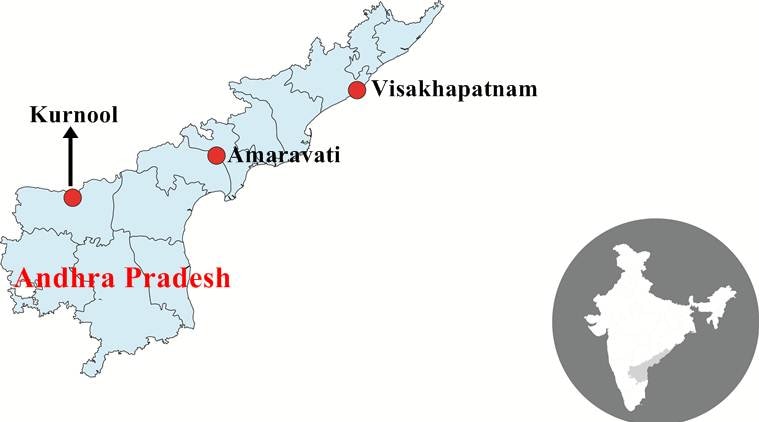
    The Andhra Pradesh Assembly passed The Andhra Pradesh Decentralisation and Equal Development of All Regions Bill, 2020, paving the way for three capitals for the state.

    Three capitals concept in Andhra Pradesh

    • Three cities serve as capitals of the country– Pretoria (executive), Cape Town (legislative), and Bloemfontein (judicial).
    • This arrangement was a result of the Second Boer War (1899-1902) in which Britain annexed the two Afrikaner speaking states -– the Orange Free State and the South African Republic (also called Transvaal Republic).
    • Cape of Good Hope then remained in the British Empire, becoming self-governing in 1872, and uniting with three other colonies to form the Union of South Africa in 1910.

    What are the other examples of multiple capital cities?

    • Several countries in the world have implemented the concept.
    • In Sri Lanka, Sri Jayawardenepura Kotte is the official capital and seat of national legislature, while Colombo is the de facto seat of national executive and judicial bodies.
    • Malaysia has its official and royal capital and seat of national legislature at Kuala Lumpur, and Putrajaya is the administrative centre and seat of national judiciary.
    • Among Indian states, Maharashtra has two capitals– Mumbai and Nagpur (which holds the winter session of the state assembly).
    • Himachal Pradesh has capitals at Shimla and Dharamshala (winter).
    • The former state of Jammu & Kashmir had Srinagar and Jammu (winter) as capitals.

    Reasons behind such considerations

    • According to the government, decentralisation was the central theme in recommendations of all major committees that were set up to suggest a suitable location for the capital of Andhra Pradesh.
    • It had been agreed in the November 16, 1937 Sri Bagh Pact (between leaders of coastal Andhra and Rayalaseema) that two university centres should be established in Waltair (Visakhapatnam) and Anantapur in Rayalaseema, and that the High Court and Metropolis should be in the coastal districts and Rayalaseema respectively.
    • In December 2010, the Justice B N Srikrishna Committee, set up to look into the demand for a Telangana state, said Rayalaseema and North Coastal Andhra were economically the most backward, and the “concentration of development efforts in Hyderabad is the key reason for demand of separate states”.
    • In August 2014, the K Sivaramakrishnan Committee appointed to identify locations for the new capital of AP said the state should see decentralised development, and that one mega capital city was not desirable.

    Major practical problems

    • The government argues that the Assembly meets only after gaps of several months, and government Ministers, officers, and staff can simply go to Amaravati when required.
    • However, coordinating between seats of legislature and executive in separate cities will be easier said than done, and with the government offering no specifics of a plan, officers and common people alike fear a logistics nightmare.
    • The distances in Andhra Pradesh are not inconsiderable. Executive capital Visakhapatnam is 700 km from judicial capital Kurnool, and 400 km from legislative capital Amaravati.
    • The Amaravati-Kurnool distance is 370 km. The time and costs of travel will be significant.
    • The AP Police are headquartered in Mangalagiri, 14 km from Vijayawada, and senior IPS officers who may be required to visit the Secretariat will have to travel 400 km to Visakhapatnam.
    • Likewise, government officers who may have to appear in the High Court will have to travel 700 km to Kurnool, which does not have an airport.
    • All officers and Ministerial staff who may have to be at hand to brief Ministers when the Assembly is in session, will probably have to stay put in Amaravati, leaving behind their other responsibilities in Visakhapatnam.