💥Join UPSC 2027,2028 Mentorship (July Batch) + XFactor Notes & Microthemes PDF

Subject: Fundamental Rights,DPSP

1. History + Evolution
2. Features
3. Amendments
4. Basic Structure

  • Row over Karnataka Temple Bill

    temple

    In the news

    • The Karnataka government’s recent move to amend the law governing the taxation of Hindu temples sparked significant debate and controversy.
    • It aims to overhaul the existing framework, particularly in terms of income allocation and management.

    Proposed Changes in Temple Taxation

    The Karnataka Hindu Religious Institutions and Charitable Endowments (Amendment) Bill, 2024 aimed to modify several provisions in the existing law:

    • Income Allocation: The proposed change sought to divert 10% of the gross income of temples earning over Rs 1 crore annually to a common pool for temple maintenance. Section 19 of the Act outlines the purposes for which the common fund may be utilized, including religious studies, temple maintenance, and charitable causes.
    • Shift in Calculation: This change would shift from the previous norm of allocating 10% of the net income of temples with earnings over Rs 10 lakh annually.
    • Dedicated Common Pool: Additionally, 5% of the income of temples earning between Rs 10 lakh and Rs 1 crore annually would have been dedicated to the common pool.
    • Priests Welfare: The Congress government proposed utilizing the enhanced funds to support lower-income temples, provide assistance to ailing priests, and offer scholarships to priests’ families.

    Additional Amendments Proposed:

    • Committee of Management: The Bill proposed including a member skilled in Vishwakarma Hindu temple architecture and sculpture within the committee of management for temples.
    • Authority of Rajya Dharmika Parishat: It granted the Rajya Dharmika Parishat the power to appoint the chairman of temple management committees.
    • Infrastructure Oversight: The Bill mandated the creation of district-level and state high-level committees to oversee infrastructural projects facilitating temple pilgrimage.

    Criticism and Opposition

    • Interference into Religious Matters: BJP leaders accused the government of attempting to “rob” Hindu temples and questioned the selective targeting of Hindu institutions.
    • Questioning Motives: Concerns were raised regarding the selective taxation of Hindu temples, prompting questions about the government’s intentions.

    Constitutional Insights into the Issue


    The proposed Bill, which aimed to divert a percentage of temple income to a common pool, raised concerns about government interference in temple finances, potentially infringing on these constitutional rights under:

    • Article 25: Ensures individuals’ freedom to profess, practice, and propagate religion, subject to public order, morality, and health.
    • Article 26: Grants religious denominations autonomy to manage their religious affairs and establish institutions for religious and charitable purposes.

    Comparison with Other States

    • Telangana’s Model: Similar to Karnataka, Telangana also mandates temple contributions towards a common good fund, utilized for temple maintenance and related expenses.
    • Kerala’s Devaswom Boards: Kerala’s temples are managed by state-run Devaswom Boards, each with its own budget and administrative laws, overseen by government-appointed nominees.

    Issues with the Bill

    • Government Interference: The appointment of members from Hindu and other religions to temple management committees raises concerns about state involvement in temple affairs.
    • Contradiction to Secularism: Perceived as contradicting the principle of secularism advocating for a separation of religion and state involvement in religious matters.
    • Conflict with Autonomy: Opposition to the diversion of temple income for a common pool fund highlights concerns about encroachment on religious autonomy and financial mismanagement by the state.

    Conclusion

    • The Karnataka temple bill controversy underscores the complex interplay between governance, religion, and finance.
    • While intended reforms aimed to enhance temple infrastructure and support, differing interpretations and political alignments led to its rejection.
    • As states grapple with temple management, a balance between tradition, governance, and public welfare remains a constant challenge.

    Try this Question from CS Mains 2018:

    Q.How the Indian concept of secularism different from the western model of secularism? Discuss. (10)


    [wpdiscuz-feedback id=”ba3uieqcag” question=”Please leave a feedback on this” opened=”1″]Post your responses here.[/wpdiscuz-feedback]

  • Article 371A’s Influence on Coal Mining Rules in Nagaland

    In the news

    • The Nagaland CM is facing pressure to regulate coal mining after a tragic incident where six miners died in an explosion.
    • The unique land rights granted under Article 371A of the Indian Constitution have complicated efforts to control illegal coal mining activities.

    Article 371A: Special Provisions for Nagaland

    Details
    Historical Context Established in 1963 for Nagaland, recognizing its autonomy after the Naga people’s struggle.
    Religious & Social Practices Protects Naga tribes’ customs, traditions, and religious practices from external interference.
    Customary Laws Allows continuation of indigenous legal systems and traditional methods of justice.
    **Autonomy Grants Nagaland autonomy in managing its land, forests, and natural resources.
    Legislation Reserves seats in the Nagaland Legislative Assembly for various tribes and communities.
    Special Rights Aims to protect Naga people’s rights and promote socio-cultural development within the state.

    Article 371A

    Why discuss this?

    • Rat-hole Mining: Nagaland’s coal mining policy, permitting rat-hole mining due to the scattered nature of coal deposits, presents challenges for effective regulation.
    • Licensing Restrictions: Small pocket deposit licenses, awarded to individual landowners, impose limitations on lease duration, mining area, and machinery usage, as outlined in the Nagaland Coal Policy (First Amendment) of 2014.

    Conclusion

    • The intersection of constitutional provisions, traditional land rights, and regulatory frameworks poses complex challenges for the Nagaland government in its endeavour to address illegal coal mining activities.
    • As legislative deliberations continue, concerted efforts towards public awareness, regulatory reforms, and enforcement actions remain imperative for safeguarding both natural resources and community welfare in the state.
  • Legal Conundrum: What constitutes a Money Bill?

    Money Bill

    Introduction

    • Against the backdrop of significant judicial pronouncements, including recent decisions on the electoral bond scheme and the Aadhaar Act, the Supreme Court grapples with a pivotal question: the delineation of a money Bill.

    Why discuss this?

    • The ongoing examination before a seven-judge constitution bench highlights the crucial need to define the scope of a money Bill and its broader implications.
    • This issue carries substantial weight for legislative efficiency and constitutional adherence.

    What are Money Bills?

    Description
    About A financial legislation exclusively dealing with revenue, taxation, government expenditures, and borrowing.
    Constitutional Basis
    • Article 109: Specifies special procedure for Money Bills.
    • Article 110(1): Specifies matters related to taxation, borrowing, and appropriation of funds.
    • Article 110(3): Grants the Speaker of the Lok Sabha the final decision on whether a bill qualifies as a Money Bill.
    Procedure
    • Introduction in Lok Sabha with the President’s recommendation.
    • Consideration and passage in Lok Sabha.
    • Transmission to Rajya Sabha for recommendations (no amendments).
    • Return to Lok Sabha for consideration of recommendations.
    • Acceptance or rejection of recommendations by Lok Sabha.
    • Assent by the President without the power to return for reconsideration.
    Criteria for a Money Bill
    • Imposition, abolition, or regulation of taxes.
    • Regulation of borrowing or giving guarantees by the Government of India.
    • Custody of the Consolidated Fund or the Contingency Fund of India.
    • Appropriation of money from the Consolidated Fund of India.
    • Declaration of any expenditure as expenditure charged on the Consolidated Fund of India.
    • Receipt of money into or out of the Consolidated Fund of India or the public account of India.
    • Any matter incidental to the specified criteria.
    Decision Authority Speaker of the Lok Sabha has the final decision on whether a bill qualifies as a Money Bill.
    President’s Role President can either accept or reject a Money Bill but cannot return it for reconsideration.
    Joint Sitting No provision for Joint sitting for the passage such Bill.


    Key Legal Precedents

    [1] Prevention of Money Laundering Act (PMLA) Amendments:

    • Amendments introduced since 2015 to the PMLA expanded the Enforcement Directorate’s powers, triggering concerns over their passage as Money Bills.
    • Critics argue that such significant alterations should have undergone standard parliamentary scrutiny involving both houses.

    [2] Finance Act of 2017:

    • The Finance Act of 2017, designated as a Money Bill, attracted scrutiny for purportedly aiming to reshape appointments to 19 crucial judicial tribunals.
    • Allegations surfaced suggesting a deliberate manoeuvre to enhance executive authority over these tribunals by categorizing the Act as a Money Bill.
    • Additionally, changes within the Act relaxed qualifications and experience prerequisites for staffing these pivotal judicial entities, raising concerns of dilution.

    [3] Aadhaar Act, 2016:

    • The Supreme Court’s 2018 ruling upheld the validity of the Aadhaar Act as a Money Bill, despite lingering legal and procedural uncertainties.
    • The government’s argument hinged on the Act’s nexus to subsidies disbursed from the Consolidated Fund of India, justifying its classification as a Money Bill.
    • However, the verdict prompted calls for a comprehensive reevaluation, reflecting lingering doubts over the Act’s classification and its implications for parliamentary oversight.

    Legal Implications  

    • Parliamentary Bypass: By categorizing crucial amendments as Money Bills, the standard legislative process involving both houses of Parliament is bypassed, limiting comprehensive scrutiny and deliberation.
    • Eroding Rajya Sabha Scrutiny: Critics argue that such amendments, which often encompass far-reaching implications, should undergo thorough examination and debate in both the Lok Sabha and the Rajya Sabha.
    • Hasty Lawmaking: Designating important legislations as Money Bills undermines the role of the Rajya Sabha, curtailing its authority in the lawmaking process.
    • Against Democratic-Ethos: This erosion of parliamentary oversight raises concerns about the equitable distribution of legislative power and the preservation of democratic principles.
    • Lack of Judicial Scrutiny: The judiciary plays a crucial role in adjudicating the legality and constitutional conformity of categorizing amendments as Money Bills.

    Future Prospects

    • Impending Legal Clarity: The anticipated verdict by the seven-judge bench holds the potential to reshape legislative dynamics, potentially paving the way for renewed challenges against contentious enactments.
    • Judicial Review: The judiciary’s vigilance in scrutinizing the validity of money Bills underscores its commitment to upholding constitutional principles and safeguarding legislative integrity.
    • Democratic Accountability: The evolving jurisprudence surrounding money Bills epitomizes the judiciary’s role in navigating complex constitutional nuances, ensuring robust legislative frameworks and institutional accountability.

    Conclusion

    • As the legal saga unfolds, the apex court’s forthcoming pronouncement holds profound implications for India’s legislative landscape and institutional accountability, heralding a new chapter in the nation’s constitutional journey.

    Try this PYQ:

    Q. Regarding the Money Bill, which of the following statements is not correct? (CSP 2018)

    (a) A bill shall be deemed to be a Money Bill if it contains only provisions relating to the imposition, abolition, remission, alteration or regulation of any tax.

    (b) A Money Bill has provisions for the custody of the Consolidated Fund of India or the Contingency Fund of India.

    (c) A Money Bill is concerned with the appropriation of money out of the Contingency Fund of India.

    (d) A Money Bill deals with the regulation of borrowing of money or giving of any guarantee by the Government of India.


    [wpdiscuz-feedback id=”qt8pwrsy49″ question=”Please leave a feedback on this” opened=”1″]Post your answers here.[/wpdiscuz-feedback]


  • In news: Mayor’s Election

    mayor
    PC: Hindustan Times

    Introduction

    • The Supreme Court has nullified the outcome of the mayoral election held on January 30 in Chandigarh.

    Who is a Mayor?

    • In India, the mayor is the head of an urban local body, which is responsible for providing essential services and infrastructure to the residents of a city or town.
    • The mayor is usually elected by the members of the Municipal Corporation or Council.
    • He/She serves as the ceremonial head of the local government.

    History of Mayor’s elections in India

    • Municipal corporation mechanisms in India was introduced during British Rule with formation of municipal corporation in Madras (Chennai) in 1688, later followed by municipal corporations in Bombay (Mumbai) and Calcutta (Kolkata) by 1762.
    • However the process of introduction for an elected President in the municipalities was made in Lord Mayo’s Resolution of 1870.
    • Since then the current form and structure of municipal bodies followed is similar to Lord Ripon’s Resolution adopted in 1882 on local self-governance.
    • The 74th Constitutional Amendment Act of 1992 was introduced providing for the transfer of 18 different powers to urban local bodies, including the election of a mayor and to recognise them which included Municipal Corporations, Nagar Panchayats, and Municipal Councils.

    Elections and tenure

    • The method of electing mayor and their tenure varies for each city in India.
    • In Bengaluru (Karnataka) the election process is indirect with a tenure being for one year.
    • In Mumbai (Maharashtra) it follows indirect elections with tenure for 2.5 years and Bhopal (Madhya Pradesh) follows a directly elected mayor with a term for 5 years.

    Roles and Responsibilities

    • Governs the local civic body.
    • Fixed tenure varying in different towns.
    • First citizen of city.
    • Has two varied roles:
    1. Representation and upholding of the dignity of the city during ceremonial times and
    2. Presiding over discussions of the civic house with elected representatives in functional capacity.
    • The Mayor’s role is confined to the corporation hall of presiding authority at various meetings relating to corporation.
    • The Mayor’s role extends much beyond the local city and country as the presiding authority at corporation meetings during visits of a foreign dignitary to the city as he is invited by the state government to receive and represent the citizens to the guest of honour.
    • At government, civic and other social functions he is given prominence.
  • The real threat to the ‘India as we know it’

    Nehru Democracy Fellowship (NDF)

    Central Idea:

    The article by M.K. Narayanan highlights the concerning decline in parliamentary practices and the polarization of Indian politics, particularly in the lead-up to the general election. It discusses the divisive nature of recent parliamentary sessions, the erosion of democratic principles, and the growing rift between the ruling party and the opposition. Narayanan emphasizes the need for adherence to constitutional mandates, the preservation of federalism, and the importance of managing differences within a rules-based order to safeguard India’s democracy.

    Key Highlights:

    • The final parliamentary session before the general election was marked by divisiveness and acrimony between the ruling party and the opposition.
    • Narayanan underscores India’s historical commitment to democracy and parliamentary practices, citing the Constitution’s provisions for Fundamental Rights, Fundamental Duties, and Directive Principles of State Policy.
    • Despite external stability, internal challenges persist, including potential flashpoints like the farmers’ agitation in Punjab and Haryana and unrest in the northeast.
    • The article reflects on the heightened polarization in Indian politics, with the Prime Minister accusing the opposition of divisive tactics and vice versa.
    • Issues such as the construction of the Ram Temple in Ayodhya and attempts to enforce an Uniform Civil Code have become politicized, further exacerbating divisions.
    • The erosion of federalism is noted, with the ruling party accused of centralizing power and undermining regional parties.
    • Engineered defections to the ruling party raise concerns about the integrity of the electoral process and democratic principles.
    • The role of Governors in opposition-ruled states is contentious, with accusations of central interference leading to strained Centre-State relations.

    Key Challenges:

    • Divisiveness and acrimony in parliamentary sessions.
    • Polarization and politicization of issues.
    • Erosion of federalism and centralization of power.
    • Engineered defections undermining democratic principles.
    • Tensions between Centre and opposition-ruled states.
    • Threats to constitutional mandates and democratic norms.

    Main Terms and key words for answer writing:

    • Parliamentary democracy
    • Federalism
    • Polarization
    • Divisiveness
    • Constitution
    • Centre-State relations
    • Electoral integrity
    • Democratic principles
    • Rule of law
    • Defections

    Important Phrases for answer quality enrichment:

    • “Divided nation”
    • “Engineered defections”
    • “Polarized politics”
    • “Centralization of power”
    • “Constitutional niceties”
    • “Rules-based order”
    • “Centre-State relations”
    • “Erosion of democratic norms”

    Quotes:

    • “The unseemly spectacle has given rise to concerns about the future of parliamentary democracy in the country.”
    • “The country today appears more divided than it has at any time in the recent past.”
    • “The absence of a rules-based order… could overturn the system altogether.”
    • “Tolerating differences is the first order of priority.”
    • “Everything has to be subordinated to the requirements of the Constitution.”

    Useful Statements:

    • “The erosion of democratic principles undermines the foundation of our parliamentary democracy.”
    • “The politicization of issues further exacerbates divisions and hampers constructive dialogue.”
    • “Adherence to constitutional mandates is essential to preserve the integrity of our democratic institutions.”
    • “The centralization of power at the expense of federalism threatens the balance of governance.”
    • “The integrity of the electoral process must be upheld to ensure the legitimacy of democratic outcomes.”

    Examples and References:

    • The farmers’ agitation in Punjab and Haryana.
    • Tensions between the Centre and opposition-ruled states.
    • Instances of engineered defections to the ruling party.
    • Accusations of central interference in the functioning of opposition-ruled states.
    • Passage of resolutions in Parliament on contentious issues like the Ram Temple in Ayodhya.

    Facts and Data:

    • India’s historical commitment to democracy and adherence to constitutional principles.
    • Instances of engineered defections and accusations of central interference in opposition-ruled states.
    • Polarization and acrimony observed in parliamentary sessions leading up to the general election.

    Critical Analysis:

    The article provides a critical analysis of the state of Indian democracy, highlighting the erosion of parliamentary practices, growing polarization, and challenges to federalism. It underscores the need for adherence to constitutional mandates, the preservation of democratic norms, and the importance of constructive dialogue to address contentious issues. The article raises concerns about the integrity of the electoral process and the erosion of democratic principles, calling for urgent action to safeguard India’s democracy.

    Way Forward:

    • Uphold constitutional mandates and democratic principles.
    • Foster constructive dialogue and mutual respect between political parties.
    • Safeguard federalism and decentralize power to promote inclusivity and diversity.
    • Ensure the integrity of the electoral process and prevent engineered defections.
    • Prioritize the national interest over partisan politics and work towards consensus-building on key issues.

    Overall, the article underscores the importance of upholding democratic values and institutions to ensure the continued stability and prosperity of India’s democracy.

  • Supreme Court Strikes Down Electoral Bonds Scheme

    electoral bond

    Introduction

    • The Supreme Court delivered a groundbreaking unanimous judgment, deeming the electoral bonds scheme “unconstitutional and manifestly arbitrary.”
    • Led by Chief Justice of India (CJI) DY Chandrachud, a five-judge Constitution Bench unanimously struck down the scheme, citing infringement on voters’ right to information and disproportionate restrictions.

    ebs

    Key Reasons for Striking Down Electoral Bonds Scheme

    [A] Violation of Right to Information (RTI)

    • Petitioners argued that the scheme violates Right to Information under Article 19(1)(a) of the Constitution, emphasizing voters’ right to information regarding political party funding.
    • Despite the government’s stance that citizens lack a “right to know” about political contributions, the court upheld voters’ right to such information, citing the inherent connection between money and politics.
    • The court highlighted the “deep association” between money and politics, stressing the need for transparency to prevent quid pro quo arrangements.

    [B] Disproportionate Restrictions:

    • The scheme’s anonymity for donors, aimed at curbing black money, was deemed disproportionate to its goal.
    • Advocates highlighted potential loopholes allowing for cash donations, undermining its efficacy in combating black money.
    • The court emphasized the availability of alternative, less restrictive measures to achieve the scheme’s objectives, such as Section 29C of the Representation of People Act, 1951.

    [C] Privacy vs. Public Interest:

    • While the government argued for donor anonymity to protect privacy rights, advocates stressed the importance of public scrutiny in political funding.
    • The court clarified that donor privacy extends only to genuine forms of public support, rejecting absolute anonymity facilitated by the scheme.

    [D] Unlimited Corporate Contributions:

    • Advocates underscored the adverse impact of unlimited corporate contributions on free and fair elections.
    • The court reinstated the cap on political contributions from companies, citing the need to prevent undue corporate influence in politics.
    • It noted concerns that unlimited contributions could incentivize quid pro quo arrangements, especially by loss-making companies.

    Impact on Key Legal Amendments

    • Representation of the People Act, 1951: The court struck down amendments exempting political parties from disclosing donations above Rs. 20,000, reinforcing the balance between voters’ right to information and donor privacy. (Section 29C)
    • Companies Act, 2013: Amendments allowing unlimited corporate contributions were overturned, restoring the cap on political donations by companies and preserving electoral integrity. (Section 182)
    • Income-tax Act, 1961: Exemptions for political parties to maintain records of donations received via electoral bonds were annulled, safeguarding voters’ right to information. (Section 13A)

    Application of Proportionality Test

    [A] Definition:

    • The proportionality test assesses the balance between competing fundamental rights or interests and the measures taken by the state to achieve its objectives.
    • It involves four criteria: legality, necessity, proportionality in the strict sense, and balancing of interests.

    [B] Government’s Arguments:

    • The government defended the scheme, citing legitimate aims such as tackling black money and protecting donor anonymity.
    • Solicitor General Tushar Mehta argued that the right to information does not extend to information not in the state’s possession.

    [C] Court’s Analysis:

    • Applying the proportionality test, the court scrutinized the balance between competing fundamental rights, emphasizing the necessity of the “least restrictive” methods.
    • It underscored the importance of less intrusive alternatives, such as the electoral trusts scheme, in achieving the scheme’s objectives.

    Why is this a Landmark case?

    • Burden of Proof: The court held that the state must demonstrate that its measures are the “least restrictive” and that no other “equally effective” methods exist to achieve its objectives.
    • Balancing Competing Rights: Unlike previous approaches prioritizing public interest over individual rights, the court’s focus is on balancing competing fundamental rights.
    • Structured Proportionality Test: The verdict applies a structured proportionality test, requiring the state to demonstrate that its actions restricting fundamental rights are proportional to its objectives.
    • Application of Legal Precedents: While the right-to-privacy ruling laid down the law, subsequent cases like Aadhaar (2018) and Demonetization (2023) applied the structured proportionality test. The electoral bonds verdict represents a significant departure in this regard.

    Conclusion

    • The Supreme Court’s verdict reaffirms its commitment to upholding constitutional principles and safeguarding democratic processes.
    • By striking down the electoral bonds scheme and reinstating key legal provisions, the court emphasizes the primacy of transparency and accountability in electoral financing.
  • British-era Act invoked to Block Internet in Punjab

    Introduction

    • The Union government invoked its authority under a colonial-era Temporary Suspension of Telecom Services Rules, 2017 to suspend mobile Internet in select districts of Punjab during Farm Protests 2.0.

    Mechanisms allowing Internet Shut-downs

    Authorities Purpose
    Temporary Suspension of Telecom Services (Public Emergency or Public Safety) Rules, 2017 Home Departments in the states, state government review committee, central government (under this law, but rarely used) Enforces shutdowns for public emergency or safety reasons.
    Section 144 of the CrPC Local law enforcement authorities Enables shutdowns, particularly before 2017, to maintain public order and safety.
    The Indian Telegraph Act, 1885, Section 5(2) Home Secretary of the Union or state governments Allows blocking of messaging during a public emergency, safeguarding public safety, or protecting sovereignty and integrity.


    Constitutional Provisions for Right to Internet

    Constitutional Provision Explanation
    Anuradha Bhasin vs. Union of India and Ors. (2020) Right to Freedom of Speech and Expression under Article 19(1)(a) Grants the right to freedom of speech and expression, which encompasses access to information and the Internet.
    Faheema Shirin RK vs. State of Kerala and others (2019) Right to Education under Article 21A Guarantees the right to education for children aged 6 to 14;

    Internet access is crucial for modern education.

    K.S. Puttaswamy (Privacy) vs. Union of India (2017) Right to Privacy under Article 21 Protects the fundamental right to privacy, and Internet access is often used for secure communication.
    Anuradha Bhasin vs. Union of India and Ors. Freedom to Practice Any Profession or Carry on Any Trade, Business, or Occupation under Article 19(1)(g) Ensures the freedom to conduct various trades, businesses, and professions, often requiring Internet access.

    Landmark Precedence: Anuradha Bhasin Judgment (2020)

    • Supreme Court’s Ruling: In January 2020, the Supreme Court of India recognized access to the Internet as a fundamental right under the Indian Constitution.
    • Restrictions Guidelines: The Court mandated that any government-imposed Internet restrictions must be temporary, limited, lawful, necessary, and proportionate. It also emphasized judicial review.
  • Rescuing grace from disgrace

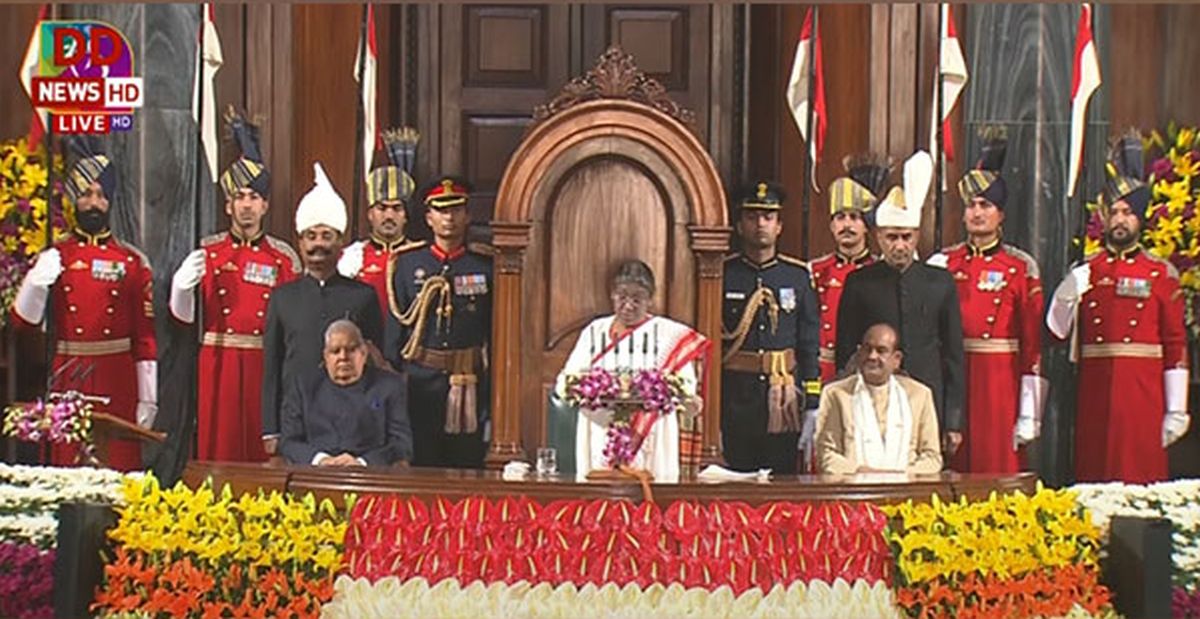
    Full text: President Murmu's address to Parliament's Budget Session - Rediff.com

    Central Idea:

    The article discusses the tradition of presidential and gubernatorial addresses to Parliament and Legislative Assemblies in India, highlighting the ceremonial and ritualistic nature of these events. It emphasizes the need for reform to streamline these addresses, suggesting a shift towards shorter, more concise speeches akin to the British practice, to save time and enhance efficiency in legislative proceedings.

    Key Highlights:

    • Presidential and gubernatorial addresses in India are steeped in tradition, characterized by elaborate ceremonies and rituals.
    • The speeches are drafted by the government of the day, with little involvement from the heads of state, leading to lengthy and sometimes tiresome readings.
    • Past presidents like R. Venkataraman and K.R. Narayanan exhibited meticulousness in reviewing draft speeches, suggesting improvements that were generally accepted.
    • Similar experiences were observed at the state level, with governors making suggestions for changes to their addresses, sometimes leading to unexpected challenges.
    • The article reflects on instances of political civility, where suggested changes were acknowledged and accommodated, despite time constraints.
    • Despite the ceremonial nature of these addresses, controversy and turbulence in legislative assemblies have been on the rise, fueled by accusations and counter-accusations.
    • The root cause of the problem lies in the disconnect between the writers and readers of these speeches, raising questions about ownership and relevance.
    • The author proposes adopting a more concise format for these addresses, similar to the British model, to refocus attention on legislative business and mitigate political polarization.

    Key Challenges:

    • Resistance from governments accustomed to using these addresses as platforms to showcase their achievements and plans.
    • Convincing stakeholders about the efficacy of shifting towards shorter, more focused speeches.
    • Overcoming entrenched traditions and resistance to change within the political system.
    • Balancing the ceremonial aspects of these addresses with the need for efficiency and relevance in legislative proceedings.
    • Addressing political polarization between central and state governments, which may hinder collaborative efforts towards reform.

    Main terms for answer quality enhancement:

    • Presidential address
    • Gubernatorial address
    • Ceremonial
    • Ritualistic
    • Legislative proceedings
    • Political polarization
    • Tradition
    • Efficiency
    • Reform

    Important Phrases:

    • “Land of largely unquestioned custom, ceremonials, and rituals”
    • “Suggesting changes by them difficult”
    • “Saving of time and the avoiding of tedium”
    • “Political civility”
    • “Root of the problem”
    • “Ornament of convention”
    • “Collective body of legislators”
    • “Innovative and self-denying Chief Minister”

    Quotes:

    • “When I am asked to read these Addresses, I feel like saying ‘Rashtrapati Bhavan’ and sitting down!” – R. Venkataraman
    • “The speech was not mine, it was yours.” – Unnamed speaker to Nitish Kumar
    • “Who Owns that Speech?” – Professor A.R. Venkatachalapathy

    Anecdotes:

    • R. Venkataraman’s meticulous review of draft speeches, despite tight timeframes.
    • Chief Minister Buddhadeb Bhattacharjee’s prompt action to rectify an oversight in a gubernatorial address.
    • The Governor of Bihar officiating a seamless legislative ceremony, earning appreciation from the Chief Minister.

    Useful Statements for critical approach in answer writing:

    • “The root of the problem lies in the foundational dichotomy of one agency writing the speech and another reading it.”
    • “Presidents and Governors will, I think, be relieved with such a rearrangement.”
    • “It will take an innovative and self-denying Chief Minister to start the reform to rescue a custom, ceremony, and ritual of grace from disgrace.”

    Examples and References:

    • Instances of past presidents and governors suggesting changes to draft speeches, with varying degrees of acceptance and acknowledgment.
    • Comparison with the British practice of brief, outline-focused speeches by the head of state.

    Facts and Data:

    • Terms of past presidents and governors mentioned in the article (e.g., R. Venkataraman, K.R. Narayanan).
    • References to specific events, such as the oversight in printing a gubernatorial address.

    Critical Analysis:

    • The article presents a nuanced critique of the ceremonial nature of presidential and gubernatorial addresses, highlighting inefficiencies and challenges.
    • It underscores the importance of streamlining these addresses to enhance legislative efficiency and mitigate political polarization.
    • The proposed reform aligns with the need for modernization and adaptation within the Indian political system.

    Way Forward:

    • Advocate for collaborative efforts among stakeholders to initiate reform and streamline the process of presidential and gubernatorial addresses.
    • Emphasize the benefits of shorter, more focused speeches in enhancing legislative efficiency and relevance.
    • Encourage political leaders to prioritize the collective interests of legislators and citizens over traditional ceremonies and rituals.
  • Governor’s Address: Insights from R. Venkataraman’s Perspective

     Introduction

    • The recent episode in the Tamil Nadu Assembly, where Governor R.N. Ravi declined to deliver the customary address, has reignited debates surrounding the significance of the Governor’s Address.
    • He actually walked out in response to an insult of National Anthem in TN Assembly.

    President’s/Governor’s Address

    • Constitutional mandate: Articles 87 and 176 of the Constitution confer authority upon the President and Governor, respectively, to address the legislature.
    • Occasions for Address: The addresses are reserved for two specific occasions: the commencement of a new legislative session post-election and the inauguration of the annual legislative session.
    • Significance: Termed the President’s or Governor’s Address, these speeches are pivotal for initiating legislative proceedings.

    Governor’s Address to the State Legislature: A Constitutional Obligation

    • Prescribed Duties: Article 176 delineates the Governor’s obligation to address the Legislative Assembly at the onset of each legislative year and post-general elections, with both Houses convened if a Legislative Council exists.
    • Procedural Norms: Established rules govern the time allocated for deliberating the address’s contents, ensuring parliamentary discourse.

    Global Parallels: Similar Practices across Democracies

    • Cross-National Comparison: Analogous provisions are observed in democratic nations worldwide.
    • State of the Union: In the United States, it manifests as the “State of the Union” address (1790), while in the United Kingdom, it is the Queen’s Speech (1536), heralding the parliamentary year’s commencement.
    • Indian Context: India’s Presidential Address mirrors the British model, reflecting the ceremonial role of the President, a sentiment echoed during the Constitution’s framing by Dr. B R Ambedkar.

    Features of the Address Content

    [A] Address Content: Proposals and Achievements

    • Legislative Agenda: The President’s or Governor’s speech encapsulates legislative proposals and government policy initiatives, coupled with a retrospective glance at previous accomplishments.
    • Government Input: Inputs for this address are curated from various government ministries, embodying the administration’s agenda.

    [B] Authorship and Agency: Government Responsibility

    • Constitutional Mandate: Governed by constitutional mandate, both the President and Governor are obligated to adhere to the Cabinet’s advice (1950) in their functions, including address preparation.
    • Policy Reflection: Hence, the address is meticulously crafted by the government, serving as a reflection of its policy stance.

    [C] Flexibility vs. Normative Adherence: Presidential/Governor Discretion

    • Adherence to Protocol: While refusal to deliver the address is impermissible, deviations from the prepared script are permissible.
    • Instances of Departure: Instances of Governors veering off the scripted path have transpired, although such actions remain rare for Presidents.

    Judicial Pronouncement: Upholding Constitutional Framework

    • Legal Precedent: The Supreme Court, in Shamsher Singh v. State of Punjab (1975), underscored the President’s (or Governor’s) adherence to Cabinet advice across functions.
    • Contested Discretion: While discretion to modify the speech is contested, any departure from parliamentary norms may invoke debate.

    R. Venkataraman’s Perspective

    • Venkataraman’s Critique: R. Venkataraman, who served as President from 1987 to 1992, vehemently opposed the practice of Presidential and Governor’s addresses, deeming it a “British anachronism” and a “meaningless formality.”
    • Calls for Constitutional Amendment: Venkataraman repeatedly urged PM Rajiv Gandhi and Chandra Shekher to abolish this tradition through a Constitutional amendment, emphasizing its lack of relevance and inherent biases.

    Perceptions of the Address

    • Government’s Voice: Venkataraman viewed the address as a mere reflection of the ruling regime’s perspectives, rendering Presidents and Governors mere “mouthpieces” devoid of independent expression.
    • Controversies and Criticism: He expressed dismay over controversies surrounding Governors’ addresses in states like Maharashtra and West Bengal, condemning the opposition’s heckling of figures like Governor Nurul Hasan.
    • Symbolic Adjustments: Venkataraman, in presenting his maiden Presidential address in 1988, advocated for subtle changes like replacing “My government” with “The government,” aligning with India’s constitutional ethos framed by the people.
    • Legacy of British Colonialism: He underscored the incongruity of retaining British-era conventions in India’s democratic framework, emphasizing the need for symbolic adjustments to reflect the nation’s sovereignty.

    Conclusion

    • Symbol of Governance: The tradition of Presidential and Governor’s addresses, rooted in constitutional mandate, and symbolizes the fusion of ceremonial protocol with legislative functionality.
    • Executive-Legislative Nexus: As integral components of democratic governance, these addresses underscore the synergy between executive authority and parliamentary accountability, while navigating the delicate balance between tradition and evolving norms.
  • States do not violate Constitution in appointment of Deputy CM: Supreme Court

    Introduction

    • The Supreme Court recently dismissed a petition challenging the appointment of Deputy Chief Ministers in States, stating that the position does not breach the Constitution.
    • Despite lacking constitutional backing, Deputy CM play significant roles in state governments, raising questions about their powers, significance, and concerns.

    What is the Deputy CM Position?

    • Constitutional Status: Unlike the Vice President of India, the Deputy CM post is political rather than constitutional.
    • Origin: The post traces back to the Deputy PM position established in 1947 post-independence, leading to the evolution of Deputy CM roles in states.
    • Appointment and Tenure: Deputy CMs are appointed and removed at the discretion of the Chief Minister, who may appoint multiple Deputy CMs.
    • Historical Context: Anugrah Narayan Sinha of Bihar was the first Deputy CM post-Independence, with 12 states in India having Deputy CMs as of July 2023.

    Powers and Responsibilities

    • Rank and Pay: Deputy CMs hold a rank equivalent to cabinet ministers, receiving similar pays and perks.
    • Portfolio Allocation: They are entrusted with portfolios, although typically smaller in scale compared to the Chief Minister.
    • Financial Powers: Deputy CMs hold no specific financial authority, requiring approval from the Chief Minister for expenditures exceeding allocated budgets.
    • Administrative Role: They facilitate governance and administration, acting as a bridge between the ruling party and its allies.

    Significance of Deputy CMs

    • Political Stability: Deputy CMs contribute to coalition government stability by bridging gaps between ruling parties and allies, reducing incidents of anti-defection.
    • Representation and Trust: Their presence ensures better representation of communities, fostering public trust in governance.
    • Succession and Accountability: Deputy CMs serve as potential successors to the Chief Minister, promoting transparency and accountability in government.

    Concerns and Suggestions

    • Lack of Constitutional Backing: Raises concerns about role ambiguity and potential exploitation by Chief Ministers.
    • Multiplicity of Appointments: No limit on the number of Deputy CMs can lead to appeasement and governance complexities.
    • Complexity in Governance: Overlapping roles with cabinet ministers may complicate governance and administration.

    Future Perspectives

    • Clarity and Limitations: Need for a defined role and limitations for Deputy CMs to simplify governance structures.
    • Political Literacy: Enhancing awareness among citizens about the role and function of Deputy CMs is essential for informed governance.