💥Join UPSC 2027,2028 Mentorship (July Batch) + XFactor Notes & Microthemes PDF

Subject: Fundamental Rights,DPSP

1. History + Evolution
2. Features
3. Amendments
4. Basic Structure

  • How is the President of India Elected?

    The presidential polls are expected to be held in July to decide on the successor of President Ram Nath Kovind, who will complete his term on July 24, 2022.

    The President of India

    • The President of India is recognised as the first citizen of the country and the head of the state.
    • The elected President of India is a part of the Union Executive along with several other members of the parliament including the Prime Minister, Attorney-General of India and the Vice – president.

    Electing the President

    • The provisions of the election of the President are laid down in Article 54 of the Constitution of India.
    • The Presidential and Vice-Presidential Election Act 1952 led to the establishment of this Constitutional provision.

    Qualifications to become the President of India

    The qualification of be the President of India are given below:

    • He/ She must be an Indian citizen
    • A person must have completed the age of 35.
    • A person must be qualified for election as a member of the House of the People.
    • Must not hold a government (central or state) office of profit
    • A person is eligible for election as President if he/she is holding the office of President or Vice-President.

    Actual course of election

    • The President of India is elected indirectly by an Electoral College following the system of proportional representation utilizing a single transferable vote system and secret ballots.
    • MPs and MLAs vote based on parity and uniformity values.

    Electoral College composition-

    (1) Legislative Assemblies of the States:

    • According to the provision of Article 333, every state’s Legislative Assembly must consist of not less than 60 members but not more than 500 members.

    (2) Council of States:

    • 12 members are nominated by the President of India based on skills or knowledge in literature, arts, science, and social service to act as the members of the Council of States.
    • In total, 238 represent act as representatives from both the States and Union Territories.

    (2) House of the People:

    • The composition of the House of People consists of 530 members (no exceeding) from the state territorial constituencies.
    • They are elected through direct election.
    • The President further elects 20 more members (no exceeding) from the Union Territories.

    Uniformity in the scale of representation of states

    To maintain the proportionality between the values of the votes, the following formula is used:

    Value of vote of an MLA= total no. of the population of the particular state/ number of elected MLAs of that state divided by 1000.

    Single vote system

    • During the presidential election, one voter can cast only one vote.
    • While the MLAs vote may vary state to state, the MPs vote always remain constant.

    MPs and MLAs vote balance

    • The number of the total value of the MPs votes must equal the total value of the MLAs to maintain the State and the Union balance.

    Quotas:

    • The candidate reaching the winning quota or exceeding it is the winner.
    • The formula sued is ‘Winning quota total number of poll/ no.of seats + 1’.

    Voters’ preference:

    • During the presidential election, the voter casts his vote in favor of his first preferred candidate.
    • However, in case the first preference candidate does not touch the winning quota, the vote automatically goes to the second preference.
    • The first preferred candidate with the lowest vote is eliminated and the votes in his/her favor are transferred to the remaining candidates.

    Why need Proportional representation?

    • The President of India is elected through proportional representation using the means of the single transferable vote (Article 55(3)).
    • It allows the independent candidates and minority parties to have the chance of representation.
    • It allows the practice of coalition with many voters under one government.
    • This system ensures that candidates who are elected don’t represent the majority of the electorate’s opinion.

    Why is President indirectly elected?

    If Presidents were to be elected directly, it would become very complicated.

    • It would, in fact, be a disaster because the public doesn’t have the absolute clarity of how the president-ship runs or if the candidate fits the profile of a president.
    • Another reason why the direct election system isn’t favorable is that the candidate running for the president’s profile will have to campaign around the country with the aid of a political party.
    • And, this will result in a massive political instability.
    • Moreover, it would be difficult and impossible for the government to hand out election machinery (given the vast population of India).
    • This will cost the government financially, and may end up affecting the economy as well.
    • The indirect election system is a respectable system for the First Man of India (rightly deserving).
    • The system/method of indirect electing of the president also allows the states to maintain neutrality and minimize hostility.


    UPSC 2022 countdown has begun! Get your personal guidance plan now! (Click here)

  • What is Reasonable Accommodation Principle?

    The Karnataka High Court decision effectively upheld the denial of entry to students wearing the hijab. The court rejected an argument in support of permitting Muslim girls wearing head-scarves that was based on the principle of ‘reasonable accommodation’.

    What is Reasonable Accommodation?

    • ‘Reasonable accommodation’ is a principle that promotes equality, enables the grant of positive rights and prevents discrimination based on disability, health condition or personal belief.
    • Its use is primarily in the disability rights sector.
    • The provision plays a major role in addressing these barriers and thus contributes to greater workplace equality, diversity and inclusion.

    Article 2 of the UN Convention on the Rights of People with Disabilities (UNCRPD) defines:

    • Reasonable accommodation is “necessary and appropriate modification and adjustments not imposing a disproportionate or undue burden, where needed in a particular case, to ensure to persons with disabilities the enjoyment or exercise on an equal basis with others of all human rights and fundamental freedoms”.

    International Labour Organization (ILO), in its recommendation on HIV/AIDS and the world of work, defines:

    • It is “any modification or adjustment to a job or to the workplace that is reasonably practicable and enables a person living with HIV or AIDS to have access to, or participate or advance in, employment”.

    How does the principle work?

    • The general principle is that reasonable accommodation should be provided, unless some undue hardship is caused by such accommodation.
    • A modified working environment, shortened or staggered working hours, additional support from supervisory staff and reduced work commitments are ways in which accommodation can be made.
    • Suitable changes in recruitment processes — allowing scribes during written tests or sign language interpreters during interviews — will also be a form of accommodation.

    What is the legal position on this in India?

    • In India, the Rights of People with Disabilities Act, 2016, defines ‘reasonable accommodation’ as “necessary and appropriate modification and adjustments, without imposing a disproportionate or undue burden in a particular case, to ensure to PwD the enjoyment or exercise of rights equally with others”.
    • The definition of ‘discrimination’ in Section 2(h) includes ‘denial of reasonable accommodation’.
    • In Section 3, which deals with equality and non-discrimination, sub-section (5) says: “The appropriate Government shall take necessary steps to ensure reasonable accommodation for persons with disabilities.”

    Judicial interpretation of Reasonable Accommodation

    • In Jeeja Ghosh and Another v. Union of India and Others (2016), the Supreme Court, awarded a compensation of ₹10 lakh to a passenger with cerebral palsy who was evicted from a flight after boarding.
    • It said: “Equality not only implies preventing discrimination …, but goes beyond in remedying discrimination against groups suffering systematic discrimination in society.
    • In concrete terms, it means embracing the notion of positive rights, affirmative action and reasonable accommodation.
    • The Supreme Court elaborated on the concept in Vikash Kumar v. UPSC (2021).
    • This was a case in which the court allowed the use of a scribe in the Union Public Service Commission examination for a candidate with dysgraphia, or writer’s cramp.
    • It said failure to provide reasonable accommodation amounts to discrimination.

    Context to the recent K’taka verdict

    • In the recent Karnataka verdict on wearing the hijab, the High Court did not accept the argument for allowing minor variations to the uniform to accommodate personal religious belief.
    • The HC meant that the court did not favour making any change or adjustment to the rule that could have enabled the students to maintain their belief or practice even while adhering to the uniform rule.
    • The appeal against the verdict in the Supreme Court provides an opportunity to see if the concept can be used in the realm of belief and conscience too.


    UPSC 2022 countdown has begun! Get your personal guidance plan now! (Click here)

  • Wearing hijab is not essential part of religion: Karnataka HC

    The Karnataka High Court has upheld the ban on the wearing of hijab (head scarf) by students in schools and colleges in the State.

    [Burning Issue] Freedom of religion and attire

    The Judgment

    • The judgment was delivered by a three-judge bench comprising Chief Justice Ritu Raj Awasthi, Justice Krishna S. Dixit and Justice J.M. Khazi.
    • It rejected all the petitions filed by girl students of pre-university colleges in Udupi district.

    Key takeaways

    • The HC held that wearing hijab is not an essential religious practice in Islam and is not, therefore, protected under by the right to freedom of religion guaranteed by Article 25 of the Constitution.
    • The court said it was a reasonable restriction that was constitutionally permissible.
    • The Bench also upheld the legality of the order prescribing guidelines for uniforms in schools and pre-university colleges under the provisions of the Karnataka Education Act, 1983.
    • The court said that school uniform will cease to be a uniform if hijab is also allowed.

    What else did the court observe?

    • The Bench also spoke about the possibility of some “unseen hands” behind the hijab row to engineer social unrest and disharmony.
    • It expressed dismay over the issue being blown out of proportion by the powers that be.

    Reactions on the Judgment

    • Some factions have said that the order is a blow to right to education for Muslim women.
    • Other see it as an empowerment of women.
    • Feminists says that it’s not about an item of clothing, it’s about the right of a woman to choose how she wants to dress.
    • The Leftists perceived it as a blow against the universal right to education without discrimination, guaranteed by the law and the Constitution of India.


    UPSC 2022 countdown has begun! Get your personal guidance plan now! (Click here)

  • Government seeks law on Rights of Foreigners

    The Union government has urged the Supreme Court to help lay down a law with a “long–lasting” implication for the country on the subject of Foreigners’ Right to approach local courts for relief after violating their visa conditions.

    Why in news?

    • The government’s request came during the hearing of petitions filed by foreign nationals who were charged with violating COVID-19 guidelines by participating in a religious congregation in New Delhi during peak COVID outbreak.

    Citizens vs. Foreigners Rights

    Fundamental Rights available to both Citizens and Foreigners (except enemy aliens)

    Fundamental Rights Available Only to Citizens of India

    • Article 14 – Equality before the law and equal protection of laws
    • Article 20 – Protection in respect of conviction for offences
    • Article 21 – Protection of life and personal liberty
    • Article 21A – Right to elementary education
    • Article 22 – Protection against arrest and detention in certain cases
    • Article 23 – Prohibition of traffic in human beings and forced labour
    • Article 24 – Prohibition of employment of children in factories etc
    • Article 25 – Freedom of conscience and free profession, practice and propagation of religion
    • Article 26 – Freedom to manage religious affairs
    • Article 27 – Freedom from payment of taxes for promotion of any religion
    • Article 28 – Freedom from attending religious instruction or worship in certain educational institutions
    • Article 15 – Prohibition of discrimination on grounds of religion, race, caste, sex or place of birth
    • Article 16 – Equality of opportunity in matters of public employment
    • Article 19 – Protection of six rights related to freedom – (a) of speech and expression; (b) to assemble peaceably and without arms; (c) to form associations or unions; (d) to move freely throughout the territory of India; (e) to reside and settle in any part of the territory of India; and (f) to practice any profession, or to carry on any occupation, trade or business
    • Article 29 – Protection of language, script and culture of minorities
    • Article 30 – Right of minorities to establish and administer educational institutions


    UPSC 2022 countdown has begun! Get your personal guidance plan now! (Click here)
  • Electoral democracy vs constitutional democracy: Post-poll lessons

    Context

    The recently concluded assembly elections have some larger implications that we need to take note of. The consequences are not confined to the five states where the electoral battle was fought.

    Undermining of non-electoral dimensions of democracy

    • In much of the world, the electoral aspects of democracy are now being used to undermine the non-electoral dimensions of democracy.
    • Today, such contradictions exist in Turkey, Poland, Hungary, Russia, to name just a few countries.
    • A freely conducted vote can thus be used to cripple the other freedoms that modern democracies also value.

    How electoral democracy can be a vehicle of assault on constitutional democracy

    • The triumph of such politics can now be used in three ways — in executive decrees, in legislative chambers to formulate laws, and on the street via vigilante forces.
    • Though minority rights are enshrined in India’s Constitution, election victories can now be used to create laws, or government policies that begin to attack precisely those rights.
    • Role of judiciary: The courts are the final custodian of constitutional proprieties in a democracy and can frustrate a legislative or executive attack on the Constitution.
    • But that depends on whether the judiciary is willing to play its constitutionally assigned role.
    • Judicial interpretation can go either way – in favour of the government or against it.

    Contradictory aspects of democracy from other parts of the world

    • These contradictory aspects of democracy do have older roots.
    • We can go all the way back to some tendencies that emerged in the democracy of America’s southern states in the 1880s, which lasted till the 1960s.
    • America’s Blacks lost their equality as well as franchise, and the courts did not invalidate a majoritarian attack on their rights.
    • The history of 1930s Germany is also viewed as an example of how democracy undermined democracy.
    • As early as the 1950s, Sri Lanka imposed a “Sinhala only” policy on the Tamil minority of the country.
    •  In the 1980s, a civil war was born as a consequence.
    • In Malaysia, following roughly similar policies, the Malay majority sidelined the Chinese minority.
    • Internal tensions and aggravations rose but, unlike Sri Lanka, a civil war did not.
    • The minorities pursued their interests by entering into coalitions with political parties within the larger parameters of the polity.

    Consider the question “How the electoral aspect of the democracy can affect the non-electoral aspect of the democracy. What are the implications of such phenomenon for the democracy?”

    Conclusion

    This process can be called the battle between electoral democracy and constitutional democracy. Processes internal to the democratic system can severely weaken democracy itself, even causing its collapse.

    UPSC 2022 countdown has begun! Get your personal guidance plan now! (Click here)

  • Highlights of the Democracy Report 2022

    A Sweden-based institute has said that India is no longer an ‘electoral democracy’, classifying the country as an ‘electoral autocracy’ instead.

    About the report

    • The study, titled ‘Democracy Report 2022: Autocratisation Changing Nature?’ states that more than twice as many countries are undergoing Autocratisation as are witnessing democratization.
    • The conceptual scheme takes into account not only the electoral dimension (free and fair elections) but also the liberal principle that democracy must protect “individual and minority rights”.
    • The V-Dem report classifies countries into four regime types based on their score in the Liberal Democratic Index (LDI):
    1. Liberal Democracy
    2. Electoral Democracy
    3. Electoral Autocracy and
    4. Closed Autocracy

    What is the report’s methodology?

    • Since key features of democracy, such as, judicial independence, are not directly measurable, and to rule out distortions due to subjective judgments, V-Dem uses aggregate expert judgments.
    • It gathers data from a pool of over 3,700 experts worldwide who provide judgments on different concepts and cases.
    • Leveraging the diverse opinions, the V-Dem’s measurement model algorithmically.

    The Liberal Democratic Index (LDI)

    • The LDI captures both liberal and electoral aspects of a democracy based on 71 indicators that make up the:
    1. Liberal Component Index (LCI): It measures aspects such as protection of individual liberties and legislative constraints on the executive.
    2. Electoral Democracy Index (EDI): It considers indicators that guarantee free and fair elections such as freedom of expression and freedom of association.
    • In addition, the LDI also uses:
    1. Egalitarian Component Index (to what extent different social groups are equal)
    2. Participatory Component Index (health of citizen groups, civil society organisations) and
    3. Deliberative Component Index (whether political decisions are taken through public reasoning focused on common good or through emotional appeals, solidarity attachments, coercion)

    Highlights of the report

    • The democratic gains of the post-Cold War period are eroding rapidly in the last few years.
    • Autocratisation is spreading rapidly, with a record of 33 countries autocratising.
    • The level of democracy enjoyed by the average global citizen in 2021 is down to 1989 levels.
    • While Sweden topped the LDI index, other Scandinavian countries such as Denmark and Norway, along with Costa Rica and New Zealand make up the top five in liberal democracy rankings.

    What does the report say about India?

    • India is one of the top ten ‘autocratisers’ in the world says the report.
    • The report classifies India as an autocracy (‘electoral autocracy’) rather than a democracy, ranking it 93rd on the liberal democracy index, out of 179 countries.
    • The report notes that India is part of a broader global trend of an anti-plural political party driving a country’s Autocratisation.
    • Ranked 93rd in the LDI, India figures in the “bottom 50%” of countries.
    • It has slipped further down in the Electoral Democracy Index, to 100, and even lower in the Deliberative Component Index, at 102.
    • In South Asia, India is ranked below Sri Lanka (88), Nepal (71), and Bhutan (65) and above Pakistan (117) in the LDI.

    Concerns raised by the report

    • (Communal) Polarisation: The report also points out that “toxic levels of polarisation contribute to electoral victories of anti-pluralist leaders and the empowerment of their autocratic agendas”.
    • Rise of political hate speeches: The report states that measures of polarisation of society, political polarisation, and political parties’ use of hate speech tend to systematically rise together to extreme levels.
    • Misinformation as a policy tool: The report identified “misinformation” as a key tool deployed by autocratising governments to sharpen polarisation and shape domestic and international opinion.
    • Repression of civil society and censorship of media: These were other favored tools of autocratising regimes.
    • Declining autonomy of Election bodies: The report also found that decisive autonomy for the electoral management body (EMB) deteriorated in 25 countries.

    Note: The west uses every nook and corner to bully India in all walks of life. This report is an evidence. It ranks India as more autocratic than Pakistan (where democracy is a namesake joke). Credibility of such reports are definitely questionable. But we as an aspirant have to take cognisance of such reports (but not very seriously).

    UPSC 2022 countdown has begun! Get your personal guidance plan now! (Click here)

  • Anti defection: Related issues

    Context

    In its verdict in the Goa MLAs case, Bombay High Court has misread the 10th schedule of the Constitution, which was meant to prevent horse trading among legislators.

    Understanding the Paragraph (4) of Tenth Schedule

    • Paragraph (4) is an exception to the Tenth Schedule’s main provisions.
    • It operates only when the defectors’ original political party has merged with the party to which they have defected and two-thirds of the members of the legislature belonging to that party have agreed to the merger.
    • Under this provision, the merger of the original political party has to take place first, followed by two-thirds of the MLAs agreeing to that merger.
    • The basic premise of the February 25 judgment is that sub-paragraph (2) is distinct from the parent paragraph, and a factual merger of the original political party is not necessary.
    • This does not square with the content, context and thrust of paragraph (4), which contemplates the factual merger of the original political party — in this case, the INC.
    • The court’s view — the merger of the 10 MLAs of the Congress Legislative Party with the BJP should be regarded as the Congress itself merging with the BJP — goes against the letter and spirit of the Tenth Schedule, paragraph (4) in particular.

    Process for the merger: 2 conditions need to be satisfied

    • 1] Merger alone is not enough: The opening words of sub-paragraph (2) — “for the purposes of sub-paragraph (1) of this paragraph” — clearly mean that to exempt a member from disqualification on account of defection, and for considering this member’s claim that he has become a member of the party with which the merger has taken place, a merger of two political parties alone is not enough.
    • 2] Not less than 2/3 members should also agree: Not less than two-thirds of the members should also agree to such a merger.
    • The lawmakers made it tough for potential defectors to defect.
    •  The words “such merger” make it clear beyond any shadow of doubt that the merger of the original political party has to take place before two-thirds of the members agree to such a merger.
    • The members of the legislature cannot agree among themselves to merge as the court has said, but they can agree to a merger after it takes place.

    Conclusion

    The anti-defection law was designed to eliminate political defection. However, the judgment of the Bombay HC seems to assume that paragraph (4) of the 10th schedule is meant to facilitate defection. This judgment is likely to open the flood gates to defection. The Supreme Court must intervene quickly.

    UPSC 2022 countdown has begun! Get your personal guidance plan now! (Click here)

  • Enforcement of the Fundamental Duties

    The Supreme Court has asked the Union and the State governments to respond to a petition to enforce the fundamental duties of citizens, including patriotism and unity of the nation, through comprehensive, well-defined laws.

    What did the plea say?

    • The plea emphasized- the need to enforce FD arises from a new illegal trend of protest by protesters in the garb of freedom of speech and expression.
    • This has been increasingly done by way of blocking of road and rail routes in order to compel the government to meet their demands.

    What are Fundamental Duties?

    • The fundamental duties of citizens were added to the constitution by the 42nd Amendment in 1976, upon the recommendations of the Swaran Singh Committee.
    • It basically imply the moral obligations of all citizens of a country and today, there are 11 fundamental duties in India, which are written in Part IV-A of the Constitution, to promote patriotism and strengthen the unity of India.
    • The FDs obligate all citizens to respect the national symbols of India, including the constitution, to cherish its heritage, preserve its composite culture and assist in its defence.
    • They also obligate all Indians to promote the spirit of common brotherhood, protect the environment and public property, develop scientific temper, abjure violence, and strive towards excellence in all spheres of life.

    Judicial interpretation of FDs

    • The Supreme Court has held that FDs are not enforceable in any Court of Law.
    • It ruled that these fundamental duties can also help the court to decide the constitutionality of a law passed by the legislature.
    • There is a reference to such duties in international instruments such as the Universal Declaration of Human Rights and International Covenant on Civil and Political Rights, and Article 51A brings the Indian constitution into conformity with these treaties.

    Total FDs

    • Originally ten in number, the fundamental duties were increased to eleven by the 86th Amendment in 2002.

    The 10 fundamental duties are as follows:

    1. To oblige with the Indian Constitution and respect the National Anthem and Flag
    2. To cherish and follow the noble ideas that inspired the national struggle for freedom
    3. To protect the integrity, sovereignty, and unity of India
    4. To defend the country and perform national services if and when the country requires
    5. To promote the spirit of harmony and brotherhood amongst all the people of India and renounce any practices that are derogatory to women
    6. To cherish and preserve the rich national heritage of our composite culture
    7. To protect and improve the natural environment including lakes, wildlife, rivers, forests, etc.
    8. To develop scientific temper, humanism, and spirit of inquiry
    9. To safeguard all public property
    10. To strive towards excellence in all genres of individual and collective activities

    The 11th fundamental duty which was added to this list is:

    1. To provide opportunities for education to children between 6-14 years of age, and duty as parents to ensure that such opportunities are being awarded to their child. (86th Amendment, 2002)


    UPSC 2022 countdown has begun! Get your personal guidance plan now! (Click here)

  • Local job laws that raise constitutional questions

    Context

    Last week, the Punjab and Haryana High Court admitted a petition challenging the constitutionality of the Act, and stayed the implementation until it heard the case.

    Laws raises constitutional questions

    • There are at least three important constitutional questions that arise from this Act.

    [1] Violation of Article 19(1)(g)

    • Article 19(1)(g) of the Constitution guarantees freedom to carry out any occupation, trade or business.
    • There may be reasonable restrictions “in the interests of the general public”, and in particular related to specifying any professional or technical qualifications, or to reserve a sector for government monopoly.
    • This Act, by requiring private businesses to reserve 75% of lower end jobs for locals, encroaches upon their right to carry out any occupation.
    • In 2005, in the P.A. Inamdar case, Supreme Court said that reservation cannot be mandated on educational institutions that do not receive financial aid from the state, as that would affect the freedom of occupation.

    [2] Violation of Article 16

    • The provision of reservation by virtue of domicile or residence may be unconstitutional.
    • Article 16 of the Constitution specifically provides for equality of opportunity for all citizens in public employment.
    • It prohibits discrimination on several grounds including place of birth and residence.
    • However, it permits Parliament to make law that requires residence within a State for appointment to a public office.
    • This enabling provision is for public employment and not for private sector jobs.
    • And the law needs to be made by Parliament, and not by a State legislature.

    [3] Breaching of 50% limit

    • In the Indra Sawhney case in 1992, the Supreme Court capped reservations in public services at 50%.
    • It however said that there may be extraordinary situations which may need a relaxation in this rule.
    • It also specified that “in doing so, extreme caution is to be exercised and a special case made out”.
    • That is, the onus is on the State to make a special case of exceptional circumstances, for the 50% upper limit on reservations to be relaxed.
    • It stated that the 50% limit is “to fulfil the objective of equality”, and that to breach the limit “is to have a society which is not founded on equality but on caste rule”.
    • The Haryana Act does not further “caste rule” as it is for all residents of the State irrespective of caste but it breaches the notion of equality of all citizens of India.

    [4] Against the conception of India as a one nation

    •  The Constitution conceptualises India as one nation with all citizens having equal rights to live, travel and work anywhere in the country.
    • These State laws go against this vision by restricting the right of out-of-State citizens to find employment in the State.
    • This restriction may also indirectly affect the right to reside across India as finding employment becomes difficult.
    • If more States follow similar policies, it would be difficult for citizens to migrate from their State to other States to find work.

    [5] Economic implications

    • The move may potentially increase the costs for companies.
    • There may also be an increase in income inequality across States as citizens of poorer States with fewer job opportunities are trapped within their States.

    Conclusion

    The courts, while looking at the narrow questions of whether these laws violate fundamental rights, should also examine whether they breach the basic structure of the Constitution that views India as one nation which is a union of States, and not as a conglomeration of independent States.

    UPSC 2022 countdown has begun! Get your personal guidance plan now! (Click here)

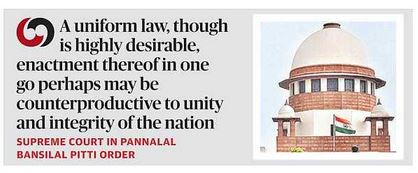
  • Back in debate: Uniform Civil Code

    Poll-bound Uttarakhand CM’s announcement to prepare a draft of the Uniform Civil Code (UCC) in the State, raises questions over whether an individual State can bring its own family law code.

    What is a Uniform Civil Code?

    • A Uniform Civil Code is one that would provide for one law for the entire country, applicable to all religious communities in their personal matters such as marriage, divorce, inheritance, adoption, etc.
    • Article 44, one of the directive principles of the Constitution lays down that the state shall endeavor to secure a Uniform Civil Code for the citizens throughout the territory of India.
    • These, as defined in Article 37, are not justiciable (not enforceable by any court) but the principles laid down therein are fundamental in governance.

    Why need UCC?

    • UCC would provide equal status to all citizens
    • It would promote gender parity in Indian society.
    • UCC would accommodate the aspirations of the young population who imbibe liberal ideology.
    • Its implementation would thus support the national integration.

    Hurdles to UCC implementation

    • There are practical difficulties due to religious and cultural diversity in India.
    • The UCC is often perceived by the minorities as an encroachment on religious freedom.
    • It is often regarded as interference of the state in personal matters of the minorities.
    • Experts often argue that the time is not ripe for Indian society to embrace such UCC.

     UCC vs. Right to Freedom of Religion

    • Article 25 lays down an individual’s fundamental right to religion;
    • Article 26(b) upholds the right of each religious denomination or any section thereof to “manage its own affairs in matters of religion”;
    • Article 29 defines the right to conserve distinctive culture.
    • An individual’s freedom of religion under Article 25 is subject to “public order, health, morality” and other provisions relating to FRs, but a group’s freedom under Article 26 has not been subjected to other FRs.
    • In the Constituent Assembly, there was division on the issue of putting UCC in the fundamental rights chapter. The matter was settled by a vote.
    • By a 5:4 majority, the fundamental rights sub-committee headed by Sardar Patel held that the provision was outside the scope of FRs and therefore the UCC was made less important.

    Enacting and Enforcing UCC: A reality check

    • Fundamental rights are enforceable in a court of law.
    • While Article 44 uses the words “the state shall endeavor”, other Articles in the ‘Directive Principles’ chapter use words such as “in particular strive”; “shall, in particular, direct its policy”; “shall be an obligation of the state” etc.
    • Article 43 mentions “state shall endeavor by suitable legislation” while the phrase “by suitable legislation” is absent in Article 44.
    • All this implies that the duty of the state is greater in other directive principles than in Article 44.

    What are more important — fundamental rights or directive principles?

    • There is no doubt that fundamental rights are more important.
    • The Supreme Court held in Minerva Mills (1980): Indian Constitution is founded on the bedrock of the balance between Parts III (Fundamental Rights) and IV (Directive Principles).
    • To give absolute primacy to one over the other is to disturb the harmony of the Constitution.
    • Article 31C inserted by the 42nd Amendment in 1976, however, lays down that if a law is made to implement any directive principle, it cannot be challenged on the ground of being violative of the FRs under Articles 14 and 19.

    What about Personal Laws?

    • Citizens belonging to different religions and denominations follow different property and matrimonial laws which are an affront to the nation’s unity.
    • If the framers of the Constitution had intended to have a UCC, they would have given exclusive jurisdiction to Parliament in respect of personal laws, by including this subject in the Union List.
    • But “personal laws” are mentioned in the Concurrent List.

    Various customary laws

    • All Hindus of the country are not governed by one law, nor are all Muslims or all Christians.
    • Muslims of Kashmir were governed by a customary law, which in many ways was at variance with Muslim Personal Law in the rest of the country and was, in fact, closer to Hindu law.
    • Even on registration of marriage among Muslims, laws differ from place to place.
    • In the Northeast, there are more than 200 tribes with their own varied customary laws.
    • The Constitution itself protects local customs in Nagaland. Similar protections are enjoyed by Meghalaya and Mizoram.
    • Even reformed Hindu law, in spite of codification, protects customary practices.

    Minority opinion in the Constituent Assembly

    • Some members sought to immunize Muslim Personal Law from state regulation.
    • Mohammed Ismail, who thrice tried unsuccessfully to get Muslim Personal Law exempted from Article 44, said a secular state should not interfere with the personal law of people.
    • B Pocker Saheb said he had received representations against a common civil code from various organizations, including Hindu organizations.
    • Hussain Imam questioned whether there could ever be uniformity of personal laws in a diverse country like India.
    • B R Ambedkar said, “no government can use its provisions in a way that would force the Muslims to revolt”.
    • Alladi Krishnaswami, who was in favor of a UCC, conceded that it would be unwise to enact UCC ignoring strong opposition from any community.
    • Gender justice was never discussed in these debates.

     Conclusion

    • Article 44 of the Constitution creates an obligation upon the State to endeavour to secure for citizens a Uniform Civil Code throughout the country.
    • The purpose behind UCC is to strengthen the object of “Secular Democratic Republic” as enshrined in the Preamble of the Constitution.
    • This provision is provided to effect the integration of India by bringing communities on the common platform on matters which are at present governed by diverse personal laws.
    • Hence UCC should be enforced taking into confidence all the sections of Indian society.
    • Goa’s Portuguese Civil Code of 1867 is an example of a common family law existing in harmony.


    UPSC 2022 countdown has begun! Get your personal guidance plan now! (Click here)