💥Join UPSC 2027,2028 Mentorship (July Batch) + XFactor Notes & Microthemes PDF

Subject: Fundamental Rights,DPSP

1. History + Evolution
2. Features
3. Amendments
4. Basic Structure

  • Political parties to publish the entire criminal history of their candidates


    • The Supreme Court has strictly ordered political parties to publish the entire criminal history of their candidates for Assembly and Lok Sabha elections along with the reasons that goaded them to field suspected criminals over decent people.

    SC’s deadline

    • It ordered political parties to submit compliance reports with the Election Commission of India within 72 hours or risk contempt of court action.
    • The information should be published in a local as well as a national newspaper as well as the parties’ social media handles.
    • It should mandatorily be published either within 48 hours of the selection of candidates or less than two weeks before the first date for filing of nominations, whichever is earlier.
    • The judgment is applicable to parties both at Central and State levels.

    Information should be detailed

    • The published information on the criminal antecedents of a candidate should be detailed and include the nature of their offences, charges framed against him, the court concerned, case number, etc.
    • A political party should explain to the public through their published material how the “qualifications or achievements or merit” of a candidate, charged with a crime, impressed it enough to cast aside the smear of his criminal background.
    • A party would have to give reasons to the voter that it was not the candidate’s “mere winnability at the polls” which guided its decision to give him a ticket to contest elections.

    Why such a move?

    • It appeared from the last four general elections that there has been an alarming increase in the incidence of criminals in politics.
    • In 2004, 24% of the MPs had criminal cases pending against them; in 2009, that went up to 30%; in 2014 to 34%; and in 2019 as many as 43% of MPs had criminal cases pending against them, SC observed.
    • The judgment was based on a contempt petition about the general disregard shown by political parties to a 2018 Constitution Bench judgment (Public Interest Foundation v. Union of India).
    • In this judgment (2018), this court was cognizant of the increasing criminalisation of politics in India and the lack of information about such criminalisation among the citizenry”, SC observed.

    Immediate Reason

    • The immediate provocation is the finding that 46% of MPs have criminal records.
    • The number might be inflated as many politicians tend to be charged with relatively minor offences —“unlawful assembly” and “defamation”.
    • The real worry is that the current cohort of Lok Sabha MPs has the highest (29%) proportion of those with serious declared criminal cases compared to its recent predecessors.

    Why are such tainted candidates inducted by political parties?

    • Such candidates with serious records seem to do well despite their public image, largely due to their ability to finance their own elections and bring substantive resources to their respective parties.
    • Some voters tend to view such candidates through a narrow prism: of being able to represent their interests by hook or by crook.
    • Others do not seek to punish these candidates in instances where they are in contest with other candidates with similar records.

    Significance of the move

    • Either way, these unhealthy tendencies in the democratic system reflect a poor image of the nature of India’s state institutions and the quality of its elected representatives.
    • The move signified the court’s alarm at the unimpeded rise of criminals, often facing heinous charges like rape and murder, encroaching into the country’s political and electoral scenes.

    Way Forward

    • While formally, the institutions of the state are present and subject to the electoral will of the people, substantively, they are still relatively weak and lackadaisical in governance and delivery of public goods.
    • This has allowed cynical voters to elect candidates despite their dubious credentials and for their ability to work on a patronage system.
    • While judicial pronouncements on making it difficult for criminal candidates to contest are necessary, only enhanced awareness and increased democratic participation could create the right conditions for the decriminalization of politics.
  • Ninth Schedule of the Indian Constitution

    A parliamentarian has said in an interview that reservation should be put under the Ninth Schedule of the Constitution.  His comments came days after the Supreme Court ruled that reservation in the matter of promotions in public posts was not a fundamental right and that a state cannot be compelled to offer quota if it chooses not to.

    What is the Ninth Schedule?

    • The Ninth Schedule contains a list of central and state laws which cannot be challenged in courts.
    • Currently, 284 such laws are shielded from judicial review.
    • The Schedule became a part of the Constitution in 1951, when the document was amended for the first time.
    • It was created by the new Article 31B, which along with 31A was brought in by the government to protect laws related to agrarian reform and for abolishing the Zamindari system.
    • While most of the laws protected under the Schedule concern agriculture/land issues, the list includes other subjects, such as reservation.
    • A Tamil Nadu law that provides 69 per cent reservation in the state is part of the Schedule.

    Article 31A and 31 B

    • While Article 31A extends protection to ‘classes’ of laws, A. 31B shields specific laws or enactments.
    • Article 31B also has retrospective operation: meaning if laws are inserted in the Ninth Schedule after they are declared unconstitutional, they are considered to have been in the Schedule since their commencement, and thus valid.
    • Although Article 31B excludes judicial review, the apex court has said in the past that even laws under the Ninth Schedule would be open to scrutiny if they violated fundamental rights or the basic structure of the Constitution.
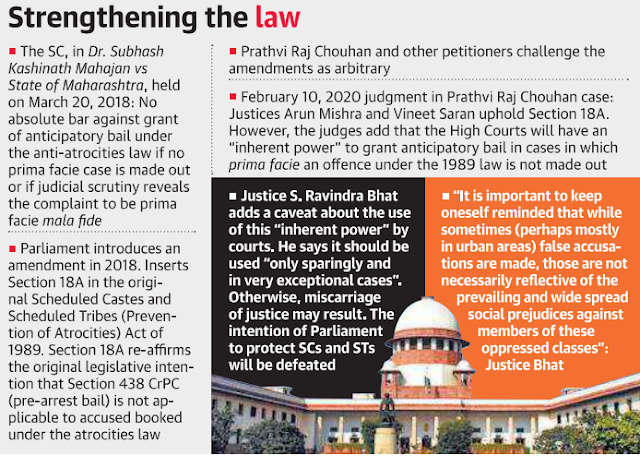
  • SC uphold changes in SC/ST Atrocities Law


    The Supreme Court has upheld the SCs/STs (Prevention of Atrocities) Amendment Act of 2018, which nullified it’s own controversial March 20, 2018 judgement.  Earlier judgment had diluted the original 1989 legislation, saying they were using its provisions to file false criminal complaints against innocent persons.

    Why such ruling?

    • The 2018 Act had nullified a March 20 judgment of the Supreme Court, which allowed anticipatory bail to those booked for committing atrocities against Scheduled Castes and Scheduled Tribes members.
    • The original 1989 Act bars anticipatory bail.
    • The Supreme Court verdict saw a huge backlash across the country. Several died in ensuing protests and property worth crores of rupees was destroyed.
    • The government reacted by filing a review petition in the Supreme Court and subsequently amended the 1989 Act back into its original form.
    • The government had enacted the Amendments, saying the SCs and STs continued to face the same social stigma, poverty and humiliation which they had been subjected to for centuries.

    Why was the SC/ST Act enacted?

    • Since crimes against SCs and STs are fundamentally hate crimes, the Rajiv Gandhi enacted the Act in 1989.
    • It gave furtherance to the provisions for abolition of untouchability (Article 17) and equality (Articles 14, 15).

    Why it was amended?

    • The Bench reasoned that human failing and not caste is the reason behind the lodging of false criminal complaints.
    • The Supreme Court condemned its own earlier judgment, saying it was against “basic human dignity” to treat all SC/ST community members as “a liar or crook.”
    • Caste of a person cannot be a cause for lodging a false report, the verdict observed.
    • Members of the SCs and STs, due to backwardness, cannot even muster the courage to lodge an FIR, much less, a false one, the judgment noted.

    The Subhash Kashinath Mahajan case

    • Mahajan was Director of Technical Education in Maharashtra.
    • Two non-SC officers had made an adverse entry on the character and integrity of a Dalit employee, whom Mahajan in 2011 denied sanction for prosecution against those officers.
    • The denial was challenged on the ground that the state government and not the director was the competent authority.
    • The apex Court held that safeguards against blackmail are necessary as by way of rampant misuse, complaints are largely being filed against public servants with oblique motive for the satisfaction of vested interests.

    In what manner had the 2018 judgment diluted provisions for arrest?

    ANTICIPATORY BAIL

    • In section 18 of the Act, Parliament had laid down that the provision of anticipatory bail under Section 438 of the CrPC of 1973 will not be available to an accused under the Act.
    • The provision of anticipatory bail was introduced for the first time on the recommendation of 41st Law Commission in 1973.
    • It is a statutory right, not part of the right to life and personal liberty under Article 21 of the Constitution, and thus there is no fundamental right to anticipatory bail.
    • In the 2018 judgment, the Court laid down safeguards, including provisions for anticipatory bail and a “preliminary enquiry” before registering a case under the Act.
    • While review the Bench said Section 18 was enacted to instil a sense of deterrence and relied on Kartar Singh (1994) in which the court had held that denial of anticipatory bail does not violate Article 21.

    FIR

    • The court had observed that “liberty of one cannot be sacrificed to protect another”, and the “Atrocities Act cannot be converted into charter for exploitation or oppression by unscrupulous persons or by police for extraneous reasons”.
    • He ordered that neither is an FIR to be immediately registered nor are arrests to be made without a preliminary inquiry by an SSP.
    • An arrest can only be made if there is “credible” information and police officer has “reason to believe” that an offence was committed.
    • In the review judgment, Justice Mishra said public servants already have a remedy in false cases under CrPC Section 482 and can get such FIRs quashed by High Courts.
    • He rejected the need of an SSP’s approval for arrest.

    PERMISSION

    • In 2018, the court had said that even if a preliminary inquiry is held and a case registered, arrest is not necessary, and that no public servant is to be arrested without the written permission of the appointing authority.
    • The court extended the benefit to other citizens and said they cannot be arrested without the written permission of the SSP of the district.
    • In review the court said that the decision on arrest is to be taken by the investigating authority, not the appointing authority.

    Were other provisions diluted?

    • The court had observed that interpretation of Atrocities Act should promote constitutional values of fraternity and integration of the society.
    • This may require ‘check on false implication of innocent citizens on caste lines’.
    • Observing that the law should not result in caste hatred, the court overlooked the fact that the Act had to be enacted due to caste hatred.
    • The review judgment said that such riders for registering a report are wrong and it would give an advantage to upper castes whose complaints can be registered without any such inquiry.

    How frequently do SCs/STs face atrocities?

    • A crime is committed against an SC every 15 minutes. Six SC women are raped every day on an average.
    • Between 2007 and 2017, there was a 66 per cent growth in crimes against SCs.
    • Data from the National Crime Record Bureau, which the 2018 judgment was based on, showed cases of rape of SC women had doubled in 10 years.

    Assist this newscard with:

    [Burning Issue] SC/ST Prevention of Atrocities Act

  • Reservation as right: on Supreme Court judgment

    Context

    The recent Supreme Court judgment, that there is no fundamental right to claim reservation in promotions, has caused some political alarm.

    Received wisdom in affirmative action jurisprudence

    • Presence of sound legal framework for a reservation: The received wisdom in affirmative action jurisprudence is that a series of Constitution amendments and judgments have created a sound legal framework for reservation in public employment, subject to the fulfilment of certain constitutional requirements.
    • Solidification of reservation as an entitlement: It is also accepted that the framework has solidified into an entitlement for the backward classes, including the SCs and STs.

    What does the judgement mean?

    • Reservations are not rights: The latest judgment is a reminder that affirmative action programmes allowed in the Constitution flow from “enabling provisions” and are not rights as such.
    • Not a new legal position: This legal position is not new. Major judgments- these include those by Constitution Benches-note that Article 16(4), on the reservation in posts, is enabling in nature.
    • The state is not bound to provide reservation: In other words, the state is not bound to provide reservations. But if the state provides reservations, it must satisfy the following two criteria-
      • For the backward class: It must be in favour of sections that are backward.
      • Inadequately represented: And inadequately represented in the services based on quantifiable data.
    • What happened in the Uttarakhand case? The Court set aside the Uttarakhand High Court order directing data collection on the adequacy or inadequacy of representation of SC/ST candidates in the State’s services.
      • What was the reasoning? Its reasoning is that once there is a decision not to extend reservation — in this case, in promotions — to the section, the question whether its representation in the services is inadequate is irrelevant.

    Question of government obligation

    • The idea in consonance with the Constitution: The idea that reservation is not a right may be in consonance with the Constitution allowing it as an option.
    • The larger question of the government obligation: But a larger question looms is there no government obligation to continue with affirmative action if-
      • The social situation that keeps some sections backwards.
      • And at the receiving end of discrimination persists?

    Why reservation matters for equality?

    • Reservation as a faced of equality-the SC: Reservation is no more seen by the Supreme Court as an exception to the equality rule; rather, it is a facet of equality.
    • Completion of equality norm: The terms “proportionate equality” and “substantive equality” have been used to show that the equality norm acquires completion only when the marginalised are given a legal leg-up.

    What may be the consequences of this judgement?

    • Possibility of the unequal system: Some may even read into this an inescapable state obligation to extend reservation to those who need it, lest its absence renders the entire system unequal.
    • Possibility of perceptible imbalance: For instance, if no quotas are implemented and no study on backwardness and extent of representation is done, it may result in a perceptible imbalance in social representation in public services.

    Conclusion

    Ensuring adequate representation to disadvantaged sections is a state obligation and the state must play its role in ensuring their representation by appropriate legislation.


  • Explained: Uniform Civil Code — the debate, the status

    Last week, while hearing a matter relating to properties of a Goan, the Supreme Court described Goa as a “shining example” with a Uniform Civil Code, observed that the founders of the Constitution had “hoped and expected” a UCC for India but there has been no attempt at framing one.

    What is a Uniform Civil Code?

    • A UCC is one that would provide for one law for the entire country, applicable to all religious communities in their personal matters such as marriage, divorce, inheritance, adoption etc.
    • Article 44 of the Constitution lays down that the state shall endeavour to secure a UCC for the citizens throughout the territory of India.
    • Article 44 is one of the directive principles. These, as defined in Article 37, are not justiciable (not enforceable by any court) but the principles laid down therein are fundamental in governance.
    • Fundamental rights are enforceable in a court of law. While Article 44 uses the words “state shall endeavour”, other Articles in the ‘Directive Principles’ chapter use words such as “in particular strive”; “shall in particular direct its policy”; “shall be obligation of the state” etc.
    • Article 43 mentions “state shall endeavour by suitable legislation” while the phrase “by suitable legislation” is absent in Article 44.
    • All this implies that the duty of the state is greater in other directive principles than in Article 44.

    What are more important — fundamental rights or directive principles?

    • There is no doubt that fundamental rights are more important.
    • The Supreme Court held in Minerva Mills (1980): “Indian Constitution is founded on the bed-rock of the balance between Parts III (Fundamental Rights) and IV (Directive Principles).
    • To give absolute primacy to one over the other is to disturb the harmony of the Constitution”.
    • Article 31C inserted by the 42nd Amendment in 1976, however, lays down that if a law is made to implement any directive principle, it cannot be challenged on the ground of being violative of the fundamental rights under Articles 14 and 19.

    Does India not already have a uniform code in civil matters?

    • Indian laws do follow a uniform code in most civil matters – Indian Contract Act, Civil Procedure Code, Sale of Goods Act, Transfer of Property Act, Partnership Act, Evidence Act etc.
    • States, however, have made hundreds of amendments and therefore in certain matters, there is diversity even under these secular civil laws.
    • Recently, several states refused to be governed by the uniform Motor Vehicles Act, 2019.
    • If the framers of the Constitution had intended to have a Uniform Civil Code, they would have given exclusive jurisdiction to Parliament in respect of personal laws, by including this subject in the Union List.
    • But “personal laws” are mentioned in the Concurrent List. Last year, the Law Commission concluded that a Uniform Civil Code is neither feasible nor desirable.

    Is there one common personal law for any religious community governing all its members?

    • All Hindus of the country are not governed by one law, nor are all Muslims or all Christians.
    • Not only British legal traditions, even those of the Portuguese and the French remain operative in some parts.
    • In Jammu and Kashmir until August 5, 2019, local Hindu law statutes differed from central enactments.
    • The Shariat Act of 1937 was extended to J&K a few years ago but has now been repealed.
    • Muslims of Kashmir were thus governed by a customary law, which in many ways was at variance with Muslim Personal Law in the rest of the country and was, in fact, closer to Hindu law.
    • Even on registration of marriage among Muslims, laws differ from place to place. It was compulsory in J&K (1981 Act), and is optional in Bengal, Bihar (both under 1876 Act), Assam (1935 Act) and Odisha (1949 Act).
    • In the Northeast, there are more than 200 tribes with their own varied customary laws.
    • The Constitution itself protects local customs in Nagaland. Similar protections are enjoyed by Meghalaya and Mizoram. Even reformed Hindu law, in spite of codification, protects customary practices.

    How does the idea of a UCC relate to the fundamental right to religion?

    • Article 25 lays down an individual’s fundamental right to religion; Article 26(b) upholds the right of each religious denomination or any section thereof to “manage its own affairs in matters of religion”; Article 29 defines the right to conserve distinctive culture.
    • An individual’s freedom of religion under Article 25 is subject to “public order, health, morality” and other provisions relating to fundamental rights, but a group’s freedom under Article 26 has not been subjected to other fundamental rights
    • In the Constituent Assembly, there was division on the issue of putting Uniform Civil Code in the fundamental rights chapter.
    • The matter was settled by a vote. By a 5:4 majority, the fundamental rights sub-committee headed by Sardar Patel held that the provision was outside the scope of fundamental rights and therefore the UCC was made less important than freedom of religion.

    What was the view of Muslim members in the Constituent Assembly?

    • Some members sought to immunise Muslim Personal Law from state regulation.
    • Mohammed Ismail, who thrice tried unsuccessfully to get Muslim Personal Law exempted from Article 44, said a secular state should not interfere with the personal law of people.
    • B Pocker Saheb said he had received representations against a common civil code from various organisations, including Hindu organisations.
    • Hussain Imam questioned whether there could ever be uniformity of personal laws in a diverse country like India.
    • B R Ambedkar said “no government can use its provisions in a way that would force the Muslims to revolt”.
    • Alladi Krishnaswami, who was in favour of a Uniform Civil Code, conceded that it would be unwise to enact Uniform Civil Code ignoring strong opposition from any community.
    • Gender justice was not mentioned in these debates.

    How did the debate on a common code for Hindus play out?

    • In June 1948, Rajendra Prasad, President of the Constituent Assembly, warned Jawaharlal Nehru that to introduce “basic changes” in personal law was to impose “progressive ideas” of a “microscopic minority” on the Hindu community as a whole.
    • Others opposed to reforms in Hindu law included Sardar Patel, Pattabhi Sitaramayya, M A Ayyangar, M M Malaviya and Kailash Nath Katju.
    • When the debate on the Hindu Code Bill took place in December 1949, 23 of 28 speakers opposed it.
    • On September 15, 1951, President Prasad threatened to use his powers of returning the Bill to Parliament or vetoing it.
    • Ambedkar eventually had to resign. Nehru agreed to trifurcation of the Code into separate Acts and diluted several provisions.
  • [op-ed snap] Course correction for the Speaker’s office

    Context 

    Recently the Supreme Court of India recommended that Parliament should rethink as to whether disqualification petitions ought to be entrusted to a Speaker as a quasi-judicial authority when such a Speaker continues to belong to a particular political party either de jure or de facto.

    What the SC recommended?

    • Provision of a ‘Permanent Tribunal’: The SC was of the opinion that Parliament may seriously consider a Constitutional amendment to substitute-
      • The Speaker of the Lok Sabha and Legislative Assemblies with a ‘permanent Tribunal headed by a retired Supreme Court judge or a retired Chief Justice of a High Court.
      • Or some other outside independent mechanism.
    • What the ‘Permanent Tribunal’ achieve?
      • Impartiality and timely decisions: This is to ensure that such disputes are decided both swiftly and impartially.
      • Proper functioning of the democracy: It will give teeth to the provisions contained in the Tenth Schedule, which are so vital in the proper functioning of India’s democracy’.

    Range of functions of the Speaker

    • What is the nature of the duties of the Speaker?
      • Role under 10th schedule: Under 10th Schedule, the nature of duties of the Speaker, is as an “arbiter” or a “quasi-judicial body”. But it also extends to a range of its functions.
      • What other functions are performed by the Speaker? While facilitating the business of the House and to maintain decorum in the House, the Speaker has ‘extensive functions to perform in matters regulatory, administrative and judicial, falling under her domain.
      • She enjoys vast authority under the Constitution and the Rules, as well as inherently’.
      • Ultimate interpreter: She is the ‘ultimate interpreter and arbiter of those provisions which relate to the functioning of the House. Her decisions are final and binding and ordinarily cannot be easily challenged.
      • She decides the duration of debates, can discipline members and even override decisions by committees.
      • A representative of the House: She represents the collective voice of the House and is the sole representative of the House in the international arena’

    Issue of alleged bias

    • Allegations of bias by the Speaker: On several occasions, the Speaker’s role has been questioned on the allegation of bias. The office has been criticised for being an agent of pernicious partisan politics.
      • The Supreme Court has observed in Jagjit Singh versus State of Haryana“…certain questions have been raised about the confidence in the matter of impartiality on some issues having political overtones which are decided by the Speaker in his capacity as a Tribunal.”
    • As a minority view, Justice J.S. Verma in Kihoto Hollohan vs Zachillhu And Others observed: “The Speaker being an authority within the House and his tenure being dependent on the will of the majority therein, the likelihood of suspicion of bias could not be ruled out.”
    • What is the problem with the neutrality of the Speaker? Howsoever desirable the proposition of neutrality maybe, in the present circumstances, it would be unrealistic to expect a Speaker to completely abjure all party considerations.
      • Structural issues: There are structural issues regarding the manner of appointment of the Speaker and her tenure in office.
    • Why the Speaker prefers to maintain party membership: A member is appointed to the office of the Speaker if a motion nominating her is carried in the House.
      • Since the electoral system and conventions in India have ‘not developed to ensure protection to the office, there are cogent reasons for Speakers to retain party membership.
      • Elections are not always by consensus and there have been cases when different parties have fielded their own candidates.
      • All political parties campaign in the constituency of the Speaker.
      • Even if the Speaker is re-elected to the House, the office of the Speaker in India is still open for elections’.
    • Way forward
      • Revamp the structure: What is required is not merely incidental changes in the powers of the Speaker; rather a major revamp in the structure of the office itself is necessary.
      • How to ensure the neutrality of the Speaker? The scheme should be brought wherein Speakers should renounce all political affiliations, membership and activity once they have been elected, both within the Assembly and in the country as a whole.
    • Replicating the UK model:
    • Reference can be sought from the United Kingdom where the ‘main characteristic of the Speaker of the House of Commons is neutrality.
    • Once elected, the Speaker gives up all-partisan affiliation, as in other Parliaments of British tradition, but remains in office until retirement, even though the majority may change.
    • She does not express any political views during debates and is an election candidate without any ticket.
    • Impartiality, fairness and autonomy in decision-making are the hallmarks of a robust institution.
    • It is the freedom from interference and pressures which provide the necessary atmosphere where one can work with an absolute commitment to the cause of neutrality as a constitutional value.

    Conclusion

    At a time when India’s fall in ranks in the latest Democracy Index has evoked concern, it is expected that Parliament will pay heed to the reasoning of the Supreme Court and take steps to strengthen the institution of the Speaker.


  • President’s Address


    Today, with the first day of the Budget Session of Parliament, Hon’ble President will address a joint sitting of the two Houses.

    President’s or Governor’s Address

    • Commonly referred to as the President’s or Governor’s Address, they are a constitutional requirement.
    • The Constitution gives the President and the Governor the power to address a sitting of the legislature. The special power is with regard to two occasions.
    • The first is to address the opening session of a new legislature after a general election. The second is to address the first sitting of the legislature each year.
    • A session of a new or a continuing legislature cannot begin without fulfilling this requirement.
    • When the Constitution came into force, the President was required to address each session of Parliament.
    • So during the provisional Parliament in 1950, the President gave an address for all three sessions. At the suggestion of Speaker G V Mavalankar, the first Constitutional Amendment in 1951 changed this position.
    • Besides being a constitutional requirement, the President’s or Governor’s Address is keenly watched as it outlines the government’s policy agenda and stand on issues.

    What procedures follow the address?

    • After the President or Governor delivers the address, a debate takes place not only on the contents of the address but also the broad issues of governance in the country.
    • This then paves the way for discussion on the Budget.

    Significance of the address

    • The President’s Address in India is mirrored on the British system.
    • During the framing of the Constitution, B R Ambedkar drew a similarity between the President and the monarch under the English system.
    • He said the President “is the Head of State but not of the executive. He represents the nation but does not rule the nation.
    • He is the symbol of the nation. His place in the administration is that of a ceremonial device of a seal by which the nation’s decisions are made known”.
    • The Constitution binds the President and the Governor to act on the aid and advice of the Council of Ministers of the Union and state governments respectively, on a majority of issues.
    • Therefore, the speech that the President or the Governor reads before the legislature is the viewpoint of the government and is prepared by it.

    Are there parallels in other countries?

    • Similar provisions exist in other democracies. In the United States, it is referred to as the “State of the Union”.
    • The phrase comes from an article in the US Constitution which specifies that the President from time to time give to Congress information of the State of the Union and recommend measures as he shall judge necessary and expedient.
    • In the United Kingdom, it is referred to as the Queen’s Speech and is part of the ceremony to mark the formal start of the parliamentary year.

    What is the content of the President’s or Governor’s address?

    • During the making of the Constitution, an unsuccessful attempt was made to bring some specificity to the content of the President’s Address.
    • The President’s speech follows the convention of the British system, where it contains legislative and policy proposals that the government intends to initiate.
    • The speech also recaps the government’s accomplishment in the previous years. The contents of the speech are put together by aggregating inputs from various ministries of the government.

    Is the text of the speech binding?

    • The President or a Governor cannot refuse to perform the constitutional duty of delivering an address to the legislature.
    • But there can be situations when they deviate from the text of the speech prepared by the government.
    • So far, there have been no instances of President doing so. But there has been an occasion when a Governor skipped a portion of the address to the Assembly.
    • In 1969, the Governor of West Bengal skipped two paragraphs of the address prepared by the United Front government.
    • The skipped portion described as unconstitutional the dismissal of the first United Front government by the Congress-ruled central government. The issue was then debated in Parliament.
    • The Opposition was critical of the Governor’s conduct and moved a motion disapproving it. But the motion was ultimately defeated.

    How have members responded to the addresses over the years?

    • The conduct of MLAs during the address has sometimes been an issue.
    • The Governor’s speech in state legislatures has routinely been interrupted.
    • In Parliament, the first instance of interruption of a President’s speech happened in 1963; President Sarvepalli Radhakrishnan was speaking when some MPs interrupted him.
    • The Lok Sabha took note of the incident and a reprimand was issued to the MPs.
    • Over the years, political parties have resolved to treat the President’s Address sacrosanct and agreed not to interrupt it.
  • [op-ed of snap] The four phases of constitutional interpretation

    Context

    The ways in which the Constitution of India is interpreted has undergone changes through four phases.

    Constitution-An Ambitious political experiment

    • Indian Constitution was an ambitious political experiment for the following reasons-
      • Universal Adult Franchise: India began its journey with the universal adult franchise.
      • Federalism: Federalism in a region consisting of over 550 princely States.
      • The promise of Equality: The Constitution was a sort of social revolution in a deeply unequal society with the promise of equality.
      • Unique constitutional design: it was equally a unique achievement in terms of constitutional design.

    The first phase of interpretation-Focus on text

    • A textualist approach-focusing on the plain meaning of the words: In its early years, the Supreme Court adopted a textualist approach, focusing on the plain meaning of the words used in the Constitution.
      • K. Gopalan v. State of Madras (1950) was one of the early decisions in which the Court was called upon to interpret the fundamental rights under Part III.
      • The leader of the Communist Party of India claimed that preventive detention legislation under which he was detained was inconsistent with Articles 19 (the right to freedom), 21 (the right to life) and 22 (the protection against arbitrary arrest and detention).
      • Fundamental rights separate from each other: The Supreme Court decided in A. K. Gopalan case that each of those articles covered entirely different subject matter, and were to be read as separate codes rather than being read together.
    • Unlimited Amendment Power: In its early years, the Court read the Constitution literally, concluding that there were no limitations on the Parliament’s power to amend the Constitution.

    The second phase of interpretation-Focus on ‘basic structure’

    • Appeals to the structure and coherence: Appeals to the text of the Constitution were gradually overtaken by appeals to the Constitution’s overall structure and coherence.
      • Limited Amendment Power-Kesavananda Bharati case: In the leading case of Kesavananda Bharati v. State of Kerala(1973), the Court concluded that Parliament’s power to amend the Constitution did not extend to altering its “basic structure”.
      • What is the “Basic Structure”: The basic structure is an open-ended list of features that lie within the exclusive control of the Court.
      • When Parliament attempted to overturn this decision by amending the Constitution yet again, the Court, relying on structuralist justifications, decisively rejected that attempt.
    • Key takeaways from Kesavananda Bharati case
      • Limited Amendment Power: In this case, the Court pronounced that Parliament’s power to amend the Constitution is not unlimited.
      • Fundamental rights as a cohesive bill of rights: In this phase, the Court also categorically rejected the Gopalan approach in favour of a structuralist one.
      • Maneka Gandhi v. Union of India (1978):  Through decision, in this case, the Court conceived of the fundamental rights as a cohesive bill of rights rather than a miscellaneous grouping of constitutional guarantees.
      • Incremental interpretation of Right to Life: The right to life was incrementally interpreted to include a wide range of rights such as clean air, speedy trial, and free legal aid.
      • Courts playing role in governance: The incremental interpretation of Article 21 paved the way for the Supreme Court to play an unprecedented role in the governance of the nation.
    • What was common in the first two phases?
      • Interpretation done by Constitutional Benches: That significant decisions involving the interpretation of the Constitution were entrusted to Constitution Benches (comprising five or more judges of court) and were carefully (even if incorrectly) reasoned.
      • Little scope for precedential confusion: There was limited scope for precedential confusion, since matters which had been decided by Constitution Benches and which demanded reconsideration were referred to larger Constitution Benches.

    Third Phase of interpretation-Eclecticism

    • Different opinions on the same issues: In the third phase the Supreme Court started to give different opinions on the same issues-i.e. it engaged in eclecticism.
      • Lesser reasoning: The Court often surrendered its responsibility of engaging in a thorough rights reasoning of the issues before it.
      • Two factors underpinned this institutional failure.
    • First-Change in the structure of the SC: The changing structure of the Court, which at its inception began with eight judges, grew to a sanctioned strength of 31; it is currently 34.
    • It began to sit in panels of two or three judges, effectively transforming it into a “polyvocal” group of about a dozen sub-Supreme Courts.
    • Second-expansion of own role by the SC-The Court began deciding cases based on a certain conception of its own role -whether as a sentinel of democracy or protector of the market economy.
    • The focus of the judgement on the result rather than reason: This unique decision-making process sidelined reason-giving in preference to arriving at outcomes that match the Court’s perception.
    • Consequences of the eclecticism
      • Rise of doctrinal incoherence and inconsistency: The failure to give reasons contributed not only to methodological incoherence but also to serious doctrinal incoherence and inconsistency across the law.
      • Conflicting decisions and interpretations: This approach can be best described as panchayati eclecticism, with different Benches adopting inconsistent interpretive approaches based on their conception of the Court’s role, and arriving at conclusions that were often in tension with one another.
      • Decision detached from precedents and established methods: The imagery that panchayati eclecticism is meant to invoke is that of a group of wise men and women (applying the analogy, sub-Supreme Courts), taking decisions based on notions of fairness that are detached from precedent, doctrine and established interpretive methods.

    Fourth phase- based on the purpose

    • Purpose of enactment of the Constitution as critical: In the fourth phase, the Court has acknowledged as critical to its interpretive exercise the purpose for which the Constitution has been enacted.
    • The realisation of revolutionary and transformative potential: The Court is now beginning to interpret the Constitution in accordance with its revolutionary and transformative potential.
      • Renaissance in decisions: With about a dozen significant Constitution Bench decisions from the Supreme Court since September 2018, there has been a renaissance in decision-making by Constitution Benches.
      • The most important decisions of this period include-
      • Court’s decisions striking down Section 377 and the criminal offence of adultery.
      • And including the office of the Chief Justice of India within the scope of the Right to Information Act.

    Conclusion

    With the interpretation process entering in the fourth phase-realising the purpose of enactment of the Constitution- Indian judiciary is on the right track, however, facets of phase 3 continue to linger on it. The Supreme Court must avoid getting in phase three mode to in order to realise the purpose it was entrusted with.


  • De-criminalization of Politics


    The Supreme Court has agreed to examine a proposition made by the Election Commission (EC) to ask political parties to not give a ticket to those with criminal antecedents.

    Cleansing of Political Parties

    • The judgment had urged Parliament to bring a “strong law” to cleanse political parties of leaders facing trial for serious crimes.
    • The ruling concluded that rapid criminalisation of politics cannot be arrested by merely disqualifying tainted legislators but should begin by “cleansing” the political parties.
    • The court had suggested that Parliament frame a law that makes it obligatory for political parties to remove leaders charged with “heinous and grievous” crimes like rape, murder and kidnapping, only to a name a few, and refuse ticket to offenders in both parliamentary and Assembly polls.
    • It had also issued guidelines, including that both the candidate and the political party should declare the criminal antecedents of the former in widely-circulated newspapers.

    Why such move?

    • 46% of Members of Parliament have criminal records.
    • A move to steer politics away from the denizens of the criminal world would definitely serve national and public interest.
    • The EC had tried several measures to curb criminalisation of politics but failed.
  • Explained: The Kashmir Pandit tragedy


    It is 30 years since the “exodus” from the Valley of its minority Hindu Kashmiri Pandit community.

    The run-up: 1980s to 1990

    • Sheikh Abdullah had died in 1982, and the leadership of the National Conference passed on to his son Farooq Abdullah, who won the 1983 election.
    • But within two years, the Centre broke up the NC, and installed dissident Ghulam Mohammed Shah as Chief Minister. This led to huge disaffection and political instability.
    • The Jammu & Kashmir Liberation Front (JKLF) stepped up its activities, and the hanging of the militant leader Maqbool Bhat in 1984 added to the sense of foreboding.
    • In 1986, after the Rajiv Gandhi government opened the Babri Masjid locks to enable Hindus to offer prayers there, ripples were felt in Kashmir too.
    • In Anantnag, the constituency of then Congress leader Mufti Mohammad Sayeed, there was a series of attacks on Hindu temples, and shops and properties of Kashmiri Pandits, blamed on separatist and secessionists.
    • Pandits had begun to be targeted. Eminent persons of the community were being shot dead.

    The night of January 19, 1990

    • Matters came to a head on January 19. By then, the Farooq Abdullah government had been dismissed and Governor’s Rule imposed.
    • According to accounts published by many eminent Kashmiri Pandits, there were threatening slogans over loudspeakers from mosques, and on the streets.
    • Speeches were made extolling Pakistan and the supremacy of Islam, and against Hinduism. Finally, the Kashmiri Pandit community decided to leave.

    The Gawkadal Massacre

    • On January 20, the first stream began leaving the Valley with hastily packed belongings in whatever transport they could find. A second, larger wave left in March and April, after more Pandits were killed.
    • On January 21, the CRPF gunned down 160 Kashmiri Muslim protesters at the Gawkadal Bridge, which has come to be known as the worst massacre in the long history of the conflict in Kashmir.
    • The two events — the flight of the Pandits and the Gawkadal massacre — took place within 48 hours.

    How many Pandits left?

    • According to some estimates, notably by the Kashmiri Pandit Sangharsh Samiti (KPSS), of 75,343 Kashmiri Pandit families in January 1990, more than 70,000 fled between 1990 and 1992 and continued until 2000.
    • The KPSS has placed the number of Kashmiri Pandits killed by militants from 1990 to 2011 at 399, the majority during 1989-90.
    • Some 800 families have remained in the Valley through these three decades.

    Role of the administration

    • The other contentious question about the exodus is the role played by the administration, and more specifically that of the J&K Governor, Jagmohan.
    • Newly appointed, he had arrived in Srinagar on January 19.
    • The Kashmiri Muslim view of the exodus is that he encouraged the Pandits to leave the Valley and thus gave a communal colour to what was until then a non-religious Kashmiri cause.
    • The Kashmiri Hindu view is that this is a disingenuous interpretation.
    • They believe that Kashmiri Muslims, with whom they had lived amicably for centuries, drove them out with a vengeance in a frenzy of Islamism that they could not have imagined even months earlier.
    • The truth, many commentators have concluded, may have been somewhere in the middle.

    The question of return

    • Those who had means rebuilt their lives elsewhere in the country — Delhi, Pune, Mumbai and Ahmedabad have Pandit populations, also Jaipur and Lucknow — or went abroad.
    • The fleeing Pandits did not think they would never return to the Valley. But as the situation in Kashmir spiraled into a full-blown militancy, return began to look remote if not impossible.
    • The longing to return to the Valley did not diminish over the years, though it may have become more an idea than a real ambition.
    • Successive governments have promised that they will help this process, but the situation on the ground in Kashmir has meant this remains only an intention.
    • There is an acute realization in the community that the Valley is no longer the same that they left behind in 1990.
    • In many cases, their properties were either immediately vandalised or sold quickly by the owners to Kashmiri Muslims. Many fell into disrepair.