💥Join UPSC 2027,2028 Mentorship (July Batch) + XFactor Notes & Microthemes PDF

Subject: History

  • ASI finds 1,300-yr-old Buddhist Stupa in Odisha

    stupa

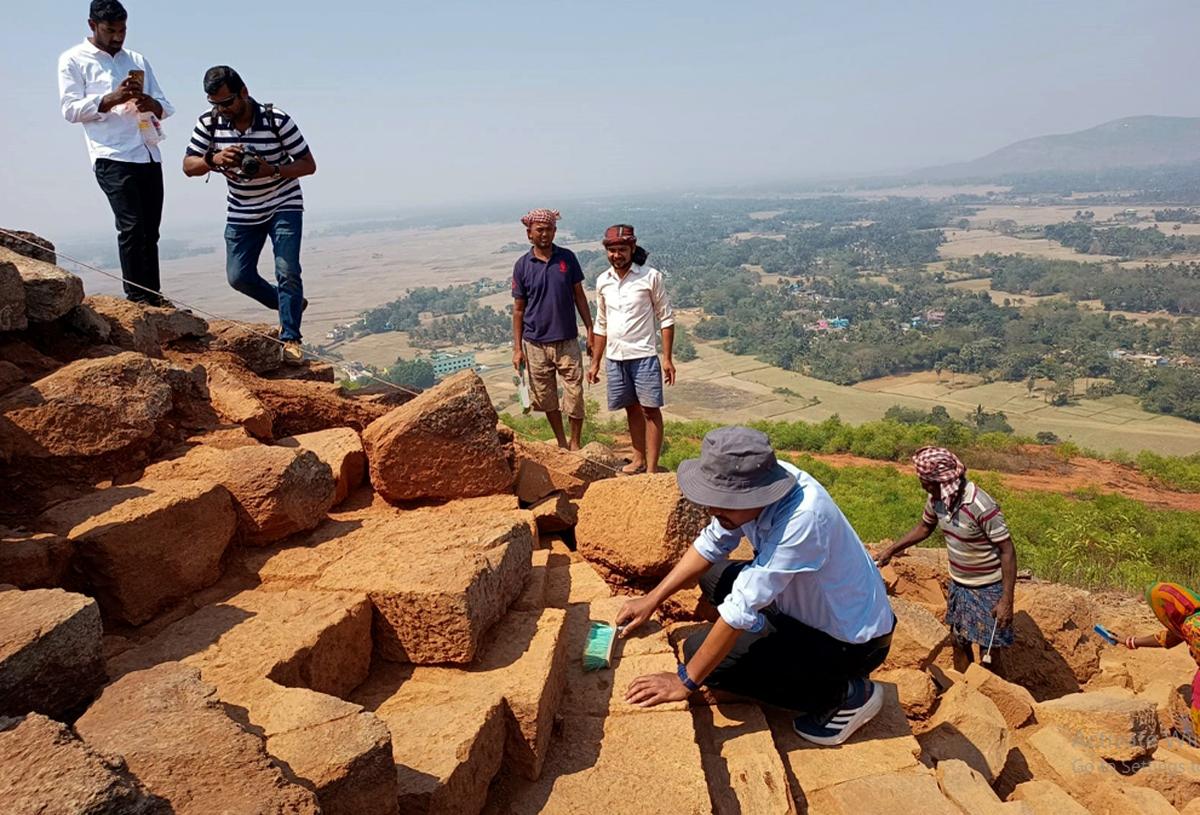
    The Archaeological Survey of India (ASI) stumbled upon a 1,300-year-old stupa right in the middle of a Khondalite mining site in Odisha’s Jajpur district.

    About the Stupa

    • The stupa could be 4.5-meter tall and initial assessment showed it may belong to the 7th or 8th
    • It was found at Parabhadi which is situated near Lalitagiri, a major Buddhist complex, having a large number of stupas and monasteries.
    • The newly discovered stupa was possibly disfigured in an earlier period.

    Khondalite

    stupa

    • Khondalite is a foliated metamorphic rock.
    • It is also called Bezwada Gneiss and Kailasa Gneiss.
    • It was named after the Khond tribe of Odisha and Andhra Pradesh because well-formed examples of the rock were found in the inhabited hills of these regions of eastern India.


    Back2Basics: Lalitagiri Buddhist Complex

    stupa

    • Lalitagiri is a major Buddhist complex in the state of Odisha.
    • The complex is home to stupas, ‘esoteric’ Buddha images, and monasteries (viharas), which is the oldest site in the region.
    • Significant finds at this complex include Buddha’s relics. Tantric Buddhism was practiced at this site.
    • Together with the Ratnagiri and Udayagiri sites a short distance away, Lalitagiri is part of the “Diamond Triangle”.
    • It used to be thought that one or all of these were the large Pushpagiri Vihara known from ancient records, but this has now convincingly located at a different site.

    Stupa Architecture

    stupa

    In the most basic sense, as an architectural representation of a sacred burial site, a stupa — no matter where it is located in the world or when it was built — has three fundamental features.

    • A hemispherical mound (anda) The anda’s domed shape (green highlights) recalls a mound of dirt that was used to cover the Buddha’s remains. As you might expect, it has a solid core and cannot be entered. Consistent with their symbolic associations, the earliest stupas contained actual relics of the Buddha; the relic chamber, buried deep inside the anda, is called the tabena. Over time, this hemispherical mound has taken on an even grander symbolic association: the mountain home of the gods at the center of the universe.
    • A square railing (harmika) The harmika (red highlights) is inspired by a square railing or fence that surrounded the mound of dirt, marking it as a sacred burial site.
    • A central pillar supporting a triple-umbrella form (chattra) The chattra, in turn, was derived from umbrellas that were placed over the mound to protect it from the elements (purple highlights). Just as the anda’s symbolic value expanded over time, the central pillar that holds the umbrellas has come to represent the pivot of the universe, the axis along which the divine descends from heaven and becomes accessible to humanity. And the three circular umbrella-like disks represent the three Jewels, or Triantha, of Buddhism, which are the keys to a true understanding of the faith: (a) Buddha; (b) dharma (Buddhist teachings or religious law); and (c) sangha (monastic community).

    Around these three core building blocks were added secondary features.

    • Enclosure wall with decorated gateways (toranas) at the cardinal directions The wall — with its trademark three horizontal stone bars (in the top image) — surrounds the entire structure. The wall is marked in light blue highlights and the toranas in yellow.
    • A circular terrace (medhi) The terrace — surrounded by a similar three-bar railing — supports the anda and raises it off the ground (black highlights); it likely served as a platform for ritual circumambulation.


    Attempt UPSC 2024 Smash Scholarship Test | FLAT* 100% OFF on UPSC Foundation & Mentorship programs

    Get your Rs 10,000 worth of UPSC Strategic Package for FREE | PDFs, Zoom session, Tests, & Mentorship

  • Key findings about Keeladi Excavation

    keeladi

    Central idea: Keeladi is an archaeological site that has been excavated by the Tamil Nadu State Department of Archaeology since 2014. Recent excavations here has pushed the Sangam age further back.

    About Keeladi

    keeladi

    • Keeladi is a tiny hamlet in the Sivaganga district in south Tamil Nadu.
    • It is about 12 km south-east to the temple city of Madurai and is located along the Vaigai River.
    • The excavations here from 2015 prove that an urban civilisation existed in Tamil Nadu in the Sangam age on the banks of the Vaigai River.

    How is Keeladi linked to Sangam age?

    • The Sangam age is a period of history in ancient Tamil Nadu which was believed to be from the third century BCE to the third century CE.
    • The name is derived from the renowned Sangam poets of Madurai from that time.

    Recent findings

    • In 2019, a TNSDA report dated the unearthed artefacts from Keeladi to a period between sixth century BCE and first century BCE.
    • Some samples sent for carbon dating in the US, dated back to 580 BCE.
    • The findings placed Keeladi artefacts about 300 years earlier than the previously believed third century BCE.

    Significance of the findings

    • Older than perceived: Recent finding at Keeladi has pushed the Sangam age to 800 BCE based on these archaeological findings.
    • Literary evidences: Keeladi, along with other Tamil Nadu sites which have over a thousand inscribed potsherds, clearly suggest the long survival of the script.
    • Substantial evidence to Sangam Age: It comes across as an industrious and advanced civilisation and has given evidence of urban life and settlements in TN during the Early Historic Period.
    • Another major civilisation: The unearthed Keeladi artefacts have led academics to describe the site as part of the Vaigai Valley Civilisation. It has all the characteristics of an urban civilisation, with brick structures, luxury items and proof of internal and external trade.
    • Filling in the cultural gaps: This could provide crucial evidence for understanding the missing links of the Iron Age (12th century BCE to sixth century BCE) to the Early Historic Period (sixth century BCE to fourth century BCE) and subsequent cultural developments.

    Links with Indus Valley

    Ans. A lot of digging and study has to be done to establish the links between these two civilisations.

    • The findings have invited comparisons with the Indus Valley Civilisation while acknowledging the cultural gap of 1,000 years between the two places.
    • Till now, the gap is filled with Iron Age material in south India, which serve as residual links.
    • However, some of the symbols found in pot sherds of Keeladi bear a close resemblance to Indus Valley signs.

    What has been unearthed so far?

    • Pottery: Unearthing of heaps of pottery suggest the existence of a pottery making industry, mostly made of locally available raw materials.
    • Inscriptions: Over 120 potsherds containing Tamil Brahmi inscriptions have been found.
    • Jewellery: There also existed a dyeing industry and a glass bead industry. Gold ornaments, copper articles, semi-precious stones, shell bangles, ivory bangles and ivory combs reflect the artistic, culturally rich and prosperous lifestyle of the Keeladi people.
    • Import of semiprecious stones: Agate and carnelian beads suggest import through commercial networks while terracotta and ivory dice, gamesmen and evidence of hopscotch have been unearthed revealing their pastime hobbies.

    Recent politicization of the excavation

    • The Keeladi site, since its discovery has been shrouded in controversies with several Dravidian and Left ideologues.
    • They claim that the archaeological finds prove that the Indus Valley Civilisation was a “Dravidian” culture and an independent “secular” Tamil civilisation.
    • The attempt to define the finds in narrow and racial terms is ideologically motivated to one, pump up Tamil exclusivist sentiments, and two, and challenge the view that sees India as one— unity in diversity.


    Attempt UPSC 2024 Smash Scholarship Test | FLAT* 100% OFF on UPSC Foundation & Mentorship programs

    Get your Rs 10,000 worth of UPSC Strategic Package for FREE | PDFs, Zoom session, Tests, & Mentorship

  • Dickinsonia Fossil found in Bhimbetka turns out to be decayed beehive

    bhim

    A Dickinsonia fossil found at Bhimbetka, previously believed to be one of the world’s earliest animals, and has been identified as a decayed beehive.

    About Bhimbetka

    bhim

    • The Bhimbetka rock shelters are an archaeological site in central India that spans the prehistoric Paleolithic and Mesolithic periods, as well as the historic period.
    • It exhibits the earliest traces of human life in India and evidence of Stone Age starting at the site in Acheulian times.
    • It is located in the Raisen District in Madhya Pradesh about 45 kilometres (28 mi) south-east of Bhopal.
    • It is a UNESCO World Heritage Site that consists of seven hills and over 750 rock shelters distributed over 10 km (6.2 mi).
    • At least some of the shelters were inhabited more than 100,000 years ago.
    • Some of the Bhimbetka rock shelters feature prehistoric cave paintings and the earliest are about 10,000 years old (c. 8,000 BCE), corresponding to the Indian Mesolithic.
    • These cave paintings show themes such as animals, early evidence of dance and hunting.
    • The Bhimbetka rock shelters were found by V S Wakankar 64 years ago. Since then, thousands of researchers have visited the site, but this rare fossil went undetected.

    What is Dickinsonia?

    bhim

    • Dickinsonia is an extinct genus of basal animal that lived during the late Ediacaran period in what is now Australia, Russia and Ukraine.
    • The individual Dickinsonia typically resembles a bilaterally symmetrical ribbed oval.
    • Its affinities are presently unknown; its mode of growth is consistent with a stem-group bilaterian affinity, though some have suggested that it belongs to the fungi or even an “extinct kingdom”.
    • The discovery of cholesterol molecules in fossils of Dickinsonia lends support to the idea that Dickinsonia was an animal.

    Cambrian Explosion and Dickinsonia

    • The ‘Cambrian Explosion’ is the term given to the period of time in history when complex animals and other macroscopic organisms such as molluscs, worms, arthropods and sponges began to dominate the fossil record.
    • Researchers from Australian found the Dickinsonia fossil since its tissue contained molecules of cholesterol a type of fat that is the hallmark of animal life.


    Try this PYQ:

    Q. Which one of the following statements is correct?

    (a) Ajanta Caves lie in the gorge of Waghora River

    (b) Sanchi Stupa lies in the gorge of Chambal River

    (c) Pandu-lena Cave Shrines lie in the gorge of Narmada River

    (d) Amaravati Stupa lies in the gorge of Godavari River


    [wpdiscuz-feedback id=”2pwq42fb8z” question=”Please leave a feedback on this” opened=”1″]Post your answers here.[/wpdiscuz-feedback]


    Attempt UPSC 2024 Smash Scholarship Test | FLAT* 100% OFF on UPSC Foundation & Mentorship programs

    Get your Rs 10,000 worth of UPSC Strategic Package for FREE | PDFs, Zoom session, Tests, & Mentorship

  • Tipu Sultan’s Contested Legacy

    tipu

    Central idea: The article examines the controversial nature of Tipu Sultan’s legacy and the differing opinions about his reign and his place in Indian history. It discusses the contrasting views of Tipu Sultan as a hero and patriot who fought against British colonialism, or as a tyrant who persecuted Hindus and Christians.

    Rise of Tipu Sultan

    • Tipu Sultan was born on November 10, 1750, in Devanahalli, present-day Bangalore.
    • His father was Hyder Ali, who rose through the ranks of the army of the Wodeyars, the Hindu rulers of Mysore.

    Rise to power

    • Hyder Ali seized power from the Wodeyars in 1761 and ruled for 20 years, a period in which the kingdom of Mysore had slowly expanded by capturing disputed areas at its borders.
    • During this time, Tipu was educated in both matters of statecraft and warcraft, participating in his first battle at the age of only 15.
    • When Hyder Ali died in 1782, Tipu’s primary motivation was to consolidate the territory he had inherited from his father.
    • Specifically, the rebellious provinces of Malabar, Kodagu, and Bednur, were crucial to Mysore’s strategic and economic interests.
    • His rule in these areas is what is often cited as proof of his bigotry and authoritarianism.

    Contribution to freedom struggle

    • In the course of India’s freedom struggle, Tipu Sultan became a symbol of resistance against British rule.
    • His death while defending his fortress of Srirangaptna against British armies in 1799 was valorised as the ultimate sacrifice for the motherland.

    Reforms carried out by Tipu

    Administrative reforms

    • Tipu Sultan also pioneered administrative and economic reforms.
    • He introduced new coins, started a new land revenue system in Mysore, as well as introduced sericulture or silkworm cultivation, which continues to employ many Kannadigas to date.
    • Furthermore, some claim that upon hearing of the plight of lower caste women who were not allowed to wear blouses, Tipu personally supplied them with cloth.

    Modernization of weaponry: Advent of Rockets

    tipu

    • Tipu is credited for the introduction of iron-cased rockets in warfare.
    • While rocket-like weapons had previously been used in War, Tipu’s army used what can be termed as the first modern war rockets in the Anglo-Mysore Wars.
    • These rockets were used to devastating effects against much larger British armies, driving them to panic and disarray.
    • The British used Tipu’s models for their own rockets, which would go on to play an important role in the Napoleonic Wars.

    Scientific temper

    tipu

    • Tipu’s fascination with European culture was a result of what he saw while fighting Europeans.
    • Tipu wanted Mysore to be a modern rival of the European powers and made investments in technology accordingly.

    Why is Tipu branded as a tyrant?

    • Warfare in Tipu’s time was brutal and those who rebelled were dealt with an iron fist. It was common practice to set strong examples to forestall future opposition.
    • The punishments Tipu applied to rebels or conspirators included forced conversion and the transfer of people from their home territories to Mysore.
    • The forced removals occurred from both Kodagu and Malabar, the former as a response to continued resistance against Mysore rule– as a result of their resistance and perceived treachery in the Anglo-Mysore Wars.
    • The right’s narrative of Tipu’s bigotry emphasizes Tipu’s militarism as well as his perceived attacks on “Hindu” rulers and subjects.

    Historian’s justification of Tipu’s actions

    • Tipu’s actions are questionable by today’s standards, they were commonplace in the 18th century among rulers of all faiths.
    • He was a tyrant, but his motivations were not necessarily religious zealotry.
    • Rather, he was a pragmatist who ruled within the accepted conventions of kingship and warfare at the time.
    • He undoubtedly ordered forced conversions in areas he annexed, Tipu also patronized various temples and Hindu shrines, including the Sri Ranganatha temple at Srirangapatna and the Math in Sringeri.
    • Both these actions were to solidify his position as a ruler — the former to crush dissidents and the latter to gain legitimacy among his largely Hindu subjects.

    Tipu’s legacy: looking at the past from the prism of the present

    • Today, there has been an increased spotlight on his autocratic tendencies and brutal repression in annexed territories, with an increased emphasis on his religion.
    • Both portrayals fall short, missing the complexity of Tipu’s character and material circumstances.


    Crack Prelims 2023! Talk to our Rankers

    (Click) FREE 1-to-1 on-call Mentorship by IAS-IPS officers | Discuss doubts, strategy, sources, and more

  • Anti-encroachment drive in historic city of Mehrauli

    mehrauli

    The Delhi Development Authority (DDA) carried out an anti-encroachment drive in the nearby villages of Mehrauli and Ladha Sarai leaving hundreds of families in uncertainty about their future.

    History of Delhi

    • Purani Dilli, commonly referred to as Old Delhi, is a misnomer as the city’s history dates back to before the establishment of Shahjahanabad.
    • The oldest evidence of habitation in Delhi, dating back to the Iron Age (around 1100-800 BC), is the painted grey ware fragments found in Purana Quila.
    • Historians recognize seven cities of Delhi, from the 11th century onwards, namely Lalkot/Quila Rai Pithora/Mehrauli, Siri, Tughlaqabad, Firozabad, Shergarh (Old Fort), Shahjahanabad, and New Delhi.
    • However, depending on what is considered a city, this number can be as high as 11.

    In focus: City of Mehrauli

    • Mehrauli is widely considered to be the oldest ‘city’ of Delhi and is the oldest area of the metropolis to be continuously inhabited.
    • It was first built by a ruler called Anangpal II in the 11th century, and it was called Lalkot.
    • Later, it was known as ‘Quila Rai Pithora’ and was fortified by the Chauhans.
    • The Mamluk dynasty took control of the city in 1192, and Qutubudin Aibak, the first ruler of the dynasty, built the Qutub Minar and the Quwwat-al-Islam mosque (oldest mosque in North India).
    • In the following century, more buildings like tombs, step wells, palaces, and fortifications were constructed during the reigns of Iltutmish, Razia Sultan, and Alauddin Khilji.

    Continued relevance and inhabitation

    • Even as the newer cities came up and the seat of power shifted northwards, Mehrauli witnessed building activity as late as the Mughal and British periods.
    • Due to its location on the lap of the Aravallis hills, the area was preferred as a summer retreat.
    • Two Mughal summer palaces (Zafar Mahal and Jahaz Mahal) and a summer abode of Sir Thomas Metcalfe (Dilkhusha) are situated here.
    • Mehrauli lay on a historic trade route, as the number of sarais (Ladho Sarai, Ber Sarai, Neb Sarai) around the area would suggest. A sarai was a resthouse for weary travellers.

    Cultural significance of Mehrauli

    • Mehrauli is also a spiritual centre. Sufi saint Hazrat Qutubuddin Bakhtiar Kaki (1173 -1235 AD) was buried in the city and his dargah remains popular till date, across religious lines.
    • Some historians cite the dargah as a reason for the city surviving the test of time – despite power shifting elsewhere, the dargah remained a revered destination for pilgrims far and wide.
    • Another spiritual centre for the community is the Yogmaya mandir, believed to be one of the oldest in the city.
    • Yoginis (semi-divine deities) have been an integral part of Indian folklore and this temple dedicated to them is believed to have been constructed by the Pandavas.

    How it ended up in encroachments?

    • Like much of the rest of Delhi, the Partition brought many changes to Mehrauli too.
    • Many refugees from the West found sanctuary here. The city has also seen sectarian tensions.


    Crack Prelims 2023! Talk to our Rankers

    (Click) FREE 1-to-1 on-call Mentorship by IAS-IPS officers | Discuss doubts, strategy, sources, and more

  • Folk dance in news: Lavani

    lavani

    Central idea: The article is based on the controversy surrounding the Maharashtra folk dance form, Lavani, which has come under criticism for being ‘vulgar’ and ‘obscene’.

    What is the Lavani folk art form?

    • The word Lavani comes from ‘lavanya’ or beauty.
    • Lavani is a traditional folk art form in which women dancers wearing nine-yard-long sarees in bright colours, make-up, and ghunghroos perform on dholak beats on a stage before a live audience.
    • As an indigenous art form, Lavani has a history going back several centuries, and it attained particular popularity in the Peshwa era in the 18th century.
    • Traditionally, performances were held in front of kings or lords, and for the entertainment of tired soldiers resting during breaks in fighting.

    Genres of Lavani

    • There are several types of Lavani, of which the most popular is the Shringarik (erotic) kind, in which the lyrics are often teasing, with sensuous dance steps and delicate gestures employed to convey erotic meaning.
    • Over the years, Lavani has gained more acceptability among the people, even though certain taboos around it continue.
    • The audience has historically been all-male, but in recent years, some women too have begun to attend performances.

    Why is it under fire these days?

    • Lost its original form: Some also argue that the commercialization of Lavani has led to a loss of authenticity and cultural significance.
    • Objectifying women: The criticism of Lavani dance centres on the traditional dance form’s alleged objectification and commodification of women’s bodies.
    • Public obscenity: It has been accused of promoting obscenity and vulgarity and reinforcing patriarchal attitudes towards women.
    • Communalizing/Stereotyping: Critics have also argued that the dance form perpetuates negative stereotypes of women from marginalized communities, such as the notion that Dalit women are “loose” or sexually promiscuous.


    Crack Prelims 2023! Talk to our Rankers

    (Click) FREE 1-to-1 on-call Mentorship by IAS-IPS officers | Discuss doubts, strategy, sources, and more

  • India’s first Law Minister Dr. Ambedkar’s resignation letter missing from records

    ambedkar

    Dr. BR Ambedkar was India’s first Law Minister after independence. The letter of his resignation is now missing from official records.

    Dr Ambedkar as Law Minister

    • Dr. B.R. Ambedkar served as Independent India’s first law minister.
    • He was an Indian jurist, economist, politician, and social reforme, who was posthumously awarded the Bharat Ratna in 1990.
    • It is believed that Sardar Patel and Mahatma Gandhi proposed Dr. Ambedkar’s name for the post of Law Minister in the Nehru Cabinet.

    Why was he selected for the post?

    • Being father of our Constitution: Sardar Patel, then deputy PM, had a high regard for Dr. Ambedkar’s intellectual abilities and his contributions to the drafting of India’s Constitution.
    • Political urge for inclusivity: Additionally, Dr. Ambedkar’s role in the Dalit movement and his fight against caste discrimination also made him a significant political figure.
    • Representation of the marginalized: His appointment as the Law Minister was seen as a symbol of inclusivity and representation of marginalized communities in the government.

    Why did Dr. Ambedkar resign?

    • Political differences with Nehru: He resigned as Law Minister, due to differences with the then PM, Jawaharlal Nehru, over the Hindu Code Bill. He specifically wanted to reform Hindu Personal Laws and not every personal laws in India.
    • Row over reforming Personal Laws: The bill aimed to reform Hindu personal laws related to marriage, divorce, and inheritance, but Dr. Ambedkar believed that it did not go far enough in granting women’s rights and wanted more radical changes.
    • Injustice to women: Ambedkar had proposed a more comprehensive set of reforms that would have given women greater rights in matters such as property ownership and inheritance, but his proposals were met with resistance from Nehru and other members of the government.

    Efforts to locate his resignation letter

    • The letter was not found in the National Archives of India and the Ministry of Home Affairs.
    • The Maharashtra government has also been unable to locate the letter in its archives.
    • RTI (Right to Information) requests were also unsuccessful.

    Significance of his letter

    • The missing letter is a matter of concern as it is an important historical document.
    • Ambedkar’s resignation was a significant event in India’s political history and the reasons behind it are still relevant today.
    • The letter could shed light on the differences between the visionary Dr. Ambedkar and then mainstream politicians.


    India’s first Provisional Government (Constitutionally)


    • Jawaharlal Nehru became the first Prime Minister of India after the country gained independence in 1947.
    • The members of his first cabinet, which was sworn in on August 15, 1947, were as follows:
    1. Jawaharlal Nehru – Prime Minister and Minister of External Affairs
    2. Vallabhbhai Patel – Deputy Prime Minister and Minister of Home Affairs
    3. Dr. B.R. Ambedkar – Minister of Law and Member of the Viceroy’s Executive Council
    4. C. Rajagopalachari – Minister of Industry and Supply
    5. John Mathai – Minister of Railways
    6. Liaquat Ali Khan – Minister of Finance
    7. Baldev Singh – Minister of Defence
    8. Sardar Baldev Singh – Minister of Communications
    9. Sardar Swaran Singh – Minister of Works, Mines and Power
    10. Jagjivan Ram – Minister of Labour and Rehabilitation
    11. Dr. Rajendra Prasad – Minister of Food and Agriculture
    12. Maulana Abul Kalam Azad – Minister of Education
    13. Sardar K.M. Panikkar – Minister of States
    14. Rafi Ahmed Kidwai – Minister of Communications (Independent Charge)
    15. Asaf Ali – Minister of Railways (Independent Charge)
    • It is worth noting that this was a provisional government, and the first general election to form a permanent government was held in 1952.


    Note: Azad Hind was not India’s first provisional government. The credit for establishing that – formally known as the ”Hukumat-i-Moktar-i-Hind” – in Kabul on 1st Dec, 1915, goes to Raja Mahendra Pratap and Maulana Barkatullah.

    Crack Prelims 2023! Talk to our Rankers

    (Click) FREE 1-to-1 on-call Mentorship by IAS-IPS officers | Discuss doubts, strategy, sources, and more

  • Who was Maharishi Dayanand Saraswati?

    dayanand

    PM inaugurated celebrations commemorating Maharishi Dayanand Saraswati’s 200th birth anniversary.

    Dayanand Saraswati (1824-1883)

    • Dayanand Saraswati (born Mool Shankar Tiwari) was a religious leader and founder of the Arya Samaj, a reform movement in the nineteenth century.
    • He was a profound scholar of the Vedic lore and Sanskrit language.
    • Dayanand was a great scholar, and was well-versed in the Vedas and the Upanishads.
    • He was also proficient in Sanskrit grammar, philosophy, religion, politics and other sciences.

    Notable works

    (1) Literary works

    • He wrote several books, including the Satyarth Prakash, which became the moral and spiritual foundation of the Arya Samaj.
    • This book was translated into many languages, including Hindi, English and Urdu.

    (2) Freedom movement

    • He was the first to give the call for Swaraj as “Indian for India” – in 1876, a call later taken up by Lokmanya Tilak.
    • Subsequently, the philosopher and President of India, S. Radhakrishnan, called him one of the “makers of Modern India”, as did Sri Aurobindo.

    (3) Religious reform

    • Denouncing the idolatry and ritualistic worship prevalent in Hinduism at the time, he worked towards reviving Vedic ideologies.
    • He believed that the Vedas should be interpreted in the light of reason and not of blind faith.
    • He also campaigned against animal sacrifice and the worship of idols.

    (4) Social reform

    • Dayanand was a staunch advocate of women’s rights.
    • He believed in the equality of all human beings and advocated the abolition of the caste system.

    (5) Education

    • Dayanand was an ardent believer in the power of knowledge and education.
    • He established the Gurukul system of education, which provided free education to all, irrespective of caste or gender.
    • Based on his teachings, in 1885 the first DAV School was established at Lahore which was subsequently upgraded to become the first DAV College.
    • In 1886 the DAV College Trust and Management Society was established and registered.


    Try this PYQ:

    Which among the following event happened earliest?

    (a) Swami Dayanand established Arya Samaj

    (b) Dinabandhu Mitra wrote Neeldarpan

    (c) Bankim Chandra Chattopadhyay wrote Anandmath

    (d) Satyendranath Tagore became the first India to succeed in the Indian Civil Services Examination.


    [wpdiscuz-feedback id=”m4telm58he” question=”Please leave a feedback on this” opened=”1″]Post your answers here.[/wpdiscuz-feedback]


    Crack Prelims 2023! Talk to our Rankers

    (Click) FREE 1-to-1 on-call Mentorship by IAS-IPS officers | Discuss doubts, strategy, sources, and more

  • Today in History: Treaty of Alinagar

    alinagar

    Signed on February 9, 1757, the Treaty of Alinagar between the Nawab of Bengal and the East India Company raised the curtains for British colonial expansion in India.

    Treaty of Alinagar, 1757

    • Signed on February 9, 1757, the Treaty of Alinagar was signed between Robert Clive of the East India Company and Mirza Muhammad Siraj Ud Daula, then Nawab of Bengal.
    • It is said to be one of the key events leading up to the Battle of Plassey later that year.
    • Plassey was where the English laid a significant blow, defeating the nawab. It paved the way for the East India Company’s takeover of Bengal.
    • The name Alinagar was a short-lived reference to modern-day Kolkata, and the treaty came about after the nawab was faced with both the British and Afghan forces.
    • He compromised with the former; however, the peace was short-lived.

    British advent in India: A quick backgrounder

    • After the Anglo-Mughal War which took place between 1686 and 1690, the British began consolidating their presence in the subcontinent.
    • It had established the Fort St. George in what was Madras, Fort William in then Calcutta and Bombay Castle by the beginning of the 18th century.
    • The British initially helped local princes and nawabs quell uprisings or revolts and they, in turn, gave them concessions.

    Course of the treaty

    • In January 1757, the British attacked the town of Hooghly, close to then Calcutta, with over 700 men.
    • The Nawab of Bengal, Siraj-ud-daulah, who had just come to power a year earlier in his early 20s, mobilised forces.
    • His troops would overpower the British and reach Calcutta on January 10, 1757, having lost over 600 men.
    • However, the losses sustained in the war had resulted in the nawab losing confidence.
    • He signed what came to be known as the Treaty of Alinagar with Robert Clive – who became the first British Governor of the Bengal Presidency – on February 9, 1757.
    • Siraj-ud-daulah agreed to the restoration of the company’s factories and allowed for the fortification of Calcutta.

    Aftermath of the battle

    • The British then moved on to wrest the remaining territories in Bengal from the French, laying siege to Chandannagar.
    • However, the move did not go down well with the nawab.
    • But, Daulah was also wary of Afghan forces under Ahmad Shah Durrani and the Marathas.
    • Traders in his kingdom were already wary of him and there was a conspiracy led by the likes of his military general, Mir Jafar.
    • Events would later culminate in the Battle of Plassey on June 23, 1757.
    • It resulted in the East India Company gaining hold of Bengal and was a significant event in its rise to power in the subcontinent.

    Try this question.

    Q.For most Indians, the history of British colonial rule in India begins in Plassey. However, the roots of it were sown long back. Discuss. (250W)


    Crack Prelims 2023! Talk to our Rankers

    (Click) FREE 1-to-1 on-call Mentorship by IAS-IPS officers | Discuss doubts, strategy, sources, and more

  • In news: Kingdom of Vijayanagara

    vijay

    A British author has published a book telling of the fictionalised story of the Vijayanagara Kingdom. He took accounts of the poet named Pampa Kampana, who witnessed Vijayanagara’s many victories and defeats.

    Who was Pampa Kampana?

    • Pampa Kampana was a 15th-century ruler of the Vijayanagara Empire, who reigned from 1484 to 1490.
    • He is known for his military campaigns against the Bahmani Sultanate and the Gajapati kingdom of Orissa.
    • He was a great patron of the arts and literature, and his court was home to illustrious poets and scholars such as Vyasatirtha.


    About Vijayanagara Kingdom

    • The Vijayanagara kingdom has long been a subject of historical and political interest.
    • From their capital, now known as Hampi, on the banks of the Tungabhadra River, the kings of Vijayanagara at the peak of their power ruled over a territory of more than 360,000 sq. km.
    • Founded in 1336, the kingdom of Vijayanagara lasted for more than three centuries, a period in which it withstood multiple political stresses, and saw significant advances in art and economy.
    • It was one of the most powerful kingdoms in the sub-continent.

    Its foundation

    • Over the course of its existence from 1336 to 1646, the kingdom saw various ups and downs.
    • Founded by Harihara I of the Sangama dynasty, Vijayanagara expanded from a strategic position on the banks of the Tungabhadra River.
    • By the 15th century, it had become a force to reckon with.

    Rise under Krishna Deva Raya I

    • The kingdom reached its peak under Krishna Deva Raya (reign 1509-1529).
    • It is a period in which Vijayanagara enjoyed military superiority to its rival kingdoms such as the Bahmani Sultanate, the Golconda Sultanate and the Gajapatis of Odisha.
    • At its peak, the kingdom stretched from Goa in the Konkan coast to parts of southern Odisha in the east and all the way to the very tip of the subcontinent in the south.

    Why the Vijayanagara history is so much celebrated?

    Ans. Economic Prosperity

    • Monetized economy: Coins were minted by the state as well as by merchant guilds using gold, silver, copper and brass, and their value depended on material weight.
    • Control over key commodities: The Empire’s principal exports were pepper, ginger, cinnamon, cardamom, myrobalan, tamarind timber, anafistula, precious and semi-precious stones, pearls, musk, ambergris, rhubarb, aloe, cotton cloth and porcelain.
    • Maritime trade: While the economy of the kingdom was largely dependent on agriculture, trade thrived in its many ports on either coast. Traveller Abd al-Razzaq Samarqandi chronicled how the ports of Mangalore, Honavar, Bhatkal, Barkur, Cochin, Cannanore, Machilipatnam, and Dharmadam saw traders from Africa, Arabia, Aden, the Red sea, China and Bengal and also served as ship building centres.

    Vijayanagara’s contributions to culture and architecture

    (1) Literary development

    • The Vijayanagar Empire was also known for its flourishing culture and literature.
    • The court was home to many poets and scholars, who wrote in both Sanskrit and Kannada.
    • The emperor Krishnadevaraya was himself a noted poet, authoring works such as the Amuktamalyada and the Jambavati Kalyanam.
    • The Vijayanagar Empire also patronized the arts, which led to a flourishing of music, dance, and painting.

    (2) Architectural development

    • Vijayanagara’s capital Hampi is a UNESCO World Heritage Site today, known for its sophisticated fortifications as well as innumerable temples and other architectural marvels.
    • From accounts of foreign travellers, by the beginning of the 16th century, Hampi-Vijayanagara was probably the second largest urban settlement on the planet (after Beijing) and among the most prosperous.
    • The most impressive architectural feat of the Vijayanagar Empire was the iconic Vitthala temple complex in Hampi.
    • This complex consists of a temple dedicated to the god Vitthala, a large audience hall, and a stone chariot shrine.
    • The Prasanna Virupaksha temple of Bukka I and the Hazara Rama temple of Krishna Deva Raya are striking examples of Vijayanagara’s characteristic style and intricate artistry.

    Causes of its decline

    • Military defeats: The first major defeat for the empire was the Battle of Talikota in 1565, in which the Vijayanagara Empire was defeated by a coalition of Muslim sultanates. This major defeat drastically weakened the Vijayanagara Empire and led to a period of political instability and civil war.
    • Economic disruption: This was further worsened by the Deccan Sultanates’ policy of destroying Vijayanagara’s economy and trade networks. This ultimately resulted in the loss of the empire’s political power and reduced its ability to defend itself from further attacks.
    • Internal conflict: Other contributing factors included internal divisions between the ruling families and the rise of local governors who declared their independence.

    Various travellers details of Vijayanagara kingdom

    • Vasco da Gama: The first encounter with the Vijayanagara Empire by a European traveller was by the Portuguese explorer, Vasco da Gama, who visited the kingdom in 1498, and was the first to recognize its wealth and power. After this, Krishnadevaraya in 1510 signed a treaty with the Portuguese to permit Albuquerque to construct forts in Bhatkal.
    • Nicolo Conti: The Italian traveller Nicolo Conti visited the kingdom in 1420 and documented his journey in a book titled “Viaggio in India”. He wrote about the grandeur of the cities and the wealth of the kingdom.
    • Jan Huyghen van Linschoten: The Dutch traveller Jan Huyghen van Linschoten visited the kingdom in 1583 and wrote a book describing his journey titled “Itinerario”. He wrote about the impressive forts, the magnificent temples, the thriving markets and the grand palaces.
    • Jean-Baptiste Tavernier: The French traveller Jean-Baptiste Tavernier visited the kingdom in 1665 and wrote a book about his journey titled “Les Six Voyages de Jean-Baptiste Tavernier”. He wrote about the fine architecture, the grandeur of the palaces, and the wealth and prosperity of the kingdom.
    • Robert Orme: The English traveller Robert Orme visited the kingdom in 1770 and wrote a book about his journey titled “Military Transactions in India”. He wrote about the size and scope of the empire, the grandeur of its cities and the advanced military technology used by the kingdom.

    Try this PYQ:

    Building ‘Kalyaana Mandapas’ was a notable feature in the temple construction in the kingdom of

    (a) Chalukya

    (b) Chandela

    (c) Rashtrakuta

    (d) Vijayanagara


    [wpdiscuz-feedback id=”hexvkj0dhf” question=”Please leave a feedback on this” opened=”1″]Post your answers here.[/wpdiscuz-feedback]


    Crack Prelims 2023! Talk to our Rankers

    (Click) FREE 1-to-1 on-call Mentorship by IAS-IPS officers | Discuss doubts, strategy, sources, and more