Since October 2023, the Indian government has shifted its focus from the Indo-Pacific to the Indian Ocean, diverting attention from strengthening the Quad alliance.
Both the Western Indian Ocean and the Northern Indian Ocean have become active geographies again.
What are the reasons behind this Policy Shift?
Maldives and China- The Maldives, under President Mohamed Muizzu, is strengthening ties with China, potentially straining its relationship with India.
Sri Lanka and India- Sri Lanka has shown sensitivity to India’s security concerns by imposing a moratorium on foreign research ships, including Chinese ones, to its ports.
India-Mauritius Cooperation– India’s SAGAR policy resulted in inaugurating infrastructure in the Agaléga Islands, enhancing Mauritius’s capability to manage its Extended Economic Zone.
Geopolitical Dynamics- The Western Indian Ocean and Northern Indian Ocean regions are witnessing increased activity, including conflicts and disruptions in maritime trade routes.
Example-In the Western Indian Ocean, the ongoing conflict between Israel and Hamas has escalated, leading to attacks by Houthi rebels on international shipping.
China’s Naval Expansion- China aims to assert dominance in the region by expanding its naval footprint and fostering partnerships with countries under the string of pearls policy like the Maldives.
India-China Strategic Competition– India and China are engaged in strategic competition, highlighted by China’s efforts to create an adverse environment for India’s security and its quest for naval bases in key locations.
Suggestive measures:
Shift in Focus to Indian Ocean: India should prioritize the Indian Ocean region over the Indo-Pacific and convey this clearly to its strategic partners.
Evaluation of Existing Mechanisms: There is a need for a critical audit of the Indian Ocean Rim Association (IORA) and the Colombo Security Conclave (CSC) due to their perceived underperformance and ineffectiveness.
Proposal for a New Mechanism: India should consider advocating for the creation of a new organization focused on bolstering maritime security and promoting the Blue Economy in the Indian Ocean region.
This proposed organization could include India, Sri Lanka, Bangladesh, Myanmar, Mauritius, Seychelles, Comoros, and Madagascar.
The ninth seat may be kept for the Maldives if it adopts a sensible policy. This group can be named the ‘Indian Ocean Cooperation Organisation.
Enhancement of Indian Navy: India should allocate new budgetary resources to strengthen its Navy further, aiming to make it the third or fourth most powerful navy globally, in line with India’s ambition to become the third-largest economy.
Conclusion
India’s policy shift towards the Indian Ocean region necessitates prioritizing strategic partnerships, auditing existing mechanisms, advocating for new collaborative initiatives, and enhancing naval capabilities to safeguard regional security and promote economic prosperity.
Analyze internal security threats and transborder crimes along Myanmar, Bangladesh, and Pakistan borders including the Line of Control (LoC). Also, discuss the role played by various security forces in this regard. (UPSC CSE 2020)
The cross-border movement of insurgents is only one of the several security challenges facing the policing of the border in North-East India. Examine the various challenges currently emanating across the India-Myanmar border. Also, discuss the steps to counter the challenges. (UPSC CSE 2019)
Evaluate the economic and strategic dimensions of India’s Look East Policy in the context of the post-Cold War international scenario. (UPSC CSE 2016)
Note4Students:
Prelims: ASEAN; Bilateral Relations;
Mains: North-East India; Bilateral Relations; International Organisation; Act East Policy;
Mentor comments: The conflict in Myanmar is not just a domestic issue but a regional problem that requires support from ASEAN and other international stakeholders. The situation on the ground is dire, with over two million civilians displaced within Myanmar and 1.5 million seeking refuge outside the country since the 2021 coup. This mass exodus has led to significant destabilization, affecting approximately 25 million people living in poverty in Myanmar. The conflict has spilled over into neighboring countries, posing security risks and humanitarian challenges for Bangladesh, China, India, and Thailand. We must study and analyze this issue given the ASEAN neighbors step up their efforts to resolve the conflict and support Myanmar’s people in their quest for stable, prosperous, and democratic resolutions.
Let’s learn.
—
Why in the News?
Despite efforts by ASEAN and other international bodies to mediate, the conflict has worsened over the past three years.
By the end of 2023, most of Myanmar’s townships are experiencing active fighting, with a substantial portion out of democratic control.
What is the Current Situation?
By the end of 2023, around 40% of Myanmar’s townships were beyond the junta’s control, with a surge in resistance groups challenging the junta’s authority.
Operation 1027, an offensive by ethnic forces in October 2023, successfully overran numerous junta camps and gained control of border gates.
What are the two major causes that are responsible for the illegal migration of the Myanmar Population?
Since the 2021 coup in Myanmar, the two major issues have led to significant displacement, with over 1.5 million individuals seeking refuge outside the country.
The Ethnic Conflict and ‘Rohingya Crisis’:
The crisis has particularly affected the Rohingya population, with more than 960,000 Rohingya refugees living in Bangladesh, primarily in the Cox’s Bazar region.
Previously the conflict escalated in August 2017, leading to a massive exodus of Rohingya refugees following brutal crackdowns by the military in Rakhine State.
This was described as “the most persecuted minority in the world,” that faced decades of violence, discrimination, and persecution in Myanmar.
Natural Disasters:
The situation has been worsened by environmental hazards like cyclones and monsoons, which pose additional risks with inadequate shelter and sanitation facilities.
Cyclone Mocha in May 2023 caused widespread destruction and impacted Rohingya refugees.
Although the International community, including organizations like UNHCR, is working towards providing humanitarian assistance, protection, and support, still the issue continues with escalations.
The challenges for ASEAN in Stability with Myanmar:
Ineffectiveness of ASEAN:
Despite claims of over 260 meetings by Indonesia, the ASEAN chair, to address the crisis in Myanmar, the conflict in Myanmar has worsened over the past three years, with most townships experiencing active fighting and a significant portion out of the junta’s control.
ASEAN special envoy was stonewalled by Naypyidaw. This has been criticized for its inability to address the escalating violence and human rights abuses in Myanmar.
Post-Coup Dilemma:
After the 2021 coup in Myanmar, international stakeholders, including the US, UN, and EU, looked to ASEAN to lead efforts in resolving the conflict.
However, ASEAN was engaged in discussions with junta leader General Min Aung Hlaing, reaching a five-point consensus after one month of serious events like the looting of Mizzima’s headquarters.
Criticism for Ignoring People’s Response:
Despite widespread calls for an end to military rule and the establishment of democracy, the State Administration Council (SAC) – the junta’s self-styled name – continues to ignore the people’s demands.
The junta has escalated its suppression tactics, including arbitrary arrests, torture, extrajudicial killings, and attacks on civilians and journalists, disregarding the population’s pleas for change.
Challenges faced by Independent Media in Myanmar:
Media Landscape Post-Coup: Post military coup in 2021, led to severe crackdowns on independent media outlets, with licenses revoked and journalists facing violent repression hampering Freedom of Expression.
Myanmar’s media landscape has evolved over the years, transitioning from strict censorship to more openness before facing setbacks post-coup.
Journalists’ Safety: Journalists were among the first targets after the coup, leading to arrests, killings, and a significant decline in the fundamentals of Living Rights and Press Freedom.
Financial Struggles: Independent media outlets in Myanmar face financial challenges due to a collapse in digital advertising prices and restrictions on social media platforms.
How India’s Act East Policy can play a significant role in addressing the Myanmar issue?
Economic Development and Trade: By promoting trade relations with ASEAN countries for economic development and industrialization, India can contribute to Myanmar’s economic growth and stability, which is crucial for addressing the ongoing crisis.
Connectivity and Infrastructure Development: Projects like the Kaladan Multi-Modal Transit Port Project, which connects India’s eastern seaports to Myanmar’s Sittwe Port, initiatives can improve trade routes and facilitate economic development in Myanmar, contributing to stability and progress.
Humanitarian Assistance and Refugee Crisis: The Act East Policy can address the humanitarian aspect by providing support to refugees and working towards resolving the root causes of displacement, India can contribute to alleviating the humanitarian challenges faced by Myanmar and its people.
Diplomatic Engagement and Regional Cooperation: India’s diplomatic efforts within ASEAN through active engagement and dialogue, India can support peace-building initiatives and contribute to stability in Myanmar.
Conclusion: The international community, including ASEAN and the UN, continues to work towards finding a political solution in Myanmar, emphasizing the importance of coordinated action, targeted sanctions, and diplomatic efforts to address the crisis and protect the people of Myanmar.
India abstained from voting on a UN General Assembly draft resolution on Islamophobia introduced by Pakistan and co-sponsored by China.
India asserted that while condemning all acts of religious discrimination, it’s crucial to recognize religiophobia against various faiths rather than singling out one religion.
India’s Position on Islamophobia:
Prevalence of Religiophobia: India emphasized that religiophobia extends beyond Abrahamic religions and affects followers of Hinduism, Buddhism, and Sikhism.
Opposition to Precedence: India expressed concerns that adopting the resolution could set a precedent for numerous resolutions centered on specific religious phobias, potentially dividing the United Nations along religious lines.
Religious Autocracy: India urged member states to consider the broader scope of religious discrimination globally in non-secular theocracies, highlighting the need to address challenges faced by all faiths.
Contemporary Forms: India cited examples of attacks on religious places of worship and the spreading of hatred against non-Abrahamic religions as evidence of contemporary religiophobia.
What is UN General Assembly?
The UNGA is the main policy-making organ of the United Nations, founded in 1945.
It serves as a forum for all Member States to discuss and make recommendations on a wide range of international issues covered by the UN Charter.
The UNGA is the only universally representative body of the UN, focusing on topics like international peace and security, development, disarmament, human rights, and international law.
Members/Observers
The UNGA comprises all Member States, with each having an equal vote in the assembly. It elects non-permanent members of the Security Council, appoints the Secretary-General, and approves the UN budget.
It has granted observer status to international organizations, entities, and non-member states, allowing them to participate in its work with certain limitations.
Notable observers include the European Union, the Holy See, and the State of Palestine.
Functions
The UNGA discusses, debates, and makes recommendations on various international issues within its competence, including political, economic, humanitarian, social, and legal matters.
It plays a central role in standard-setting, codification of international law, and making recommendations to promote international political cooperation.
It has the power to
Consider and approve the UN budget,
Elect non-permanent members of the Security Council, and
Make recommendations on maintaining international peace and security, disarmament, and other matters outlined in the UN Charter.
What are UNGA Resolutions?
A UNGA resolution is a formal expression of the General Assembly’s opinion, will, or intention on various matters of global significance.
UNGA resolutions are adopted through a voting process during plenary sessions of the General Assembly.
Each member state has one vote, and decisions are typically made by a two-thirds majority of those present and voting.
While UNGA resolutions are not legally binding on their own, they can influence the development of customary international law and provide guidance for the interpretation of treaties and conventions.
Types of Resolutions:
Binding Resolutions: Some resolutions are legally binding on member states, requiring them to take specific actions or comply with certain obligations.
Non-binding Resolutions: Many resolutions are non-binding, serving as recommendations, expressions of concern, or statements of principle. While non-binding, these resolutions carry significant political weight and influence.
PYQ:
With reference to the United Nations General Assembly, consider the following statements:
The UN General Assembly can grant observer status to the non-member States.
Inter-governmental organisations can seek observer status in the UN General Assembly.
Permanent Observers in the UN General Assembly can maintain missions at the UN headquarters.
Which of the statements given above are correct? (2022)
India’s Commerce and Industry Minister Piyush Goyal, virtually took part in IPEF’s (Indo-Pacific Economic Framework) 1st Ministerial meeting in 2024, along with other IPEF partners.
What is the Indo-Pacific Economic Framework (IPEF)?
It is a US-led initiative that aims to strengthen economic partnerships among participating countries to enhance resilience, sustainability, inclusiveness, economic growth, fairness, and competitiveness in the Indo-Pacific region.
The IPEF was launched in 2021with 12 initial partners who together represent 40% of the world GDP.
The IPEF is NOT a Free Trade Agreement (FTA) but allows members to negotiate the parts they want to.
Four main “Pillars” of IPEF
Tradethat will include digital economy and emerging technology, labor commitments, the environment, trade facilitation, transparency and good regulatory practices, and corporate accountability, standards on cross-border data flow and data localisations;
Supply chain resilience to develop “a first-of-its-kind supply chain agreement” that would anticipate and prevent disruptions;
Clean energy and decarbonization that will include agreements on “high-ambition commitments” such as renewable energy targets, carbon removal purchasing commitments, energy efficiency standards, and new measures to combat methane emissions; and
Fair Economy Agreement, with commitments to enact and enforce “effective tax, anti-money laundering, anti-bribery schemes in line with [American] values”.
Members Countries include:
Currently, India and 13 countries other located in the Pacific Ocean are its members: Australia, Brunei, Fiji, India, Indonesia, Japan, South Korea, Malaysia, New Zealand, Philippines, Singapore, Thailand, United States, and Vietnam.
How is IPEF different from other trade deals?
No market access or tariff reductions have been outlined in the IPEF, although experts say it can pave the way to trade deals.
It’s not a take-it-or-leave-it arrangement, like most multilateral trade deals are.
Since the IPEF is not a regular trade pact, the members so far are not obligated by all four pillars despite being signatories.
Practice MCQ:
Regarding the Indo-Pacific Economic Framework (IPEF), consider the following statements:
Mains PYQ Relevance: How does illegal transborder migration pose a threat to India’s security? Discuss the strategies to curb this, bringing out the factors which give impetus to such migration. [UPSC 2014]
Border management is a complex task due to difficult terrain and hostile relations with some countries. Elucidate the challenges and strategies for effective border management. [UPSC 2016]
‘China is using its economic relations and positive trade surplus as tools to develop potential military power status in Asia’, In the light of this statement, discuss its impact on India as her neighbor. [UPSC 2017]
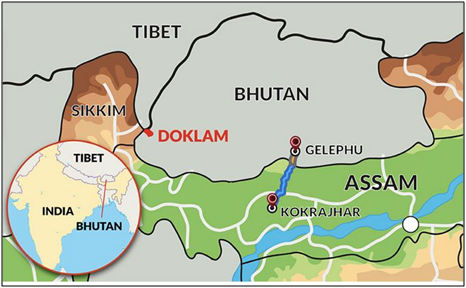
Mentor comments: Bhutan’s Gelephu project, aims to create a “Gelephu Mindfulness City” as a carbon-neutral economic hub spanning 1,000 square kilometers. This initiative focuses on sustainable industries like IT, education, and healthcare, positioning Gelephu as an investment destination and health and wellness center. This project is aligned with Bhutan’s Gross National Happiness philosophy, aiming to drive regional development and job creation responsibly. The project is crucial for Bhutan’s economic challenges, including the need to boost tourism revenues and address outmigration of youth seeking jobs abroad. Along this infrastructural learning, we need to align India’s involvement with its regional connectivity to emphasize the importance of land-based connectivity throughout Asia and the Indo-Pacific region.
Let’s learn.
—
Why in the News?
The recent project by Bhutan government of “Gelephu Mindfulness City” holds geopolitical significance, offering Bhutan a controlled way to engage globally while managing relations with China.
About the Gelephu Project:
The Gelephu Mindfulness City project in Bhutan is a significant initiative envisioned by His Majesty the King Jigme Khesar Namgyel Wangchuck to create a unique economic hub with a focus on sustainable development and cultural preservation.
This project involves the establishment of a Special Administrative Region (SAR) covering 1000 square kilometers, emphasizing conscious and sustainable businesses inspired by Bhutan’s spiritual heritage and values.
The SAR will have executive autonomy, legal independence, and will prioritize businesses that align with Bhutan’s Gross National Happiness philosophy, aiming to drive regional development and job creation responsibly.
India’s involvement aligns with its regional connectivity plans, emphasizing the importance of land-based connectivity across South Asia and the Indo-Pacific region.
How are Bhutanese concerns aligned with India?
1) Geographical concerns:
Floods: With warmer temperatures than in the mountains, Gelephu gets high amounts of rainfall during a monsoon season that lasts several months, leading to considerable flooding each year.
Habitat and Conservation Issues: The surrounding forests and wildlife populations place Gelephu right in the middle of elephant corridors.
2) Geopolitical concerns:
China Factor: Pressure from its northern neighbor China to conclude a boundary resolution deal and to establish diplomatic ties.
Far away to the south, Gelephu offers Bhutan a way to open itself up in a controlled manner to the rest of the world, while also continuing negotiations with Beijing for a stable border.
Security Issues:Insurgencies in Assam and the northeastern states and just across the Indian border in Myanmar have been an area of great concern in the past.
This has led to a major military operation (Operation All Clear) by Bhutan’s former king in 2003, working with the Indian Army to drive out militant groups sheltering in the area.
Administrative Concern: As Gelephu is landlocked, it is dependent on primarily India, to provide the infrastructure for trade and transport out of the special administrative region.
3) Economic concerns:
Lag in Decision Making: Apart from hydropower, tourism is Bhutan’s mainstay, but the kingdom has always discouraged mass tourism, preferring instead a “high value, low volume” motto to ensure sustainability.
Bhutan needs to scale up its capacity to take in more tourists and visitors and land bigger planes in the narrow Paro valley.
Financial need for infrastructure: The Gelephu project involves scaling up the Gelephu airport and tarmac to international standards, which will need financing and expertise from India.
Employment issue: The growing “outmigration” of Bhutanese youth in search of jobs abroad is another challenge, and the government hopes a mega project such as Gelephu will stem that.
Prevailing India-Bhutan Relationship:
Officially, the diplomatic relations between Bhutan and India were established in January 1968. This Bilateral relationship is majorly guided by the Indo-Bhutan Friendship Treaty.
Article 2 of the Treaty declares that India would not interfere in Bhutan’s administrative affairs and the latter would be guided by the former’s advice in its external relations.
Economic Cooperation:
Since 2014, India’s trade with Bhutan has almost tripled from USD 484 million in 2014-15 to USD 1422 million in 2021-22. This accounts for about 80% of Bhutan’s overall trade, with the balance of trade in India’s favor.
India is the leading source of investments in Bhutan, comprising 50% of the country’s total FDI. Interestingly, Bhutanese currency Ngultrum is officially pegged to the Indian Rupee.
Infrastructural Cooperation: India has constructed three Hydroelectric Projects (HEPs) in Bhutan:336 MW Chukha HEP, 60 MW Kurichhu HEP and 1020 MW Tala HEP.These three plants are operational and export surplus power to India. Hydropower projects in Bhutan are an example of win-win cooperation, providing a reliable source of inexpensive and clean electricity to India, generating export revenue for Bhutan and cementing our economic integration.
Growth Cooperation: For the 12th Five-Year Plan of Bhutan, India is assisting Rs. 45 billion.
What needs to be India’s current interest w.r.t the recent escalating Geopolitics?
Climate Change: India’s plans for a South Asian power grid (throughSolar and Wind power generation projects) that would draw electricity from Nepal and Bhutan, with supply to Bangladesh and Sri Lanka would lend itself to more consistent power supplies needed for Gelephu.
Connectivity: Nearly decades of deteriorating ties with Pakistan have seen the Indian government virtually cut off any plans for land connectivity over India’s western border. The International North-South Transport Corridor, faces western sanctions, the IMEC and I2U2 initiative are challenged by Israel’s bombardment of Gaza and Houthi attacks in the Red Sea.
Conclusion:
At the 7th Indian Ocean Conference 2024, External Affairs Minister highlighted the need for lateral land-based connectivity across the Indian Ocean region, which is essential to supplement and complement the maritime flows. The Gelephu project offers a chance for the region to conjure an imagination beyond the problematic present. Although it is a huge gamble for Bhutan, but also a potential game changer for the region, with help from India.
Renewed clashes in eastern DRC between the Congolese army and Rwandan-backed M23 rebels have raised global concerns.
Context:
The conflict exacerbates the humanitarian crisis in the region, with increased fatalities, displacements, and food security risks.
The United Nations and several Western countries denounce the attacks and urge the M23 rebels to halt their offensive
What is the conflict?
Origin: Conflict in the eastern region of the Democratic Republic of the Congo (DRC) stems from the aftermath of the Rwandan genocide in 1994, where extremist Hutus killed hundreds of thousands of minority ethnic Tutsis and Hutu moderates.
Refugee Crisis: Following the genocide, around two million Rwandan refugees fled to eastern Congo, leading to tensions between local Congolese and Rwandan emigrants.
First Congo War: Ethnic tensions escalated into the First Congo War, pitting Zairean soldiers against Tutsi militias and the Alliance of Democratic Forces for the Liberation of Congo (AFDL), supported by Rwanda and Uganda.
Political Changes: The AFDL captured Kinshasa, leading to the renaming of Zaire as the Democratic Republic of the Congo (DRC) in 1997.
Africa’s World War: The Second Congo War erupted in 1998, characterized as “Africa’s world war,” involving various armed groups, including the Rwanda-backed rebel group, the Rally for Congolese Democracy (RCD).
Despite multiple peace agreements, violence persists in the region, making it one of the deadliest conflicts since World War II.
Who are the M23 rebels?
Formation of M23 rebels: The March 23 Movement (M23) was formed in 2012 to defend Tutsi interests against Hutu militias, stemming from a 2009 ceasefire agreement. It broke away from the Congolese army, accusing the government of failing to integrate Tutsis.
Recent Resurgence: M23 resurged in 2022, citing attacks by Hutu militias. Recent attacks near Goma have exacerbated the humanitarian crisis, leading to protests urging Rwanda’s withdrawal of support.
Escalating Tensions: Violence has strained relations between the DRC and Rwanda, with the DRC accusing Rwanda of backing M23 rebels. Rwanda denies these allegations and attributes the escalation to Congo’s decision to send back regional peacekeepers.
Potential Regional Escalation: The worsening violence raises concerns about regional tensions and the involvement of more countries. Attacks on civilian settlements have caused significant casualties and forced health and aid workers to withdraw.
Measures to resolve these issues-
Regional Cooperation: Foster cooperation among neighboring countries to address cross-border security challenges and prevent the spread of violence. Establishing joint patrols and intelligence-sharing mechanisms can enhance security along shared borders.
Peacekeeping Missions: Increased peacekeeping efforts can help stabilize conflict-affected areas and create conducive conditions for peace talks.
Socio-Economic Development: Invest in socio-economic development initiatives in conflict-affected areas to address underlying drivers of instability and marginalization. Providing livelihood opportunities, access to education, healthcare, and infrastructure can help alleviate poverty and promote social cohesion.
Disarmament and Reintegration: Implement effective disarmament, demobilization, and reintegration (DDR) programs which should include vocational training, psychosocial support, and community-based reconciliation efforts.
International Support: Mobilize international support and Regional organizations, donor countries, and civil society actors to provide timely and coordinated assistance to affected populations.
Conclusion:
The conflict in eastern DRC, fueled by historical grievances and ethnic tensions, requires diplomatic engagement, regional cooperation, peacekeeping missions, comprehensive peace agreements, socio-economic development, disarmament, international support to achieve lasting peace and stability.
Mains PYQ-
The anti-colonial struggles in West Africa were led by the new elite of Western-educated Africans. Examine. (UPSC IAS/2016)
Much of the discussion over illegal immigration to the US has in recent weeks moved its focus south to the Darien Gap.
What is Darien Gap?
The Darien Gap spans northern Colombia and Southern Panama, covering approximately 97 km of dense jungle terrain.
It is situated in the narrowest part of the Isthmus of Panama, connecting North America to South America.
It covers an area of approximately 41,440 square km.
The landscape is characterized by dense rainforests, swamps, rivers, and rugged mountains.
It is one of the most biologically diverse regions on Earth, home to a wide array of plant and animal species, including jaguars, pumas, tapirs, and numerous bird species.
Why in the news?
Ans. Surge in Illegal Crossings
Escalating Numbers: In 2021, the Panamanian government recorded a staggering 133,000 crossings, with over half a million individuals transiting through the region in 2023.
Root Causes: Violence, insecurity, and limited legal immigration options in home countries propel individuals, including Venezuelans, Haitians, and Afghans, to undertake the perilous journey.
Try this PYQ from CSE Prelims 2015:
The area known as ‘Golan Heights’ sometimes appears in the news in the context of the events is related to:
Health ministers from 11 African nations grappling with the heaviest malaria burdens have recently signed the Yaounde Declaration.
What is Yaounde Declaration?
Details
Signed at
Yaoundé conference, hosted by WHO and the Government of Cameroon in Yaoundé, Cameroon (capital).
Participants
Ministers of Health, global malaria partners, funding agencies, scientists, civil society organizations, and other malaria stakeholders.
Signatory countries
Burkina Faso, Cameroon, the Democratic Republic of the Congo, Ghana, Mali, Mozambique, Niger, Nigeria, Sudan, Uganda, and Tanzania.
These countries collectively account for over 70% of the global malaria burden.
Pledges
Effective tackling of malaria threat in Africa, leading better and investing more money in fighting malaria, using new technology for data, etc.
Investing more in health infrastructure, personnel, and programs, collaborating across sectors, forming partnerships for funding, research, and innovation.
Showing strong commitment to quickly reducing malaria deaths and holding each other and their countries accountable for the commitments.
The 13th Ministerial Conference (MC13) of the World Trade Organization (WTO) convened in Abu Dhabi, UAE, from February 26 to March 2, drawing participation from 166 member countries.
The conference culminated in the adoption of a ministerial declaration outlining a reform agenda to bolster the WTO’s role in regulating global trade and facilitating seamless cross-border commerce.
About World Trade Organization (WTO)
Details
Establishment
1995, replacing GATT
Objective
To regulate international trade
Headquarters
Geneva, Switzerland
Members
164
India is a Founding Member.
Objectives
Formulate rules for trade
Negotiate further liberalization
Settle disputes
Assist developing countries
Cooperate with major economic institutions
Principles
Non-Discrimination
Most Favored Nation
National Treatment
Reciprocity
Predictability through Binding Commitments
Transparency
Encourage Development and Reforms
Important Trade Agreements
Agreement on Agriculture (AoA),
Agreement on TRIPS (Trade-Related Aspects of Intellectual Property Rights),
Agreement on the Application of Sanitary and Phytosanitary Measures (SPS),
Agreement on Technical Barriers to Trade (TBT),
Agreement on Trade-Related Investment Measures (TRIMS),
General Agreement on Trade in Services (GATS) etc.
WTO Agreement on Agriculture (AoA)
Negotiated during Uruguay Round (1995)
Aims to reform trade in agriculture
Allows support for rural economies with fewer trade “distortions”
Focuses on improving market access, reducing subsidies, and eliminating export subsidies
Subsidies Types:
Green Box – No distortion in trade
Amber Box – Can distort production and trade (subject to limits)
Blue Box – Subsidies linked to production-limiting programs
Most Favoured Nation Clause
Ensures non-discriminatory trade
Prevents discrimination among trade partners
First clause in GATT
Special trade statuses extended to all WTO members
Key Decisions at MC13
Dispute Settlement System: Member countries reaffirmed their commitment to establishing a fully functional dispute settlement system by 2024.
Special and Differential Treatment (S&DT): Emphasis was placed on enhancing the utilization of S&DT provisions to support the development objectives of developing and least developed countries (LDCs).
Challenges to Multilateral Trading Order
Rising Protectionism: Developed economies, amid growing domestic pressures, have exhibited a propensity towards protectionist policies, challenging the prevailing globalized trade paradigm.
Supply Chain Disruptions: Ongoing conflicts and sanctions have disrupted global supply chains, necessitating a reassessment of trade norms to ensure resilience and efficiency.
Development Disparities: Concerns persist regarding the equitable treatment of nations, with attention directed towards mitigating disparities between richer nations and LDCs.
India’s Approach
Public Stockholding (PSH) Programme: India advocated for a resolution concerning the PSH program, crucial for ensuring food security. The program enables the procurement and distribution of essential food grains to millions of beneficiaries at subsidized rates.
Fisheries Subsidies: India proposed measures to regulate fisheries subsidies, advocating for support to poor fishermen within national waters while curbing subsidies for industrial fishing in international waters.
E-commerce Customs Duties: India pressed for the removal of the moratorium on customs duties for cross-border e-commerce, citing the need to safeguard revenue generation in the digital trade landscape.
Outcomes
Agriculture: MC13 witnessed the formulation of a text addressing agricultural issues, marking a significant milestone after decades of negotiations.
Fisheries: Progress towards consensus on fisheries regulations was noted, with expectations of finalization by mid-year.
E-commerce Duties: Despite efforts, the exemption from customs duties for e-commerce transactions was extended for an additional two years, disappointing several developing economies.
Conclusion
The outcomes of MC13 underscore the imperative for collaborative efforts to address pressing challenges in global trade.
While strides were made in certain areas such as agriculture and fisheries, unresolved issues surrounding e-commerce and development disparities persist.
As nations navigate the evolving trade landscape, sustained dialogue and concerted action are essential to foster inclusive and sustainable economic growth worldwide.
Try this PYQ from CSE Prelims 2015:
The terms ‘Agreement on Agriculture’, ‘Agreement on the Application of Sanitary and Phytosanitary Measures’ and Peace Clause’ appear in the news frequently in the context of the affairs of the:
(a) Food and Agriculture Organization
(b) United Nations Framework Conference on Climate Change
(c) World Trade Organization
(d) United Nations Environment Programme
[wpdiscuz-feedback id=”cygi29n862″ question=”Please leave a feedback on this” opened=”1″]Post your response here.[/wpdiscuz-feedback]
Recently Philippines and China Coast Guard collided with each other near the Second Thomas Shoal of the Spratly Islands in South China Sea.
About Second Thomas Shoal
It is located approximately 105 nautical miles (195 km) west of Palawan, Philippines.
It lies within the Philippines’ EEZ (exclusive economic zone).
The shoal is part of the Spratly Islands, which are subject to overlapping territorial claims by multiple countries, including China, the Philippines, Vietnam, Malaysia, and Taiwan.
It is strategically significant due to its location in the South China Sea, a major maritime trade route rich in natural resources.
Note: An Exclusive Economic Zone (EEZ) is an area of the ocean, generally extending 200 nautical miles (230 miles/370.15 km) beyond a nation’s territorial sea, within which a coastal nation has jurisdiction over both living and non-living resources.
What is the South China Sea Dispute?
It is a dispute over territory and sovereignty over ocean areas, and the Paracels and the Spratlys – two island chains claimed in whole or in part by a number of countries.
China, Vietnam, the Philippines, Taiwan, Malaysia, and Brunei all have competing claims.
Alongside the fully-fledged islands, there are dozens of rocky outcrops, atolls, sandbanks, and reefs, such as the Scarborough Shoal.
China claims by far the largest portion of territory – an area defined by the “nine-dash line” which stretches hundreds of miles south and east from its most southerly province of Hainan.
Beijing says its right to the area goes hundreds of centuries to when the Paracel and Spratly island chains were regarded as integral parts of the Chinese nation.
It showed the two island groups falling entirely within its territory. Those claims are mirrored by Taiwan.
Spat over Chinese claims
China has backed its expansive claims with island-building and naval patrols.
The US says it does not take sides in territorial disputes but has sent military ships and planes near disputed islands, calling them “freedom of navigation” operations to ensure access to key shipping and air routes.
Both sides have accused each other of “militarizing” the South China Sea.
There are fears that the area is becoming a flashpoint, with potentially serious global consequences.
Try this PYQ from CSE Prelims 2011:
Q.Southeast Asia has captivated the attention of global community’ over space and time as a geostrategically significant region. Which among the following is the most convincing explanation for this global perspective?
(a) It was the hot theatre during the Second World War
(b) Its location between the Asian powers of China and India
(c) It was the arena of superpower confrontation during the Cold War period
(d) Its location between the Pacific and Indian oceans and its pre-eminent maritime character
[wpdiscuz-feedback id=”mjythkywde” question=”Please leave a feedback on this” opened=”1″]Post your answers here.[/wpdiscuz-feedback]


![[15 March 2024] The Hindu Op-ed: Bhutan’s opening move, its Gelephu gambit](https://d18x2uyjeekruj.cloudfront.net/wp-content/uploads/2024/03/WhatsApp-Image-2024-03-17-at-2.41.10-PM-1568x882.jpeg)