💥Join UPSC 2027,2028 Mentorship (July Batch) + XFactor Notes & Microthemes PDF

Subject: International Relations

  • ‘Sea is an important Component of the Cosmos’. Discuss in the light of the above statement the role of the IMO(International Maritime Organisation) in protecting environment and enhancing maritime safety and security.

    The oceans cover nearly 71% of the Earth’s surface and are the foundation of planetary life. The IMO, a UN specialized agency established in 1959, plays a critical role in promoting safe, secure, and environmentally sustainable use of the seas.

    Sea as an Important Component of the Cosmos

    It regulates climate, supports biodiversity, and drives global trade (over 80% of international trade by volume)

    Oceans absorb about 30% of global CO₂ emissions, produce half of the world’s oxygen, and absorb 90% of excess heat generated.

    Biodiversity and Life: Marine ecosystems host nearly 80% of all life forms

    Moral Value as part of the “common heritage of mankind”

    Engine of the Blue Economy: fisheries, renewable ocean energy, tourism, and seabed resources

    Role of IMO in Environmental Protection

    Net-Zero Framework – a global mechanism to price carbon emissions from ships and use the proceeds to help developing countries transition to green shipping.

    Pollution Prevention through MARPOL convention:

    Regulates oil, chemical, sewage, garbage, and air pollution.

    Enforce low-sulphur fuel standards and Energy Efficiency Design for new ships

    IMO’s Initial GHG Strategy targets 50% reduction in ship emissions by 2050 (from 2008 levels).

    Promotes green shipping and alternative fuels (LNG, methanol, hydrogen), and carbon intensity.

    Prevents transfer of invasive aquatic species through Ballast Water Management Convention

    IMO’s Polar Code addresses safety and environmental protection in polar waters

    Role in Maritime Safety and Security

    IMO provides a legal and technical framework for cleaner and safer shipping.

    SOLAS (Safety of Life at Sea, 1974) is IMO’s flagship convention, setting global ship design and emergency standards.

    STCW Convention (1978): Mandates uniform global training and certification for seafarers.

    ISPS Code (2002): Strengthens ship-port security against terrorism and piracy.

    IMO assists regional frameworks like Djibouti Code of Conduct (Somalia Basin) and ReCAAP (Asia) to combat piracy.

    Introduced e-navigation and Global Maritime Distress and Safety System (GMDSS) to improve real-time communication.

    Challenges

    Weak Enforcement: IMO relies on flag states’ compliance.

    Developing countries face technological and financial limitations for meeting emission targets.

    Emerging Threats: Cybersecurity and illegal fishing.

    Slow Decision-Making due to consensus-based model.

    Climate-Trade Dilemma: Balancing decarbonization with global trade competitiveness remains difficult.

    Recently, negotiations on the net zero framework have been adjourned for a year after opposition from the US and Saudi Arabia.

    Way Forward

    Stronger Monitoring Mechanisms through real-time tracking.

    Capacity Building of developing nations under a “Common but Differentiated Responsibility” framework.

    Strengthening R&D : green shipping corridors, hydrogen fuel, and maritime innovation hubs

    Global Cooperation among IMO, UNEP, UNDP, and regional maritime bodies like IORA

    As seas sustain both life and livelihood, global cooperation under IMO’s leadership is essential to achieve a safe, secure, and sustainable ocean future.

  • ‘The expansion and strengthening of NATO and a stronger US-Europe strategic partnership works well in India.’ What is your opinion about this statement? Give reasons and examples to support your answer.

    The NATO, Cold War-era collective defence alliance, has been revitalized after Russia’s invasion of Ukraine (2022), leading to strengthening of US-Europe strategic convergence.

    While India is not a NATO member, this development aligns with many of India’s strategic interests in maintaining a stable, rules-based international order.

    NATO Strengthening Works Well for India

    A stronger NATO balances Russia-China “no-limits partnership” (2022) that could undermine India’s strategic space in Eurasia.

    NATO’s stand against territorial aggression (Ukraine invasion) reinforces the sovereignty principle, resonating with India’s stance on border integrity (Galwan Clash).

    Strategic Convergence with the West – NATO’s pivot to the Indo-Pacific (NATO 2022 Strategic Concept) opens opportunities for India-NATO dialogue on maritime and cyber security.

    Countering China – A stronger transatlantic alliance allows US to share security responsibilities with Europe, freeing bandwidth for the Indo-Pacific focus under Quad and AUKUS.

    Western unity enables India to access cutting-edge defence technology and enhanced intelligence sharing. Eg- India-France Rafale Deal.

    Value-Based Convergence – Reinforces shared democratic values, human rights, and rule of law. Eg- India’s participation in the Summit for Democracy.

    Trade and investment flow – Stability in Europe can facilitate greater cooperation in trade, connectivity and technology domains. Eg- Recent India-UK trade deal

    Challenges

    NATO’s expansion risks reviving Cold War-style bipolarity, which goes against India’s principle of strategic autonomy and multi-alignment.

    USA’s policy of Bait and Bloodletting by prolonging Russia-Ukraine war undermines India’s policy of peaceful resolutions of disputes.

    NATO’s confrontation with Russia complicates India’s long-standing defence and energy ties with Moscow. Eg- US sanctions on Russian Oil

    A tighter US-Europe nexus could monopolize advanced technologies and make India dependent on Western supply chains.

    NATO’s eastward expansion and Russia’s isolation weaken Eurasian platforms (like SCO and BRICS) which can limit India’s influence in Central Asia.

    The West’s climate and trade protectionism undermines developing nations’ interests. Eg- EU Carbon Border Adjustment Mechanism

    Way Forward

    Strategic autonomy with issue based partnerships based on enlightened self interest (S. Jaishankar)

    Waivers for Chabahar Port and Russian oil and defense imports to preserve Strategic Autonomy

    Strengthening Bilateral Relations with EU and other European powers like UK, France. Eg- early conclusion of India-EU FTA

    Promoting Atmanirbharta in defence sector. Eg- make in India-make for the world.

    As per Shivshankar Menon, foreign policy is about Mini-maxing i.e. minimising harm and maximising gain. Multi-vector diplomacy and strategic autonomy is the way forward.

  • ‘Virus of Conflict is affecting the functioning of the SCO’. In the light of the above statement point out the role of India in mitigating problems.

    The SCO, evolved from the Shanghai Five (1996), was founded in 2001, as a Eurasian political, economic, and security organisation.

    Virus Conflict within SCO

    China-India border tensions (Galwan 2020) – undermine mutual trust.

    India-Pakistan rivalry over terrorism. Eg- Pahalgam Attack

    The China-Pakistan-Russia axis creates an internal power imbalance.

    China’s BRI expansionism – violates sovereignty. Eg- CPEC through PoK.

    Russia-Ukraine conflict divides members’ geopolitical alignments.

    Afghanistan instability – differing member approaches toward Taliban.

    India’s Role in Mitigating Problems

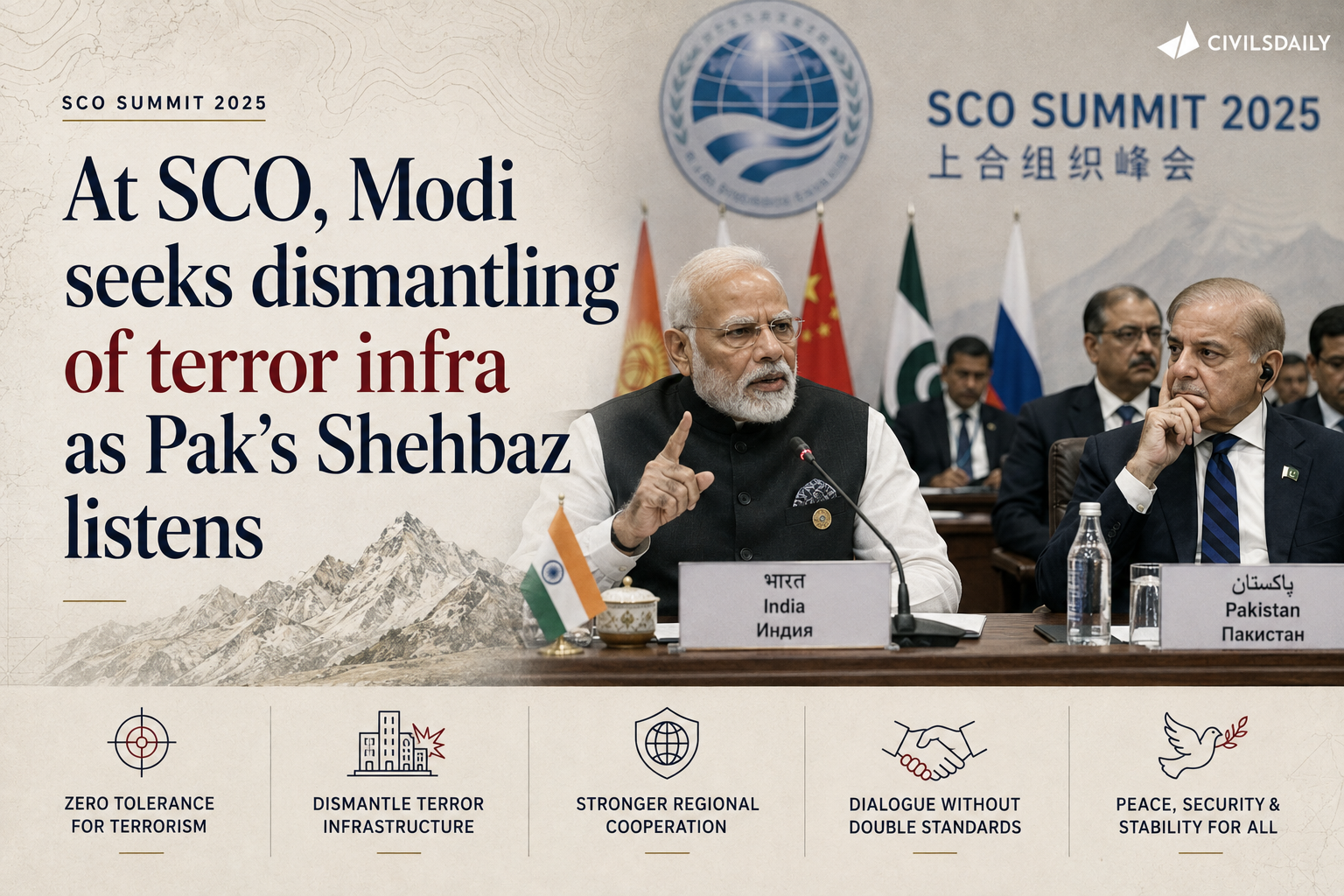
    Dialogue-based dispute resolution – SCO as a platform for engagement with China and Pakistan. PM Modi (2023): “SCO must not be divided by barriers of mistrust.”

    Act as a Balancer to China – Supported by CAR and Russia

    Enhancing Economic and Connectivity Alternatives – Promotes Chabahar Port and INSTC.

    Pushes for energy partnerships and supply-chain diversification with Central Asia.

    Encourages collaboration in AI, digital governance, and fintech. Eg- UPI as Model for CARs

    Active role in RATS (Tashkent) to share intelligence on terrorism. Calls for zero tolerance against extremism and radicalisation.

    Promotes respect for territorial integrity and international law. Advocates transparency in connectivity and infrastructure projects.

    Supports inclusive multipolarity in global and regional affairs. Acts as a moderating voice against bloc politics.

    Using India’s civilizational linkages to bridge ideological divides. Eg- Buddhist and sufi diplomacy with Central Asian nations.

    Climate Cooperation – joint action on climate resilience, renewable energy, and green hydrogen initiatives.

    SCO can help realise India’s ambitions on “multi-alignment”, “strategic autonomy” and becoming a “balancing power” in the world.

  • Indian diaspora has scaled new heights in the West. Describe its economic and political benefits for India.

    With over 32 million PIOs and NRIs spread across 200 countries, the Indian diaspora has become one of the most influential transnational communities in the world.

    Indian Diaspora Scaling New Heights

    Kamala HarrisVice President of the USA

    Sundar PichaiCEO of Alphabet (Google)

    Rishi SunakPrime Minister of the UK

    Anita AnandMinister of Defence, Canada

    Leo VaradkarPrime Minister of Ireland

    Indra Nooyi – Former CEO of PepsiCo

    Leena NairCEO of Chanel

    Economic Benefits

    Remittances – strengthen foreign exchange reserves and domestic consumption. Eg- In 2024-25, India received $135 billion, the highest in the world (World Bank).

    Investment – Successful diaspora members invest in Indian startups, real estate, and venture capital. Eg- Silicon Valley-Bangalore corridor

    Trade and Business Networks – Diaspora acts as a bridge for exports and market access. Enhances India’s competitiveness in Western markets.

    Indiaspora network and initiatives like Pratham, Akshaya Patra, IIT Alumni Foundations channel diaspora philanthropy to education and health.

    Knowledge Transfer – Highly skilled diaspora professionals contribute to knowledge flow, R&D collaboration, and technological innovation in India.

    University Collaborations- Diaspora academics help forge institutional tie-ups. Eg- Indo-US Science & Technology Forum.

    Brain Circulation- Reverse migration of skilled professionals enhances India’s innovation capacity.

    Political Benefits

    Lobbying and Advocacy for India-friendly trade, defense, and immigration policies. Eg- Strong diaspora lobbying contributed to the Indo-US Civil Nuclear Deal (2008).

    Soft Power Promotion through festivals, yoga days, and cultural events. Eg- Diwali celebration in White House

    Representation in International Platforms elevate India’s presence in multilateral decision-making. Eg- Gita Gopinath – Chief Economist, IMF.

    Bilateral Relations – facilitate closer diplomatic ties and mutual understanding between India and host countries. Eg- Kamala Harris (US) and Rishi Sunak (UK)

    Countering Anti-India Narratives- Diaspora think tanks and professionals help counter misinformation on Kashmir, CAA, or farmers’ protests.

    Challenges

    Security Threats – Eg- Khalistani groups in Canada

    Issues of discrimination and racism

    Brain Drain concerns

    As PM Narendra Modi noted, “The Indian diaspora is our global ambassador of talent, trust, and transformation.” Thus, sustained institutional dialogue is essential.

  • Terrorism has become a significant threat to global peace and security’. Evaluate the effectiveness of the United Nations Security Council’s Counter-Terrorism Committee (CTC) and its associated bodies in addressing and mitigating this threat at the international level.

    Terrorism refers to the use of violence or threat to create fear and achieve political, ideological, or religious objectives by targeting civilians and governments.

    Terrorism as a Threat to Global Peace and Security

    Non-traditional global security challenge undermining state sovereignty, human rights, and economic stability.

    Evolving naturecross-border networks, online radicalization, financing through illicit trade, and use of emerging technologies (drones, crypto-assets).

    Threats

    Economic – Terrorism and organised crime linkage. Eg- role of D-Company in Bombay Blasts 1993

    Bioterrorism – Eg- use of chemical weapons in Syria

    State sponsored terrorism – Eg- Pakistan

    Cyber terrorism – Eg- online radicalization by ISIS

    Regional Instability – Eg- Taliban in Afghanistan

    United Nations Security Council’s Counter-Terrorism Committee (CTC) and Associated Bodies

    Established under UNSC Resolution 1373 (2001) after 9/11.

    CTC’s mandate: Enhance state co-operation and capacity building to deal with global terror

    Associated Bodies:

    CTED (Counter-Terrorism Committee Executive Directorate): Provides technical assistance to member states.

    UNOCT (UN Office of Counter-Terrorism): Coordinates UN counter-terror programs.

    FATF : Monitors terror financing and money laundering globally.

    Positive Role

    Global Framework: Universal adoption of Resolution 1373, creating a global legal framework.

    Capacity Building: Support to developing states in border management, cyber surveillance, and financial tracking.

    Curbing Terror Financing: Criminalization of fund-raising and cross-border money flows.

    Information Sharing: Enhanced coordination among INTERPOL, UNODC, and regional organizations (ASEAN, AU, SAARC).

    1267 Sanctions Regime: Travel bans and arms embargoes on listed terrorist entities.

    Limitations

    No Universal Definition of Terrorism: Political differences hinder cohesive action.

    Enforcement Limitations: CTC cannot impose sanctions; compliance depends on state will.

    Selectivity and Geopolitics: Veto politics within UNSC prioritizes strategic interests over global consensus. Eg- China blocking Masood Azhar terrorist designation

    TRF, designated a terrorist group by India, has not been formally designated as a terrorist organisation by the UNSC 1267 Sanctions Committee.

    Unequal Capacities: Developing nations lack financial and technological resources to meet obligations.

    Emerging Threats: Cyber-terrorism, lone-wolf attacks, and digital radicalization outpace global responses.

    Human Rights Concerns: Some counter-terror laws compromise due process and civil liberties.

    Lack of consensus – as per T.S. Tirumurti, the world has gone back to the era of “my terrorist” and “your terrorist” and consensus reached after 9/11, to fight terror comprehensively, has run its course.

    Way Forward

    3C Approach: Collaborate, Coordinate, and Cooperate among nations.

    UNSC Reforms: voice to Global South and democratization of decision-making.

    Early finalization of Comprehensive Convention on International Terrorism (CCIT)

    A comprehensive consensus-based approach on zero tolerance for corruption is needed to tackle the menace of terrorism.


  • Discuss the geopolitical and geostrategic importance of Maldives for India with a focus on global trade and energy flows. Further also discuss how this relationship affects India’s maritime security and regional stability amidst international competition?

    The Maldives, located southwest of India in the central Indian Ocean, sits astride critical Sea Lines of Communication (SLOCs) that carry a major share of global oil and trade flows.

    Geopolitical and Geostrategic Importance of Maldives for India

    Strategic Location on Global Trade Routes through which over 80% of India’s crude oil and global container traffic transit.

    Energy Security Corridor- positions near the Eight Degree Channel are vital for the free flow of energy from the Persian Gulf to Indian and East Asian markets.

    As part of India’s SAGAR vision, Maldives strengthens India’s maritime domain awareness (MDA) through coastal radar systems integrated with India’s Information Fusion Centre – Indian Ocean Region (IFC-IOR).

    Economic and Blue Economy Cooperation for trade connectivity and sustainable ocean management.

    Impact on India’s Maritime Security Amidst International Competition

    India’s partnership with Maldives enables real-time monitoring of sea lanes, joint patrols, and defense training, enhancing maritime security in the Arabian Sea-Central IOR belt.

    The Belt and Road Initiative (BRI) and Chinese-funded infrastructure projects in Maldives (e.g., Sinamalé Bridge, port expansions) raise concerns of strategic encirclement (“String of Pearls”).

    Securing SLOCs Against Non-Traditional Threats like piracy, smuggling, terrorism, and illegal fishing.

    First-Responder Advantage- India’s humanitarian and disaster-relief operations (e.g., Operation NEER, COVID-19 aid) reinforce its role as the preferred security partner in the Indian Ocean Region (IOR).

    Impact on India’s Regional Stability Amidst International Competition

    Maintaining Balance of Power in the IOR- Maldives’ cooperation ensures that strategic outposts in the central Indian Ocean remain friendly to India and aligned with its Indo-Pacific vision.

    Shifts between pro-India and pro-China governments in Maldives (e.g., “India Out” campaigns) requires non-interference and developmental diplomacy to ensure long-term engagement.

    Regional Multilateralism and Cooperative Security through the Colombo Security Conclave and Indian Ocean Rim Association (IORA).

    India’s investments in infrastructure, tourism, and climate adaptation projects foster goodwill, ensuring Maldives remains a stable democratic partner in an increasingly contested Indo-Pacific.

    Challenges

    India’s Panipat Syndrome – Reactive rather than proactive diplomacy

    Political Instability due to Chinese influence (Deep Pocket Diplomacy)

    India’s delivery deficit and Big Brother Syndrome

    Way Forward

    Expand joint naval patrols, intelligence sharing

    Gujaral Doctrine – non-intrusive, partnership-based approach

    Institutionalize Political and Strategic Dialogue- 2+2 Ministerial Dialogue

    Provide viable alternatives to Chinese Belt and Road projects via Neighbourhood First and SAGAR

    A stable, sovereign, and friendly Maldives is essential for India’s ambition of Net Security Provider in IOR.

  • The West is fostering India as an alternative to reduce dependence on China’s supply chain and as a strategic ally to counter China’s political and economic dominance.’ Explain this statement with examples.

    The world order today is in ‘flux’ (M. K. Narayanan). In this context, “India is shaping up to be the trusted partner in a turbulent world.” (S. Jaishankar)

    China’s Dominance

    Political

    Alternative governance and development model of authoritarian capitalism

    Strategic assertion in South China Sea, Taiwan Strait, and Indian Ocean. Eg- boiling frog strategy

    Dual-use infrastructure- Eg- BRI ports and bases (Djibouti, Gwadar).

    Economic

    Parallel institutional ecosystem- Creation of AIIB, NDB, and BRI

    Complex interdependence- 18% of world GDP, major supplier in 70% of global supply chains.

    Debt Trap diplomacy through BRI loans and surplus-deficit strategies. Eg- Sri Lanka

    Weaponisation of supply chains – Eg- export restrictions on rare earths

    India’s Emerging Role as an Alternative to China

    (A) Geoeconomic Dimension – Supply Chain Diversification

    “China+1” Strategy-

    Global firms (Apple, Foxconn, Dell, Samsung) shifting manufacturing to India.

    India’s PLI Scheme attracted global investment in electronics, semiconductors, and solar.

    Recent FTA with UK

    Resilient Supply Chain Initiative by India, Japan, and Australia to reduce dependence on Chinese manufacturing.

    US-India Initiative on Critical and Emerging Technologies (iCET, 2023)- Cooperation in semiconductors, AI, quantum computing, and space.

    EU-India Trade and Technology Council (TTC, 2023)- Platform for technology, green energy, and digital infrastructure collaboration.

    (B) Strategic and Geopolitical Dimension

    Indo-Pacific Strategy-

    India is central to US-led Indo-Pacific vision ensuring a free and open Indo-Pacific.

    Participation in QUAD (India, US, Japan, Australia) to balance China’s maritime influence.

    Increasing defence trade and interoperability under COMCASA, BECA, LEMOA agreements.

    Critical Minerals Partnership (2022) to counter China’s monopoly in rare earth supply chains

    Infrastructure Connectivity- IMEC (India-Middle East-Europe Corridor, 2023) launched at G20 to provide an alternative to China’s BRI.

    (C) Multilateral and Institutional Cooperation

    India’s G20 Presidency (2023) strengthened its global credibility as a bridge between Global North and South.

    Western nations back India’s UNSC reform demand, recognizing its role in a multipolar world.

    ASEAN Countries and CARs as well as Russia support India’s role in ASEAN and SCO respectively as a counterbalance to China

    As the centre of gravity of world politics is shifting towards Indo-Pacific, India’s role is going to be critical in shaping 21st century great power dynamics.

  • Critically analyse India’s evolving diplomatic, economic and strategic relations with the Central Asian Republics (CARs) highlighting their increasing significance in regional and global geopolitics.

    The region of Central Asia is located in the heart of Eurasia and denoted as Heartland by Helford Mackinder. It connects Europe, West Asia, South Asia, and Russia.

    Significance of CARs in Regional and Global Geopolitics-

    Energy Hub- CARs hold 4% of global gas and 3% of oil reserves. Turkmenistan (gas), Kazakhstan (uranium, oil).

    Strategic Location- Land bridge between Europe, Russia, South Asia, and China, vital for Eurasian connectivity (BRI, INSTC, Ashgabat).

    Security Buffer- Acts as a buffer against terrorism and extremism from Afghanistan.

    Great Power Competition- Arena for China-Russia-US rivalry; China’s BRI investments exceed USD 60 billion.

    India’s Engagement-

    Diplomatic-

    Connect Central Asia Policy – based on 4 Cs-Commerce , Connectivity , Consular and Community.

    Institutionalized through India-Central Asia Summit (2022) and SCO membership (2017).

    Economic-

    Trade at USD 3 billion (2023);

    Focus on energy, IT, and pharma

    US$1 billion line of credit for development projects in infrastructure, IT, energy and agriculture in 2020.

    Joined Ashgabat Agreement (2018) and INSTC.

    Strategic-

    Cooperation on counterterrorism (SCO RATS)

    India operates Ayni Air Base (Tajikistan)

    Invests via ONGC Videsh in Kazakhstan.

    Challenges-

    Connectivity gaps due to lack of direct access (Pakistan barrier).

    China’s dominance under BRI and Russia’s influence in security.

    Instability in Afghanistan affecting corridors.

    Low trade volumes and implementation delays in projects like TAPI.

    US sanctions on Iran hinder Chabahar-INSTC route.

    Early finalization of FTA between India and the Eurasian Economic Union (EAEU) and air corridors can help to realise India’s energy security, connectivity, and strategic depth.

  • “Energy security constitutes the dominant kingpin of India’s foreign policy, and is linked with India’s overarching influence in Middle Eastern countries.” How would you integrate energy security with India’s foreign policy trajectories in the coming years?

    India is the world’s 3rd largest energy consumer, importing over 85% of its crude oil and 55% of natural gas. The Middle East accounts for nearly 60% of India’s crude imports.

    Energy Security is dominant kingpin of India’s foreign policy due to

    India’s energy demand is projected to double by 2040 (IEA). Energy diplomacy is central to India’s economic growth and geopolitical outreach.

    Geopolitical Risks – Instability in West Asia (Iran-Israel tensions, Strait of Hormuz) threatens supply chains.

    Price Volatility – Fluctuating global oil prices widen India’s current account deficit.

    US sanctions on Iran, Venezuela, Russia limit India’s diversification options

    China’s aggressive investments in overseas oilfields and LNG projects crowd out India. Eg- in Africa

    Infrastructure Gaps – Limited strategic petroleum reserves, LNG terminals, and pipelines.

    Integrating Energy Security with India’s Foreign Policy

    A. Short-Term Measures (2025-2030)

    Diversification of Suppliers- Expand sourcing from US, Russia, Africa, and Latin America.

    Expand Strategic Petroleum Reserves capacity from 5.3 MMT to 10 MMT.

    Chabahar & INSTC Connectivity- Use Iran-Central Asia corridor to secure overland energy routes and bypass chokepoints.

    Maritime and Energy Diplomacy- Strengthen cooperation with UAE, Saudi Arabia, and Oman for logistics bases and secure sea lines of communication.

    Financial Resilience- Develop Rupee-based oil trade and local currency settlements to cushion against dollar volatility and sanctions.

    B. Long-Term Measures (2030-2050)

    “Nearshoring” energy supplies and greening the Indian grid under Neighbourhood First policy. Eg- hydropower projects in Nepal

    Review of Civil Liability for Nuclear Damage Act and Atomic Energy Act for FDI in civil nuclear power.

    Green Energy Partnerships-

    Collaborate with Gulf nations on green hydrogen, solar parks, and carbon capture (India-UAE Green Energy Corridor).

    Promote India as a global hub for renewable technology and green financing.

    Energy Investments Abroad-

    Scale ONGC Videsh and IOCL investments in upstream oil and gas fields in Iraq, UAE, Mozambique, and Russia.

    Establish a Sovereign Energy Investment Fund for strategic acquisitions.

    Critical Minerals Diplomacy- Partner with CAR and African nations for lithium, nickel, and cobalt supply chains.

    Institutional Integration- Create an Energy Diplomacy Wing within MEA for coherent foreign policy alignment.

    “Energy security is not just about fuel, it is about strategic autonomy, and India’s foreign policy must secure both.” – M.K.Narayanan

  • “The reform process in the United Nations remains unresolved, because of the delicate imbalance of East and West and entanglement of the USA vs. Russo-Chinese alliance.” Examine and critically evaluate the East-West policy confrontations in this regard.

    “The UN was not created to take mankind to heaven, but to save humanity from hell.” – 2nd Secretary-General Dag Hammarskjöld. However, in the 21st century, the reform process-particularly of the Security Council-remains stalled, leading to a crisis of confidence in the UN.

    Major reforms needed in the UN

    Security Council expansion to reflect 21st-century realities

    Veto-restraint or limitation – Eg- code of conduct.

    Greater regional representation – Eg- African Union and Latin America.

    Strengthening General Assembly role with clear mandate and resources.

    Peacekeeping reform – mandates, rules of engagement, training and rapid deployment.

    Financial autonomy for agencies like UNDP

    Secretariat reform – streamline bureaucracy and merit-based senior appointments.

    Transparency & accountability – stronger oversight and audit for agencies and peace operations.

    Reasons the reform process remains unresolved

    A. Delicate East-West imbalance

    Historic institutional lock-in – UNSC P5 structure reflects 1945 power distribution.

    The West (US, UK, France) advocates “value-based liberal multilateralism,” emphasizing democracy, human rights, and rule-based order.

    The East (Russia, China) emphasizes “sovereign equality, non-interference, and multipolarity.” Eg- criticism of “Responsibility to Protect (R2P)” as neo-interventionism

    Regional rivalries – rival claims (Japan vs. China, India vs. Pakistan) block consensus on new permanent seats.

    B. Entanglement: USA vs. Russo-Chinese alignment

    P3 vs P2 divide over veto and reforms. Eg- Syria, Ukraine.

    P5 members resist reforms that could reduce their leverage.

    Security dilemmas and Great-power rivalry turns UN reform into a question of strategic advantage rather than institutional efficiency.

    C. Other decisive factors

    Charter rigidity – amendments need 2/3 members + P5 ratification.

    Bloc fragmentation G4, African Union (Ezulwini), Uniting for Consensus dilute consensus

    Resource dependence – Eg- UN budget has been slashed by 15% in 2026 (from USD 3.7 billion to USD 3.2 billion) as the US, China, Russia failed to complete their payments.

    Proliferation of parallel forums like BRICS, G20, SCO provide alternative platforms, reducing political pressure for UN reform.

    Way Forward

    Reforming the UN Security Council by increasing permanent membership and addressing the under-representation of Asia, Africa, and Latin America.

    Adopt a “two-tier” membership model (permanent without veto) as an interim compromise (Kofi Annan’s proposal, 2005).

    Empower the UNGA to act when the Security Council is paralyzed – via the Uniting for Peace Resolution (1950).

    Rationalization of the Veto System

    France-Mexico Initiative (2015): Voluntary veto restraint during mass atrocities.

    Accountability Proposal by ACT Group (27 countries): P5 must justify veto use before the General Assembly.

    Financial and Bureaucratic Reforms

    Diversify funding base to reduce donor dominance.

    Introduce independent audit mechanisms for UN agencies for transparency.

    Rationalize overlapping agencies (UNDP, UNEP, WHO) to ensure resource efficiency.

    Establish a UN Accountability Commission to monitor performance and corruption within UN bodies.

    As UN Secretary General Antonio Guterres put it, we can’t create a future fit for our grandchildren with systems built for our grandparents. Thus, “reformed multilateralism” with the UN at its core is essential.