Consider the following statements in respect of questions asked by the Members in the
Parliament of India:
1. Unstarred questions are those to which a Member desires an oral answer in the House.
2. Starred questions are those to which a Member desires a written answer.
3. No supplementary question can be asked on an unstarred question.
Which one of the following conclusions based on the above statements is correct?
Subject: Polity
-
Consider the following statements in respect of questions asked by the Members in the
-
Consider the following statements about provisions pertaining to SC/STs in India
Consider the following statements about provisions pertaining to SC/STs in India:
1. Provisions for Tribal Areas in Assam, Meghalaya, Tripura and Mizoram are in the Fifth Schedule.
2. Some tribes of India are entitled to exemption from paying Income Tax on certain incomes.
3. The Constitution provides for reservation of seats in Panchayats for women belonging to SCs and STs. -
Consider the following statements with reference to the Constitution of India
Consider the following statements with reference to the Constitution of India:
1. There is no Article in the Constitution of India that specifies that the Constitution of India
will be officially called the ‘Constitution of India’.
2. There is no Article in the Constitution of India that specifies that the Indian Independence
Act, 1947 and the Government of India Act, 1935 stand repealed.
3. There is no Article in the Constitution of India that mentions 26th January, 1950 as the date
of the commencement of the Constitution of India.
Which one of the following conclusions based on the above statements is correct? -
X’ was addressing a seminar on the meaning of the term ‘law’ as provided under Article 13, Part III of the Constitution of India. ‘X’ explained that the meaning of the term ‘law’ in the Constitution of India was very comprehensive. It included ordinances, orders and even rules and regulations. ‘Y’ pointed out that the term ‘law’ in Article 13 also included custom or usage having in the territory of India the force of law, to which ‘X’ was not convinced. Based on the above, select the correct conclusion from the options given below
X’ was addressing a seminar on the meaning of the term ‘law’ as provided under Article 13, Part III of the Constitution of India. ‘X’ explained that the meaning of the term ‘law’ in the Constitution of India was very comprehensive. It included ordinances, orders and even rules and regulations. ‘Y’ pointed out that the term ‘law’ in Article 13 also included custom or usage having in the territory of India the force of law, to which ‘X’ was not convinced. Based on the above, select the correct conclusion from the options given below:
-
[29th May 2026] The Hindu OpED: Will increasing the strength of the SC solve the pendency problem
PYQ Relevance[UPSC 2024] Explain the reasons for the growth of Public Interest Litigation in India. As a result of it, has the Indian Supreme Court emerged as the world’s most powerful judiciaryLinkage: The PYQ examines the expanding role and jurisdiction of the Supreme Court, which lies at the core of the present debate on pendency and judicial burden.The article discusses judicial reforms and institutional capacity of the Supreme Court. Efficient justice delivery is essential for preserving judicial independence and constitutional governance. Mentor’s Comment
The Union government has recently increased the sanctioned strength of the Supreme Court from 34 to 38 judges, reviving an old debate on judicial reforms: Can more judges solve India’s mounting judicial pendency? The issue has direct relevance for judicial reforms, separation of powers, access to justice, and constitutional governance in India.
What is the Constitutional Provision Governing the Number of Supreme Court Judges?
- Article 124(1): Establishes the Supreme Court and provides for a Chief Justice of India (CJI) and other judges.
- Parliamentary Power: The Constitution does not fix a permanent number of judges. It authorises Parliament to determine the number of judges by law.
- Flexible Institutional Design: Enables periodic expansion of judicial strength based on rising caseload, pendency, and administrative requirements.
How has the Number of Supreme Court Judges Increased?
- Ordinary Legislation: Increase in judicial strength requires amendment of the Supreme Court (Number of Judges) Act, 1956.
- No Constitutional Amendment Required: Since Article 124 empowers Parliament, increase occurs through ordinary parliamentary legislation, not a constitutional amendment under Article 368.
- Recent Change (2025): Parliament passed the Supreme Court (Number of Judges) Amendment Bill, 2025, increasing sanctioned strength from 34 to 38 judges.
- Ordinance Route: The President promulgated an ordinance under Article 123 before Parliament formally completed the process, despite Parliament expected to convene shortly.
How Has the Supreme Court’s Strength Increased Over Time?
Year Strength of SC Judges 1950 8 (including CJI) 1956 11 1960 14 1977 18 1986 26 2009 31 2019 34 2025 38 What Does This Trend Indicate?
- Rising Caseload: Expansion reflects increasing litigation and constitutional responsibilities.
- Persistent Pendency: Repeated increases have not prevented rising backlog, indicating structural inefficiencies beyond numerical shortage.
- Shift in Institutional Role: Expansion coincides with the Supreme Court increasingly functioning as a general appellate court, rather than primarily a constitutional court.
Can Increasing Judicial Strength Alone Reduce Pendency in the Supreme Court?
- Judicial Capacity: Increasing sanctioned strength from 34 to 38 judges enhances disposal capacity and may reduce waiting time for hearings.
- Limited Impact: Pendency of nearly 94,000 cases suggests backlog is structural rather than merely numerical.
- Historical Continuity: Successive governments have periodically increased judicial strength, yet pendency continues to rise.
- Institutional Limitation: More judges do not automatically improve efficiency unless accompanied by procedural reforms.
- Concerns Over Ordinance Route: The government introduced the increase through an ordinance, despite Parliament being expected to convene soon, raising concerns about legislative bypass.
Has the Supreme Court Drifted from Its Intended Constitutional Role?
- Constitutional Design: The Supreme Court was envisioned primarily as a constitutional court, dealing with substantial constitutional interpretation.
- Article 136 Expansion: The Court’s extraordinary power under Article 136 (Special Leave Petition) has expanded its jurisdiction significantly.
- Routine Appeals: A substantial share of the Court’s docket is now occupied by SLPs, converting the Court into a de facto regular appellate court.
- Judicial Observation (2016): A Constitution Bench refused to restrict Article 136, observing that no effort should be made to reduce the Court’s powers.
- Consequences: Excessive appellate workload diverts attention from constitutional matters of national significance.
Do Special Leave Petitions (SLPs) Contribute to Judicial Backlog?
- Extraordinary Remedy: SLPs were designed as exceptional remedies under Article 136 for rare cases involving grave injustice.
- Judicial Overreach of Scope: SLPs now dominate a substantial portion of Supreme Court litigation.
- Absence of Guidelines: Lack of strict admission standards has encouraged indiscriminate filing.
- Case Example: Vijaya Bank v. Prashant B. Narnaware: A contractual employment dispute reached the Supreme Court despite involving issues more suited for lower courts.
- Constitutional Concern: Excessive admission of routine matters dilutes the Court’s constitutional focus.
Does Government Litigation Worsen Judicial Pendency?
- Largest Litigant: Governments remain among the largest litigants in Indian courts.
- National Litigation Policy Failure: The proposed National Litigation Policy (NLP) aimed to reduce avoidable government litigation but was never effectively implemented.
- Routine Appeals Culture: Government departments frequently pursue appeals even in settled legal matters.
- Administrative Inconsistency: Frequent changes in legal officers produce contradictory litigation strategies.
- Institutional Burden: Excessive state appeals consume judicial time and prolong case disposal.
- Illustration: Cases often remain pending for years before reaching the Supreme Court because High Courts do not conclusively settle disputes.
Will More Benches Improve Consistency or Create Conflicting Judgments?
- Expanded Bench Strength: More judges imply greater number of division benches.
- Potential Benefit: Greater benches may increase disposal rates and reduce waiting time.
- Risk of Fragmentation: Larger bench numbers may generate inconsistent judicial interpretations.
- Polyvocality Challenge: Different benches may reach different conclusions on similar legal principles.
- Need for Coordination: Greater reference to larger Constitution Benches becomes essential for doctrinal consistency.
Can Institutional Reforms Address Pendency More Effectively Than Numerical Expansion?
- Filtering Mechanism: Strengthens scrutiny of frivolous litigation, particularly under Article 136.
- Case Prioritisation: Ensures only cases involving substantial constitutional questions reach the Supreme Court.
- Written Submissions: Reduces prolonged oral arguments and judicial time consumption.
- Bench Management: Facilitates better coordination among benches to reduce conflicting rulings.
- High Court Empowerment: Encourages High Courts to decisively settle disputes rather than passing litigation upward.
- Case Illustration: State of Uttaranchal v. Balwant Singh Chaufal (2010): Supreme Court stressed that Public Interest Litigation (PIL) must serve genuine public causes and not personal interests.
Can Judicial Appointments Improve Gender Representation?
- New Opportunity: Four additional judicial positions create scope for increasing women’s representation.
- Gender Gap: High Courts continue to have relatively low numbers of senior women judges.
- Transparency Need: Judicial appointments require greater openness and diversity considerations.
- Convention Bias: Seniority norms have often disadvantaged women in elevation to higher courts.
Conclusion
Increasing the sanctioned strength of the Supreme Court from 34 to 38 judges may improve disposal rates and reduce immediate workload pressures, but pendency is fundamentally a structural and institutional challenge rather than a purely numerical one. Sustainable reform requires restoring the Court’s constitutional role through stricter filtering of Special Leave Petitions (SLPs), reducing excessive government litigation, strengthening High Courts, improving case management, and ensuring doctrinal consistency. Judicial expansion can facilitate faster justice only when accompanied by systemic reforms that enhance efficiency, coherence, and access to justice.
-
Why SC online gaming tax verdict could be a final death blow to sector
Why in the News?
The Supreme Court recently upheld the constitutional validity of the government’s retrospective 28% GST levy on online real-money gaming, reviving tax demands of nearly ₹2.5 lakh crore against gaming companies, fantasy sports platforms, and casinos. The ruling is significant because it overturns relief granted by the Karnataka High Court .
Understanding Online Gaming in India: What is Being Regulated?
- Online gaming refers to digital games played over the internet through mobile applications, websites, or gaming platforms.
- In India, the sector includes real-money gaming, fantasy sports, skill-based games (rummy, poker), casino-style betting, and casual entertainment gaming.
- The regulatory challenge arises because gaming falls at the intersection of technology, taxation, public order, consumer protection, and gambling laws, with different legal treatment depending on the nature of the game.
How is online gaming regulated in India?
- Constitutional Position: Betting and gambling fall under the State List (Entry 34, List II, Seventh Schedule), allowing states to enact their own laws. This has created a fragmented regulatory landscape.
- Central Regulation: The Union government regulates aspects relating to intermediary liability, digital platforms, taxation, cybersecurity, money laundering, and online content.
- IT Rules Framework: The Information Technology (Intermediary Guidelines and Digital Media Ethics Code) Rules, 2021, amended in 2023, introduced provisions for regulation of online real-money games, due diligence by intermediaries, and verification mechanisms.
- State-Level Variation: States adopt differing approaches:
- Permissive Approach: States such as Sikkim and Nagaland license certain online skill games.
- Restrictive Approach: States such as Tamil Nadu and Telangana imposed restrictions on some online money games citing addiction and public welfare concerns.
- Tax Regulation: Since October 2023, online gaming, casinos, and horse racing attract 28% GST on the full face value of bets/deposits, rather than only platform commissions.
What is the difference between a ‘Game of Skill’ and a ‘Game of Chance’?
Game of Skill
- A game in which success predominantly depends upon a player’s knowledge, training, strategy, judgment, or expertise, even if some chance element exists.
- Examples:
- Rummy: Recognised by courts as substantially skill-based.
- Fantasy Sports (Dream11): Judicial rulings have treated team selection requiring statistical judgment as skill-oriented.
- Chess, Bridge, E-sports: Depend primarily on cognitive ability and strategy.
- Judicial Position: Courts have held that a game remains one of skill if skill predominates over chance.
Game of Chance
- A game in which outcomes depend predominantly on luck, randomness, or uncertain events, with limited influence of player expertise.
- Examples:
- Roulette
- Slot machines
- Lottery
- Casino gambling
- These activities are generally treated as betting or gambling and face stricter regulation.
Why does the skill-versus-chance distinction matter?
- Legal Treatment: Games of skill generally receive greater constitutional protection under Article 19(1)(g) (right to trade/business), whereas gambling may face prohibition.
- Taxation: The GST dispute emerged because gaming firms argued that skill-based games should be taxed on Gross Gaming Revenue (GGR) rather than total player deposits.
- State Regulation: Several states permit skill games while prohibiting gambling and betting.
- Consumer Welfare: Governments increasingly view even skill-based money gaming through a public health lens due to addiction concerns.
Why has the Supreme Court verdict become a watershed moment for India’s online gaming sector?
- Retrospective Tax Validation: Upholds the constitutional validity of the 28% GST levy retrospectively, reviving tax notices worth approximately ₹2.5 lakh crore against gaming firms, fantasy sports companies, and casinos.
- Judicial Finality: Settles a prolonged legal dispute by dismissing petitions filed by gaming companies challenging GST demands and retrospective tax notices.
- Reversal of Earlier Relief: Overturns relief granted by the Karnataka High Court to Gameskraft, which had challenged a ₹21,000 crore GST notice.
- Massive Fiscal Exposure: Creates unprecedented liabilities for firms such as Dream11, which reportedly faced notices of around ₹40,000 crore, and Delta Corp, which received notices totalling ₹23,204 crore.
How did the dispute over GST liability on online gaming emerge?
- Taxation Ambiguity: Emerged from disagreement over whether GST should apply only on platform fees/commissions (Gross Gaming Revenue-GGR) or on the full value of deposits/bets placed by users.
- Industry Position: Argued that taxation should apply prospectively from 1 October 2023, following GST Council amendments.
- Government Position: Treated real-money gaming involving uncertain outcomes as betting and gambling, irrespective of skill elements.
- Skill vs Chance Debate: The industry maintained that games such as fantasy sports and rummy involve skill and should be taxed differently from gambling.
- Supreme Court Position: Accepted the government’s interpretation by treating online money gaming involving uncertain outcomes as taxable similarly to betting activities.
Why is taxation on the ‘full face value’ of bets controversial?
- Commercial Unsustainability: Imposes GST on the entire deposited amount rather than platform earnings, substantially increasing tax liability.
- Revenue Mismatch: Creates tax demands many times higher than cumulative revenues generated by companies.
- Retrospective Burden: Applies liabilities to past operations, creating sudden and severe liquidity pressures.
- Consumer Pricing Constraints: Restricts firms’ ability to transfer increased tax burdens to users due to market competition and affordability concerns.
- Business Viability Risk: Forces firms to reconsider business models, downsize operations, or shift to alternative sectors.
- Illustration: A platform earning only a small commission on player deposits may still face taxation on the total deposited amount, sharply inflating liabilities.
Does the verdict strengthen fiscal governance or undermine ease of doing business?
- Tax Certainty: Strengthens clarity by resolving prolonged legal ambiguity regarding GST treatment.
- Revenue Protection: Enhances government capacity to prevent tax avoidance and regulatory arbitrage.
- Consumer Protection: Aligns with state concerns regarding gambling addiction and financial vulnerability among youth.
- Retrospective Taxation Concerns: Raises questions regarding predictability of taxation, a core element of investment confidence.
- Ease of Doing Business: Creates apprehensions regarding sudden regulatory shifts affecting emerging digital sectors.
- Regulatory Signalling: Indicates stronger state oversight over digital platforms operating in legally grey areas.
How has India’s regulatory approach towards online gaming evolved?
- Tax Tightening: GST Council introduced 28% GST on online gaming based on the face value of bets.
- Security Concerns: Authorities flagged concerns relating to digital wallets, cryptocurrency-based transfers, illicit fund movement, and money laundering.
- National Security Risks: Identified gaming platforms as potential communication channels for organised criminal and extremist activities.
- Legal Restrictions: The Promotion and Regulation of Online Gaming (PROG) Act, 2025 introduced strict restrictions on online money gaming platforms.
- Financial Restrictions: Prohibits banks and financial institutions from facilitating transactions linked to prohibited platforms.
- Penal Consequences: Provides imprisonment and financial penalties for operators, promoters, and facilitators of prohibited gaming activities.
Can India balance innovation in digital gaming with regulatory safeguards?
- Regulatory Clarity: Requires a transparent legal distinction between games of skill and games of chance.
- Consumer Safeguards: Ensures age verification, spending limits, addiction prevention, and grievance redressal.
- Proportionate Taxation: Supports sustainable taxation aligned with actual revenue generation.
- Technology Oversight: Strengthens anti-money laundering (AML) and cybersecurity frameworks.
- Economic Potential: Recognises gaming as part of India’s digital economy, employment generation, and technology ecosystem.
- Federal Coordination: Requires harmonisation between central taxation policies and state gambling laws.
Conclusion
The Supreme Court verdict represents more than a taxation dispute; it signals a decisive shift in India’s governance of emerging digital sectors. While the judgment strengthens regulatory clarity and fiscal oversight, the retrospective nature and scale of tax liabilities raise concerns regarding investment certainty and innovation. India’s challenge lies in designing a framework that simultaneously ensures consumer protection, revenue integrity, and sustainable growth of legitimate digital enterprises.
-
A revival of sedition tied to consent
Why in the News?
The Supreme Court on May 21, 2026, clarified that courts may resume proceedings in pending sedition cases under Section 124A of the IPC if the accused voluntarily consent, partially relaxing the 2022 stay order. The development has revived debate over free speech and misuse of sedition while its constitutional validity remains pending before the Court.
What is Sedition?
Sedition under Section 124A of the Indian Penal Code (IPC), 1860 historically criminalised acts bringing “hatred, contempt or disaffection” against the government established by law. Although Section 124A stands repealed with the enforcement of the Bharatiya Nyaya Sanhita (BNS), 2023, a comparable provision now exists under Section 152 of the BNS, titled “Acts Endangering Sovereignty, Unity and Integrity of India.” The Supreme Court’s recent clarification primarily concerns pending Section 124A IPC cases, while the constitutional debate has now expanded to include Section 152 of the BNS.
Feature Section 124A IPC Section 152 BNS Law Indian Penal Code, 1860 Bharatiya Nyaya Sanhita, 2023 Offence Name Sedition Acts Endangering Sovereignty, Unity and Integrity of India Focus Hatred/disaffection against government Secession, armed rebellion, separatism, subversive activities Terminology Explicitly used term “sedition” Removes word “sedition” Punishment Life imprisonment or up to 3 years + fine Life imprisonment or up to 7 years + fine Criticism Misuse against dissent Alleged “repackaged sedition” with broader scope Why has sedition remained controversial since colonial times?
- Colonial Origins: Sedition traces back to the Statute of Westminster, 1275, and later became part of British colonial criminal law.
- Colonial Instrument: Used by British authorities against Indian nationalists including Bal Gangadhar Tilak and Mahatma Gandhi.
- Nehru’s Criticism: Prime Minister Jawaharlal Nehru described sedition in Parliament (1951) as “highly objectionable and obnoxious.”
- Democratic Contradiction: Critics argue sedition criminalises legitimate criticism of government.
- Recent Misuse Example: A former independent MP and her husband reportedly faced sedition charges after allegedly threatening to recite the Hanuman Chalisa outside a former Maharashtra Chief Minister’s residence.
How has the Supreme Court’s May 21 clarification altered the status of sedition proceedings?
- Judicial Clarification: Permits courts to continue trials, appeals, and proceedings under Section 124A if the accused person voluntarily consents.
- Partial Revival: Modifies the effective pause imposed by the Supreme Court’s May 2022 interim order, which had directed governments to refrain from registering fresh FIRs and coercive action under sedition.
- Case Illustration: The clarification emerged in State of Madhya Pradesh v. Kanhaiya Lal, where accused persons convicted under sedition sought appeal proceedings.
- Procedural Shift: Allows High Courts and lower courts to proceed selectively rather than maintaining a blanket suspension.
Why had sedition proceedings been effectively paused since 2022?
- Constitutional Challenge: Multiple petitions led by S.G. Vombatkere v. Union of India questioned Section 124A for violating fundamental rights, especially free speech under Article 19(1)(a).
- Executive Reconsideration: The Union Government informed the Supreme Court in 2022 that it intended to re-examine the sedition provision.
- Interim Judicial Protection: The Court expected governments not to register new FIRs, continue investigations, or take coercive action during reconsideration.
- Protection Against Misuse: Intended to prevent arbitrary criminalisation of speech while constitutional validity remained unresolved.
How does a consent-based revival create unequal legal consequences?
- Legal Disparity: Creates different legal outcomes between accused persons who consent to proceedings and those who refuse due to fear of imprisonment.
- Coercive Choice: Places vulnerable accused persons between two difficult outcomes:
- Consent to trial: Risk imprisonment under a constitutionally contested law.
- Refusal to consent: Remain indefinitely trapped in legal limbo.
- Unequal Burden: Individuals seeking quick closure may voluntarily proceed despite uncertainty, whereas others continue facing unresolved proceedings.
- Judicial Inconsistency: Produces uneven implementation of Section 124A across courts and states.
Why is prolonged delay in deciding sedition’s constitutionality problematic?
- Rule of Law Concerns: Citizens remain subject to prosecution under a law whose constitutional status remains undecided.
- Violation of Personal Liberty: Prolonged uncertainty potentially affects Article 21 (Right to Life and Personal Liberty).
- Administrative Burden: Courts and police continue managing pending cases without legal clarity.
- Judicial Delay: The S.G. Vombatkere petitions have remained unresolved for nearly four years despite the law’s immense constitutional significance.
- Constitutional Ambiguity: Creates uncertainty regarding permissible limits of dissent and criticism.
What constitutional safeguards currently govern sedition law?
- Kedar Nath Singh v. State of Bihar (1962): Supreme Court upheld sedition but restricted it only to speech involving incitement to violence or public disorder.
- Protection of Criticism: Mere criticism of government policies, measures, or actions does not amount to sedition.
- Article 19(2): Permits reasonable restrictions on free speech in interests of sovereignty, integrity, and public order.
- Article 21 Linkage: Excessive restrictions on speech may indirectly affect liberty and dignity.
- Judicial Balancing: Courts attempt to reconcile national security with democratic dissent.
Should sedition continue in a constitutional democracy?
Arguments Supporting Retention
- National Security: Ensures legal protection against secessionism, violent insurgency, and anti-state mobilisation.
- Public Order: Enables state intervention against speech directly inciting violence.
- Sovereignty Protection: Addresses organised attempts to destabilise constitutional authority.
Arguments Supporting Repeal
- Chilling Effect: Discourages legitimate criticism and democratic dissent.
- Colonial Legacy: Retains a law originally designed to suppress anti-colonial voices.
- Potential Misuse: Broad interpretation enables politically motivated prosecutions.
- Redundancy: Provisions relating to terrorism, unlawful activity, criminal conspiracy, and incitement to violence already exist.
Conclusion
The Supreme Court’s clarification on resuming pending Section 124A IPC (sedition) proceedings for consenting accused has reopened concerns over free speech, legal certainty, and constitutional fairness. A democratic constitutional order requires that restrictions on dissent remain narrowly defined, judicially consistent, and proportionate, making an early adjudication on the validity of Section 124A IPC and Section 152 of the BNS, 2023 essential to balance national security with civil liberties.
PYQ Relevance
[UPSC 2014] What do you understand by the concept “freedom of speech and expression”? Does it also cover hate speech? Why do the films in India stand on a slightly different plane from other forms of expression? Discuss.
Linkage: This PYQ examines freedom of speech and reasonable restrictions under Article 19, central to the sedition debate. Sedition similarly concerns limits on speech vis-à-vis public order, sovereignty, and democratic dissent.
-
SC upholds SIR as EC’s constitutional duty
Why in the News?
In a landmark judgement, the Supreme Court of India unanimously upheld the Election Commission of India’s (ECI) authority to conduct a Special Intensive Revision (SIR) of electoral rolls.
What is Special Intensive Revision (SIR) of electoral rolls?
The Special Intensive Revision (SIR) is a massive, door-to-door voter list verification and clean-up exercise conducted by the Election Commission of India (ECI). Its core philosophy is to ensure that “no eligible citizen is left out while no ineligible person is included in the Electoral Roll“.
The ECI typically uses two different methods to maintain voter lists:
- Summary Revision (Routine): Done annually or before minor elections. It updates the voter list mostly at a desk level, adding new 18-year-olds or processing forms submitted voluntarily by citizens without visiting every home.
- Special Intensive Revision (SIR): An extraordinary, physically demanding exercise. Booth Level Officers (BLOs) must physically visit every single household in a designated region to manually verify the identity and status of every registered voter.
The Step-by-Step SIR Process:
- Pre-Enumeration: The ECI prints unique, pre-filled Enumeration Forms (EFs) for every registered voter using existing databases.
- House-to-House Verification: Government-appointed Booth Level Officers (BLOs) make at least three distinct visits to every home. They hand over the EFs, help family members link entries with older historical lists, and note down changes.
- Data Collection: The BLOs mark down and flag voters who fall into the “ASDD” category: Absent, Shifted, Dead, or Duplicate. New eligible voters are provided Form 6 to register immediately.
- Draft and Hearings: A purged “Draft Electoral Roll” is published. Anyone whose name is dropped or flagged is issued an official notice and given a fair hearing to provide supportive documentation (like Aadhaar, government IDs, or old birth records) to prove their eligibility.
- Final Roll Publication: Once all claims, disputes, and appeals are legally settled by District Magistrates, the finalized, clean voter list is published.
Why has the Supreme Court upheld Bihar’s SIR as constitutionally valid?
- Constitutional Mandate: Recognises that the ECI has a constitutional obligation to conduct free and fair elections, which requires maintaining accurate and updated electoral rolls.
- Citizenship Requirement: Affirms that citizenship constitutes a precondition for enrolment in electoral rolls, making scrutiny of citizenship legally permissible during roll revision.
- Article 324 Authority: Strengthens the ECI’s powers under Article 324, which grants superintendence, direction, and control over elections.
- Electoral Integrity: Accepts that electoral democracy depends not merely on polling but also on accurate voter identification and authentic electoral rolls.
- Judicial Validation: Rejects the argument that SIR amounts to a “backdoor citizenship screening exercise”, holding that such verification falls within EC’s legitimate powers.
Why did Bihar’s Special Intensive Revision become politically and legally controversial?
- Voter Exclusion Concerns: Critics argued that SIR risked excluding legitimate voters through stringent verification measures.
- Citizenship Screening Allegation: Petitioners claimed the exercise indirectly imposed a citizenship verification process under the guise of electoral revision.
- Pending Judicial Challenge: The second phase of SIR commenced even while legal challenges remained pending before the Supreme Court, intensifying political contestation.
- Political Opposition: Opposition parties termed the verdict a setback for electoral inclusiveness and democratic participation.
- Federal Implications: Concerns emerged regarding possible replication of such exercises in other States, potentially altering electoral politics.
What constitutional and legal reasoning did the Supreme Court rely upon?
- Electoral Roll Purity: The Court held that maintaining a clean electoral roll remains essential to constitutional democracy.
- Constitutional Competence: Recognised ECI’s authority to examine citizenship issues only for electoral enrolment purposes, without replacing statutory citizenship authorities.
- Citizenship Adjudication: Clarified that disputed citizenship cases requiring determination under the Citizenship Act, 1955 must be referred to competent authorities.
- Representation of the People Framework: Linked EC’s powers to the Representation of the People Act, 1950, governing electoral registration.
- Judicial Interpretation of Article 324: Expanded the interpretation of Article 324 as a continuous supervisory power extending beyond election-day management.
How serious were inaccuracies in Bihar’s electoral rolls that justified the SIR exercise?
- Large-Scale Migration: The Court recognised substantial migration patterns affecting voter records.
- Duplicate Entries: Accepted concerns regarding repeated duplication of voter names, creating inaccuracies.
- Demographic Change: Acknowledged shifts in population and residence affecting electoral eligibility.
- Death and Non-reporting: Identified failures in removing deceased voters due to inadequate reporting systems.
- Massive Scale of Electoral Revision: Bihar’s final electoral roll published in September 2024 recorded nearly 7.42 crore electors, compared with approximately 7.89 crore voters notified in June 2025, indicating substantial revision.
- Purged Voter Data: Around 65 lakh electors were reportedly excluded after verification, making the exercise politically sensitive and administratively significant.
Does the judgment expand the Election Commission’s institutional power?
- Institutional Strengthening: Enhances EC’s constitutional legitimacy in undertaking intensive roll verification exercises.
- Supervisory Expansion: Interprets Article 324 broadly to include continuous oversight over electoral machinery.
- Administrative Responsibility: Places responsibility on ECI to balance electoral purity with inclusiveness.
- Future Precedent: Creates judicial precedent for similar voter verification exercises in other States.
- Accountability Requirement: Simultaneously requires procedural safeguards to prevent arbitrary deletions or disenfranchisement.
What concerns remain regarding the implementation of SIR?
- Risk of Exclusion: Vulnerable populations, migrants, marginalised communities, and those lacking documents may face exclusion risks.
- Documentation Challenges: Citizenship and residence verification may disproportionately burden poorer citizens.
- Administrative Discretion: Excessive discretion by local officials may produce errors or politically motivated exclusions.
- Electoral Trust Deficit: Perceived bias in revision exercises may reduce confidence in electoral neutrality.
- Democratic Balance: Ensures electoral integrity but requires safeguards to preserve universal franchise.
Conclusion
The Supreme Court’s endorsement of Bihar’s SIR reinforces the Election Commission’s constitutional authority to preserve electoral integrity through accurate voter rolls. However, the legitimacy of such exercises will depend on procedural fairness, transparency, and safeguards against wrongful exclusion. The challenge lies in balancing electoral purity with inclusive democratic participation.
PYQ Relevance
[UPSC 2022] Discuss the role of the Election Commission of India in the light of the evolution of the Model Code of Conduct
Linkage: This question links to the constitutional powers and institutional autonomy of the ECI under Article 324, which the present judgment substantially expands in the context of electoral roll verification.
-
Supreme Court Upholds Bihar SIR Exercise
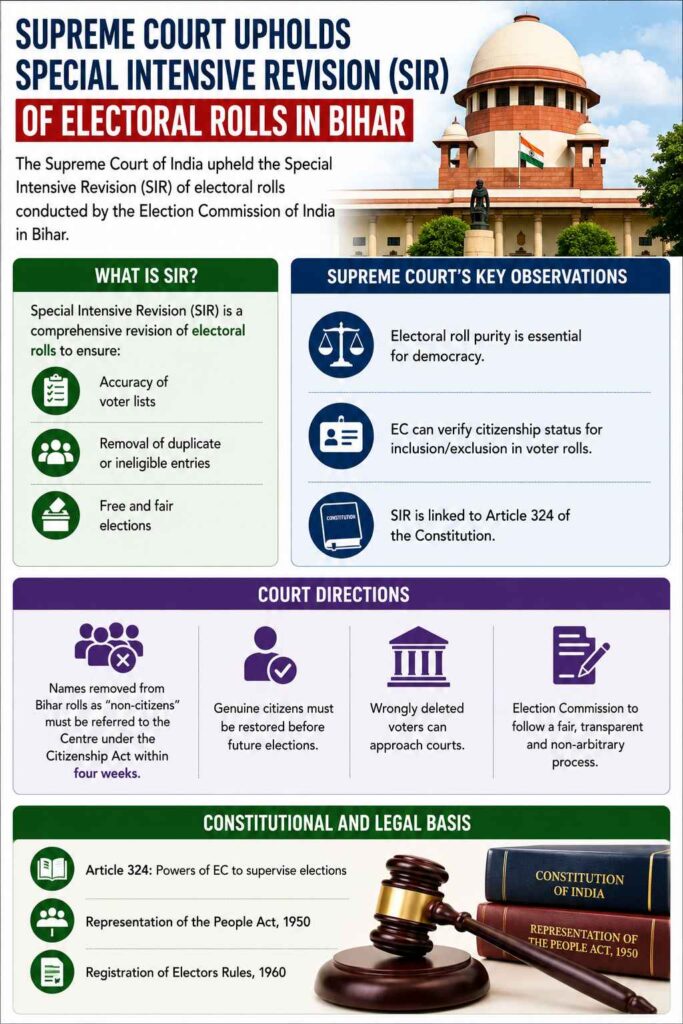
Why in News?
The Supreme Court of India upheld the Special Intensive Revision (SIR) of electoral rolls conducted by the Election Commission of India in Bihar.
What is SIR?
Special Intensive Revision (SIR) is a comprehensive revision of electoral rolls to ensure:
- Accuracy of voter lists
- Removal of duplicate or ineligible entries
- Free and fair elections
Supreme Court’s Key Observations
- Electoral roll purity is essential for democracy.
- EC can verify citizenship status for inclusion/exclusion in voter rolls.
- SIR is linked to Article 324 of the Constitution.
Court Directions
- Names removed from Bihar rolls as “non-citizens” must be referred to the Centre under the Citizenship Act within four weeks.
- Genuine citizens must be restored before future elections.
- Wrongly deleted voters can approach courts.
Constitutional and Legal Basis
- Article 324: Powers of EC to supervise elections
- Representation of the People Act, 1950
- Registration of Electors Rules, 1960
Reasons Supporting SIR
The Court accepted EC’s concerns regarding:
- Migration
- Duplicate entries
- Unreported deaths
- Urbanisation
- Long gap since last intensive revision
Safeguards Mentioned by Court
- Notice before deletion
- Opportunity of hearing
- Aadhaar accepted as indicative document
- Publication of excluded voters list
[2017] Right to vote and to be elected in India is a
A. Fundamental Right
B. Natural Right
C. Constitutional Right
DLegal Right -
[27th May 2026] The Hindu OpED: Rajya Sabha Defections, constitutional questions
PYQ Relevance[UPSC 2020] The anti-defection law has failed to achieve its intended purpose. Discuss.Linkage: The PYQ tests understanding of the Tenth Schedule, defections, party discipline, and constitutional loopholes. The AAP Rajya Sabha controversy exposes ambiguity in the merger exception under Paragraph 4, questioning whether legislative majorities can bypass the original political party. Mentor’s Comment
A constitutional controversy has emerged after seven of AAP’s ten Rajya Sabha MPs reportedly invoked the merger exception under the Tenth Schedule of the Constitution of India to join the BJP. They have claimed support of over two-thirds of legislators. The episode has triggered a constitutional debate on whether legislators alone can claim merger without approval of the original political party, making it a major test for the Tenth Schedule.
How did India’s anti-defection framework evolve from permitting splits to restricting defections?
- 1950 (Original Constitution): Articles 102 and 191 outlined basic disqualifications like holding an office of profit or unsound mind. The President or Governor decided cases based on the Election Commission’s opinion. Political defections were not explicitly penalized.
- 52nd Constitutional Amendment Act, 1985: Introduced the Tenth Schedule (Anti-Defection Law) to address frequent political defections and instability.
- Objective of the Law: Ensures political stability by discouraging elected representatives from abandoning party affiliation for political gain.
- Split Provision (Paragraph 3): Recognised a “split” if one-third members of a legislature party separated, thereby protecting them from disqualification.
- 2003 (91st Amendment): Deleted Paragraph 3 entirely. This eliminated the “split” defense, meaning individual or minor group defections always lead to disqualification.
- Under Paragraph 3, if a faction consisting of one-third or more of a party’s elected legislators decided to break away, the law deemed it a “split”. This newly formed faction was completely exempt from disqualification and could function as a separate group or support an opposition coalition without losing their seats.
- Shift in Constitutional Philosophy: Restored primacy of the political party over temporary legislative factions.
Dinesh Goswami Committee (1990): Recommended tightening anti-defection provisions to reduce political opportunism.170th Law Commission Report (1999): Supported removal of the split provision due to misuse in legitimising defections. Why does the AAP Rajya Sabha episode raise constitutional concerns beyond routine defections?
- National-Level Significance: Involves Rajya Sabha MPs at the Union level, unlike previous state-level controversies.
- Striking Data: Seven out of ten AAP Rajya Sabha MPs (over two-thirds) reportedly sought merger with BJP.
- Merger Exception Invoked: Legislators relied on Paragraph 4 of the Tenth Schedule, claiming exemption from disqualification.
- Constitutional Question: Raises uncertainty regarding whether legislators alone can engineer a merger without consent of the parent political party.
- Opposition Integrity: Affects the constitutional role of the Opposition in parliamentary democracy, especially if legislative majorities can dissolve party identity.
- Institutional Consequences: Tests the authority of the Rajya Sabha Chairman in deciding disqualification under the Tenth Schedule.
Does the “merger exception” under Paragraph 4 permit legislators to override the original political party?
Paragraph 4 refers to the “Merger Exception” within the Tenth Schedule of the Constitution of India. It provides legal immunity from disqualification for elected members (MPs or MLAs) when their political party merges with another party.
The Core Mechanism: The “Twin Test”: To legally claim a merger and escape disqualification under Paragraph 4, a specific two-step requirement must be met:
- Party-Level Merger (The Origin): The original political party must decide to merge with another political party.
- Legislative Agreement (The Numbers): Following the organizational merger, not less than two-thirds (66.6%) of the elected legislators of that party in the House must agree to accept the merger.
Key Provisions of Paragraph 4
Paragraph 4(1): Protection for Members: States that a legislator will not be disqualified if their original political party merges with another, and they choose to either join the new party or function as a separate group.
Paragraph 4(2): The Deeming Fiction: Establishes that a merger is legally deemed to have taken place if and only if a minimum of two-thirds of the legislature party’s members give their consent to it.- Core Constitutional Ambiguity: Uncertainty persists on whether legislators can independently trigger merger or merely implement a party-level decision.
- Judicial Position: In Subhash Desai (2023), the Supreme Court reinforced primacy of the political party over the legislature wing.
- Constitutional Concern: Allowing legislators alone to merge may enable temporary legislative majorities to appropriate party identity and electoral mandate.
- Democratic Implication: Risks weakening party stability and Opposition politics within parliamentary democracy.
How has the judiciary interpreted the relationship between legislature parties and political parties?
Core Judicial Principles
- Constitutional Hierarchy: The political party is the parent body. The legislature party is its subordinate wing and cannot sever ties or act independently.
- Source of Legitimacy: Legislators win elections based on the political party’s ticket, manifesto, platform, and campaign symbols. Therefore, their allegiance remains tied to the organizational party.
- The Whip Authority: The power to appoint the Chief Whip and the Party Leader belongs strictly to the political party organization, not to a majority faction of legislators.
- Protection vs. Usurpation: The “deeming fiction” in Paragraph 4 protects a two-thirds legislative majority from disqualification only after an actual party merger. It does not empower them to hijack the party’s identity or organizational assets.
Landmark Judgment: Subhash Desai v. Governor of Maharashtra (2023): In this pivotal case, a 5-judge Constitution Bench of the Supreme Court firmly established the supremacy of the political party over the legislative wing:
- Continuous Guidance: The Court ruled that a political party’s influence does not end on election day; it continuously guides its elected representatives throughout their tenure.
- Illegal Appointments: The Court declared the Eknath Shinde faction’s appointment of their own Whip and Leader as illegal, stating that the Speaker must recognize only the Whip authorized by the parent political party.
- No Shield for Rebellion: Internal dissent or achieving a legislative majority cannot be used as a tool to bypass the Anti-Defection Law, especially since the “split” doctrine (Paragraph 3) was deleted in 2003.
Structural Comparison
Feature Political Party (Parent Body) Legislature Party (Subordinate Wing) Composition Office bearers, cadres, and members nationwide/statewide. Only the elected MPs or MLAs in the House. Constitutional Role Holds the fundamental democratic mandate and symbols. Executes the party’s agenda within the legislature. Control of the Whip Yes. Has the exclusive right to appoint the Whip. No. Must follow the Whip appointed by the parent party. Can legislative majorities appropriate the identity of a political party?
- Constitutional Identity: A political party derives continuity from its organisation, leadership, ideology, and electoral mandate, not merely elected legislators.
- Risk of Party Capture: Permitting temporary legislative majorities to claim party identity may enable numerical capture of parties, weakening internal democracy and organisational autonomy.
- Legislature-Party Distinction: Legislators derive legitimacy from the party’s symbol and mandate; the legislature wing remains subordinate to the parent political organisation.
- Judicial Position: In Subhash Desai (2023), the Supreme Court reinforced primacy of the political party, including authority over appointment of the Chief Whip.
- Parliamentary Consequence: Allowing legislators to appropriate party identity may undermine Opposition politics and weaken the anti-defection law’s objective of preserving party-system integrity.
What are the broader implications for parliamentary democracy and Opposition politics?
- Opposition Preservation: Anti-defection law indirectly protects parliamentary dissent, especially in the Rajya Sabha.
- Constitutional Morality: Prevents legislative arithmetic from undermining electoral mandates and voter trust.
- Need for Doctrinal Clarity: Ambiguity in Paragraph 4 of the Tenth Schedule over whether merger requires party approval or only legislative majority necessitates clear judicial interpretation to prevent inconsistent decisions and constitutional instability.
- Federal Relevance: Similar disputes in Maharashtra, Karnataka, Arunachal Pradesh, and Manipur show that ambiguity in anti-defection law is a recurring issue across States. This necessitates uniform constitutional principles to ensure consistency and political stability.
- Democratic Stability: Ensures continuity of party-based representation, which remains central to parliamentary governance.
Conclusion
The Rajya Sabha defection episode involving AAP is not merely a question of political realignment but a constitutional test regarding the relationship between legislative numbers and political legitimacy. The interpretation of Paragraph 4 of the Tenth Schedule will shape the future of India’s anti-defection regime, the integrity of political parties, and the institutional strength of parliamentary opposition.