Why in the News
The Central Electricity Regulatory Commission (CERC), the central power sector regulator, replaced the automatic revocation of grid connectivity for delayed renewable energy projects with a compensation based mechanism. Developers who miss project milestones can now retain transmission access by paying a daily charge, which converts a binary penalty into a priced extension. At least 5.3 gigawatts (GW) of renewable capacity was facing revocation up to October for failure to achieve the commercial operation date.
What is grid connectivity under the General Network Access Regulations?
- About: Grid connectivity is the regulatory right of a generating station to connect to and inject power into the inter State transmission system.
- Why it is scarce: Transmission corridors are built years in advance at public cost, and granting connectivity to one project blocks that corridor capacity for every other applicant.
- The milestone conditions: A developer holding connectivity must submit land ownership documents, achieve financial closure, and commission the project by its stated date.
- The earlier consequence: Failure on any of these three milestones led to automatic revocation of connectivity and forfeiture of the associated bank guarantees.
- Governing instrument: These milestones sit under the General Network Access Regulations, which govern access to the inter State transmission network.
Who is the Central Transmission Utility of India Limited (CTUIL)?
- About: CTUIL is the central transmission utility, carved out of Power Grid Corporation of India Limited, which plans the inter State transmission system and grants connectivity and general network access.
- Role here: CTUIL issues the notices of revocation to developers who miss milestones, and its data records the capacity at risk.
What is financial closure?
- About: Financial closure is the stage at which all financing agreements for a project are signed and the conditions precedent to the first drawdown of funds are satisfied.
- Why it is a milestone: A project without financial closure has no committed money to build with, so it is treated as unlikely to use the connectivity it holds.
What is the commercial operation date?
- About: The commercial operation date is the date from which a generating unit is declared ready to supply power commercially after successful trial operation.
- Regulatory use: It is the point from which tariffs, transmission charges and contractual obligations of a project become operative.
What are Monthly Transmission Charges under the Sharing Regulations, 2020?
- About: Monthly Transmission Charges are the pooled cost of the inter State transmission system, recovered from all users in proportion to their use.
- Governing instrument: The Sharing of Inter State Transmission Charges and Losses Regulations, 2020 set the formula by which this pooled cost is allocated among users.
Why did the regulator have to intervene?
- Scale of the problem: CTUIL data showed at least 5.3 GW of renewable energy capacity was expected to face connectivity revocation up to October for failure to achieve the commercial operation date.
- Developers approached the Commission: Several developers who had received notices from CTUIL sought additional time to achieve the milestones.
- Stage of the affected projects: The Commission recorded that entities seeking time are at various stages of implementation, including some at an advanced stage.
- Case by case disposal: The Commission had already disposed of several such cases individually, granting additional time on payment of compensation.
- Need for uniformity: The order records an immediate requirement to handle such cases uniformly rather than through separate individual rulings.
What does the new compensation mechanism provide?
- Core change: Projects that miss key implementation deadlines retain grid connectivity and receive additional time, instead of facing automatic revocation of transmission access.
- Charge for land and financial closure: Developers pay Rs 1,000 per megawatt per day to obtain extra time for land documents and financial closure.
- Charge for delayed commissioning: Developers pay Rs 3,000 per megawatt per day for delays in starting commercial operations.
- Graded escalation: Compensation is levied by the specific milestone sought, with rates generally increasing over time to push early compliance.
- Reasons made irrelevant: The order allows additional time on payment of compensation irrespective of the reasons for the delay.
- The stated justification: The Commission recorded that such entities have been holding on to connectivity, described as a scarce resource, which is why the extension is priced.
What must a developer show to qualify for an extension?
- Timing condition: An entity must demonstrate project progress at least 15 working days before the original milestone deadline.
- Land threshold for the first two milestones: For land documentation and financial closure, the developer must furnish land documents for at least 20 per cent of the required land.
- Land threshold for commissioning: For an extension of the commercial operation date, the developer must furnish land documents for 50 per cent to 75 per cent of the required land, depending on the project type.
- Extension lengths: Developers can get up to three additional months for land requirements, six months for financial closure and up to 12 months to commission the project.
- Consequence of a second failure: Projects that still miss the extended deadlines risk losing both grid connectivity and the associated bank guarantees.
Where does the compensation money go?
- Full pass through for commissioning delay: 100 per cent of the compensation collected for delays in commercial operations is used to reduce Monthly Transmission Charges for other users.
- Half pass through for the other two milestones: 50 per cent of the compensation collected for additional time on land documents and financial closure is applied the same way.
- The governing regulation: This reduction operates under the Sharing Regulations, 2020.
- The economic logic: The cost of an idle transmission corridor is otherwise socialised across all users, and the charge shifts part of that cost back to the developer causing the delay.
- What it does not do: The transfer compensates users financially and does not release the blocked corridor capacity for another project.
Does pricing the delay protect the grid or entrench the hoarding of a scarce resource?
- The case for pricing: Revoking connectivity from a project at an advanced stage destroys sunk investment and returns the corridor to a queue that may take years to reallocate.
- The case against: A developer who can pay the daily charge can retain a corridor for up to a further twelve months, which keeps a scarce resource locked with the least prepared applicant.
- The design compromise: The land thresholds of 20 per cent and 50 to 75 per cent exist to separate genuinely progressing projects from speculative applications.
- The unaddressed gap: Compensation is payable irrespective of the reason for delay, so a developer delayed by a land dispute and one delayed by inaction are treated identically.
- The underlying constraint: The real bottleneck is that transmission capacity is built ahead of generation, and neither revocation nor compensation adds a single new corridor.
Challenges to renewable energy grid connectivity in India
- Transmission lagging generation: Renewable capacity is commissioned faster than the evacuation lines that must carry it. e.g. wind and solar capacity in Rajasthan and Gujarat has repeatedly outpaced the completion of the associated Green Energy Corridor lines.
- Land aggregation delay: Utility scale solar and wind need large contiguous parcels assembled from many private owners. e.g. projects in Rajasthan have stalled over common land and grazing land claims that block the required land documentation.
- Curtailment risk: Even connected projects are backed down when the grid cannot absorb their output. e.g. wind generators in Tamil Nadu have faced curtailment during high wind season for want of evacuation capacity.
- Weak counterparty balance sheets: Distribution companies delay payment, which raises the cost of financial closure for developers. e.g. accumulated distribution company dues to generators ran into tens of thousands of crores before the late payment surcharge rules were tightened.
- Storage deficit: Solar output peaks at midday while demand peaks after sunset, so firm supply needs storage that remains costly. e.g. battery energy storage tenders have repeatedly been undersubscribed or repriced upward.
- Module and cell supply concentration: Domestic content requirements collide with the concentration of cell manufacturing abroad. e.g. approved list of models and manufacturers requirements have forced project timeline extensions when domestic module supply fell short.
- Speculative bidding: Aggressive tariff bids won without the ability to execute lock up corridors and tender capacity. e.g. several record low solar tariff bids were followed by unsigned power purchase agreements and stalled projects.
Conclusion
Grid connectivity is a scarce public asset built ahead of demand, and the regulator has moved from confiscating it on default to pricing its continued use. The order gives projects at an advanced stage a route to survive a missed milestone, and it transfers part of the cost of the delay from all transmission users back to the delaying developer. The mechanism is now in force with rates of Rs 1,000 and Rs 3,000 per megawatt per day and defined land thresholds. The next milestone is the treatment of the 5.3 GW facing revocation up to October, which will show whether the compensation route clears the backlog or extends it.
Renewable Energy Sector in India
- About: The renewable energy sector covers solar, wind, small hydro, biomass, waste to energy and, in policy terms, large hydro and nuclear are counted within the wider non fossil category.
- Scale: India ranks among the top five countries globally in installed renewable energy capacity, and is placed in the top four in both solar and wind capacity.
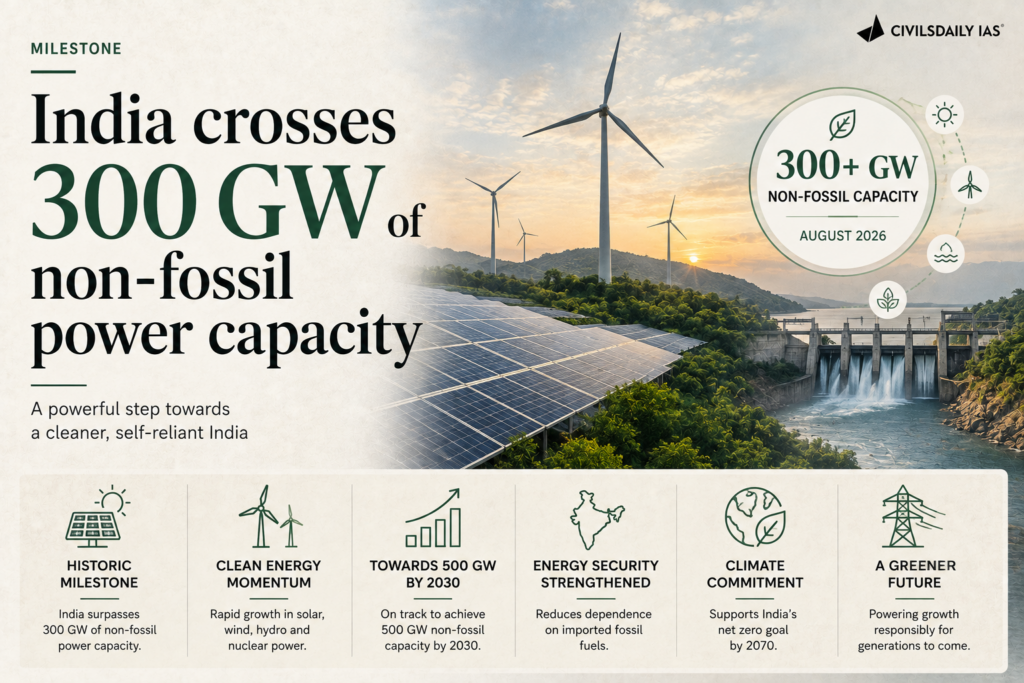
- Milestone achieved: Non fossil sources crossed 50 per cent of India’s total installed electricity generation capacity in 2025, ahead of the timeline pledged under the Paris Agreement.
- Stated target: India has committed to 500 GW of non fossil fuel based installed capacity by 2030 and to net zero emissions by 2070.
- Geographic concentration: Rajasthan, Gujarat, Karnataka, Tamil Nadu and Andhra Pradesh account for the bulk of installed solar and wind capacity.
- Structural feature: Renewable generation is variable and location bound, which makes transmission planning and storage central to the sector rather than incidental.
- Institutional structure: The Ministry of New and Renewable Energy frames policy, SECI acts as the central nodal agency for tenders, and CERC regulates inter State transmission and tariffs.
Statutory Framework Governing Electricity and Grid Access
- Entry 38 of the Concurrent List: Places electricity in the concurrent domain, so both Parliament and State legislatures can legislate on it.
- Section 79 of the Electricity Act, 2003: Sets out the functions of the Central Electricity Regulatory Commission, including regulation of inter State transmission.
- Section 38 of the Electricity Act, 2003: Provides for the Central Transmission Utility and its duty to provide non discriminatory open access.
- Section 61 of the Electricity Act, 2003: Lays down the principles the regulator must follow while determining tariffs.
- Section 86 of the Electricity Act, 2003: Gives State Electricity Regulatory Commissions the power to fix renewable purchase obligations.
- Section 63 of the Electricity Act, 2003: Allows adoption of tariffs discovered through a transparent competitive bidding process.
Laws and Rules Governing Renewable Energy and Transmission
- Electricity Act, 2003: The parent statute governing generation, transmission, distribution, trading and use of electricity.
- Open access provision: Sections 39, 40 and 42 create the right of non discriminatory open access to transmission and distribution networks.
- Energy Conservation Act, 2001: Provides for energy efficiency standards and designated consumers.
- Energy Conservation (Amendment) Act, 2022: Introduced the carbon credit trading scheme and a renewable consumption obligation for designated consumers.
- CERC (Connectivity and General Network Access to the inter State Transmission System) Regulations, 2022: Govern grant, milestones and revocation of connectivity, the framework this order operates under.
- CERC (Sharing of Inter State Transmission Charges and Losses) Regulations, 2020: Set the method for pooling and allocating transmission charges among users.
- Electricity (Promoting Renewable Energy Through Green Energy Open Access) Rules, 2022: Allow consumers above a threshold to buy renewable power directly through open access.
- Electricity (Late Payment Surcharge and Related Matters) Rules, 2022: Impose a graded surcharge on distribution company dues to generators and restrict access on default.
- Electricity (Rights of Consumers) Rules, 2020: Set service standards including timelines for new connections and metering.
Back2Basics: Central Electricity Regulatory Commission (CERC)
- Governing Act: Constituted under the Electricity Regulatory Commissions Act, 1998 and now functions under the Electricity Act, 2003.
- Year established: 1998.
- Headquarters: New Delhi.
- Composition: A Chairperson and up to three other Members, with the Chairperson of the Central Electricity Authority as an ex officio Member.
- Jurisdiction: Regulates tariffs of central generating stations, inter State transmission, inter State trading licences and the national grid.
- Mandate: Sets grid standards, regulates the power market, adjudicates disputes among inter State licensees and generating companies, and advises the Union government on tariff policy.
- Appeal route: Its orders are appealable to the Appellate Tribunal for Electricity and thereafter to the Supreme Court on a question of law.
Government Initiatives in the Renewable Energy Sector
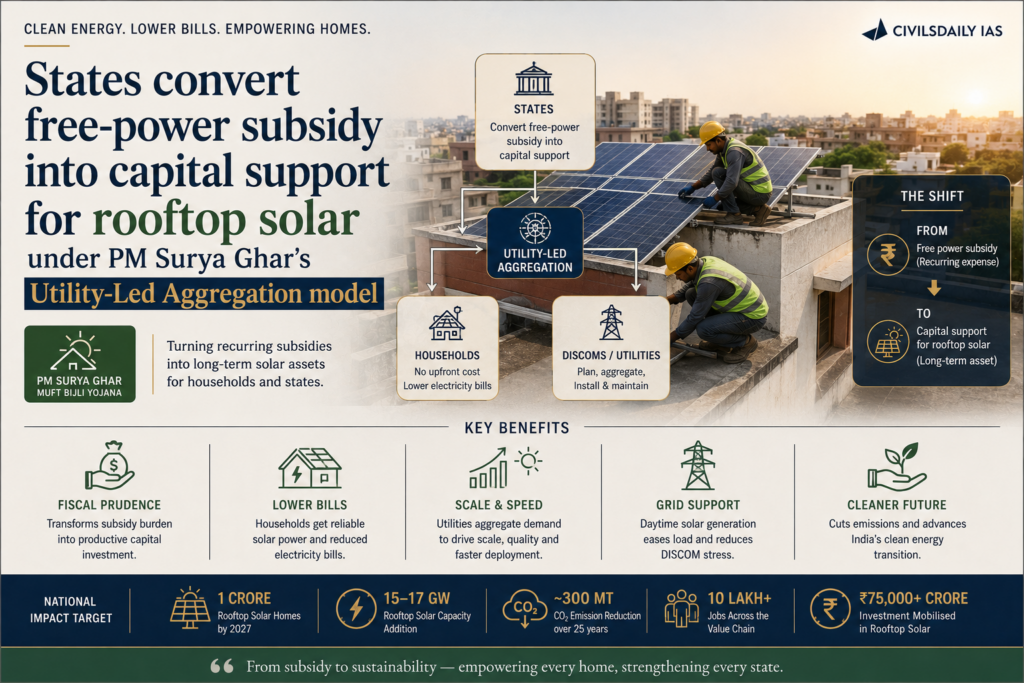
- PM Surya Ghar Muft Bijli Yojana: Provides central financial assistance for rooftop solar installations on residential houses, targeting one crore households.
- PM KUSUM: Supports solarisation of agricultural pumps and installation of decentralised solar plants on barren farmland for farmers.
- National Green Hydrogen Mission: Aims to build green hydrogen production capacity and associated electrolyser manufacturing, with incentives under the SIGHT programme.
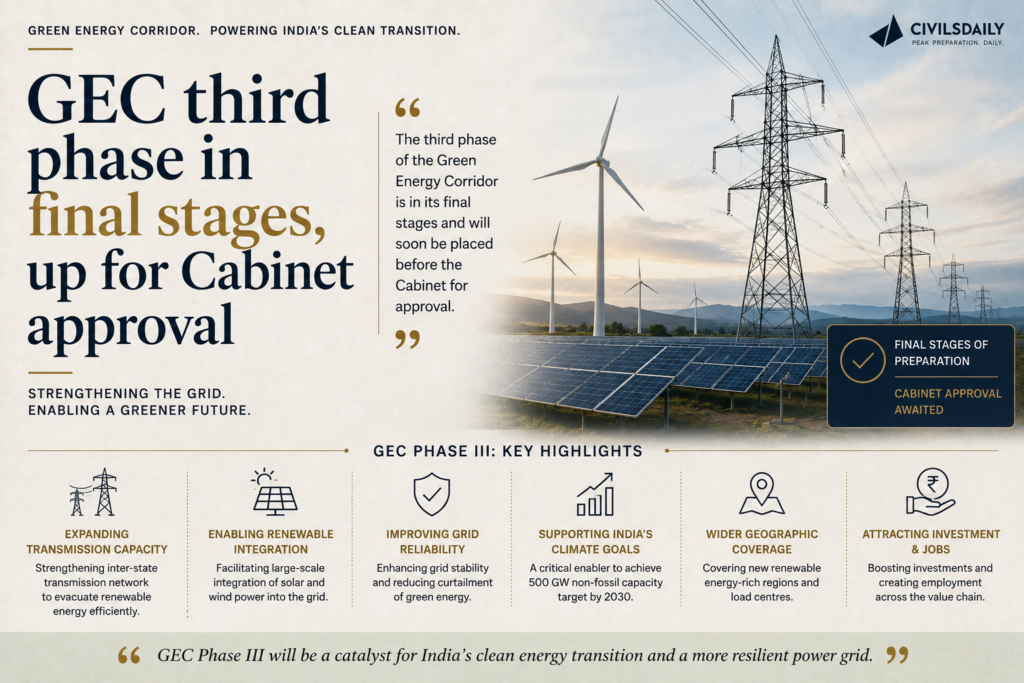
- Green Energy Corridor: Funds dedicated transmission infrastructure to evacuate renewable power from generation rich States to demand centres.
- Waiver of inter State transmission charges: Exempts qualifying renewable and storage projects from inter State transmission charges for a defined period to improve project viability.
- PLI National Programme on High Efficiency Solar Photovoltaic Modules: Supports integrated domestic manufacturing of polysilicon, ingots, wafers, cells and modules.
- Solar Park and Ultra Mega Solar Power Projects Scheme: Provides pre acquired land and ready evacuation infrastructure to reduce developer risk.
- Viability Gap Funding for Battery Energy Storage Systems: Supports grid scale storage to address the evening peak and firm up variable renewable supply.
Key Facts about India’s Renewable Energy Sector
- Nodal ministry: Ministry of New and Renewable Energy, the only dedicated renewable energy ministry of its kind when created.
- Non fossil milestone: India reached the 50 per cent non fossil installed capacity mark five years ahead of its Paris Agreement commitment.
- International Solar Alliance: Headquartered at Gurugram in India, jointly initiated by India and France in 2015.
- Largest solar parks: Bhadla in Rajasthan and Pavagada in Karnataka are among the largest solar parks in the world.
- Hybrid policy: India was among the first to notify a dedicated wind solar hybrid policy to improve capacity utilisation of a single grid connection.
- Renewable purchase obligation: State regulators fix a minimum share of renewable power that obligated entities must buy each year.
- Nodal tender agency: Solar Energy Corporation of India Limited conducts the largest share of central renewable capacity auctions.
Challenges in India’s Renewable Energy Sector
- Grid integration and stability: High variable renewable penetration strains frequency and voltage management. e.g. States with high solar share face a steep evening ramp when solar output drops and demand peaks.
- Distribution company finances: Weak buyers delay payments and refuse to sign power purchase agreements at discovered tariffs. e.g. thousands of megawatts of auctioned capacity remained without signed agreements for want of buyers.
- Land and environmental conflict: Large projects compete with grazing land, wildlife habitat and community rights. e.g. transmission lines in the Thar region were litigated over Great Indian Bustard mortality.
- Manufacturing import dependence: Cells, wafers and polysilicon remain concentrated in a few countries. e.g. India continues to import a large share of solar cells despite module capacity expansion.
- Storage cost: Firm and dispatchable renewable supply needs storage that is still expensive at scale. e.g. round the clock renewable tenders have discovered tariffs well above plain solar tariffs.
- Skilled workforce and operation and maintenance: Remote plants need trained technicians for module cleaning, inverter servicing and blade repair. e.g. offshore wind, newly tendered off Gujarat and Tamil Nadu, has almost no domestic trained workforce.
- Recycling and waste: End of life modules and batteries carry a hazardous waste burden not yet planned for. e.g. India has no large scale commercial solar module recycling capacity.
Way Forward
- Plan transmission ahead of generation: Commission evacuation corridors on a fixed lead over auctioned capacity so connectivity ceases to be the binding constraint.
- Tighten entry screening: Raise land and financial readiness thresholds at the connectivity application stage rather than only at the extension stage.
- Differentiate causes of delay: Provide a lower compensation rate for delays caused by force majeure or by transmission side readiness, and a higher rate for developer inaction.
- Scale storage procurement: Expand viability gap funding and mandate storage linked capacity in new renewable tenders to smooth the evening peak.
- Fix the buyer side: Enforce payment security mechanisms and time bound signing of power purchase agreements after auction.
- Build domestic supply chains: Extend manufacturing support upstream to wafers, polysilicon and battery grade materials.
- Create a module and battery recycling framework: Notify extended producer responsibility for solar modules and grid batteries before the first large retirement wave.
Matching Previous Year Question
“[2022, GS3, 15 marks] Do you think India will meet 50 percent of its energy needs from renewable energy by 2030 ? Justify your answer. How will the shift of subsidies from fossil fuels to renewables help achieve the above objective? Explain.”